

Pakistan Scam Centre: The 4-Step Call Aimed at Malaysians
About 130 Malaysians held in a Pakistan scam centre raid. The fake bank-then-police call script, its red flags, and why you call 997 fast.
In this article
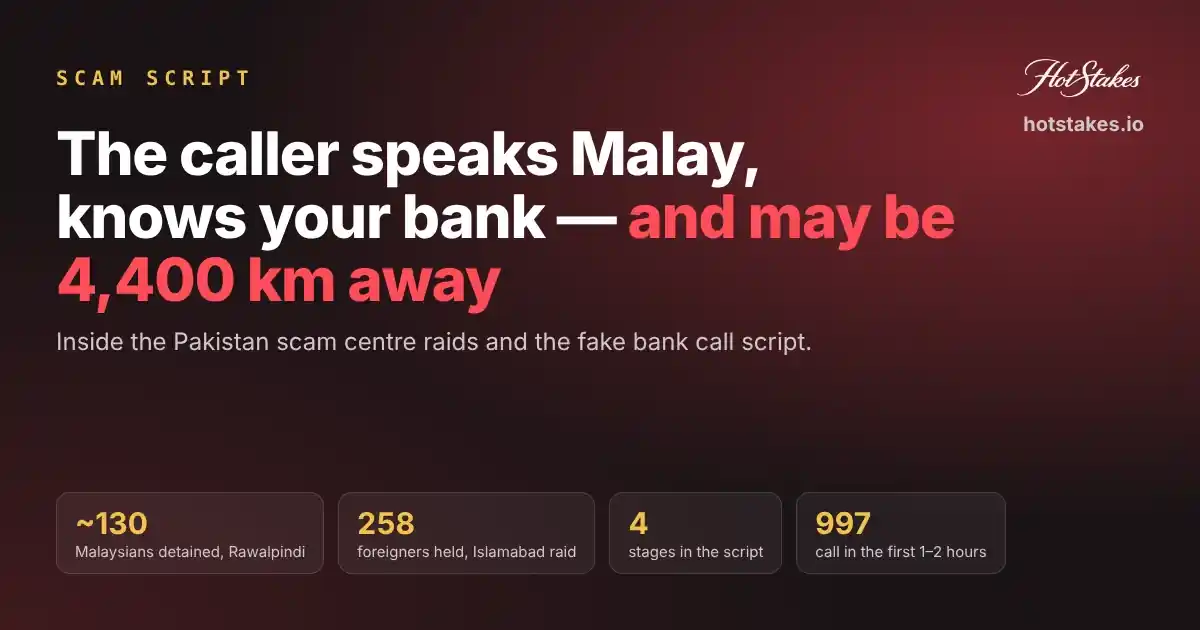
Two raids in Pakistan this year put Malaysians at the centre of alleged scam call centres. In August, Pakistan’s FIA detained 258 foreigners near Islamabad; the one Malaysian among them was later cleared. In late October, Malaysia’s police chief confirmed about 130 Malaysians were detained in Rawalpindi, over a centre that allegedly phoned people in Malaysia posing as bank staff, then police. The caller may speak fluent Malay and know your bank, yet sit about 4,400 km away, so hang up and call 997. Below: the script, its red flags, and the first hour.
What happened in Pakistan: two raids, two sets of numbers
Reports often blur these together. They are separate operations, by separate Pakistani agencies, two months apart.
| August 2026 raid | October 2026 raid | |
|---|---|---|
| Agency | Federal Investigation Agency (FIA) | National Cyber Crime Investigation Agency (NCCIA), under a court warrant |
| Place | Gulberg Green, outskirts of Islamabad | KASA Tower, Bahria Town Phase VIII, Rawalpindi |
| Detained | 258 foreigners: 170 Vietnamese, 40 Chinese, 48 others | About 130 Malaysians |
| Malaysians | One, aged 32. Police say he was found to have no link to the syndicate and has returned home | All passport holders confirmed Malaysian, says the IGP |
| Reported by | AFP via Khaleej Times, The News, Malay Mail | SAYS, Sinar Harian (Bernama) |
In August, an FIA official told AFP the foreigners had entered on tourist visas and “were not allowed to do what they were doing”. One ARY News photo caption said 275, not 258; the article text and other outlets use 258. Inspector-General of Police Tan Sri Mohd Khalid Ismail said PDRM sent a special team to Islamabad, according to The Star TV. Bukit Aman’s commercial crime director later told Bernama the lone Malaysian had been released.
The October case is the one aimed at Malaysians. SAYS first reported the 130 figure from a Harian Metro report and a Pakistani police report. Sinar Harian, crediting Bernama, then quoted the IGP confirming 130 Malaysians were held. He said some had valid visas and others had overstayed, and that an investigation team may be sent to Pakistan.
Latest (3 Nov): Home Minister Datuk Seri Saifuddin Nasution Ismail said he spoke with Pakistan’s Interior Minister and told Bukit Aman’s CCID director to start talks with Pakistani counterparts. He is waiting for their report before deciding next steps, The Star reported. When we checked on 9 Nov, we found no report of charges or repatriation yet.
Takeaway: Everyone detained is a suspect, not a convict. The investigations are ongoing in Pakistan, under its Prevention of Electronic Crimes Act 2016 and Penal Code provisions, according to Sinar Harian.
How the Rawalpindi centre allegedly worked
According to the Pakistani police report described by SAYS and Sinar Harian, the alleged operation ran like this:
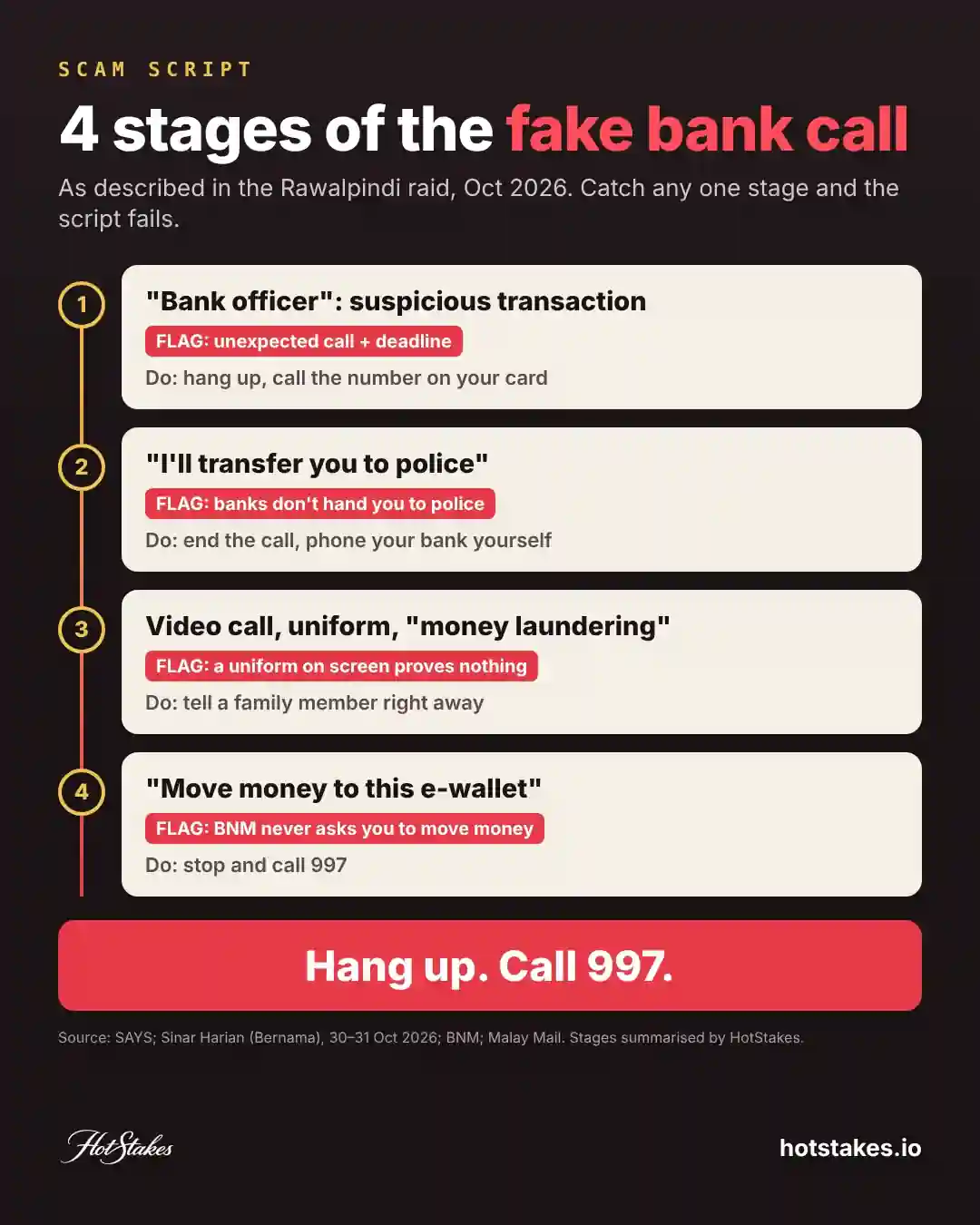
- Callers used internet calling apps and posed as bank customer service officers, claiming suspicious or unauthorised transactions on the victim’s account.
- The call was then passed to people posing as Malaysian police. Some allegedly wore uniforms resembling PDRM’s and used office-style backdrops on video calls.
- Victims were threatened with money laundering charges and pressed to transfer money.
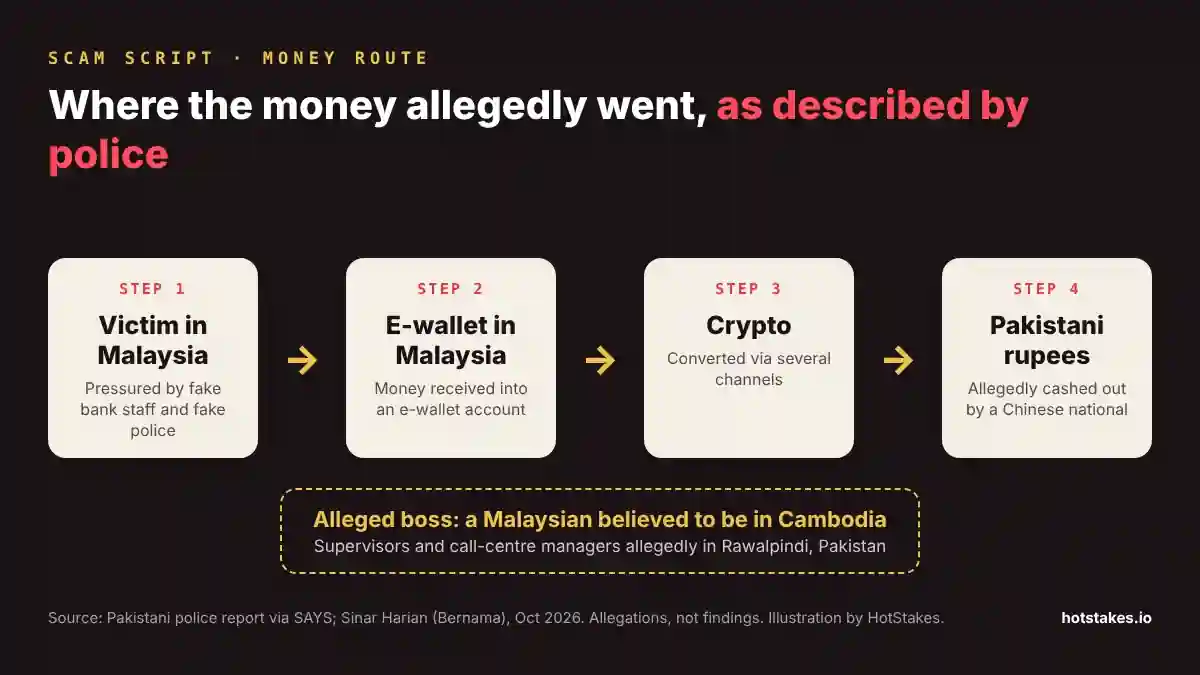
- Money allegedly went into a Malaysian e-wallet, was converted into cryptocurrency through several channels, and a Chinese national allegedly turned the crypto into Pakistani rupees.
- The syndicate is believed to be run by a Malaysian operating from Cambodia, with supervisors and managers in Pakistan.
If that sounds like the classic Macau scam, it is the same family. Our walk-through of a fake police call that took RM1.2 million covers one local case. What is different here is geography. The callers sit in a tower block abroad, the “bank” and “police” voices are local, and the money leaves through an e-wallet and crypto rather than a single bank transfer.
The Cambodia link fits a wider pattern. Our explainer on Southeast Asia’s scam compounds shows how operations move country to country when one is raided. The receiving accounts at the start of the chain are often money mule accounts, rented from ordinary people.
Takeaway: The voice on the phone tells you nothing about where the caller is. Judge the request, not the accent.
The script: four stages, four red flags
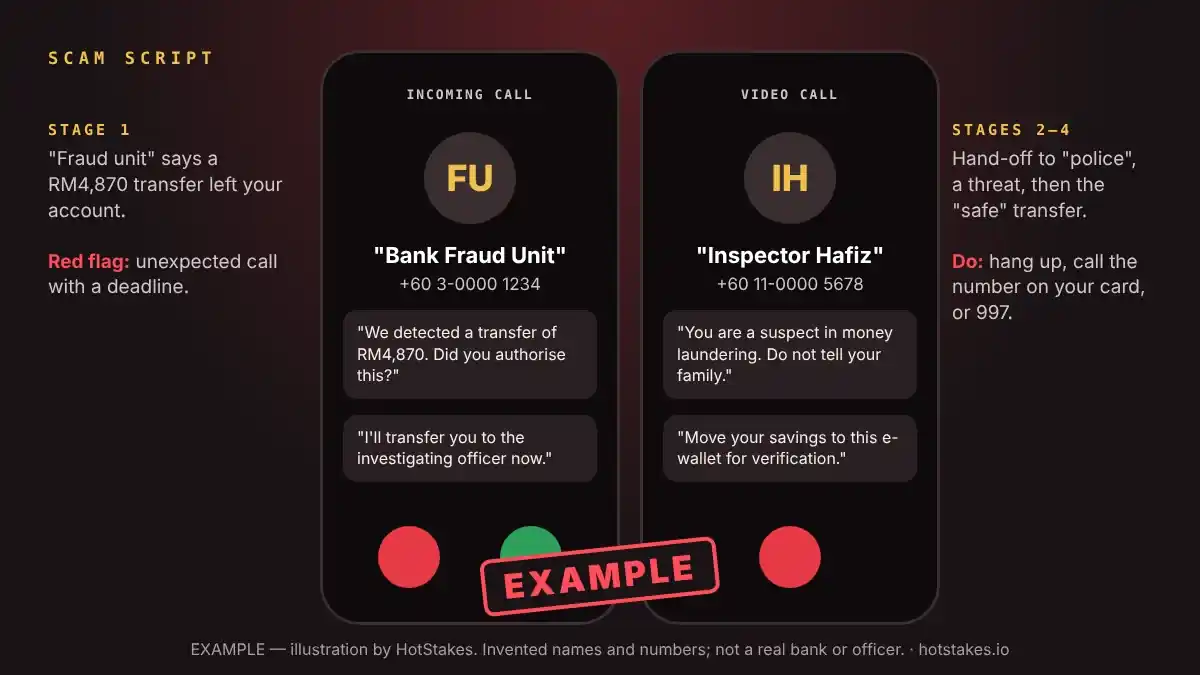
The lines below are examples we wrote, built from the methods described in this case and from BNM and Singapore Police Force warnings. They are not transcripts. They are here so the shape is familiar when it happens to you.
Stage 1: the “bank officer”
EXAMPLE: “Good afternoon, this is the fraud unit at your bank. We detected a transfer of RM4,870 from your account. Did you authorise this?”
EXAMPLE: “Puan, if not, I need to verify your details now before the account is frozen.”
Red flag: an unexpected call about a transaction, with a deadline. Do instead: say “I’ll call the bank myself”, hang up, and dial the number on the back of your card.
Stage 2: the hand-off to “police”
EXAMPLE: “Your IC was used to open an account linked to a case. I’m transferring you to the investigating officer now.”
Red flag: a bank call that turns into a police call. Singapore police say their officers will never transfer calls to the police. Do instead: end the call, then phone your bank on its official number yourself.
Stage 3: the video call and the threat
EXAMPLE: “This is Inspector Hafiz. You are a suspect in money laundering. Switch on your camera. Do not tell your family, or they will be investigated too.”
Red flag: a uniform and an office wall on a video call. The Rawalpindi callers allegedly used exactly that. Secrecy and a threat aimed at family are pressure tools. Do instead: hang up and tell someone straight away. Breaking the secrecy breaks the script.
Stage 4: the “safe” transfer
EXAMPLE: “To clear your name, move your savings to this e-wallet for verification. It will be returned in 24 hours.”
Red flag: any request to move money to protect it. Bank Negara Malaysia says it will never ask individuals to transfer money for safekeeping. Do instead: stop. Call 997. If the caller sends a link to “log in and confirm”, run our fake bank login page check first.
Takeaway: You only need to catch one stage. The cheapest exit is stage 1: hang up and call your bank yourself.
How to check the call is real
- Hang up and call the number printed on the back of your card, or on your bank’s official website. Never a number the caller gives you.
- Police and Bank Negara do not ask you to transfer money, to an e-wallet or anywhere else.
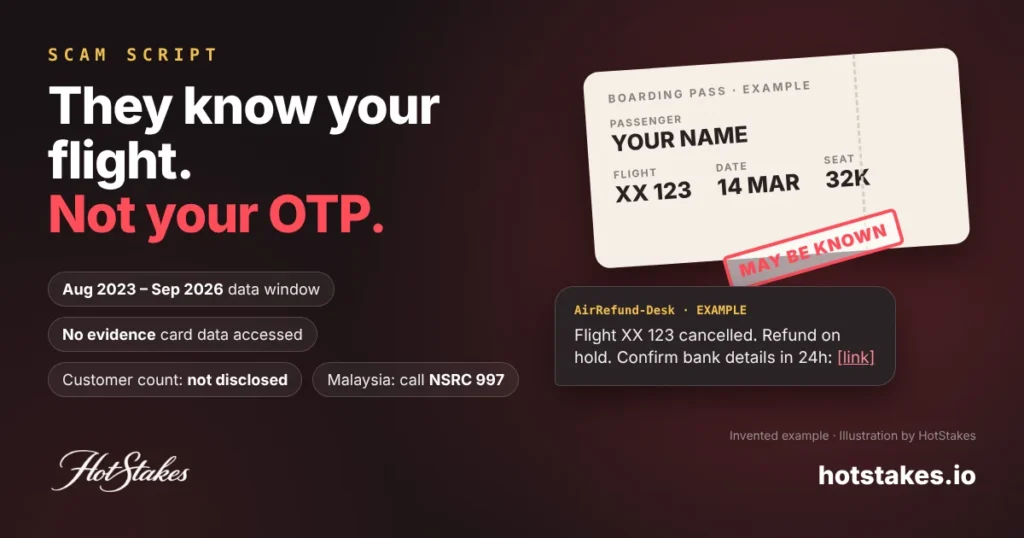
- Caller ID, a uniform or your correct IC number is not proof. Your data may already be out there.
Singapore just made this easier. From 2 November 2026, outgoing Singapore Police Force calls show the single caller ID 6000 0999, followed by an SMS from the gov.sg sender ID. That number cannot receive calls and is not used on WhatsApp or Telegram, according to Malay Mail. In Malaysia, calling back on a number you looked up yourself remains the check.
| Where | Anti-scam line | Note |
|---|---|---|
| Malaysia | 997 (NSRC) | 24/7, led by PDRM with BNM and MCMC (Malay Mail) |
| Singapore | 1799 (ScamShield) | 24/7; call 999 if urgent police help is needed (ScamShield) |
| Hong Kong | 18222 (ADCC) | 24-hour consultation; report at a police station, 999 in an emergency (ADCC) |
Takeaway: Save 997 in your phone today, under “Scam Help”, for yourself and your parents.
The first hour: why speed decides what comes back
On 27 October 2026, Home Minister Datuk Seri Saifuddin Nasution Ismail told the Dewan Rakyat that NSRC 997 had returned RM14.3 million to victims and prevented RM100.93 million in losses, reported Malay Mail. Over a similar period, 468,675 calls reported about RM1.2 billion in losses.
We did the division on 3 Nov 2026. The money returned is about 1.2% of reported losses. Returned plus prevented is about 9.6%. The periods are not identical (returns to September 2026, losses to August), so treat these as rough shares.
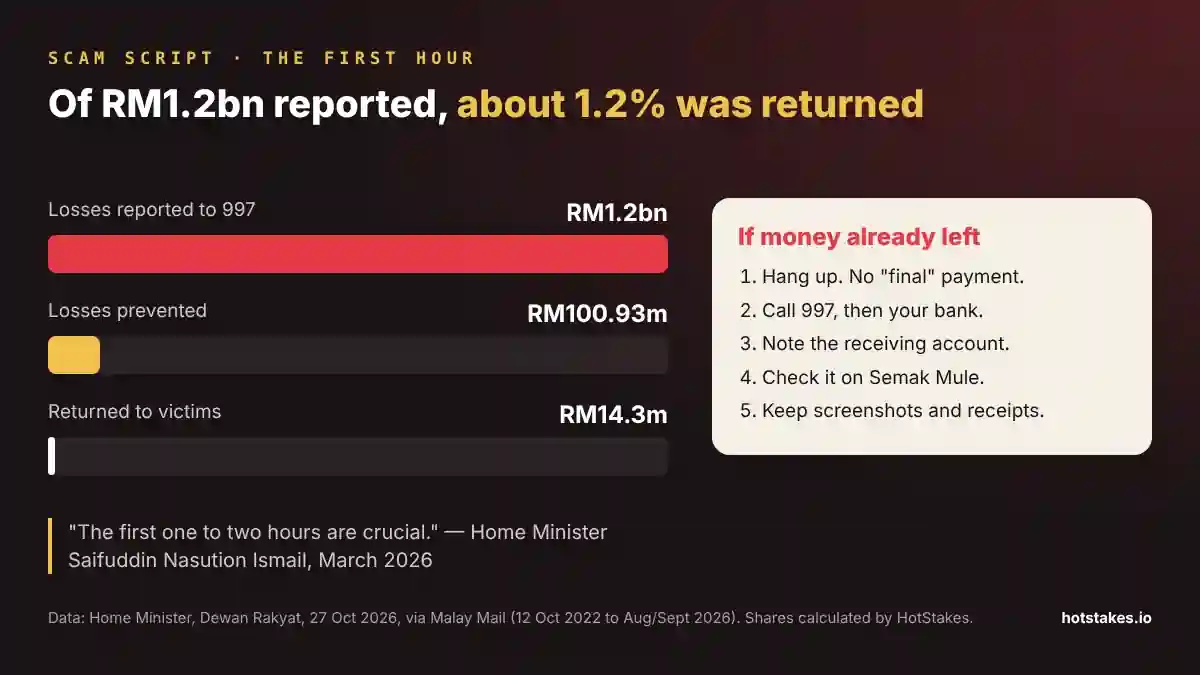
Why so little comes back? Speed. In March, Saifuddin said “the first one to two hours are crucial”, and cited cases where 80 to 90 per cent of an account was emptied within three to 10 minutes through mule accounts. The Star reported one victim who called about eight hours after the theft; of more than RM800,000 lost, only RM170,000 was saved.
If you, or a parent, already sent money:
- Stop. Hang up. Do not send a “final” payment to “release” the first one.
- Call 997 now, then your bank’s official line to block your account and cards. Our online banking kill switch guide lists the fast options.
- Write down the receiving account or e-wallet number, the caller’s numbers, times and amounts.
- Check them on Semak Mule, the CCID portal for bank accounts, phone numbers and company names.
- Keep evidence: screenshots, receipts and call logs. Do not delete the chat.
- Police report: Communications Minister Fahmi Fadzil said a 997 call is now enough. For a large loss, SAYS’ guide still suggests visiting a station and asking for the investigating officer’s contact.
- Expect a second call. Anyone offering to “recover” your money for a fee is running a recovery scam.
For families: one rule to agree tonight
The script works on fear and isolation. “Don’t tell your family” is part of it. So make a family rule now, before the call comes.
- Nobody in this family moves money because of a phone call. We hang up and call back.
- If someone says “police”, call a family member first. That call costs nothing.
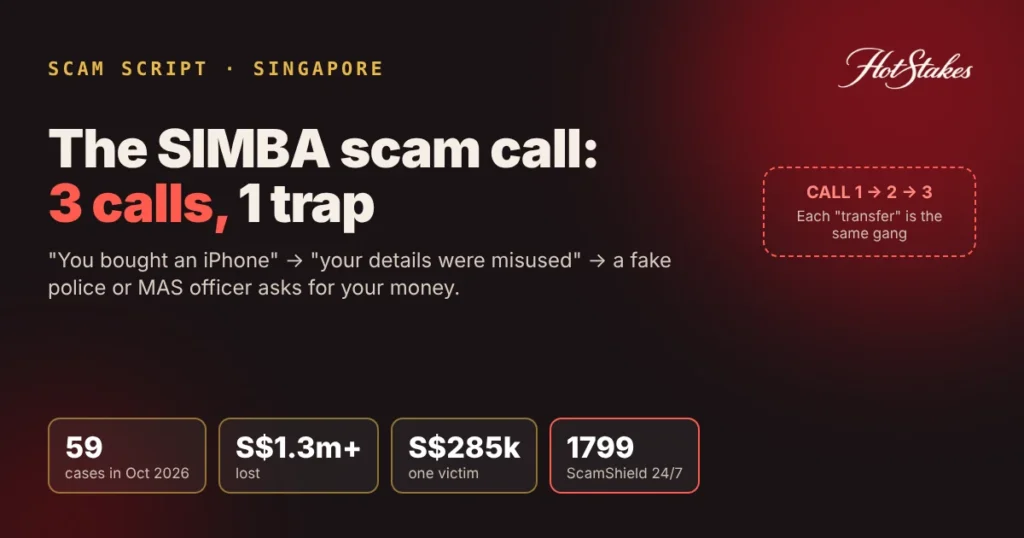
- Know the script. The SIMBA scam call script uses the same pressure, and our scam quiz takes two minutes to run through with a parent.
Takeaway: The person most at risk is often the one who would never tell you. Raise it first.
FAQ
How many Malaysians were detained in the Pakistan scam centre raid?
About 130 in the October raid in Rawalpindi, as confirmed by Malaysia’s Inspector-General of Police, according to Sinar Harian (Bernama). In the separate August raid near Islamabad, one Malaysian was among 258 foreigners detained; police say he was cleared and returned home.
Is this the same as the Macau scam?
It is the same family: fake bank or police callers who push you to move money. What is different in this case, as reported, is that the alleged callers were in Pakistan and the money allegedly moved through an e-wallet into cryptocurrency.
Will a real bank or police officer ever ask me to move money?
No. Bank Negara Malaysia says it will never ask individuals to transfer money for safekeeping. Singapore police say their officers will never ask you to transfer money or valuables, or transfer calls to the police.
The caller knew my name, IC number and bank. Does that mean it is real?
No. Personal data can leak, and correct details are not proof. Hang up and call the number on the back of your card.
I already transferred money. What do I do first?
Call 997 immediately, then your bank’s official line. Ministers say the first one to two hours are crucial. Keep the receiving account number and screenshots, and check the account on Semak Mule.
What is the new Singapore police caller ID?
From 2 November 2026, outgoing Singapore Police Force calls show 6000 0999 and are followed by a gov.sg SMS. The number does not take incoming calls and is not used on WhatsApp or Telegram.
HotStakes is an independent directory. Some links on this site are affiliate links; we may earn a commission at no cost to you, and it never changes our rankings. Gambling involves risk — only play with money you can afford to lose, and if it stops being fun, seek help. This article is general information, not legal advice. Read our full disclaimer.
 Next story →Ultra Lotto 6/58 Jackpot Tops PHP 500M: No Winner 8 Nov

Start the discussion