

Southeast Asia Scam Compounds: Scale, Trafficking, Crackdown
What UN, US and SEA government reports say about scam compounds in Myanmar, Cambodia, Laos and the Philippines, and the 2024-2026 crackdowns.
In this article
Southeast Asia’s scam compounds are fenced office-and-dormitory complexes, mostly in the border zones of Myanmar, Cambodia and Laos, where trafficked workers are forced to run online fraud on victims around the world. The UN human rights office has estimated that at least 120,000 people in Myanmar and around 100,000 in Cambodia may be held in these operations. Here is what UN agencies, governments and courts have put on the record: how big the industry is, who ends up inside, and what the crackdowns from 2024 to 2026 have actually achieved.
What is a scam compound?
A scam compound looks like a business park or a casino resort. Inside, workers run romance, crypto-investment and illegal-gambling scams aimed at strangers online. Many of those workers did not choose the job. According to UN News’ report on the OHCHR study of online scam operations, people are trafficked into the compounds and forced to commit fraud. Lao PDR, the Philippines and Thailand are also named as destination or transit countries. “They are victims. They are not criminals,” UN human rights chief Volker Türk said.
The US Treasury has described the pattern. Workers are recruited with promises of well-paid jobs, then held against their will. Abuses include physical violence, isolation, restricted movement, confiscated passports and phones, and threats of sexual exploitation, according to Treasury’s October 2025 Prince Group sanctions announcement. US prosecutors allege that some compounds ran “phone farms”: automated call centres using thousands of phones and millions of mobile numbers.
Takeaway: A scam compound is a fraud factory. Many people in its workforce are trafficking victims themselves.
How big is the scam-compound industry?
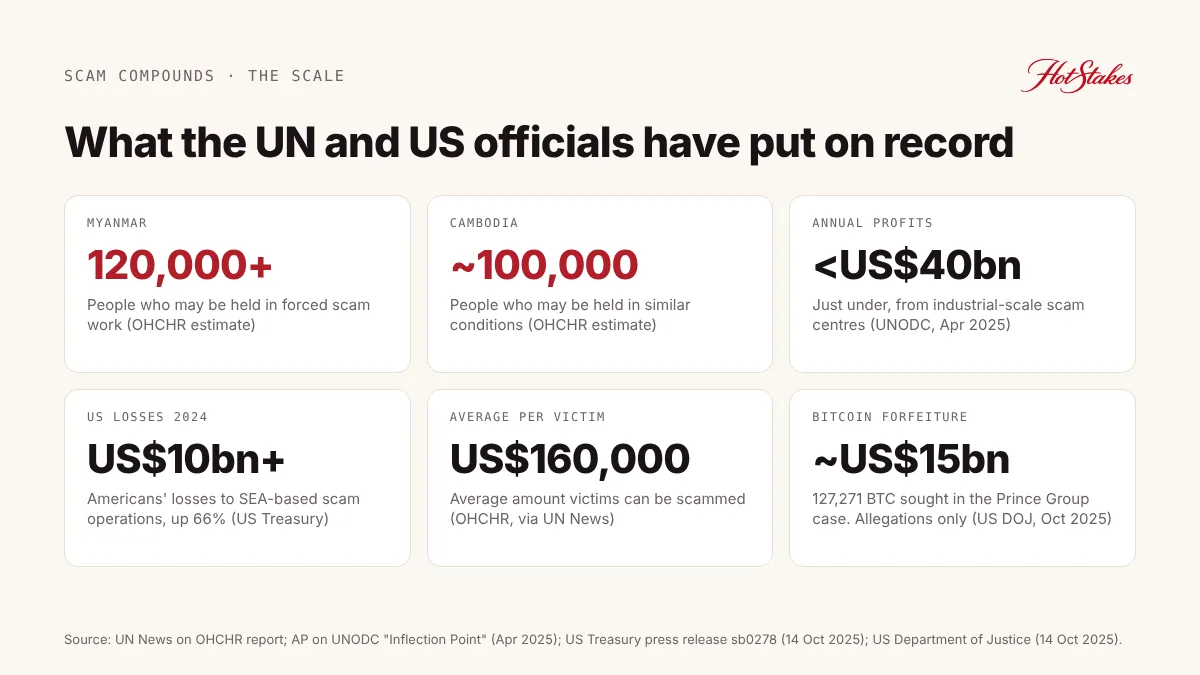
The UN Office on Drugs and Crime’s April 2025 report, Inflection Point, estimated that industrial-scale scam centres in the region generate just under US$40 billion a year in profits, according to AP’s report on the UNODC Inflection Point study. The same report found the networks expanding into Africa (Nigeria, Zambia and Angola), Latin America (especially Brazil), the Middle East, South Asia and some Pacific islands. UNODC’s Benedikt Hofmann called this “a hedging against future risks should disruption continue and intensify in Southeast Asia”.
The US government estimates Americans lost at least US$10 billion to Southeast Asia-based scam operations in 2024, a 66% rise on the year before (Treasury). The OHCHR study, as reported by UN News, says victims can be scammed an average of US$160,000 each.
Takeaway: This is a multi-billion-dollar global industry. It is moving to new regions, not shrinking.
Country by country: Myanmar, Cambodia, Laos, the Philippines
| Country | Hub named in reports | Key action | Reported figure |
|---|---|---|---|
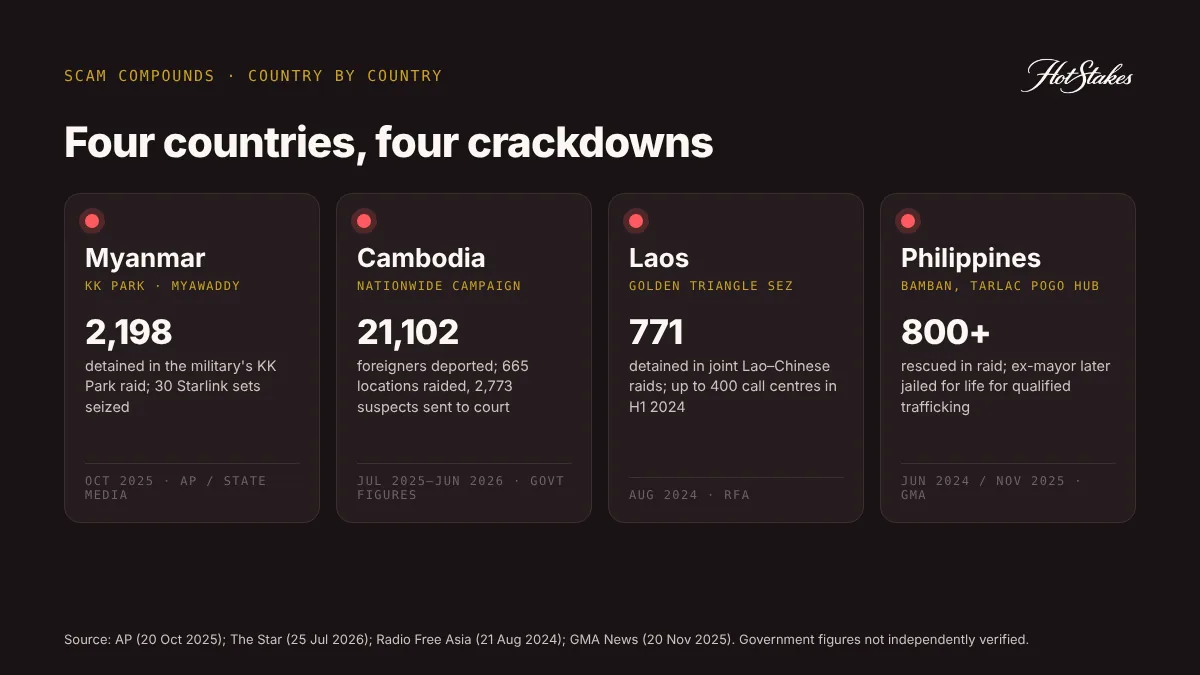
| Myanmar | KK Park near Myawaddy (Kayin State) | Military raid on KK Park, Oct 2025 | 2,198 detained; 30 Starlink sets seized |
| Cambodia | Compounds alleged to be linked to Prince Group; 86 suspected sites per Amnesty | Nationwide campaign, Jul 2025–Jun 2026 | 665 locations raided; 21,102 foreigners deported |
| Laos | Golden Triangle SEZ, Bokeo | Joint Lao–Chinese raids, Aug 2024 | 771 detained |
| Philippines | POGO hub in Bamban, Tarlac | Raid Jun 2024; court verdict Nov 2025 | Over 800 rescued; ex-mayor jailed for life |
Myanmar
On 4 February 2025, Thailand announced it would cut power to border areas linked to scam centres. Its security chief named Tachileik, Myawaddy and Payathonzu. By 24 February, Reuters reported that about 7,000 former scam workers, most of them Chinese, were being held by two Karen armed groups while they waited to be moved out (Reuters, via Malay Mail). In October 2025 the military raided KK Park outside Myawaddy. It detained 2,198 people and seized 30 Starlink terminal sets, according to AP’s report on the KK Park raid, which cited state media. In December 2025 the junta said it had sent more than 70,000 foreigners home to 54 countries over two years and razed 398 of 635 structures. These are government claims, not independently verified, as OCCRP’s report on Myanmar’s repatriation claims notes.
Cambodia
On 14 October 2025, US prosecutors unsealed an indictment against Prince Group chairman Chen Zhi for wire fraud conspiracy and money laundering conspiracy. They also filed to forfeit about 127,271 bitcoin, worth roughly US$15 billion, which the US Justice Department’s Prince Group indictment release calls the largest forfeiture action in its history. These are allegations, and he is presumed innocent. The same day, Treasury sanctioned 146 targets in what it calls the Prince Group Transnational Criminal Organization. It said the network ran at least ten scam compounds in Cambodia, and FinCEN cut Cambodia’s Huione Group off from the US financial system for allegedly laundering at least US$4 billion. Chen was arrested in Cambodia on 6 January 2026 and extradited to China, and Cambodia revoked his citizenship (OCCRP).
Phnom Penh reports big numbers from its own campaign. Between July 2025 and June 2026, authorities raided 665 locations, 582 of them active scam compounds, sent 2,773 suspects to court and deported 21,102 foreigners from 38 countries, according to The Star’s report on Cambodia’s first-year crackdown figures. A new law in force since 7 April 2026 allows life sentences for scam-network leaders. Amnesty International disputes how much has changed. In June 2026 it said it had identified 86 suspected scam sites, with government intervention at only 24, and accused police of “apparent collusion” with compound managers. The government rejected the report as “one-sided” (Reuters, via Interaksyon).
Laos
From 12 August 2024, Lao and Chinese security forces raided call centres in the Golden Triangle Special Economic Zone in Bokeo province. They detained 771 people, including 275 Laotians, 231 Burmese and 108 Chinese, and seized more than 2,000 devices. As many as 400 call centres had operated in the zone in the first half of 2024, according to Radio Free Asia’s report on the Golden Triangle raids.
The Philippines
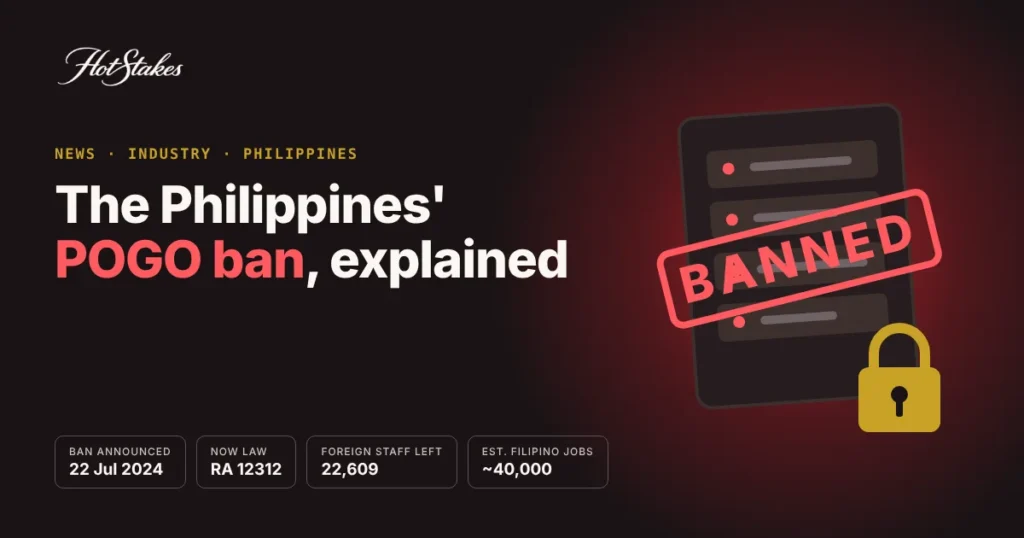
The Philippines went further and banned offshore gaming operators outright. Our explainer on the Philippines’ POGO ban has the full timeline. The best-known case is Bamban, Tarlac: a June 2024 raid rescued more than 800 people. On 20 November 2025, a Pasig court convicted former mayor Alice Guo and seven co-accused of qualified human trafficking. It sentenced them to life imprisonment and ordered the ₱6-billion Baofu compound forfeited, as GMA News’ report on the Alice Guo verdict details.
Takeaway: Every country now reports raids, deportations and arrests. Independent monitors say many operations simply move rather than close.
Timeline: the crackdowns, 2024–2026
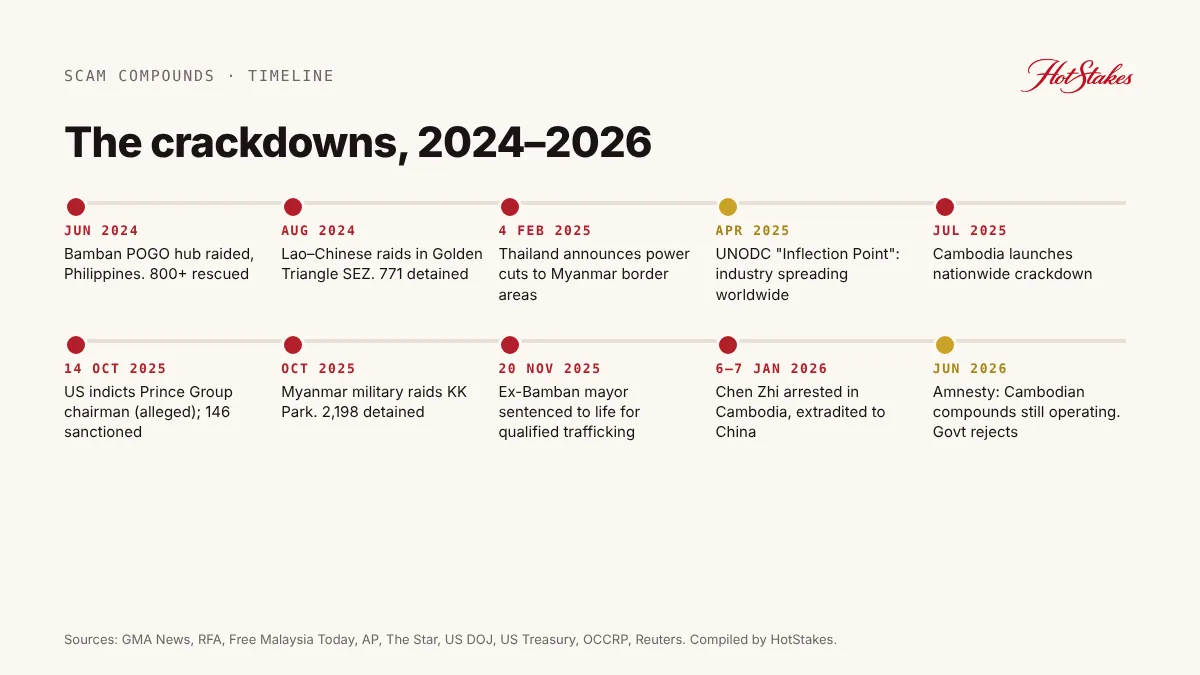
- Jun 2024: Raid on the Bamban POGO hub, Philippines. Over 800 rescued.
- Aug 2024: Lao–Chinese raids in the Golden Triangle SEZ. 771 detained.
- 4 Feb 2025: Thailand announces power cuts to Myanmar border areas.
- Apr 2025: UNODC’s Inflection Point warns the industry is going global.
- Jul 2025: Cambodia launches its nationwide crackdown.
- 14 Oct 2025: US indicts Chen Zhi and files to forfeit about US$15 billion in bitcoin. Treasury sanctions 146 targets.
- Oct 2025: Myanmar military raids KK Park. 2,198 detained.
- 20 Nov 2025: Alice Guo sentenced to life for qualified trafficking.
- 6–7 Jan 2026: Chen Zhi arrested in Cambodia and extradited to China.
- Jun 2026: Amnesty says Cambodian compounds are still operating. Cambodia rejects the findings.
Takeaway: 2025 was the year enforcement went international. The open question for 2026 is whether it lasts.
What this means for anyone online in Southeast Asia
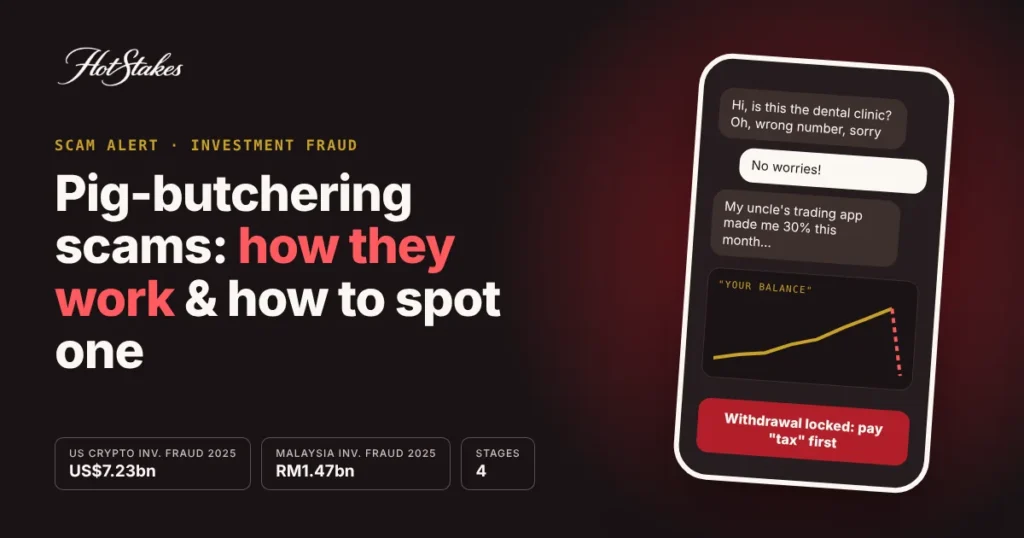
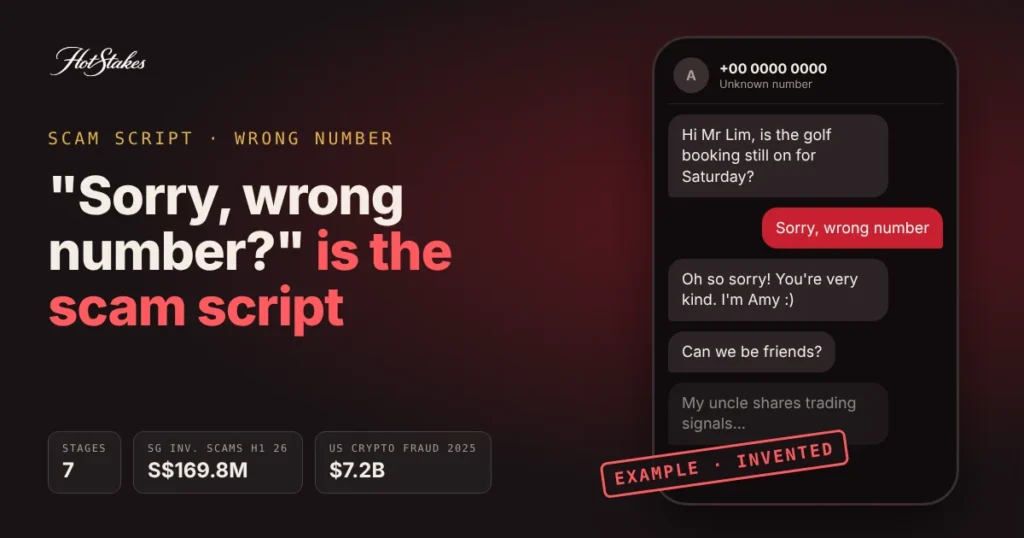
The compounds’ output lands in your phone: wrong-number texts, “mentor” investment groups, fake betting apps. Our step-by-step guide to how pig-butchering scams work covers the most common script. Our fake gambling app red flags guide covers the betting version. Before you deposit anywhere, check the operator’s licence on a public register.
Recruitment works the same way in reverse. Treasury says workers are lured with promises of well-paid jobs. An overseas job offer with high pay, few requirements and flights paid by a stranger deserves the same scepticism as a “guaranteed” investment return. If you’re targeted or worried about someone, call Malaysia’s NSRC on 997, Singapore’s ScamShield Helpline on 1799, or Hong Kong’s Anti-Scam Helpline on 18222.
Takeaway: The same industry targets you as a victim and as a recruit. Both pitches promise easy money from a stranger.
Frequently asked questions
Where are most Southeast Asian scam compounds located?
The UN human rights office named Myanmar and Cambodia as the main hubs, with Lao PDR, the Philippines and Thailand also identified as main countries of destination or transit. Reported hotspots include Myawaddy in Myanmar and the Golden Triangle SEZ in Laos.
Are the people working in scam compounds criminals or victims?
Many are both targets and tools. The UN says large numbers were trafficked and forced to scam. Amnesty has criticised authorities for treating escapees as irregular migrants instead of trafficking victims.
Have the crackdowns worked?
Partly. Governments report tens of thousands deported and hundreds of sites raided. UNODC says the networks are spreading to other continents, and Amnesty says many Cambodian sites still operate.
Is Prince Group’s chairman convicted?
Not in the US. As of the sources cited here, the US charges are allegations and he is presumed innocent. He was extradited to China in January 2026, where Xinhua reported he is suspected of fraud-related crimes.
For the high-roller side of the same cross-border money story, see our explainer on the Macau junket collapse and Alvin Chau’s 18-year sentence.
HotStakes is an independent directory. Some links on this site are affiliate links; we may earn a commission at no cost to you, and it never changes our rankings. Gambling involves risk — only play with money you can afford to lose, and if it stops being fun, seek help.
Looking for operators checked by Cyndia’s team? Browse vetted operators by currency.
 Next story →Pig-Butchering Scam: How It Works, Red Flags, What to Do




Start the discussion