

How Much Have I Lost Gambling? A 10-Minute Money Audit
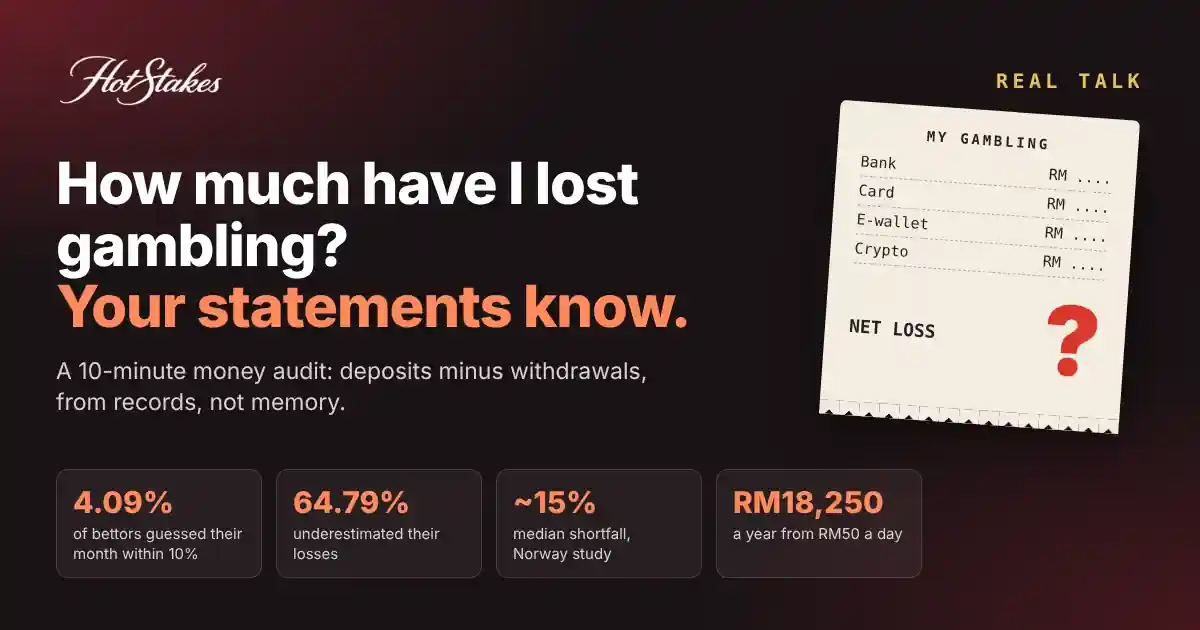
Most gamblers guess their losses too low. Find your real number in 10 minutes: deposits minus withdrawals, straight from your statements.
In this article
- Why your guess is probably too low
- The formula: total deposited minus total withdrawn
- Where to find your real number
- The 10-minute gambling money audit
- Worked example (invented numbers)
- Our maths: what a “small” habit adds up to
- For partners and family
- What to do with the number
- Free, confidential help (verified 6 Nov 2026)
- FAQ
If you’re asking “how much have I lost gambling?”, don’t trust your memory. Pull your bank, card, e-wallet and crypto records and work out total deposited minus total withdrawn. That one subtraction is your real net loss, and research shows most people’s guesses come in too low. In one study that checked players’ guesses against their account data, only about 1 in 25 got their last month within 10%. The audit below takes about 10 minutes for one period. No judgement, just a number you can act on.
Why your guess is probably too low
This isn’t about honesty. Researchers have checked what gamblers say they lost against what the operator’s records show. The gap is real and it mostly runs one way.
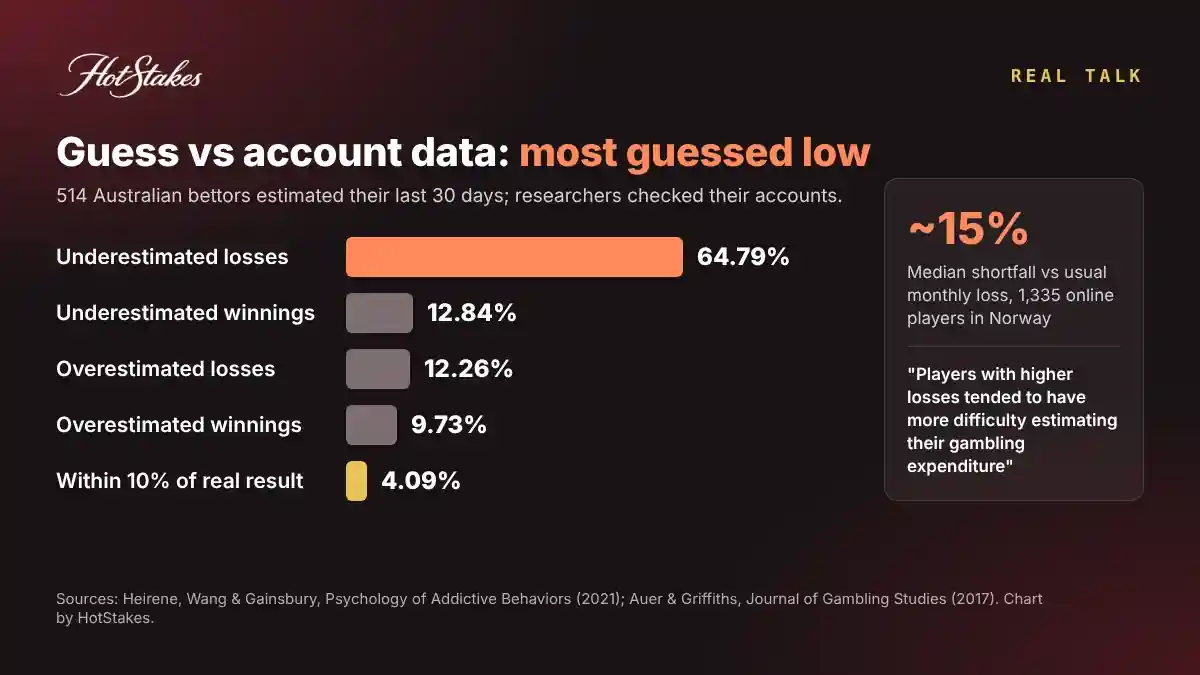
A 2021 Australian study by Heirene, Wang and Gainsbury in Psychology of Addictive Behaviors compared 514 sports and race bettors’ estimates of their last 30 days with their account data:
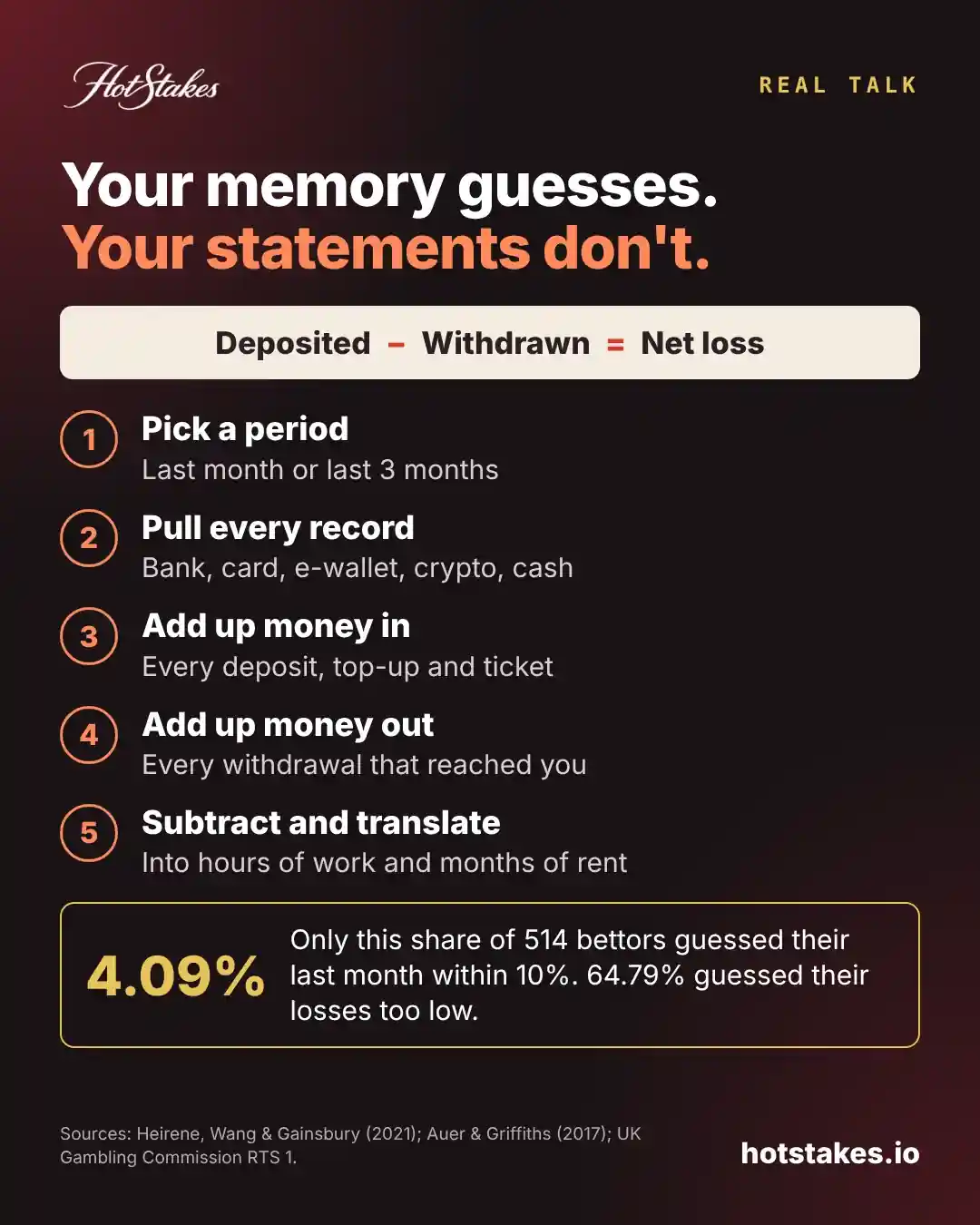
- Only 21 people (4.09%) were accurate within 10% of their real net result. Just 2 (0.39%) were spot on.
- 64.79% underestimated their losses. Only 12.26% overestimated them.
- Among people who lost money, those who lost more were more likely to underestimate rather than overestimate.
An earlier study by Auer and Griffiths in the Journal of Gambling Studies (2017) looked at 1,335 online players with Norway’s state operator, Norsk Tipping, over one month:
- The median player underestimated losses by about 15% of their usual monthly loss. Half underestimated by at least 105 Norwegian kroner.
- Guesses and real results were only loosely linked (a correlation of 0.35).
- The authors found that “players with higher losses tended to have more difficulty estimating their gambling expenditure”.
Both studies had limits: one operator each, and people who chose to answer a survey. Still, they point the same way. They also measured just one month. Over a year, a gap of that size piles up.
Takeaway: Your guess is a starting point, not the answer. Most people in these studies guessed low, and the bigger losers found it harder to guess well.
The formula: total deposited minus total withdrawn
You don’t need to rebuild every bet. You only need money in and money out.
Net loss = total deposited − total withdrawn
This is the same measure the UK Gambling Commission makes licensed online operators show customers. Its technical standard RTS 1 defines net deposits as “the running total of all deposits minus the sum of all withdrawals”.
A few rules keep the number honest:
- Count each ringgit, peso or dollar once. If money went bank → e-wallet → gambling site, count only the step into the gambling site.
- Cash counts. ATM withdrawals you spent at a casino, a betting outlet or on 4D tickets belong in deposits. Estimate them honestly and mark them as estimates.
- Winnings you replayed don’t count twice. They never left the account, so they’re already inside the formula.
- Borrowed money counts in full. A deposit funded by a credit card, a loan or a friend is still a deposit.
Takeaway: If it went in and didn’t come back out, it’s lost. Everything else is detail.
Where to find your real number
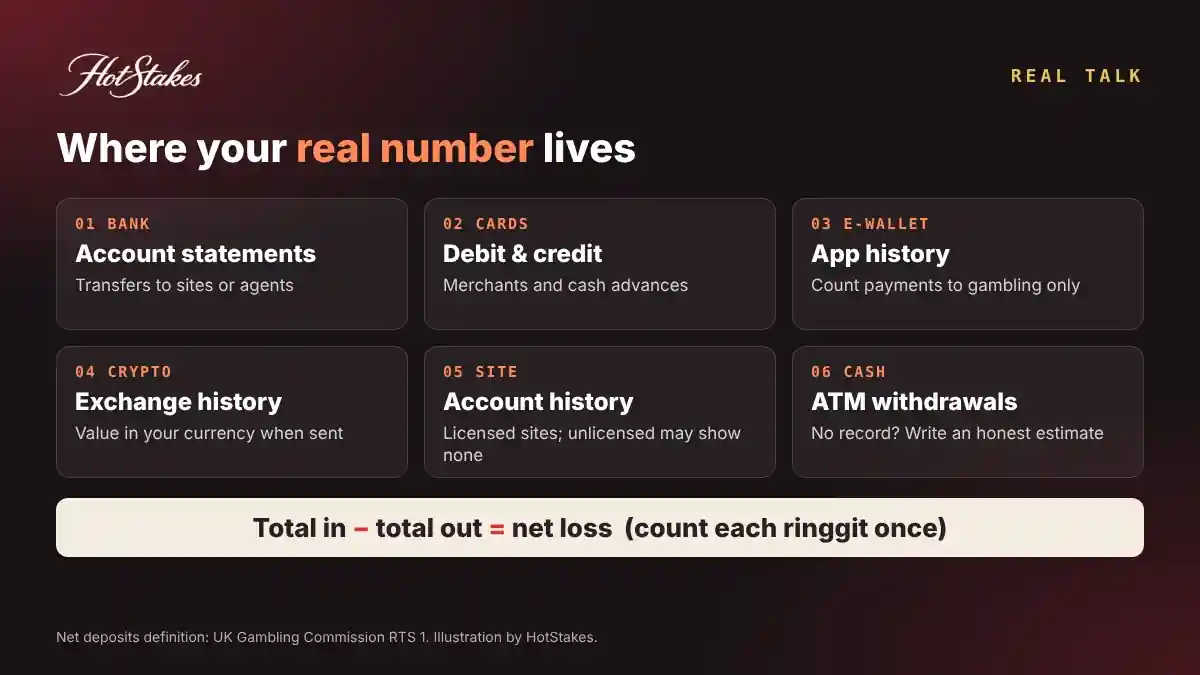
Most of your gambling money leaves a trail. Here is where to look, and what trips people up.
| Record | Where to look | Watch out for |
|---|---|---|
| Bank account | Online banking statements or downloadable history; ask the branch for older statements | Transfers to personal accounts or agents rather than a site name |
| Debit and credit cards | Monthly card statements in your banking app | Unfamiliar merchant names; cash advances |
| E-wallets (for example Touch ’n Go, GCash, GrabPay) | The transaction history in the app | Top-ups from your bank and payments out are both listed; count only payments to gambling |
| Crypto exchange | Withdrawal and deposit history; transaction export if offered | Value changes over time; use the amount in your currency when you sent it |
| Casino or betting account | Account, transaction or “history” page on licensed sites | Unlicensed sites may show little or nothing; your bank records are the backup |
| Cash | ATM withdrawals near venues or outlets; receipts | No record at all; write down an honest estimate |
Licensed operators in some places must keep this history for you. In the UK, the Gambling Commission requires easy access to at least three months of account and gambling history, and 12 months on request. If you played somewhere with no licence, don’t count on any history at all.
Takeaway: Start with your bank and card statements. They show the money that actually left you, whatever the site did or didn’t record.
The 10-minute gambling money audit
Do one period first. Last month or the last three months is enough to start.
- Pick a period. Choose start and end dates. Shorter is faster; you can extend later.
- Pull every record. Open statements for each bank account, card, e-wallet and exchange you used in that period. Add a line for cash.
- Total the money in. List every payment into gambling: site deposits, agent transfers, top-ups, tickets, chips. Add them up.
- Total the money out. List every withdrawal or payout that reached your account. Add them up.
- Subtract and translate. Deposits minus withdrawals is your net loss. Divide by the number of months for a monthly figure, then compare it with your hourly pay and your rent.
Use a notebook or a simple spreadsheet. Write “estimate” next to anything you couldn’t find a record for.
Takeaway: Five steps, one subtraction. The hard part is opening the statements, not the maths.
Worked example (invented numbers)
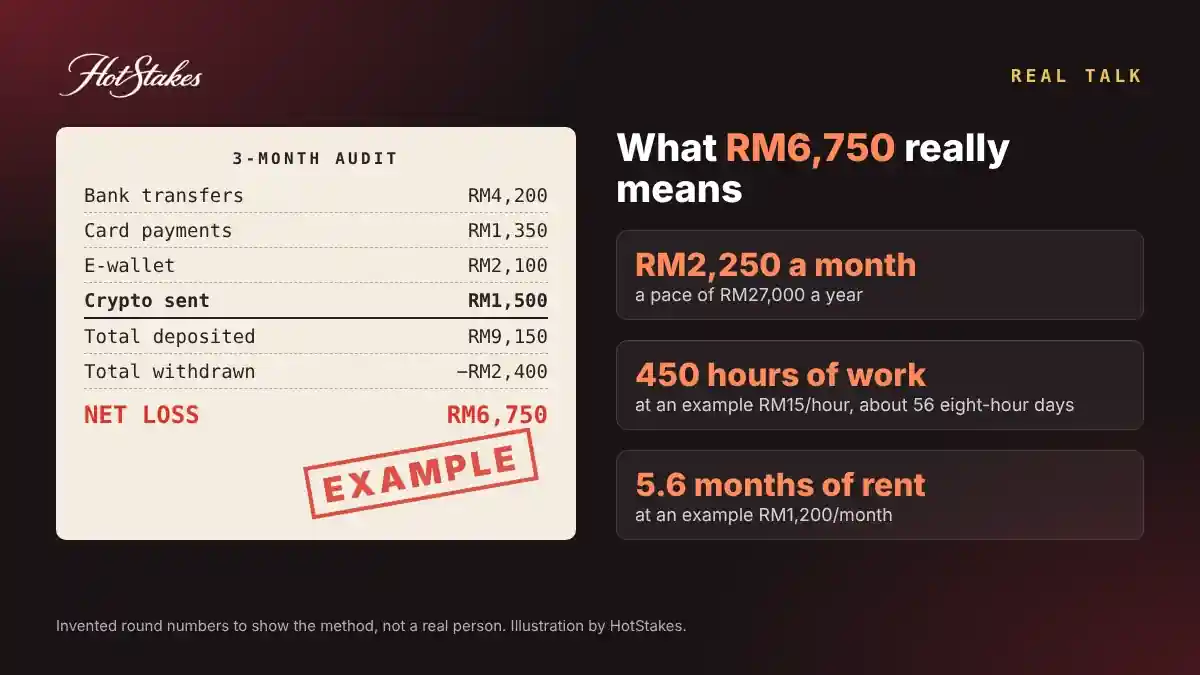
This is an example with made-up round numbers to show the method. It isn’t a real person.
- Period: three months
- Bank transfers to gambling sites or agents: RM4,200
- Card payments to gambling: RM1,350
- E-wallet payments to gambling: RM2,100
- Crypto sent to gambling sites (value when sent): RM1,500
- Total deposited: RM9,150
- Total withdrawn back to the bank: RM2,400
The maths: RM9,150 − RM2,400 = RM6,750 net loss in three months. That’s RM2,250 a month, or a pace of RM27,000 a year.
Now make it real. At an example pay of RM15 an hour, RM6,750 is 450 hours of work, about 56 eight-hour days. At an example rent of RM1,200 a month, it’s more than five and a half months of rent.
Takeaway: Swap in your own pay and rent. The translation is often what makes the number land.
Our maths: what a “small” habit adds up to
We ran these sums on 6 Nov 2026. They show steady net losses, not bets, carried forward with no change. Monthly figures use 365 ÷ 12 days or 52 ÷ 12 weeks.
| Net loss | Per month | Per year | Over 5 years |
|---|---|---|---|
| RM10 a day | RM304 | RM3,650 | RM18,250 |
| RM20 a day | RM608 | RM7,300 | RM36,500 |
| RM50 a day | RM1,521 | RM18,250 | RM91,250 |
| RM100 a day | RM3,042 | RM36,500 | RM182,500 |
| RM100 a week | RM433 | RM5,200 | RM26,000 |
| RM250 a week | RM1,083 | RM13,000 | RM65,000 |
| RM500 a week | RM2,167 | RM26,000 | RM130,000 |
The arithmetic for the bold row: RM50 × 365 = RM18,250 a year. RM18,250 × 5 = RM91,250.
One more sum. In the Auer and Griffiths study, the median player’s guess fell short by about 15% of what they usually lost in a month. For someone who typically loses RM2,000 a month, that’s RM300 missing from the guess (RM2,000 × 0.15). Repeat it every month and RM3,600 a year goes uncounted. That’s the median player in one Norwegian study, so treat it as a rough guide. Your own gap could be smaller or much bigger.
Takeaway: “Only RM50” a day is RM18,250 a year. Small daily numbers are exactly the ones memory rounds down.
For partners and family
If you’re worried about someone else’s gambling, the same formula works. How you use it matters more.
- Do it together, not behind their back. An audit sprung as an ambush tends to start a fight, not a plan.
- Stick to the numbers. “RM6,750 went in and RM2,400 came back” is easier to hear than a character judgement.
- Protect shared money first. If joint accounts are at risk, our guide to blocking online banking fast covers the quick locks.
If you’re the one gambling and want to tell family, our guide to telling your family about a gambling problem walks through the conversation in four steps. A finished audit makes it easier, because you can show a number instead of guessing out loud.
Takeaway: A shared, factual number is a better starting point than blame.
What to do with the number
A number on paper can feel heavy. It’s also the most useful thing you’ve got right now. A few honest next steps:
- Don’t try to win it back. That urge is common and it usually makes the number bigger. Our guide to how to stop chasing losses explains why.
- Take a 2-minute self-check. Our PGSI-based gambling self-check uses a standard research questionnaire. It’s a prompt to reflect, not a diagnosis.
- Look forward, too. This audit measures the past. To project what the habit will cost next year, read should I quit gambling? what your habit costs a year.
- If there’s debt, act early. Our gambling debt guide for the first 48 hours covers what to do first.
- Add friction. Blocks on sites and payments buy you time when an urge hits. See how to block yourself from gambling.
For the bigger picture on harm, start with our Real Talk pillar, is gambling bad for you? As a reference point, GambleAware’s spend calculator checks your gambling against lower-risk guidelines that include spending no more than 1% of income.
Takeaway: Write the number down, date it, and redo the audit in a month. Watching it change is how you know whatever you try is working.
Free, confidential help (verified 6 Nov 2026)
We checked each number on the linked page on 6 Nov 2026. Where we found no national gambling-specific line, we list the government mental health line, which can talk through gambling too. In an emergency, call your local emergency number.
| Where | Service | Contact | Source |
|---|---|---|---|
| Malaysia | HEAL national mental health helpline (no national gambling-specific line found) | 15555 | Malay Mail, 6 Jan 2026 |
| Singapore | NCPG Helpline and webchat, daily 8am–11pm | 1800-6-668-668 | MSF / NCPG |
| Philippines | NCMH Crisis Hotline (no national gambling-specific line found) | 1553, 0919-057-1553, 0917-899-8727 | Manila Bulletin, 3 Jan 2026 |
| Hong Kong | Gambling counselling hotline | 1834 633 | HK Government, 4 Dec 2024 |
| India | Tele-MANAS mental health helpline (no national gambling-specific line found) | 14416 or 1-800-891-4416 | PIB, Ministry of Health |
| Anywhere | Gambling Therapy (Gordon Moody), free online support | gamblingtherapy.org | Gambling Therapy |
Takeaway: You don’t need to have “hit bottom” to call. Bringing your audit number to the first conversation helps.
FAQ
How do I calculate my gambling losses?
Add up every payment you made into gambling over a set period, then add up everything you withdrew back. Subtract the second from the first. That’s your net loss. Use bank, card, e-wallet and crypto records rather than memory.
Can I see gambling losses on my bank statement?
Usually you can see the money going out, though not always under a site’s name. Payments may show as card merchants, e-wallet payments or transfers to agents or personal accounts. List anything you know went to gambling, and treat cash withdrawals you gambled with as deposits.
How do I check how much I spent on gambling if the site has no history?
Use your own records. Bank, card, e-wallet and exchange histories show what left your accounts, even if the site shows nothing. Unlicensed sites may give you little or no history, so your statements are the reliable source.
Why do I think I’ve lost less than I really have?
You’re not alone. In one Australian study, 64.79% of bettors underestimated their losses and only 4.09% were within 10% of their real result. Records beat memory.
Does a big number mean I’m addicted?
Not on its own. The number shows cost, not a diagnosis. For a fuller picture, try our 2-minute PGSI self-check or talk to one of the free helplines above.
HotStakes is an independent directory. Some links on this site are affiliate links; we may earn a commission at no cost to you, and it never changes our rankings. Gambling involves risk — only play with money you can afford to lose, and if it stops being fun, seek help. This article is general information, not legal advice. Read our full disclaimer.
 Next story →‘Divine’ 4D Number Scam: Klang Man Loses RM3,250



Start the discussion