

How to Complain About an Online Casino That Won’t Pay
Casino won't pay out? The 5-step complaint ladder: evidence, formal complaint, free ADR, chargeback, police, with each licence's deadlines.
In this article
- First: is it a delay, a dispute or a scam?
- Step 1: Gather your evidence before you do anything else
- Step 2: Use the casino’s formal complaints process
- Step 3: Escalate to the ADR or regulator named on the licence
- The honest part: your local regulator probably can’t help
- Step 4: Dispute the payment with your bank or card issuer
- Step 5: If it’s a scam site, report it now
- FAQ
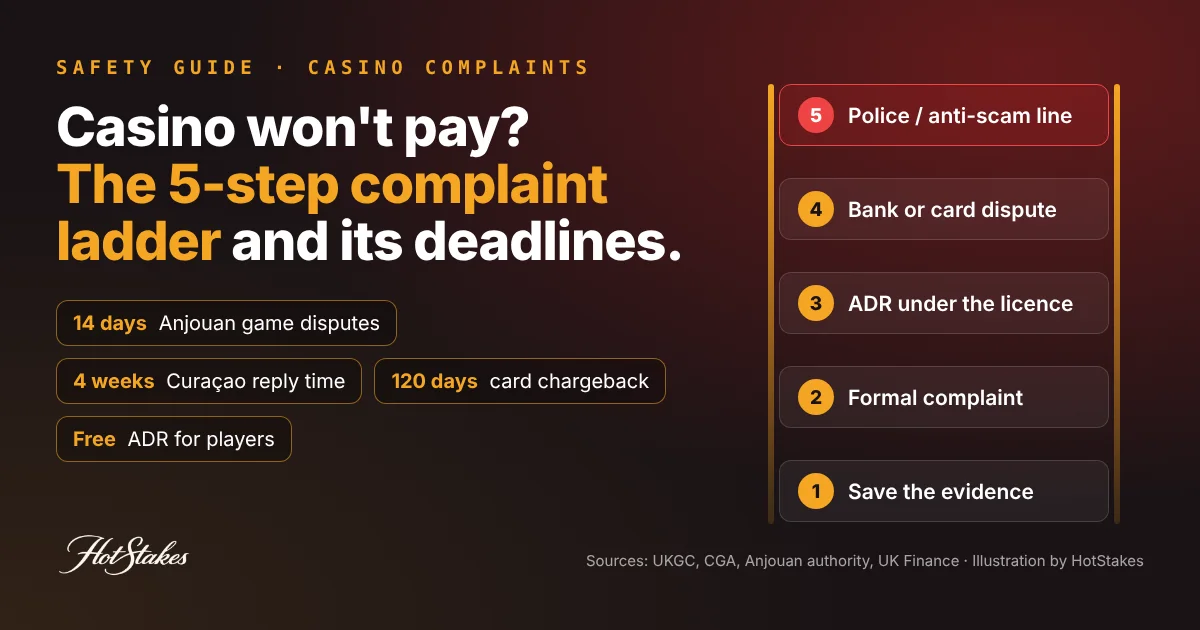
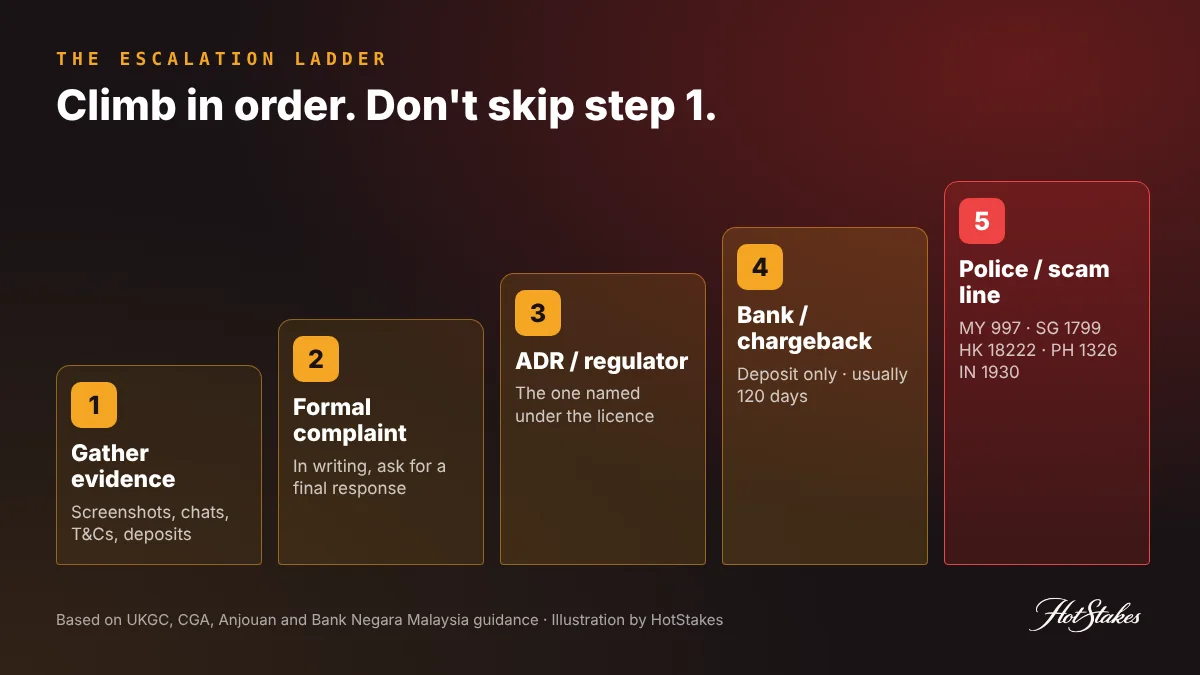
Your withdrawal is stuck and support keeps saying “pending”. To complain about an online casino that won’t pay, climb five rungs in order: save your evidence, file a formal complaint with the casino, escalate to the free dispute service named under its licence, dispute the payment with your bank, and report it to police if the site is a scam. Each rung has a deadline. We read the complaint rules of four licensing regimes on 22 Oct 2026 so you can see who handles what, what it costs and how long you have.
First: is it a delay, a dispute or a scam?
The right complaint depends on what is actually happening. Spend two minutes sorting your case into one of three boxes:
- A delay. The casino wants ID, proof of address or proof of payment before paying. That is normal at licensed sites, and annoying. Our guide to KYC withdrawal holds explains what is reasonable.
- A dispute. The casino has refused to pay, voided winnings or closed your account, and cites its terms. This is what the complaint ladder below is built for.
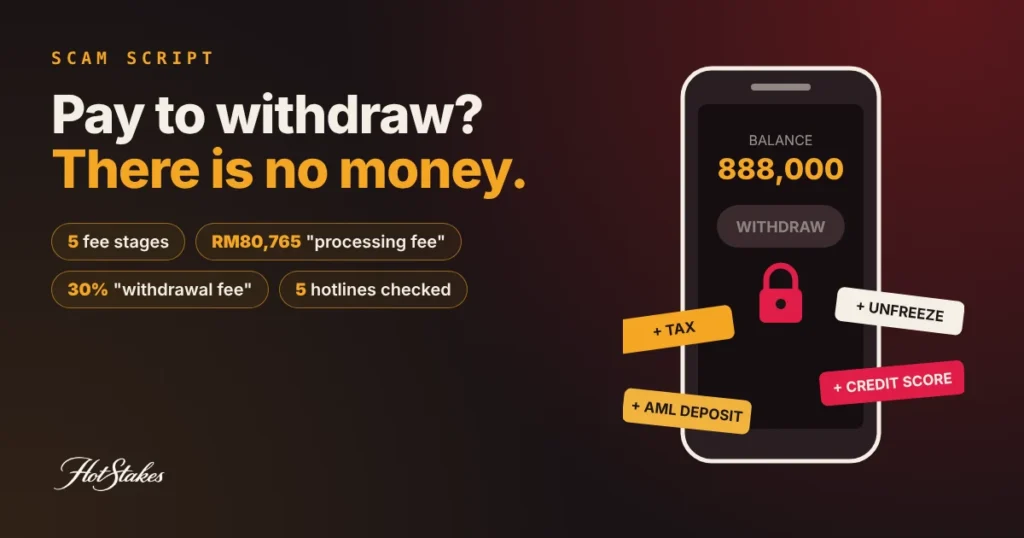
- A scam. The “casino” says you must pay a tax, fee or deposit before you can withdraw, or the site has no licence you can verify. Read our breakdown of the withdrawal fee scam script and skip to Step 4 and Step 5.
Not sure if the licence is real? Our pillar guide on how to spot an unlicensed online casino shows how to check the regulator’s own register.
Takeaway: A delay needs documents. A dispute needs a complaint. A scam needs your bank and the police, today.
Step 1: Gather your evidence before you do anything else
Casinos can close accounts, and chat histories can disappear. Save everything while you still have access. The UK Gambling Commission tells players to “keep a copy of everything that you tell them”. IBAS, a UK dispute service, asks for the specific email or live chat your case relies on, plus screenshots and your account number (IBAS).
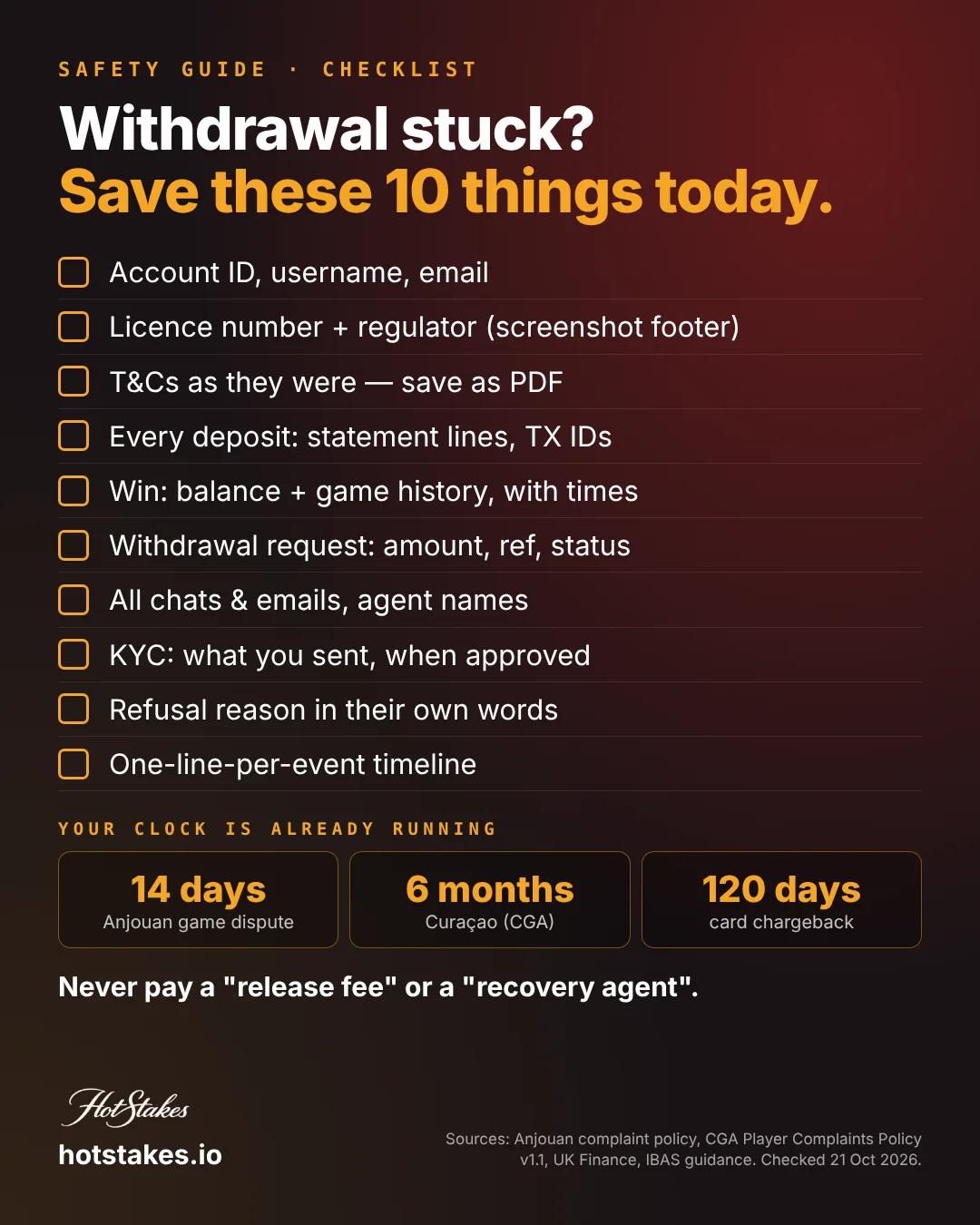
- Your account details: username, account ID, registered email.
- The licence: a screenshot of the site footer showing the licence number and regulator, and the date you took it.
- The terms and conditions as they were when you played. Save the page as a PDF; terms change.
- Every deposit: bank or card statement lines, transaction IDs, wallet addresses for crypto.
- The win: screenshots of your balance and game history, with dates and times.
- The withdrawal request: amount, method, reference number, status.
- All support contact: live chat transcripts (export or screenshot every page), emails, agent names.
- KYC proof: what documents you sent and when they were approved.
- Any reason given for refusal, in the casino’s own words.
- A simple timeline: one line per event, date first. ADR services ask what happened, when, and what you expected.
Takeaway: Evidence decides disputes. Ten minutes of screenshots now can be worth more than any angry email later.
Step 2: Use the casino’s formal complaints process
Every route that follows requires this step first. The UK Gambling Commission says you “cannot take your complaint to an ADR without first going through the gambling business’s complaint process”. Curaçao, Malta and Anjouan rules say the same.
- Find the complaints procedure. Look in the terms, the footer or the help centre. Anjouan-licensed sites must accept complaints through the complaint function in their interactive licence seal (Anjouan policy).
- Write, don’t just chat. Use the words “formal complaint” in the subject line. Malta’s regulator also requires a first complaint to its Player Support team to be in writing.
- Keep it factual. Dates, amounts, reference numbers, what you want (for example, payment of a stated amount).
- Ask for a final response and note the date you sent it. That date starts the operator’s clock.
Here is an EXAMPLE of how a clear complaint can open. It is written by HotStakes for illustration; adjust it to your facts.
EXAMPLE: “Formal complaint, account ID 000000. On 3 October I requested a withdrawal of RM2,400 (ref. W-0000). My KYC was approved on 1 October. On 10 October your agent said winnings were voided under clause 7.2, but did not say which action breached it. Please explain the specific breach with evidence, or pay the withdrawal, and confirm this as your final response.”
Why this works: it names the date, amount and reference, shows KYC is done, and asks for a specific reason. An ADR service will ask the same questions.
Takeaway: A short, dated, written complaint that asks for a final response is the key that opens every door after it.
Step 3: Escalate to the ADR or regulator named on the licence
ADR stands for alternative dispute resolution: an independent body that reviews the dispute so you don’t have to go to court. Which one you use depends entirely on where the casino is licensed, not where you live. Here is what each regime’s own documents say.
UK Gambling Commission licence
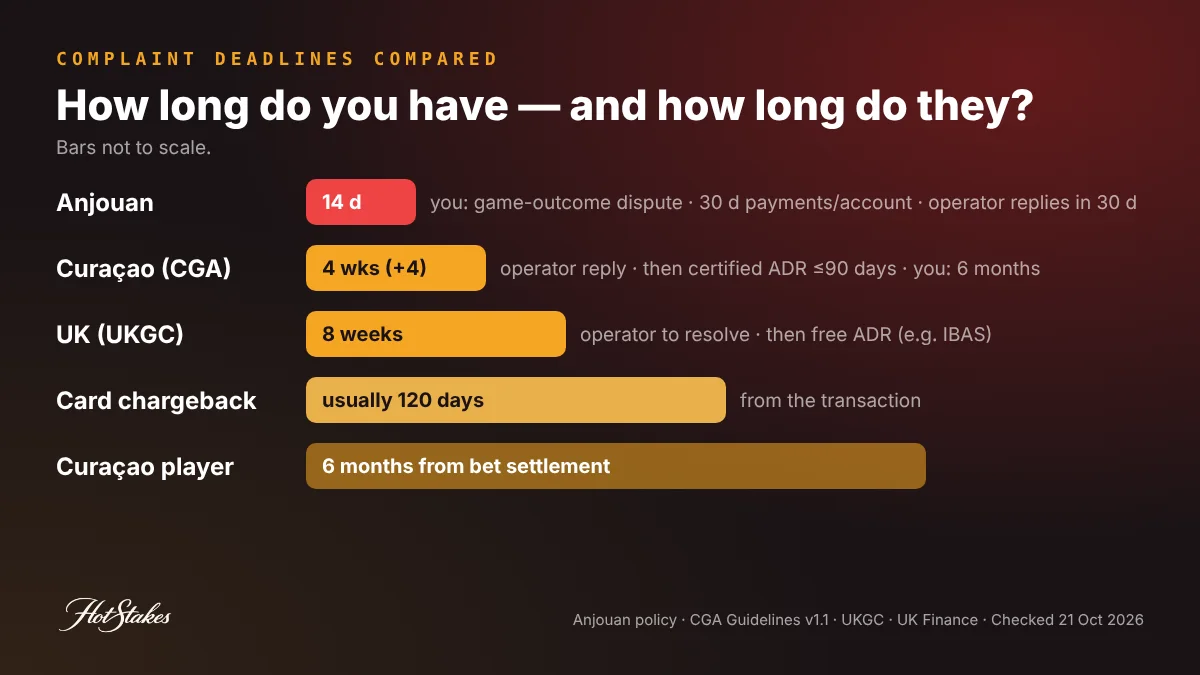
- The operator has 8 weeks to resolve your complaint. If you’re still unhappy, you can go to an ADR provider, which the Commission describes as “a free, independent service”.
- Approved providers include IBAS and eCOGRA, plus ADR Group, Pegasus ADR, CEDR, ProMediate and others (Commission ADR list). The casino must tell you which one it uses.
- The Commission itself does not decide individual disputes.
- For IBAS, the Commission notes the outcome is non-binding, and the referral window must be at least 12 months from the operator’s final response (Commission IBAS page).
Malta Gaming Authority (MGA) licence
- Complain to the operator first. If that fails, you can refer the complaint to the MGA’s Player Support Unit or another ADR entity (MGA FAQ).
- Use the online form on the MGA’s Lodge a Complaint page. Player Support can be called on +356 2546 9000, but your first complaint must be in writing.
- The MGA pages we read do not state a fee or a deadline, so file promptly.
Curaçao Gaming Authority (CGA) licence, under the new LOK law
- You can complain free of charge for up to 6 months after the bet is settled (CGA Player Complaints Policy Guidelines v1.1).
- The operator must confirm receipt within one week and respond within 4 weeks, extendable once by 4 weeks with notice. Responsible-gambling complaints, such as a self-exclusion breach, should be resolved within 5 business days.
- If unresolved, you can escalate to an independent ADR provider, free; the operator pays. Only CGA-certified ADR entities may handle these cases, the operator must name them in its terms, and the process is expected to take no more than 90 days (CGA ADR Role and Certification).
- The CGA does not mediate individual disputes, but the operator may not stop you contacting the CGA about malpractice or licence breaches.
Old “Curaçao sublicences” and the new CGA licences are not the same thing. Our explainer on the Curaçao licence reform covers how to tell them apart.
Anjouan licence
- Complaints go to the operator first, through its licence seal. The operator must reply within 30 calendar days (Anjouan complaint policy).
- Your own windows are tight: 14 calendar days after the session for game-outcome disputes, 30 calendar days for account disputes such as payments, suspensions and bonuses.
- If unresolved after 30 days, escalate to an approved ADR provider. The authority lists EGIS ADR, Axion ADR, iGaming ADR and CADRE, and says the operator bears the cost (authorised ADR providers).
- The authority says it does not handle, mediate or adjudicate player complaints, and everything must be in English.
| Licence | Operator must reply | Who handles escalation | Cost to you | Your time limit |
|---|---|---|---|---|
| UK Gambling Commission | 8 weeks | Approved ADR named by the casino (e.g. IBAS, eCOGRA) | Free | IBAS: at least 12 months from final response |
| Malta (MGA) | Not stated on MGA pages | MGA Player Support Unit or another ADR | No fee stated | Not stated: act promptly |
| Curaçao (CGA, LOK) | 4 weeks (+4 once); 5 business days for responsible-gambling cases | CGA-certified ADR named in the casino’s terms; ≤90 days | Free (operator pays) | 6 months from bet settlement |
| Anjouan | 30 calendar days | Approved ADR: EGIS, Axion, iGaming ADR, CADRE | Free (operator pays) | 14 days (game outcome); 30 days (payments, account) |
| No verifiable licence | No obligation | Nobody: go to your bank and police | n/a | Card dispute usually 120 days |
Sources: the regulator pages linked above, read on 22 Oct 2026. Rules change; check the licence holder’s terms for its named ADR.
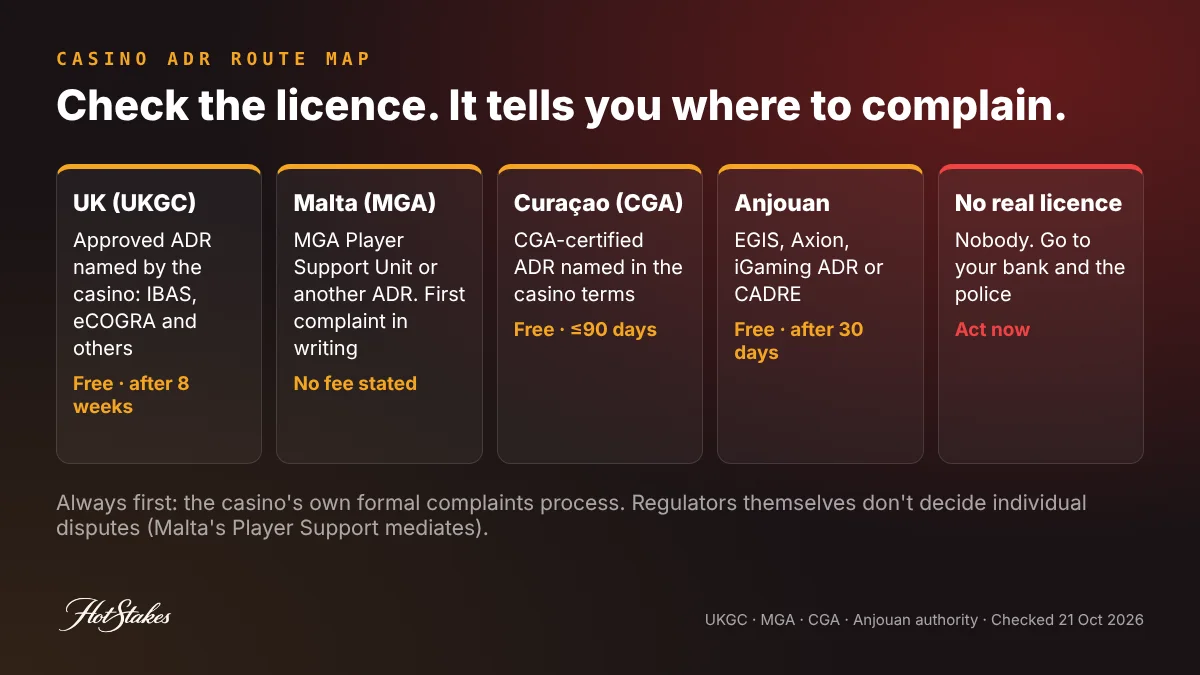
Takeaway: The licence number in the footer tells you exactly where to go next. Find it, then find the ADR named in the casino’s terms.
The honest part: your local regulator probably can’t help
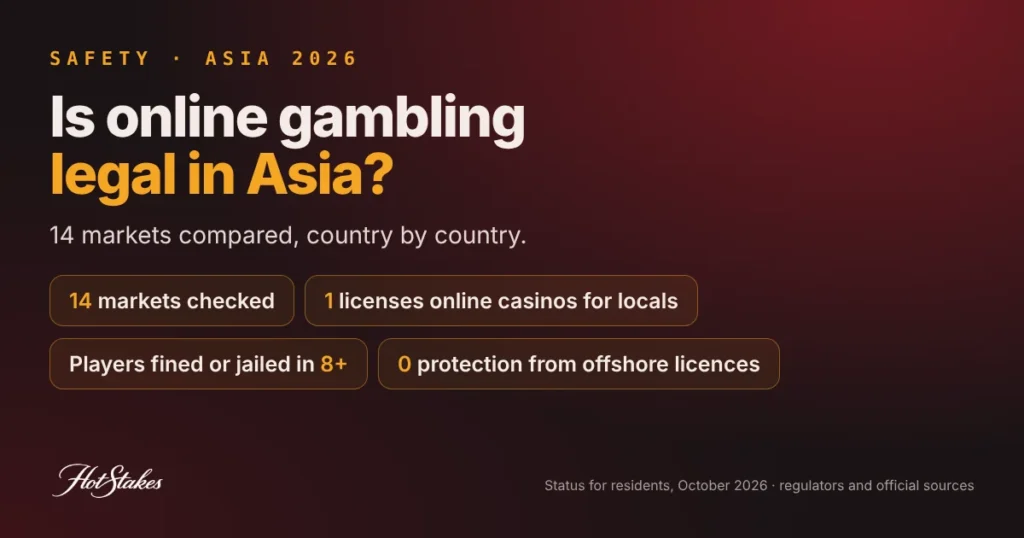
In most of the Asian markets we cover, offshore online casinos are not licensed locally. That means your home gambling regulator has no licence to pull and no complaints scheme for them.
Your leverage sits in two places: the offshore licence (Step 3) and the payment provider you used (Step 4). If neither exists, because the site has no real licence and you paid in crypto, the realistic route is a police report.
Takeaway: Don’t waste weeks on the wrong regulator. Work the licence and your bank in parallel.
Step 4: Dispute the payment with your bank or card issuer
A chargeback asks your card issuer to reverse a card transaction. UK Finance is clear that “chargeback is not a legal right”: it runs on Visa, Mastercard and American Express rules, and your issuer usually has to start it within 120 days of the transaction. MoneyHelper says it works for debit, credit and prepaid cards, and that you should ask the company for a refund first (MoneyHelper).
Know its limits before you start:
- It reverses a payment, not a promise. A chargeback targets the money you deposited. It is not a way to collect winnings the casino refused to pay.
- E-wallet top-ups are weak cover. Which? notes that spending money loaded into PayPal or similar accounts is unlikely to be covered, because the loading is treated as the card transaction (Which?).
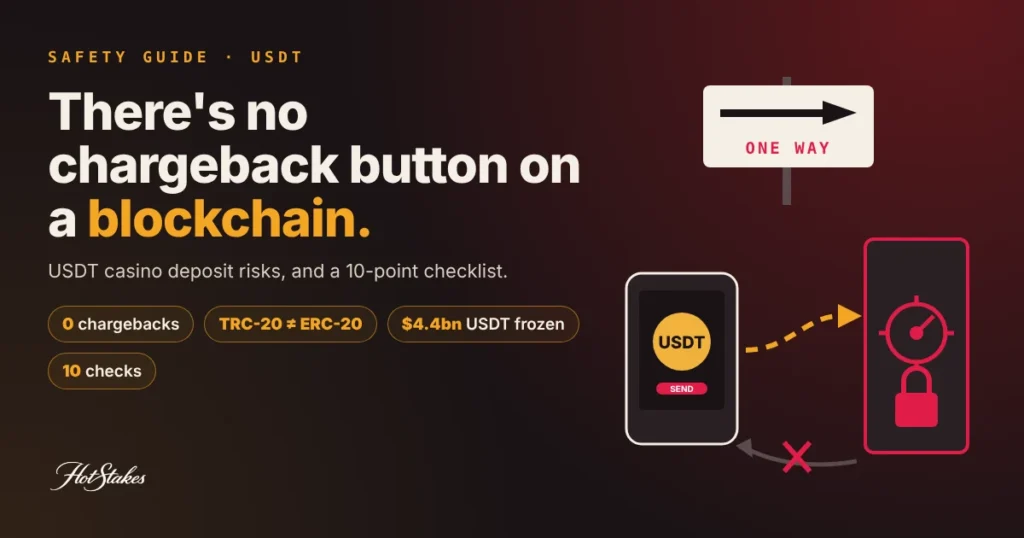
- Crypto has no chargeback. Once USDT leaves your wallet, no card scheme can pull it back. See our USDT casino deposit risks checklist.
If your bank mishandles the dispute, you can escalate the bank’s decision:
- Malaysia: complain to the bank’s complaints unit (Bank Negara says expect feedback within 14 days). If you’re unhappy, or have no final decision after 60 days, contact BNMTELELINK on 1-300-88-5465, and refer eligible cases to the Ombudsman for Financial Services within 6 months of the bank’s final decision (BNM Complaint & Redress).
- Singapore: complain to the bank first, then go to FIDReC within 6 months of the bank’s final reply (MoneySense).
- UK: if the card provider doesn’t respond to a complaint within eight weeks, Which? says you can go to the Financial Ombudsman Service.
Takeaway: Call your bank early. Its 120-day window is the one deadline that is often shorter than the casino’s own complaint process.
Step 5: If it’s a scam site, report it now
If you were asked to pay fees to withdraw, or the licence turned out to be fake, treat it as fraud. Bank Negara Malaysia tells scam victims to call their bank’s scam hotline or the NSRC on 997 immediately and lodge a police report (BNM scam FAQ).
| Where you are | Call | What it does |
|---|---|---|
| Malaysia | 997 (National Scam Response Centre) | Call it or your bank’s scam hotline fast, then make a police report (BNM) |
| Singapore | 1799 (ScamShield Helpline) | 24/7 advice and directs you to your bank; file the police report online (ScamShield) |
| Hong Kong | 18222 (Anti-Scam Helpline) | 24-hour police consultation line; report at a police station (ADCC) |
| Philippines | 1326 (CICC I-ARC hotline) | 24/7 line to report online scams (PNA) |
| India | 1930 | Cyber fraud helpline; also report at cybercrime.gov.in (PIB) |
A warning about “recovery” offers. After you complain in public, strangers may message you offering to get your money back for an upfront fee, often claiming links to regulators, lawyers or “blockchain tracing”. Treat any such offer as a likely scam: the regulators and ADR services above charge players nothing.
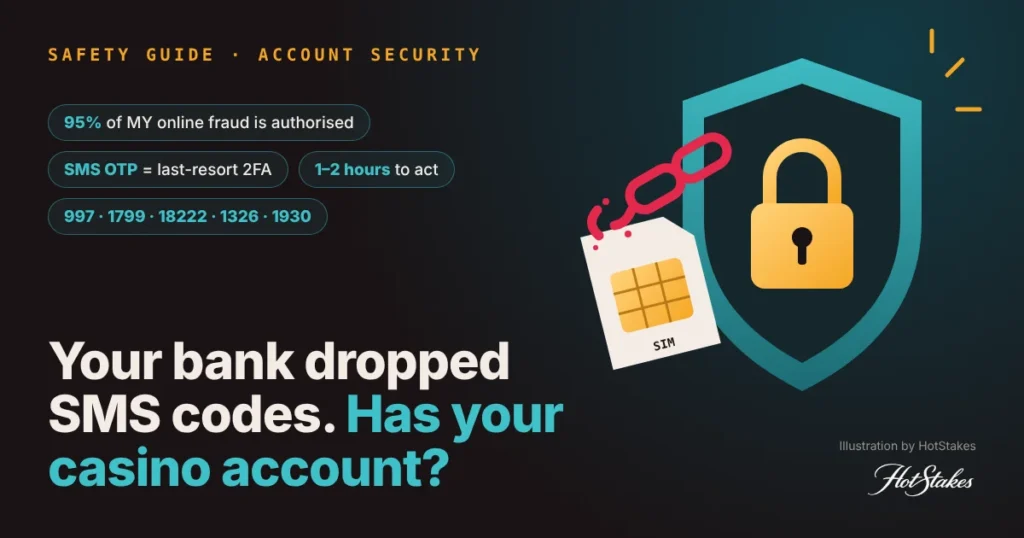
Shared logins, ID photos or card details with a fake site? Lock things down with our casino account security checklist. And if you play again, pick an operator whose licence you can check on the regulator’s own register, whether you find it through our operator directory or anywhere else. More guides: Safety guides.
Takeaway: With a scam site, the money moves fast. Bank first, police second, and nobody who asks for a fee.
FAQ
Can I complain to the regulator directly if a casino won’t pay?
Usually only after the casino’s own complaints process. The UK Gambling Commission, Curaçao Gaming Authority and Anjouan authority do not decide individual disputes; they send you to an approved ADR service. Malta’s MGA Player Support Unit accepts written complaints after you have tried the operator.
Does casino ADR cost money?
Not for players under the regimes we checked. UK-approved providers such as IBAS and eCOGRA are free to consumers, and the Curaçao and Anjouan rules say the operator bears the ADR costs.
How long do I have to complain?
It depends on the licence. Anjouan sets 14 days for game disputes and 30 days for payment or account disputes; Curaçao allows 6 months from bet settlement. Card chargebacks usually must start within 120 days.
Can a chargeback get my casino winnings back?
No. A chargeback can reverse a card payment you made, such as a deposit, if your issuer accepts the claim under card scheme rules. It is not a legal right and does not cover winnings, and crypto payments cannot be charged back.
Someone offered to recover my casino money for a fee. Should I pay?
No. Treat it as a likely scam. Official regulators, ADR services and anti-scam hotlines do not charge players, and nobody can guarantee recovery.
HotStakes is an independent directory. Some links on this site are affiliate links; we may earn a commission at no cost to you, and it never changes our rankings. Gambling involves risk — only play with money you can afford to lose, and if it stops being fun, seek help. This article is general information, not legal advice. Read our full disclaimer.
 Next story →Signs Your Child Is Gambling: Loot Boxes, Skins, What to Do

Start the discussion