

SIMBA Scam Call: The 3-Call Script Police Warned About
Fake SIMBA staff, then fake police: 59 cases, S$1.3m lost in Oct 2026. The 3-call script, the red flag in each call, and what to do.
In this article
Last updated: 1 November 2026, 08:30 MYT.
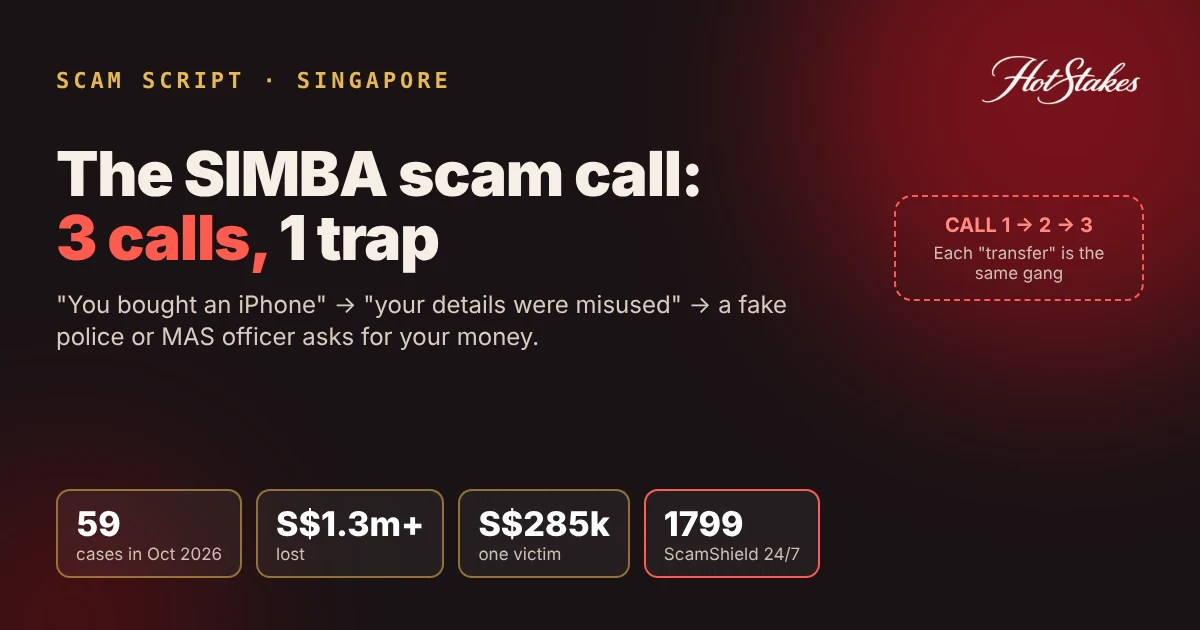
The SIMBA scam call starts with a purchase you never made and ends with a fake police or MAS officer asking for your money. If a caller says you bought an iPhone or a mobile plan, then “transfers” you to the police, hang up: real officials never transfer your call to the police and never ask you to move money or hand over valuables. Singapore Police say at least 59 people lost S$1.3 million or more this way in October 2026 alone. Below: the three calls, the exact red flag in each, and what to do.
Cyndia’s take: This scam works because every step sounds like a normal phone call, and every new voice sounds more official than the last. You don’t need to spot the lie in each sentence. You only need one rule: the moment a call gets “transferred to the police”, it’s a scam. Put the phone down and call 1799 yourself.
What happened: the October 2026 police warning
On 29 October 2026 the Singapore Police Force issued an advisory on scams impersonating SIMBA staff and government officials. The key facts:
- At least 59 cases were reported in October 2026.
- At least S$1.3 million was lost.
- In one case, a single victim transferred S$285,000.
- Victims were told to transfer money to bank accounts, or to withdraw cash and hand over valuables such as jewellery or luxury watches in person.
SIMBA is a real Singapore mobile network. The scammers borrow its name because almost everyone has a phone plan, and a surprise bill for an iPhone feels urgent. AsiaOne reported that the method resembles earlier scams that used Harvey Norman and M1 staff as the opener. On the same day, StarHub and M1 issued their own warnings; StarHub said it “does not make such calls” about replacement SIM cards with a recontract device.
Takeaway: the brand on the first call changes. The rest of the script doesn’t.
The script: three calls, one gang
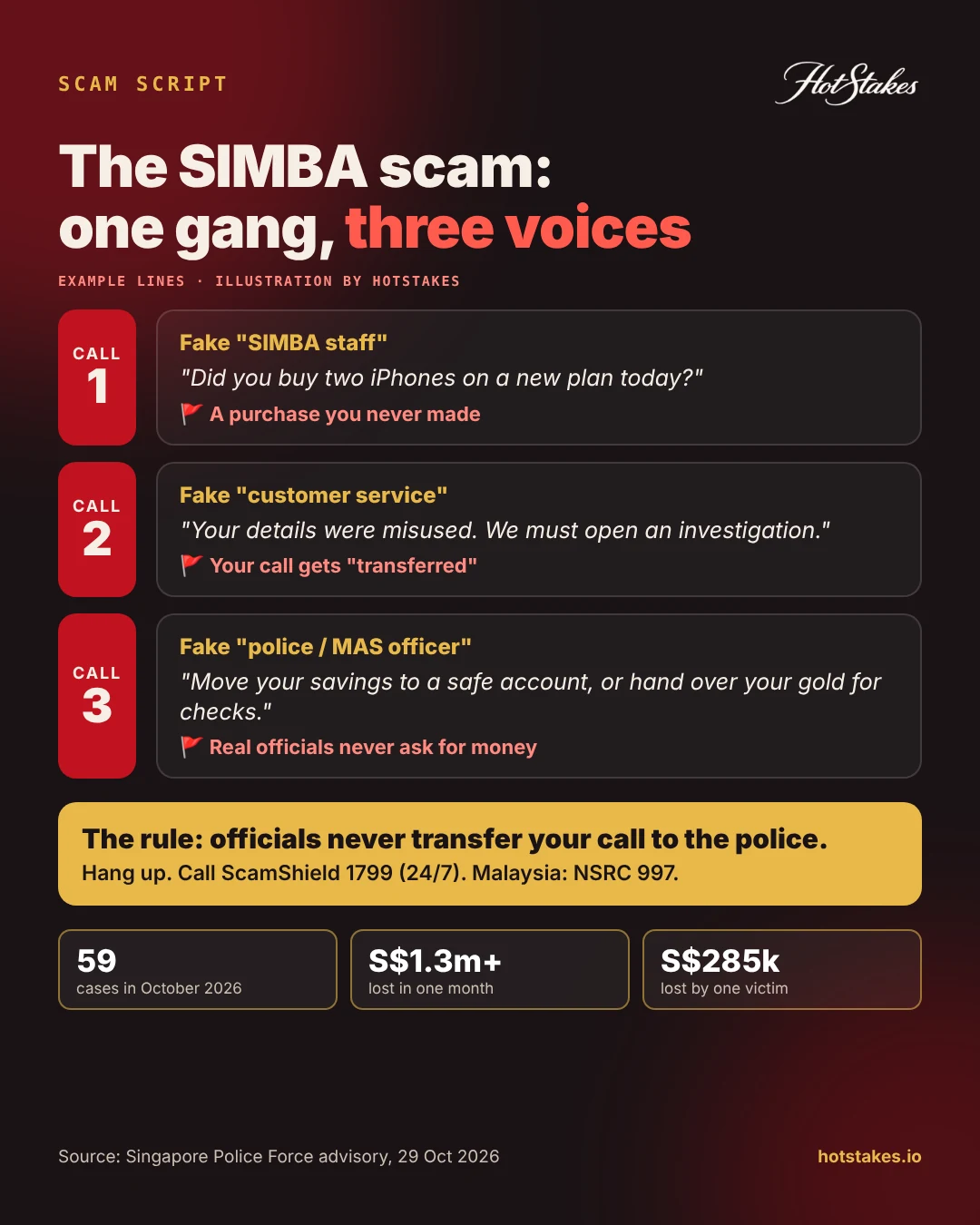
Every line marked EXAMPLE below was written by HotStakes to match the steps police described. They are short on purpose: the goal is to help you recognise the call, not to copy it.
Call 1: the fake SIMBA staff member
According to police, the caller claims you bought an iPhone or subscribed to a mobile plan or package. You didn’t, so you deny it. That denial is exactly what they want.
Red flag: an unexpected call about a purchase you never made. The “problem” is designed so that you are the one who asks for help.
Do this instead: say nothing about yourself, hang up, and check your account in the official SIMBA app or by calling the number on SIMBA’s own website. Don’t call back a number the caller gives you.
Call 2: the fake customer service officer
Police say the call is then “transferred” to someone posing as SIMBA customer service, who says your details were misused and an investigation is needed.
Red flag: a phone company telling you it will connect you to an investigation. Telcos don’t run police investigations, and they don’t hand your call to officers.
Do this instead: end the call. Nothing about a misused identity needs to be fixed on a call someone else started.
Call 3: the fake police or MAS officer
The third voice poses as a police or Monetary Authority of Singapore (MAS) officer. Victims are told to transfer money or hand over cash, gold or watches for the “investigation”. AsiaOne reported that in some past cases victims were promised the money would be returned once the “investigation” ended.
Red flag: any official who asks for money, valuables or crypto, or tells you to keep it secret from your family or bank.
Do this instead: hang up and call the ScamShield Helpline on 1799 yourself. If you need the police, call them on a number you looked up, not one they gave you.
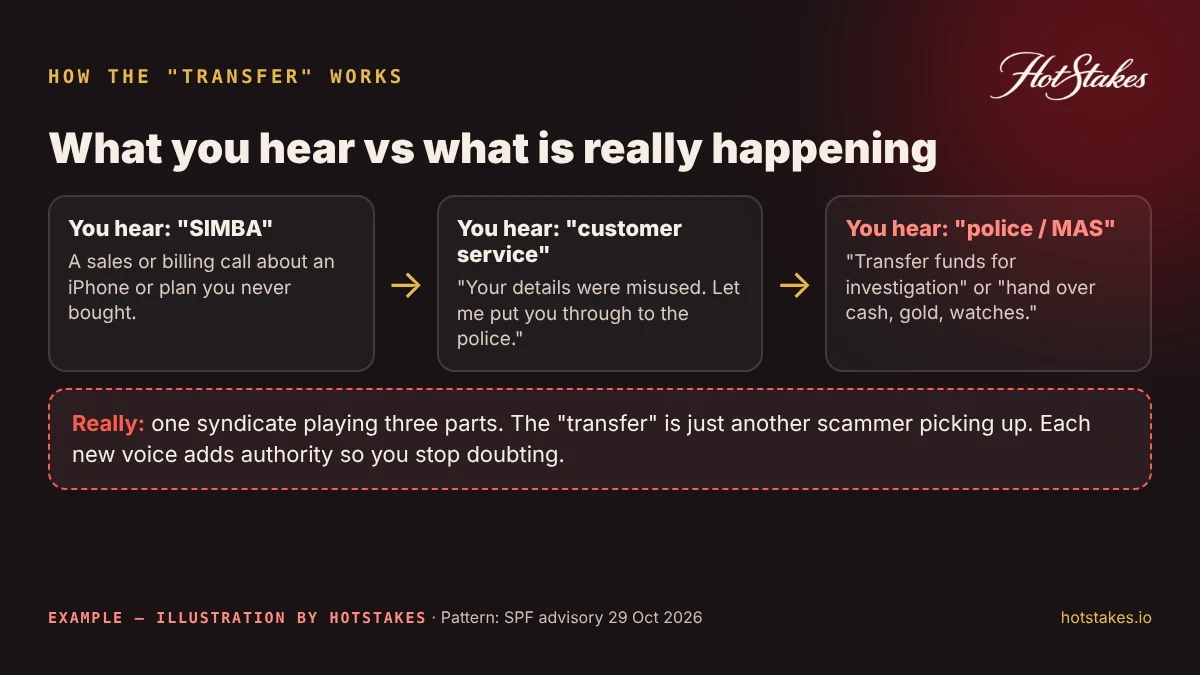
Takeaway: each transfer adds authority so you stop doubting. Counting the transfers is easier than judging each voice.
We compared 3 police advisories from 2026: same script, new costume
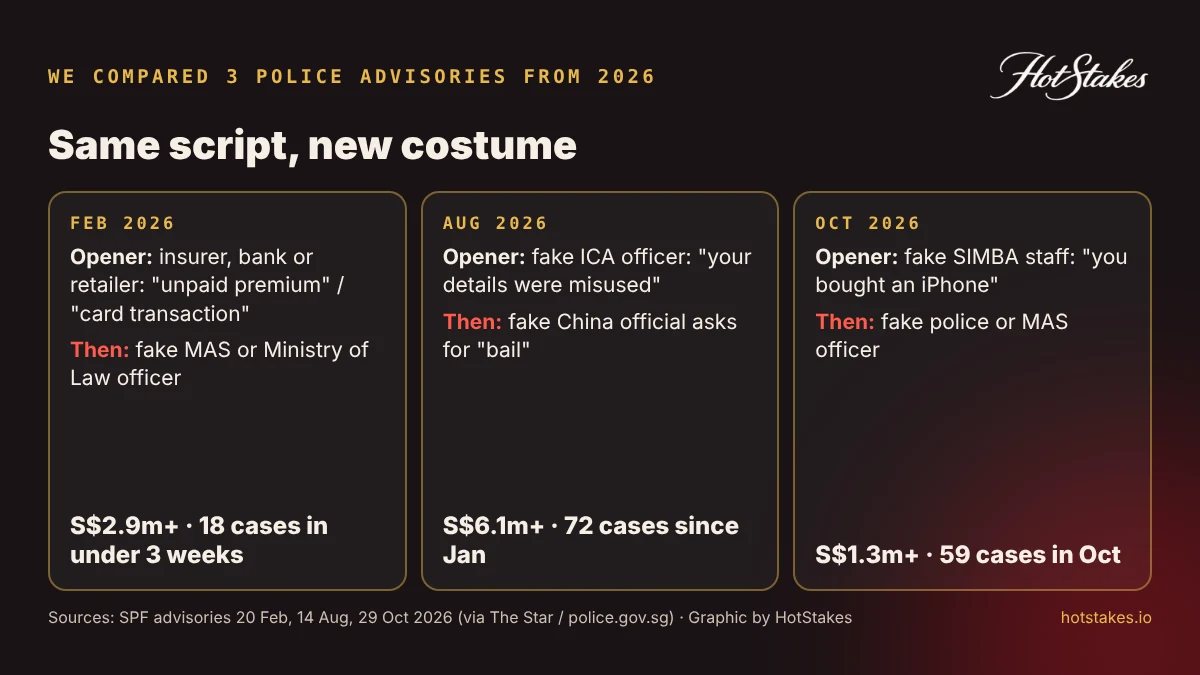
To see whether the SIMBA version is new, we read three Singapore police advisories issued this year and lined up their steps. The opener changes each time. The structure doesn’t: a believable business or agency, a claim you deny, a “transfer” to a higher authority, then a demand for money or valuables.
| Advisory | Call 1 (the opener) | Who you’re “transferred” to | Reported losses |
|---|---|---|---|
| 20 Feb 2026 | Insurer, bank or retailer: “unpaid premium” or “card transaction” | Fake MAS or Ministry of Law officer, with fake “warrants” | At least S$2.9m in valuables, 18 cases in under 3 weeks (The Star) |
| 14 Aug 2026 | Fake ICA officer: “your details were misused” | Fake China official asking for “bail” | At least S$6.1m, 72 cases since January (SPF) |
| 29 Oct 2026 | Fake SIMBA staff: “you bought an iPhone” | Fake police or MAS officer | At least S$1.3m, 59 cases in October (SPF) |
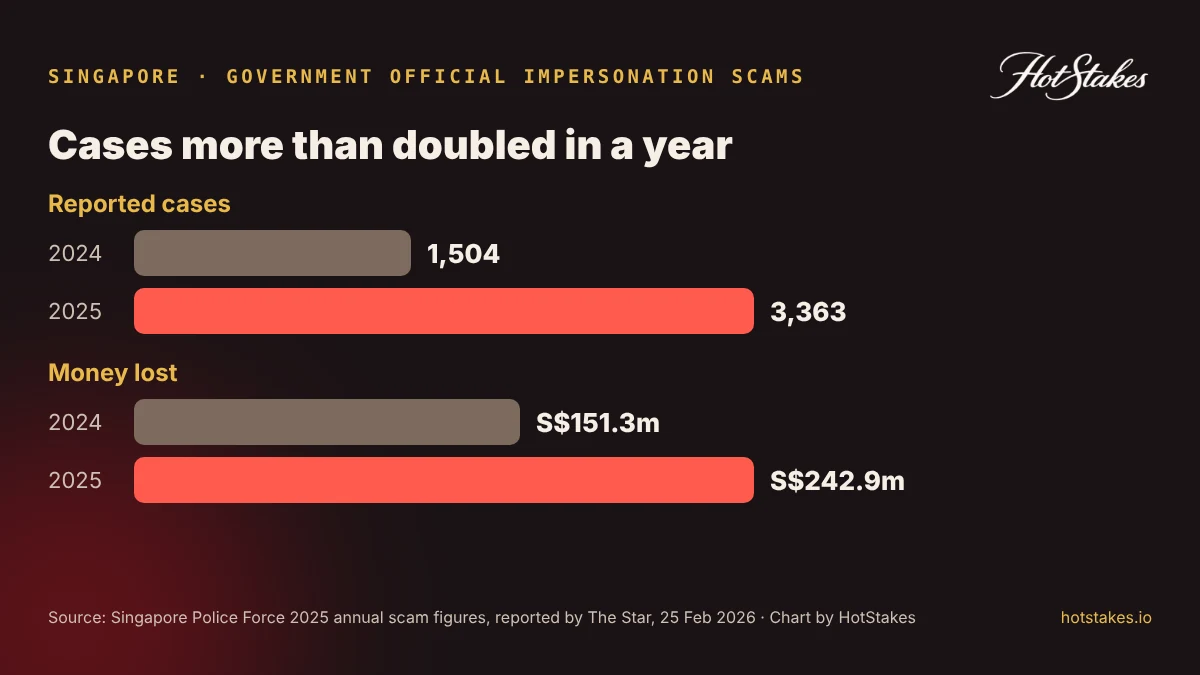
The bigger picture explains why the costumes keep changing. In 2025, Singapore recorded 3,363 government official impersonation scam cases, up from 1,504 in 2024, and losses rose from S$151.3 million to S$242.9 million, The Star reported from police figures. That happened in a year when total scam losses fell to S$913.1 million. Police also counted at least 131 cases in 2025 where victims were persuaded to buy gold bars and hand them over.
If you’re in Malaysia, you’ll recognise this pattern from the Macau scam, and in India it shows up as the “digital arrest” scam. Same idea, different uniforms.
What real officials will never do
The police advisory lists what government officials will never ask. Use it as a checklist while you’re on the phone:
- Ask you to transfer or hand over money, luxury watches, gold or cryptocurrency.
- Ask you to take a loan from a licensed moneylender.
- Ask for your banking login details.
- Ask you to install apps from unverified app stores.
- Transfer your call to the police or any other government official.
One “yes” to any of these means you are talking to a scammer. Police also told AsiaOne that, later in 2026, police calls will start using a common, recognisable prefix to make impersonation harder.
Takeaway: a real officer never needs your money to “clear your name”.
Already paid or handed something over? Do this now
- Stop paying. Ignore every new instruction, even threats of arrest.
- Call your bank immediately using the number on your card or the bank’s app, and ask them to block the transactions and your cards. If your bank has a Money Lock feature, turn it on.
- Call the ScamShield Helpline on 1799 (24/7) and report it to the police on the Police Hotline 1800-255-0000 (you can also pass information to police online through i-Witness).
- Write everything down: phone numbers, names used, account numbers you paid into, times, and where you left any valuables.
- Tell family. Scammers ask for secrecy because a second opinion breaks the spell.
- Watch for round two. Victims are often targeted next by fake “recovery” agents who charge a fee. Read our recovery scam explainer before you trust anyone who offers to get the money back.
Not sure whether a call or message was fake? Run it through our free fake support checker (7 quick questions), or report it to us with the report-a-scam form so we can warn others.
Where to report it
We checked each number on its official source on 1 November 2026:
- Singapore: ScamShield Helpline 1799, 24/7 (named in the SPF advisory). Police Hotline 1800-255-0000. Call 999 in an emergency.
- Malaysia: National Scam Response Centre 997, open 24 hours daily, for online financial scams.
For other countries, see our scam help page.
FAQ
Is SIMBA calling customers about iPhone purchases?
Police say scammers are posing as SIMBA staff and claiming victims bought iPhones or mobile plans. If you get such a call, hang up and check your account through SIMBA’s official app or the contact details on its own website.
Can a phone company transfer my call to the police?
No. Singapore Police say government officials will never transfer your call to the police or another official. A “transfer” to an officer is the clearest sign of this scam.
How did the scammers know my name or number?
Police haven’t said how the callers in these cases got victims’ details. Scammers often already know a name or ID number, so knowing your details doesn’t prove a caller is real.
The caller said I’d be arrested if I hung up. What should I do?
Hang up anyway. Real police don’t arrest people for ending a call, and they never ask for money to clear a case. Then call 1799 to check.
Is this the same as the Macau scam?
It uses the same structure: a believable opener, then a fake official who demands money. Our Macau scam guide shows the Malaysian version, and our 2-minute scam quiz trains you to spot both.
HotStakes is an independent directory. Some links on this site are affiliate links; we may earn a commission at no cost to you, and it never changes our rankings. Gambling involves risk — only play with money you can afford to lose, and if it stops being fun, seek help. This article is general information, not legal advice. Read our full disclaimer.
 Next story →Do Lucky 4D Numbers Win More? We Checked 61 Numbers

Start the discussion