

Scratch and Win Scam: The Script Behind the Fake Prize
Penang police busted a US$2m 'scratch and win' ring. Here is the script: live stream, fake win, fee ladder, and the one reply that stops it.
In this article
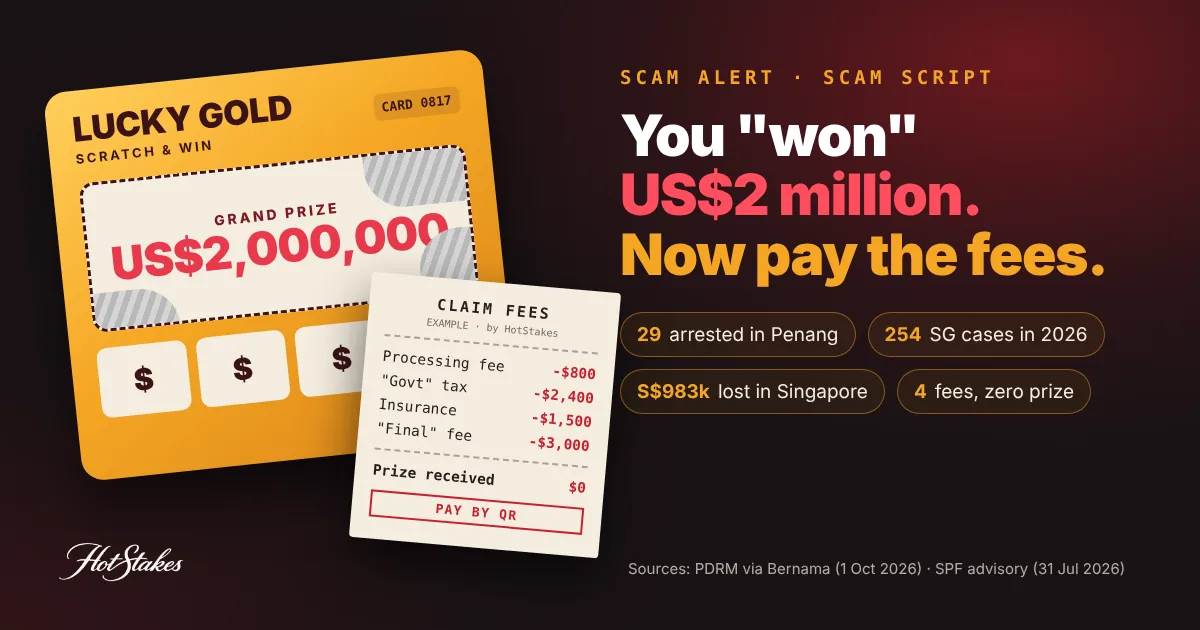
Someone in the family scratched a card on a Facebook live stream and “won” US$2 million. Now a friendly agent says there is just a small processing fee, then a tax, then insurance. A real prize never costs you money to collect: the moment a “win” comes with a fee, a tax or insurance you must pay first, it is a scratch and win scam. Below is the script these syndicates follow, stage by stage, with example messages, the red flag in each, and what to reply instead.
What police found in Penang
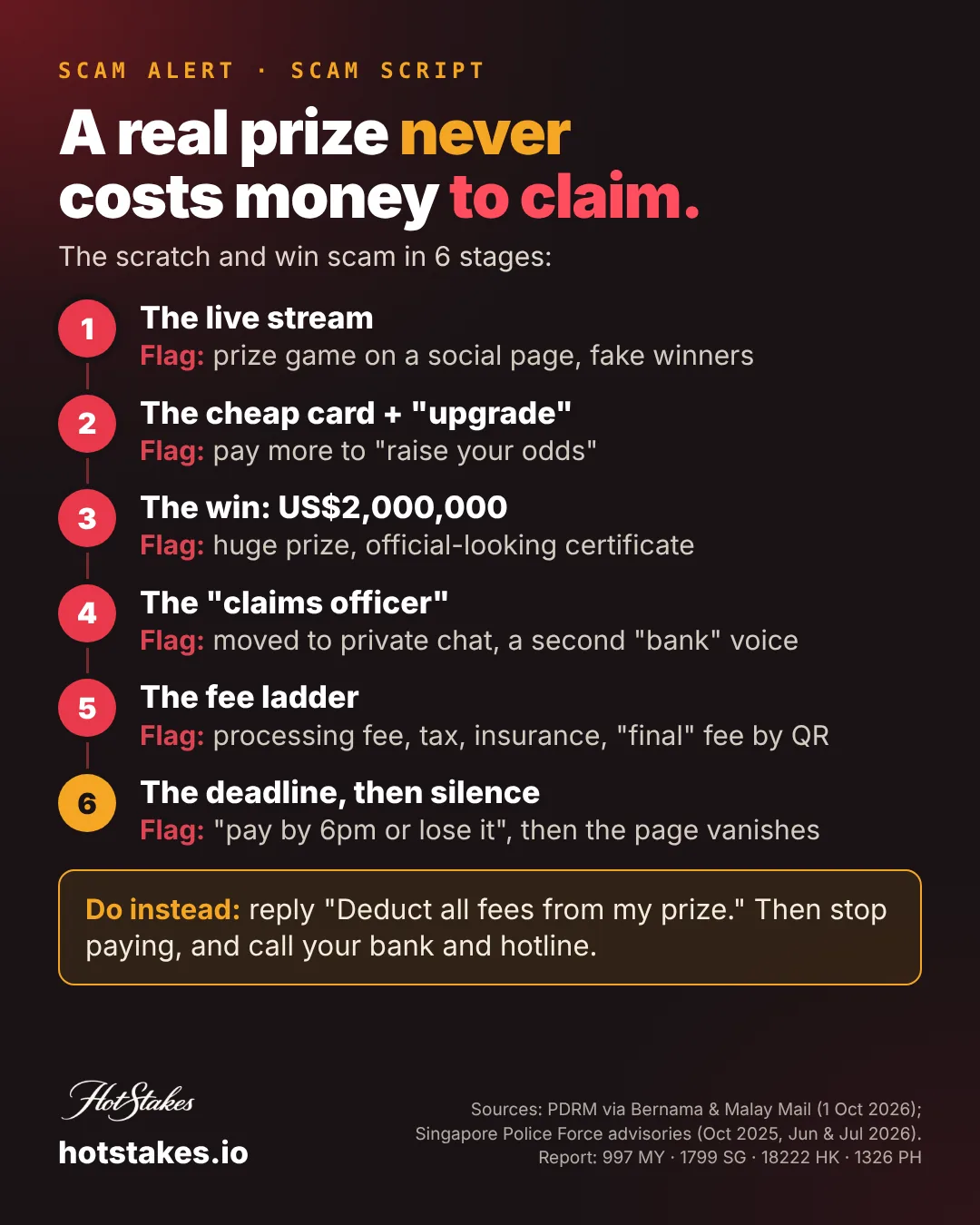
Penang police chief Datuk Dennis Lim Kwang Keng announced the case on 1 October 2026. According to Bernama and Malay Mail, the state Commercial Crime Investigation Department raided three bungalows in the Barat Daya district on 22 September.
- Where: two houses in Teluk Kumbar and one in Solok Bukit Belah, Bayan Baru, used as call centres.
- Who: 29 foreigners, 19 Chinese and 10 Cambodian nationals, aged 20 to 63. All were remanded until 13 October.
- How: the syndicate allegedly used Facebook Live and the LINE app to reach victims in China and Cambodia, offering prizes of up to US$2 million.
- The catch: victims were told to pay processing fees, taxes and insurance via QR code, and never received a prize. Police said the QR codes appeared to be registered in Cambodia.
- Seized: more than 200 phones (The Star counted 251), 17 laptops, customer records, scratch cards, suspected fake documents and studio equipment.
- Laws: investigated under Section 420 (cheating) read with Section 120B (criminal conspiracy) of the Penal Code, plus the Immigration Act 1959/63.
A follow-up report in The Star adds a detail worth remembering. The cards came with certificates and licences claiming links to major Las Vegas casinos. Buyers checked their “win” by watching live videos.
These are allegations under investigation. No one has been convicted. The setting, a rented house full of phones and a studio, matches the industrial model we describe in our explainer on Southeast Asia scam compounds.
Takeaway: This was not one con artist. Police describe a studio, a script and a payment pipeline, run like a business.
The scratch and win scam script, stage by stage
We built the examples below from what police and anti-scam centres say victims were told. They are short, invented illustrations so you can recognise the pattern. They are not real messages.
Stage 1: The live stream and the “lucky viewer”
“Big Prize Night is LIVE! 50 lucky viewers tonight. Comment ‘IN’ to get your card!”
(comments) “I won RM5,000!!” “Paid out, thank you boss!”
Red flag: a prize game run from a social media page, with “winners” cheering in the comments. Singapore police say these streams often run under Chinese-language usernames and are linked to so-called “China lottery” draws (SPF, 31 July 2026). ScamShield adds that they can look professional.
Do instead: leave the stream. A real lottery is run by a licensed operator, not a Facebook page.
Stage 2: The cheap card and the “upgrade”
“Card is only RM20. Gold card = 10x prize. Pay later also can!”
Red flag: you pay to “upgrade your odds”. Singapore police found scammers asking buyers for more money to raise odds or prize size, even offering deferred payment (SPF, 18 October 2025).
Do instead: do not buy. The small first payment is a test of whether you will pay again.
Stage 3: The win
“CONGRATULATIONS! Card No. 0817 = GRAND PRIZE US$2,000,000. Certificate attached.”
Red flag: a life-changing prize from a game you barely entered, with an official-looking certificate. In Penang, the cards allegedly came with licences claiming casino links.
Do instead: treat the certificate as decoration. Anyone can print one.
Stage 4: The claim agent
“Hello, I am Claims Officer Jenny. Please add me on chat app to process your prize. Keep this confidential until payout.”
Red flag: you are moved to a private chat with a new “officer”. Sometimes a second actor appears. Singapore police describe scammers posing as a bank, saying the winnings are stuck and need an “activation fee” (SPF). In a Kuantan case, a second caller claimed to be a Hong Kong bank officer (NST, 2022).
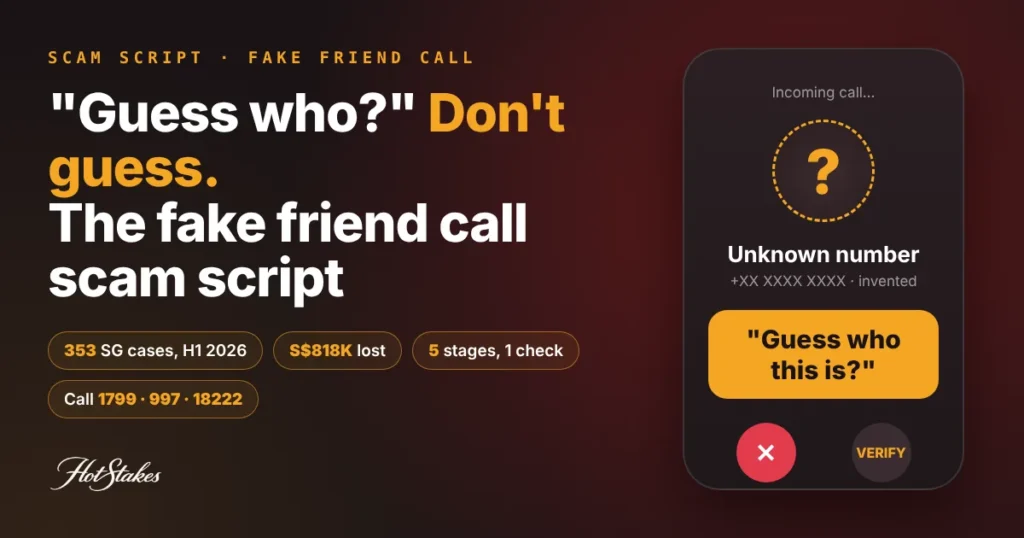
Do instead: call your own bank on the number printed on your card. Never use a number the “agent” gives you. The same trick of a new identity in a new chat runs through our fake friend call scam script.
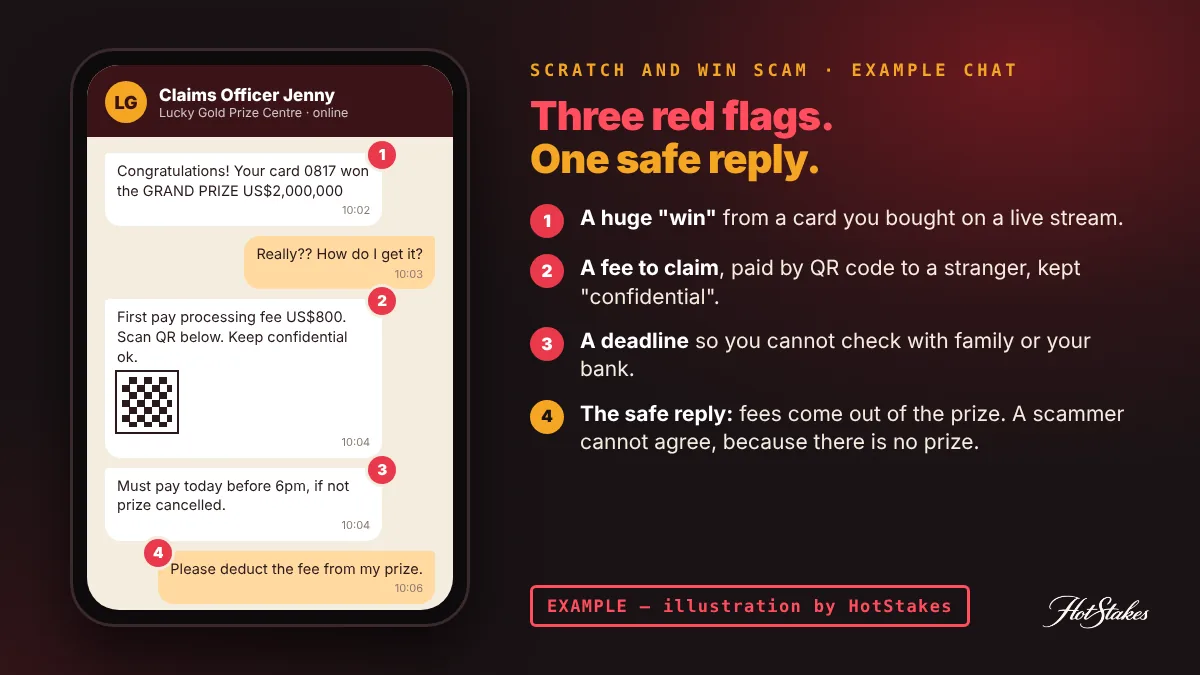
Stage 5: The fee ladder
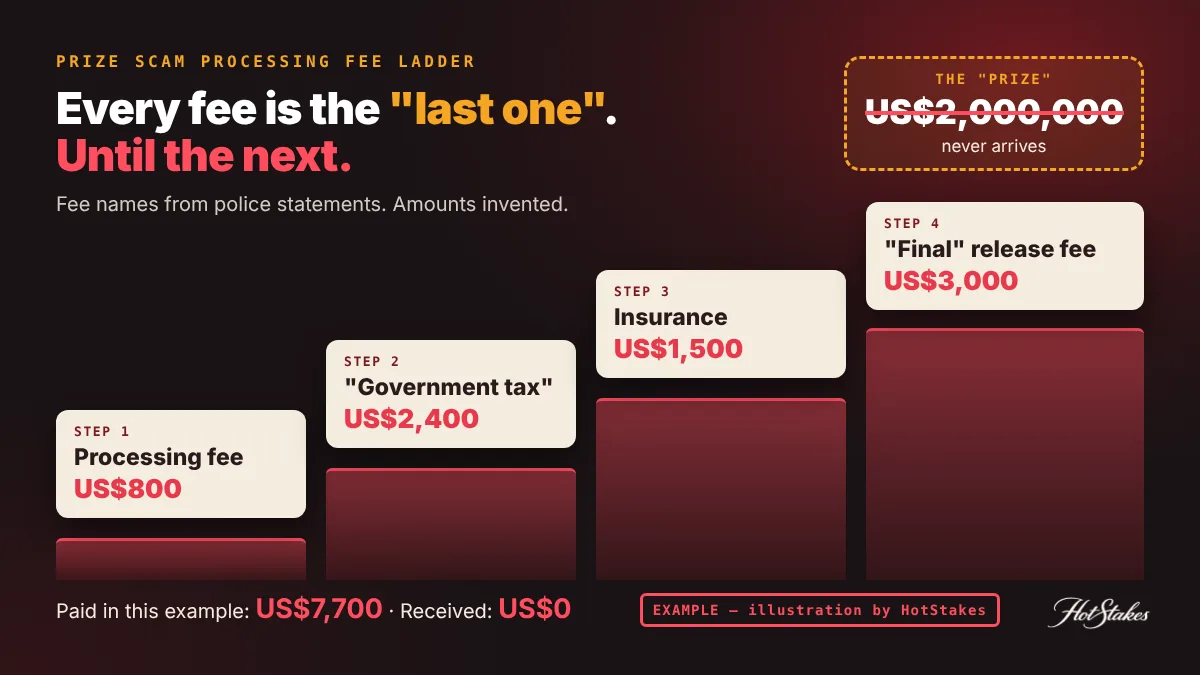
“Step 1: processing fee. Scan QR.”
“Step 2: government tax 5% before release.”
“Step 3: insurance for international transfer. This is the FINAL fee.”
Red flag: every payment “releases” the next one. Penang police say victims were asked for processing fees, taxes and insurance. Singapore’s ScamShield puts it plainly: “Legitimate lucky draws and lotteries will never ask you to pay fees” (ScamShield). A real tax would be deducted from the prize or paid to a tax authority, not sent to a stranger’s QR code.
Do instead: reply with one line: “Deduct all fees from my prize and send the balance.” A scammer cannot do that, because there is no prize. Then stop replying.
Stage 6: The deadline, then silence
“If fee not paid by 6pm, prize goes back to the company. Don’t waste your luck!”
Red flag: a countdown so you cannot ask anyone. Malaysia’s trade ministry lists “high-pressure sales” that deny victims time to check (The Vibes, 9 May 2026). When the money stops, the page disappears or the agent goes silent, Singapore police say.
Do instead: take the pressure as your answer. Then expect a “we can get your money back” offer next: that is a recovery scam.
Takeaway: The script has one turning point: the first fee. Everything before it is set-up. Everything after it is extraction.
Why the fees feel reasonable: the maths
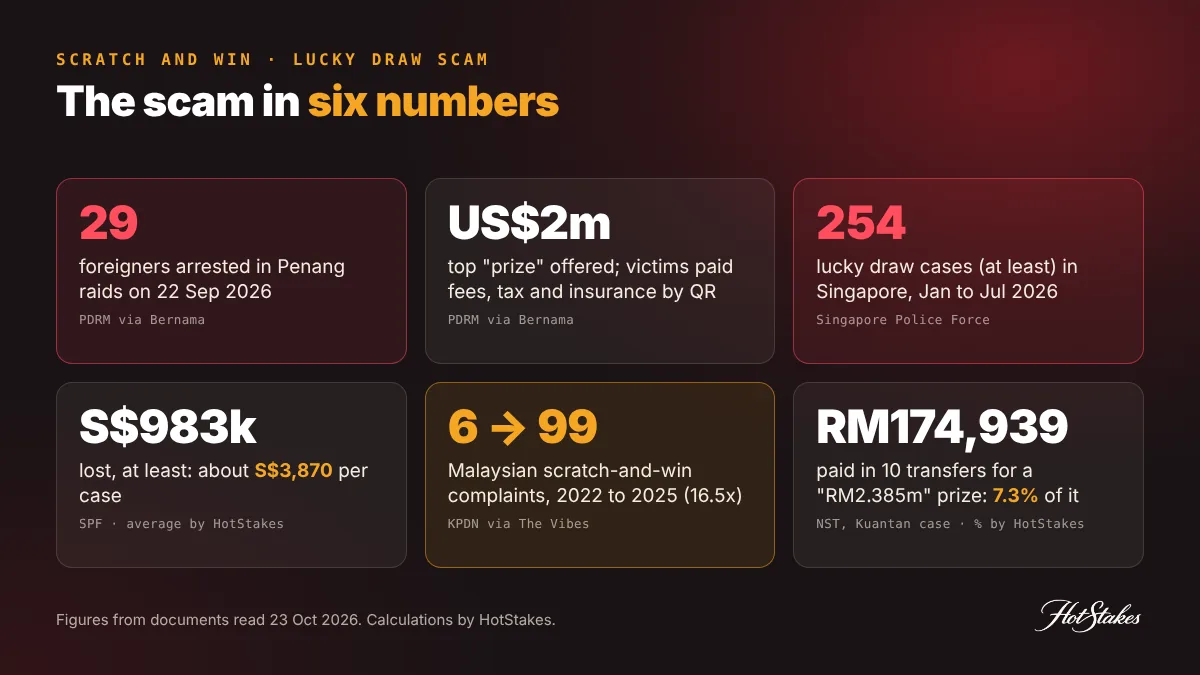
Nobody pays US$2 million to get US$2 million. Victims pay because each fee looks tiny next to the prize. We ran the numbers on figures from documents we read on 23 October 2026:
- Kuantan, Malaysia: a victim told he had won a lucky draw worth about RM2.385 million paid RM174,939 in 10 transfers to five bank accounts (NST). That is about 7.3% of the “prize”, or roughly RM17,500 per transfer. Each step looked like a small slice.
- Singapore, January to July 2026: at least 254 lucky draw cases and at least S$983,000 lost (SPF). That averages about S$3,870 per case.
- Malaysia, complaints: the trade ministry recorded 6 scratch-and-win complaints in 2022 and 99 in 2025, a 16.5-fold rise, plus 30 cases in the first three months of 2026 (The Vibes).
Takeaway: The prize is the anchor. A 1% “fee” on a fake US$2 million is still US$20,000 of real money.
Same trick, wider net
The Penang syndicate allegedly targeted China and Cambodia. The pattern itself reaches everyone.
- Singapore: police warned in June 2026 of at least 33 Facebook Live scratch-card cases since 20 May, with payments made by PayNow QR code (SPF). By July, scammers were also impersonating a Malaysian influencer running a “quiz”.
- Malaysia: the trade ministry warns of “100th customer” and scratch-and-win tickets handed out in public places, and says older people are especially exposed.
- By post: Western Australia’s ScamNet describes scratch cards mailed from Malaysia where “both cards” win, followed by a tax demand (ScamNet).
Takeaway: The channel changes: a stall, an envelope, a live stream. The fee demand does not.
Prize-fee scam vs withdrawal-fee scam
Both are “pay to receive” frauds, a type of advance-fee scam. The difference is how you got to the money that does not exist.
| Scratch and win / lucky draw scam | Withdrawal fee scam | |
|---|---|---|
| Where the “money” comes from | A prize you supposedly won | A balance you built on a fake platform |
| How long the set-up takes | Minutes to days | Weeks or months of grooming |
| Typical opener | Live stream, flyer, mailed card, “you won” message | Romance, “mentor”, investment or betting app |
| Names of the fees | Processing fee, tax, insurance, activation | Withdrawal fee, tax, verification, “unfreeze” deposit |
| Your own money already in | Usually small (card price) | Often large (deposits) |
| The rule that stops it | Any fee must be deducted from the payout, never paid in first | |
The longer version, where the “balance” is built through a fake friendship, is covered in our pig butchering scam guide. Short definitions sit in our glossary.
Takeaway: Different bait, same hook. Money that only moves after you pay is not your money.
How to warn a parent
Older relatives are the target the trade ministry worries about most. A lecture rarely works. A rule does.
- Give one rule: “If a prize asks for money, it is not a prize.”
- Agree a pause: any request to pay a stranger waits until they have called you.
- Show them this page’s example messages, so the script feels familiar when it arrives.
- Turn on bank limits: Singapore police suggest transaction limits and a Money Lock on savings; ask your bank what it offers.
- Try our scam quiz together. It takes a few minutes.
One more warning: never let anyone “borrow” your account to receive a prize transfer. That is how people become money mules.
Takeaway: Agree the rule before the call comes, not during it.
How to report it
Stop paying first. Then call, fast: Malaysia’s NSRC asks victims to call within 24 hours so banks can try to freeze transfers. We confirmed each number below on an official source on 23 October 2026.
| Country | Who to call | Official source |
|---|---|---|
| Malaysia | National Scam Response Centre 997 (24 hours), then your bank and a police report | malaysia.gov.my |
| Singapore | ScamShield Helpline 1799 (24/7); police 999 for urgent help | police.gov.sg |
| Hong Kong | ADCC Anti-Scam Helpline 18222 (24 hours) | adcc.gov.hk |
| Philippines | CICC Inter-Agency Response Center hotline 1326 (24/7) | Philippine News Agency |
Keep the evidence: screenshots of the stream, the chat, the QR codes and every receipt. The Malaysian trade ministry asks complainants to keep “receipts, advertisements and all related communications”.
Takeaway: Speed beats shame. The sooner the bank hears, the better the chance of freezing the money.
FAQ
What is a scratch and win scam?
It is a fake prize game. You scratch a card, often bought during a social media live stream or handed out in public, and “win” a large prize. Then you are told to pay fees, taxes or insurance before you can collect. The prize does not exist.
Do real lucky draws charge a processing fee?
No. Singapore’s ScamShield says legitimate lucky draws and lotteries never ask you to pay fees to claim winnings. Any genuine tax or charge would be deducted from the prize, not paid by you first.
Is a lucky draw scam the same as a withdrawal fee scam?
They use the same “pay to receive” trick. A lucky draw scam invents a prize; a withdrawal fee scam invents a balance on a fake investment or betting platform, usually after weeks of grooming.
What happened in the Penang scratch and win case?
Police raided three bungalows in Teluk Kumbar and Bayan Baru on 22 September 2026 and arrested 29 foreigners. They allegedly used Facebook Live and LINE to offer prizes up to US$2 million to victims in China and Cambodia, then demanded fees by QR code.
I already paid a fee. What now?
Stop paying, even if told it is the final fee. Call your bank and your national hotline at once: 997 in Malaysia, 1799 in Singapore, 18222 in Hong Kong, 1326 in the Philippines. Keep every screenshot and receipt.
HotStakes is an independent directory. Some links on this site are affiliate links; we may earn a commission at no cost to you, and it never changes our rankings. Gambling involves risk — only play with money you can afford to lose, and if it stops being fun, seek help. This article is general information, not legal advice. Read our full disclaimer.
 Next story →How to Complain About an Online Casino That Won’t Pay

Start the discussion