

Binance Refund Scam: 5 Fake Messages to Ignore
Binance says it covers hack losses itself, so no refund needs your seed phrase, 2FA code or a fee. 5 fake messages to spot, and what to do next.
In this article
Last updated: 31 October 2026, 08:00 MYT.
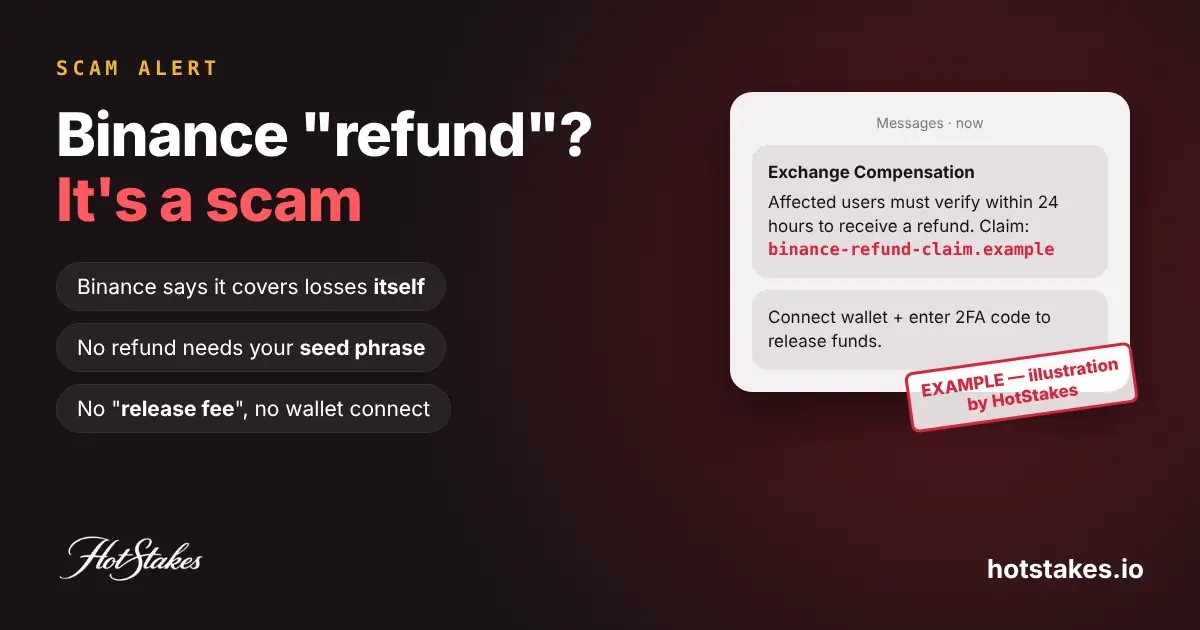
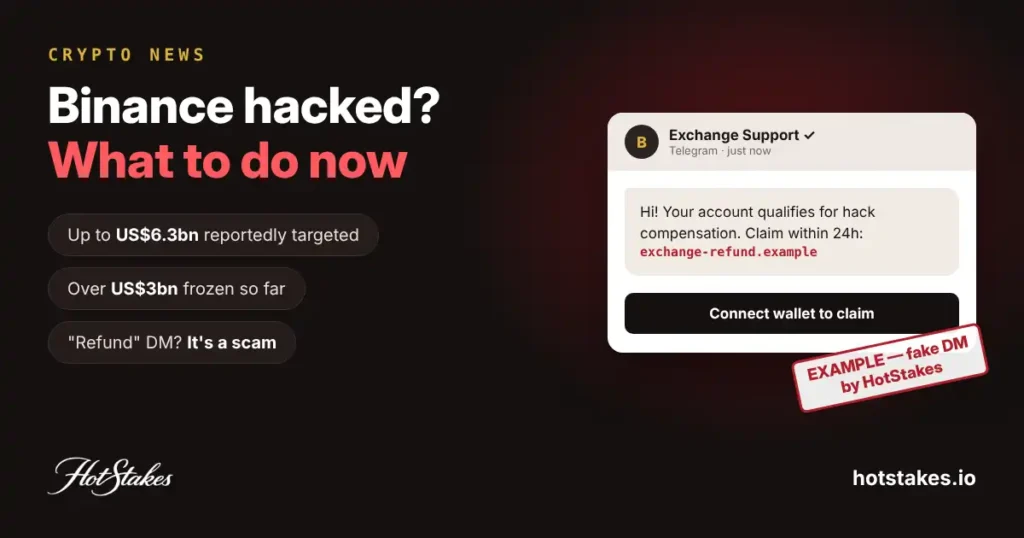
After the 29 October Binance hack, fake “refund” and “compensation” messages are the next wave to expect. Binance has said it will cover all losses from the hack, estimated at US$6.3 billion, and that withdrawals should resume by Sunday, according to Yahoo Finance. Binance says it is paying for the losses itself, so no real refund will ever need your seed phrase, your 2FA code, a “release fee” or a wallet connection. A message asking for any of those is the Binance refund scam. Below: five fake messages and what to do if you clicked.
Cyndia’s take: A hack this big hands scammers a perfect setup: millions of worried people, all waiting for news at the same moment. The real fix is happening inside Binance, not in your inbox or your DMs. If you do one thing today, open the Binance app yourself to read updates there, and treat every message that reaches you first as fake until proven otherwise.
What Binance has actually said, and why scammers love it
Here is what had been reported by the morning of 31 October 2026:
- Binance announced the security incident on Thursday, 29 October, and estimated the impact at about US$6.3 billion.
- Binance said it would cover all losses. It paused withdrawals, and co-CEO Yi He said they should resume by Sunday, 1 November, Yahoo Finance reported.
- Binance hasn’t confirmed who carried out the attack. Our full Binance hack explainer covers the timeline, the frozen funds and what analysts suspect.
Security people saw the next step coming. Tomas Sinicki of Nord Security told Yahoo Finance that “incidents like this are prime time for follow-up scams”. He warned about fake “exchange support” messages and phishing emails that promise to help recover funds.
The reason is simple. Every headline says “refund”, “compensation” and “withdrawals paused”, and scammers reuse those exact words. None of the reports we read for this article mention a claim form that users have to fill in. If Binance ever launches one, you’ll find it in the app’s own announcements, not in a text message.
Takeaway: Binance is covering the losses itself. You don’t need to “claim”, “verify” or “unfreeze” anything through a link someone sent you.
The 5 fake messages to ignore
Every example below is an EXAMPLE written by HotStakes, with invented names and domains. The goal is recognition only: if you’ve seen the shape of a message once, it’s easier to spot the next time.
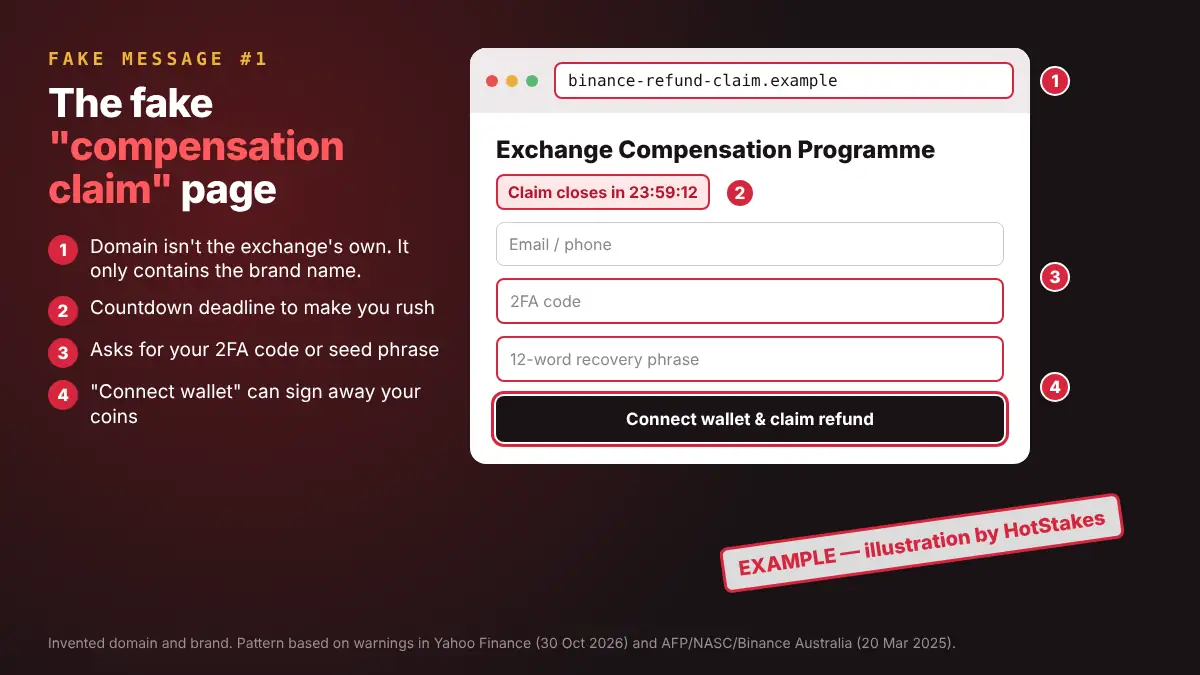
1. The “compensation claim” link
Red flag: a deadline, a domain that isn’t binance.com, and a “claim” Binance never announced. On the page behind the link you’re asked to log in or “connect wallet”. A login page steals your password and 2FA code. A wallet connection asks you to sign an approval that can let someone drain the wallet.
Do this instead: close the message. Type the address yourself or open the app you already have. Our 10-second fake login page check works for exchange logins too.
2. The “Binance Support” DM
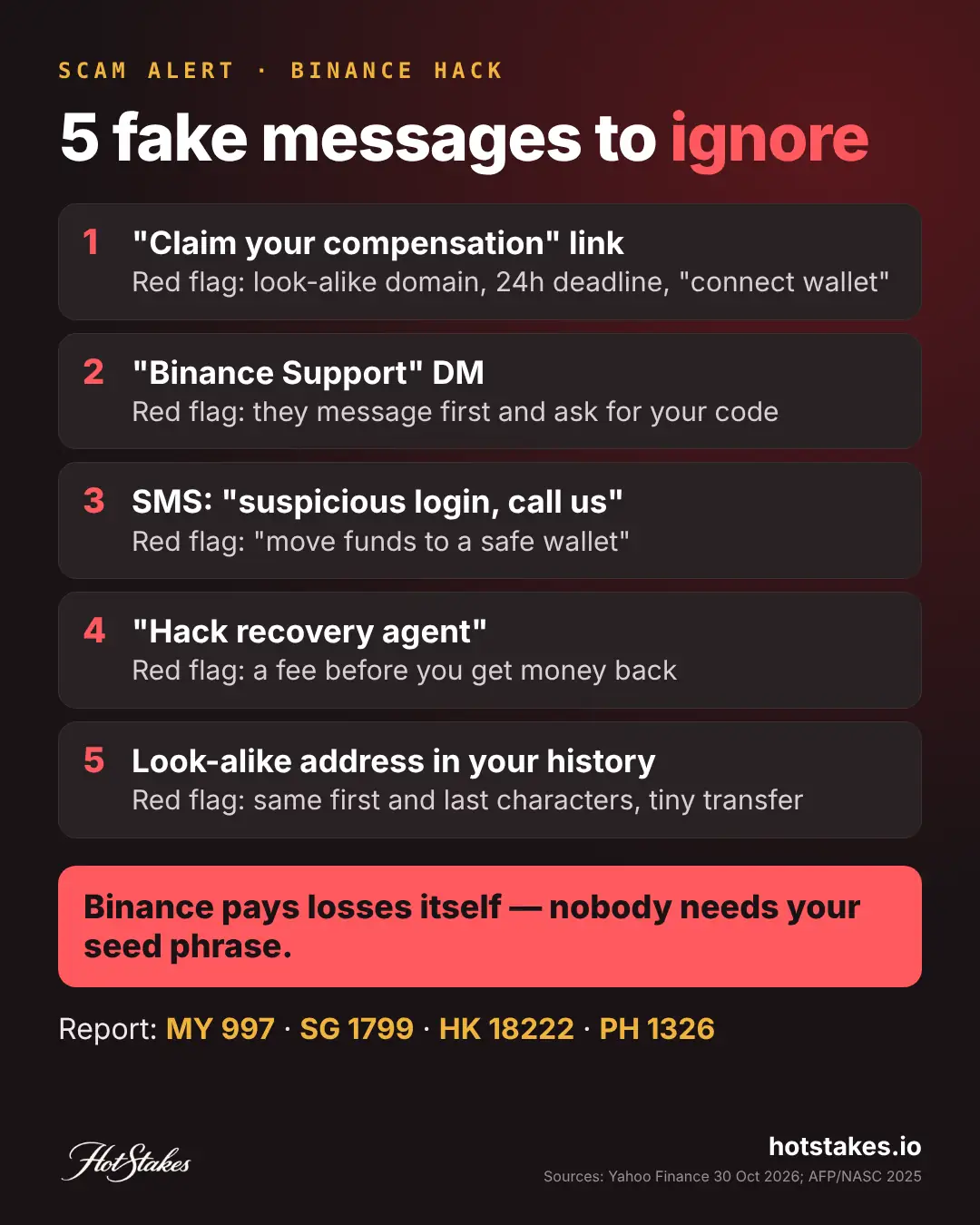
Red flag: support contacts you first, on Telegram, WhatsApp or X, and asks for a code. A 2FA or SMS code is the key to your account. Anyone who asks you to read one out is trying to log in as you.
Do this instead: don’t reply. Binance offers a tool called Binance Verify for checking whether a handle, phone number or email is official. Look the sender up there, then block and report them. Real help starts when you open the support chat inside the app.
3. The spoofed SMS: “suspicious login, call us”
This one has already happened. In March 2025, the Australian Federal Police, the National Anti-Scam Centre and Binance Australia warned about texts from fake Binance staff claiming accounts had been breached. The messages were often spoofed, so they showed up inside people’s genuine Binance SMS thread. Victims who called the number were told to move their crypto to a “trust wallet” for protection, and that wallet belonged to the scammer. The National Anti-Scam Centre said it contacted more than 130 potential victims.
Red flag: a phone number to call, then an instruction to move your coins to a “safe”, “protected” or “partner” wallet. Binance’s Chief Security Officer Jimmy Su said in that release: “Never share sensitive information like your seed phrase or transfer funds under pressure.”
Do this instead: don’t call any number from a text. Check your login history inside the app yourself. A message showing up in the “real” thread proves nothing.
4. The “hack recovery agent”
Red flag: an upfront fee to get your money back. Binance says it is covering the losses, so a stranger can’t “release” anything for a price. This is the classic recovery scam, and it often comes back for a second and third fee, much like the pay-to-withdraw script.
Do this instead: never pay anyone to recover crypto. If you lost money to a scammer, report it to Binance and your national scam hotline (see below), both of which are free.
5. Address poisoning when withdrawals reopen
Red flag: the look-alike address is there so you’ll copy it from your history when you finally withdraw. Withdrawals reopening is exactly when people hurry and paste the wrong address.
Do this instead: copy the address from the original source, compare the whole thing (not just the first and last few characters), and use a withdrawal whitelist. Run it through our USDT address checker and see the USDT safety checklist for more.
Takeaway: all five messages want the same four things: your login, your code, your seed phrase or your coins. Binance’s fix doesn’t need any of them from you.
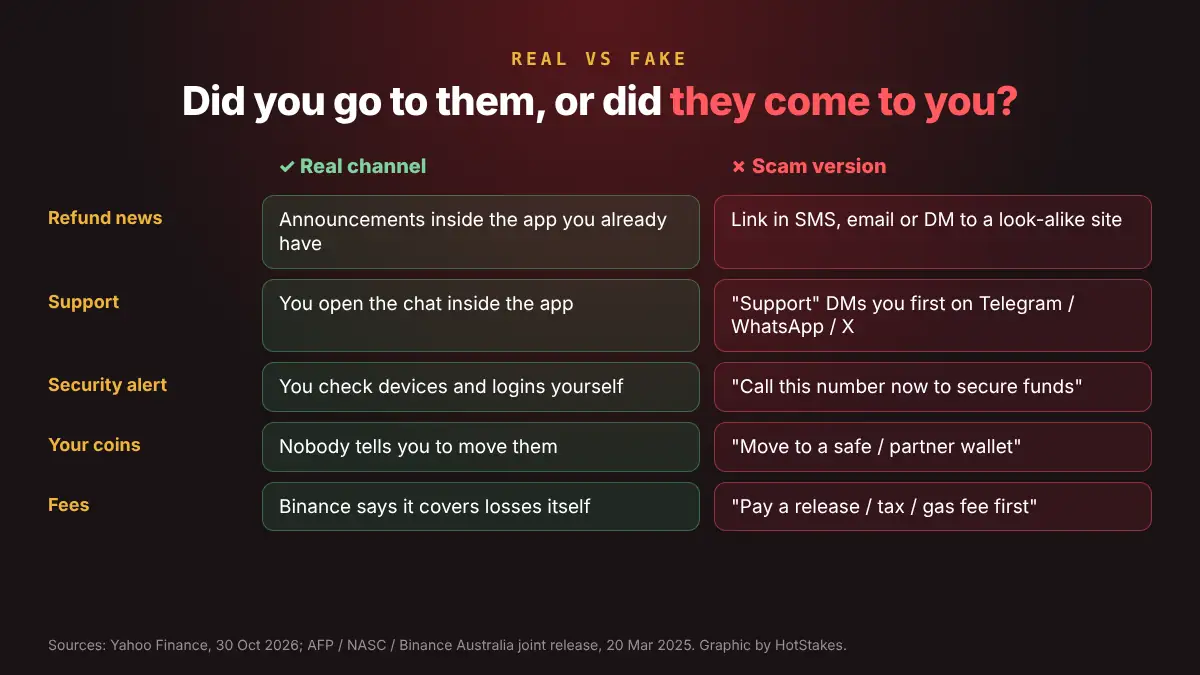
Real Binance channel vs the scam version
| Situation | What the real channel looks like | What the scam version looks like |
|---|---|---|
| Refund or compensation news | Announcements inside the app, or on binance.com when you type it yourself | A link in an SMS, email or DM to a look-alike domain |
| Support contact | You open the chat inside the app | “Support” messages you first on Telegram, WhatsApp or X |
| Security alert | You check devices and login history in the app yourself | A text telling you to call a phone number |
| Moving funds | No one tells you to move coins to a wallet they provide | “Move to a safe or partner wallet now” |
| Fees | Binance says it is covering the losses | “Pay a release, tax or gas fee first” |
| Checking who’s who | Binance Verify, where you look up the contact yourself | A staff ID photo, a badge or “trust me” |
Already clicked or sent? The next 60 minutes
Speed matters most here. Here’s the order we’d follow:
- Stop. Don’t reply, don’t call back and don’t pay any further “fee”.
- Secure the account. In the official Binance app (not a link), change your password, reset 2FA, remove unknown devices and delete any API keys you didn’t create.
- Seed phrase typed somewhere? Treat that self-custody wallet as burned. Create a new wallet yourself and move what’s left into it.
- Connected a wallet and signed something? Revoke token approvals using your wallet’s own settings or a well-known block explorer’s approval checker.
- Report it to Binance through the support chat in the app. Include the scam address, transaction IDs and screenshots.
- Call your scam hotline (list below) and make a police report. If you also paid from a bank account, call your bank too.
- Watch for round two. Victims often get contacted by fake “recovery” services next. That’s message number 4 above.
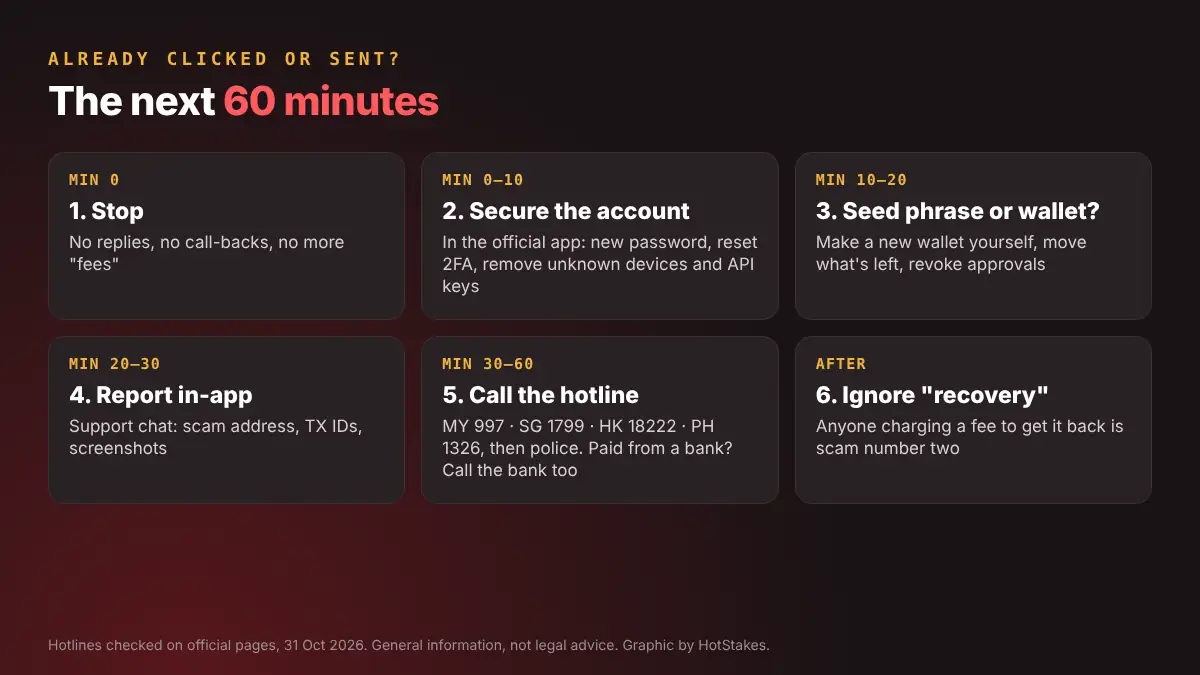
Takeaway: secure the account first, report it second, and ignore anyone who promises to get the money back for a fee.
Where to report it: Malaysia, Singapore, Hong Kong, the Philippines
We checked each of these numbers on its official or government source on 31 October 2026:
- Malaysia: National Scam Response Centre, 997, 24 hours.
- Singapore: ScamShield Helpline 1799, 24 hours. Call 999 for urgent police help.
- Hong Kong: Police Anti-Deception Coordination Centre, Anti-Scam Helpline 18222, 24 hours.
- Philippines: CICC’s Inter-Agency Response Center, hotline 1326, 24/7.
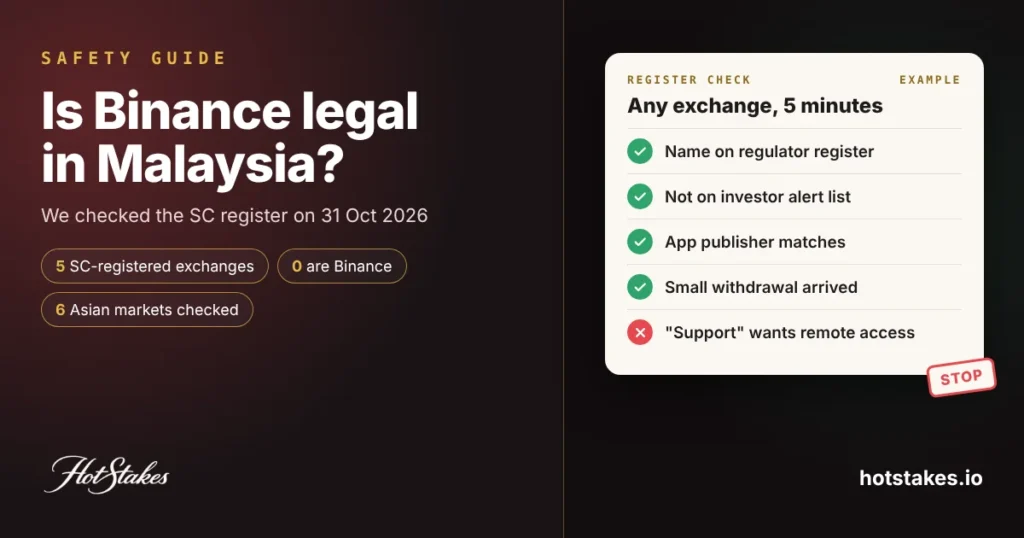
There’s also a Malaysia-specific catch. Binance isn’t a registered exchange here. On 31 October 2026 we checked the Securities Commission’s list of registered digital asset exchanges (dated 20 July 2026). It names five operators: HATA Digital, Luno Malaysia, MX Global, SINEGY DAX and Kinetic DAX. Binance isn’t on it. In 2021 the SC publicly reprimanded Binance for operating in Malaysia without registration.
For you, that means there’s no Malaysian market regulator to escalate a complaint about Binance itself to. You’d be relying on Binance’s own support. A scam is different: it’s still a crime wherever the exchange is based, so 997 and the police remain your first call. For more on who to contact, see our scam help page.
Takeaway: save your country’s hotline number now, before you need it.
FAQ
Is Binance giving refunds after the hack?
Binance has said it will cover all losses from the hack itself. None of the reports we read mention a claim form that users have to submit. Any real update will appear in the Binance app’s announcements.
Do I need to do anything to get compensated?
Nothing that has been reported so far. A message asking you to log in, connect a wallet, share a code or pay a fee in order to “get compensated” is a scam.
The text appeared in my real Binance SMS thread. Can it still be fake?
Yes. Australian police warned in 2025 that spoofed texts can land in a genuine Binance thread. Where a message shows up proves nothing. What it asks you to do is what gives it away.
Someone says they can recover my crypto for a fee. Should I pay?
No. That’s a recovery scam. Report what you lost to Binance and your national scam hotline instead. If you’re unsure about a message, our 2-minute scam quiz walks you through the warning signs.
Is Binance regulated in Malaysia?
No. When we checked on 31 October 2026, Binance wasn’t on the Securities Commission’s list of registered digital asset exchanges. This is general information, not legal advice.
HotStakes is an independent directory. Some links on this site are affiliate links; we may earn a commission at no cost to you, and it never changes our rankings. Gambling involves risk — only play with money you can afford to lose, and if it stops being fun, seek help. This article is general information, not legal advice. Read our full disclaimer.
 Next story →PG Soft New Slots: Thunder Reckoning & Grimms’ Bounty
Start the discussion