

Gambling Relapse: What to Do in the First 24 Hours
Gambled again after quitting? One slip isn't a relapse. What research says about lapses, the shame spiral, and a 24-hour and 7-day plan.
In this article
- Lapse vs relapse: what just happened
- How common are slips? What the research says
- The “I’ve blown it anyway” trap
- Why chasing the slip is the most expensive move
- The first 24 hours: a step-by-step plan
- The next 7 days
- If you’re the family: how to respond to a slip
- Free, confidential help (verified 9 Nov 2026)
- FAQ
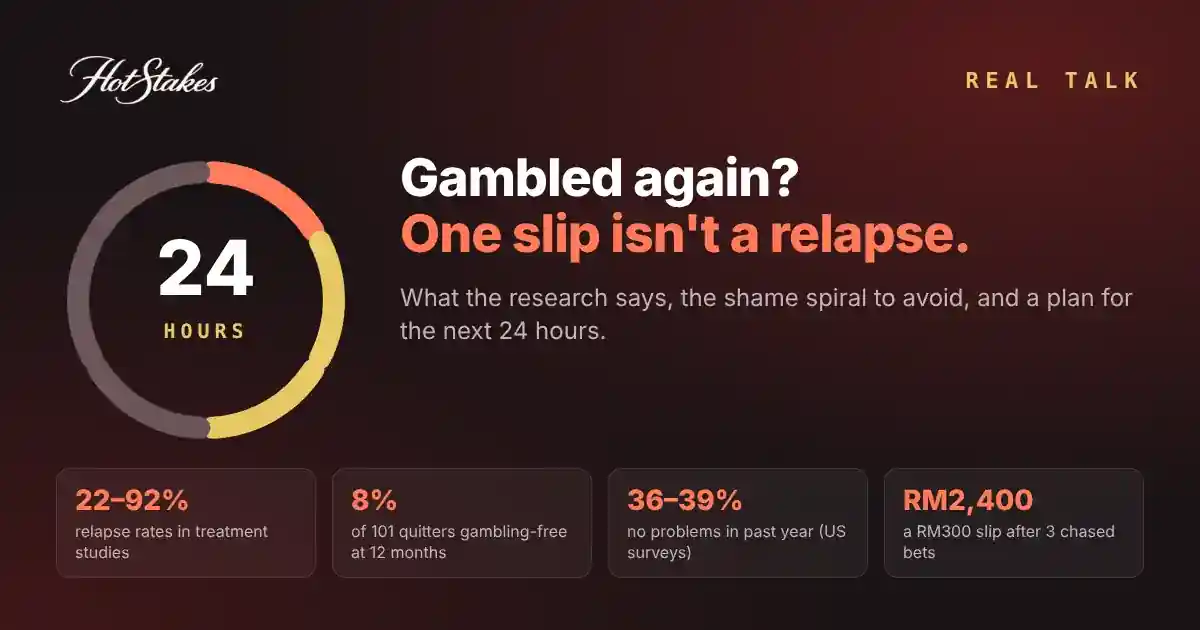
You were trying to stop, and you gambled again. Take a breath. A single slip is what researchers call a lapse, and it is very common among people quitting gambling. One slip is not a relapse, and what you do in the next 24 hours matters far more than the bet you just placed. The biggest danger now isn’t the money already gone. It’s the urge to win it back and the “I’ve blown it anyway” feeling. Below: what the research says, why the shame spiral happens, and a plan for today and this week.
Lapse vs relapse: what just happened
Addiction researchers separate a slip from a full return to old habits. The best-known framework is psychologist G. Alan Marlatt’s relapse prevention model. An overview by Larimer, Palmer and Marlatt (1999) describes a lapse as “the first violation of the abstinence goal”. A relapse is a return to uncontrolled use or giving up the goal altogether. The key line: “the progression from lapse to relapse is not inevitable.”
Gambling researchers have used similar definitions. A systematic review of gambling treatment studies by Pickering and colleagues in Addiction (2018) quotes one team’s wording:
| Lapse | Relapse | |
|---|---|---|
| Definition used in research | “Isolated gambling episode with only mild consequence” | “Two or more consecutive episodes or one episode with loss of control” |
| What it looks like | One session, one evening, then you stop | Gambling again the next day, or one night where you couldn’t stop |
| What it means | A warning light. Your plan has a gap | Time for more support, not less |
| What to do | The 24-hour plan below | The 24-hour plan, plus professional help this week |
Definitions aren’t universal. A 2006 review in Clinical Psychology Review, “What do we know about relapse in pathological gambling?”, noted that “no consistent definition of relapse to gambling exists.” The label matters less than stopping the next bet.
Takeaway: If you gambled once and stopped, that’s a lapse. If it has become several days, or a night you lost control, call it a relapse and get more support. Both are recoverable.
How common are slips? What the research says
If you feel like the only person who has slipped, the evidence says otherwise.
- 22% to 92%. A 2026 systematic review led by University of Bristol researchers, Torrance and colleagues in Addiction Research & Theory, reports that relapse rates among people treated for gambling disorder range “from approximately 22% to as high as 92%” (full text).
- Only 8% gambling-free at 12 months. In Hodgins and el-Guebaly’s 2004 study of 101 people who had recently quit, “only 8% of participants were free of gambling at 12-months”, as summarised by Oakes and colleagues in the Journal of Gambling Studies (2011).
- Recovery still happens, often without formal treatment. Slutske’s 2006 analysis of two US national surveys found that among people who had ever had pathological gambling, “36%–39% did not experience any gambling-related problems in the past year”. Yet “only 7%–12%” had ever sought treatment or attended Gamblers Anonymous.

These studies have limits. Most are small, from Western countries, and define relapse in different ways. The Bristol review notes that 19 of its 26 studies came from Spain. Still, they point the same way: slips are common, and people still recover.
The same review found what tends to protect people. These included family support, meaningful activities and regular attendance at self-help meetings. A 2015 Australian cohort study by Smith and colleagues found gambling urges were “significantly associated with relapse”. Planning for urges is planning against relapse.
Takeaway: A slip puts you in the majority of people trying to quit, not outside it. What counts is how fast you stop.
The “I’ve blown it anyway” trap
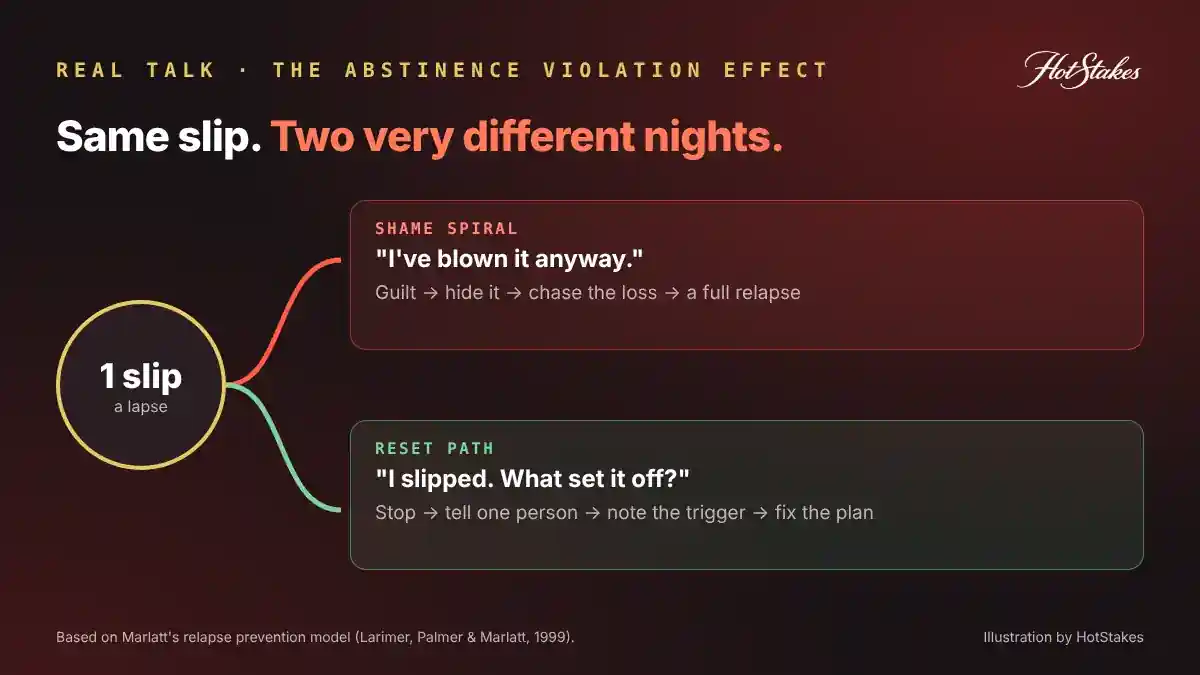
Marlatt’s model has a name for the feeling that turns one slip into a binge: the abstinence violation effect.
It works like this. You break your rule. You decide it proves you’re weak or hopeless. According to Larimer, Palmer and Marlatt, people who blame a lapse on personal failure “are likely to experience guilt and negative emotions”. Those feelings can then drive more use “as a further attempt to avoid or escape the feelings of guilt or failure.”
With gambling, the loss itself also feels like a debt to win back before anyone notices.
The fix the model suggests is a change in how you read the slip. Treat lapses “not as failures or indicators of a lack of willpower but as mistakes or errors in learning.” In practice, that means swapping one thought for another:
- Spiral thought: “I’ve ruined everything, so I may as well keep going tonight.”
- Reset thought: “I slipped. What set it off, and what do I change before tomorrow?”
Takeaway: Guilt is normal, but it’s a bad decision-maker. Don’t let tonight’s shame book tomorrow’s bet.
Why chasing the slip is the most expensive move
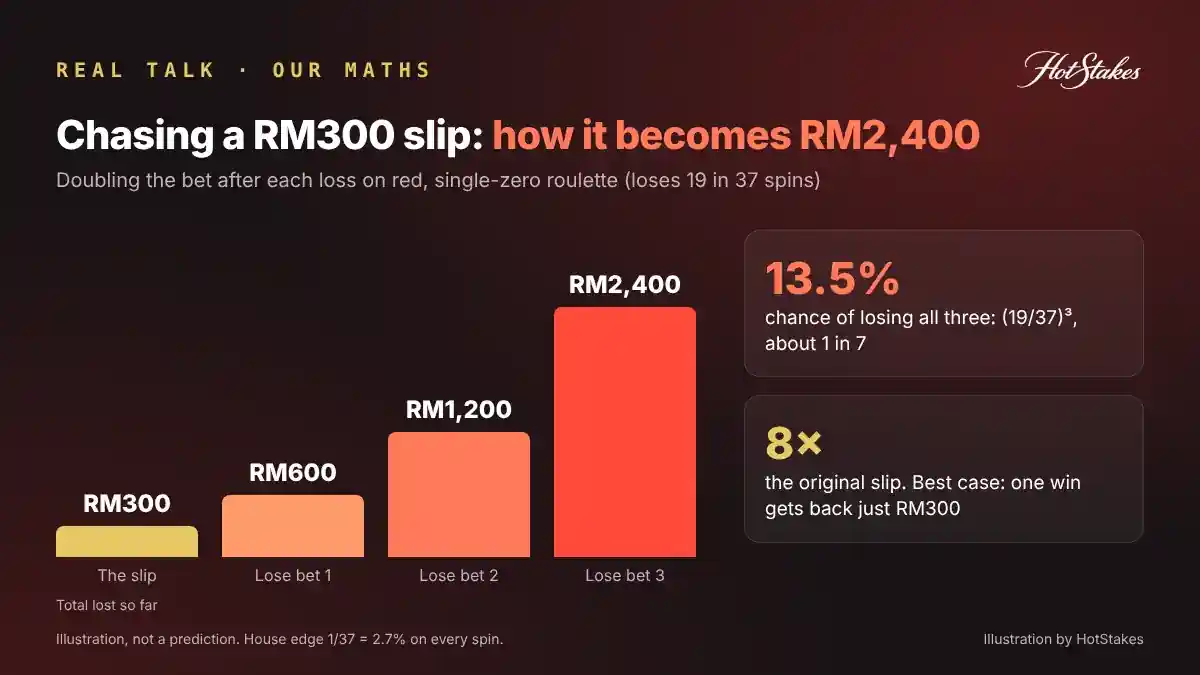
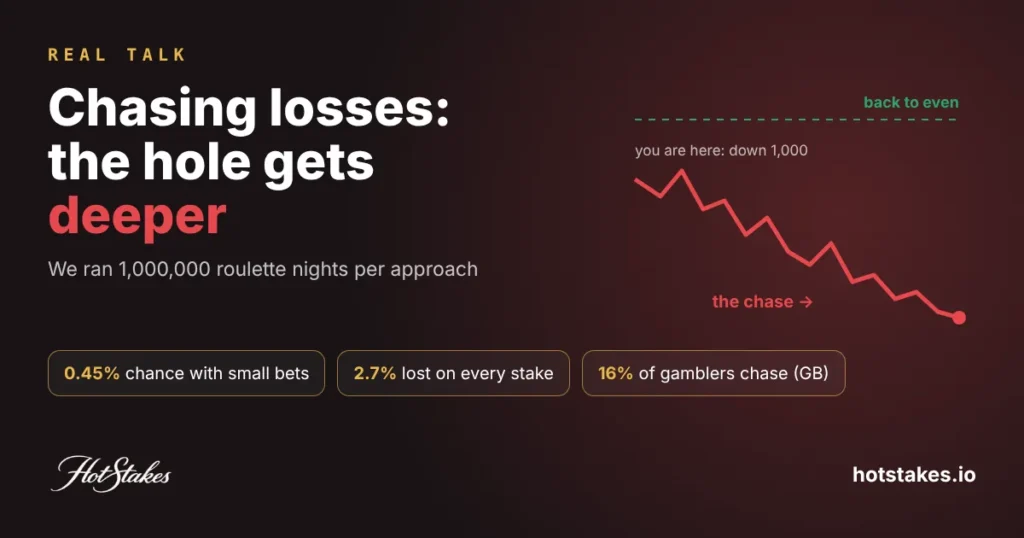
Here is our own maths, as an illustration, not a prediction. Say the slip cost you RM300. You decide to win it back by betting on red at single-zero roulette. Each spin loses 19 times in 37. Every time you lose, you double the stake.
- Spin 1: bet RM300. Lose, and you’re down RM600.
- Spin 2: bet RM600. Lose, and you’re down RM1,200.
- Spin 3: bet RM1,200. Lose, and you’re down RM2,400.
The chance of losing all three is (19/37)³ = 13.5%, about 1 in 7. In that case the RM300 slip becomes RM2,400, eight times bigger. The best case? One win, and you recover the RM300. You risk up to RM2,100 extra to undo a RM300 loss. And on every spin the house edge (1/37, or 2.7%) is working against you.
Real chasing rarely stops at three bets. More in our guide to how to stop chasing losses.
Takeaway: The RM300 is gone. Accepting that is cheaper than any plan to win it back.
The first 24 hours: a step-by-step plan
Do these in order. None of them needs you to feel ready.
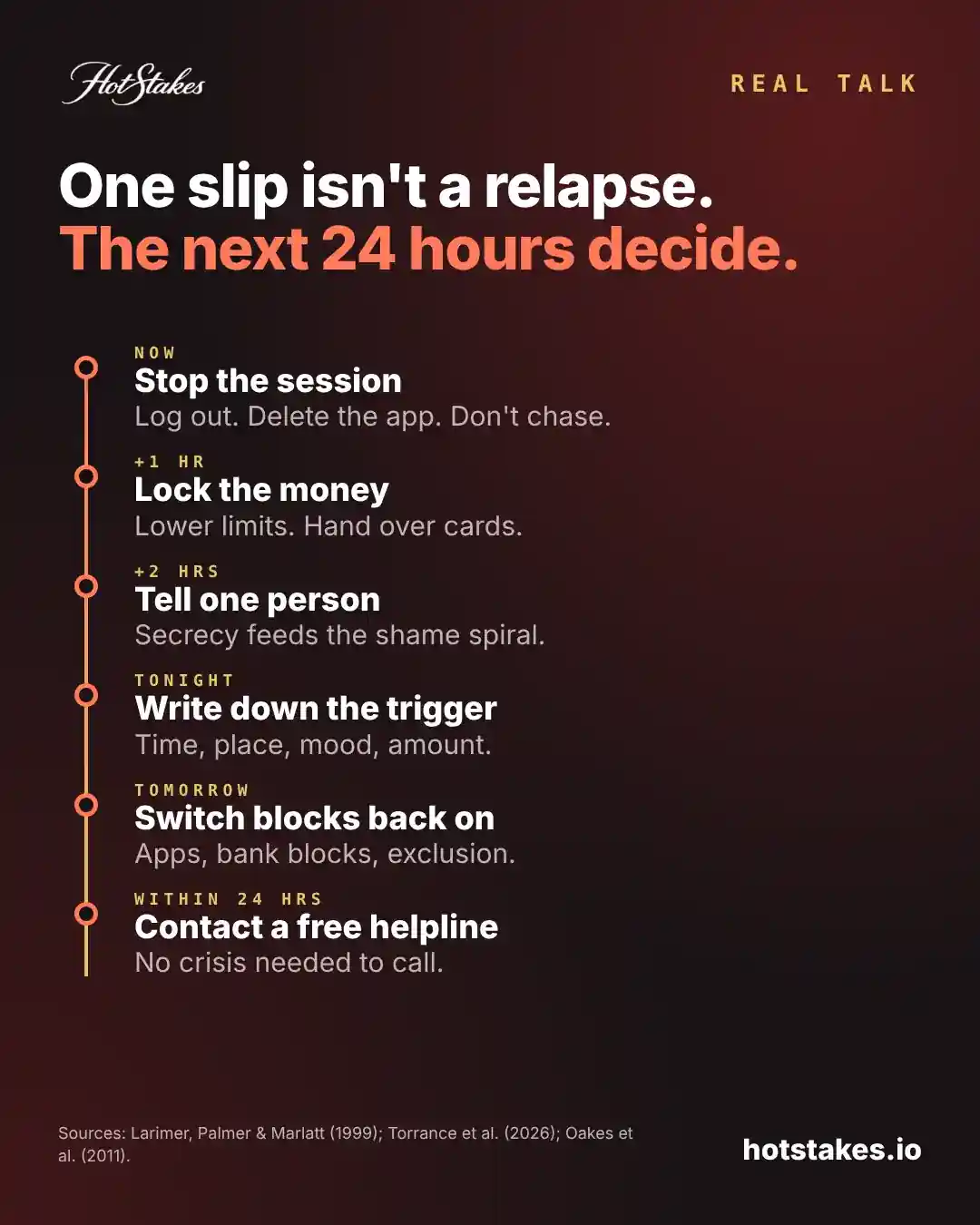
- Stop the session now. Log out, close the app, delete it from your phone. If the urge is loud, use our 30-minute plan for a gambling urge.
- Lock the money. Move spare cash to an account you can’t reach easily, lower card and e-wallet limits, or ask someone you trust to hold your cards for a few days.
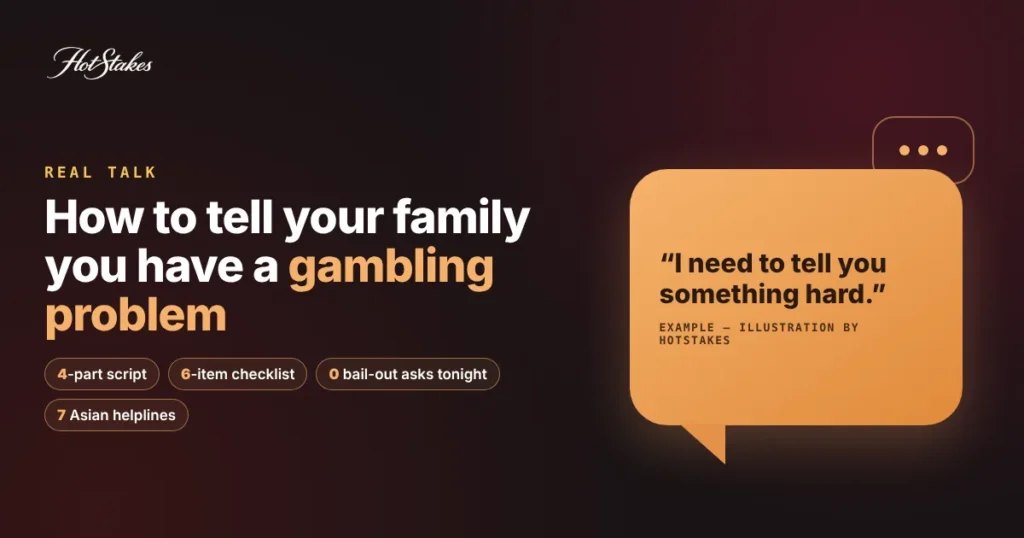
- Tell one person. A partner, sibling, friend or helpline counsellor. Secrecy feeds the abstinence violation effect. Saying it out loud takes some of its power away. If it’s family, our guide on how to tell your family has scripts.
- Write down the trigger. Time, place, mood, what you were doing, how much. Payday, an ad, a bad day, boredom at 1am? This turns the slip into information.
- Switch your blocks back on. Reinstall blocking software, renew self-exclusion where it exists, turn bank gambling blocks back on. See how to block yourself from gambling.
- Contact a free helpline. Use the table below. You don’t need to be in crisis to call.
Takeaway: Six steps, one day. Done is better than perfect.
The next 7 days
- Day 2: count the cost. Use our 10-minute money audit on the slip and any bills it affects. Pay essentials first.
- Day 3: plug the gap. Look at the trigger note. Make one concrete change, such as a different route home, a new payday rule, or muting gambling ads and groups.
- Days 4–5: add support. Book a counselling session, use Gambling Therapy’s free online support, or go to a self-help meeting. The Bristol review lists meeting attendance among protective factors.
- Day 6: fill the time. Plan something for the hours you used to gamble, ideally with other people.
- Day 7: review. What worked? What nearly didn’t? Update your plan. Count your days from the slip, but keep everything you learned before it.
See also our gambling recovery stories and the pillar guide, is gambling bad for you?
Takeaway: A slip shows you where your plan was weak. This week is for fixing that one spot.
If you’re the family: how to respond to a slip
Finding out about a slip hurts, especially after promises. The Bristol review found family support was protective, and one study it cites linked lack of family support with relapse.
- Thank them for telling you, if they did. You want the next slip reported early, not hidden.
- Focus on the next step, not the verdict. “What do you need to do today?” works better than “You always do this.”
- Protect the household money. Agree on temporary controls together. Don’t pay gambling debts in secret.
- Look after yourself too. This is stressful for you as well. Talk to someone you trust, or contact one of the services below.
For partners, our guide My husband gambles: what can I do? goes further.
Takeaway: Calm and clear beats angry and vague. You can be firm about money and kind about the person.
Free, confidential help (verified 9 Nov 2026)
We checked each number on the linked page on 9 Nov 2026. Where we found no national gambling-specific line, we list the government mental health line, which can talk through gambling too. In an emergency, call your local emergency number.
| Where | Service | Contact | Source |
|---|---|---|---|
| Malaysia | HEAL national mental health helpline (no national gambling-specific line found) | 15555 | Malay Mail, 6 Jan 2026 |
| Singapore | NCPG Helpline and webchat, daily 8am–11pm | 1800-6-668-668 | MSF / NCPG |
| Philippines | NCMH Crisis Hotline (no national gambling-specific line found) | 1553, 0919-057-1553, 0917-899-8727 | Manila Bulletin, 3 Jan 2026 |
| Hong Kong | Gambling counselling hotline | 1834 633 | HK Government, 4 Dec 2024 |
| India | Tele-MANAS mental health helpline (no national gambling-specific line found) | 14416 or 1-800-891-4416 | PIB, Ministry of Health |
| Anywhere | Gambling Therapy (Gordon Moody), free online support | gamblingtherapy.org | Gambling Therapy |
Takeaway: Calling after a slip is exactly what these lines are for.
FAQ
Is one bet after quitting a relapse?
Usually not. Researchers call a single episode with mild consequences a lapse. A relapse is repeated gambling or an episode where you lost control. Either way, stop now and use the 24-hour plan.
Do I have to start my recovery from zero?
No. The skills, blocks and support you built still count. South Australia’s Gambling Harm Support calls setbacks “a normal part of the change process”. Restart your day count if it helps, but keep the lessons.
How common is gambling relapse?
Very common. A 2026 systematic review reports relapse rates of about 22% to 92% among people treated for gambling disorder. In one study, only 8% of 101 people were completely gambling-free after 12 months.
Should I try to win back what I lost during the slip?
No. Chasing usually makes the loss bigger. In our illustration, doubling stakes to recover a RM300 slip turns it into a RM2,400 loss about 1 time in 7, after just three bets.
My partner relapsed. What should I say?
Stay calm, thank them for being honest, and ask what they need to do today. Agree on money safeguards together. Contact a helpline for yourself too.
HotStakes is an independent directory. Some links on this site are affiliate links; we may earn a commission at no cost to you, and it never changes our rankings. Gambling involves risk — only play with money you can afford to lose, and if it stops being fun, seek help. This article is general information, not legal advice. Read our full disclaimer.
 Next story →Magnum 4D Jackpot 1 of RM6.55M Partially Won on 8 Nov
Start the discussion