

Money Mule Accounts Explained: Jail, Fines and Red Flags
Renting out your bank account can mean up to 10 years in jail in Malaysia. How mule recruitment works, the laws, red flags and what to do.
In this article
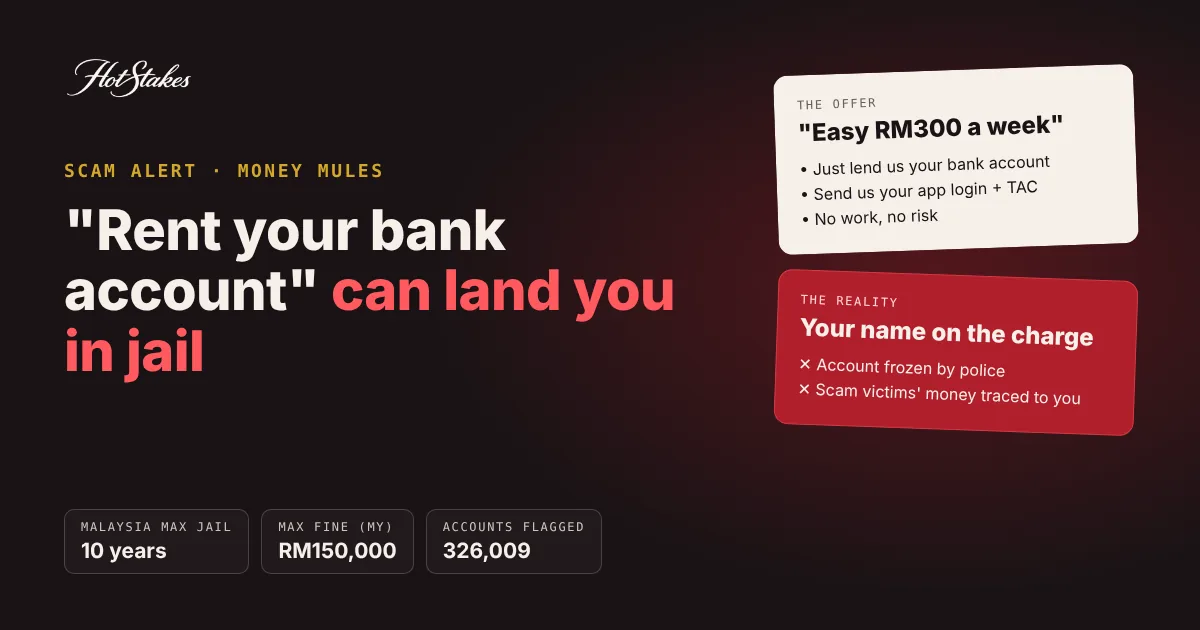
The pitch usually sounds harmless, something like “earn a few hundred ringgit a week, no work needed, just let us use your bank account.” Malaysian police say many of the people who take it are students, and a growing number end up in court. A money mule is anyone who lets criminals move money through their bank account, and in Malaysia giving someone control of your account can now mean up to 7 years in jail, or up to 10 years if the account is used for unlawful transactions. This guide explains how mule recruitment works, why scam and illegal gambling syndicates need your account, what the law says in Malaysia, Singapore and Hong Kong, and how to get out if you’re already in.
What a money mule is, in one minute
Scam syndicates and illegal gambling operators have a problem: they collect money from victims and players, but they can’t take it into accounts in their own names without leaving a trail straight to themselves. So they borrow, rent or buy accounts that belong to ordinary people. In Malaysia these are called akaun keldai (donkey accounts); in Hong Kong, “stooge accounts”. The account holder is the mule: the money is “carried” through their name.
The UK Gambling Commission describes the gambling version in its money laundering risk assessment: “mule” betting accounts are opened using a third party’s personal details, with or without their knowledge, and are used to spread illicit funds across many accounts with low-risk bets. It rates the risk as high.
Takeaway: if someone else controls money flowing through an account in your name, you are the mule, whatever the “job” is called.
How big the problem is
The numbers come from police and regulators, not estimates:
- Malaysia: the police Commercial Crime Investigation Department (CCID) said in March 2026 that its Semak Mule database lists 326,009 bank accounts and 251,484 phone numbers linked to scams. Of 30.5 million public checks since launch, 9.8% came back positive (New Straits Times, 25 Mar 2026).
- Penang, online gambling: police froze more than 150 mule accounts holding over RM32 million, suspected of serving online gambling syndicates, the state’s Chief Minister told the assembly in May 2025 (The Vibes).
- Singapore: at least 74 people were charged under the new money-mule laws between 9 September and 1 November 2024 alone (Singapore Police Force).
- Hong Kong: police and banks intercepted HK$480 million in fraudulent payments in 2025 through their joint scam-intervention programme (Hong Kong Police, 11 Feb 2026).
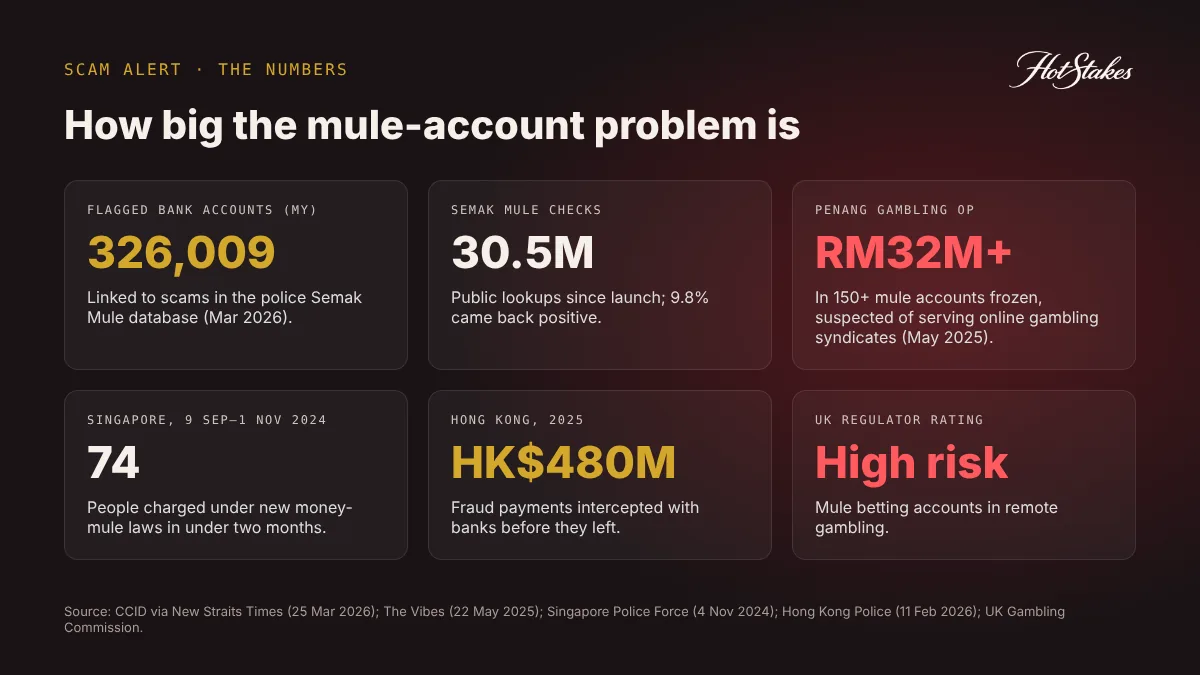
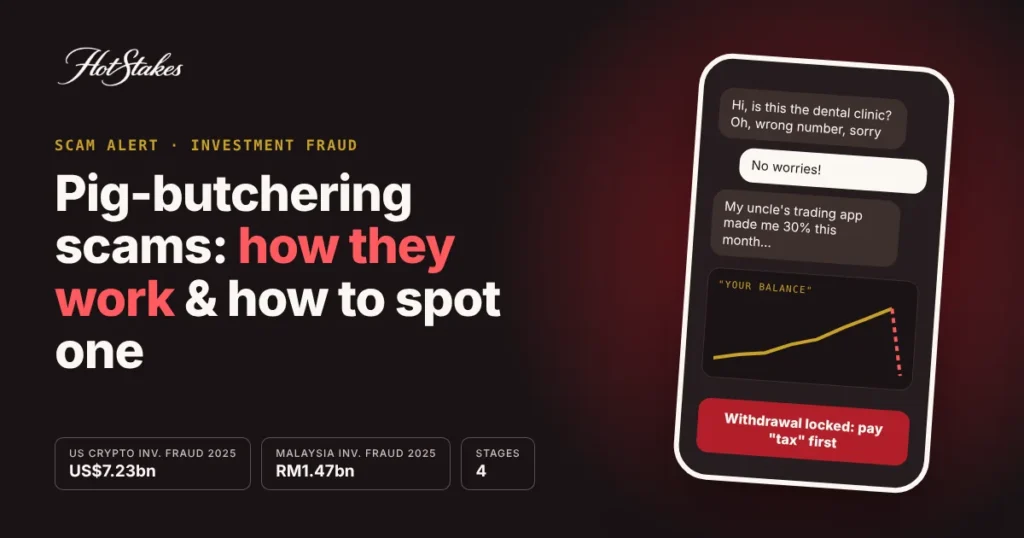
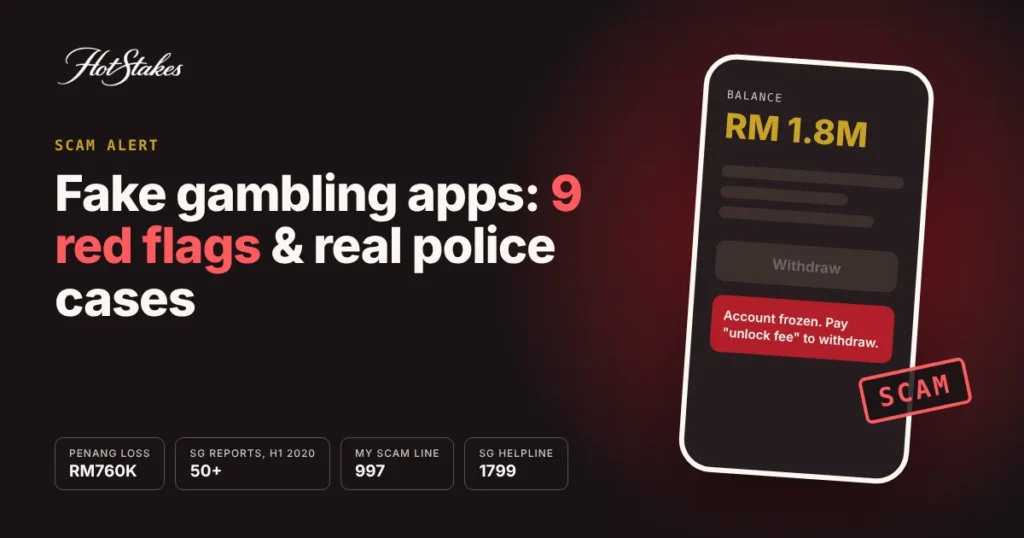
Takeaway: one in ten account checks in Malaysia’s police database comes back linked to a scam. Mule accounts are the plumbing of the whole scam economy, including the fake gambling apps and pig-butchering investment scams we’ve covered before.
How mule recruitment works, step by step
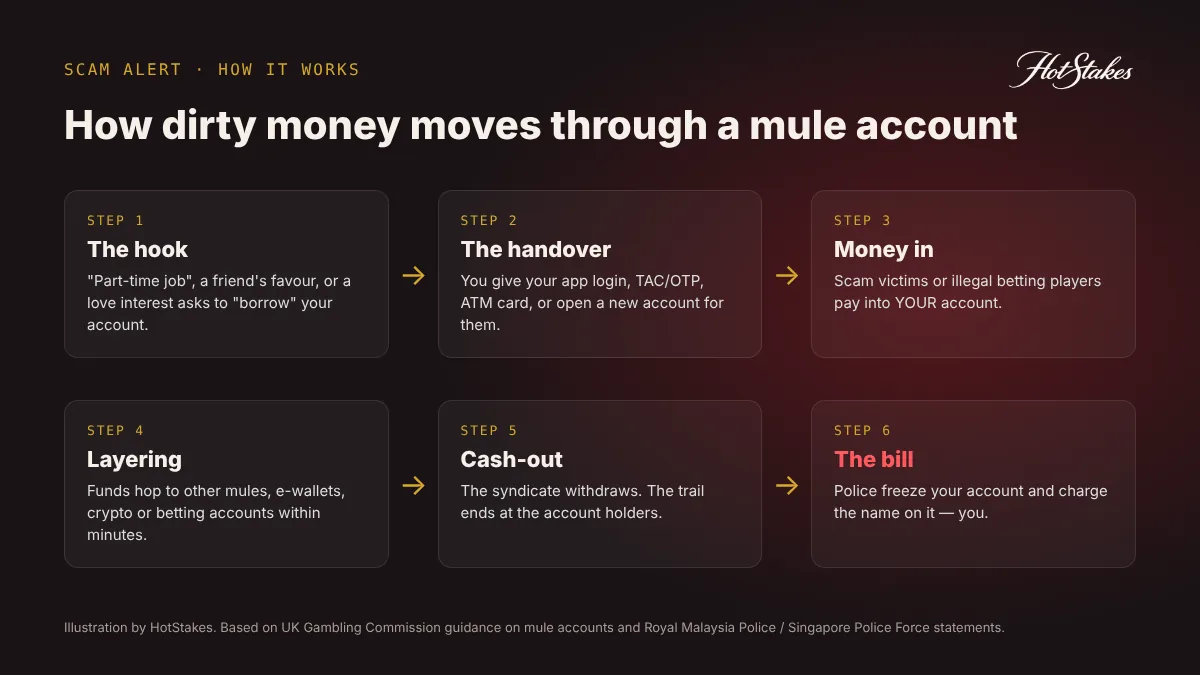
Recruiters (sometimes called “mule herders”) rarely say what they really want. The pattern police describe goes like this:
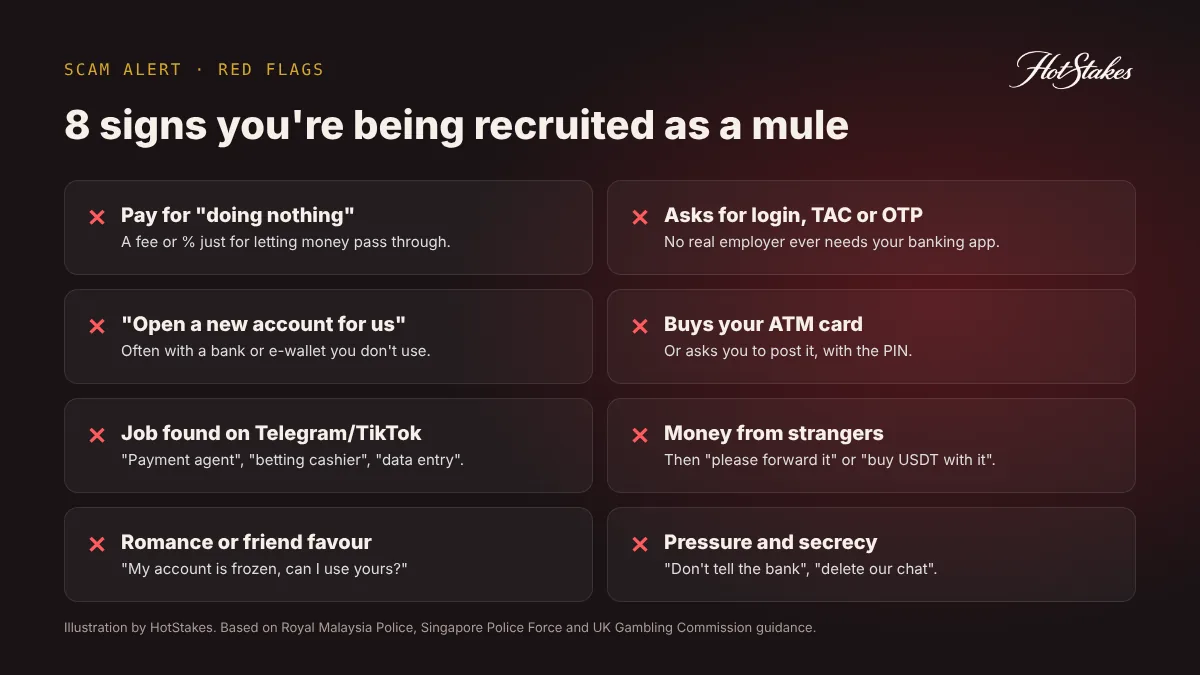
- The hook. An ad for a “part-time payment agent”, “betting cashier” or “data entry” job on Telegram, TikTok or Facebook; or a friend, relative or online love interest who says their own account is frozen.
- The handover. You’re asked to share your banking app login and TAC/OTP, sell or post your ATM card and PIN, or open a new bank or e-wallet account and hand over the details.
- Money in. Victims of scams, or players on illegal betting sites, are told to pay into your account. To them it looks like a normal person’s account, which is the point.
- Layering. Within minutes the money is moved on: to other mules, e-wallets, crypto exchanges or betting accounts, so each hop makes it harder to trace.
- Cash-out. The syndicate withdraws from the last account in the chain. You might get a few hundred ringgit.
- The bill. When a victim reports the scam, the trail leads to the named account holder. Police can freeze the account and charge you.
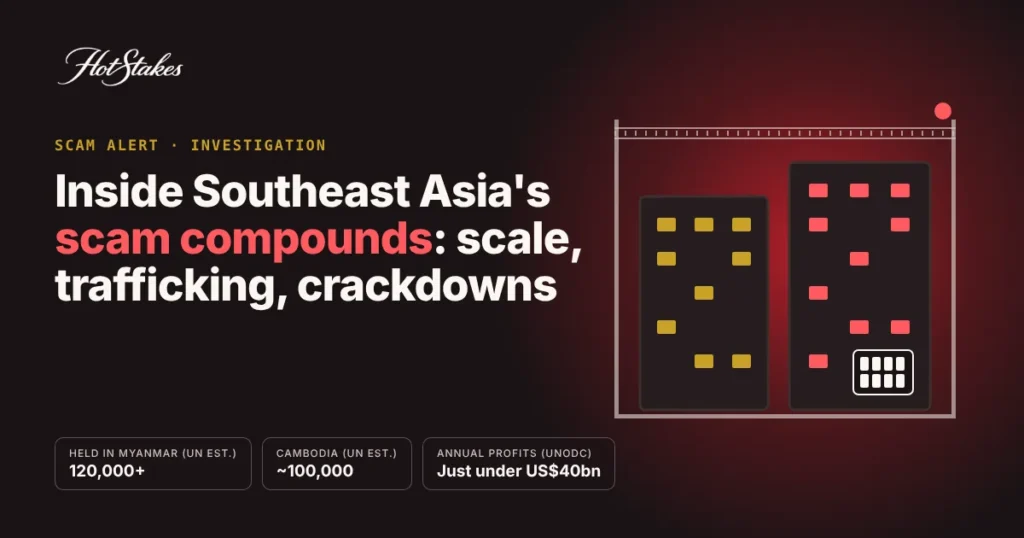
Many of these syndicates are the same groups behind the Southeast Asian scam compounds: they need thousands of local accounts because banks keep closing them.
Takeaway: you are not “just lending” an account. You are the last link police can find.
What the law says: Malaysia, Singapore, Hong Kong
Malaysia rewrote its law in 2024. Before that, mule cases were charged under Section 424 of the Penal Code, a general fraudulent-dealings provision, with a maximum of five years’ jail. The Penal Code amendments tabled on 9 July 2024 created dedicated offences (Malay Mail):
| Offence | Who it targets | Fine | Jail |
|---|---|---|---|
| s.424A | Having or controlling someone else’s account or payment instrument | RM5,000 – RM50,000 | 6 months – 5 years |
| s.424B | Giving control of your own account to someone else (the mule) | RM10,000 – RM100,000 | 1 – 7 years |
| s.424C(1) | Unlawful transactions through your own account | RM10,000 – RM100,000 | 3 – 10 years |
| s.424C(2) | Unlawful transactions through someone else’s account | RM10,000 – RM150,000 | 3 – 10 years |
Courts are still sentencing older-style cases too. In August 2026, a Johor Baru Sessions Court fined a 22-year-old student RM500 under Section 424 after RM525 passed through her account, and jailed another man for nine months over nine mule charges tied to fake room-rental listings worth about RM36,000 (The Star).
Singapore added new money-mule offences to the Corruption, Drug Trafficking and Other Serious Crimes (Confiscation of Benefits) Act and the Computer Misuse Act from 8 February 2024. Police report one person jailed six months for handing over internet banking details and an OTP; the account then laundered over S$160,000. The Sentencing Advisory Panel says significant jail terms should be the norm, even for young offenders. In Hong Kong, police say interbank information sharing has grown several-fold and the FINEST data-sharing platform is expanding from 10 to all 28 retail banks.
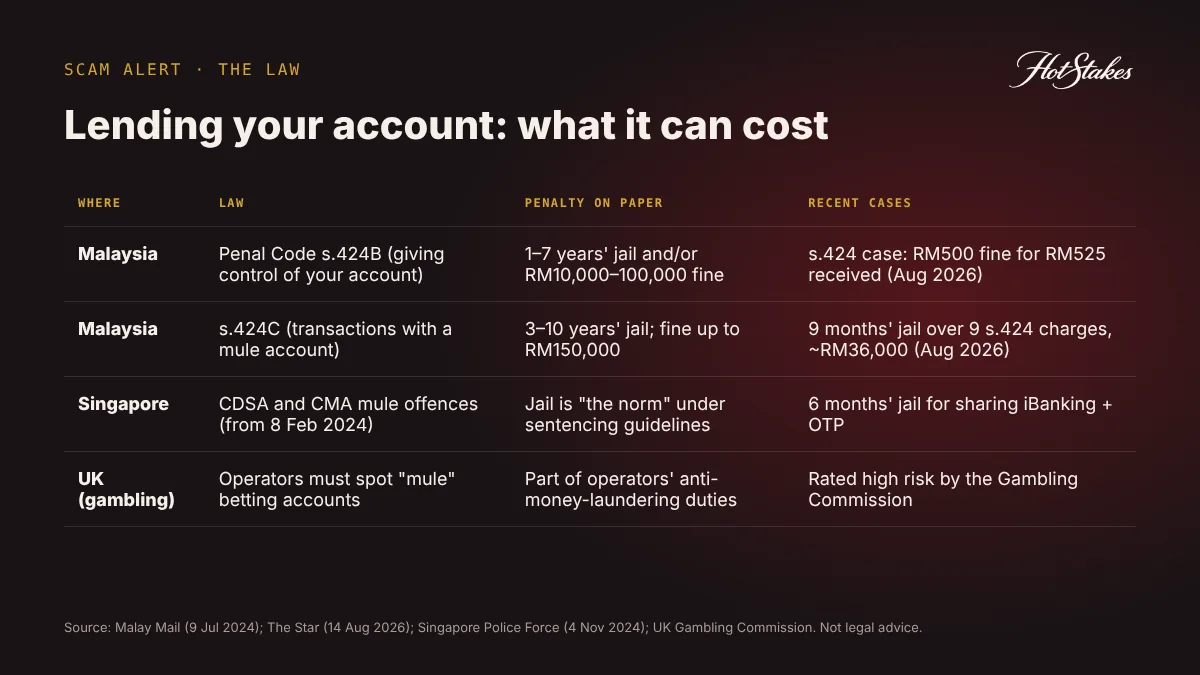
Takeaway: “I didn’t know what the money was” is not a safe defence. The new Malaysian offences target the act of handing over the account itself.
Normal favour vs mule request: the comparison
| Situation | Usually fine | Mule red flag |
|---|---|---|
| A friend asks for help with money | You transfer your own money to them | They want money sent into your account and forwarded on |
| A job pays you | Salary from a registered employer, with a contract | A commission for “processing payments” through your personal account |
| Someone needs your details | Your account number, to pay you | Your app login, TAC/OTP, ATM card or PIN |
| Opening an account | For yourself | “Open one for us, we’ll pay RM200” |
| Crypto | Buying for yourself on a licensed exchange | “Use the money we sent you to buy USDT and send it to this wallet” |
Takeaway: any request that puts other people’s money into your account, or your login into someone else’s hands, is the mule pattern. Crypto doesn’t change that; see our USDT currency page for how licensed operators handle it.
Already in? What to do now
- Stop. Don’t move any more money and don’t reply to the recruiter.
- Call your bank and ask them to block the account and change your logins.
- Report it. In Malaysia, call NSRC 997 and make a police report. In Singapore, call the ScamShield Helpline 1799. In Hong Kong, call the ADCC Anti-Scam Helpline 18222 and report at a police station.
- Keep everything: chats, the job ad, transfer receipts. Coming forward early helps investigators, and a lawyer can advise you on your position.
- Check before you pay anyone. Malaysia’s police Semak Mule portal lets you check whether a bank account or phone number has been reported.
Takeaway: the sooner the account is frozen, the less money passes through your name.
Why this matters for anyone who gambles online
Illegal betting sites often take deposits through personal bank accounts instead of proper payment processors. If an “operator” asks you to transfer to a private individual’s account, that account is very likely a mule, and the site is very likely unlicensed. Our guide to spotting an unlicensed online casino covers the other warning signs, and our KYC withdrawal hold explainer explains why legitimate operators check that the payment account is yours. On the MYR page and SGD page we only list operators checked by Cyndia’s team.
FAQ
Is renting out my bank account illegal in Malaysia?
Yes. Giving someone else control of your account is an offence under Penal Code s.424B, with 1–7 years’ jail, a fine of RM10,000–RM100,000, or both.
What if I didn’t know the money came from a scam?
You can still be investigated and charged, and your account can be frozen while police investigate. Get legal advice; don’t rely on “I didn’t know”.
How do illegal gambling sites use mule accounts?
They tell players to deposit into personal accounts that look ordinary, then move the money on quickly. Penang police froze 150+ such accounts with RM32 million in one crackdown.
Can I check if an account is a mule before I pay?
In Malaysia, the police Semak Mule portal lets you look up bank accounts and phone numbers that have been reported for scams.
HotStakes is an independent directory. Some links on this site are affiliate links; we may earn a commission at no cost to you, and it never changes our rankings. Gambling involves risk — only play with money you can afford to lose, and if it stops being fun, seek help. This article is general information, not legal advice.
Looking for operators checked by Cyndia’s team? Browse vetted operators by currency.
 Next story →Baccarat House Edge Explained: Speed vs Classic

Start the discussion