

Deepfake Celebrity Ads: How the Scam Works, Step by Step
Deepfake celebrity ads explained: real cases in Malaysia, Korea, Hong Kong and more, how the scam works, and 7 checks before you click.
In this article
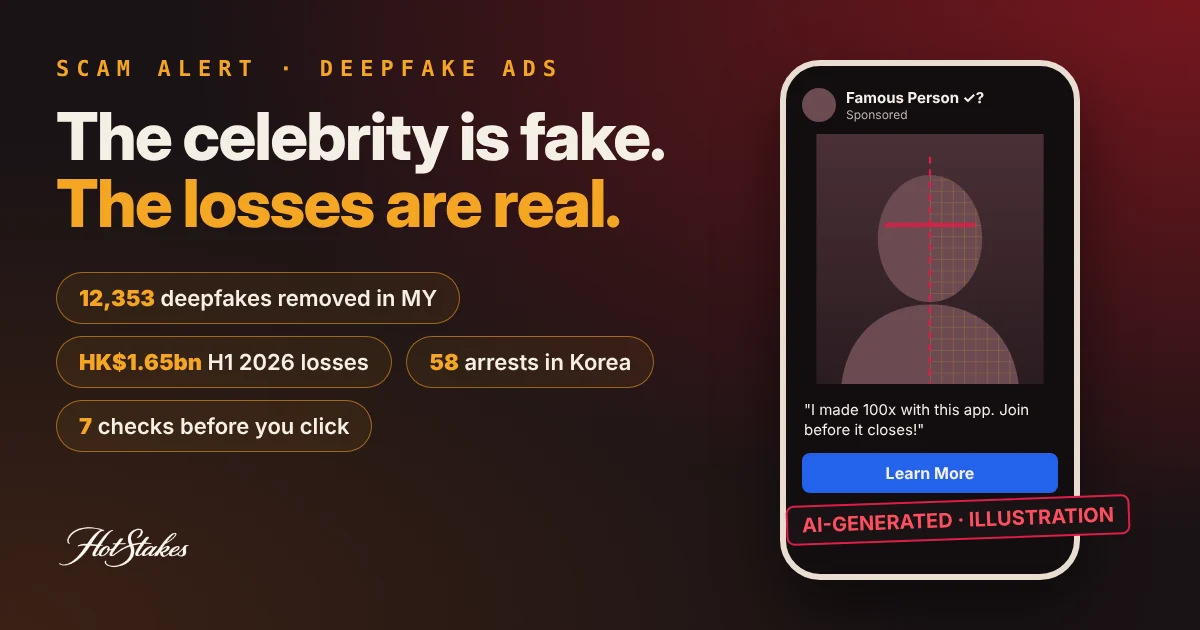
A famous face on your feed says they made a fortune on a new investment platform or “casino app”, and there is a button that says Learn More. If a celebrity, tycoon or politician appears in an ad urging you to invest or gamble through a link, treat it as a deepfake scam until an official source proves otherwise. Police and regulators in Malaysia, Hong Kong, Singapore, South Korea, the Philippines, India and Japan have all reported AI-faked endorsements in 2024–2026. Here is how the scam works, the real cases, and seven checks before you click.
What is a deepfake celebrity ad?
A deepfake is video or audio made or altered with AI so that a real person appears to say something they never said. In a “celeb-bait” ad, scammers paste a famous face and cloned voice onto a pitch for a get-rich investment, a trading bot or a gambling app, then pay social platforms to show it to you.
The new part is the price. Making a convincing clip used to take skill and time; now it takes cheap tools and an old interview. Malaysia’s communications minister Fahmi Fadzil told the Senate in March 2026 that deepfake scam videos often run as paid posts: “Scammers are paying platforms to target Malaysians”.
Takeaway: The face is borrowed, the voice is cloned, and the reach is bought. None of it is an endorsement.
Real cases in Asia, 2024–2026
These are cases confirmed by police, regulators, courts or the people impersonated. We opened every source on 21 Oct 2026.
| Where / when | Who was faked | What was sold | What happened |
|---|---|---|---|
| Malaysia, Oct 2026 | Senior officials of Bank Negara Malaysia and the Securities Commission | Private investment schemes | Joint public warning; check entities on BNM and SC alert lists (The Vibes) |
| Malaysia, Mar 2025 | PM Anwar Ibrahim, Donald Trump, Elon Musk, MP Teresa Kok, Petronas management | “Government-backed” investments promising up to 100x returns | Bukit Aman found five videos, believed made by one syndicate (Bernama) |
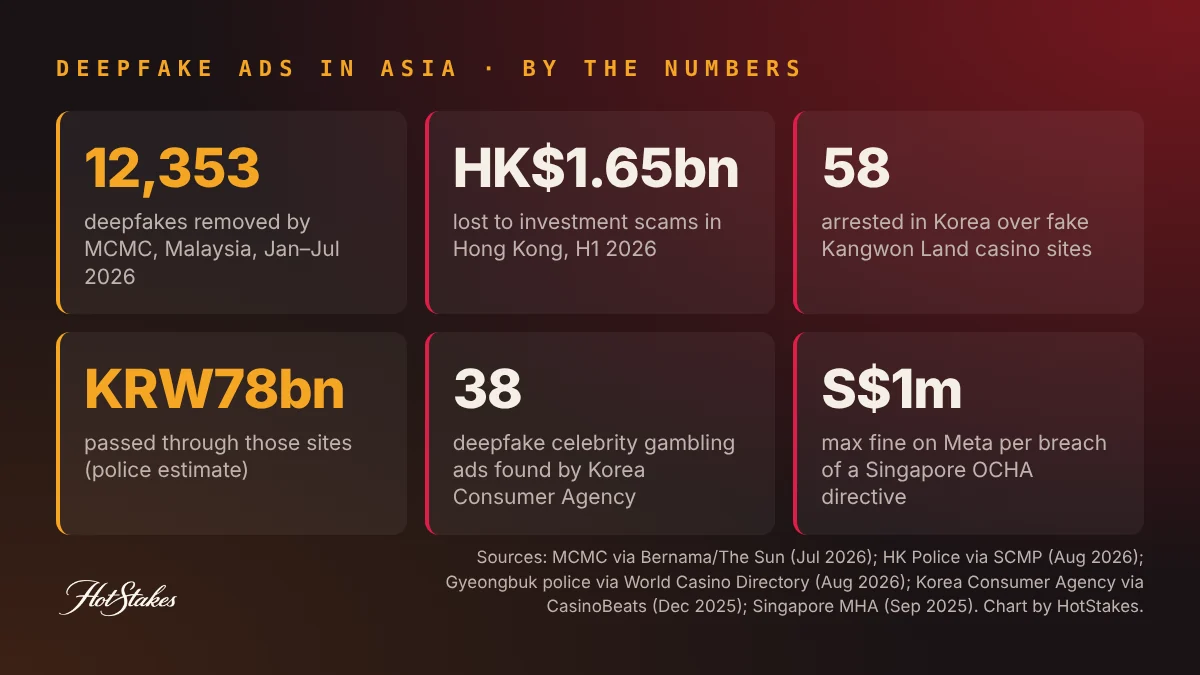
| South Korea, Aug 2026 | Well-known athletes (faces and voices) | Fake “Kangwon Land” online casino sites | Gyeongbuk police arrested 58; about KRW78 billion passed through the sites, according to police (World Casino Directory) |
| South Korea, Dec 2025 | IU, Son Heung-min, Lee Jung-jae, RM of BTS | Illegal online gambling | Korea Consumer Agency found at least 38 such ads and asked Meta to block them (CasinoBeats) |
| Hong Kong, H1 2026 | “Stars” in investment ads | Investment schemes | 2,151 investment scam cases, HK$1.65 billion lost; police said some stars in the ads were AI-generated (SCMP) |
| Macau / Hong Kong, Sep 2025 | MGM China chairperson Pansy Ho | Fake investment plan with “massive returns” | MGM China warned the public and said it would take legal action (The Standard) |
| Philippines, Jan 2025 | TV anchor Karen Davila and a Pragmatic Play executive | “PH888.COM” gaming platform falsely claiming a PAGCOR licence | PAGCOR said the site was not licensed (AGB) |
| India, Jan 2024 | Cricketer Sachin Tendulkar | An online gaming app “to make quick money” | Tendulkar flagged the video; police registered an FIR (The Week) |
| Japan, Jul 2026 | “Well-known figures” in AI videos | Fake investment | A woman in her 80s lost 17 million yen in cash; two alleged couriers were arrested and deny the charges (News On Japan) |
Takeaway: The pattern is the same everywhere: a trusted face, a too-good return, and a link that takes you off the platform.
How the scam works, step by step
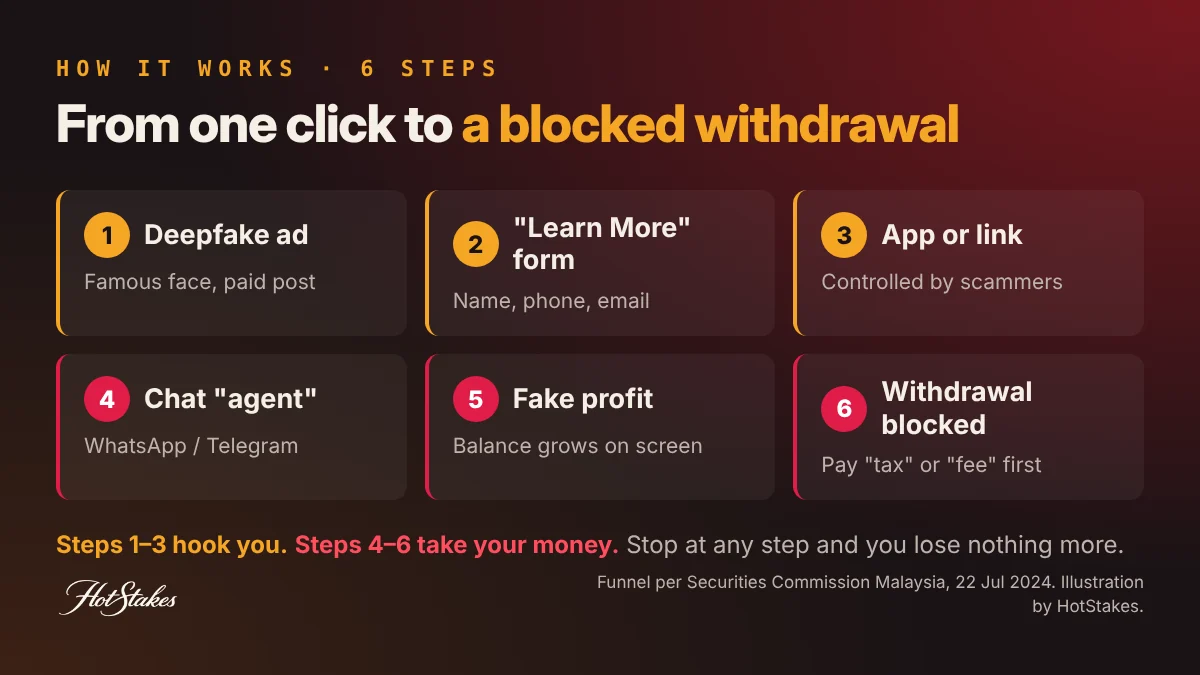
The Securities Commission Malaysia laid out the funnel in a July 2024 warning, and later police reports follow the same order:
- The ad. A deepfake video of a public figure runs as a paid post on Facebook, Instagram, YouTube or TikTok, often dressed as a news report.
- The “Learn More” form. The button opens a sign-up page that collects your name, phone number and email.
- The app. You are asked to download an app or open a “platform” link. It is controlled by the scammers.
- The agent. A “consultant” or “mentor” contacts you on WhatsApp or Telegram and walks you through deposits, usually to personal or company bank accounts or crypto wallets.
- The fake profit. Your balance grows on screen. A small early withdrawal may even work, to build trust.
- The block. When you try to take out real money, you are told to pay a tax, fee or “unfreeze” deposit first. That is the withdrawal fee scam, and the money is already gone.
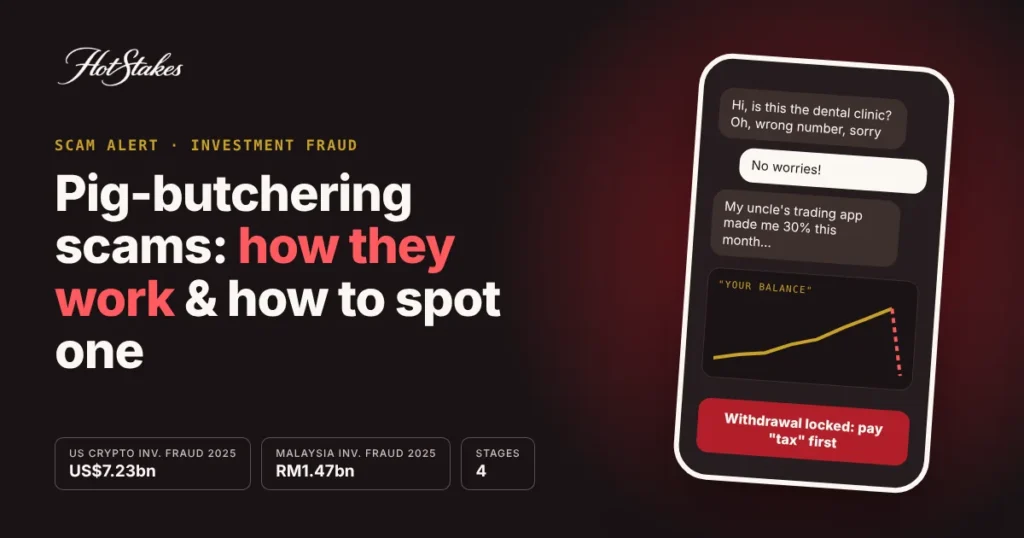
From step 4 on, it is the same playbook as pig-butchering scams and the fake casino investment scam. The deepfake is just a faster way to get the first click. Investment fraud is big business: Malaysian police said victims lost RM1.37 billion to fake investment schemes between January and November 2025.
Takeaway: The ad is only step 1. Every step after it moves you to a place the platform cannot police: a form, an app, a private chat.
Why fake “casino app” deepfakes are spreading
Gambling is a perfect cover story for a deepfake. Online casino gambling is illegal for residents in much of Asia, so victims hesitate to report losses, and fake platforms can claim licences that few people know how to check.
- Borrowed trust from real brands. In South Korea, the fake sites copied the logo of Kangwon Land, the only casino where Korean citizens may legally gamble; Kangwon Land says it runs no online gambling site. Police said the group used deepfake videos of athletes to make the sites look credible.
- Fake licences. The Philippine PH888 ad claimed a PAGCOR licence and used a real game studio’s logo. PAGCOR said it had not licensed the platform.
- “Easy money” framing. The Tendulkar video presented a gaming app as a quick way to earn, with a family member supposedly using it. Games of chance do not pay a reliable income; the house edge guarantees the opposite over time.
- Industry faces. Even casino executives are targets: MGM China had to warn that a video of its chairperson promoting an investment plan was fake.
Our guide to fake gambling apps lists the nine red flags once you are inside the app, and how to check a casino licence shows how to verify a licence claim on the regulator’s own register.
Takeaway: A celebrity plus a licence logo is not proof. A licence is only real if the regulator’s own website lists that exact domain.
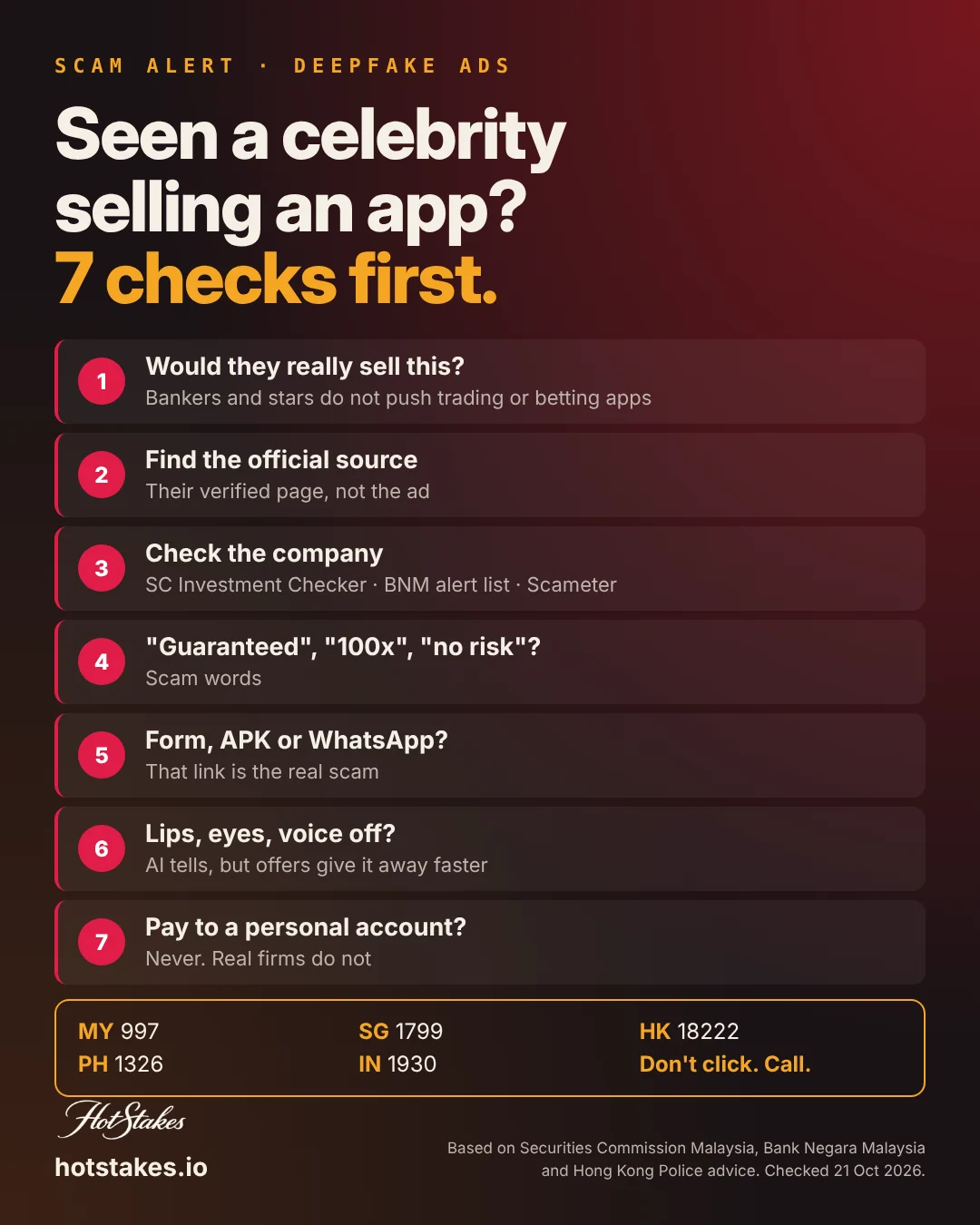
How to spot a deepfake ad: 7 checks
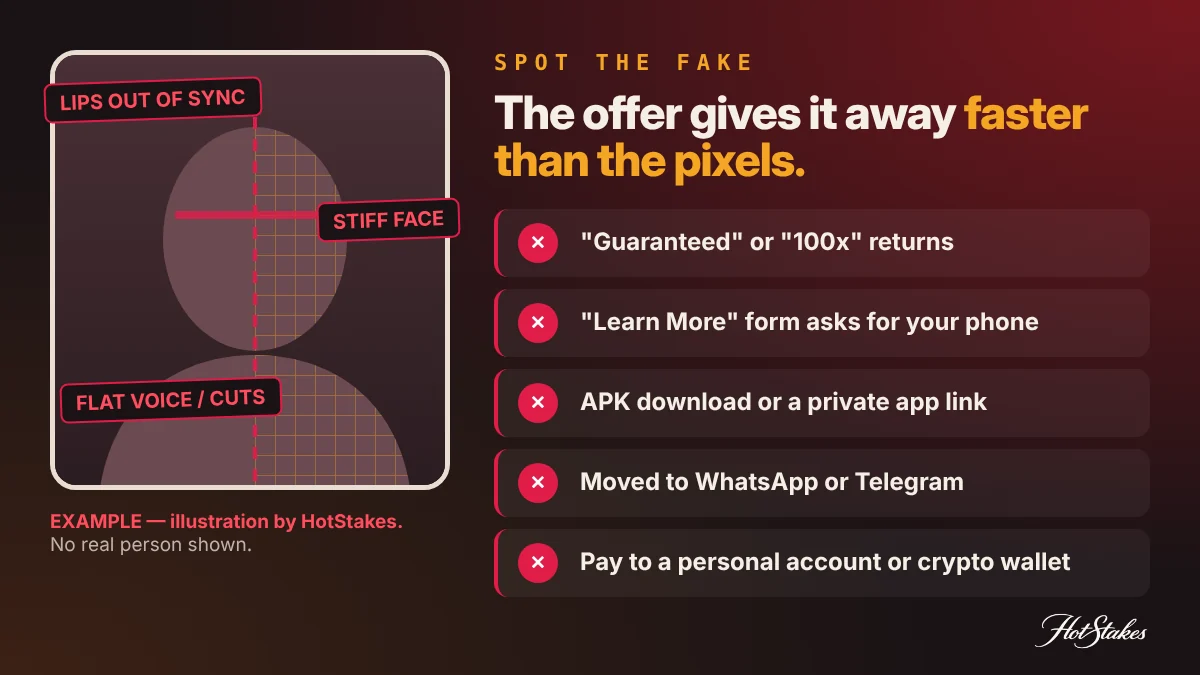
Deepfakes keep improving, so do not rely on spotting glitches alone. The offer gives the scam away faster than the pixels do.
- Would this person really sell this? Central bankers, prime ministers and sports stars do not promote trading apps or betting sites in social media ads.
- Find the official source. Search the person’s verified account or official website yourself. Bank Negara Malaysia keeps examples of fake content at bnm.gov.my/verify.
- Check the company. In Malaysia use the SC Investment Checker and BNM’s Financial Consumer Alert List; in Hong Kong, Scameter. Unlisted means do not pay.
- Look at the promise. Fixed or “guaranteed” returns, “100x”, “government-backed” or “no risk” are scam words.
- Follow the link, not the face. A sign-up form, an APK download or a jump to WhatsApp or Telegram is the scam’s real engine.
- Watch for AI tells. Lips slightly out of sync, a stiff face, odd blinking, a flat voice, sudden cuts or a fake news-studio frame. For video calls, Hong Kong police suggest asking the person to turn their head and verifying by calling them back.
- Check how you pay. Deposits to a personal bank account or a crypto wallet given in chat are never how a real investment firm or licensed casino takes money.
Want to test yourself? Try our free Scam or Legit? quiz: 10 real-world scenarios, one minute.
Takeaway: Two or more of these signs together means scam. You do not need to prove the video is fake to walk away.
What platforms and governments are doing
- Singapore issued Meta its first Implementation Directive under the Online Criminal Harms Act in September 2025, ordering facial recognition against Facebook ads impersonating key office holders. Police had disrupted about 2,000 such ads and accounts in the year to June 2025. A second directive in January 2026 widened it to other high-risk people. Non-compliance can mean a fine of up to S$1 million plus up to S$100,000 a day.
- Malaysia brought the Online Safety Act 2025 into force on 1 January 2026, and the minister said platforms, not users, may face compound penalties if deepfake scam content stays widespread. MCMC reported 12,353 deepfakes removed in the first months of 2026.
- Hong Kong police said in a 2024 LegCo reply that all 21 deepfake clips of officials or celebrities found since November 2023 were removed at police request.
- South Korea‘s Korea Consumer Agency sent its findings on deepfake gambling ads to Meta and is increasing monitoring.
- Meta says it has enrolled more than 500,000 public figures in facial recognition that detects celeb-bait ads, and in February 2026 sued advertisers in China and Brazil over celeb-bait scams.
Takeaway: Takedowns are rising, but removal comes after the ad has run. Your own check before clicking is still the fastest protection.
Already clicked or paid? Do this now
- Stop paying. No fee, tax or deposit will release your “profit”.
- Call your bank immediately to try to freeze the transfer, then call your national scam line: Malaysia NSRC 997, Singapore ScamShield Helpline 1799, Hong Kong Anti-Scam Helpline 18222, Philippines CICC 1326, India 1930.
- Save evidence: screenshots of the ad, the page link, chats, account numbers and receipts.
- Report the ad on the platform and make a police report.
- Delete the app and change passwords if you shared logins or one-time codes.
- Ignore “recovery agents”. Anyone who contacts you offering to get your money back for a fee is usually the next scam.
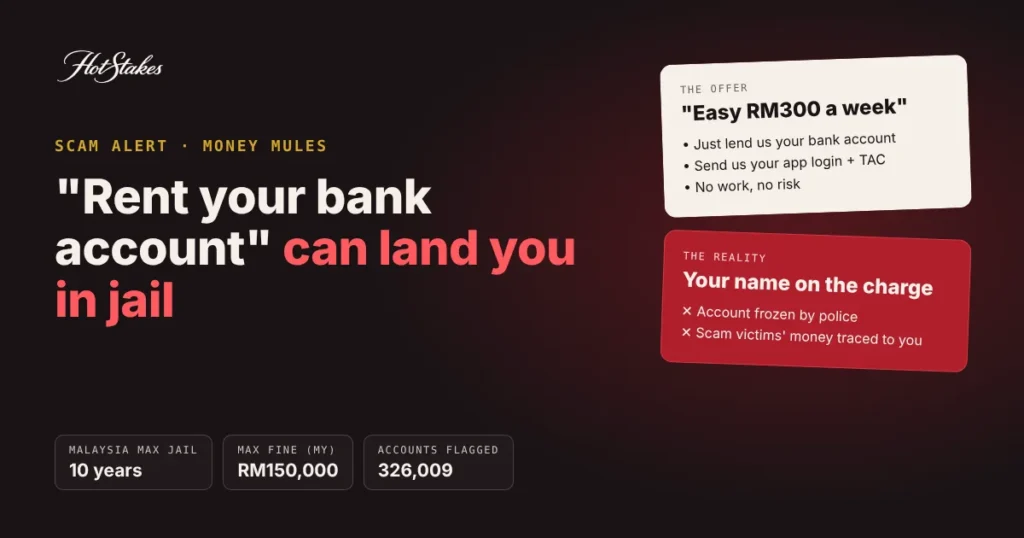
If you were asked to receive or pass on money for “the platform”, stop: that can make you a money mule in the eyes of the law. For more warnings like this, see our Scam Alerts and the iGaming glossary.
FAQ
Are celebrity-endorsed investment or casino apps ever real?
Real public figures do not recruit investors or gamblers through social media ads with sign-up forms and private chats. Regulators in Malaysia and Hong Kong treat such ads as scam warnings. Verify through the person’s official channels before doing anything.
How can I tell if a video is a deepfake?
Look for lip-sync errors, a stiff face, odd blinking, a flat voice and sudden cuts, but do not rely on glitches. The stronger signs are in the offer: guaranteed returns, an app download, a WhatsApp agent and payment to a personal account.
Where do I report a deepfake scam ad?
Report it on the platform, then to police or your scam line: 997 in Malaysia, 1799 in Singapore, 18222 in Hong Kong, 1326 in the Philippines or 1930 in India. In Malaysia you can also alert BNM and the Securities Commission.
I paid after seeing a deepfake ad. Can I get my money back?
Call your bank immediately; speed gives the best chance of freezing funds. Then make a police report. Never pay anyone who promises to recover your money for a fee.
HotStakes is an independent directory. Some links on this site are affiliate links; we may earn a commission at no cost to you, and it never changes our rankings. Gambling involves risk — only play with money you can afford to lose, and if it stops being fun, seek help. This article is general information, not legal advice.
Prefer to play only where licences are checked? Browse vetted operators by currency. 18+ only.
 Next story →USDT Casino Deposit Risks: A 10-Point Safety Checklist

Start the discussion