

Recovery Scam: Why “We’ll Get Your Money Back” Is a Trap
Recovery scams target people who already lost money. Real 2026 cases from Malaysia, Singapore and Hong Kong, the 6 disguises and where to report.
In this article
- What is a recovery scam?
- Real recovery scam cases in Asia (2025–2026)
- The 6 disguises recovery scammers use
- How the recovery scam script runs, step by step
- Lost money to a fake online casino? Why you are a target
- Real recovery vs fake recovery
- Already contacted or paid? What to do now
- Where to report a recovery scam
- FAQ
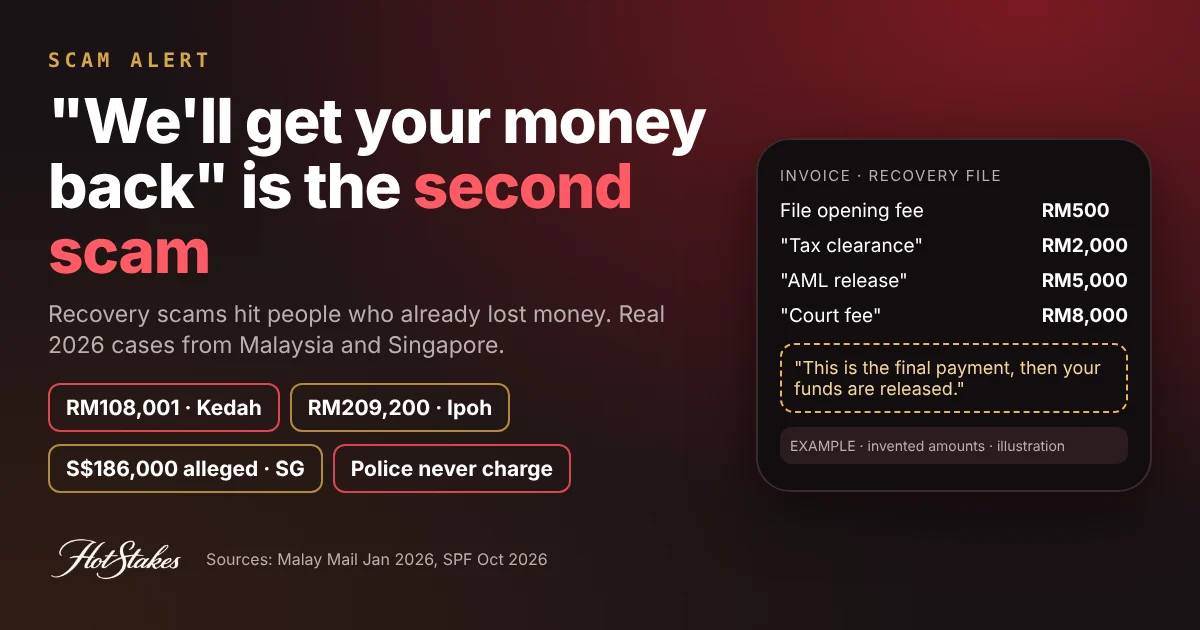
A recovery scam is a second scam aimed at people who have already lost money: someone posing as a lawyer, police officer, cyber agency or “fund recovery service” promises to get the money back, then charges fee after fee and returns nothing. If anyone you did not contact yourself offers to recover your losses for a fee, it is a scam: real police, banks and regulators never charge to recover money. In 2026 alone, police in Malaysia and Singapore reported recovery-scam losses of RM108,001, RM209,200 and an alleged S$186,000. Below: how the script works, the 6 disguises, and where to get real help.
What is a recovery scam?
A recovery scam (also called a fund recovery scam or refund scam) targets someone who has just lost money to an investment, love, job or online gambling scam. The scammer offers a way to get that money back. To start, you must pay: a deposit, a legal fee, a tax, a “verification” charge. The recovery never comes.
The UK’s national fraud reporting service describes the same shape: criminals pose as a government body, police force or law firm, already know details of the earlier loss, and ask for an upfront fee, then more fees. If you ask them to take the fee out of the recovered money, they invent a reason why they cannot (Report Fraud, UK police).
It works because the victim is desperate. The US FBI warned in August 2025 that fake law firms exploit victims’ “emotional state and financial need to recover funds from a previous scam” (FBI IC3, 13 Aug 2025).
Takeaway: A recovery scam is not a new trick. It is the last chapter of the first scam. See our glossary entry for recovery scam for the short definition.
Real recovery scam cases in Asia (2025–2026)
These are cases reported by police or official agencies. Victims are not named, and the Singapore case is an allegation, not a conviction.
- Kedah, Malaysia: RM108,001. A 54-year-old retired engineer saw a Facebook ad saying “If you are a victim of a scam, please contact us.” He left his name and phone number, was contacted on WhatsApp, asked for personal details, then told to pay an advance to “open a file”. Between 28 May and 18 June 2025 he made eight transfers to accounts in different individual and company names. When he reported it, they were still asking for more (Malay Mail / Bernama, 14 Jan 2026).
- Ipoh, Malaysia: RM209,200 on top of RM320,000. A 67-year-old medical specialist lost RM320,000 to an investment link shared on TikTok. He then found a Facebook post from a group claiming it could help resolve scam cases, contacted a man who said he was a lawyer, and paid RM209,200 more for the “recovery process”. Total: RM529,200. Police are investigating under Section 420 of the Penal Code (Malay Mail, 4 Jan 2026).
- Singapore: at least S$186,000 (alleged). A 69-year-old told a 43-year-old friend about a crypto scam loss. Police allege the friend then asked for payments over 15 months for “legal, witness protection and administrative fees”, and more for overseas court hearings. He was arrested on 21 October 2026 and was to be charged with cheating (Goody Feed, citing a police release, 23 Oct 2026).
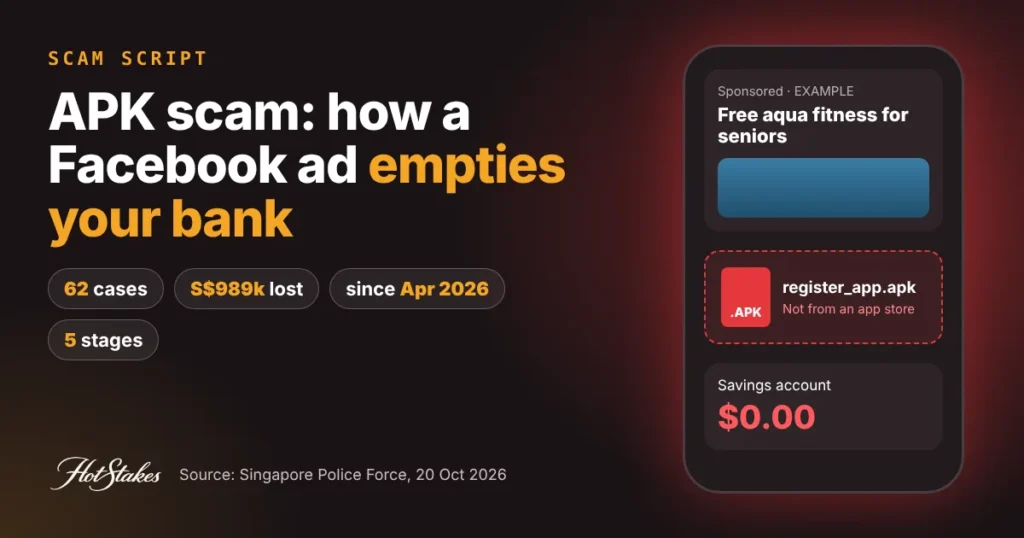
- Singapore: AI-generated “police officer” ads (23 Oct 2026). Facebook ads used AI-generated images of police officers to promote “scam recovery services”, led to a form, then asked for a one-time password (OTP) sent by WhatsApp or SMS, which can hand over your accounts (SPF, 23 Oct 2026).
- Singapore: “Fun Coffee” victims targeted (27 Aug 2026). People who lost money on the Fun Coffee platform were contacted by scammers claiming to represent the platform or a recovery service, asking for a deposit, tax or fee by bank transfer (SPF, 27 Aug 2026).
- Hong Kong: the “casino trace” story. Bogus solicitors told victims they had worked with the Anti-Deception Coordination Centre and traced the stolen money to a casino, where it was laundered. Victims were added to a WhatsApp group called “Cyber Task Force on Loss Recovery”, told to download a casino-branded app to “trace” the money, then asked for “service charges” (ADCC, 22 Oct 2024).
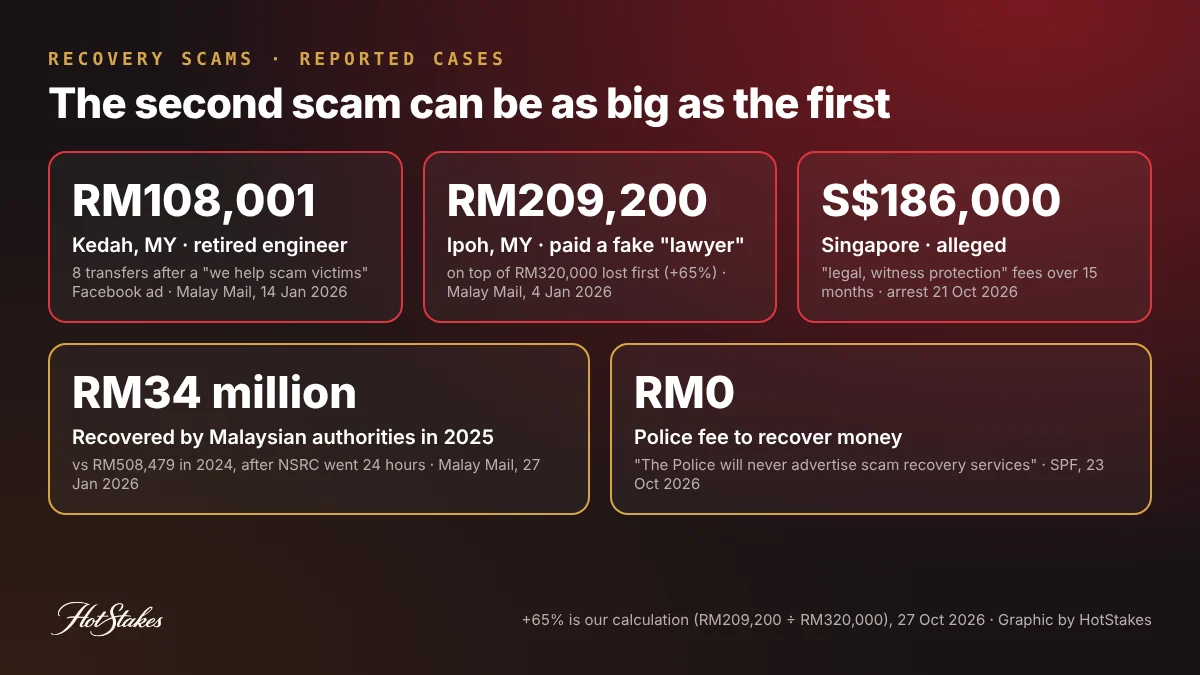
Our calculation (27 Oct 2026): In the Ipoh case, the recovery scam took another 65% on top of the first loss (RM209,200 vs RM320,000). Four in every ten ringgit he lost went to the people promising to get it back.
Takeaway: The second scam can be almost as big as the first, because a victim will pay a lot to undo a mistake.
The 6 disguises recovery scammers use
We grouped the official warnings above into six costumes. The costume changes; the fee does not.
| Disguise | What they say | The tell |
|---|---|---|
| Fake lawyer or law firm | “Our chambers recovers crypto and casino losses through legal channels.” | No practising certificate you can check; avoids video calls; asks for crypto or transfers (FBI IC3) |
| Fake police or anti-scam centre | “You are on the official scam victim list. Pay the release fee.” | Police logos on a Facebook ad. Malaysia’s CCID said such an ad had “no affiliation” with police (Malay Mail, May 2025) |
| Fake cyber or government agency | “Our technical expert traced your funds. Here is your certificate.” | Official-looking documents with spelling errors; HKCERT warned of a fake “Certificate of Asset Recovery” (HKCERT, May 2025) |
| “Fellow victim” | “I got my money back with this team. Join our group.” | A stranger who knows your name, number and loss amount, then adds you to a WhatsApp group |
| Hacker or blockchain tracer | “We can trace your USDT and hack the scam wallet.” | Asks for a new crypto wallet, remote access to your phone, or your OTP |
| The platform’s own “refund team” | “Your casino balance is unfrozen. Pay the tax to withdraw.” | The same site that took your money now wants more to release it |
Takeaway: If they contacted you first and they want money first, the costume does not matter.
How the recovery scam script runs, step by step
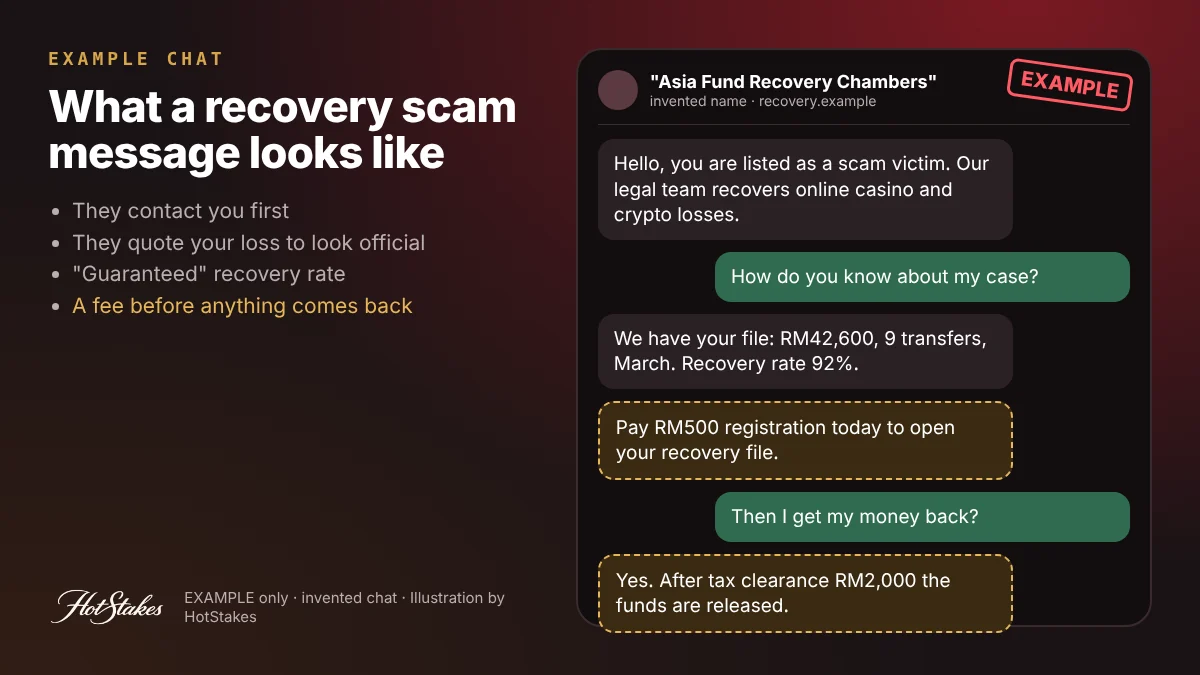
The order below comes from the police and agency reports above. EXAMPLE lines are invented, for recognition only.
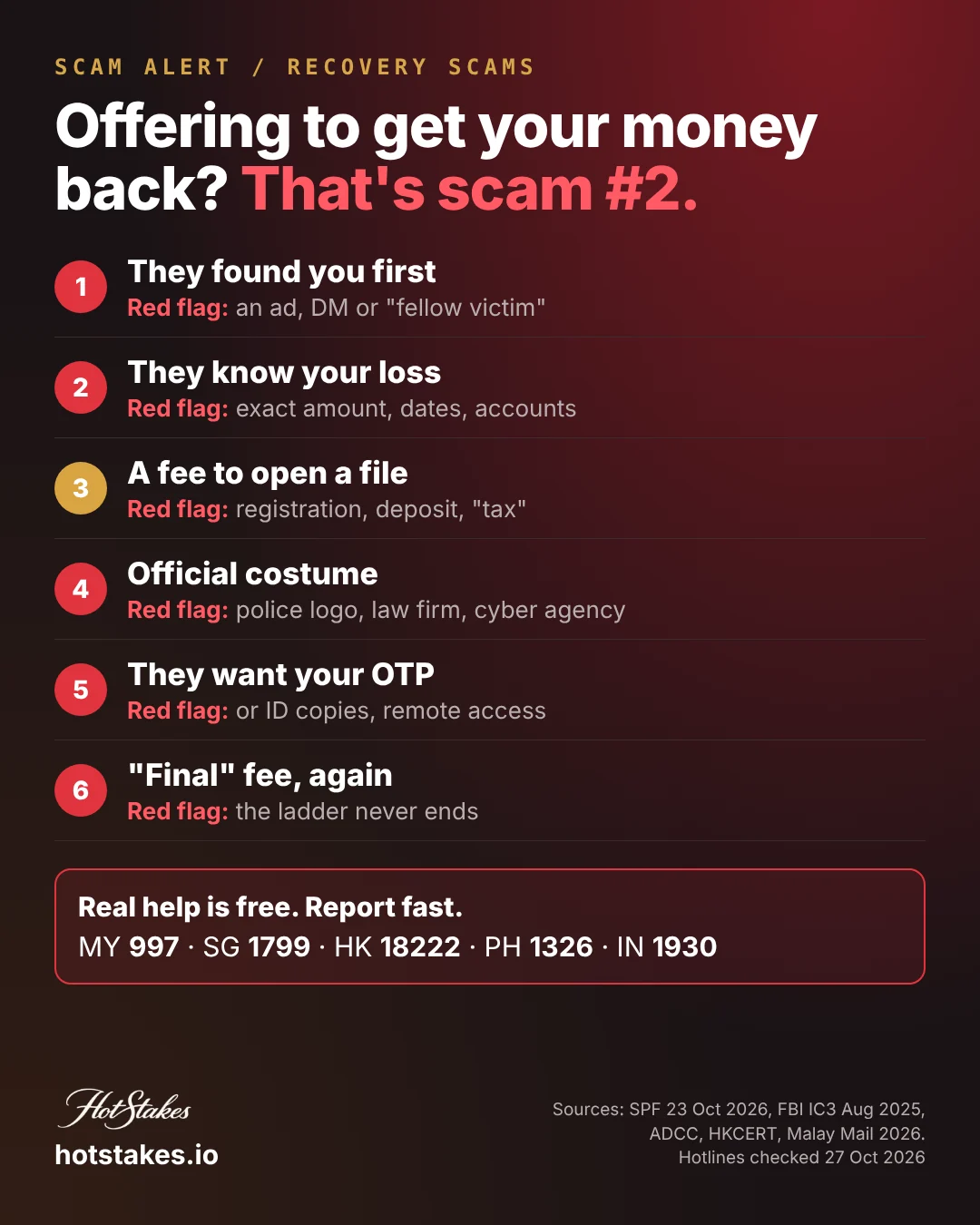
- The hook. An ad, a search result or a message finds you right after your loss. EXAMPLE: “Lost money online? Our legal team recovered RM2.4 million last month.”
- Proof they know you. They quote your exact loss, dates and the account you paid. The FBI lists this as a red flag, and HKCERT says scammers obtain lists of earlier victims.
- The “file fee”. A small first payment to open your case. EXAMPLE: “Pay RM500 registration to open your recovery file today.”
- The fee ladder. Then a “tax”, an “anti-money-laundering clearance”, a “court fee”, a “witness protection” charge. Each payment is the last one, until the next.
- Silence or a new round. They disappear, or a new “agency” calls offering to recover what the first recovery team took.
Some versions do not even want a fee. Singapore’s 23 Oct 2026 advisory describes ads that only want your one-time password. Once you share it, they can take over your WhatsApp or bank login, and use your account for the next scam.
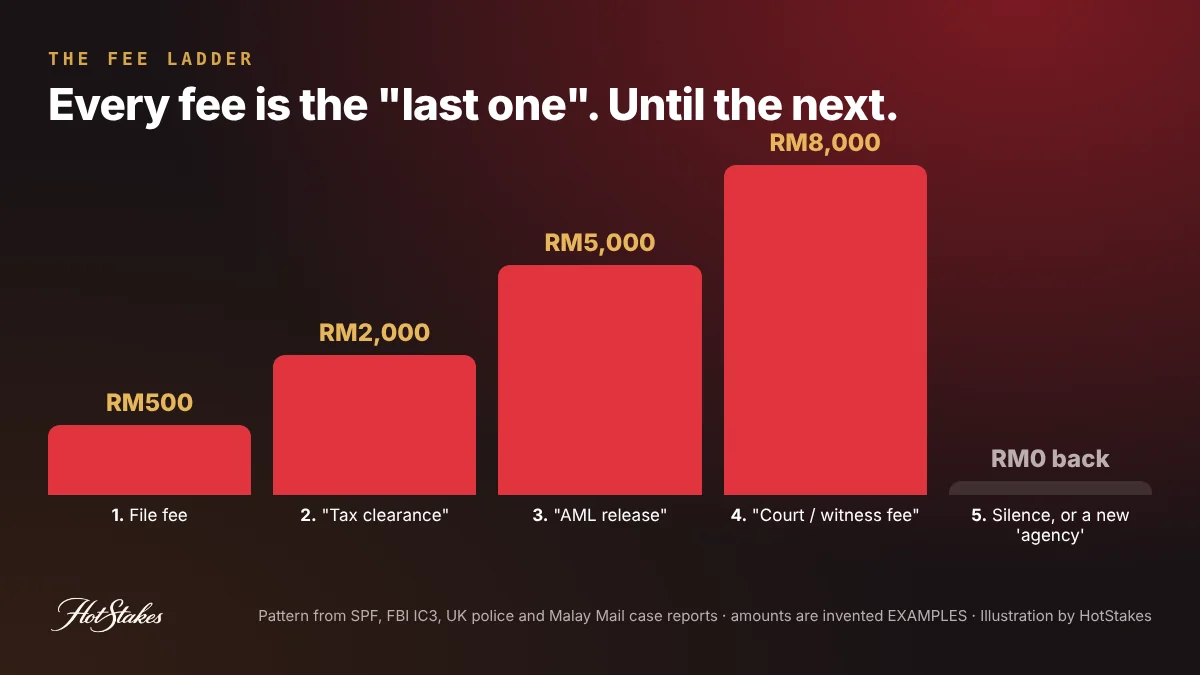
Takeaway: Step 3 is where to stop. Real help never starts with you paying to open a file.
Lost money to a fake online casino? Why you are a target
Gambling-scam victims are prime targets for a recovery scam for three reasons:
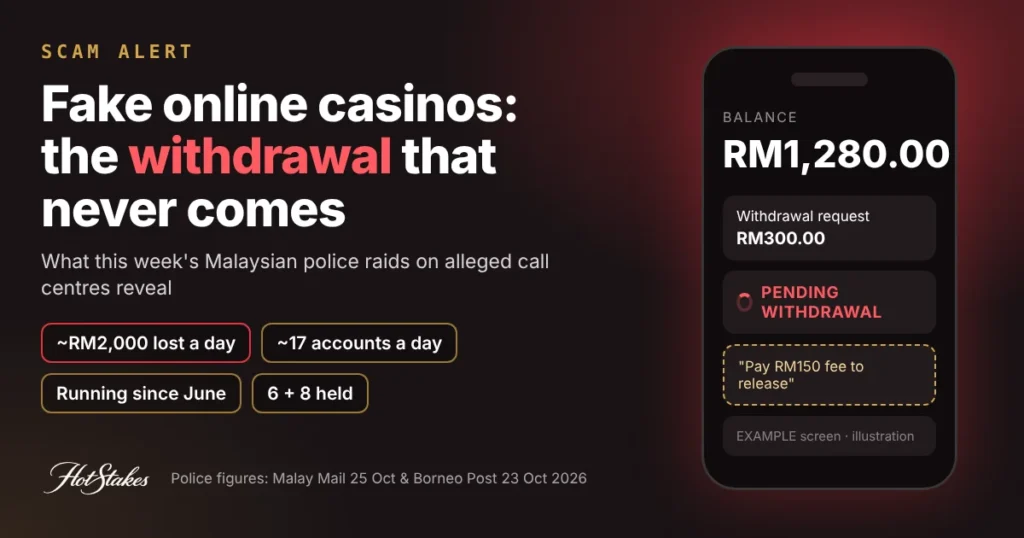
- The money feels “almost there”. A fake casino shows a balance on screen. A fake online casino keeps it on “pending withdrawal”, so a “recovery agent” who says he can release it sounds believable. That is the same move as the withdrawal fee scam, in a new costume.
- Shame keeps people quiet. Many players do not tell family or police because gambling was involved, so they look for a private fix online, where the ads are waiting.
- The casino story sounds real. In the Hong Kong case, scammers said stolen money had been laundered through a casino and handed victims a casino-branded app to “trace” it. A famous name makes a false story feel official.
If a licensed operator is really holding your withdrawal, there is a free route: the operator’s complaint process, then its regulator or an independent dispute service. Our online casino complaint guide explains each step. You never pay a stranger to do it.
Takeaway: A balance on a scam site is not money waiting to be released. Nobody can “unlock” it for a fee.
Real recovery vs fake recovery
Money can come back, but only through channels that never charge you upfront. Malaysia’s Home Minister told Parliament that RM34 million was recovered from scam activities in 2025, up from RM508,479 in 2024, after the National Scam Response Centre (NSRC) moved to 24-hour operation (Malay Mail, 27 Jan 2026). That is about 67 times more, and it came from speed, not from paid agents.
| Check | Real help | Recovery scam |
|---|---|---|
| Who contacts whom | You contact them, using a number you found yourself | They find you: ad, DM, “fellow victim”, search result |
| Cost | Police, NSRC, ScamShield and banks: free | File fee, tax, clearance fee, then more |
| Promise | “We will try to freeze the accounts.” No guarantee | “Guaranteed recovery”, often a set percentage |
| How you pay | You do not pay to report | Bank transfer to personal or company accounts, crypto, gift cards |
| Proof of identity | Police report number; a lawyer you can find on the Bar or Law Society register | Logos, certificates, no video call, no checkable licence |
| What they ask for | Transaction details and evidence | Your OTP, passwords, ID copies, remote access |
A real lawyer can help with civil claims, but you choose them, you check them on the official register (in Hong Kong, the Law Society of Hong Kong, as the ADCC advises), and they do not cold-call you through Facebook.
Takeaway: Recovery comes from reporting fast, not paying more.
Already contacted or paid? What to do now
Prefer a checklist? Our free “Scammed? Do this now” tool gives you the hotline for where you live and the steps in order.
- Stop all payments. No “final fee” will release anything.
- Do not share any OTP, password or ID copy. If you already did, change passwords and turn on two-step verification on WhatsApp and email.
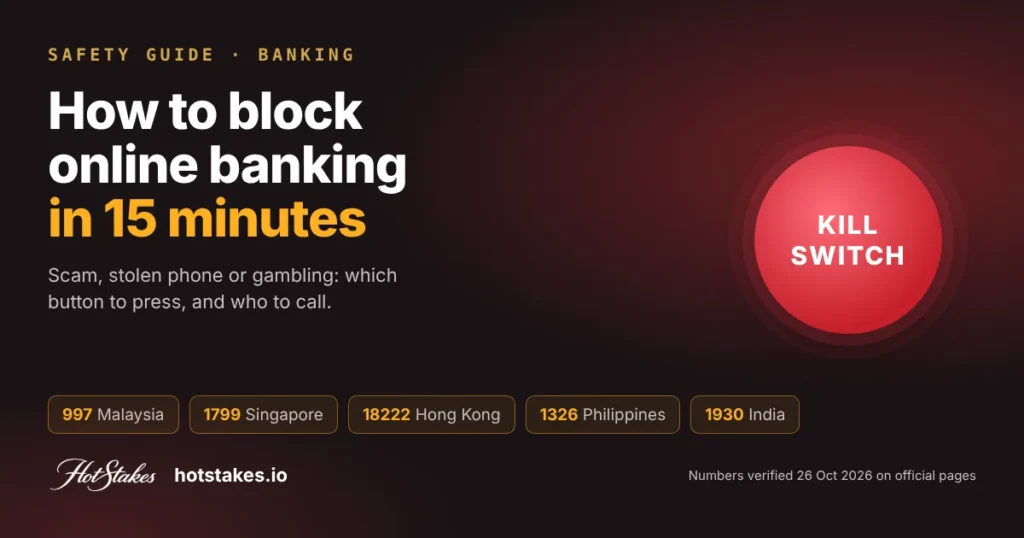
- Call your bank using the number on your card or banking app, and ask it to block or recall the transfers. Our guide to blocking online banking fast shows the kill-switch options.
- Call your scam hotline (table below) with every account number you paid, the first scam and the recovery scam.
- Make a police report and keep the report number. Save chats, ads, receipts and phone numbers.
- Expect a third approach. Your details may be sold again. Hang up on anyone who calls offering recovery, as the UK police advise.
- Tell one person you trust. Scammers rely on you keeping it secret.
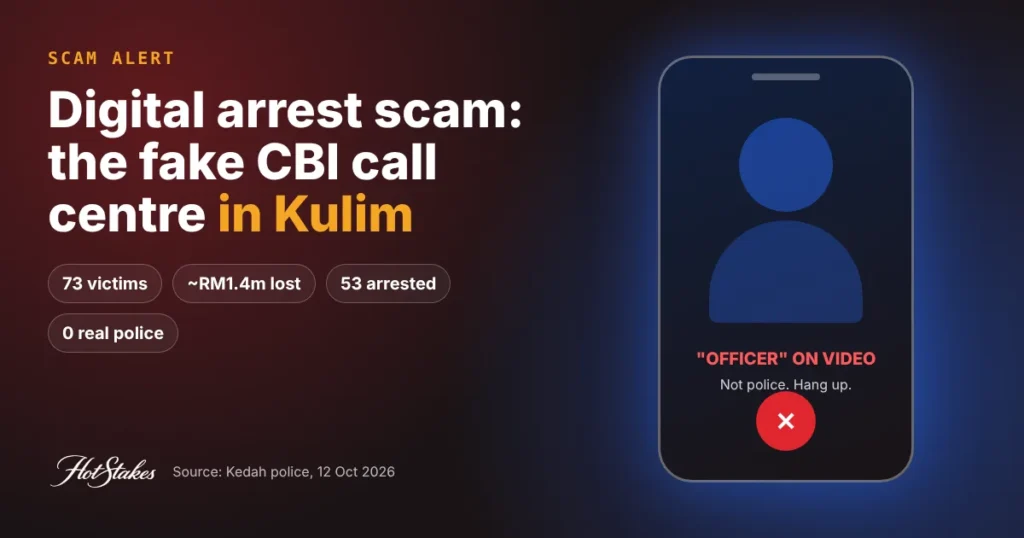
Not sure if a message is a scam? Try our scam or legit quiz. And because some recovery ads impersonate officials, read how the digital arrest scam uses fake police, and how deepfake ads fake trusted faces.
Where to report a recovery scam
We checked each number on 27 Oct 2026 against official or news sources.
| Where you are | Who to contact | Notes |
|---|---|---|
| Malaysia | 997 National Scam Response Centre | 24 hours (Malay Mail); police also point to the Semak Mule check |
| Singapore | ScamShield Helpline 1799; police hotline 1800-255-0000; 999 if urgent | 1799 is 24/7 (SPF) |
| Hong Kong | Anti-Scam Helpline 18222; check numbers and sites on Scameter | Report at a police station (ADCC) |
| Philippines | CICC Hotline 1326 | 24/7 (PNA) |
| India | 1930 or cybercrime.gov.in | 24 hours (Kerala Police) |
For how the first scam usually builds trust over weeks before it takes everything, read our pillar guide to how pig butchering scams work.
Takeaway: One fast, free call beats any paid “recovery expert”.
FAQ
Can a recovery company really get my scammed money back?
Be very careful. Police in Malaysia, Singapore, Hong Kong and the UK all warn that people offering to recover scam losses for a fee are usually scammers. Real recovery happens when police or your bank freeze money fast, and they do not charge you.
Do the police charge a fee to recover money?
No. The Singapore Police Force said on 23 Oct 2026 that the police will never advertise scam recovery services, and the UK police say genuine agencies do not charge fees to recover money lost to fraud.
How did the recovery scammer know my loss amount?
Scammers obtain lists of earlier victims, HKCERT warns. The FBI and HKCERT both describe recovery scammers who already knew victims’ names, phone numbers, loss amounts and transfer dates. Knowing your details proves nothing.
Is a “fund recovery” lawyer on Facebook real?
Assume not. Check any lawyer yourself on the official register (for example the Law Society of Hong Kong or the Malaysian Bar), call the firm on a number you found independently, and never pay by crypto, gift card or personal bank transfer.
I lost money on a fake casino. Can someone release my withdrawal?
No. A balance on a scam site is not real money waiting to be released. Anyone offering to unlock it for a fee is running the next stage of the scam. Report it to your scam hotline instead.
What if I already gave a recovery scammer my OTP?
Call your bank immediately using the number on your card, change your passwords, check your WhatsApp linked devices, turn on two-step verification and report to your scam hotline.
HotStakes is an independent directory. Some links on this site are affiliate links; we may earn a commission at no cost to you, and it never changes our rankings. Gambling involves risk — only play with money you can afford to lose, and if it stops being fun, seek help. This article is general information, not legal advice. Read our full disclaimer.
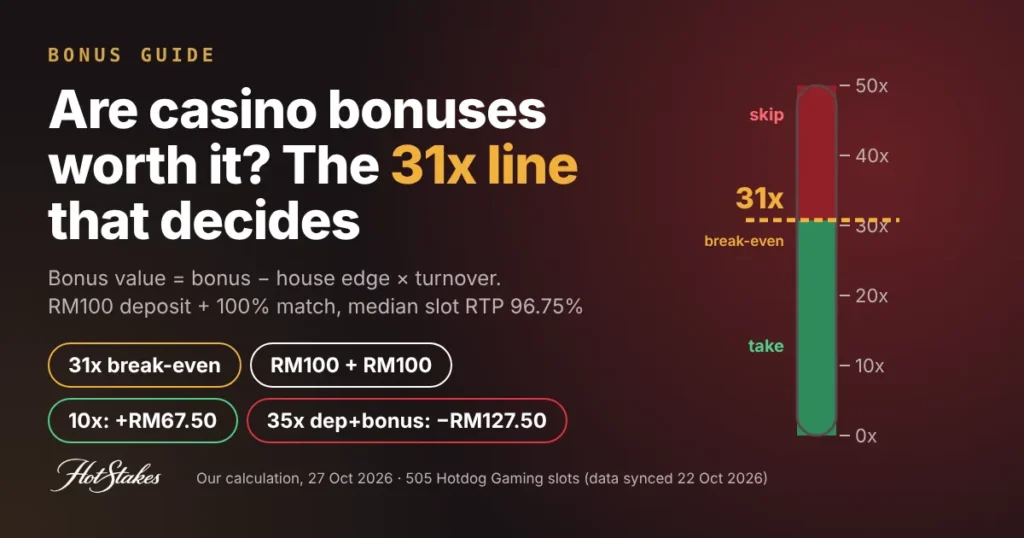 Next story →Are Casino Bonuses Worth It? The 31x Line That Decides

Start the discussion