

Withdrawal Fee Scam: The Pay-to-Withdraw Script, Explained
Frozen account, tax, clearance fee, credit score: the withdrawal fee scam script stage by stage, what each line means and who to call.
In this article
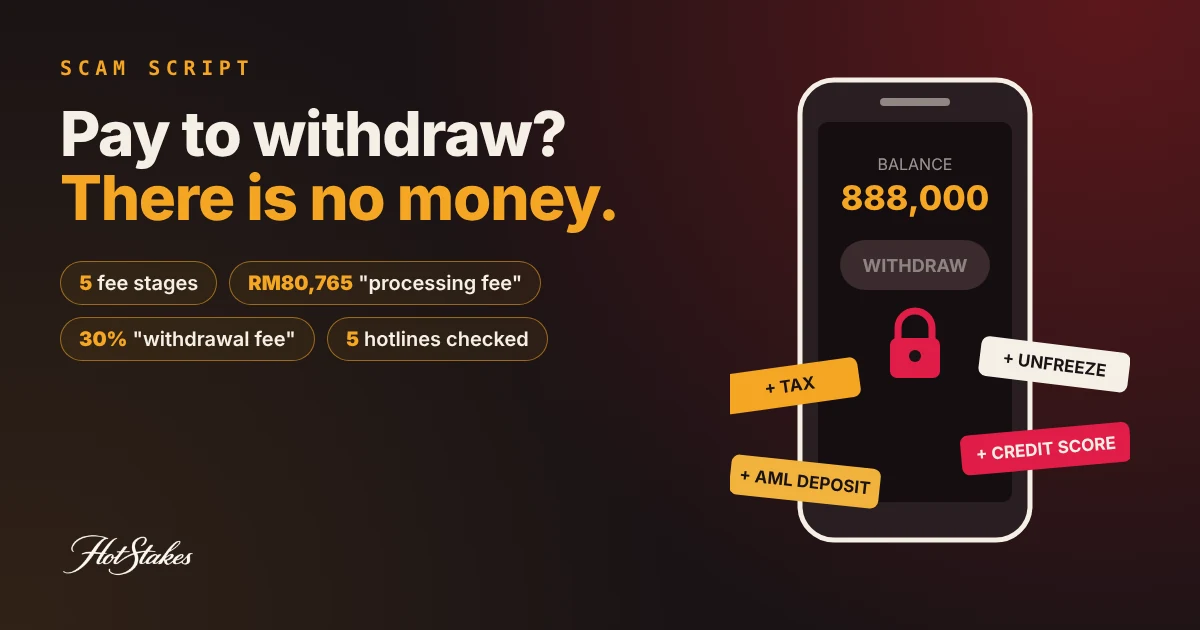
Your balance says you’ve made a fortune. You press withdraw, and an “agent” says you must pay a tax, a clearance fee or a deposit first. If a platform needs more of your money before it releases your money, the money isn’t there. This is the withdrawal fee scam, the last stage of fake investment, trading and gambling platforms. Below are the lines scammers use, in the order they usually come, what each one really means, and what to do in the next hour. We opened every report cited here on 21 Oct 2026.
Where the withdrawal fee fits in the scam
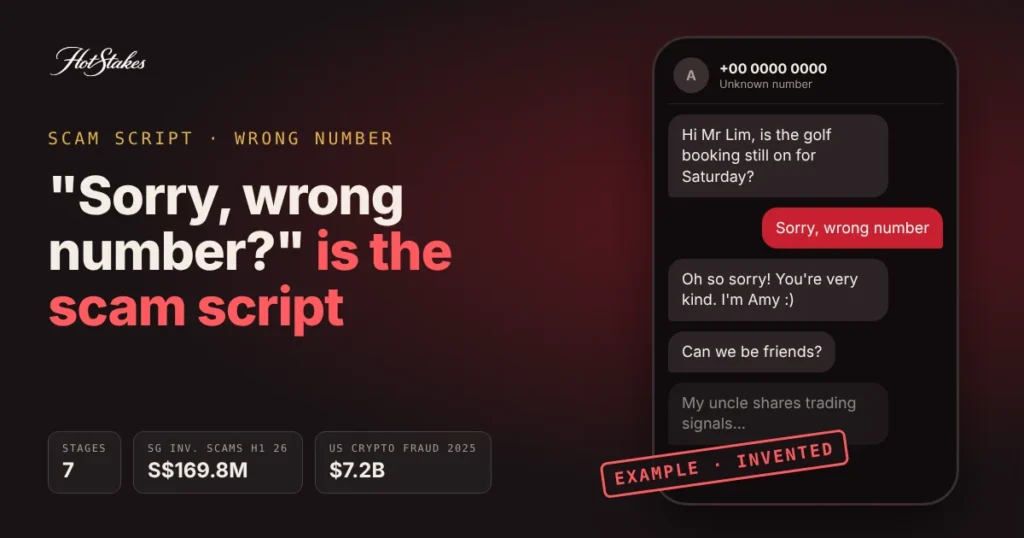
By the time a fee appears, the scam is nearly over. The earlier stages are covered in our pillar on how pig butchering scams work and in the wrong-number text scam script. In short: friendly contact, a platform, a small early payout to build trust, then bigger deposits.
The US Commodity Futures Trading Commission describes the turn well. Small withdrawals may work, but try to take out large sums and “suddenly there are problems”.
It is not rare. Singapore Police recorded at least 470 investment scam cases and S$32.6 million in losses in roughly the first six weeks of 2025. Police said most victims realised it was a scam when they could not withdraw their “profits”, after paying increasingly large “fees incurred”.
Takeaway: The withdrawal fee is not a hurdle before your payout. It is the scam’s final harvest.
The script, stage by stage
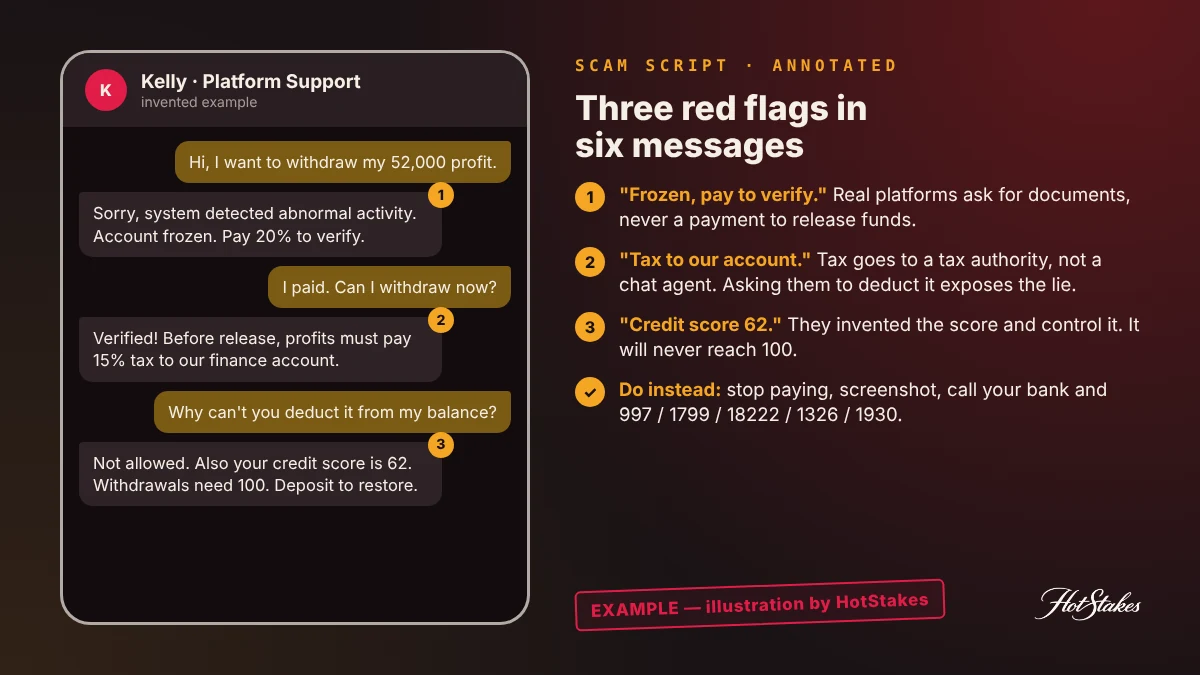
The messages below are short EXAMPLES written by HotStakes. Each is built from a pattern in a police statement or news report, linked under it. They are recognition-level excerpts, so you can spot the stage you or a parent are in. Names, numbers and platforms are invented.
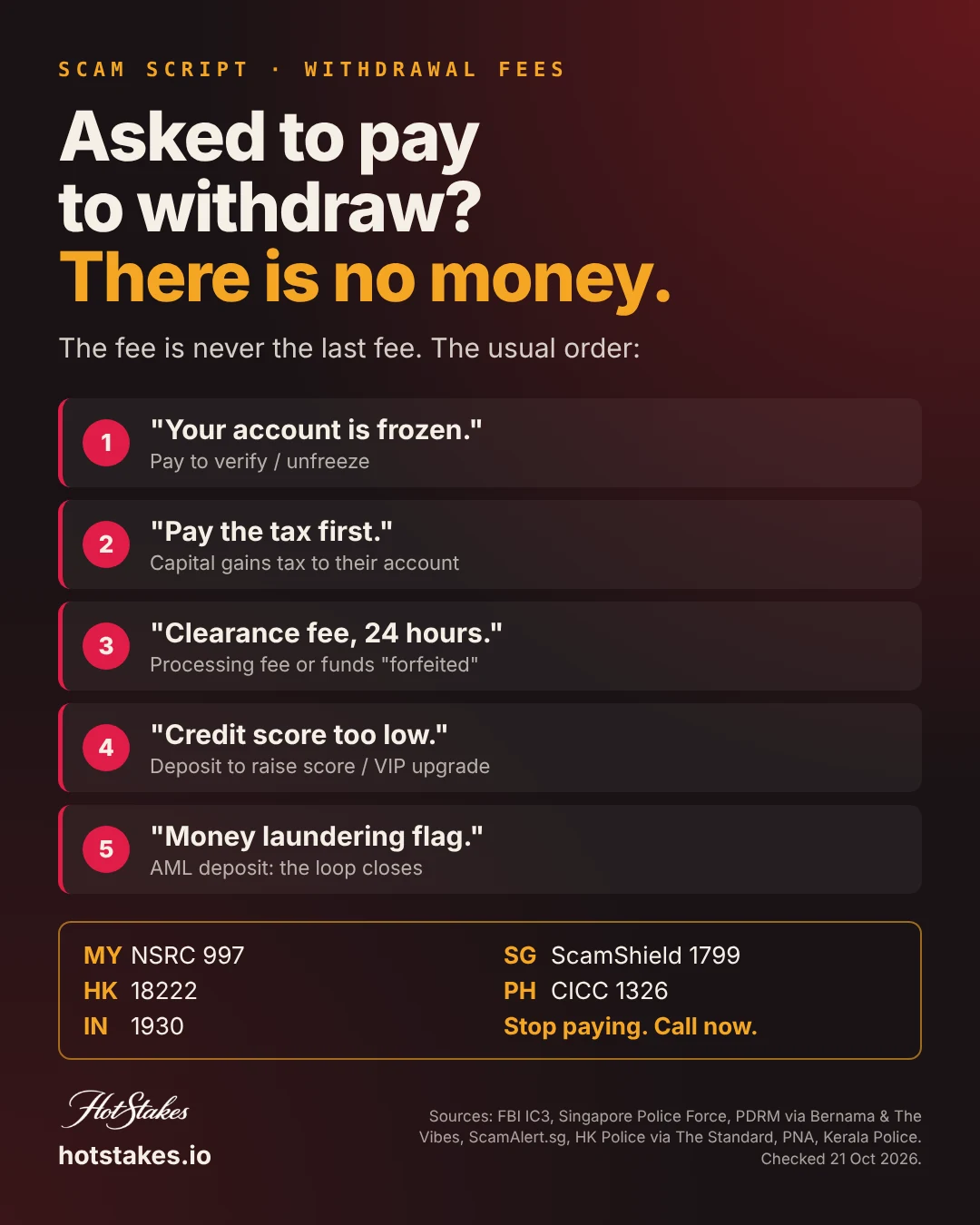
Stage 1: “Your account is frozen”
EXAMPLE: “System detected abnormal activity. Account frozen. Pay 20% of balance to verify and release.”
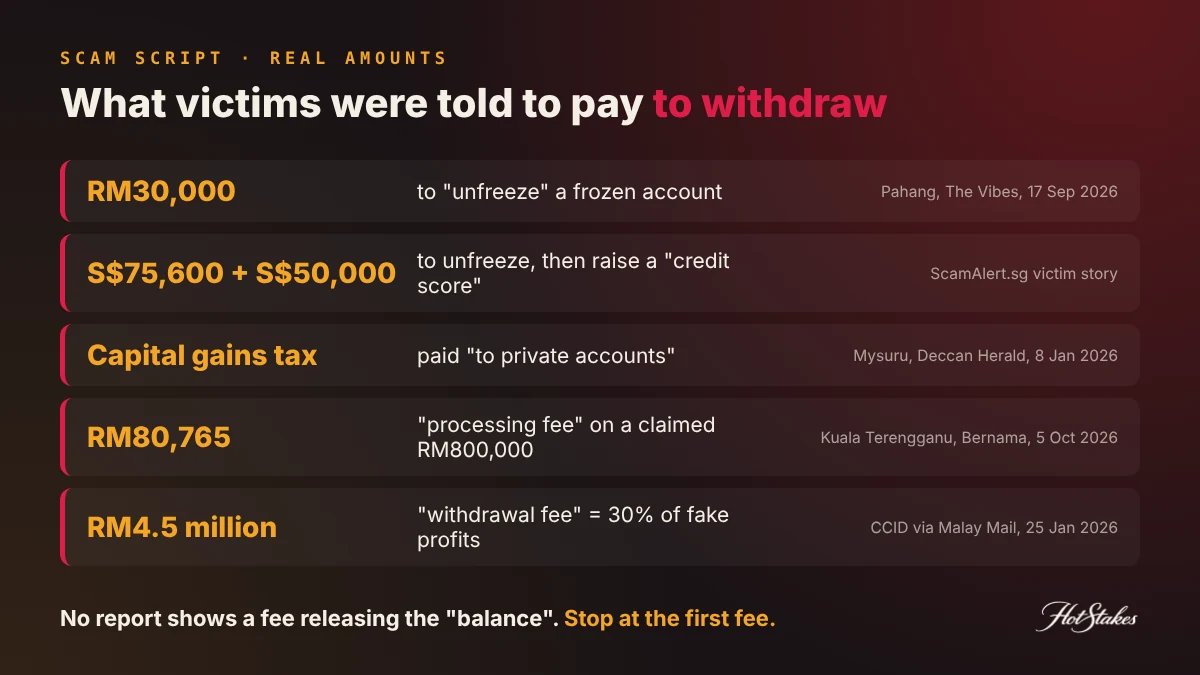
- Real report: A 65-year-old in Pahang was told in August 2026 his account was frozen and he had to pay RM30,000. He had already lost RM218,239, police said. A victim story on ScamAlert.sg describes S$75,600 demanded “to unfreeze it”.
- Red flag: A real platform that freezes an account asks for documents. It never charges you to unfreeze.
- Reply / do instead: Don’t reply. Screenshot the message and call your bank.
Stage 2: “Pay the tax first”
EXAMPLE: “Profits above 100k are taxable. Pay capital gains tax to our finance account before release.”
- Real report: A Mysuru man whose fake app showed over Rs 15 crore was told to pay capital gains tax “to private accounts”, Deccan Herald reported in January 2026. He had lost Rs 1.77 crore. An Australian victim told Scamwatch the same story.
- Red flag: Tax goes to a tax authority, assessed on you, later. It is never paid to a platform’s agent before a payout.
- Reply / do instead: “Deduct it from my balance.” A scam can’t, because the balance is fake.
Stage 3: “Processing fee” or “clearance fee”
EXAMPLE: “Withdrawal approved. Clearance fee 10% must be paid separately within 24 hours or funds are forfeited.”
- Real report: In Kuala Terengganu, a victim was told his platform balance had passed RM800,000 but he had to pay a “processing fee of RM80,765”. He refused and went to police (Bernama, 5 Oct 2026). In a clone investment case, Malaysia’s CCID said a businessman was asked for a RM4.5 million withdrawal fee, 30% of displayed profits.
- Red flag: A deadline plus “forfeited”. Pressure is the tool.
- Reply / do instead: Nothing. Refusing, like the Terengganu victim did, is the right move.
Stage 4: “Your credit score is too low” or “upgrade to VIP”
EXAMPLE: “Credit score 62. Withdrawals need 100. Deposit to restore score, then withdraw in 48 hours.”
- Real report: After paying to unfreeze, the ScamAlert.sg victim was told to deposit S$50,000 “to increase my credit score” for a “48-hour withdrawal”. A guide from crypto exchange CoinJar lists the “account upgrade” to a higher withdrawal tier as another version.
- Red flag: The platform invented the score and controls it. It will never reach 100.
- Reply / do instead: Tell one person you trust today. Saying it out loud breaks the spell.
Stage 5: “Money laundering flag”
EXAMPLE: “Compliance alert: source of funds unusual. Anti-money-laundering deposit required.”
- Real report: The ScamAlert.sg story ends here. The account was flagged for money laundering over the “unusual source of funds”, after the victim had taken out loans to pay.
- Red flag: The fees are now being blamed on the fees. That is the loop closing.
- Reply / do instead: Call the hotline in the table below. You are not in trouble for being scammed.
Takeaway: The labels change. The ask never does: send more money to get your money.
What the scammer says vs what it really means
| What the scammer says | What it really means | What to do |
|---|---|---|
| “Account frozen, pay to verify” | There is nothing to verify; the balance is a number on their screen | Stop. Screenshot. Call your bank |
| “Pay tax before withdrawal” | No tax office collects tax through a chat agent | Ask them to deduct it. They won’t |
| “Clearance / processing fee, 24 hours” | A deadline to stop you asking anyone | Ignore the deadline. Tell family |
| “Credit score too low” | A score they made up and will keep lowering | Don’t deposit to “fix” it |
| “Upgrade to VIP to withdraw” | A bigger deposit with a nicer name | Same answer: no |
| “Anti-money-laundering deposit” | The script is ending; they are squeezing the last payment | Report to police now |
| “We recovered your money, small fee” | A second scam, often by the same people | Call the official hotline yourself |
Takeaway: Every row means the same thing. Your money has already gone; only new money is at risk.
The gambling version: fake casinos and lottery “wins”
The same script runs on fake online casinos and lotteries, which matters for anyone who bets.
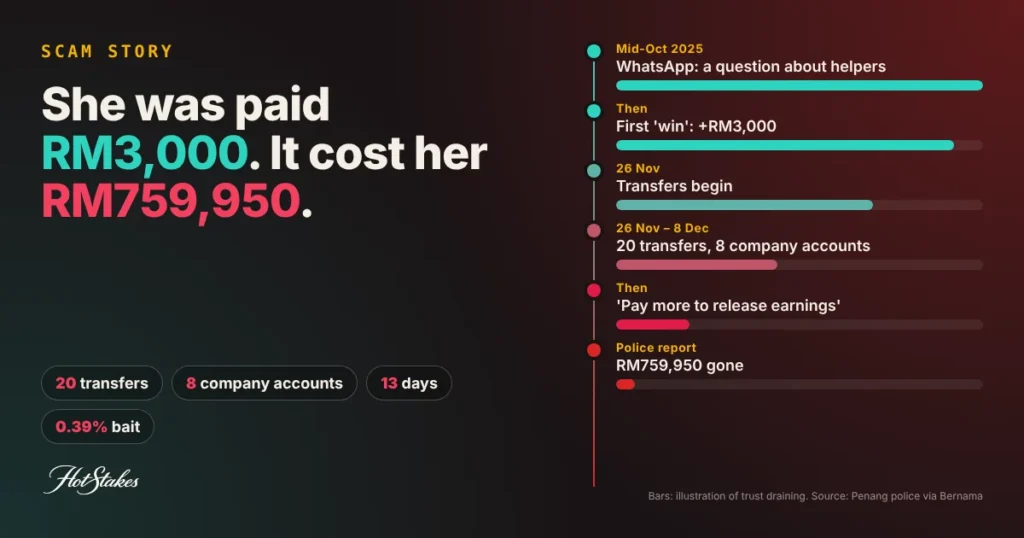
- A 64-year-old Penang real estate agent got a RM3,000 payout from an “online gambling investment”, then lost RM759,950 over 20 transfers. When profits stopped, she was asked for more payments to withdraw, police told NST in January 2026.
- A woman in Bau, Sarawak “won” RM80,400 on livestreamed scratch cards from a Facebook ad. To claim it, she paid RM6,128 in “various related fees”, Malay Mail reported. She got a fake transfer receipt; no money arrived.
We cover the casino-as-investment pitch in fake casino investment scams.
Here is the confusing part. Real, licensed casinos do sometimes hold a withdrawal. That is a KYC check, explained in our guide to why a KYC withdrawal hold happens. The difference is simple:
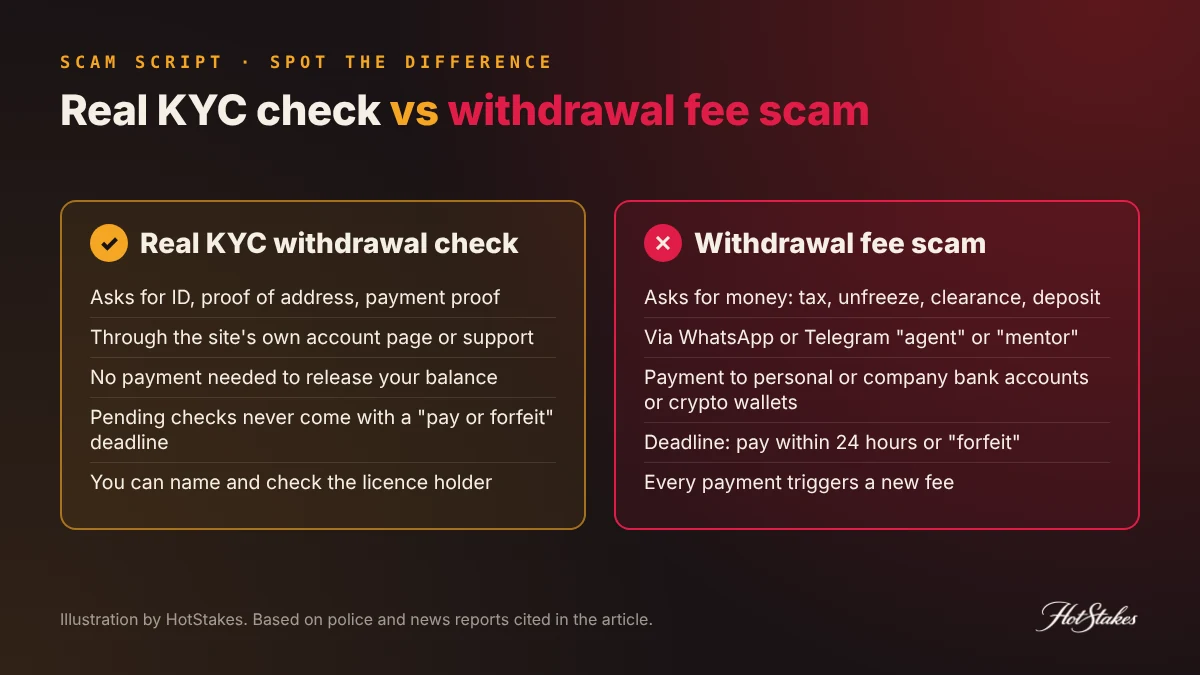
Takeaway: A real withdrawal check asks for your ID. A scam asks for your money.
What follows the last fee
When the money runs out, the agent goes quiet, the app stops loading or the account is “blocked”. In a Kulai case reported in June 2026, the app showed RM1.5 million in profits when the victim found her account had been blocked. She had paid RM343,190.
Then a new contact may promise to get your money back for a fee. Hong Kong police warned in February 2026 that scammers posing as its Anti-Deception Coordination Centre were doing exactly this, and that real officers never ask for money. Never pay anyone to recover scam losses.
Takeaway: There is no final fee. The script ends only when you stop paying or they think you have nothing left.
Already paid? Do this in the next hour
Speed matters. At the launch of Malaysia’s round-the-clock scam centre, Home Minister Saifuddin Nasution Ismail said “The first one to two hours are crucial.”
- Stop all payments. Don’t send “one last” fee, even if they threaten to forfeit your balance.
- Don’t argue or warn them. Just stop replying.
- Save evidence. Screenshot chats, the app, the website address, and every bank account or wallet you paid.
- Call your bank and your national scam line (table below) so transfers can be traced or blocked.
- Make a police report. Bring the screenshots and transfer list.
- Tell family. Shame keeps people paying. A second pair of eyes stops it.
| Where | Call | Notes (checked 21 Oct 2026) |
|---|---|---|
| Malaysia | NSRC 997 | 24 hours; call as soon as possible, then your bank and a police station (MyGOV) |
| Singapore | ScamShield Helpline 1799 | 24/7; Police Hotline 1800-255-0000 (SPF) |
| Hong Kong | Anti-Scam Helpline 18222 | Also checks suspicious “ADCC” contacts (The Standard) |
| Philippines | CICC I-ARC 1326 | 24/7 scam reporting (PNA) |
| India | 1930 / cybercrime.gov.in | 24-hour cyber fraud helpline and portal (Kerala Police) |
Not sure if what you’re seeing is a scam? Take our two-minute scam quiz, or browse more scam alerts.
Takeaway: Save your country’s number in your phone, and in your parents’ phones, today.
FAQ
Is it normal to pay a fee to withdraw from an investment or casino platform?
No. A legitimate platform may hold a withdrawal to check your ID, but it does not ask you to send a separate payment first. Any tax, unfreeze, clearance or deposit demand before a payout is a classic withdrawal fee scam sign.
If I pay the tax, will I get my money?
No. The FBI warns victims cannot get their money back even after paying the imposed fees or taxes, and advises not to pay any more. Each payment usually triggers a new fee.
My account is frozen and they want a deposit to unfreeze it. What should I do?
Stop paying, save screenshots, and call your bank and your national scam line: 997 in Malaysia, 1799 in Singapore, 18222 in Hong Kong, 1326 in the Philippines or 1930 in India. Then make a police report.
Why did they let me withdraw a small amount at first?
To build trust. Police reports describe early payouts, such as RM3,000 in one Penang case, before much larger deposits. Small withdrawals working does not prove the platform is real.
Someone says they can recover my money for a fee. Is that real?
Treat it as a scam. Hong Kong police say real Anti-Deception Coordination Centre officers never ask for money. Contact official hotlines yourself and never pay to recover losses.
HotStakes is an independent directory. Some links on this site are affiliate links; we may earn a commission at no cost to you, and it never changes our rankings. Gambling involves risk — only play with money you can afford to lose, and if it stops being fun, seek help. This article is general information, not legal advice.
 Next story →Casino Cashback Bonus Explained: What 10% Back Is Worth

Start the discussion