

Macau Scam: How a Fake Police Call Took RM1.2 Million
A spoofed police call cost a Kelantan mother RM1.2 million. How the Macau scam works, the script's red flags, and who to call: 997, 1799.
In this article
- The case: one call, RM1.2 million, two months of silence
- How the Macau scam works: 5 stages
- The script: 5 example lines and their red flags
- How big is the Macau scam? Police numbers
- What real police, BNM and LHDN never do
- For families: protect a parent before the call comes
- Already paid or shared details? Report it now
- FAQ
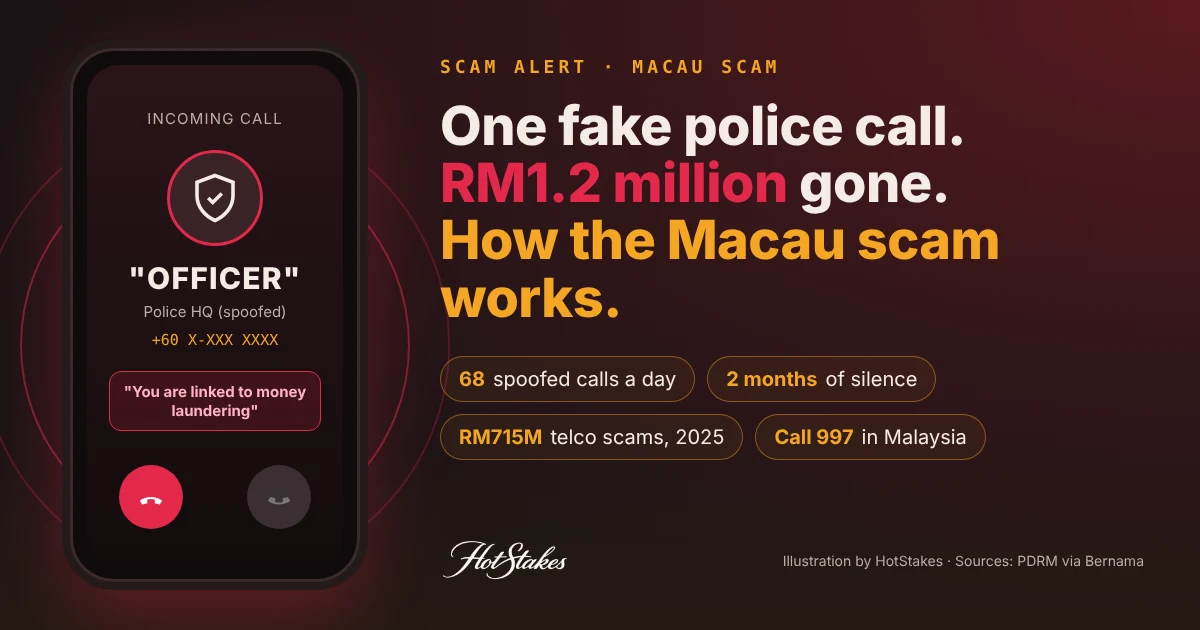
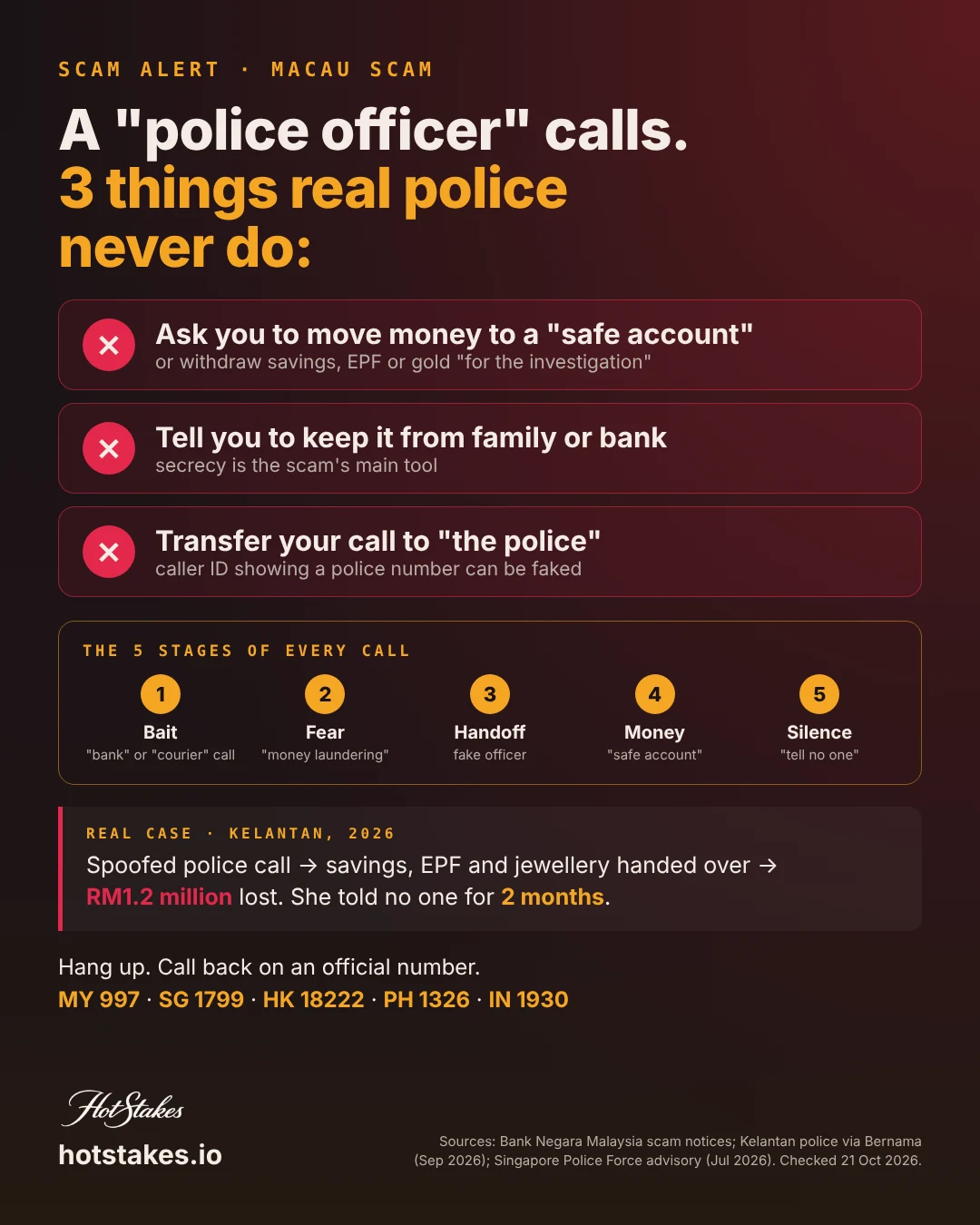
A caller says your IC is linked to money laundering. He sounds official, the screen may even show a police number, and he says the case is secret. If any caller accuses you of a crime and then tells you to move money, open a new account or keep the call from your family, it is a Macau scam: hang up and call 997 in Malaysia (1799 in Singapore) or your bank on its official number. Below is one real 2026 case, step by step, the five stages every version follows, and the three things real police never ask.
The case: one call, RM1.2 million, two months of silence
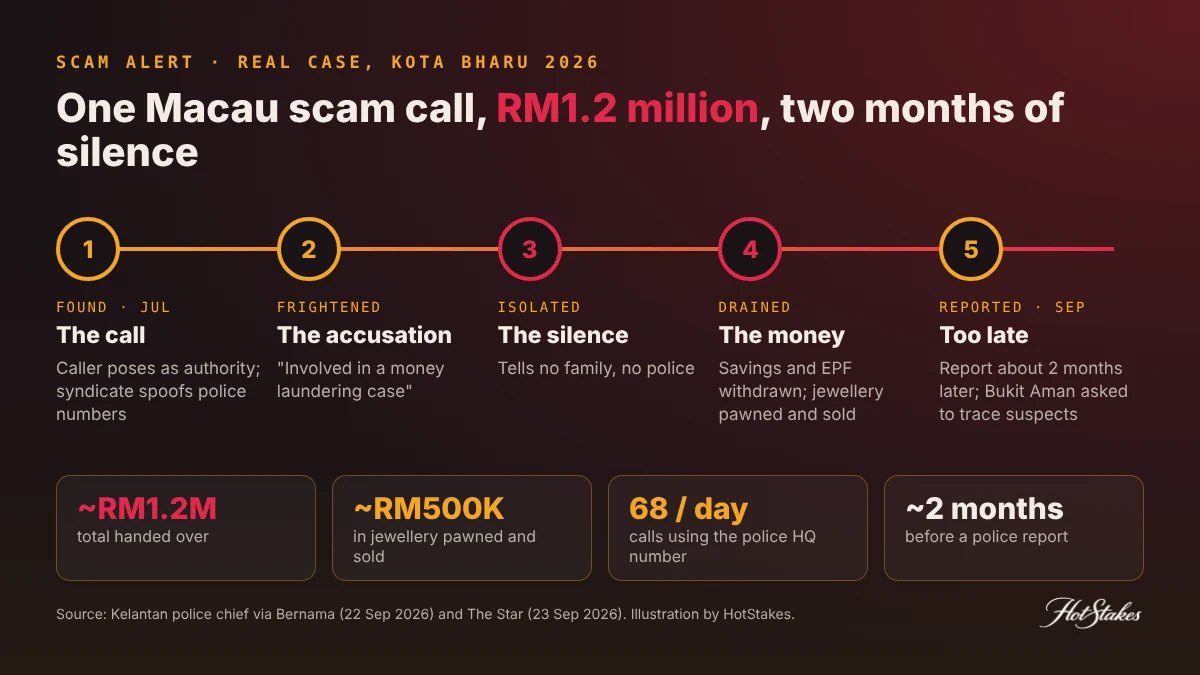
In September 2026, Kelantan police chief Datuk Mohd Yusoff Mamat described one of the largest individual scam losses the state has recorded. The victim was a woman in her 50s in Kota Bharu, a company investment manager and a single mother. Here is what police said happened, as reported by Bernama and The Star. We have not added any detail they did not publish.
Found: a call that looked like the police
In July 2026 she received a phone call from someone posing as an authority figure. Police said the syndicate used spoofing apps so its calls appeared to come from the police, including the Kelantan police headquarters’ own telephone number.
That number was being abused at scale. Police detected about 68 calls a day made using it.
Frightened: “you are linked to money laundering”
The caller told her she was involved in a money laundering case. She was not. According to the police chief, she knew she was innocent, but she was “so frightened” that she followed the caller’s instructions anyway.
That is the design. Fear makes a sensible, financially literate person act before she thinks.
Isolated: no family, no bank, no police
She did not tell her family. She did not tell the police. It took her about two months to lodge a report, which the police chief called the most concerning part of the case.
Drained: savings, EPF, jewellery
- She withdrew money from her bank accounts, including her EPF savings.
- She pawned and sold jewellery worth nearly RM500,000.
- All of it was handed over. Total loss: about RM1.2 million.
Kelantan police have asked Bukit Aman to help trace the suspects. The chief’s advice was simple: if you get such a call, “hang up and contact the relevant agency through its official channels”.
Takeaway: The money was lost over weeks, not seconds. Every day of silence was another day the syndicate could keep taking.
How the Macau scam works: 5 stages
The name is a Malaysian nickname for phone scams in which callers impersonate banks, couriers, police or government agencies. Even Macao News says it is uncertain how the label started. The method is better documented than the name. Bank Negara Malaysia described the core sequence in a scam notice, and the Singapore Police Force lays out the same steps in its July 2026 advisory:
- The bait call. A “bank”, “courier”, “telco” or “insurance” caller flags a suspicious charge, parcel, contract or policy in your name.
- The accusation. When you deny it, your identity is “tied to money laundering”.
- The handoff. You are “transferred” to a police or central bank officer from the same gang.
- The safe account. To “clear your name”, you must transfer funds, open new accounts, hand over cash or valuables, or share banking logins.
- The secrecy order. You must tell no one, not even bank staff or family.
| Stage | What the caller wants you to believe | What is really happening | Red flag |
|---|---|---|---|
| 1. Bait call | Your bank or a courier is helping you | The gang is checking if you will stay on the line | You did not call them |
| 2. Accusation | You are a suspect | Fear is being used to stop you thinking | A crime alleged by phone |
| 3. Handoff | An officer is now on your case | Same gang, new voice, maybe a spoofed number | Your call is “transferred to police” |
| 4. Safe account | Your money will be checked and returned | The account belongs to the gang or its money mules | Any request to move money |
| 5. Secrecy | Talking will ruin the investigation | Isolation stops family or bank staff stepping in | “Do not tell anyone” |
Two more Malaysian cases show the stages in action:
- Muar, Johor (Oct to Nov 2025). A 67-year-old retiree was accused of suspicious financial activity, then passed to a man claiming to be a police officer from Sarawak. Out of fear, he made 17 transfers to several accounts over nine days, totalling RM173,506, according to The Star.
- Seremban, Negeri Sembilan (Dec 2024 to Feb 2025). A 62-year-old former businessman got WhatsApp messages from a “Sergeant Michael” who said he was involved in money laundering. He paid RM4.2 million into company accounts “for investigation purposes” and only realised when his bank called him, police told Malay Mail.
Notice the Seremban case: the bank, not the “police”, raised the alarm. Outside eyes are what break the scam.
Takeaway: The script changes its costume (courier, bank, police, BNM, WhatsApp, phone) but never its order: bait, fear, handoff, money, secrecy.
The script: 5 example lines and their red flags
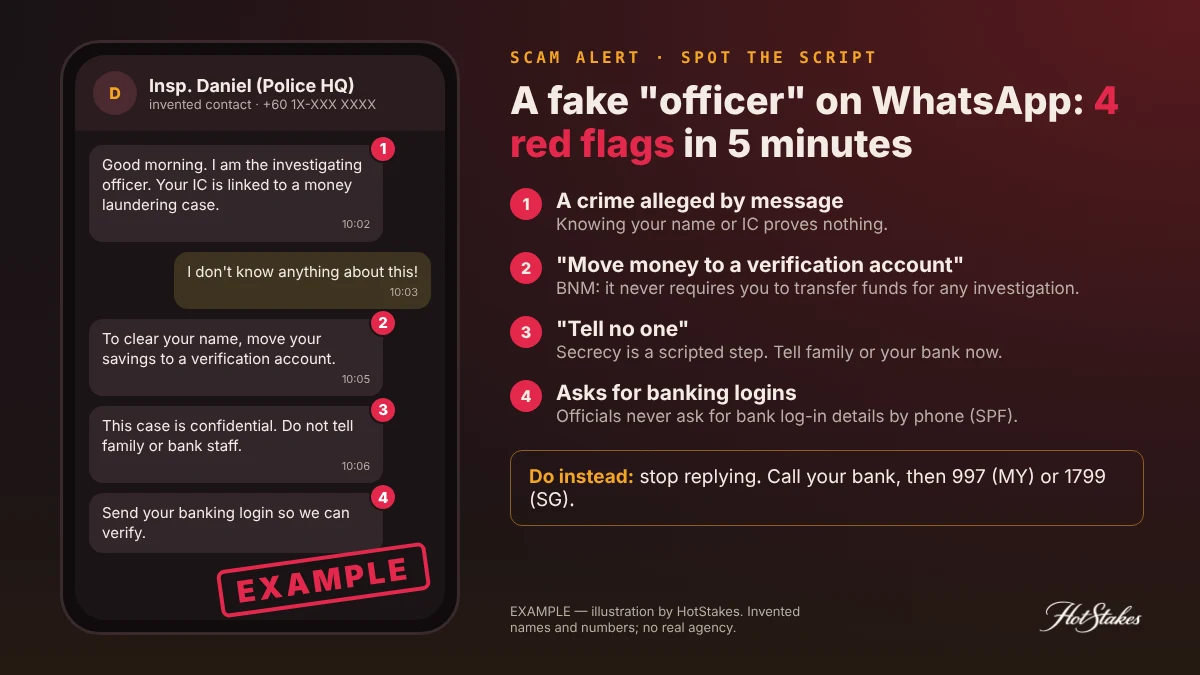
These are EXAMPLE lines written by HotStakes to help you recognise the stages. They are built from the police and central bank warnings above, not copied from a real call, and they are deliberately incomplete. If you hear anything like them, the call is over.
- EXAMPLE, bait: “This is the card fraud unit. A transaction of RM8,000 was made with a card in your name. Was that you?”
Red flag: an unsolicited call about a charge you do not recognise is the opening BNM describes. Do instead: hang up and call the number printed on the back of your own card. - EXAMPLE, accusation: “Your IC number was used to open an account in a money laundering case.”
Red flag: knowing your name or IC number proves nothing; ScamShield warns scammers use personal details to seem legitimate. Do instead: say nothing more and end the call. - EXAMPLE, handoff: “I will connect you now to the investigating officer at police headquarters.”
Red flag: Singapore police state government officials will never transfer your call to the police. A real-looking number on screen can be spoofed, as Kelantan police found. Do instead: hang up and dial the police station yourself. - EXAMPLE, safe account: “Move your savings into this verification account so Bank Negara can check them.”
Red flag: BNM says it will “never require you to transfer funds” for any investigation. Do instead: do not transfer a single ringgit. Call 997 or your bank. - EXAMPLE, secrecy: “This is a confidential case. If you tell your family or the bank, you will be in more trouble.”
Red flag: a demand for secrecy is a scripted step in BNM’s own description of the scam. Do instead: tell a family member or the bank right away. That one conversation is what the gang fears most.
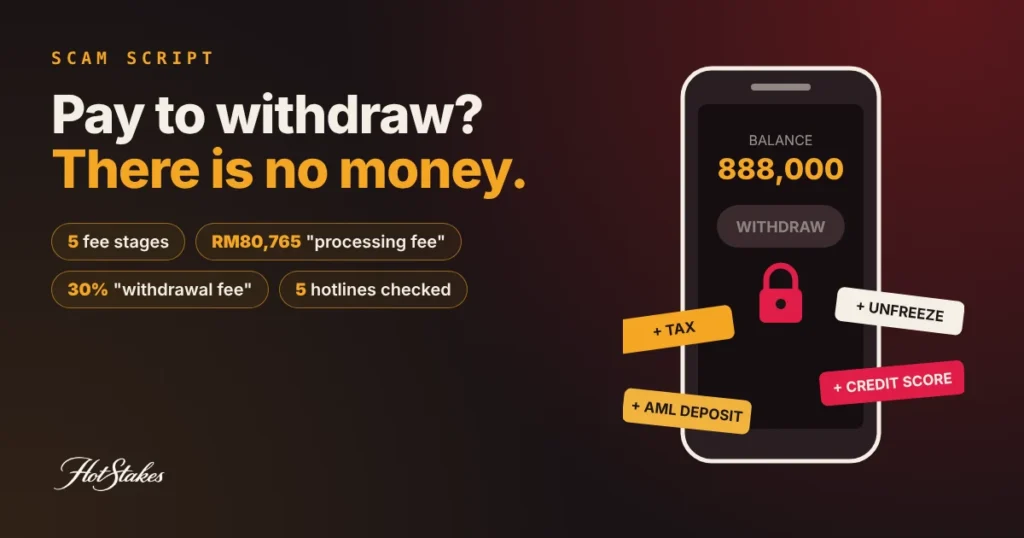
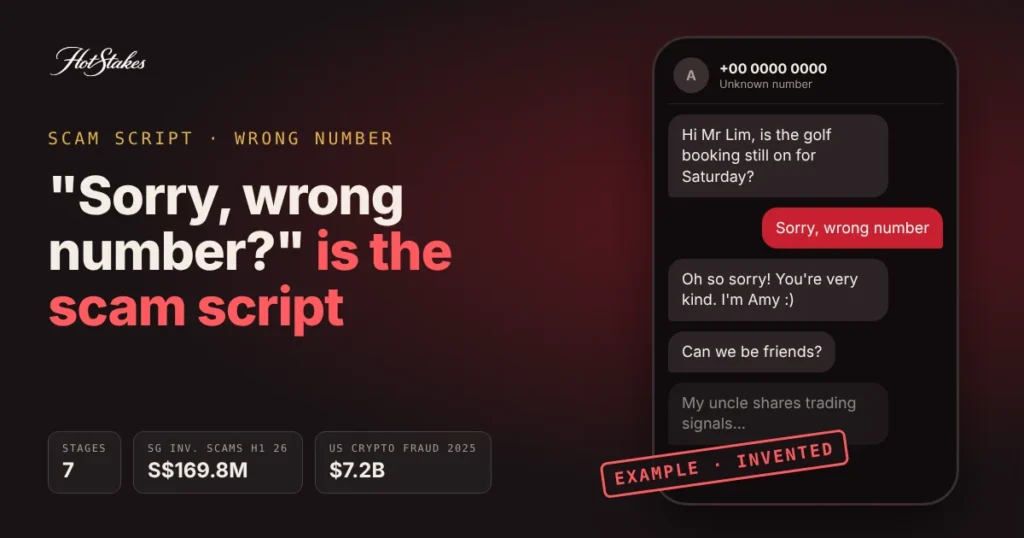
The same pressure-then-pay pattern shows up in other scripts we have broken down, from the wrong-number text scam to the withdrawal fee scam.
Takeaway: You do not need to win the argument. Any call that ends with “move your money” or “tell no one” is a scam.
How big is the Macau scam? Police numbers
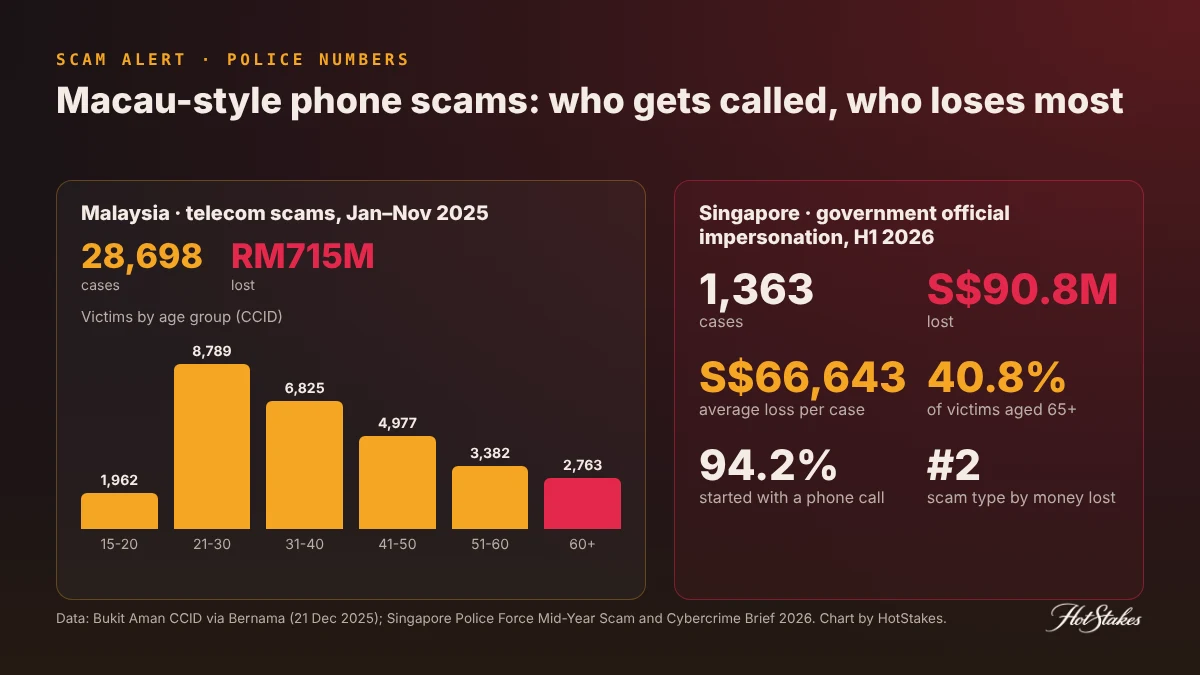
Malaysian police report phone-based fraud under a broader “telecommunications scam” category, so there is no clean Macau-only total. Singapore reports government-impersonation scams separately. Here is what both forces have published:
| Malaysia | Singapore | |
|---|---|---|
| Category | Telecommunications scams (CCID) | Government Officials Impersonation Scams |
| Period | Jan to Nov 2025 | Jan to Jun 2026 |
| Cases | 28,698 | 1,363 |
| Losses | RM715 million | S$90.8 million |
| Older victims | 2,763 aged over 60 | 40.8% of victims aged 65+ |
| Average loss | Not published | S$66,643 per case |
| Source | Bukit Aman CCID via Bernama | SPF Mid-Year Brief 2026 |
Two things stand out:
- Young adults get hit most often in Malaysia. The 21 to 30 group had the most telecom scam cases (8,789), according to CCID figures reported by FMT. But the biggest single losses in this article (RM1.2 million in Kelantan, RM4.2 million in Seremban) both hit people in their 50s and 60s, who tend to have more savings and EPF money within reach.
- Calls still dominate. In Singapore, 94.2% of government-impersonation cases in H1 2026 started with a call, and it was the second-biggest scam type by money lost.
The callers are organised. In April 2026 Bukit Aman’s CCID raided a Kuala Lumpur bungalow used as a call centre and arrested 22 people. Police seized 49 phones and 12 copies of victim scripts; the group posed as Indian police officers, according to The Star. Our guide to Southeast Asia’s scam compounds shows how these operations are staffed.
Takeaway: You are not talking to one con man. You are talking to a call centre working from a script, with daily targets.
What real police, BNM and LHDN never do
- Bank Negara Malaysia says it will never ask you to transfer funds or disclose personal banking details for any investigation, and will never ask you to pay a deposit or send money to a personal account (BNM scam alerts). Its older notice is blunter: BNM “will never ask individuals to transfer money for safekeeping”.
- Malaysian police: Kelantan’s police chief said neither the police nor agencies like BNM will call to instruct you to withdraw money or open new accounts (The Star).
- LHDN warns that scammers may get you to transfer money to bank accounts that do not belong to LHDN, and that its official emails end with @hasil.gov.my (Malay Mail).
- Singapore: government officials will never, over a phone call, ask you to transfer money, ask for bank log-in details, or transfer your call to the police (ScamShield).
Takeaway: There is no such thing as a government “safe account”. If someone names one, you already know who they are.
For families: protect a parent before the call comes
The Kelantan victim stayed silent for two months because she was scared. The best protection is a family that has already talked about this, before anyone is frightened.
- Share this rule: “Anyone who says move money or keep it secret is a scammer, even if the screen shows a police number.”
- Make it safe to tell. Promise there will be no blame. Shame keeps victims quiet and keeps the money flowing.
- Save the real numbers in their phone: 997 (NSRC), the bank’s hotline from the back of the card, and your own number.
- Agree a pause: any request involving money from a “government” caller waits until they have spoken to you. Singapore police also urge older people to check with loved ones when unsure.
- Watch for changes: sudden visits to the bank, EPF withdrawals, pawned jewellery or new bank accounts with no clear reason.
Want a quick refresher to share? Our free Scam or Legit? quiz takes one minute.
Takeaway: A Macau scam is a race between the caller and the family. Make sure your parent calls you first.
Already paid or shared details? Report it now
| Where you are | Call | Notes |
|---|---|---|
| Malaysia | 997 (National Scam Response Centre) | Round the clock; works with banks to freeze accounts (Bernama) |
| Singapore | 1799 (ScamShield Helpline) | 24/7; call your bank immediately too |
| Hong Kong | 18222 (Anti-Scam Helpline) | Police-run hotline |
| Philippines | 1326 (CICC) | Cybercrime Investigation and Coordinating Center |
| India | 1930 | National cybercrime helpline |
- Stop paying and stop talking to the “officer”. Block the number.
- Call your bank’s official hotline to freeze accounts and cards, then call 997 (or your country’s line). Speed matters: money is moved on quickly.
- Save evidence: call logs, numbers, WhatsApp chats, account numbers and receipts.
- Change your banking passwords if you shared logins, PINs or one-time codes.
- Ignore anyone offering to “recover” your money for a fee. That is usually the next scam.
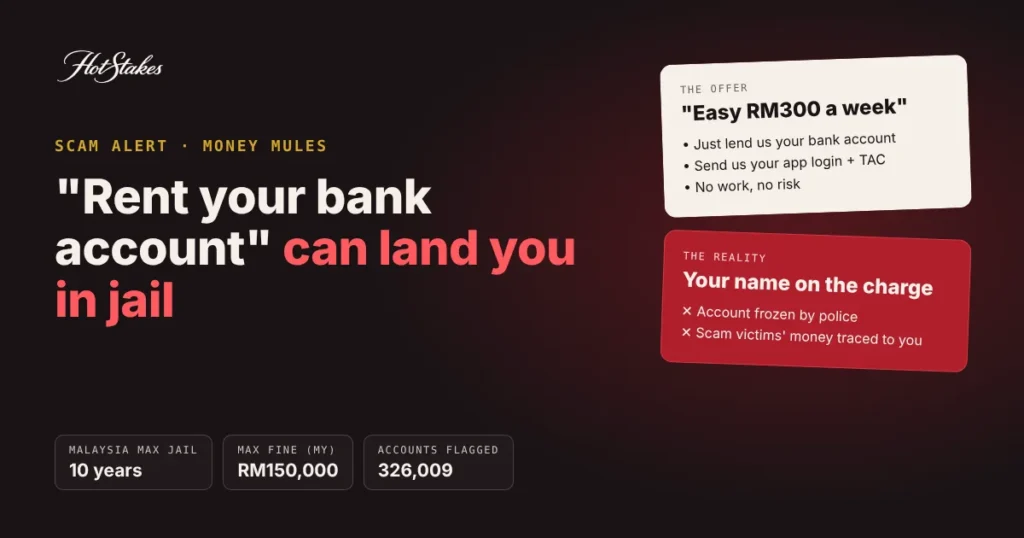
If anyone asks you to receive or pass on money for “the investigation”, refuse: that can make you a money mule. For how phone scams connect to investment cons, read our pig-butchering scam guide, and see all our Scam Alerts.
Takeaway: Report first, feel embarrassed later. The first hours after a transfer are the best chance of freezing it.
FAQ
What is a Macau scam?
It is the Malaysian name for a phone scam in which callers pretend to be a bank, courier, police officer or government agency, accuse you of a crime such as money laundering, and pressure you to move your money to a so-called safe account while keeping it secret.
Why is it called the Macau scam?
Nobody is sure. Macao News says the origin of the name is uncertain. The scam itself has nothing to do with Macau casinos and is run by call centres in many countries.
The caller ID showed a real police number. Can it still be a scam?
Yes. Kelantan police said a syndicate spoofed the state police headquarters’ number, which was used in about 68 calls a day. Hang up and call the police station or agency yourself on its official number.
Will Bank Negara or the police ever ask me to move money to a safe account?
No. Bank Negara Malaysia says it will never require you to transfer funds for any investigation, and police say they will not call to tell you to withdraw money or open new accounts.
I already transferred money. Can I get it back?
Call your bank and 997 in Malaysia (1799 in Singapore) immediately; the faster you report, the better the chance funds can be frozen. Never pay anyone who promises recovery for a fee.
HotStakes is an independent directory. Some links on this site are affiliate links; we may earn a commission at no cost to you, and it never changes our rankings. Gambling involves risk — only play with money you can afford to lose, and if it stops being fun, seek help. This article is general information, not legal advice.
 Next story →Golden Mahjong vs Caishen Win!: RTP, Max Win & the Catch


Start the discussion