

Fake Friend Call Scam: The “Guess Who” Script Exposed
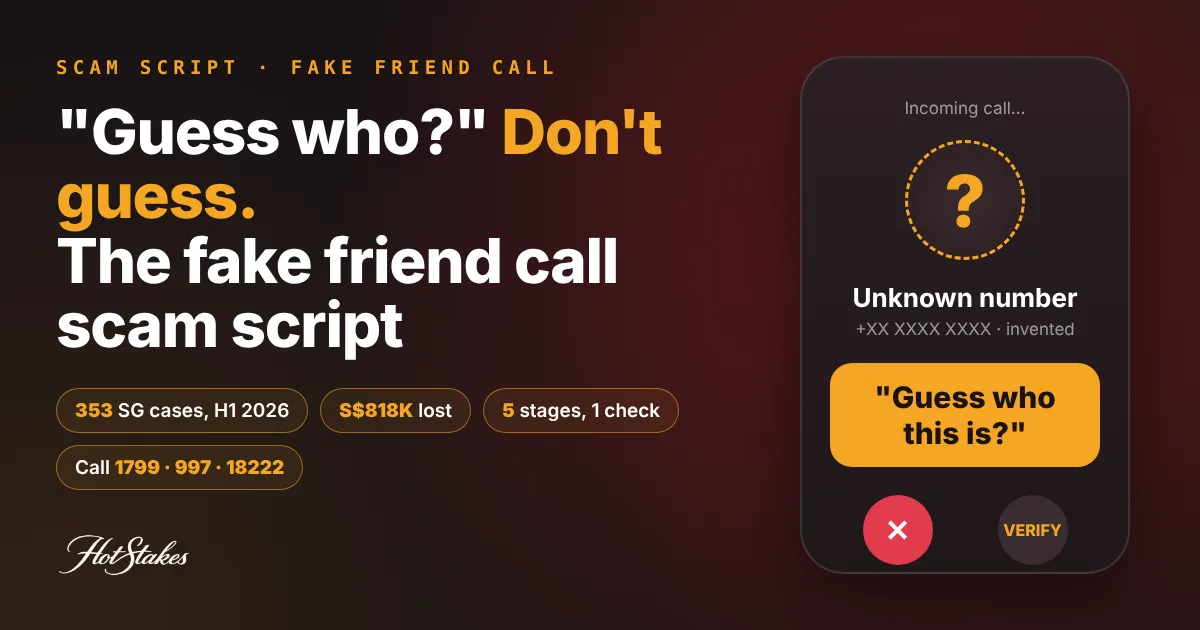
"Guess who?" from an unknown number is a scam opener. The 5-stage fake friend call script, SPF numbers, and who to call: 1799, 997, 18222.
In this article
- The case: an “acquaintance”, an airport and S$20,000 in cash
- The fake friend call scam script: 5 stages, red flags and what to say
- How big is the fake friend call scam? SPF numbers, 2022 to 2026
- How to verify a “friend” in 60 seconds
- For families: set this up with your parents today
- Already sent money? Report it now
- FAQ
An unknown number calls. A cheerful voice says, “Guess who?” You say a name, and the caller happily becomes that person. If an unknown caller asks you to guess who they are, then asks you to save a new number or lend money, it is a fake friend call scam: hang up and call your friend on the number you already have. Below: a real 2026 case from Singapore police, the five stages of the script with example lines and safe replies, the latest SPF numbers, and who to call in Singapore, Malaysia and Hong Kong.
The case: an “acquaintance”, an airport and S$20,000 in cash
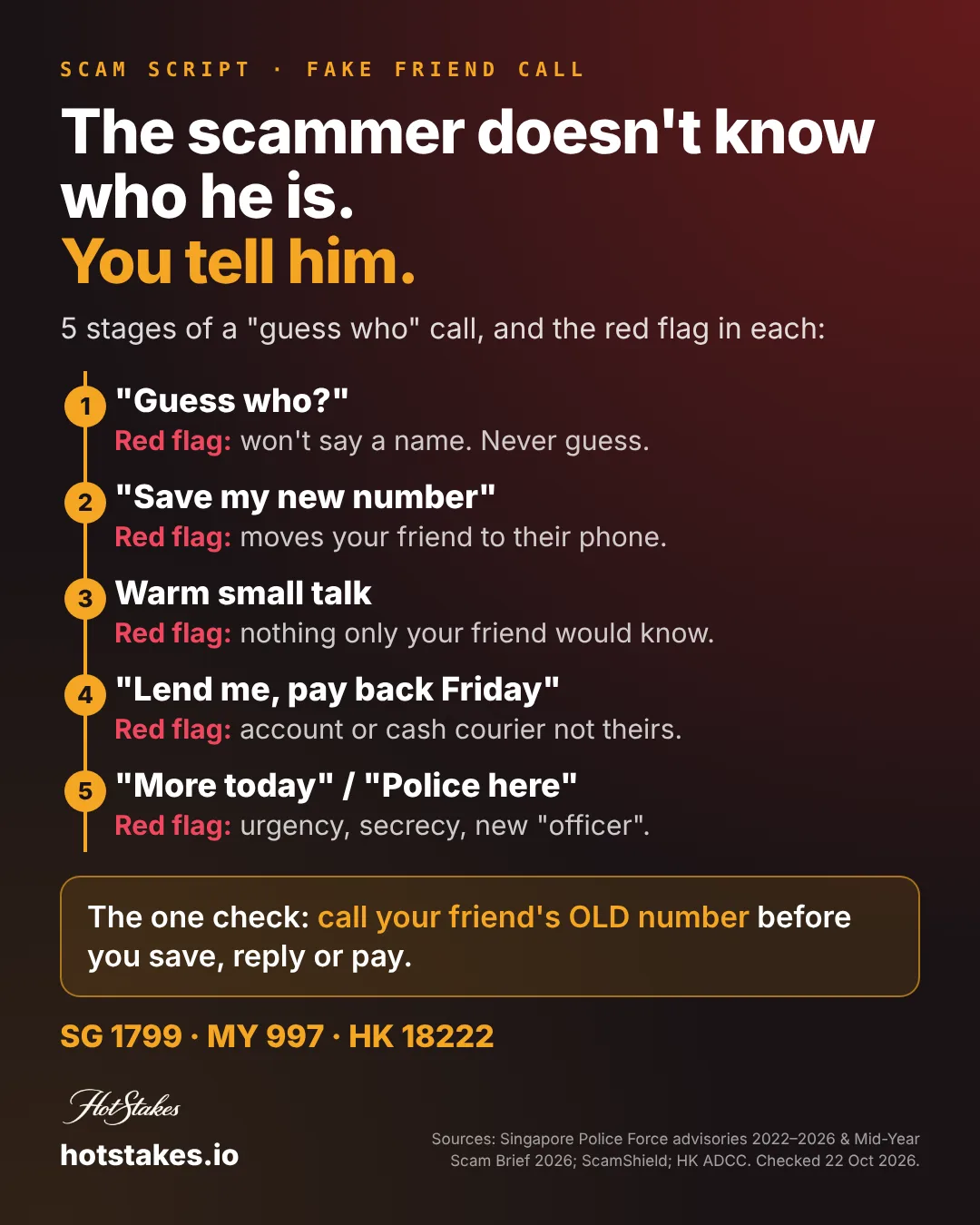
In July 2026 the Singapore Police Force described a case that shows how fast this scam moves. Here is what police said happened, from the SPF news release of 22 July 2026. We have added nothing they did not publish.
- 2 July 2026: a 69-year-old woman got a call from someone posing as an “acquaintance”.
- The story: he said Singapore immigration had detained him at Changi Airport Terminal 4 for failing to declare funds, and he needed S$20,000 as bail.
- 3 July, morning: she went to Terminal 4 and handed S$20,000 in cash to an unknown man.
- The tell: she realised it was a scam when she was asked to make further payments by bank transfer, and reported it the same day.
On 22 July police arrested a 23-year-old Malaysian man at the Terminal 4 departure hall before he could leave Singapore. Police allege he collected cash from scam victims and passed it on, and believe he was recruited by a transnational syndicate. He was to be charged with assisting another to retain benefits from criminal conduct, which carries up to 10 years’ jail, a fine of up to S$500,000, and caning.
Hong Kong police reported the same play in January 2026. A “Guess Who I Am” ring impersonated children or relatives of elderly people aged 69 to 88, claimed the relative had been arrested and needed bail, and sent a courier to collect cash. Ten cases totalled HK$1.63 million, one of them a HK$600,000 loss, according to The Standard.
Takeaway: When a “friend” in trouble wants cash handed to a stranger, the stranger is the scam’s delivery van.
The fake friend call scam script: 5 stages, red flags and what to say
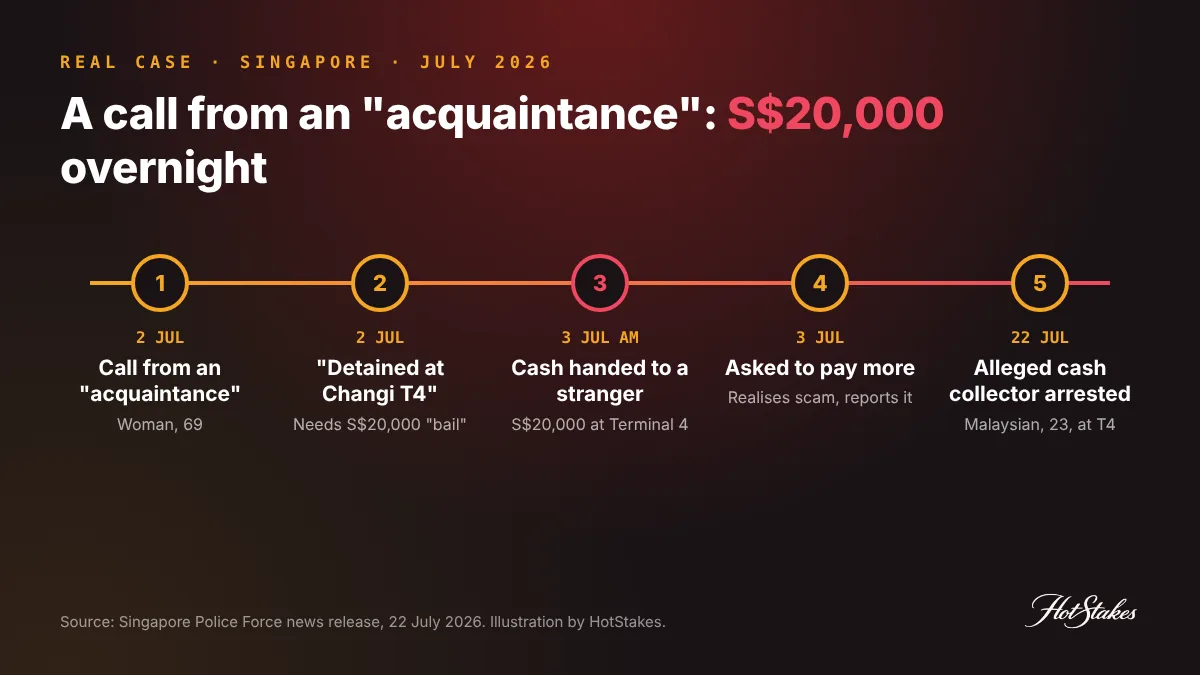
The lines below are EXAMPLE lines written by HotStakes, built from the steps the Singapore police have described in a June 2021 advisory and in their 2022, 2023 and 2026 advisories. They are short on purpose, so you can recognise them, not reuse them.
Stage 1: the opener, “Guess who?”
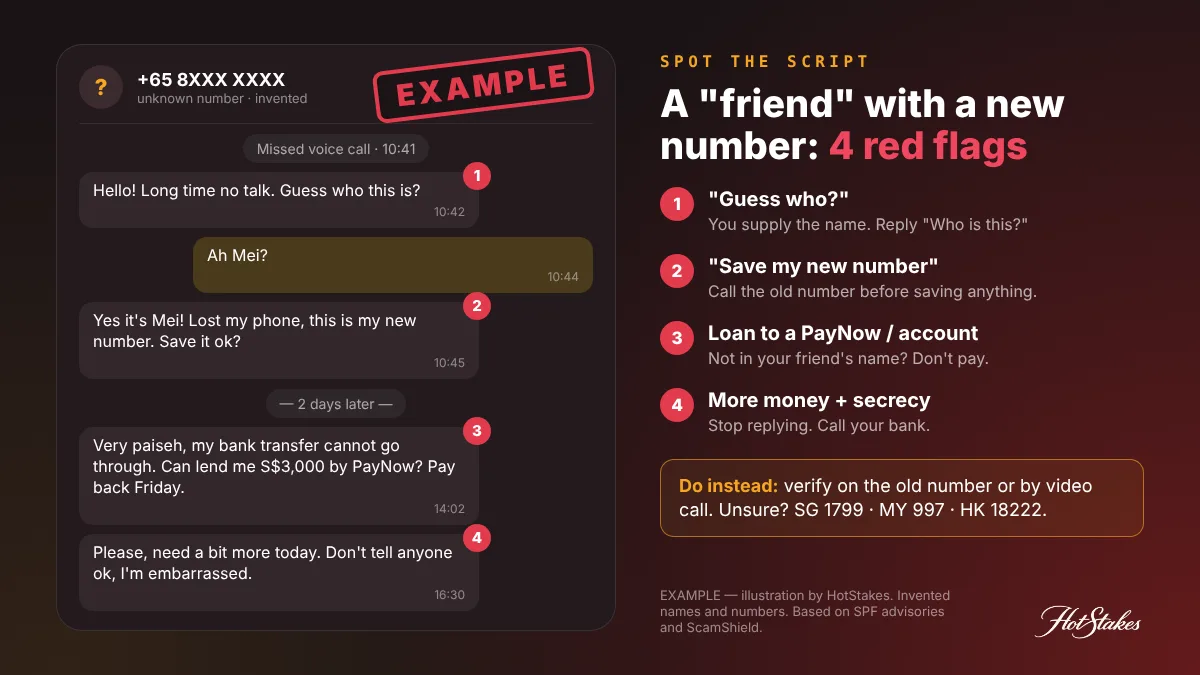
EXAMPLE: “Hello! Long time no talk. Guess who this is?”
- Red flag: an unknown number that will not say its own name. The SPF says the scammer asks you to guess, then “assumes the identity” of whoever you name.
- Say instead: “Sorry, who is this?” and nothing more. Never offer a name. If they still won’t say, hang up.
Stage 2: the “new number”
EXAMPLE: “Wah, you still remember my voice! I lost my phone, this is my new number. Save it, OK?”
- Red flag: a lost or changed phone is the standard excuse, according to ScamShield. Saving the number moves your friend’s name onto the scammer’s phone.
- Do instead: don’t save or replace anything. Call the old number first.
Stage 3: the small talk
EXAMPLE: “How is your family? We must meet for kopi soon.”
- Red flag: friendly chat with no detail only the real friend would know. In the 2022 advisory, the loan request came “a few days later”, after rapport was built.
- Do instead: ask a question only your friend can answer (see the check below).
Stage 4: the urgent money ask
EXAMPLE: “Very paiseh, my bank transfer cannot go through. Can you lend me S$3,000 by PayNow? I’ll pay back on Friday.”
- Red flag: the SPF lists the reasons: a banking transaction that “cannot” go through, financial difficulty, trouble with the law, or, per ScamShield, renovation or supplier bills. You get a local bank account, PayNow number or QR code that is not in your friend’s name. In the July 2026 case it was cash for “bail”.
- Do instead: no money until you have spoken to your friend on a number you already trust.
Stage 5: the follow-up pressure
EXAMPLE: “Please, I need a bit more today. Don’t tell anyone, I’m embarrassed.”
- Red flag: a second request, more urgency, and a plea for secrecy. In some 2026 cases, a second scammer posing as police or the Monetary Authority of Singapore then said the first transfers were linked to crime and demanded more “for investigation purposes”, the SPF’s April 2026 advisory says. That is the Macau scam joining in.
- Do instead: stop replying, call your bank, then call 1799 (SG), 997 (MY) or 18222 (HK).
| Stage | What you hear | Red flag | Safe reply |
|---|---|---|---|
| 1. Opener | “Guess who?” | Caller won’t give a name | “Who is this?” Never guess |
| 2. New number | “Lost my phone, save this one” | Asks you to update a contact | Call the old number first |
| 3. Small talk | Warm, vague catch-up | No shared detail | Ask a question only they know |
| 4. Money ask | “Lend me, I’ll pay back” | Account or PayNow not in their name; cash courier | No money before verifying |
| 5. Pressure | “More today” / “Police here” | Urgency, secrecy, a new “official” | Stop, call your bank and the hotline |
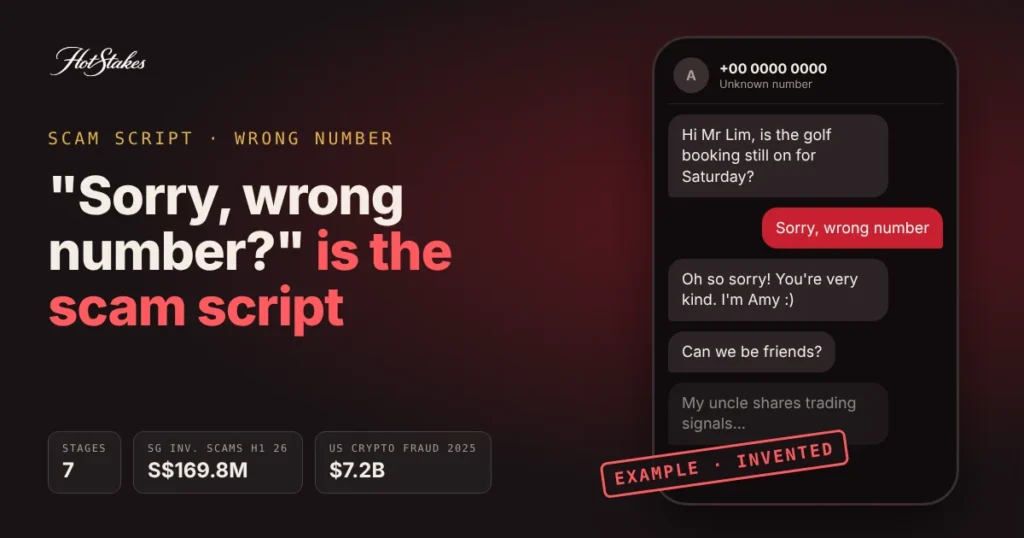
The same warm-up-then-money shape runs through the wrong-number text scam, only slower.
Takeaway: The whole script depends on one thing you give away for free: a name. Don’t guess, and it has nowhere to go.
How big is the fake friend call scam? SPF numbers, 2022 to 2026
On 22 Oct 2026 we opened the Singapore Police Force advisories, news releases and statistics brief on this scam and lined up their figures. Each covers a different period, so read them as snapshots, not one series.
| Period | Victims / cases | Losses | Source |
|---|---|---|---|
| Jan to 12 May 2022 | 587+ victims | S$2.7m+ | SPF, May 2022 |
| Jan to 30 Aug 2023 | 4,800+ victims | S$15.7m+ | SPF, Aug 2023 |
| Jan to Nov 2023 | 6,300+ victims | S$21.1m+ | SPF, Jan 2024 |
| Jan to Jun 2025 (H1) | 1,052 cases | S$3.0m | SPF Mid-Year Brief 2026 |
| Jan to Jun 2026 (H1) | 353 cases | S$818,000 (avg S$2,319) |
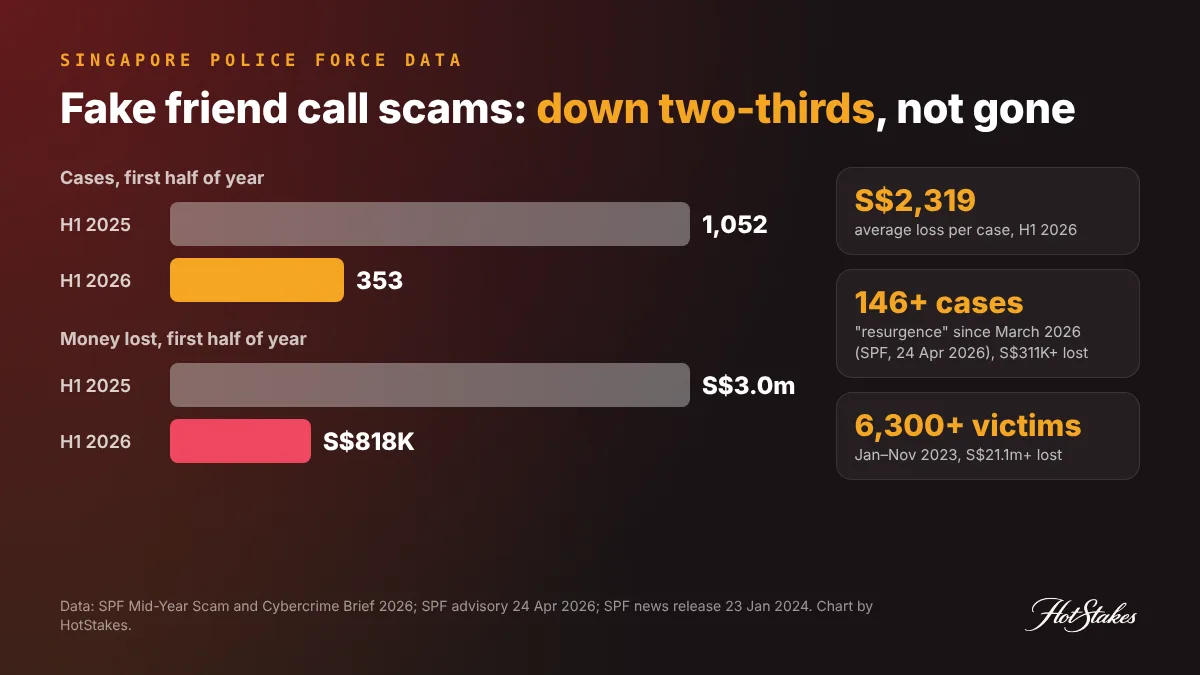
Three things stand out:
- It is shrinking. Cases fell about two-thirds from H1 2025 to H1 2026, and it was the smallest of Singapore’s top 10 scam types by money lost.
- It comes back in waves. Police issued “resurgence” warnings in May 2025 (187+ reports, S$653,000+ since April) and April 2026 (146+ cases, S$311,000+ since March).
- Losses per victim are small, which is the trap. An average of S$2,319 feels like a favour, not a fraud. Then the “police” call comes.
Syndicates are organised and often cross-border. In January 2024, Singapore and Johor police raided two apartments in Johor and arrested five Malaysian men aged 19 to 36, allegedly linked to more than 500 reports and over S$1.4 million in losses; they were extradited and charged with conspiracy to cheat (SPF).
Elsewhere the scam has a different accent. In Malaysia, CCID counted 494 impersonation cases and RM2.5 million in losses in 2023, often through hijacked WhatsApp or Telegram accounts asking friends for loans (Malay Mail). Hong Kong’s anti-scam centre warned in July 2026 that “Guess Who” reports were rising, including an 86-year-old who lost about HK$35,000 to a caller posing as her daughter (ADCC).
Takeaway: Fewer cases does not mean the call won’t come. It means the people still getting it are the ones nobody has warned.
How to verify a “friend” in 60 seconds
- Call the old number. ScamShield’s first check is to call their last known number. Victims usually find out when the real friend says they never changed it.
- Ask a question only they know. Not “where do you live?” (findable online), but “what did we eat after your daughter’s wedding?”
- Ask for a video call or meet in person. The SPF suggests confirming through other means rather than the new contact details.
- Don’t trust the voice. Hong Kong’s ADCC warns scammers may use voice mimicry; verify “even if the voice sounds familiar”.
- Check the account name. Malaysian police say to be wary when the account belongs to someone other than your friend.
Takeaway: A real friend will understand a 60-second check. A scammer will get angry or hang up, and either answer tells you enough.
For families: set this up with your parents today
- Teach one rule: “If a caller says ‘guess who’, the answer is ‘you tell me’.”
- Agree a family question that anyone asking for money must answer.
- Save the hotlines in their phone: 1799 in Singapore, 997 in Malaysia, 18222 in Hong Kong, plus the bank’s number from the back of the card.
- Turn on protections: ScamShield suggests its app to block scam calls and enabling international call blocking with your telco.
- Remove the shame. Promise no blame if they get caught out. Fast reporting matters more than pride.
For a quick refresher you can share in the family chat, try our one-minute Scam or Legit? quiz.
Takeaway: The best defence is a parent who has already practised saying “who is this?”
Already sent money? Report it now
We checked each number below on an official page on 22 Oct 2026.
| Where you are | Call | Notes |
|---|---|---|
| Singapore | 1799 (ScamShield Helpline) | Round the clock; call your bank first if you transferred money (SPF) |
| Singapore | 1800-255-0000 (Police Hotline); 999 if urgent | To give information to police (SPF) |
| Malaysia | 997 (National Scam Response Centre) | Daily, 24 hours; call within 24 hours so accounts can be blocked (MyGOV) |
| Hong Kong | 18222 (Anti-Scam Helpline) | Round the clock (ADCC) |
- Stop paying. Don’t answer the “friend” or any “officer” who follows up.
- Call your bank’s official hotline to stop or trace the transfer, then the scam line for your country.
- Make a police report and keep the call log, chat screenshots, account or PayNow numbers and receipts.
- Warn the real friend. Their name is being used on others, and their account may have been hijacked.
- Ignore anyone offering to recover your money for a fee.
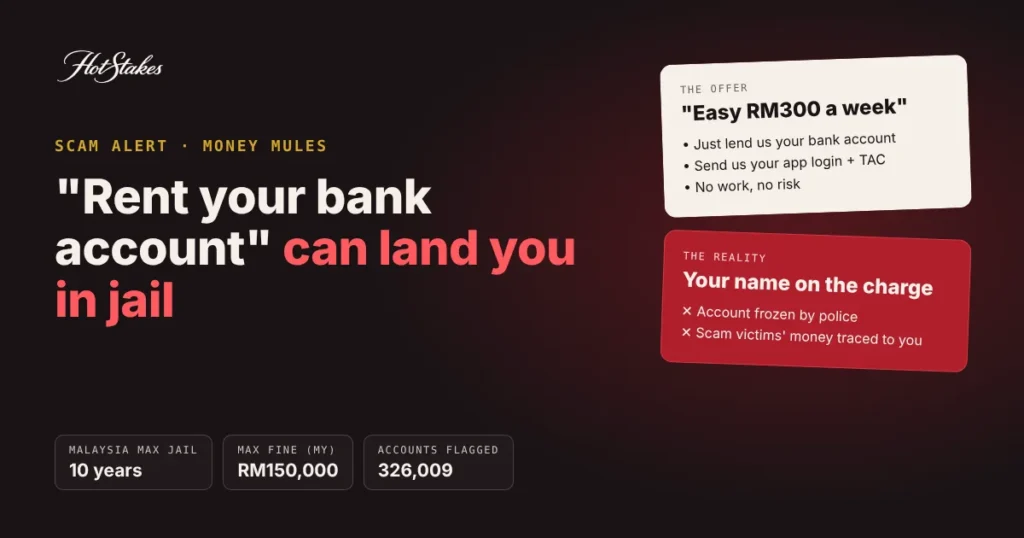
If someone asks you to receive and pass on money “for a friend”, refuse: that is how people become money mules, like the cash collector in the Changi case. For the bigger picture, read our pig-butchering scam guide and browse all our Scam Alerts.
Takeaway: Report first, feel embarrassed later. The first hours are the best chance to freeze a transfer.
FAQ
What is a fake friend call scam?
A scammer calls or messages from an unknown number, gets you to guess who they are, pretends to be the person you name, and later asks for an urgent loan or help with a bank transfer. Singapore police have warned about it repeatedly since 2021.
Why does the scammer ask me to guess who they are?
Because they do not know which of your friends to pretend to be. When you say a name, you give them their disguise. Reply “Who is this?” and never guess.
My friend’s “new number” sounds just like them. Is it safe?
Not until you check. Call their old number, ask a question only they know, or video call them. Hong Kong’s anti-scam centre warns scammers may imitate voices.
How much do people lose to fake friend call scams in Singapore?
In the first half of 2026, the SPF recorded 353 cases and S$818,000 lost, an average of S$2,319, down from 1,052 cases and S$3.0 million in the first half of 2025.
Who do I call if I already sent money?
Call your bank immediately, then 1799 in Singapore, 997 in Malaysia or 18222 in Hong Kong, and make a police report. Never pay anyone who promises to recover the money for a fee.
HotStakes is an independent directory. Some links on this site are affiliate links; we may earn a commission at no cost to you, and it never changes our rankings. Gambling involves risk — only play with money you can afford to lose, and if it stops being fun, seek help. This article is general information, not legal advice.
 Next story →Casino Account Security: 10-Minute Lockdown Checklist


Start the discussion