

Gambling Streamers: Who Pays Them and How It Works
How casinos pay gambling streamers: sign-up fees, a cut of viewers' losses and funded balances. Plus a checklist for watching any stream.
In this article
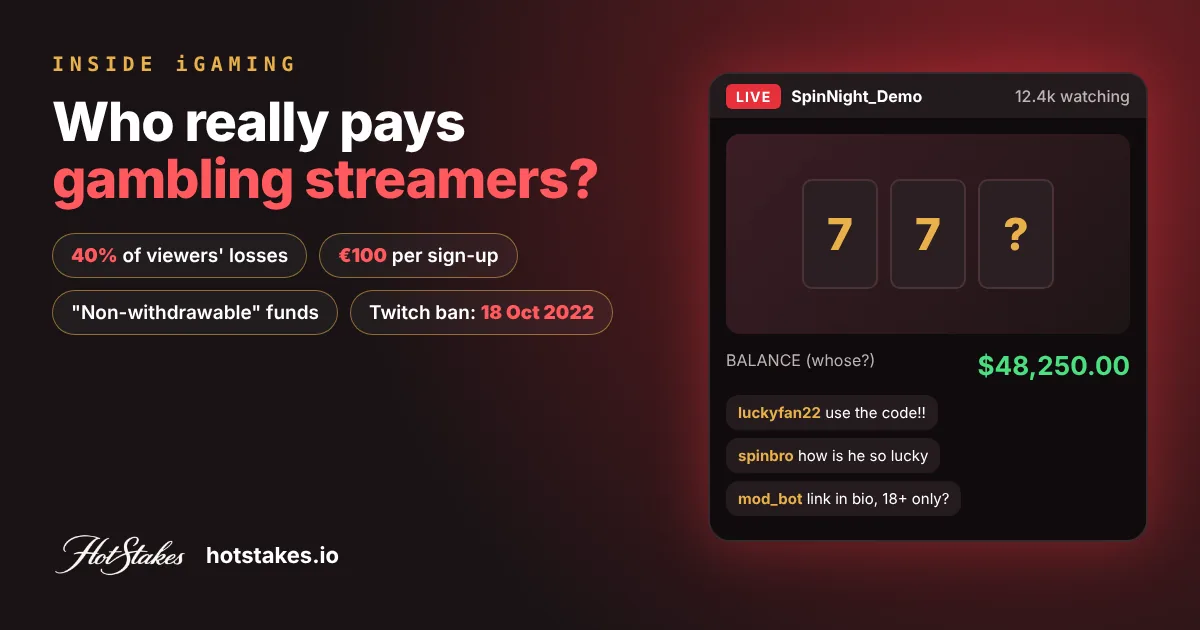
Gambling streamers look like players having a wild night. Many are closer to paid marketers. Investigations and police cases show casinos paying streamers flat fees, a cut of what referred viewers lose, and sometimes the balance on screen. Under one referral deal reported by Investigate Europe, the streamer earned 40% of a referred player’s losses, so the streamer did better when that viewer lost. This guide follows the money, shows what platforms and regulators have done, and gives you a checklist for judging any stream.
How gambling streamers get paid
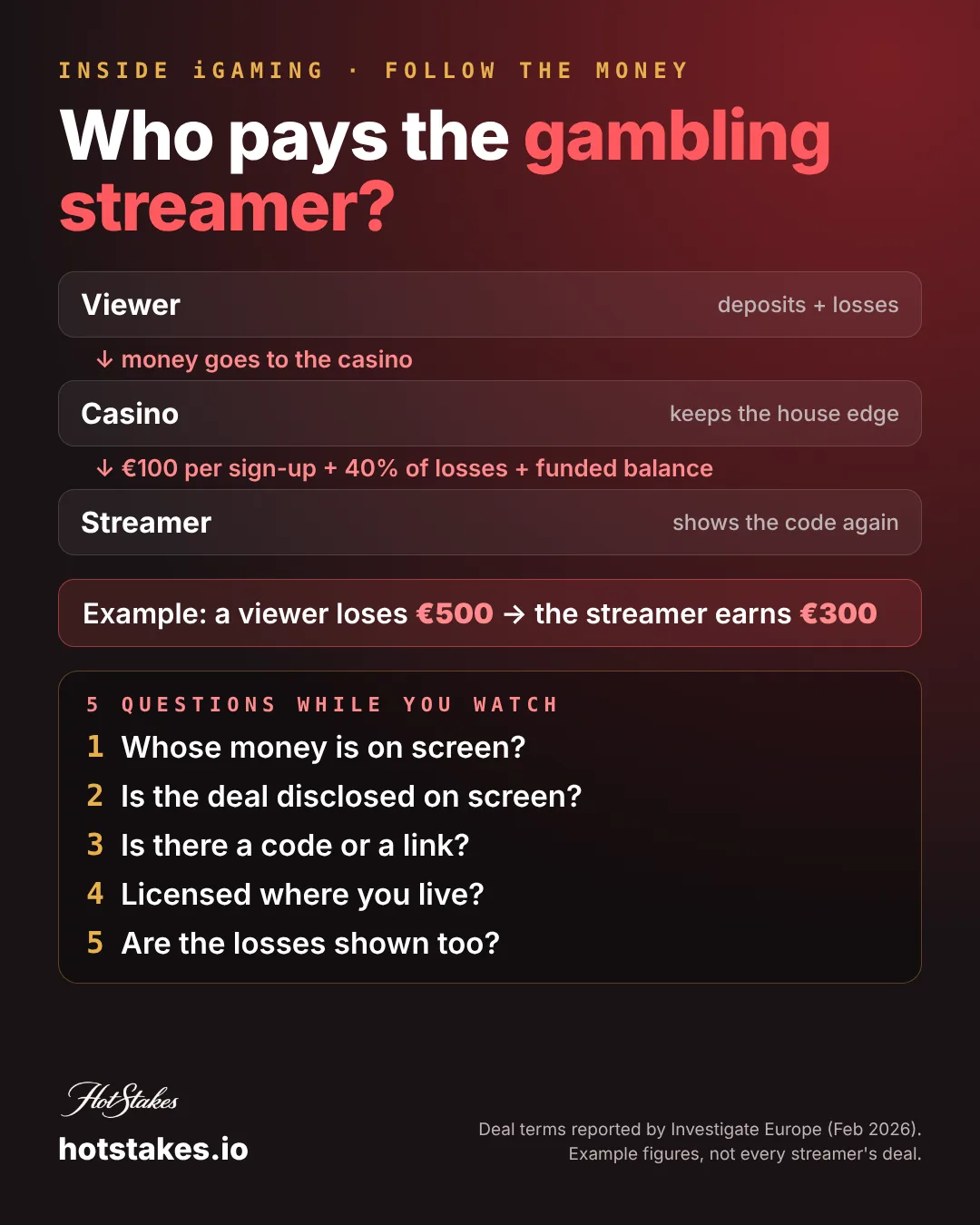
Most casino streamers don’t earn from gambling. They earn from you. They’re paid as marketers: for traffic, sign-ups and, in many deals, the money referred players go on to lose.
The same affiliate commission models that pay casino review sites also pay streamers. The difference is the format. A live personality, a chat full of fans and a referral code on screen.
| Payment type | Who pays whom | Documented example | Source |
|---|---|---|---|
| Sign-up fee (CPA) | Casino → streamer, per new depositing player | A fixed €100 per signed-up player in one affiliate agreement | Investigate Europe, Feb 2026 |
| Revenue share on losses | Casino → streamer, a % of what referred viewers lose | 40% of referred players’ losses (same agreement); a German streamer told ZDF his share was 45–50% | Investigate Europe 2026; ZDF via MeinMMO 2020 |
| Funded balance (“house money”) | Casino → streamer’s casino account | An affiliate programme describing “non-withdrawable playing funds” for streaming content | Investigate Europe, Feb 2026 |
| Sponsorship / flat fee | Casino → streamer, per month or per year | A top streamer said he was offered $19 million a year to gamble live, and turned it down | Bloomberg, Aug 2022 |
| Paid posts | Promoter → influencer | Indonesian influencers allegedly paid Rp 3–5 million a month to endorse gambling sites | The Jakarta Post, Jul 2024 |
| Viewer deposits and donations | Viewer → casino; viewer → streamer | Researchers saw viewers donate money for streamers to gamble with | University of Sydney, Apr 2025 |
Sources: Investigate Europe’s 2026 investigation into gambling influencers, MeinMMO’s report on the ZDF documentary, Bloomberg’s 2022 report on Twitch’s gambling boom, The Jakarta Post on the 2024 influencer arrests and the University of Sydney’s live-streaming study.
The revenue-share maths
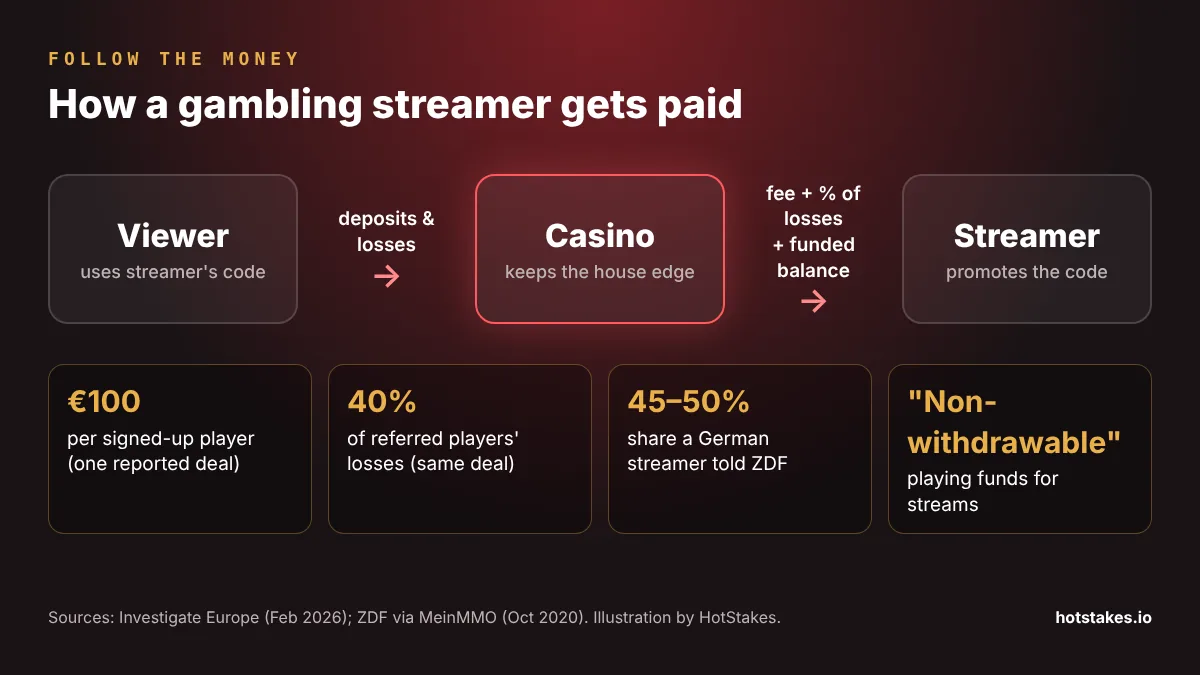
Here is an illustrative example using the deal terms Investigate Europe published. The numbers are invented and round.
- A viewer signs up through the streamer’s code and deposits. The streamer earns the €100 sign-up fee.
- Over the month, that viewer loses €500 in net terms.
- At a 40% revenue share, the streamer earns another €200.
- Total for the streamer: €300. Total for the viewer: −€500.
- If the viewer had won overall that month, the revenue-share part would pay the streamer nothing.
That is the conflict of interest in one line. The house edge makes sure most players lose over time (here’s why the house always wins). A streamer on revenue share gets a slice of it.
Takeaway: a referral code on screen can mean the streamer’s income goes up when viewers’ balances go down.
Are gambling streamers using real money?
Sometimes yes. Often you can’t tell. And that is a big part of the problem.
Investigate Europe reported that streamers register with each casino and receive a real-money balance. One affiliate programme offered “non-withdrawable playing funds” for streaming content. Money you can’t withdraw costs the streamer nothing to lose.
The biggest deals go further. In a February 2026 investigation, Bloomberg Businessweek reported that it had analysed almost 500 hours of slots streams on one crypto casino, mostly from June to August 2025, and found that top streamers paid by the casino hit wins above 1,000× the bet more often than casual streamers in its sample. The casino rejected the findings.
Viewers fund streams too. The University of Sydney team saw viewers donate money so streamers could gamble on their behalf.
Takeaway: unless a stream clearly says whose money is on screen, assume it may not be the streamer’s own.
What the research says about who watches
Gambling streams don’t just reach gamblers. They reach gamers, including teenagers.
- University of Sydney (2025): Dr Mark Johnson’s team, funded by the NSW Office of Responsible Gambling, surveyed 350 viewers and watched 25 channels on Twitch and Kick. Most viewers said streams made them more likely to gamble. Channels often linked to gambling sites. Johnson called age restrictions on streaming platforms “extremely lax”.
- Swansea University (2026): a peer-reviewed interview study of 15 UK young adults who regularly watch gambling streams found some watched to curb urges, while others reported stronger urges and more gambling after viewing. Participants recognised streamers’ deceptive marketing tactics.
- Earlier work: Abarbanel and Johnson (2020) in International Gambling Studies showed how Twitch’s own engagement features use chance-based rewards, blurring the line between watching and gambling.
Takeaway: the research points one way. These streams act as gambling marketing, and age gates around them are weak.
What platforms and regulators have done
Platforms moved only after public pressure. In September 2022, after reports that one streamer had misled fans and fellow streamers into giving him at least $200,000 to gamble, Twitch announced a ban on unlicensed slots, roulette and dice streams. It took effect on 18 October 2022. Sports betting, fantasy sports and poker stayed allowed.
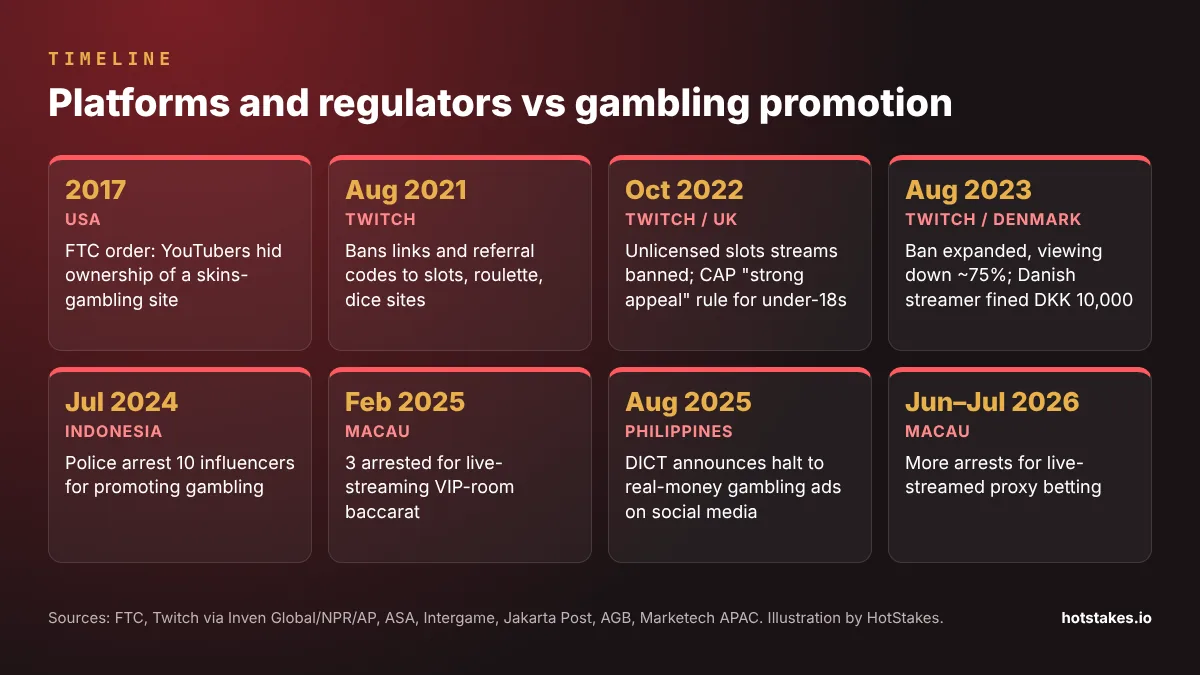
- 2017, USA: the FTC finalised an order against two YouTubers who promoted a skins-gambling site without disclosing they owned it, and paid other influencers to promote it without disclosure.
- 2021, Twitch: Twitch banned links and referral codes to slots, roulette and dice sites.
- 2022, UK: from 1 October 2022, CAP rule 16.3.12 says gambling ads “must not be of strong appeal” to under-18s. The ASA lists an influencer whose content focuses on youth themes as someone to avoid.
- 2023, Twitch: it added two more casinos to its ban and said gambling viewership had fallen about 75% (AP).
- 2023, Denmark: the gambling regulator fined a Twitch streamer DKK 10,000 for advertising unlicensed gambling providers, its first such case.
Our check of Twitch’s policy today
On 29 October 2026 we read Twitch’s Gambling Education Resource. It bans links and referral codes for sites promoting “slots, roulette, dice games or skins gambling”. It bans promotion, endorsement or sponsorship of prohibited sites, and streaming their free social versions. Gambling streams from allowed sites must carry a “Gambling” content classification label. We found no age requirement for viewers on that page.
Asia: influencers, police and proxy streams
- Indonesia: police said in 2023 that promoting online gambling is punishable by up to six years in prison. In July 2024, police arrested 10 influencers. In October 2024, the national police said they had questioned 27 influencers in one gambling case. In October 2025, a 22-year-old influencer faced charges after admitting she was paid to upload casino promo videos, according to police.
- Philippines: in August 2025 the DICT announced a halt to real-money gambling ads on social media. In September, the national creator and influencer council told members not to promote illegal gambling.
- Macau: a different kind of stream. Judiciary Police arrested three men in February 2025 for live-streaming VIP-room baccarat to remote gamblers in mainland China. More arrests followed in June 2026 and July 2026. One suspect allegedly earned about HK$1,000 an hour, using a hidden phone and an earpiece to take betting instructions.
Many casinos behind streams hold offshore licences that offer players little protection. Here is what Curaçao’s licence reform does and doesn’t change.
Takeaway: regulators treat paid gambling promotion as advertising, and in Indonesia and Macau, as a crime.
How to watch a gambling stream critically
You don’t need to quit watching to stop being marketed to. Run these six checks every time.
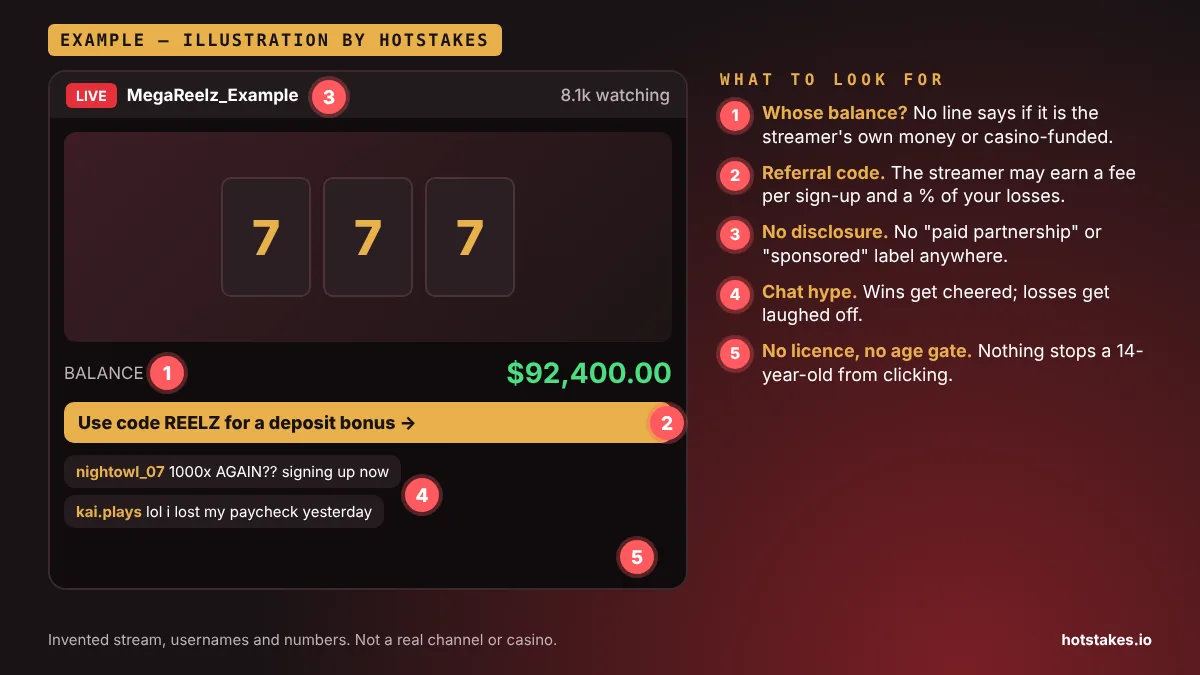
- Whose money is it? Look for a clear statement. Words like “funded”, “sponsored” or “house balance” mean the risk isn’t the streamer’s.
- Is there a disclosure? A paid relationship should be stated on screen, not buried in a bio. The FTC treated hidden ownership and undisclosed payments as deceptive endorsement.
- Is there a code or link? A referral code usually means the streamer earns from sign-ups, and often from losses.
- Is the casino licensed where you live? If the stream doesn’t name a regulator you recognise, assume it isn’t. Many Asian countries ban online casinos outright (see whether online gambling is legal in your country).
- Is there an age gate? If a 14-year-old can watch and click the link, the promotion isn’t built for safety.
- Are losses shown? Count the clips. If you only ever see wins, you’re watching a highlight reel, not a session.
Scammers copy the format with fake celebrity “wins” too: here’s how deepfake celebrity gambling ads work.
Takeaway: if a stream fails two or more of these checks, treat it as an advert.
If you’re a parent
A teenager watching slot streams isn’t the same as a teenager gambling. But it’s worth a calm conversation. Ask what they watch, whether they know the streamer is paid, and whether anyone in chat has pushed codes or “free” crypto. Our guide to signs your teen may be gambling covers what to look for next.
The streamer culture of personal “hosts” and big-spender treatment mirrors how casino VIP hosts work: the relationship feels personal, but it’s paid for by losses.
If gambling is causing harm, free help is available:
- Singapore: NCPG Helpline 1800-6-668-668 (8am–11pm daily)
- Philippines: PAGCOR National Problem Gambling Helpline (02) 8248-9568
- Hong Kong: Gambling Counselling Hotline 183 4633
- Malaysia: no national gambling helpline; Talian HEAL 15555 (mental health, 8am–midnight)
Takeaway: talk about who pays the streamer. It’s a more useful conversation than banning the app.
FAQ
Are gambling streamers using real money?
Sometimes, but not always their own. Investigate Europe reported that affiliate programmes give streamers real-money balances, including “non-withdrawable playing funds” for streaming. Bloomberg reported a crypto casino topping up big streamers’ balances. Unless a stream clearly discloses the source, you can’t know.
How are casino streamers paid?
Documented models include a fixed fee per sign-up, a revenue share on referred players’ losses (40% in one published deal, 45–50% in another), funded balances and flat sponsorship fees. Some streamers also receive viewer donations.
Do slot streamers earn when viewers lose?
Under revenue-share deals, yes. The streamer gets a percentage of the net losses of players who signed up through their code or link, so the streamer earns more when those players lose more.
Is gambling streaming allowed on Twitch?
Partly. Since 18 October 2022 Twitch has banned streams of unlicensed slots, roulette and dice sites. On 29 October 2026 its policy page also banned referral links and sponsorship of prohibited sites. Sports betting, fantasy sports and poker are allowed, with a “Gambling” content label.
Is it illegal to promote online gambling as an influencer in Asia?
In some countries, yes. Indonesian police have arrested and charged influencers for promoting online gambling, and say it carries up to six years in prison. Macau police have arrested people for live-streaming casino tables to remote gamblers. Rules differ by country.
HotStakes is an independent directory. Some links on this site are affiliate links; we may earn a commission at no cost to you, and it never changes our rankings. Gambling involves risk — only play with money you can afford to lose, and if it stops being fun, seek help. This article is general information, not legal advice. Read our full disclaimer.
 Next story →Is There a Safe Amount to Gamble? The 1% Rule Explained
Start the discussion