

Is There a Safe Amount to Gamble? The 1% Rule Explained
No amount is risk-free, but research sets a lower-risk line: 1% of income, 4 days, 2 games. Here it is in RM, S$, HK$ and pesos.
In this article
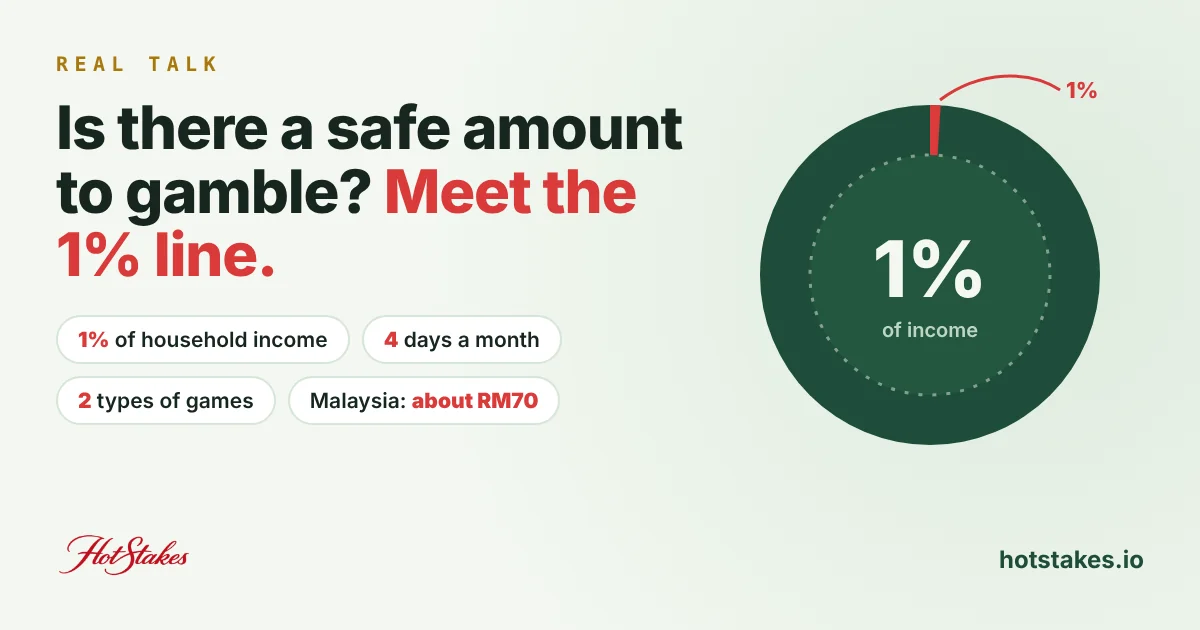
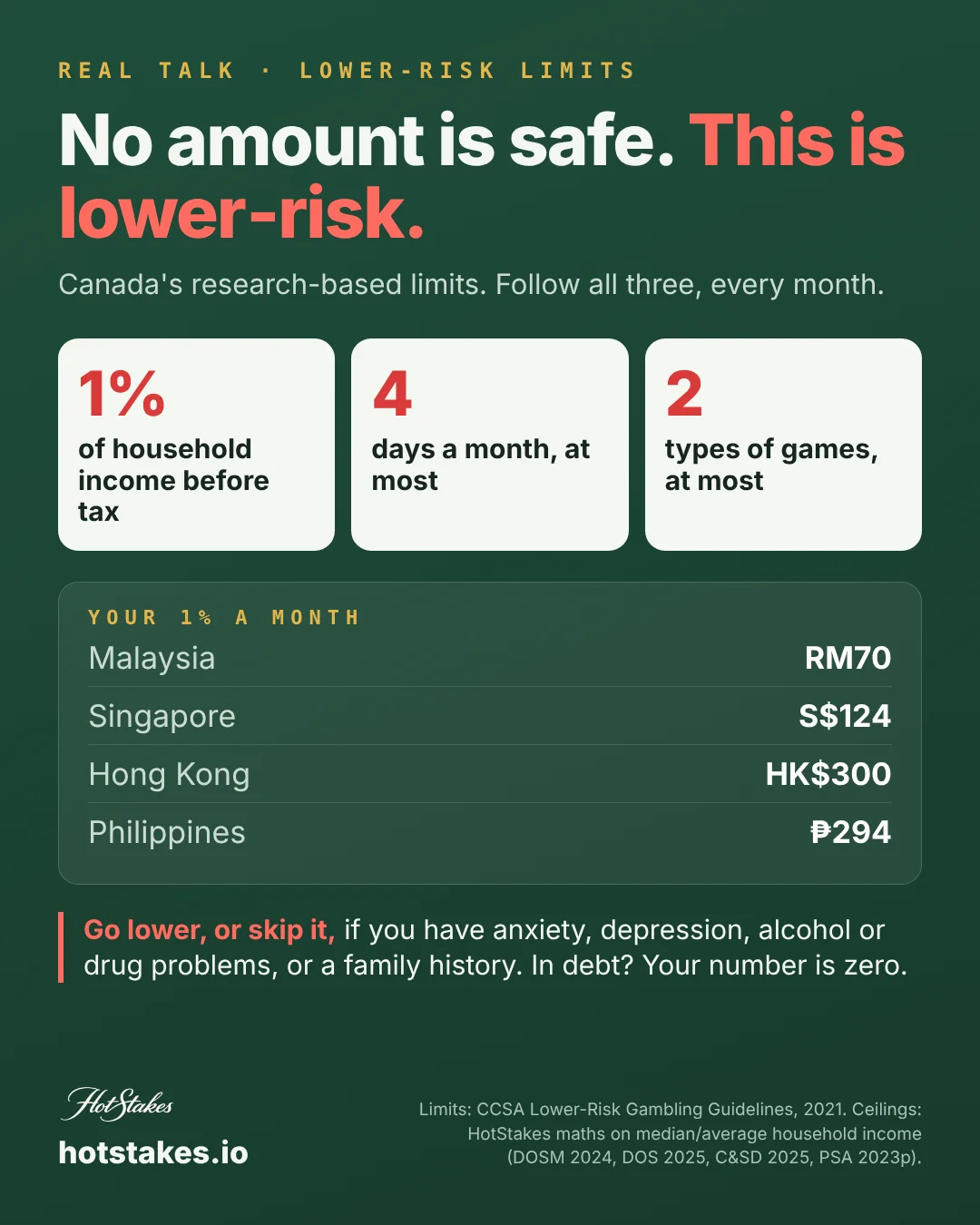
No amount of gambling is risk-free. Research finds that risk rises with every extra dollar lost. But there is a research-based line where risk stays low for most people. Canada’s Lower-Risk Gambling Guidelines say: gamble no more than 1% of household income before tax a month, on no more than 4 days, and on no more than 2 types of games. Below, we apply that 1% to official household income figures for Malaysia, Singapore, Hong Kong and the Philippines. In Malaysia, it is about RM70 a month.
The short answer: no safe amount, but a lower-risk one
Two things are true at once, and most articles only tell you one of them.
First, there is no threshold below which gambling is harmless. A 2016 study in Addiction compared national surveys from Australia, Canada, Finland and Norway. It found “no evidence of a threshold” below which bigger losses stop raising the risk of harm. Lead author Francis Markham told ANU that “every increase in spending increases your risk”.
Second, risk is not flat. At low spending and low frequency, the share of people who report harm is small. It climbs fast after that. That is the zone the guidelines try to keep you in.
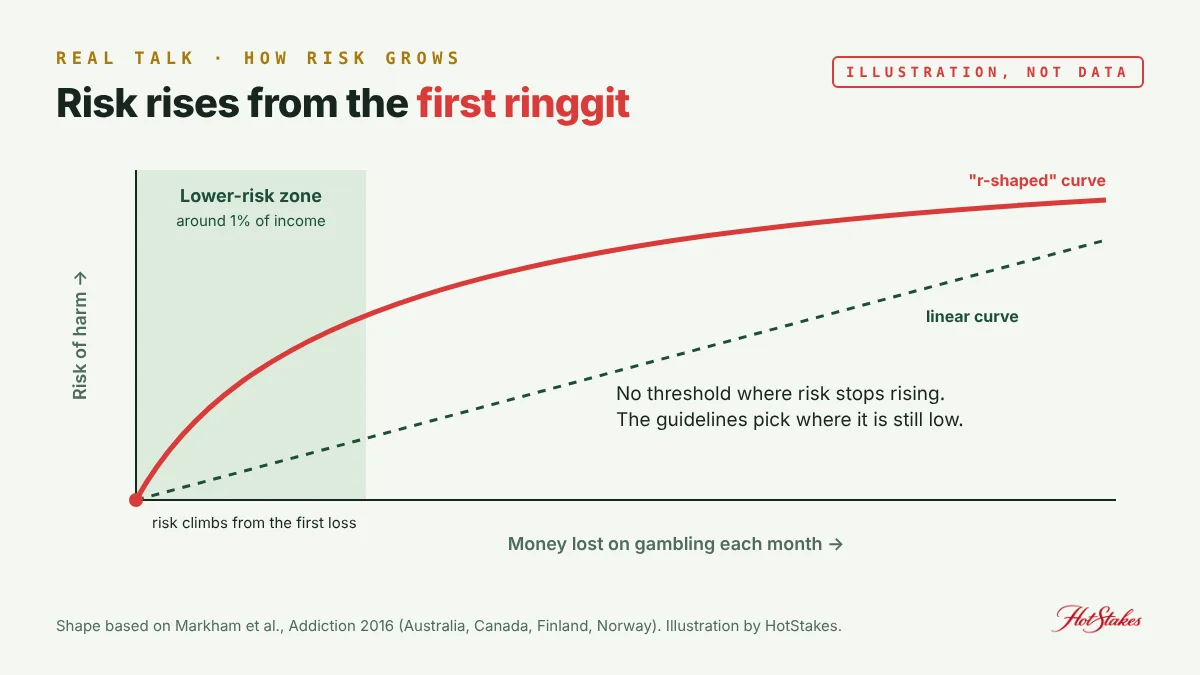
Takeaway: “safe” is the wrong word. “Lower risk” is the honest one.
The three lower-risk limits, in plain words
The Canadian Centre on Substance Use and Addiction (CCSA) released the guidelines on 15 September 2021. They were built from data on more than 60,000 people who gamble, in eight countries. The official guideline page sets three limits:
- Money: no more than 1% of household income before tax, per month. Their example: a C$70,000 household should gamble no more than C$58 a month.
- Days: no more than 4 days a month.
- Types: if you gamble regularly, no more than 2 types of games (for example, lottery and sports betting).
The site says all three must be followed at the same time. Keeping to 1% while playing slots 20 days a month does not count.
Who should go lower, or not gamble at all
The guidelines say the limits may not suit you if you have:
- problems with alcohol, cannabis or other drugs
- problems with anxiety or depression
- a personal or family history of gambling or substance problems
They also warn that fast games with frequent betting, such as slots, poker and many online games, can lead to problems more quickly. Gambling to escape problems raises the risk too.
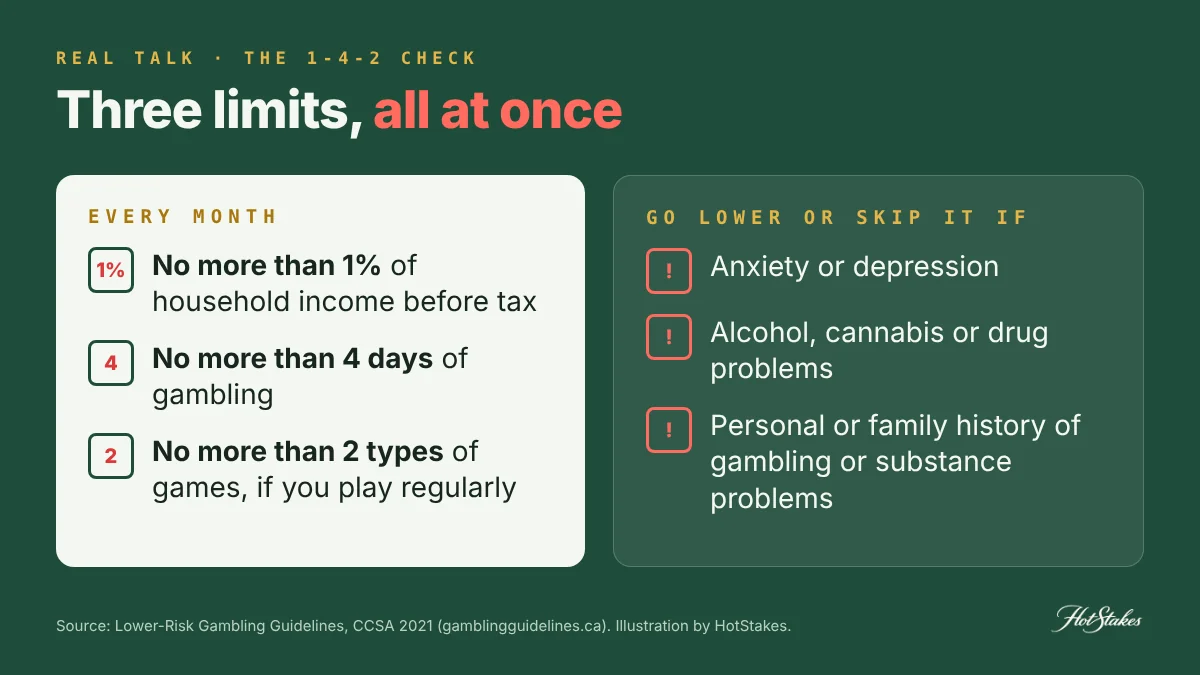
Takeaway: three limits, all at once, and lower again if any special consideration applies to you.
What 1% means in your currency
The Canadian page lists only Canadian dollars. So we took the latest official household income figure for four Asian markets and did the maths on 29 Oct 2026. The guideline uses income before tax, so we used gross or pre-tax figures where the statistics office gives them.
| Country | Official household income figure | Maths | Monthly 1% ceiling |
|---|---|---|---|
| Malaysia | Median gross monthly household income RM7,017 (2024), DOSM | RM7,017 × 1% | RM70 |
| Singapore | Median monthly household market income S$12,446 (2025, before transfers and taxes), DOS Singapore | S$12,446 × 1% | S$124 |
| Hong Kong | Median monthly household income HK$30,000 (Q2 2025, excl. foreign domestic helpers), C&SD data in LegCo reply | HK$30,000 × 1% | HK$300 |
| Philippines | Average annual family income ₱353,230 (2023, preliminary), PSA FIES | ₱353,230 ÷ 12 = ₱29,436; × 1% | ₱294 |
| Canada (reference) | Example income C$70,000 a year, gamblingguidelines.ca | Official table | C$58 |
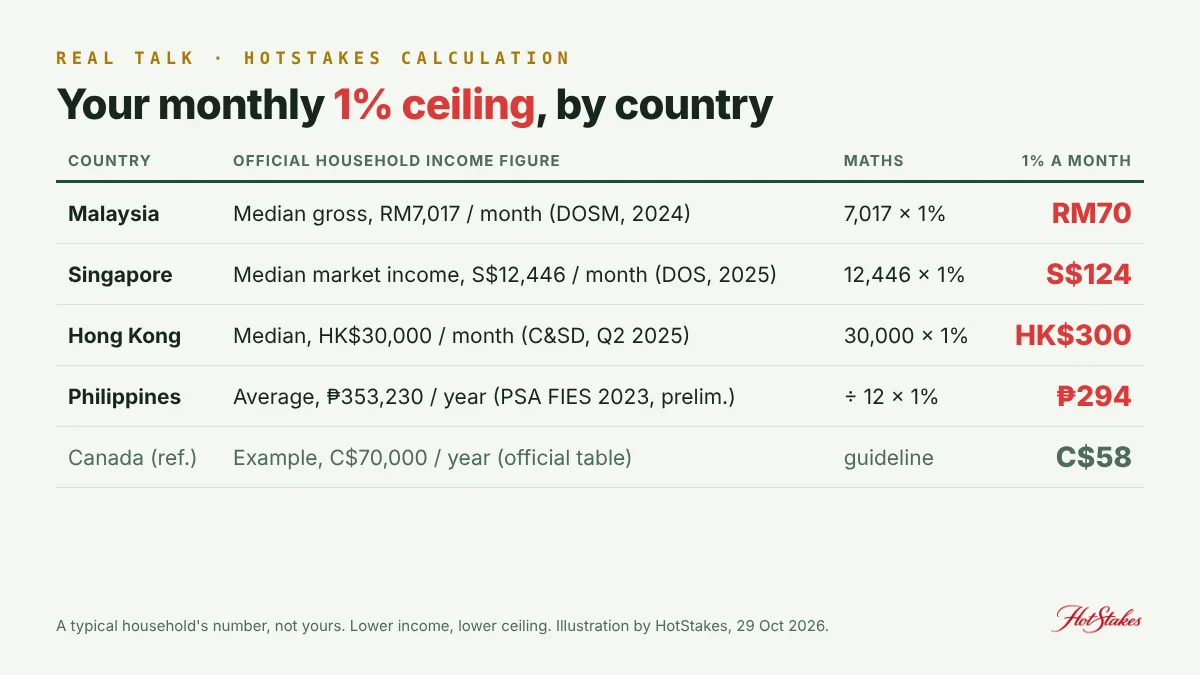
Read these as a typical household’s number, not yours. Four cautions:
- Half of households earn less than a median. If your household earns less, your 1% is smaller.
- The Philippine figure is an average, not a median. Averages are pulled up by high earners, so most families’ 1% is lower than ₱294.
- It is household income, not yours alone. A partner’s salary is not extra gambling money.
- Debt changes everything. If you owe money, the honest ceiling is zero until it is paid.
Takeaway: to find your own number, take your household’s monthly income before tax and move the decimal point two places left.
What that money buys at a slot (illustrative maths)
The guidelines do not say whether 1% means money staked or money lost. So here are both readings. We used an online slot with a 4% house edge (96% return) and one bet every 5 seconds. These are assumptions for illustration, not a real game. For why the house keeps that edge, see how the house always wins.
| Country | 1% ceiling | Bet size | Strict reading: spins you can stake | Average-loss reading: bets covered at 4% edge |
|---|---|---|---|---|
| Malaysia | RM70 | RM1 | 70 spins, about 6 minutes | about RM1,754 of bets, roughly 2.4 hours |
| Singapore | S$124 | S$1 | 124 spins, about 10 minutes | about S$3,112 of bets, roughly 4.3 hours |
| Hong Kong | HK$300 | HK$5 | 60 spins, about 5 minutes | about HK$7,500 of bets, roughly 2.1 hours |
| Philippines | ₱294 | ₱5 | 58 spins, about 5 minutes | about ₱7,359 of bets, roughly 2 hours |
Now compare a typical one-hour session. At one RM1 spin every 5 seconds, that is 720 spins and RM720 wagered. The average cost at a 4% edge is RM28.80, or 41% of the Malaysian ceiling, in one hour.
Play four such hours a month and the average cost is RM115. That is well over RM70, and that is before bad luck. Slots swing far more than the average. A losing streak can take the full RM70 in a few minutes.
Speed matters too. Great Britain’s regulator requires at least 2.5 seconds between online slot spins. That allows up to 1,440 spins an hour, twice our example. Many sites serving Asia have no such rule.
Takeaway: 1% buys a few short sessions a month at small stakes, not a nightly habit.
Where the numbers came from
The 1% figure was not picked at random. It comes from about 15 years of survey research:
- Currie et al. (2006) studied 19,012 Canadians. Risk of harm rose above about 2 to 3 times a month, C$501 to C$1,000 a year, or 1% of gross family income.
- Hodgins, Young, Currie and colleagues pooled 11 datasets from eight Western countries for the 2021 guidelines. Risk rose at more than 1 to 3% of gross income, 5 to 8 times a month, or 3 to 4 game types.
Other countries have tested or adopted similar lines:
| Country | Limits | Status |
|---|---|---|
| Canada | 1% of pre-tax household income, 4 days a month, 2 types | Official national guidelines, 2021 (CCSA) |
| Finland | “2-4-2”: 2% of monthly personal net income, 4 days a month, 2 types | Launched by the national health institute, rolled out from 2025 (Nordic Welfare Centre) |
| Australia | 20 to 30 times a year, A$380 to A$615 a year, 0.83 to 1.68% of personal income, 2 types | Research “working guidelines”, not official (Dowling et al., 2021) |
| England | Canadian frequency and game-type limits tested | Research only: harm data fit the Canadian limits; spending not tested (Rochester & Cunningham) |
| Asia | None found | We found no published lower-risk limits from an Asian government or health body |
Finland’s version shows the numbers are not fixed. Finnish focus groups found “household income” felt foreign, as people think in personal income. Finland now uses 2% of personal income after tax.
Takeaway: different countries land near the same place: a small share of income, about once a week at most, and few game types.
The honest limits of the guidelines
- Lower risk is not no risk. Some people inside the limits still get hurt. Researchers who found no safe level for poker machines warn against messaging that implies moderate gambling is risk-free.
- They are a population tool. They describe where harm becomes common across thousands of people. They cannot tell you how your own brain or bank account will react.
- No Asian data went in. All eight datasets were from Western countries. Costs of living, family money and game types differ here.
- They are built on self-reported spending. People tend to under-count losses, so the limits may be generous, not strict.
The guidelines are also not a target. If you gamble less than this, or not at all, nothing is missing.
Takeaway: treat the limits as a ceiling and a warning light, not permission.
Quick self-check: are you over the line?
Answer these about the last month:
- Did you gamble more than 1% of your household’s monthly income before tax?
- Did you gamble on more than 4 days?
- Do you regularly play more than 2 types of gambling?
- Did you spend more, or for longer, than you planned?
- Did you hide it, borrow for it, or chase a loss?
One “yes” on 1 to 3 means you are outside the lower-risk zone. A “yes” on 4 or 5 is worth a closer look with our signs of a gambling problem checklist.
If you want to cut down, these help:
- Use the steps in our guide to blocking gambling sites and apps.
- If losses have turned into borrowing, read what to do about gambling debt.
- If cutting down keeps failing, our page on whether to quit gambling completely walks through the choice.
- For the bigger picture, see is gambling bad for you.
Free help lines (checked 29 Oct 2026)
| Country | Who to call | Number |
|---|---|---|
| Singapore | NCPG Helpline (8am to 11pm daily) | 1800-6-668-668 |
| Malaysia | No national gambling line. HEAL mental health line; Befrienders KL (24 hours) | 15555; 03-7627 2929 |
| Philippines | PAGCOR gambling helpline (24/7); NCMH crisis hotline | (02) 8248-9568; 1553 |
| Hong Kong | Gambling counselling hotline (Ping Wo Fund centres) | 183 4633 |
| Indonesia | No national gambling line. Healing119, Ministry of Health (24 hours) | 119 ext. 8 |
| India | Tele-MANAS (24×7, free) | 14416 |
Takeaway: if you are over the limits, cutting back is a normal, sensible step, and calling a helpline is not an admission of anything.
FAQ
Is there a safe amount to gamble?
No amount is proven risk-free. Studies find risk rises with every extra amount lost. Canada’s guidelines set a lower-risk line instead: 1% of pre-tax household income a month, no more than 4 days a month, and no more than 2 types of games.
What is the 1% rule in gambling?
It is the money part of Canada’s Lower-Risk Gambling Guidelines: gamble no more than 1% of your household’s monthly income before tax. For a Malaysian household on the 2024 median of RM7,017, that is about RM70 a month.
How much gambling is too much?
Research found harm becomes more common above about 1 to 3% of gross income, 5 to 8 times a month, or 3 to 4 types of games. Spending more than planned, hiding it, borrowing or chasing losses are signs it is already too much.
Do the lower-risk gambling guidelines apply in Asia?
They were built from Western data, and no Asian government has published its own limits that we could find. The three limits are still a useful, cautious reference. Use your own household’s income, not a national median.
Who should not follow the guidelines?
People with alcohol or drug problems, anxiety or depression, or a personal or family history of gambling or substance problems should gamble less than the guidelines or not at all.
HotStakes is an independent directory. Some links on this site are affiliate links; we may earn a commission at no cost to you, and it never changes our rankings. Gambling involves risk — only play with money you can afford to lose, and if it stops being fun, seek help. This article is general information, not legal advice. Read our full disclaimer.
 Next story →Casino Referral Bonus Explained: Who Really Gets Paid

Start the discussion