

How Slot Games Reach Online Casinos, Explained
Who builds, hosts and sells the slot you play? The 4-layer game supply chain, who holds which licence, and why local currency proves nothing.
In this article
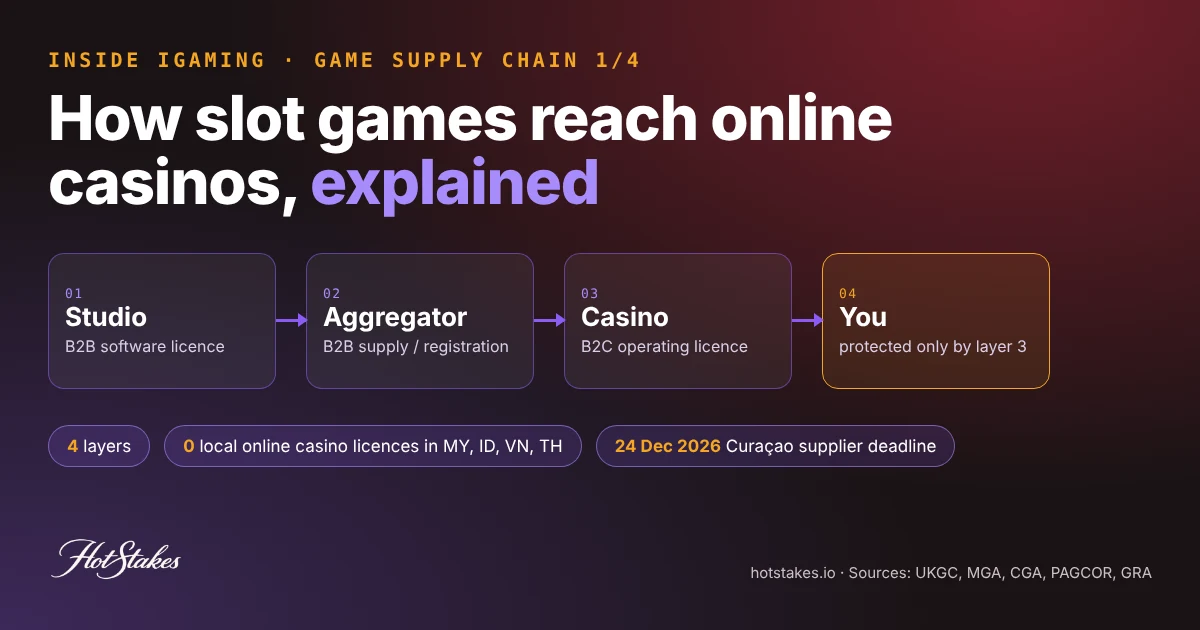
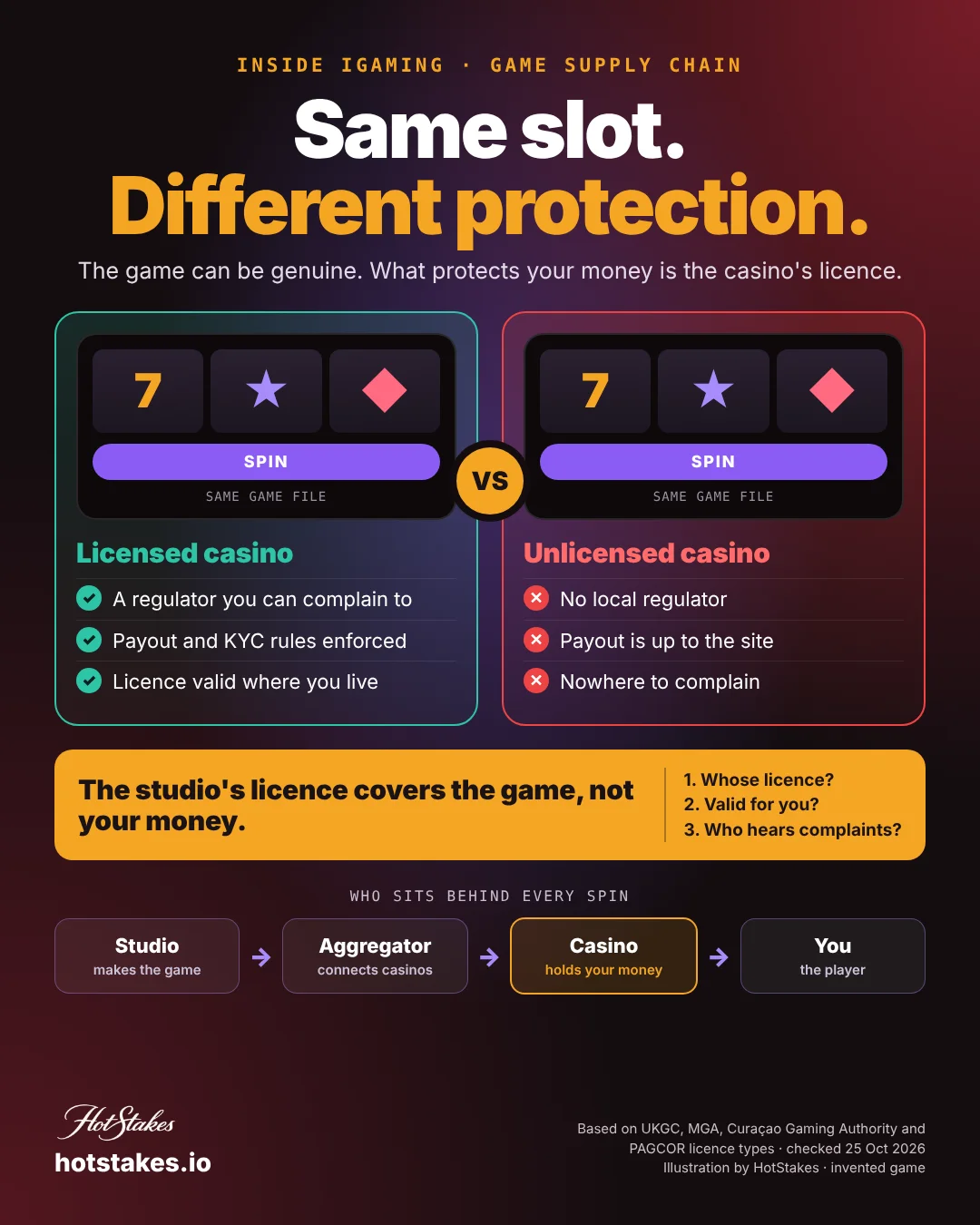
A slot you play online passes through up to four businesses before it reaches your screen. A studio builds it, an aggregator or distributor connects it to casinos, an operator puts it on its site, and you press spin. The game usually runs on the supplier’s server, but your balance, your currency and your payout all sit with the casino, so a famous game in ringgit or baht tells you nothing about whether that casino is licensed where you live. Here is how the chain works, who holds which licence, and what you can actually check.
The four layers of the game supply chain
Think of a film: studio, distributor, cinema, audience. The twist online is that the “film” often keeps running on the studio’s computer while you watch it on the casino’s site.
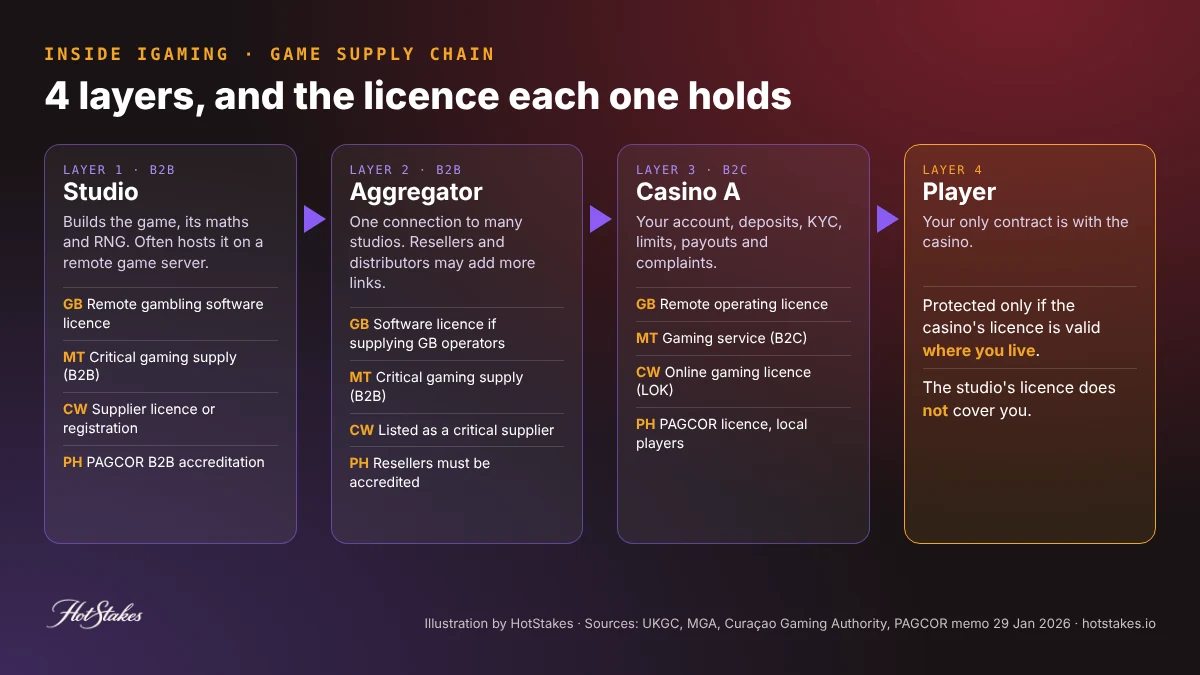
- Game studio (B2B supplier). Designs the game, its maths and its random number generator (RNG). It licenses the game to businesses, not to players.
- Aggregator, distributor or reseller. Bundles games from many studios behind one connection, so a casino does not have to integrate hundreds of studios one by one. In practice, one aggregator connection can bring a casino games from many studios at once.
- Operator (B2C casino). Runs the website or app, opens your account, takes your deposit, sets limits, checks your ID and pays you. This is the business that needs a licence to serve players.
- Player. You. Your only contract is with layer 3.
Who holds which licence
Serious regulators license both sides of the chain, under different names. We read each source on 25 Oct 2026.
| Regulator | Supplier side (B2B) | Casino side (B2C) |
|---|---|---|
| Great Britain: Gambling Commission | Remote gambling software licence, to “manufacture, supply, install or adapt gambling software” (UKGC) | Remote operating licence (for example, remote casino) |
| Malta: Malta Gaming Authority | “Critical gaming supply” licence, a business-to-business licence to supply and manage games or software (MGA) | “Gaming service” licence, a business-to-consumer licence |
| Curaçao: Curaçao Gaming Authority | Local suppliers need a supplier licence; foreign suppliers must register. Fully enforceable 24 Dec 2026 (Curaçao Chronicle, Jun 2026) | Online gaming licence under the LOK law, in force since 24 Dec 2024 |
| Philippines: PAGCOR | Accreditation for game content providers and resellers, deadline 31 Mar 2026 (AsGam, Feb 2026) | PAGCOR licence for online gaming offered to players in the Philippines |
One detail from Great Britain matters for players. The Commission says a software business that also hosts “a games platform” needs a remote casino operating licence too, “as it is responsible for the fairness of the gambling” (UKGC). Whoever runs the engine answers for its fairness.
Takeaway: A studio’s licence covers the studio. Only the casino’s licence covers you.
Where the game actually runs, and why it shows your currency
Most online slots are not installed on the casino’s website. They live on a remote game server (RGS) run by the studio or aggregator, which runs the game logic and random number generation; your browser only draws the reels and buttons (UK Gambling Commission: whoever hosts the games platform is “responsible for the fairness of the gambling”).
When you click a game, this happens in under a second:
- The casino creates a one-time session token for you.
- It opens the game in a frame using a launch URL that carries the game ID, your language, your currency and that token.
- The game server asks the casino’s wallet for your balance.
- Each spin, the server sends a debit for your stake and a credit for any win back to the casino’s wallet.
Here is an invented EXAMPLE of what a launch URL can look like. It points to a reserved .example domain and does not work:
https://games.studio.example/launch?game=demo-slot-01¤cy=MYR&lang=en&token=EXAMPLE-7f3a&lobby=https://casino-a.example/lobby
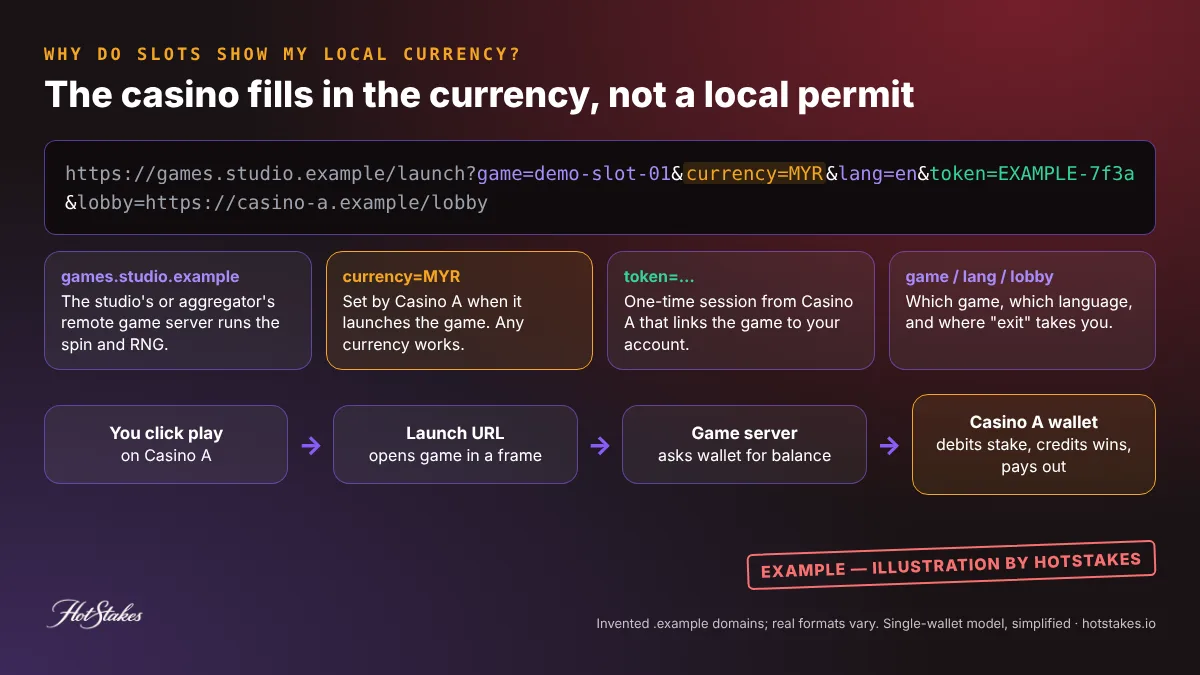
Notice who fills in currency=MYR. The casino does. In the common “single wallet” set-up, the casino keeps your balance, and the game server asks the casino’s wallet to take each bet and pay each win. The same guide lists “multiple currencies” among the balance types an operator’s wallet must handle.
Takeaway: Ringgit, pesos, baht or dong on the reels is a setting the casino chose. It is not a sign of local approval.
Why big-name games appear on sites with no local licence
Most of Southeast Asia has no legal online casino market to license. Offshore-licensed and unlicensed sites fill the gap.
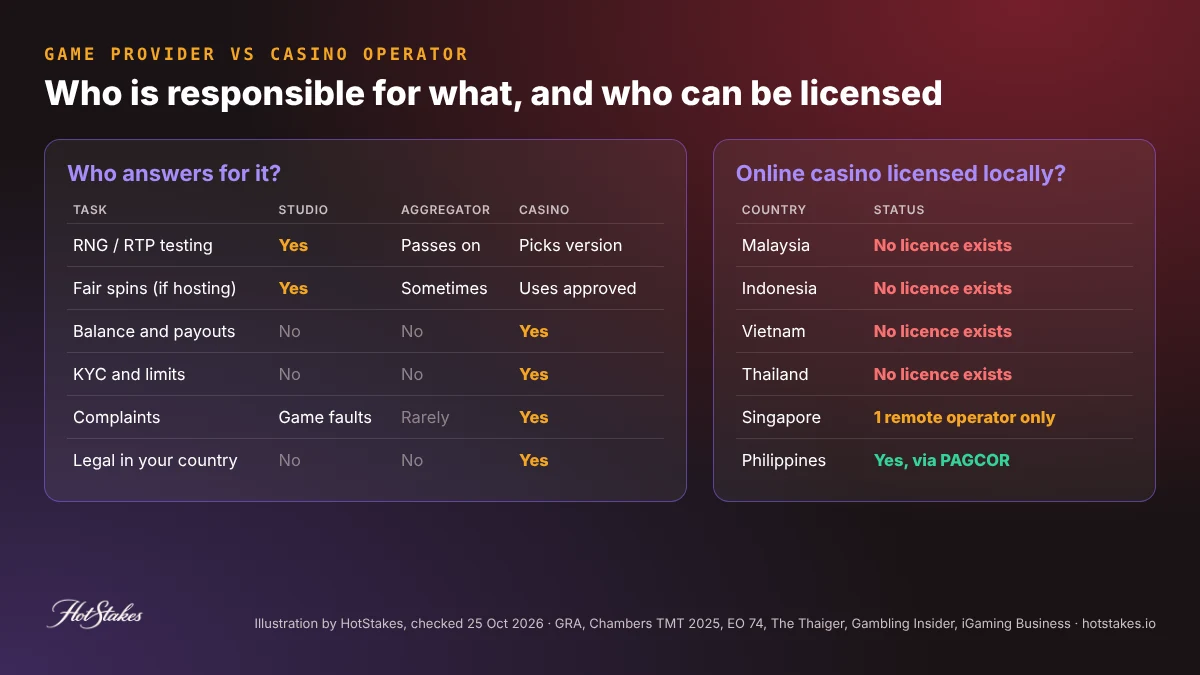
| Country | Can an online casino be licensed locally? | Source |
|---|---|---|
| Malaysia | No. Prosecutions run under the Common Gaming Houses Act 1953; the Court of Appeal held in October 2023 that online gambling is an offence under it. | Chambers TMT 2025, Shearn Delamore |
| Singapore | Only one: Singapore Pools is “the only operator licensed by GRA to provide remote gambling services.” Players on unlicensed sites face fines up to S$10,000. | GRA |
| Philippines | Yes, for players in the country, via PAGCOR. Offshore gaming (POGO) was banned by Executive Order 74, signed 5 Nov 2024. | EO 74 (Lawphil) |
| Thailand | No. Online gambling is illegal under the Gambling Act 1935; the casino-resort bill was withdrawn on 9 July 2025 and did not cover online play. | The Thaiger, Aug 2026 |
| Indonesia | No. Gambling is banned (Criminal Code Article 303); almost one million gambling sites blocked. | Gambling Insider, Feb 2025; Aug 2022 |
| Vietnam | No. Internet gambling is prohibited; legal sports betting is limited and excludes online and mobile wagering. | iGaming Business, Jan 2025 |
So how does a well-known slot reach a site with an offshore licence, or none? Three common routes:
- Offshore-licensed operators. A casino licensed elsewhere may accept players from countries that do not license it. That foreign licence does not make it legal for you. The Thaiger notes that a foreign licence, whether from Malta, Curaçao or the Philippines, does not change a player’s legal position in Thailand.
- Long chains. Games can pass from studio to aggregator to sub-aggregator or reseller. Each extra link makes it harder to see who finally serves players.
- Counterfeits. Some sites run copies that only look like the real thing (see below).
Our full guide to whether online gambling is legal in Asia covers each country in more depth.
Takeaway: A famous game on a site does not prove the studio chose to supply that site.
Fake games: the copy is not the original
Industry reporting describes a growing trade in counterfeit slots. A 2024 report covered by Gambling Insider said these copies are made to look like titles from well-known developers, run on unregulated, untested engines, and often include customisable RTP settings (Gambling Insider, Oct 2024). A dispute-resolution specialist told iGaming Expert that a typical trick is to make the top wins on the paytable impossible to hit, so the game pays well below its advertised RTP (iGaming Expert, Mar 2025). SiGMA reported that such games appear mainly on unlicensed sites (SiGMA, Mar 2025).
Part 3 of this series will cover how to check whether a game is genuine. For now, our explainer on how slot RTP is certified shows what real testing looks like.
Takeaway: On an unlicensed site, you cannot be sure the game is the tested original.
What regulators say about suppliers and illegal markets
Regulators increasingly treat suppliers as gatekeepers. What the documents say:
- Great Britain. Every gambling software licence carries a condition: the supplier must “secure contractually with its B2C operator clients” that British players reach its games only through a Commission-licensed casino. The Commission also says it has “a strong interest in deterring those we license” from supporting illegal competitors (UKGC).
- Great Britain, enforcement tone. At its CEO Briefing on 6 Nov 2025, chief executive Andrew Rhodes urged firms to check where their B2B partners do business, and said of providers “who may be also servicing the illegal market”: “There will be no more warnings for those actors” (UKGC).
- Curaçao. Under Article 5.16(4) of the LOK, licensed operators may not do business with unregistered suppliers, and the regulator must keep a public supplier register. Its list of critical suppliers includes game aggregation platforms (Curaçao Chronicle). By 17 Dec 2025 the authority had issued 551 B2C and 53 B2B provisional licences (CGA via Curaçao Chronicle). Background: our Curaçao licence reform explainer.
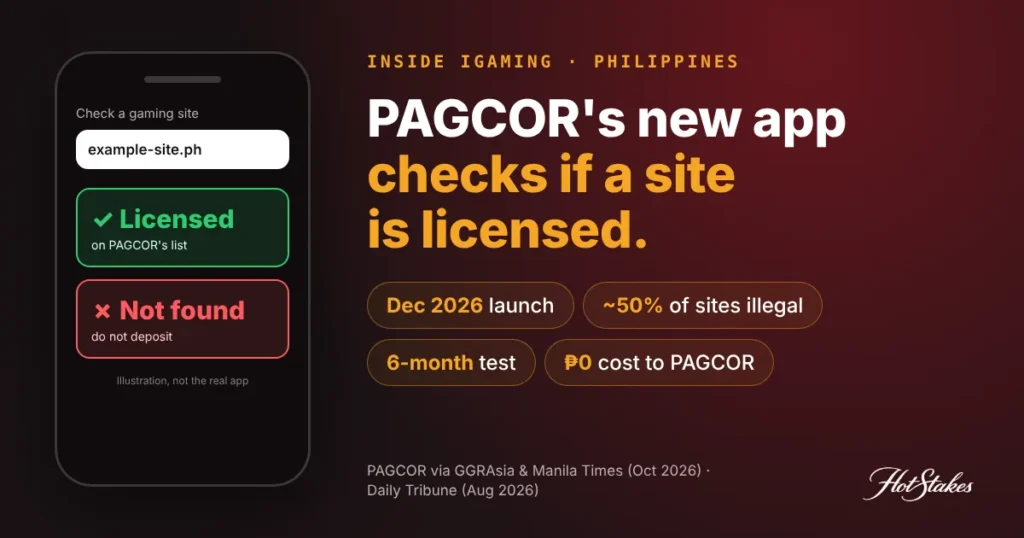
- Philippines. A PAGCOR memo dated 29 Jan 2026 required licensees to list all their B2B suppliers and set a 31 Mar 2026 accreditation deadline. Resellers must be accredited and keep a local studio or branch office, and platforms using unaccredited providers face cease-and-desist orders (AsGam). In practice, PAGCOR-licensed sites can reach some studios through accredited local distributors. For the offshore side, see our POGO ban explainer.
Takeaway: Licensed suppliers are expected to know their customers. None of these rules protects you on a site that is unlicensed where you live.
Who is responsible for what
| Task | Studio / RGS | Aggregator | Casino (operator) |
|---|---|---|---|
| Game maths, RNG and RTP testing | Yes, before release | Passes certified versions on | Chooses which version and RTP to offer, where options exist |
| Running each spin fairly | Yes, if it hosts the game | Sometimes hosts | Must use approved games |
| Your balance and payouts | No | No | Yes |
| ID checks (KYC) and limits | No | No | Yes |
| Complaints and disputes | Game faults only | Rarely | Yes, then its regulator or ADR |
| Being legal in your country | No | No | Yes |
This is HotStakes’ summary of the regulator rules above. Specifics vary by licence.
Takeaway: The casino, not the studio, decides whether and how fast you get paid.
What you can actually check as a player
- Find the casino’s licence, not the game’s. Look for the licence number and regulator in the site footer, then confirm it on the regulator’s own register. Our guide on how to spot an unlicensed online casino walks through it.
- Ask whether that licence covers your country. In Malaysia, Indonesia, Vietnam and Thailand, no online casino licence is valid locally. In the Philippines, check PAGCOR’s list with our PAGCOR licence check guide.
- Read the game’s info screen. Genuine games usually show a version and RTP figure; be wary if they are missing.
- Ignore the currency. It is a setting, not a stamp of approval.
- Know who to complain to before you deposit. If the casino has no regulator or dispute service you can reach, you have nowhere to go. Our online casino complaint guide explains the routes. Got the casino as an app from a link? See our fake gambling app red flags.
Takeaway: Three checks matter most: who licenses the casino, whether that licence covers you, and where you can complain.
FAQ
What is a casino game aggregator?
An aggregator is a business that connects games from many studios to many online casinos through one integration. It sells to casinos, not to players. Regulators such as Curaçao’s now list game aggregation platforms as critical suppliers that must be registered.
What is the difference between a game provider and a casino operator?
A game provider (studio) builds and often hosts the game and sells it to businesses. The casino operator runs the site, holds your account and money, checks your ID, pays withdrawals and needs a licence to serve players. Your contract is only with the operator.
Why do slots show my local currency on a site with no local licence?
The casino passes your currency to the game when it launches it, and its wallet holds your balance. Showing ringgit, baht or pesos is a technical setting chosen by the operator. It does not mean any local authority has approved the site.
Does a famous game mean the casino is safe?
No. The studio’s licence covers the studio, not the casino. The casino decides payouts, limits and complaints. Industry reports also describe counterfeit copies of popular games on unlicensed sites, with altered payouts.
Do game suppliers need a licence?
In regulated markets, yes. Great Britain issues remote gambling software licences, Malta issues critical gaming supply licences, Curaçao requires supplier licensing or registration from 24 December 2026, and PAGCOR requires B2B accreditation in the Philippines.
HotStakes is an independent directory. Some links on this site are affiliate links; we may earn a commission at no cost to you, and it never changes our rankings. Gambling involves risk — only play with money you can afford to lose, and if it stops being fun, seek help. This article is general information, not legal advice. Read our full disclaimer.
 Next story →NB99 Review 2026: Licence, Bonus Terms & Safety Check

Start the discussion