

Is Gambling a Sin? What 6 Major Religions Actually Say
Is gambling a sin? What the Qur'an, Bible, Catechism, Buddhist, Hindu, Jewish and Sikh texts say, and the harms they all worry about.
In this article
- The short answer, faith by faith
- Islam: is gambling haram?
- Christianity: what about gambling in the Bible?
- What does Buddhism say about gambling?
- Hinduism: the Rig Veda’s gambler’s lament
- Judaism: the dice player who can’t be a witness
- Sikhism: one line in the code of conduct
- Is lottery a sin? Where traditions draw the line
- What each tradition is actually worried about
- What harm research finds
- If faith is how you want to talk to someone who gambles
- Where to get help
- FAQ
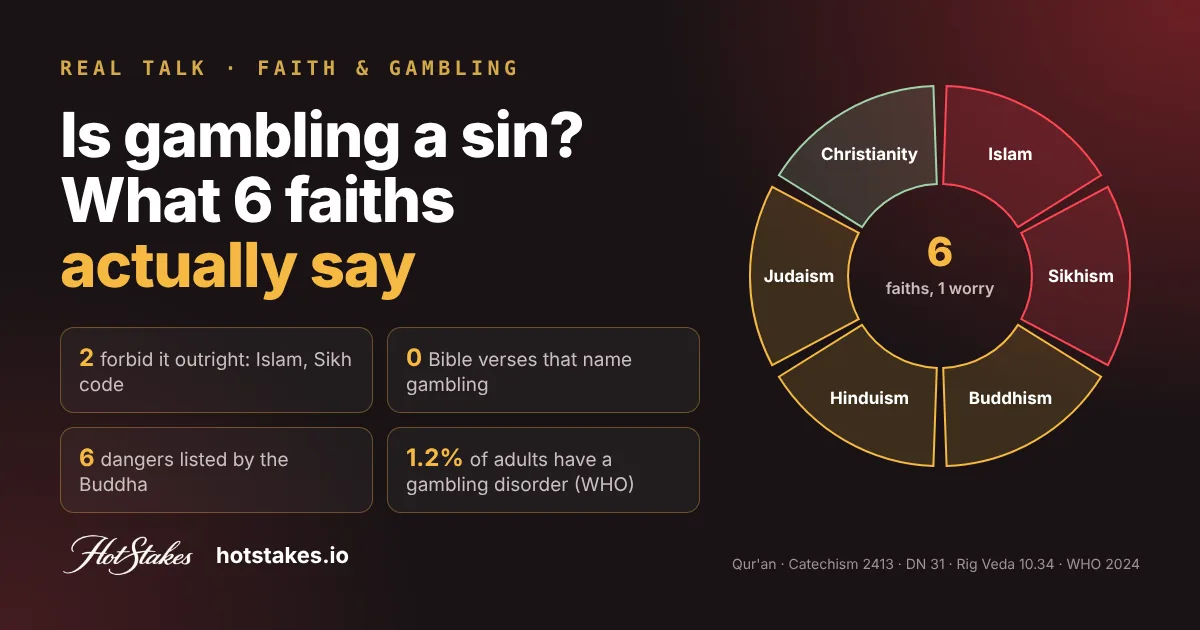
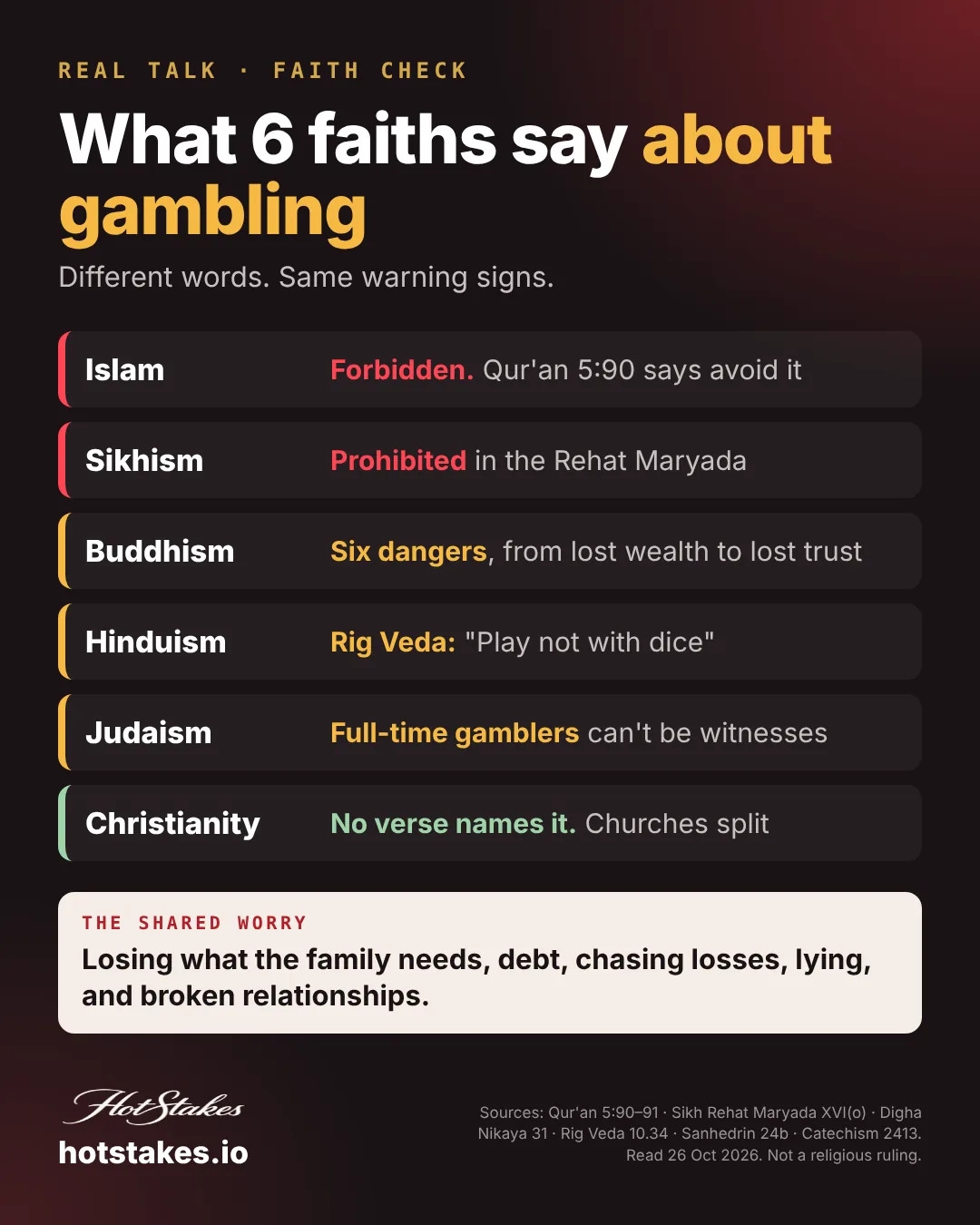
It depends on the faith. Islam forbids gambling outright. The Bible never names it, so churches split: Catholic teaching allows games of chance within limits, while many Protestant churches oppose them. Buddhist, Hindu, Jewish and Sikh texts all warn against it. Read closely, the six traditions worry about the same things clinicians screen for today: chasing losses, debt, lying and broken families.
The short answer, faith by faith
Here is the whole picture in one table. Each row links to the primary text or official body we used.
| Tradition | Key text | Position | What it worries about |
|---|---|---|---|
| Islam | Qur’an 2:219, 5:90–91 | Forbidden (haram) | Enmity, distraction from prayer, unearned gain |
| Christianity (Catholic) | Catechism 2413 | Not wrong in itself; wrong when it takes what others need | Enslavement, depriving the family, cheating |
| Christianity (many Protestant) | United Methodist, Southern Baptist | Opposed | Harm to the poor, families, society |
| Buddhism | Sigalovada Sutta (DN 31) | A “channel for dissipating wealth” | Lost wealth, grief, broken trust |
| Hinduism | Rig Veda 10.34, Manusmriti IX | Warned against; kings told to suppress it | Debt, the gambler’s wife and mother |
| Judaism | Talmud, Sanhedrin 24b | Professional gamblers barred as witnesses | Unearned gain, not contributing to society |
| Sikhism | Sikh Rehat Maryada XVI(o) | Prohibited in the code of conduct | Grouped with stealing and bad company |
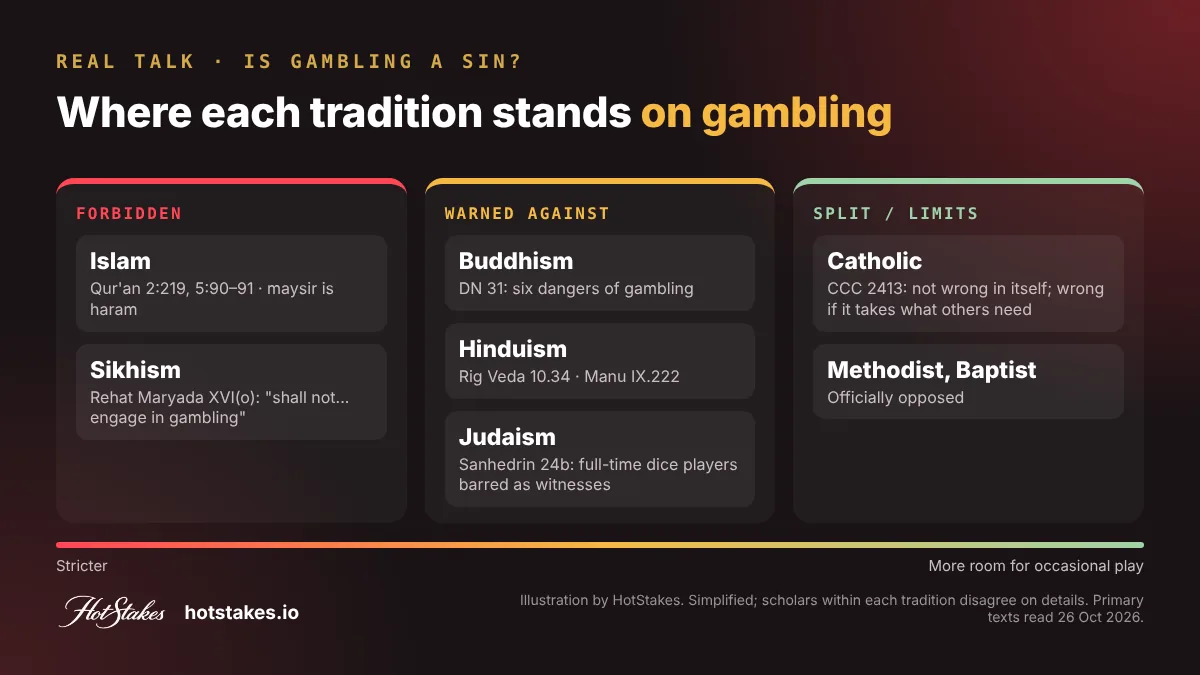
Takeaway: of the bodies covered here, only the Catholic Church says gambling is not wrong in itself, and even it draws a hard line at harm. Jewish law comes closest, targeting only full-time gamblers.
Islam: is gambling haram?
What the Qur’an says
Yes. Mainstream Islamic scholarship treats gambling (maysir, also called qimar) as haram. Two passages carry the ruling.
The first, Qur’an 2:219, admits gambling has some pull. Wine and gambling contain “great sin and [yet, some] benefit for people“, but the sin is greater. The second, 5:90, groups gambling with intoxicants and tells believers to “avoid it that you may be successful“. Verse 5:91 gives the reason: it sows “animosity and hatred” and turns people away from prayer.
That reason is social, not just ritual. The text worries about what gambling does between people.
What official bodies in Indonesia and Malaysia say
- Indonesia: in May 2022, the deputy secretary of the MUI Fatwa Commission restated that all gambling, offline or online, is haram, and so is the money it produces, “a little or a lot”.
- Malaysia: for Muslims, gambling is also a Syariah offence. Section 18 of the Syariah Criminal Offences (Federal Territories) Act 1997 sets a fine of up to RM3,000, up to two years’ jail, or both. States have their own enactments.
- Edge cases: fatwa bodies look at structure, not labels. In 2024 the Sabah Mufti’s Office said fishing contests whose prizes come from entry fees are gambling and haram. Sponsored prizes are fine.
Takeaway: in Islam the test is whether you pay in for a chance to win from others’ losses. If you do, it is maysir, whatever it is called.
Christianity: what about gambling in the Bible?
No verse names gambling
This surprises many people. A study guide from Baylor University’s Center for Christian Ethics states plainly that “there is no explicit biblical prohibition against gambling“.
The Bible does mention casting lots, for example to choose Matthias as an apostle in Acts 1:26. The same Baylor guide notes that was a way to make a fair decision, not to win money. Churches that oppose gambling lean instead on texts about money: “the love of money is a root of all kinds of evils” (1 Timothy 6:10) and “wealth gained hastily will dwindle” (Proverbs 13:11).
The Catholic view: Catechism 2413
The Catechism says games of chance and wagers are not in themselves contrary to justice. They become morally unacceptable when they deprive someone of what is necessary for their own or others’ needs. It adds a warning: “The passion for gambling risks becoming an enslavement.” Cheating and unfair wagers are grave matter.
Protestant views
Many Protestant churches go further. The United Methodist Church’s Social Principles call gambling “a menace to society” and urge members to abstain. The Southern Baptist Convention’s 1997 resolution blames gambling for “pain and destruction in the lives of countless people“, especially children, the poor and the elderly.
Takeaway: Christians genuinely disagree. The common ground is that gambling becomes wrong once it harms the family’s needs or takes control.
What does Buddhism say about gambling?
In the Sigalovada Sutta (Digha Nikaya 31), the Buddha’s advice to a young layman, gambling is one of “the six channels for dissipating wealth”. The text then lists its six evil consequences (Narada Thera’s translation):
- The winner begets hate.
- The loser grieves for lost wealth.
- Loss of wealth.
- His word is not relied upon in a court of law.
- He is despised by friends and associates.
- He is not sought after for marriage.
The Parabhava Sutta adds that being “a drunkard, a gambler, and a squanderer” is a cause of a person’s downfall.
Takeaway: Buddhist teaching frames gambling as practical folly that costs money, trust and relationships, more than as an offence against a god.
Hinduism: the Rig Veda’s gambler’s lament
Hinduism has no single authority, but one of its oldest texts holds a famous poem on gambling. Rig Veda 10.34 is a gambler’s own lament. “My wife holds me aloof, her mother hates me,” he says (Griffith’s translation). Verse 10 describes him wandering “in debt” while his mother mourns. The poem ends with plain advice: “Play not with dice: no, cultivate thy corn-land.”
The later Manusmriti treats gambling as a matter for the state. Verse IX.222 says gambling and betting “amount to open theft” and tells the king to suppress them.
Takeaway: the Hindu texts read like a family’s story: debt, shame and a wife and mother left behind.
Judaism: the dice player who can’t be a witness
The Mishnah in Sanhedrin 24b disqualifies dice players from serving as witnesses or judges. The Talmud gives two reasons, as My Jewish Learning summarises:
- Rami bar Hama: the loser never fully agreed to lose, so winnings are close to theft.
- Rav Sheshet: gamblers don’t contribute to “settling the world” (productive society), so they can’t be trusted on fairness.
Rabbi Yehuda narrows the rule to people with no other occupation. Someone with an honest job who plays occasionally stays a valid witness.
Takeaway: Jewish law targets gambling as a way of life, not every bet.
Sikhism: one line in the code of conduct
The Sikh Rehat Maryada, the code published by the SGPC in Amritsar, is direct: “A Sikh shall not steal, form dubious associations or engage in gambling.” It sits next to the ban on intoxicants.
Takeaway: for observant Sikhs, gambling is simply off the list.
Is lottery a sin? Where traditions draw the line
Lotteries and raffles are where the answers diverge most.
- Islam: Jordan’s General Iftaa’ Department ruled in 2024 that “‘Lotto’ is nothing more than a form of gambling“, even when proceeds go to charity. In 2013, MUI ruled prize walks that require a paid coupon haram.
- Catholic: the same Catechism 2413 test applies. A ticket is not wrong in itself unless it takes what the household needs.
- Southern Baptist: a 1985 resolution called lotteries “a regressive source of government revenue particularly victimizing the poor“.
Takeaway: a “small” ticket does not change the ruling in Islam. In Christianity it depends on your church and on what the money was meant for.
What each tradition is actually worried about
This section is our own synthesis, not a religious ruling. We put each tradition’s stated worry next to two clinical tools: the nine DSM-5 criteria for gambling disorder and the nine-question Problem Gambling Severity Index (PGSI).
| Shared worry | Where the faiths say it | Matching clinical sign |
|---|---|---|
| Losing what the family needs | Catechism 2413; Sigalovada “loss of wealth” | PGSI: bet more than you could afford; financial problems for the household |
| Debt and borrowing | Rig Veda 10.34.10 “in debt” | PGSI: borrowed or sold things to gamble; DSM-5: relies on others for money |
| Chasing losses | Sigalovada “the loser grieves for lost wealth” | DSM-5 and PGSI: going back to win back losses |
| Losing control | Catechism “enslavement”; 1 Timothy 6:10 | DSM-5: repeated failed attempts to cut down; preoccupation |
| Lying and broken trust | Sanhedrin 24b; Sigalovada “word not relied upon” | DSM-5: lies to hide gambling |
| Family and friendship breakdown | Qur’an 5:91 “animosity and hatred”; Rig Veda 10.34.3 | DSM-5: jeopardised a relationship or job |
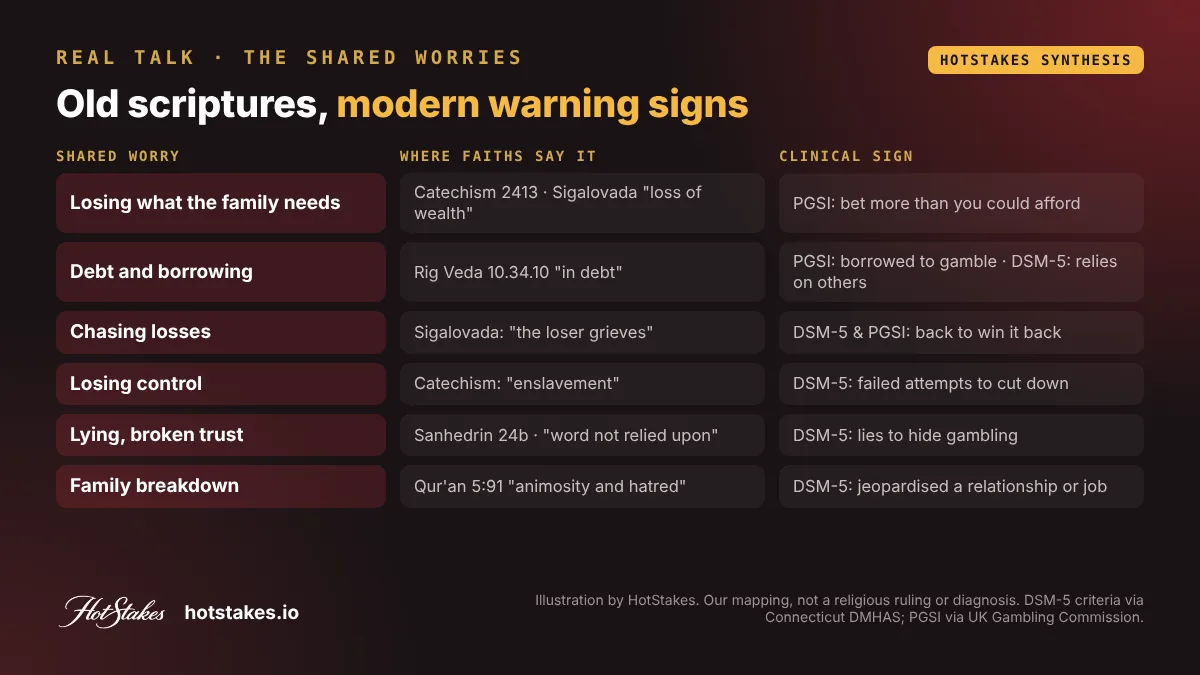
Takeaway: you don’t need to agree on theology to agree on the warning signs. Each of the six worries has a matching item in DSM-5, the PGSI or both.
What harm research finds
The World Health Organization’s 2024 fact sheet on gambling lists the same harms the scriptures describe: financial distress, relationship breakdown, family violence, neglect of children, and higher rates of mental illness and suicide. Three of its numbers stand out:
- About 1.2% of adults worldwide have a gambling disorder.
- For each person gambling at high-risk levels, about six others are affected.
- People gambling at harmful levels generate around 60% of gambling losses.
That last figure links to the maths: the operator’s edge means losses pile up over time. Our explainer on why the house always wins shows how. For the wider picture, see is gambling bad for you.
Takeaway: the “six others” figure is why so many faiths speak about the family, not just the gambler.
If faith is how you want to talk to someone who gambles
Faith can open a conversation or shut it down. These steps help keep it open:
- Start from worry, not sin. “I’m scared about the money and about you” lands better than a verse.
- Use their tradition’s own reason. The Qur’an’s concern about enmity, the Catechism’s “enslavement” and the Buddha’s six dangers are all about harm, so they invite care rather than shame.
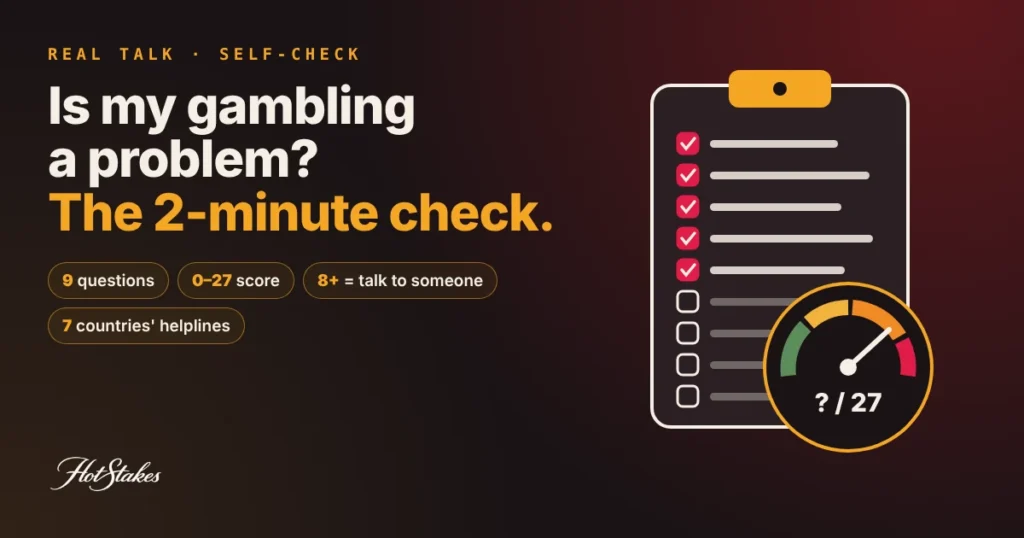
- Name specific signs. Use our gambling problem signs checklist to point to behaviour, not character.
- Protect the household first. If debt is involved, read what to do about gambling debt before lending money.
- Bring in a counsellor, and a religious teacher if they want one. A helpline gives practical help; a trusted imam, priest, monk or granthi can give spiritual support.
For specific relationships, see our guides on a partner with a gambling problem and on signs your teen is gambling.
Takeaway: shame keeps people gambling in secret. Concern, specifics and a phone number work better.
Where to get help
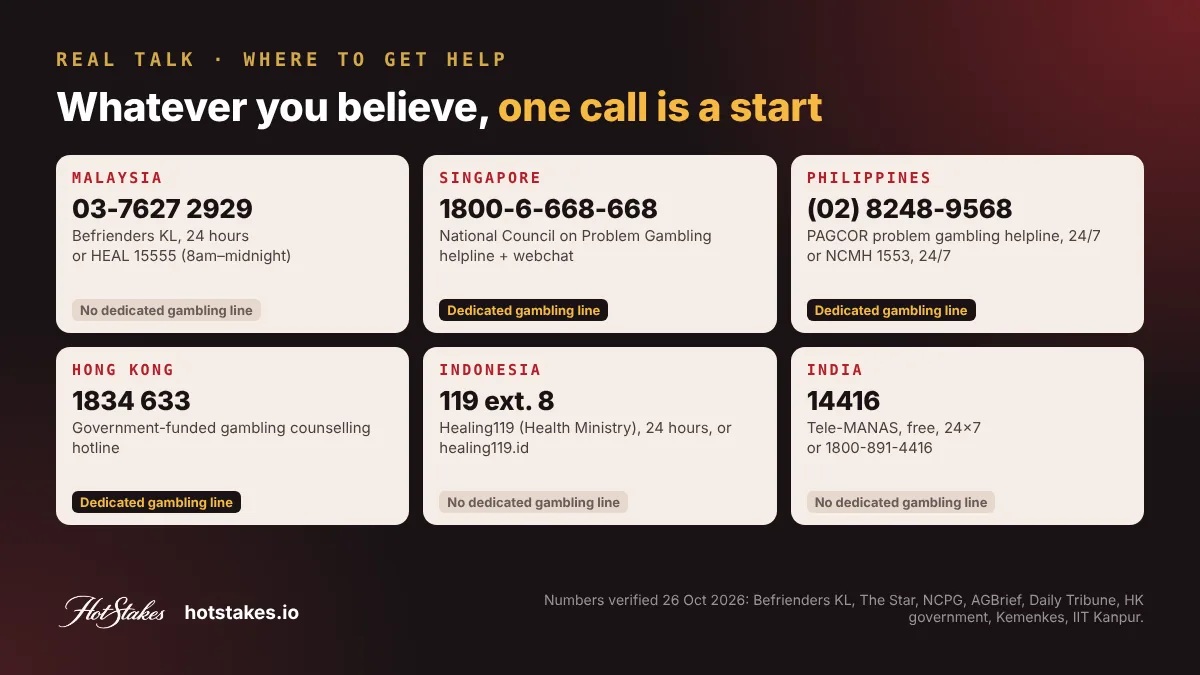
We checked every number below against an official or news source on 26 Oct 2026. Where a country has no dedicated gambling helpline, we say so.
- Malaysia: no dedicated national gambling helpline. Befrienders KL 03-7627 2929 (24 hours) or the Health Ministry’s HEAL 15555 (8am to midnight daily).
- Singapore: National Council on Problem Gambling helpline 1800-6-668-668, plus webchat.
- Philippines: PAGCOR’s National Problem Gambling Helpline (02) 8248-9568 (24/7) or the NCMH crisis hotline 1553 (24/7).
- Hong Kong: government-funded gambling counselling hotline 1834 633.
- Indonesia: we found no dedicated national gambling helpline. The Health Ministry’s Healing119: call 119 ext. 8 or chat via healing119.id (24 hours).
- India: no dedicated national gambling helpline. Tele-MANAS 14416 or 1800-891-4416 (free, 24×7).
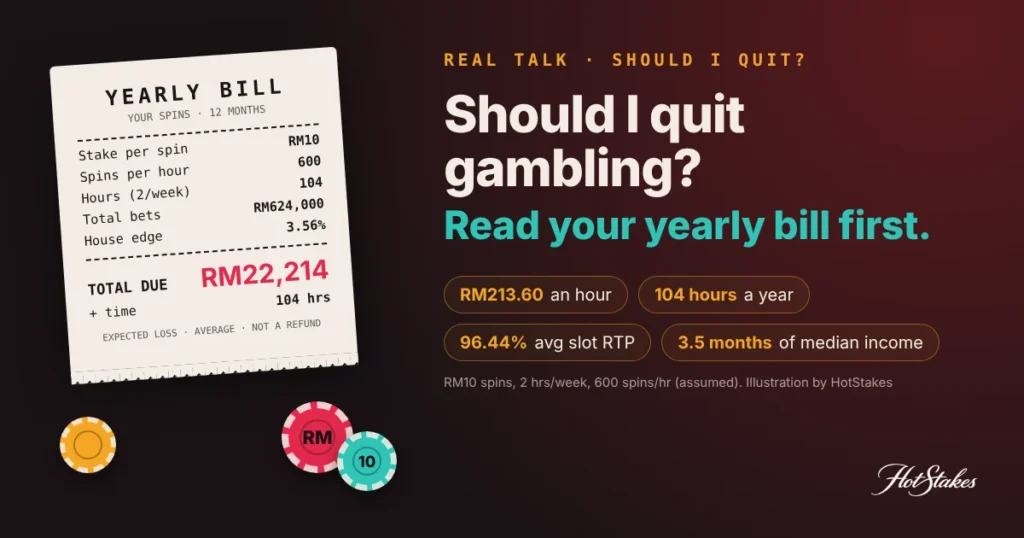
If someone is in immediate danger, call your local emergency number. Thinking about stopping yourself? Start with should I quit gambling.
Takeaway: one call is enough to start, whatever you believe.
FAQ
Is gambling a sin in the Bible?
The Bible has no verse that names gambling. Churches that oppose it point to warnings about the love of money (1 Timothy 6:10). The Catholic Catechism says games of chance are not wrong in themselves, but become wrong when they take what a family needs.
Is gambling haram in Islam?
Yes. Qur’an 5:90–91 tells believers to avoid gambling (maysir), and bodies such as Indonesia’s MUI say all gambling, online or offline, is haram. In Malaysia it is also a Syariah offence for Muslims.
Is lottery a sin?
In Islam, official bodies such as Jordan’s General Iftaa’ Department treat lotteries as gambling, even for charity. In Christianity it depends on the church: Catholic teaching allows it within limits, while the Southern Baptist Convention opposes lotteries.
What does Buddhism say about gambling?
The Sigalovada Sutta calls gambling a channel for dissipating wealth and lists six dangers, including lost wealth, grief, broken trust and being despised by friends.
Does Hinduism forbid gambling?
Hinduism has no single authority. The Rig Veda’s gambler’s lament (10.34) warns against dice, and the Manusmriti tells the king to suppress gambling and betting, calling them open theft.
HotStakes is an independent directory. Some links on this site are affiliate links; we may earn a commission at no cost to you, and it never changes our rankings. Gambling involves risk — only play with money you can afford to lose, and if it stops being fun, seek help. This article is general information, not legal advice. Read our full disclaimer.
 Next story →NB99 Review 2026: Licence, Bonus Terms & Safety Check



Start the discussion