

Indonesia Online Gambling: Is the Crackdown Working?
Gambling money in Indonesia fell, but transactions rose 167% and the average deposit halved to Rp97k. What PPATK's data really shows.
In this article
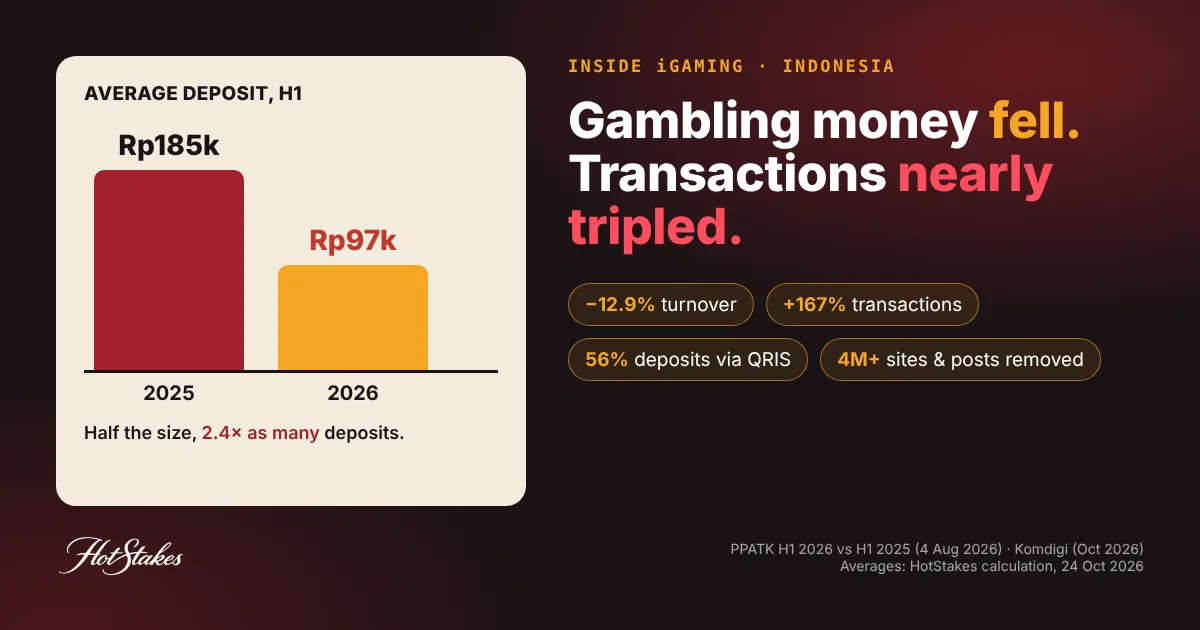
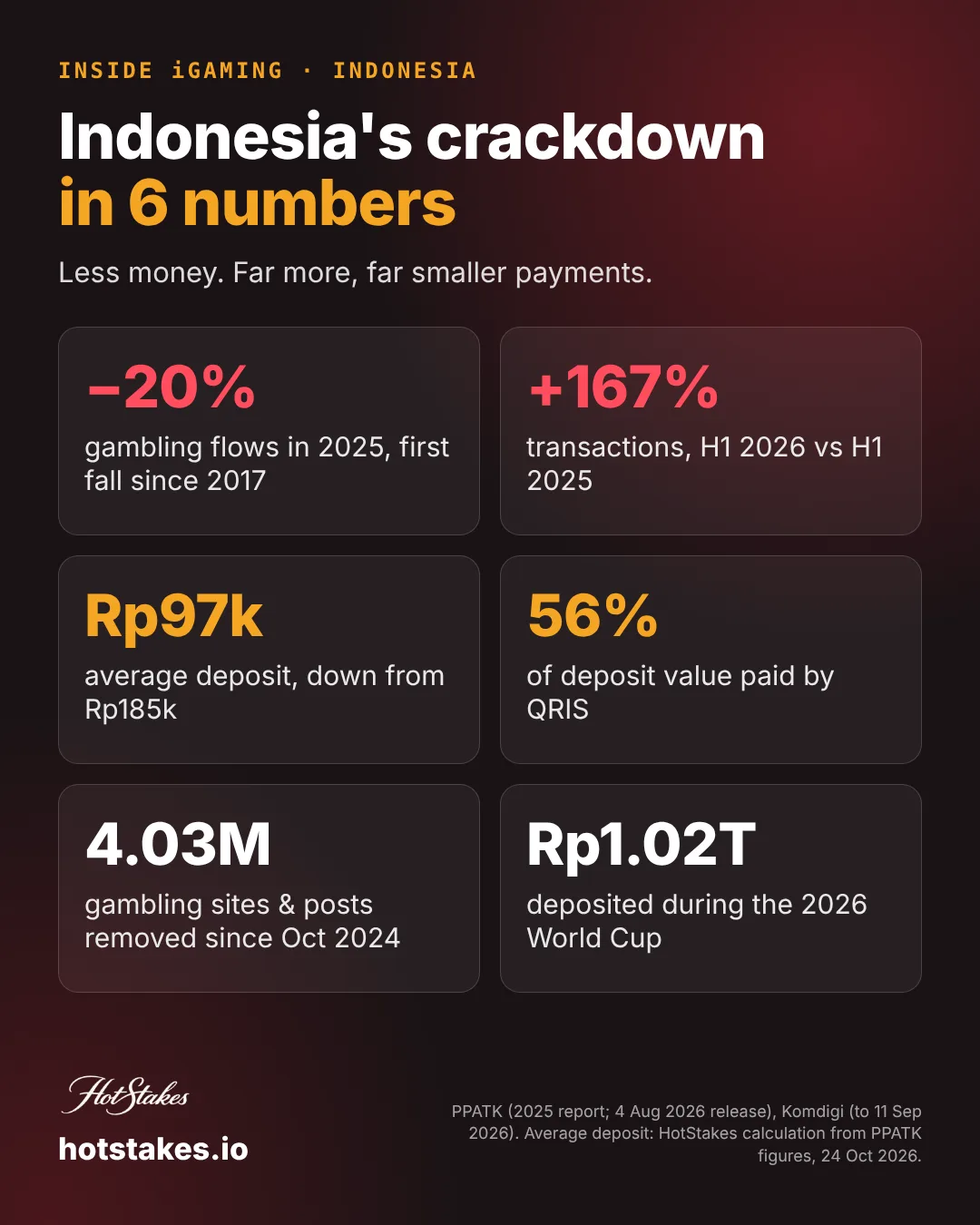
Is Indonesia’s online gambling crackdown working? Partly. Money flowing through judi online fell 20% in 2025, the first drop since 2017, and turnover fell another 12.9% in the first half of 2026. But transactions rose 167% in the same half-year, and the average deposit almost halved to about Rp97,000: the money is not gone, it is moving in smaller, faster pieces. That is our reading of the financial intelligence agency PPATK’s own figures, and PPATK says operators split payments on purpose to avoid detection.
The numbers: what fell and what exploded
PPATK, Indonesia’s Financial Transaction Reports and Analysis Center, tracks gambling money through bank, e-wallet and QRIS reports. Two releases matter.
First, the full year. Gambling fund flows fell to Rp286.84 trillion in 2025 from Rp359.81 trillion in 2024, a 20% drop, and deposits fell from Rp51.3 trillion to Rp36.01 trillion, RRI reported from PPATK data. PPATK head Ivan Yustiavandana called it “a new record”. About 12.3 million people made gambling deposits in 2025, according to PPATK’s 2025 report.
Second, the half-year. The PPATK press release of 4 August 2026 compares January–June 2026 with the same months of 2025:
| Indicator | H1 2025 | H1 2026 | Change |
|---|---|---|---|
| Turnover (all gambling flows) | Rp99.68 trillion | Rp86.82 trillion | −12.9% |
| Number of transactions | 174.90 million | 467.32 million | +167.2% |
| Deposit value | Rp17.50 trillion | Rp22.05 trillion | +26% |
| Deposit transactions | 94.50 million | 226.76 million | +140% |
| Average deposit* | Rp185,185 | Rp97,239 | −47.5% |
| Average turnover per transaction* | Rp569,926 | Rp185,783 | −67.4% |
*HotStakes calculation from PPATK figures, 24 Oct 2026 (value divided by number of transactions).
Look at the deposit line. Turnover fell, but the money players actually put in rose by a quarter. That is the part most headlines skip.
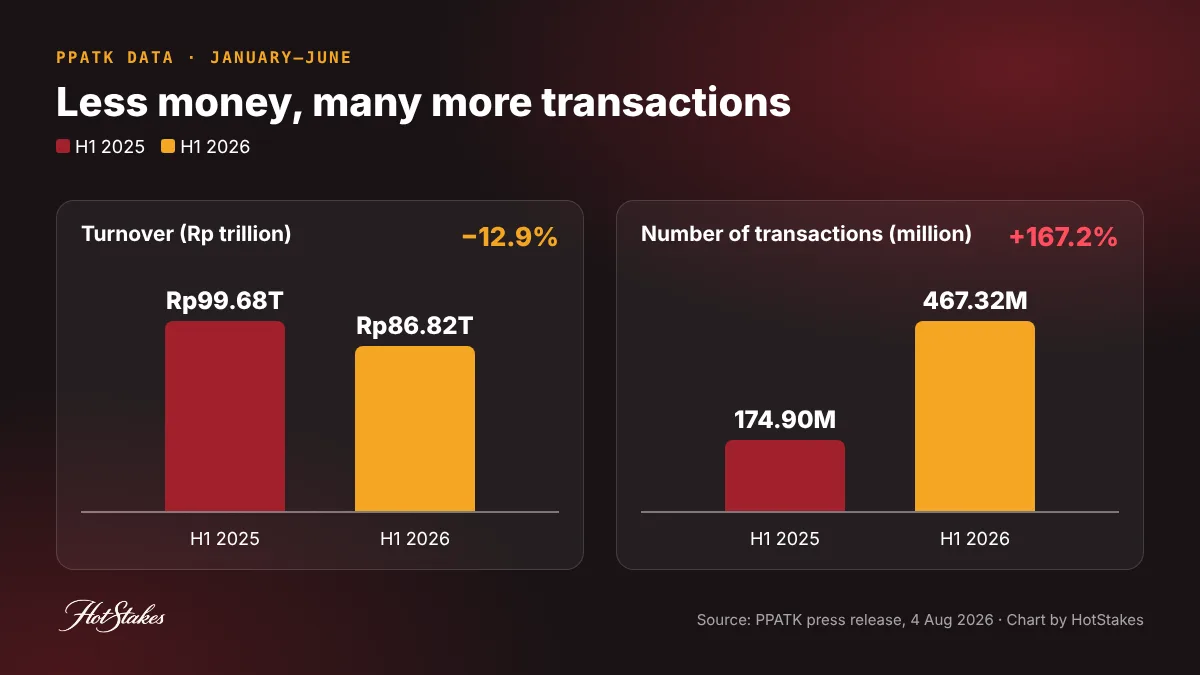
Takeaway: The headline total is down. The number of times money moves is up almost threefold.
Our maths: the average bet shrank by half
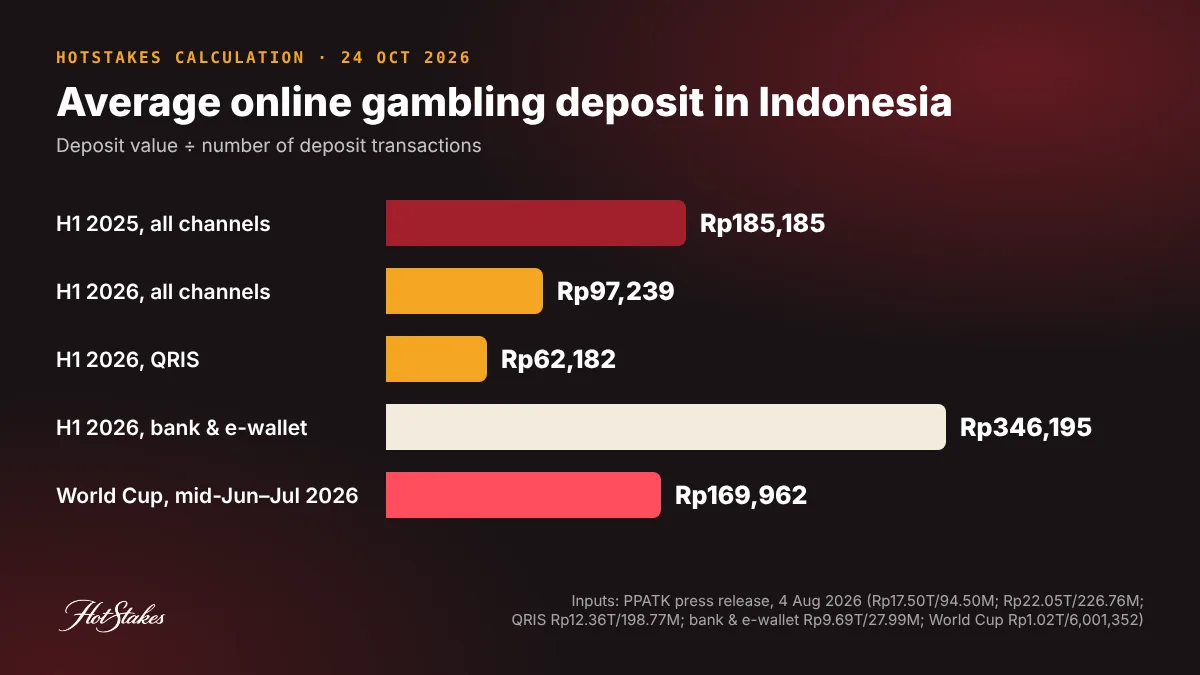
We divided PPATK’s values by its transaction counts on 24 October 2026. Here is what falls out.
- Average deposit: Rp185,185 in H1 2025, Rp97,239 in H1 2026. Down 47.5%.
- Average turnover per transaction: Rp569,926 down to Rp185,783. Down 67.4%.
- QRIS deposits: Rp12.36 trillion over 198.77 million transactions = Rp62,182 each. QRIS carried 56.04% of deposit value but 87.66% of deposit transactions.
- Bank and e-wallet deposits: Rp9.69 trillion over 27.99 million = Rp346,195 each, about 5.6 times the QRIS average.
- World Cup period (mid-June to July 2026): Rp1.02 trillion over 6,001,352 deposits = Rp169,962 each, well above the half-year average.
- Deliberate splitting. PPATK says gambling networks adapted by breaking transactions into smaller amounts at higher frequency.
- Better detection. PPATK also says the jump partly reflects stronger monitoring that now catches small, repeated payments, not only growth in gambling.
- Who plays. Small-ticket QRIS top-ups suit players with little spare cash (see “Who gets hurt” below).
The World Cup average being higher fits a simple story: big tournaments pull in occasional sports bettors who stake more per go. That is our reading, not a finding.
Ivan put the detection point plainly: suspicious transactions, “however small”, are “increasingly recognisable” (PPATK, our translation).
Takeaway: A typical gambling top-up in Indonesia is now under Rp100,000, and a typical QRIS one is near Rp62,000.
How the money moves
This is a recognition guide, not a manual. Gambling is illegal in Indonesia, and so is helping move its money. PPATK and police describe the main channels:
- QRIS merchant misuse. Players pay a QR code that looks like a shop. Behind it sits a merchant set up, or hijacked, to collect gambling deposits. PPATK says QRIS itself is valuable and the target is those who abuse it.
- Bought, rented and dormant accounts. PPATK found about 150,000 nominee accounts used for laundering in 2020–2024, roughly 120,000 of them from buying and selling accounts, Ivan said in August 2025. If someone offers cash to “borrow” your account, that is the money mule account scam, and you carry the legal risk.
- Layers of fronts. Shell companies, fake merchants, merchant aggregators, payment gateways, remittance and money-changer businesses, fintech platforms and digital vouchers, per PPATK as reported by RRI.
- Rotating sites. One network raided in June 2026 allegedly ran over 145 gambling sites and rotated them to dodge blocks, with servers abroad, police said.
Red flags that your own account or shop QR is being used: incoming small payments from strangers, a “job” that pays you to receive and forward money, or a request to sell a dormant account.
Takeaway: The crackdown has pushed gambling money into ordinary payment rails, which is why ordinary account holders get caught up in it.
What Indonesia is doing: the crackdown toolkit
Gambling has long been a crime in Indonesia, and online gambling is covered twice: by the criminal code and by the electronic information law. The legal breakdown from Hukumonline sets out the penalties:
| Law | Who it targets | Maximum penalty |
|---|---|---|
| Old Criminal Code (KUHP), Art. 303 | Organising or offering gambling | 10 years or Rp25 million |
| Old KUHP, Art. 303 bis | Taking part | 4 years or Rp10 million |
| New KUHP (Law 1/2023), Art. 426 | Organising or offering gambling | 9 years or up to Rp2 billion |
| New KUHP, Art. 427 | Taking part | 3 years or up to Rp50 million |
| ITE Law (as amended by Law 1/2024), Art. 27(2) with 45(3) | Distributing or making gambling content accessible | 10 years and/or Rp10 billion |
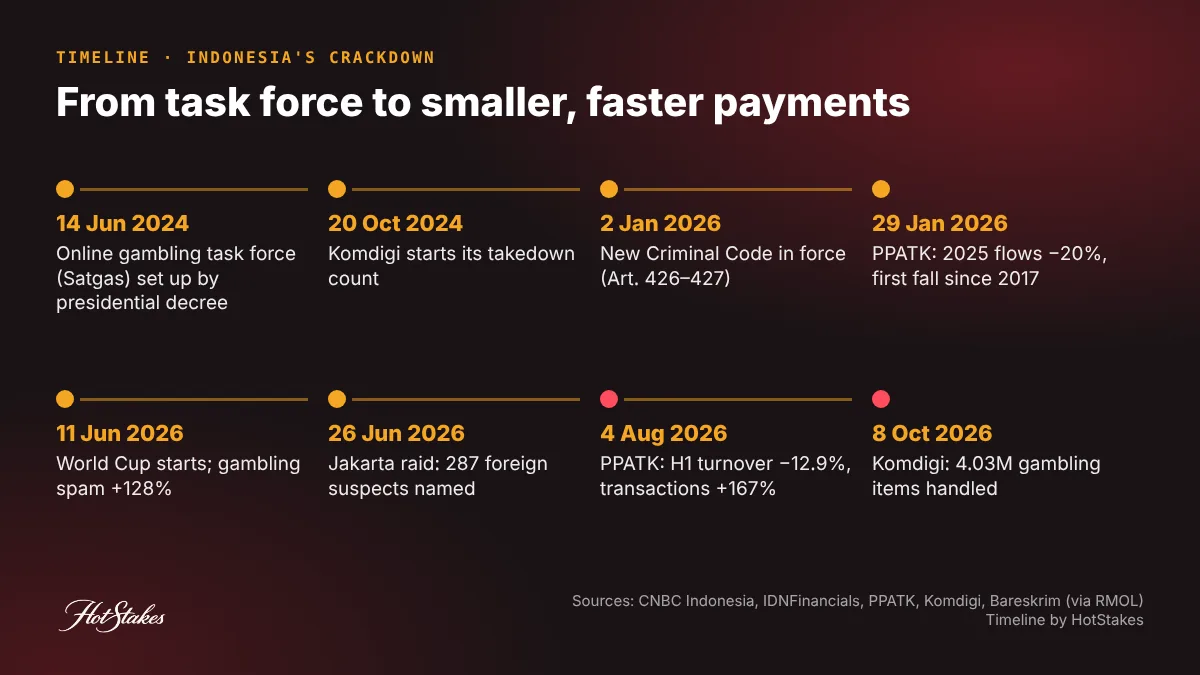
The new criminal code took effect on 2 January 2026. Players can still be prosecuted; the heaviest penalties target operators and promoters.
Enforcement runs on four tracks:
- A task force. Presidential Decree 21/2024 set up the online gambling task force (Satgas) on 14 June 2024, CNBC Indonesia reported.
- Takedowns. The Ministry of Communication and Digital (Komdigi) handled 4.03 million gambling items from 20 October 2024 to 11 September 2026, the government news service said. Gambling spam comments rose about 128% when the World Cup started, Komdigi said.
- Accounts. About 32,500 of 38,000 accounts Komdigi flagged to the financial regulator OJK were closed, Antara reported. PPATK suspended 5,762 accounts holding Rp1.07 trillion in H1 2026, RRI reported.
- Raids. In June 2026 police named 287 foreign nationals and 4 Indonesians as suspects after raiding an alleged gambling operation in West Jakarta. The case is still under investigation.
Takeaway: Blocking sites is the loudest tool; following the money is the one that moved the totals.
Who gets hurt
The small-deposit pattern matters because of who is depositing.
- Low earners. 71% of 9.8 million players in 2024 earned under about Rp5 million a month, Katadata Insight Center said, citing PPATK data.
- Teenagers. PPATK counted 197,054 players aged 11 to 19 with Rp293.4 billion in deposits, Tempo reported in July 2024.
A Rp62,000 QR payment feels harmless. A hundred of them is Rp6.2 million, more than a month’s pay for anyone earning under Rp5 million.
If that sounds familiar, our gambling problem signs checklist is a calm place to start, and our guide to blocking gambling sites and payments covers practical barriers. We found no dedicated national gambling helpline in Indonesia. The Ministry of Health’s free counselling line, Healing119, is reachable on 119 ext. 8 (checked 24 Oct 2026). Suspicious accounts can be reported at cekrekening.id, the Komdigi channel Antara cites above.
Takeaway: Smaller deposits do not mean smaller harm when the players have the least to lose.
Indonesia vs Cambodia vs the Philippines
Indonesia’s neighbours took different routes. For the wider picture, see our guide to online gambling laws in Asia.
| Indonesia | Cambodia | Philippines | |
|---|---|---|---|
| Main problem | Millions of local players on offshore sites | Foreign-run online gambling and scam hubs | Licensed offshore operators (POGOs) serving foreigners |
| Key move | Task force (2024), takedowns, account freezes, payment tracking | Stopped issuing online gambling licences (2019 directive); 91 scam-linked casinos shut (2026) | Executive Order 74 banned offshore gaming from 31 Dec 2024 (GMA) |
| Main lever | The payment system | Licensing, raids, deportations | Licensing |
| Our explainer | This page | Cambodia’s ban explained | The POGO ban explained |
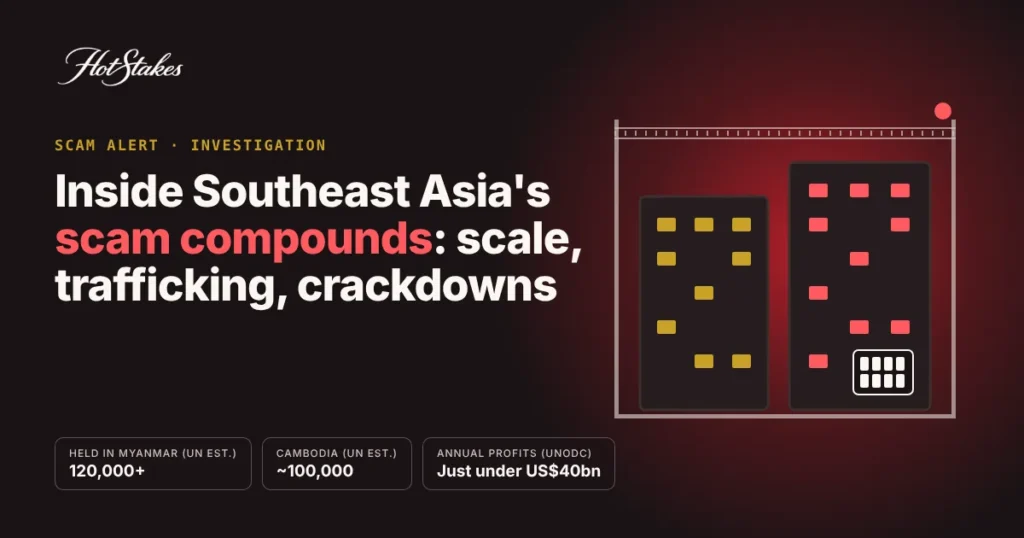
The pattern across all three: operations displaced by one ban tend to resurface elsewhere, which is how the region ended up with Southeast Asia’s scam compounds. Indonesia’s raid in June involved suspects from six countries.
Takeaway: Cambodia and the Philippines shut supply; Indonesia, a country of players, is squeezing demand through payments.
So, is it working? A verdict in four points
- Yes, on totals. 2025 flows fell 20%, the first fall since 2017, and H1 2026 turnover fell 12.9%.
- No, on activity. Transactions rose 167% and deposit value rose 26% in H1 2026.
- Unclear, on cause. PPATK itself says better detection explains part of the jump. Tracking changed, so the trend is hard to read cleanly.
- Worrying, on harm. An average deposit near Rp97,000, and Rp62,000 by QRIS, points to frequent small bets by people on low incomes.
The real test is the second half of 2026: if deposits keep rising while turnover falls, the crackdown is reshaping gambling rather than shrinking it.
FAQ
Is online gambling legal in Indonesia?
No. Organising and taking part in gambling are crimes under the criminal code (Articles 426 and 427 of the new KUHP in force since 2 January 2026, replacing Articles 303 and 303 bis), and the ITE Law bans distributing gambling content online.
Did online gambling in Indonesia go down?
The money did: PPATK says flows fell 20% in 2025 to Rp286.84 trillion, the first decline since 2017, and H1 2026 turnover fell 12.9%. But transactions rose 167% and deposits rose 26% in H1 2026.
What is the average online gambling deposit in Indonesia?
About Rp97,239 in H1 2026, down from Rp185,185 a year earlier, by our calculation from PPATK figures (24 Oct 2026). QRIS deposits averaged about Rp62,182.
Why are there more transactions if less money is moving?
PPATK says gambling networks split payments into smaller, more frequent amounts to avoid detection, and that stronger monitoring now catches more small transactions. Both push the count up while the total falls.
What should I do if someone asks to rent my bank account?
Refuse. Accounts used to move gambling money can be frozen, and the account holder can face legal trouble. You can report suspicious accounts at cekrekening.id.
HotStakes is an independent directory. Some links on this site are affiliate links; we may earn a commission at no cost to you, and it never changes our rankings. Gambling involves risk — only play with money you can afford to lose, and if it stops being fun, seek help. This article is general information, not legal advice. Read our full disclaimer.
 Next story →EW8 Review 2026: Licence, Bonus Terms & Safety Check







Start the discussion