

Signs Your Child Is Gambling: Loot Boxes, Skins, What to Do
Signs your child is gambling, what loot boxes and skins really are, how to talk without shaming, and the settings that stop the spending.
In this article
- How common is teen gambling? What the 2025 data says
- Loot boxes, skins and gambling-style games: what’s what
- Do loot boxes lead to gambling problems? Association, not proof
- Signs your child is gambling
- How to talk to your teen without shaming them
- Stop the spending: parental controls in 10 minutes
- Where to get help (verified 22 Oct 2026)
- FAQ
A strange charge on your card. A sudden obsession with opening “packs” or “cases”. Pocket money that disappears faster than it should. The clearest signs your child is gambling are money that doesn’t add up, secrecy about it, and a growing fixation on winning, and the most useful response is a calm conversation plus a few minutes switching on purchase approvals. This guide gives you the 2025 data, an honest answer on loot boxes, a sourced signs list, and what to say. It also covers the exact settings on iPhone and Android, plus verified helplines for Singapore, Malaysia and beyond.
How common is teen gambling? What the 2025 data says
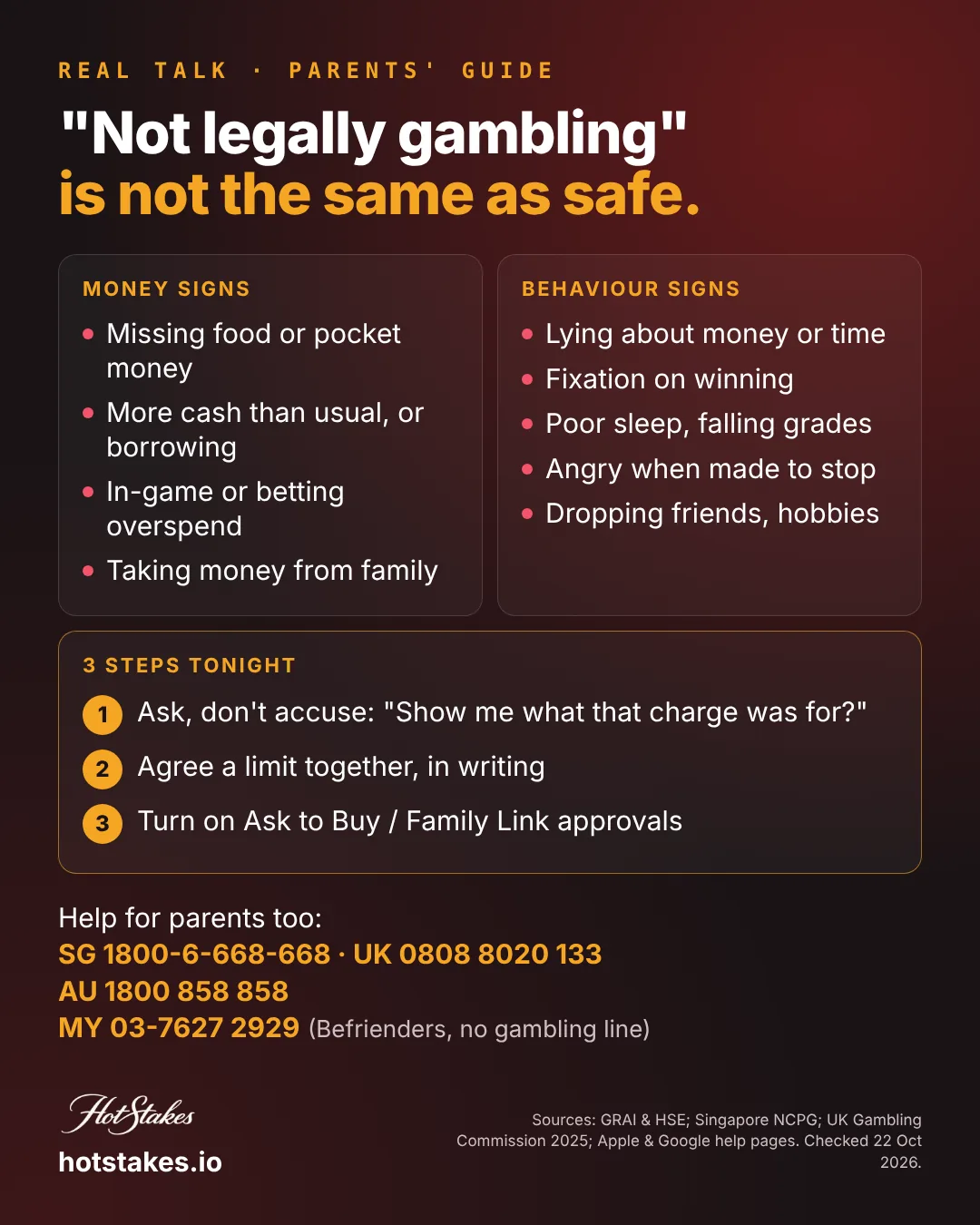
The best large dataset on under-18s comes from Britain. The UK Gambling Commission’s Young People and Gambling 2025 official statistics, published on 13 November 2025, surveyed 3,666 pupils aged 11 to 17 in England, Scotland and Wales. We read the report’s sections ourselves on 22 Oct 2026. The headline numbers:
- 30% had spent their own money on gambling in the past 12 months, up from 27% in 2024.
- 49% had experienced some form of gambling in the past 12 months.
- The most common types were arcade machines such as penny pushers and claw machines (21%) and bets with friends or family (14%).
- 8% had gambled online in the past year (online gambling section).
- 1.2% scored 4 or more on the youth problem gambling screen (DSM-IV-MR-J), statistically unchanged from 1.5% in 2024 (active involvement summary).
The top reason young people gave for gambling was that it is “fun”, cited by 78% of those who spent their own money.
What about Asia? When we searched on 22 Oct 2026, we did not find a published Singaporean or Malaysian survey of under-18s comparable to the UK one. Treat the UK figures as a well-measured reference point, not a local estimate.
Takeaway: Teen gambling is common and mostly small. A real problem is rare, but 1.2% is still roughly 1 in 80 children.
Loot boxes, skins and gambling-style games: what’s what
Most teen “gambling” today hides inside games. Here are the four features parents ask about most, and where the law stands.
| Feature | What it is | Legally gambling? | Why parents should care |
|---|---|---|---|
| Loot boxes (packs, cases, chests) | Pay real or in-game money for a random item | Usually no: UK says most aren’t, because prizes can’t be cashed out; Australia rates such games M (not recommended under 15) | Random rewards plus real money; research links spending with problem gambling |
| Skins betting | Betting tradeable cosmetic items on outside websites | Yes in Great Britain, and those sites aren’t legal there | Items have cash value, so it works like betting money |
| In-game casinos and social casino apps | Slot, roulette or card games inside a game or free app | Simulated gambling games get an R 18+ rating in Australia | NCPG says easy wins can normalise gambling for teens |
| Real-money betting apps | Sports, casino or esports betting | Yes; illegal for under-18s in licensed markets | Often accessed through a parent’s account |
Loot boxes: not legally gambling in most places
Britain’s government decided in 2022 that most loot boxes fall outside the Gambling Act because “the prize is confined for use within the game and cannot be converted into real-world money” (DCMS response). It still said children “should not be able to purchase loot boxes without parental approval”.
Since 22 September 2024, Australia has given games with paid chance-based items an M rating and games with simulated gambling an R 18+ rating (Australian Classification).
In Singapore, a Gambling Regulatory Authority advisory lets games award in-game items that cannot be converted into money, while pay-to-play games that let players cash in-game items out remain prohibited. In September 2025 the Home Affairs Minister said MHA and the GRA would review probability disclosure and parental consent for loot boxes (MHA). No new rule had been announced on that page when we checked.
Skins betting: the part that is gambling
A 2025 evidence review for the UK government says skins gambling meets the legal definition of gambling in Great Britain, and skins gambling sites are not legal there. Many operate without licences, out of regulators’ reach. In the Gambling Commission data, 4% of young people in 2024 had bet with in-game items on outside websites, and 27% had paid to open loot boxes.
In-game casinos: practice runs with easy wins
In 2025, 59% of UK young people knew they could pay to play casino games inside a game, and 9% of those had done it (gaming section). Singapore’s NCPG warns that social casino games can make winning look easier than it is, and that loot boxes use near misses (“what you could have gotten”) to prompt another try. Slot machines play similar tricks, which we explain in losses disguised as wins.
Takeaway: Ask one question about any feature: can the prize be turned into money? If yes, it is betting. If no, it may still be built like a slot machine.
Do loot boxes lead to gambling problems? Association, not proof
This is where most articles overstate the case. Here is what the research actually found:
- Zendle and Cairns (2018), PLOS ONE. A survey of 7,422 gamers found loot box spending was linked with problem gambling severity far more strongly than spending on other in-game items (White Rose repository). The authors said it was unclear whether loot boxes act as a gateway, or whether people with gambling problems are drawn to loot boxes.
- Spicer and colleagues (2021), New Media & Society. A systematic review found 12 of 13 publications reported a positive link between loot box engagement and problem gambling, with a moderate average correlation of r = .27 (BCU Open Access). It concluded that more evidence is needed to settle the direction of causality.
- The UK government reached the same place in 2022: it “found an association between loot boxes and harms” but has “not found whether there is a causative link”.
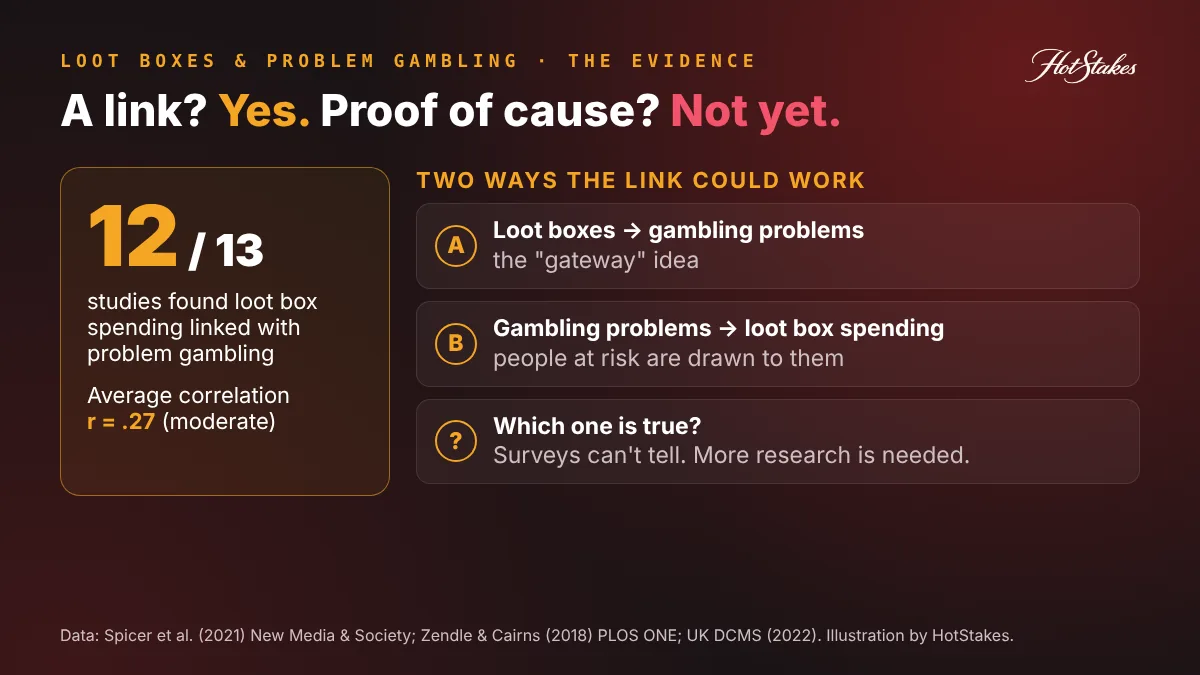
For a parent, the honest reading is this. Heavy loot box spending does not prove your child will become a gambler. It is still a signal worth noticing, because it tends to show up alongside gambling problems.
Takeaway: Treat heavy loot box spending like a smoke alarm. It doesn’t prove there’s a fire, but you check.
Signs your child is gambling
These signs come from the Gambling Regulatory Authority of Ireland and the HSE (GRAI and HSE) and from Singapore’s NCPG. We grouped them; the wording is summarised.
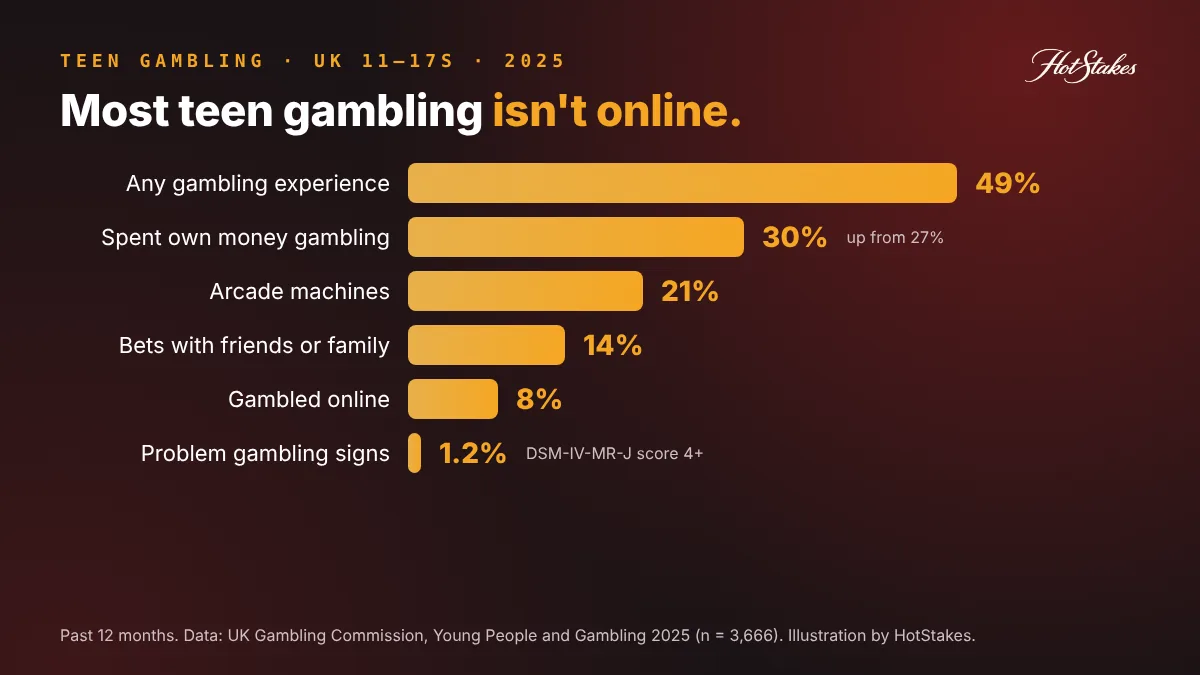
Money signs
- More money than usual, or borrowing money.
- Money meant for food, travel or pocket money going missing.
- Spending beyond their means on in-game purchases or betting sites.
- Borrowing or taking money from friends and family.
Behaviour signs
- Lying about gambling, or about money and time spent gaming.
- Withdrawing from friends, hobbies or family.
- Poor sleep, tiredness, missed school or falling grades.
- Unusually moody, anxious, guilty or angry, especially when made to stop gaming.
Gaming-specific signs
- Talking more about gambling or gambling-style games, and a sudden fixation on winning.
- Preoccupation with gaming or watching esports tournaments, to the point that school and family slip.
One sign alone means little. Many of these also describe a normal stressed teenager. Look for a cluster, especially money signs plus secrecy. For the adult screening questions, see our signs of a gambling problem checklist.
Takeaway: Money plus secrecy is the pattern to act on. Mood alone is not.
How to talk to your teen without shaming them
GRAI’s advice for parents is simple: stay calm, plan first, listen, and don’t wait. Shame tends to push it underground. Here is that advice as steps:
- Plan before you speak. Pick a quiet moment, not right after you found the charge.
- Start with curiosity, not evidence. EXAMPLE opener: “I saw a few game charges I didn’t recognise. Can you show me what they were for?”
- Ask how it works. EXAMPLE: “What’s in a case? What are the odds of getting the good one?”
- Listen more than you talk. GRAI warns that being too emotional can make children hide things.
- Agree rules together. A spending limit, approval for purchases, no betting sites. Write them down.
- Check in again. GRAI says one conversation will not be enough.
- Don’t model it. GRAI also advises against placing bets for them, which makes betting seem normal.
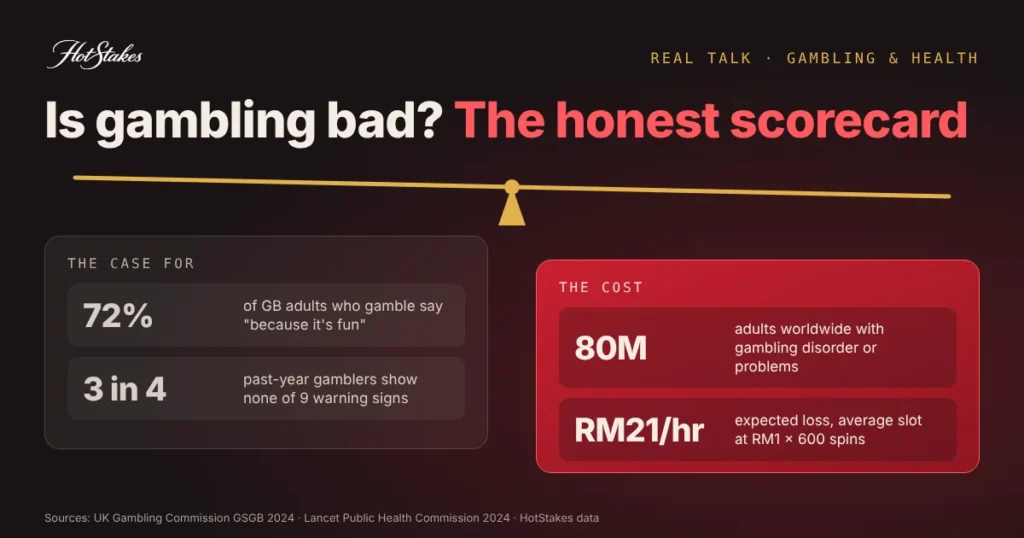
If the money involved is large, or another adult in the house gambles, our guide to what to do when a partner gambles covers protecting family finances. For the bigger picture, read is gambling bad for you?
Takeaway: Your goal for the first talk is that they tell you the truth next time. That matters more than winning the argument.
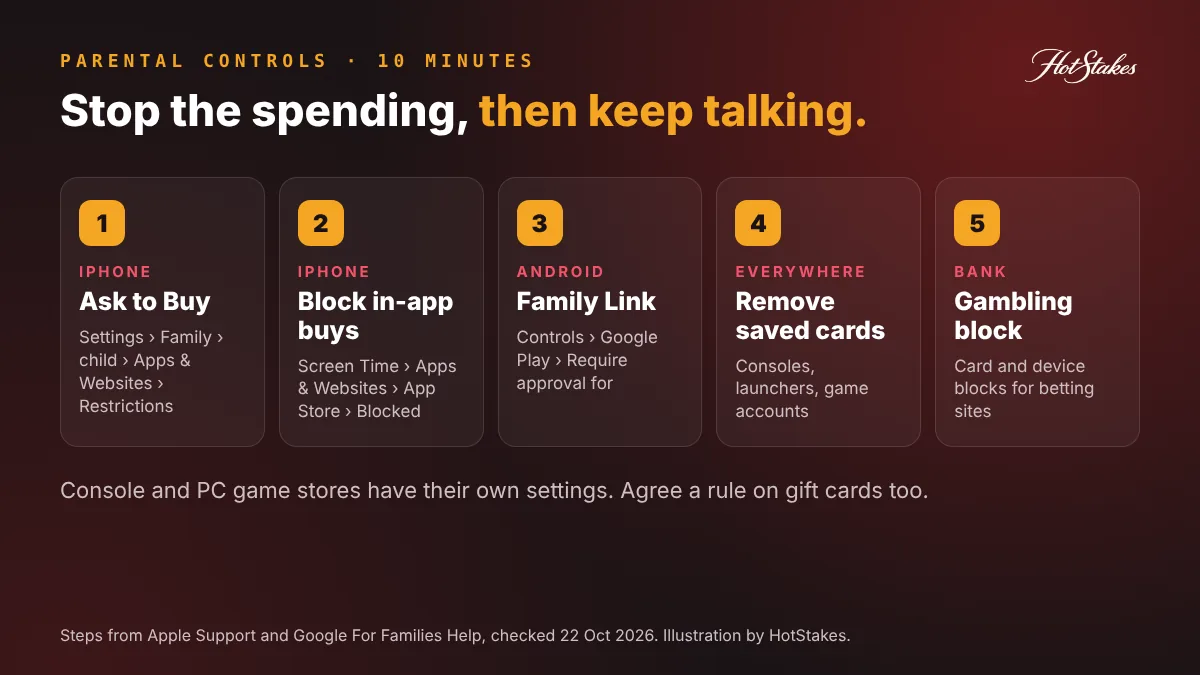
Stop the spending: parental controls in 10 minutes
We opened Apple’s and Google’s official help pages on 22 Oct 2026. These are the current steps:
- iPhone or iPad: turn on Ask to Buy. On your device, go to Settings, Family, your child’s name, Apps & Websites, Restrictions, Ask to Buy, then turn on Require Purchase Approval. Apple says it covers app downloads and in-app purchases (Apple Support).
- iPhone or iPad: block in-app purchases entirely. In Screen Time, go to Apps & Websites, App Store, In-app Purchases, and set it to Blocked (Apple Support).
- Android: Family Link purchase approvals. In the Family Link app, select your child, then Controls, Google Play, and Require approval for. Choose all content, paid content only, or in-app purchases only (Google For Families Help). Google notes this only covers purchases made through Google Play billing.
- Remove saved cards from consoles, game launchers and your child’s accounts. Apple says redeeming codes does not create an Ask to Buy request, and consoles and PC game stores have their own settings, so agree a rule on gift cards and top-ups too.
- Check your own accounts. In 2025, 7% of UK young people who gambled online had used a parent’s account without permission (UKGC). Log out of betting apps and use a passcode.
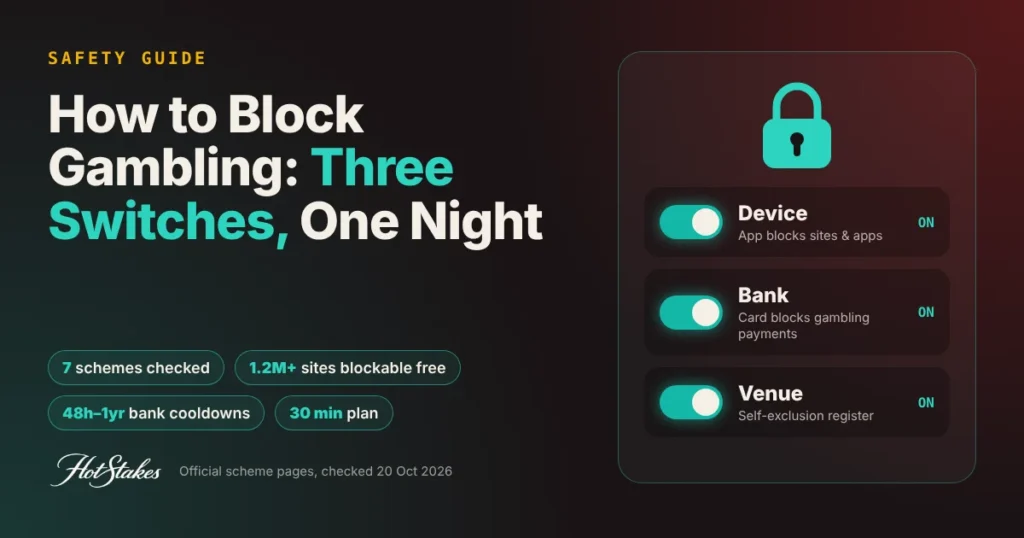
- Add gambling blocks on devices and bank cards. Our how to block gambling guide walks through the options.
Takeaway: Controls back up the conversation; they don’t replace it. A determined teen can borrow a friend’s phone, so trust still does most of the work.
Where to get help (verified 22 Oct 2026)
We checked every number below on an official or published source this run. Not every country has a youth gambling helpline, so we say where we list a general line instead.
| Where | Call | Notes |
|---|---|---|
| Singapore | 1800-6-668-668 (National Problem Gambling Helpline) | Parents can call for advice on helping someone; anonymous webchat daily 8am to 11pm (NCPG). NCPG also suggests a school counsellor for teens. We found no separate youth line. |
| Malaysia | 03-7627 2929 (Befrienders KL) or 15555 (Talian HEAL) | We found no dedicated national gambling helpline. Befrienders KL runs 24 hours; Talian HEAL 15555 is the national mental health support line. |
| UK | 0808 8020 133 (National Gambling Helpline) | 24 hours; GamCare’s Young People’s Support Service covers ages 18 and under, and parents can call too |
| Australia | 1800 858 858 (Gambling Help) | 24/7, free (Gambling Help Online); Kids Helpline 1800 55 1800 for ages 5 to 25 (GambleAware NSW) |
| Hong Kong | 1834 633 (gambling counselling hotline) | Listed in a Dec 2024 government reply on gambling counselling (HK government) |
| Philippines | 1553 (NCMH crisis hotline) | No dedicated gambling line found; 24/7 mental health line (Daily Tribune) |
| India | 14416 (Tele-MANAS) | No dedicated gambling line found; 24×7 national mental health line (IIT Kanpur) |
The WHO warns that heavy promotion risks normalising gambling for children, and that gambling harm reaches families, not just players. Reaching out early is normal, not an admission of failure. More honest reads live in our Real Talk section.
Takeaway: You don’t need proof to call. Helplines advise worried parents, not only people who gamble.
FAQ
What are the signs your child is gambling?
Watch for missing money or unexplained cash, borrowing, spending on in-game purchases or betting sites, lying about money or time spent gaming, and a new fixation on winning. These signs come from GRAI with the HSE and Singapore’s NCPG. A cluster of money signs plus secrecy matters more than any one sign.
Are loot boxes gambling?
Legally, usually not. The UK says most loot boxes fall outside its Gambling Act because prizes cannot be cashed out, and Singapore allows in-game prizes that cannot be converted into money. Betting tradeable skins on outside sites is gambling in Great Britain.
Do loot boxes cause gambling addiction?
Research shows a link, not proof of cause. A 2021 review found 12 of 13 studies reported a positive association with problem gambling, but the direction of cause is still unknown.
How many teenagers gamble?
In the UK Gambling Commission’s 2025 survey of 11 to 17 year olds, 30% had spent their own money on gambling in the past year and 1.2% showed signs of problem gambling. Most of it was arcade machines and bets with friends or family.
How do I stop my child buying loot boxes?
On iPhone, turn on Ask to Buy or block in-app purchases in Screen Time. On Android, set Family Link to require approval for in-app purchases. Remove saved cards from consoles and agree rules on gift cards.
HotStakes is an independent directory. Some links on this site are affiliate links; we may earn a commission at no cost to you, and it never changes our rankings. Gambling involves risk — only play with money you can afford to lose, and if it stops being fun, seek help. This article is general information, not legal advice. Read our full disclaimer.
 Next story →Is Online Gambling Legal in Asia? 14 Countries Compared

Start the discussion