

India Online Gaming Ban Explained: What the 2025 Act Bans
India banned every online money game from 1 May 2026. What the law bans, who gets punished, the court fight and why offshore apps still appear.
In this article
- What India’s Online Gaming Act bans, and what it allows
- From bill to ban: the timeline
- Who gets punished: operators, advertisers and banks, not players
- What happened to Dream11, MPL and the rest of the industry
- The offshore problem: blocked sites keep coming back
- The court fight: what the Supreme Court has and has not decided
- How India compares with the rest of Asia
- What to do if you are in India
- FAQ
Is online gaming banned in India? Yes: since 1 May 2026, India bans every online game played for money, whether it is rummy, poker, fantasy cricket or a casino slot, and the law punishes the companies, advertisers and payment firms behind them, not the players. The Promotion and Regulation of Online Gaming Act, 2025 passed Parliament in two days, shut down a multi-billion-rupee industry overnight, and is still being fought in the Supreme Court. Here is what it bans, what it allows, and why offshore betting apps still reach Indian phones.
What India’s Online Gaming Act bans, and what it allows
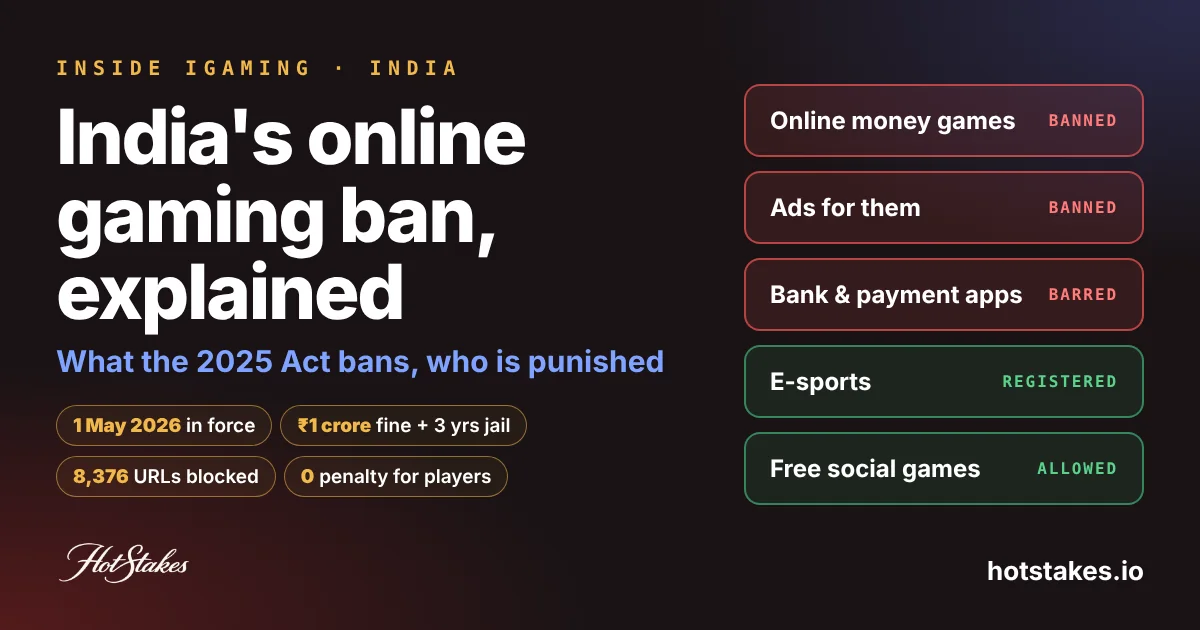
The Act sorts every online game into three buckets. According to the government’s own PIB explainer, online money games are prohibited, while e-sports and online social games are recognised and promoted.
The key word is money, not chance. For decades Indian law split games into “skill” (often legal) and “chance” (gambling). The new Act ignores that split for online play: if you deposit or stake money expecting to win more, it is an online money game, even if the game takes real skill.
| Category | Examples | Status since 1 May 2026 | What the rules require |
|---|---|---|---|
| Online money games | Paid fantasy sports, cash rummy and poker, online casinos, betting apps | Banned | No offering, advertising or payment processing |
| E-sports | Organised competitive video gaming | Allowed | Registration with the new Online Gaming Authority |
| Online social games | Free casual games played for fun or learning | Allowed | Registration only if the government notifies the category |
The rules, notified on 22 April 2026, also set up the Online Gaming Authority, chaired by a senior official of the IT ministry (MeitY) with members from Home, Finance, Law, Information and Broadcasting and Sports, MediaNama reported. The Authority can decide whether a specific game counts as a money game, looking at deposits, stakes, the expectation of winnings, the revenue model and whether in-game rewards can be cashed out.
Takeaway: in India the test is now simple. If real money goes in hoping for more money out, the game is banned online, skill or not.
From bill to ban: the timeline
The speed surprised the industry. The cabinet approved the bill on 19 August 2025 and Parliament passed it within days.
- 20 Aug 2025: the Lok Sabha passes the bill. IT Minister Ashwini Vaishnaw tells MPs that players “are victims” and will not be penalised (Business Today).
- 21–22 Aug 2025: the Rajya Sabha passes it and the President signs it into law as Act No. 32 of 2025 (legislative history).
- 22 Aug 2025: Dream11, MPL, Zupee and PokerBaazi stop paid games (The Week).
- Sep 2025: the Supreme Court pulls every challenge from the Karnataka, Delhi and Madhya Pradesh High Courts to itself.
- 12 Oct 2025: draft rules are published for comment.
- 22 Apr 2026: final rules are notified; 1 May 2026 they take effect with the Act.
- 27 May and 15 Oct 2026: the Supreme Court upholds state bans in Tamil Nadu and Karnataka, then rejects the industry’s review petitions.
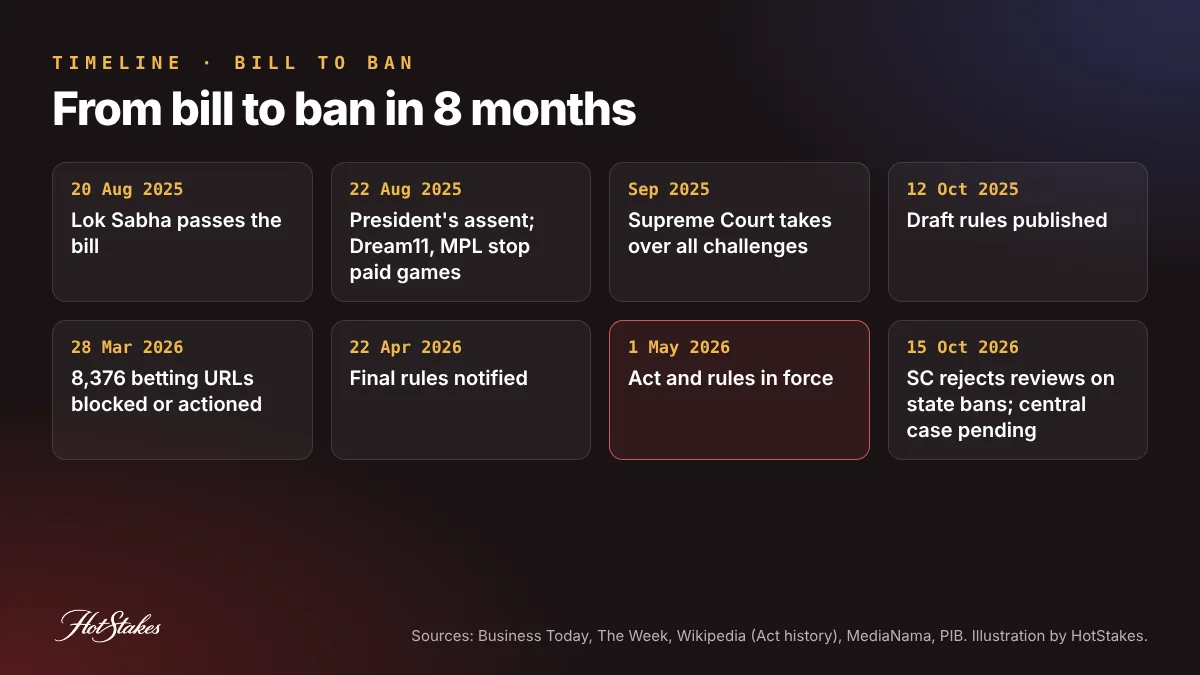
Takeaway: the ban is not a proposal or a draft. It has been fully in force since 1 May 2026.
Who gets punished: operators, advertisers and banks, not players
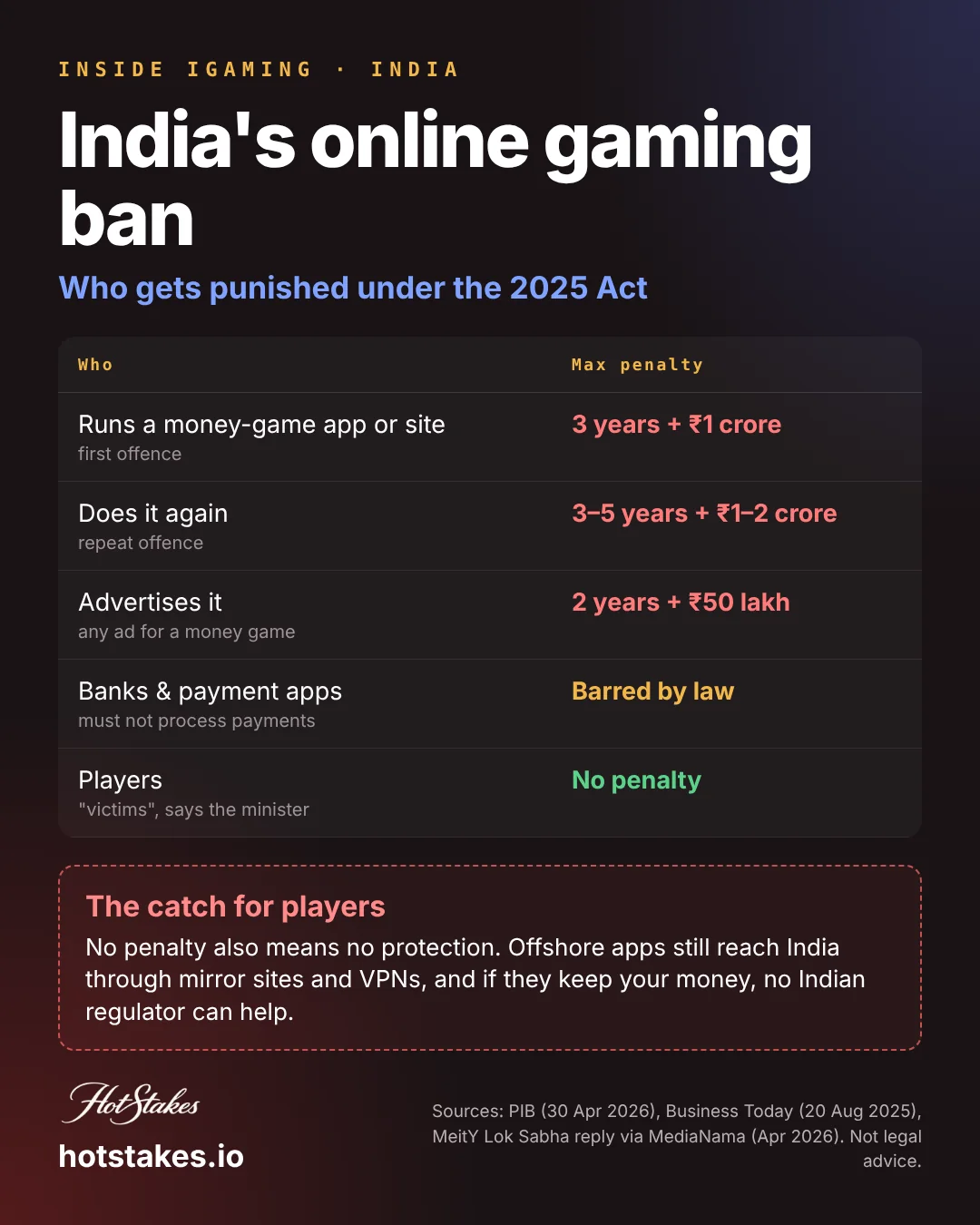
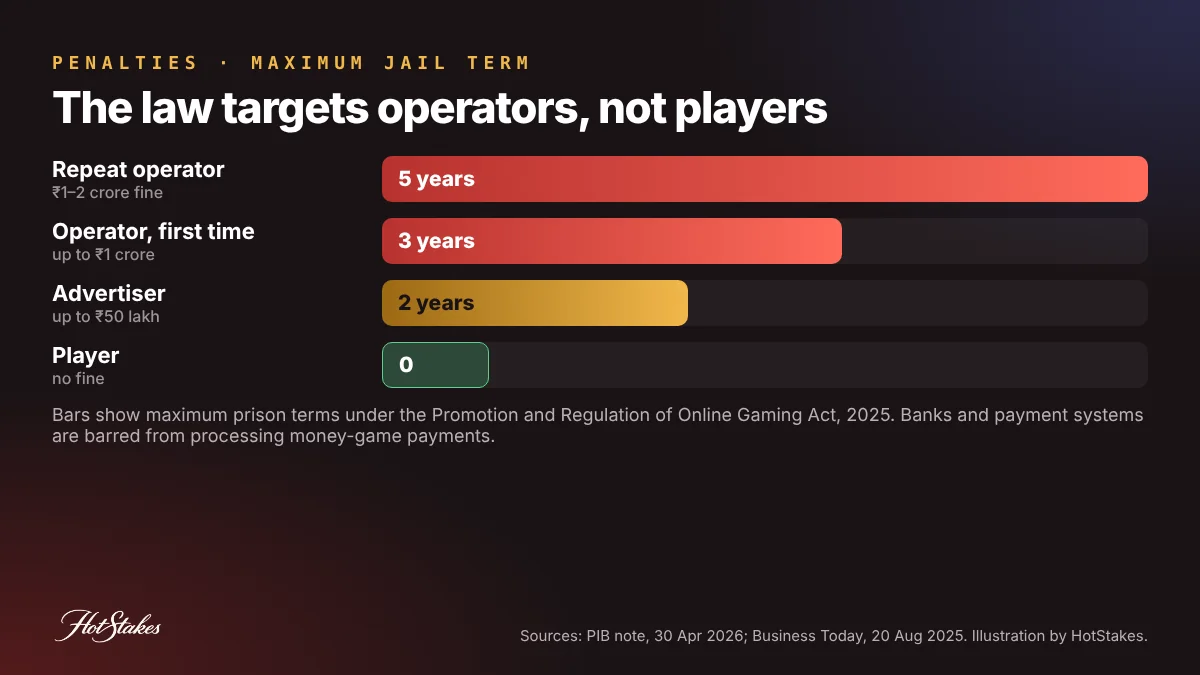
The penalties fall on the businesses that make money gaming possible. The figures below are from the PIB note of 30 April 2026.
| Who | Offence | Maximum penalty |
|---|---|---|
| Operator | Offering or facilitating an online money game | Up to 3 years in jail, up to ₹1 crore fine, or both |
| Repeat operator | Doing it again | 3 to 5 years in jail and ₹1 crore to ₹2 crore |
| Advertiser | Advertising an online money game | Up to 2 years in jail, up to ₹50 lakh fine, or both |
| Banks and payment systems | Processing money-game payments | Barred by the Act |
| Player | Playing | No penalty under the Act |
Trade outlet AGBrief, reporting on the Supreme Court case in August 2026, described the offences as cognisable and non-bailable, meaning police can arrest without a warrant (AGBrief).
The advertising rule matters across Asia. Influencers and Telegram channels pushing “Indian” betting apps are breaking Indian law if they target India. It is the same playbook we described in our guaranteed-win Telegram betting scam investigation.
Takeaway: “players are not punished” is true, but it is not a green light. It means the law sees you as the likely victim.
What happened to Dream11, MPL and the rest of the industry
India had one of the world’s biggest real-money gaming markets. The PIB note puts the whole online gaming market at ₹232 billion in 2024, with 77% of that revenue from transaction-based games.
- Dream11 stopped paid fantasy contests, which made up over 90% of its revenue, according to The Week.
- MPL stopped new deposits but let users withdraw balances. It later planned to cut about 60% of its India staff, and Baazi Games (PokerBaazi) more than 200 roles, both per Moneycontrol figures summarised by YourStory.
- Zupee dropped paid games and kept free titles such as Ludo Supreme.
The government’s case, set out in the same PIB note, is that around 45 crore (450 million) people were affected by money gaming platforms, with losses estimated above ₹20,000 crore. Those are the government’s estimates; the industry disputes the framing.
Takeaway: the licensed, tax-paying Indian brands left the market first. What remains for anyone still looking to bet is mostly offshore.
The offshore problem: blocked sites keep coming back
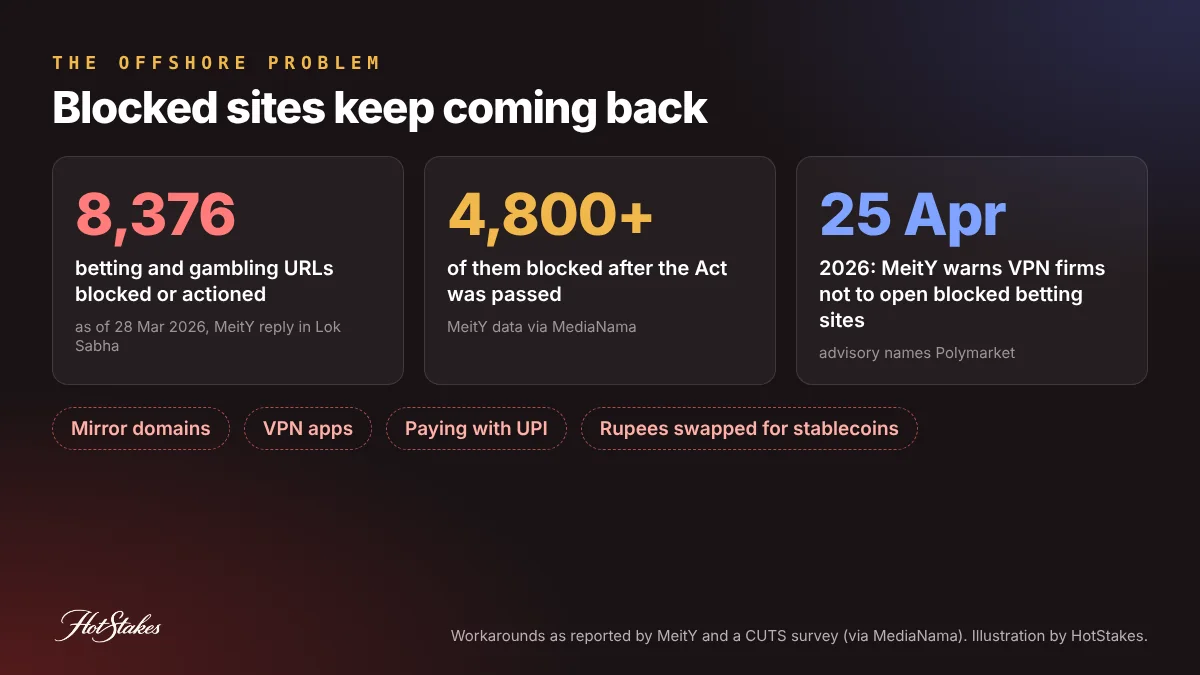
Banning domestic apps did not stop demand. In a Lok Sabha reply reported by MediaNama, the IT ministry said 8,376 betting and gambling URLs had been “blocked or actioned” as of 28 March 2026, more than 4,800 of them after the Act was passed. The same report cites CUTS surveys suggesting offshore platform use rose after the ban, with users reaching sites through mirror domains and paying with UPI.
On 25 April 2026 MeitY went a step further. Its advisory told VPN providers and other intermediaries not to enable access to blocked betting and prediction platforms, naming Polymarket and warning that some users were converting rupees into stablecoins such as USDC (MediaNama). Firms that ignore it risk losing their legal “safe harbour”.
For players this is the real danger. An offshore site serving India is, by definition, operating against Indian law, so there is no Indian regulator to complain to when withdrawals stop. Deposits often go to personal “agent” accounts, the pattern behind the money mule account scam. Our checklist of fake gambling app red flags applies in full.
Takeaway: in India today, any real-money betting app you can download is either offshore, illegal to promote, or a scam. Often all three.
The court fight: what the Supreme Court has and has not decided
Two separate legal battles are running, and headlines often mix them up.
| Case | What it is about | Status (29 Oct 2026) |
|---|---|---|
| State bans (Tamil Nadu, Karnataka) | Can a state ban online games played for stakes, including skill games? | Yes. Upheld 27 May 2026; review petitions dismissed 15 Oct 2026 (MediaNama) |
| Central Act (Clubroom 11, Head Digital Works and others v. Union of India) | Does the nationwide ban breach the right to do business under Article 19(1)(g)? | Pending. The court agreed in Aug 2026 to final hearings (AGBrief); a hearing reported for 6–7 Oct 2026 could not be confirmed |
The state-ban ruling weakens the industry’s main argument. In May the court said states may prohibit online games with money stakes, “and this includes skill-based games as well”, as reported by The Gamblest. Industry lawyers have called the central ban “civil death” for the sector, while the government argued in earlier hearings that unregulated money gaming enabled laundering and large losses (LawBeat).
Takeaway: until the Supreme Court rules on the central Act, the ban stays in force. Nothing has been suspended.
How India compares with the rest of Asia
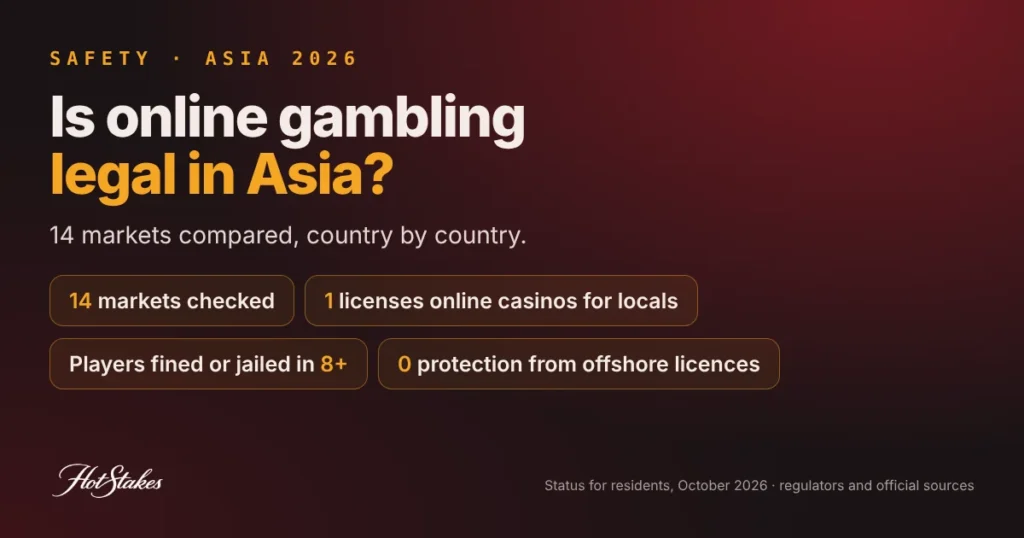
India is now one of Asia’s strictest online markets, but it is not alone. Cambodia switched off online casino gambling in 2026, and the Philippines forced e-wallets to drop gambling links. Our 14-country Asia legality guide has the full map; see also the Cambodia ban and the Philippines e-wallet ban.
The pattern is the same everywhere: a ban removes the regulated operators first, and grey-market sites move in. Our guide on how to spot an unlicensed online casino explains the checks.
What to do if you are in India
- Treat any real-money app as off-limits. Since 1 May 2026 no online money game can be legally offered to you.
- Ignore “Indian betting ID” agents on Telegram, WhatsApp or Instagram. Advertising money games is itself a crime.
- Never pay into a personal UPI ID for a game, and never let anyone use your account to receive money.
- If money was taken, report it on the national cyber helpline 1930 or at cybercrime.gov.in, and see our scam help tool. Watch out for “recovery agents” who call afterwards.
- If gambling is hurting you, Tele-MANAS (14416) is the government’s free mental health line (telemanas.mohfw.gov.in).
Test yourself with our 10-question scam or legit quiz.
FAQ
Is online gaming banned in India?
Online money gaming is. Since 1 May 2026 the Promotion and Regulation of Online Gaming Act, 2025 bans offering, advertising or processing payments for any online game played for money. Free social games and registered e-sports are allowed.
Is online rummy or poker for money legal in India now?
No. The Act bans online money games whether they are based on skill or chance, so cash rummy, poker and paid fantasy sports are covered.
Will players be punished under the Online Gaming Act?
No. The penalties apply to operators, advertisers and those facilitating payments. The IT minister told Parliament players are treated as victims. They also get no protection if an offshore site refuses to pay.
What is the penalty for running an online betting app in India?
Up to 3 years in jail and a fine of up to ₹1 crore for a first offence, and 3 to 5 years plus ₹1 crore to ₹2 crore for repeat offences. Advertising carries up to 2 years and ₹50 lakh.
Is Dream11 still working?
Dream11 stopped its paid contests in August 2025. Free-to-play formats are not covered by the ban.
Has the Supreme Court struck down the ban?
No. The challenge to the central Act is still pending. Separately, the court upheld state bans in Tamil Nadu and Karnataka in May 2026 and rejected review petitions in October 2026.
HotStakes is an independent directory. Some links on this site are affiliate links; we may earn a commission at no cost to you, and it never changes our rankings. Gambling involves risk — only play with money you can afford to lose, and if it stops being fun, seek help. This article is general information, not legal advice. Read our full disclaimer.
 Next story →ZEAGAME Review 2026: Licence, Bonus Terms & Safety Check

Start the discussion