

How Do Gambling Affiliates Make Money? The Honest Answer
CPA, revenue share and negative carryover explained: why affiliates can earn more when you lose, what UK rules require, and a 7-point checklist.
In this article
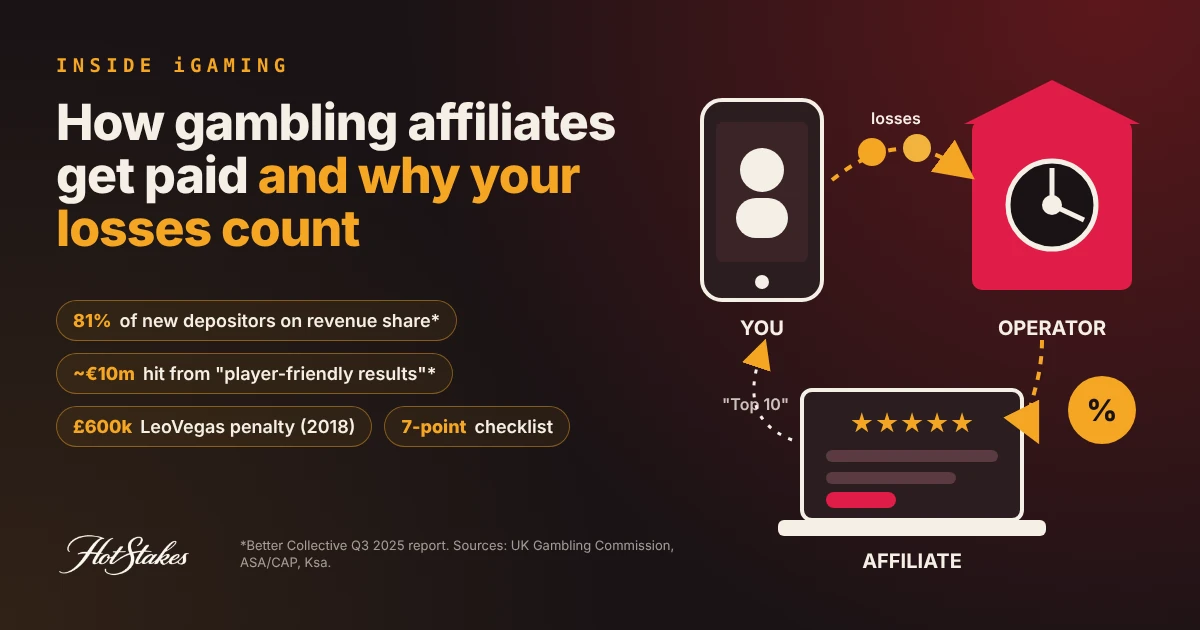
Gambling affiliate sites make money by sending you to casinos and sportsbooks, which then pay them a commission. That commission is a one-off fee for each new depositing player (CPA), a cut of what the operator wins from the players they sent (revenue share), or a mix of both. On a revenue-share deal, the affiliate earns more when the players it referred lose more. That doesn’t make every review site dishonest. It does mean you should know how the money flows, what regulators demand and how to test a site in five minutes.
How do gambling affiliates make money? The three deal types
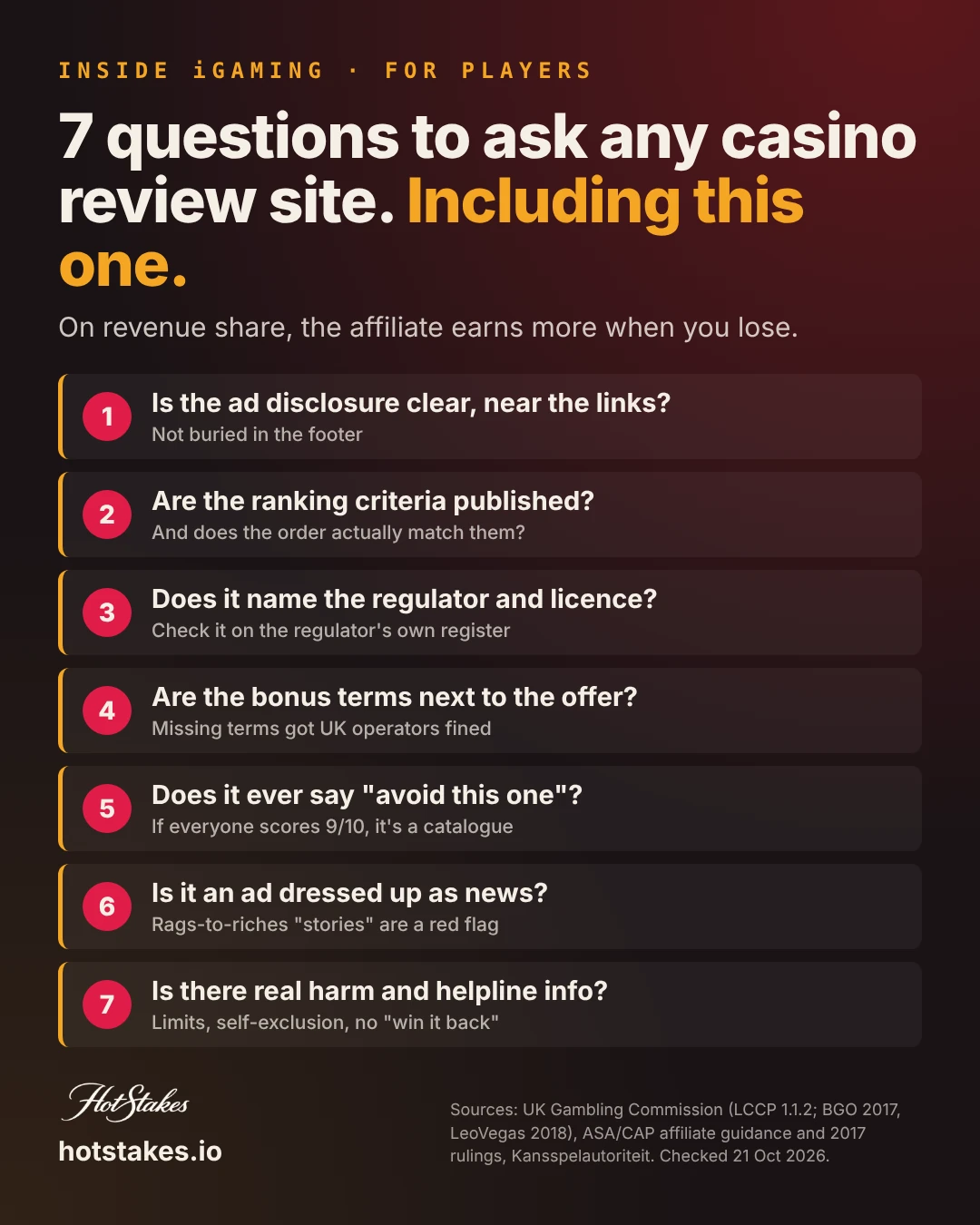
An affiliate is any website, app, streamer or social account that sends players to a gambling operator and gets paid for it. Gambling.com Group, a listed affiliate company, says in its 2025 annual report (Form 20-F) that its deals are “primarily based on a revenue share model, a Cost Per Acquisition model, or hybrid model”. Its own definitions are the clearest in the industry:
| Model | Definition (Gambling.com Group 20-F) | When the affiliate gets paid | What the affiliate needs from you |
|---|---|---|---|
| CPA (cost per acquisition) | “a single cash payment for each referred player” | Once, after you sign up (and usually deposit) | That you register and deposit |
| Revenue share | “a percentage of the NGR produced by a pool of referred players” | Every month the deal runs | That you keep playing, and that the operator keeps winning |
| Hybrid | “a combination of revenue share and CPA per referred player” | A smaller one-off fee, then a smaller monthly cut | Both of the above |
NGR means net gaming revenue. The same filing describes it as the operator’s gross win from a player, adjusted for costs such as bonuses, transaction fees and taxes. In plain English: what you lost, minus a few deductions.
Negative carryover: what happens when players win
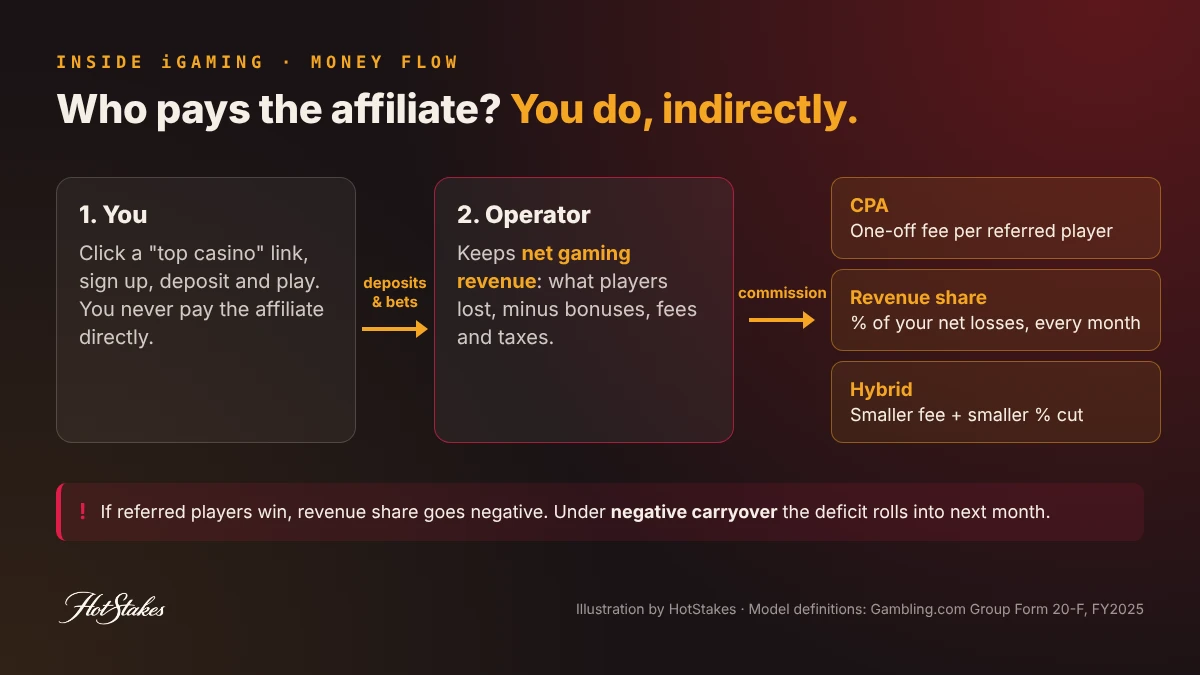
Revenue share is calculated on a pool of players, not one at a time. Gambling.com Group warns investors that “a large winning referred player can zero-out the commission” owed on everyone else it referred that month.
Many programmes go further. Under negative carryover, as affiliate-software firm Track360 explains it, a losing month’s deficit rolls into the next period. The affiliate earns nothing new until that hole is filled. Some programmes reset to zero each month instead, which Track360 calls the most expensive option for operators.
Takeaway: On a revenue-share deal, a referred player who wins big is a cost to the affiliate. That is the incentive, whatever any individual site chooses to do about it.
The conflict of interest, in the industry’s own numbers
This isn’t a theory dreamed up by critics. It shows up in investor reports.
Better Collective is one of the largest listed sports-betting affiliates. In its Q3 2025 report (12 November 2025), it said “player-friendly results in September led to a record-low sports win margin”, “negatively impacting Q3 revenue by approximately 10 mEUR” against the same quarter a year earlier. The same report shows how much it relies on the model:
- 81% of its 279,000 new depositing customers that quarter were on revenue-share contracts.
- Recurring revenue was 50 mEUR, or 64% of total revenue of 78 mEUR.
- Recurring revenue fell 5% year on year, “primarily driven by lower revenue share”.
Put simply: when bettors had a good month, the affiliate had a bad one.
Casino games make the link even steadier, because the house edge is built in. Across the 424 slots in our directory data (synced 20 Oct 2026), the average RTP is 96.44%. That leaves the house about 3.56% of everything staked, on average, over the long run. We explain why that edge always wins in why the house always wins. A revenue-share affiliate is paid a slice of it.
A worked example (hypothetical numbers)
The figures below are invented by HotStakes to show the mechanics. They are not any real deal, including ours. We assume a £100 CPA, a 30% revenue share, and a hybrid of £50 plus 15%. We also treat NGR as the player’s net loss; real NGR deducts bonuses, taxes and fees, so real commissions would be lower.
| Referred player (hypothetical) | CPA £100 | Revenue share 30% | Hybrid £50 + 15% |
|---|---|---|---|
| Wins £400 overall | £100 | −£120 (carried forward) | £50, then −£60 carried forward |
| Breaks even | £100 | £0 | £50 |
| Loses £500 in month one, then stops | £100 | £150 | £125 |
| Loses £100 a month for 12 months (£1,200) | £100 | £360 | £230 |
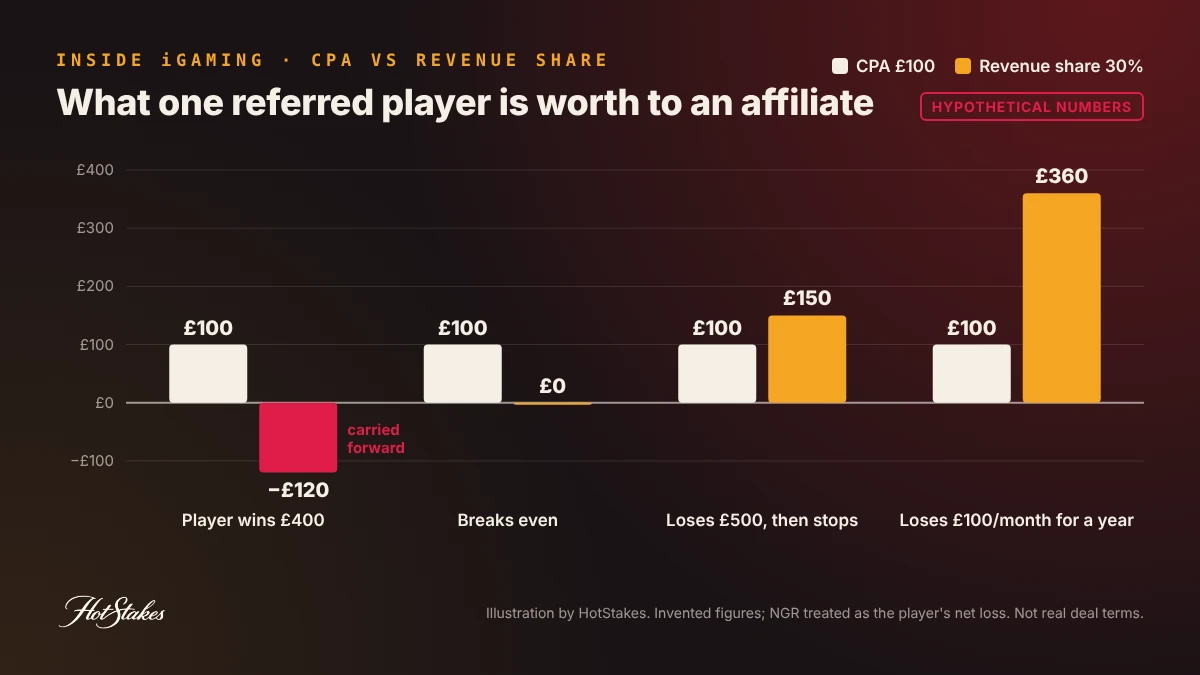
The pattern is the point. Under revenue share, the most valuable player is the one who loses steadily for a long time. The least valuable is the one who wins.
Is CPA cleaner?
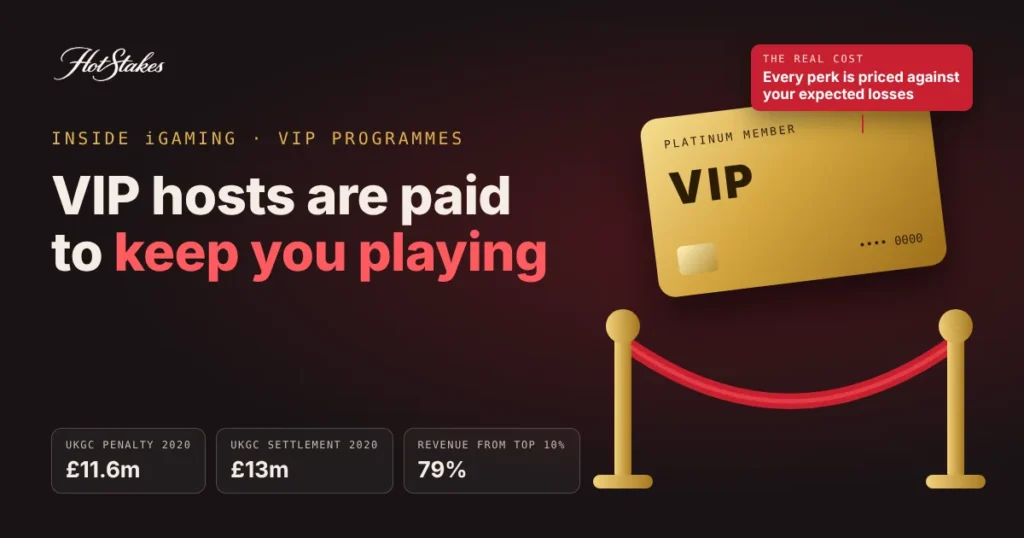
Partly. A CPA affiliate is paid once, so your later losses don’t flow to it. But its whole income depends on one action: you signing up and depositing. That pushes CPA sites toward the biggest headline offer and the fastest “Claim now” button. It’s the same logic behind how casino VIP hosts work: the person being friendly is paid on a number you can’t see.
Takeaway: No model is neutral. CPA rewards your sign-up; revenue share rewards your losses. Ask which one a site is likely on, and read its rankings with that in mind.
What regulators require
UK Gambling Commission: the operator is on the hook
In Great Britain, licence condition LCCP 1.1.2 says “Licensees are responsible for the actions of third parties with whom they contract”. Contracts must make affiliates behave as if bound by the operator’s own licence conditions. Operators must also be able to end the deal promptly if an affiliate breaches an advertising code.
The Commission has fined operators over their affiliates’ ads:
- BGO Entertainment, £300,000 (May 2017) for misleading advertising on its own and its affiliates’ websites.
- LeoVegas, £600,000 (May 2018) as part of a package that also covered self-exclusion failures. Of 31 promotional ads that left out significant terms, 23 were on affiliates’ sites, according to the Commission’s 2018–19 enforcement report.
ASA and CAP: an ad has to look like an ad
In September 2017 the Advertising Standards Authority upheld complaints about affiliate-made “advertorials” dressed as news stories about a man in financial and medical hardship who won at a casino. In the 888 ruling, the operator said an affiliate made the ad. The ASA held operators responsible “as the beneficiaries of the marketing material”. Law firm CMS reported three parallel rulings against Sky Vegas, Ladbrokes and Casumo.
The CAP Code’s guidance is blunt. CAP told operators that “primary responsibility for observing the CAP Code remains with the Gambling operator”. Its affiliate marketing advice adds that the affiliate is responsible too, and that disclosure should be clear when you meet the content.
The Netherlands and elsewhere
The Dutch regulator, the Kansspelautoriteit (Ksa), wrote to more than 50 affiliate sites in May 2022. Its warning: if the operator has no Dutch licence, the affiliate site is in breach too. In 2023 it announced a €675,000 fine on Red Ridge Marketing for promoting unlicensed online casinos, including claims that a foreign licence made them safe.
Not every regulator reaches affiliates directly. Ontario’s AGCO says in its supplier guide that sites sending traffic for commission may not need to register, decided case by case.
| Regulator | Who answers for affiliate ads | Example on record |
|---|---|---|
| UK Gambling Commission | The licensed operator (LCCP 1.1.2) | BGO £300,000 (2017); LeoVegas £600,000 (2018) |
| ASA / CAP (UK ads) | Operator primarily, affiliate jointly | 888 and three other operators, affiliate advertorials (2017) |
| Kansspelautoriteit (Netherlands) | Operator and the affiliate site | Red Ridge Marketing €675,000 (2023) |
| AGCO (Ontario) | Registered operators; affiliates may not need to register | Case by case |
If a site promotes a casino that holds no licence where you live, none of these protections reach you. Our guide on how to spot an unlicensed online casino shows how to check.
Takeaway: In the UK and the Netherlands, affiliate ads are regulated like any other gambling ad, and someone can be fined. Outside licensed markets, you are the only check.
How to read an affiliate site critically: a 7-point checklist
Use this on any casino review or “best betting sites” page. It takes about five minutes.
- Find the disclosure. Is it clear, and is it near the links, not buried in the footer? The ASA’s guidance says readers should know it’s advertising when they meet it.
- Read the ranking criteria. Does the site publish how it ranks? Does the order match the criteria, or does the biggest bonus always come first?
- Check the licence yourself. A real review names the regulator and licence number. In Great Britain, look the operator up on the Commission’s public register.
- Look for the significant terms. Wagering, time limits and caps should sit next to the headline offer. Missing terms are exactly what got BGO and LeoVegas fined.
- Look for a “no”. Has the site ever told readers to avoid a brand, or covered complaints and slow withdrawals? A list where everyone scores 9/10 is a catalogue.
- Check it’s not an ad dressed as news. Rags-to-riches stories, “our reporter” and fake comment threads are the 2017 advertorial playbook.
- Look for harm content. Are there helplines, deposit-limit and self-exclusion info, and honest talk about losses? Or phrases like “win it back”?
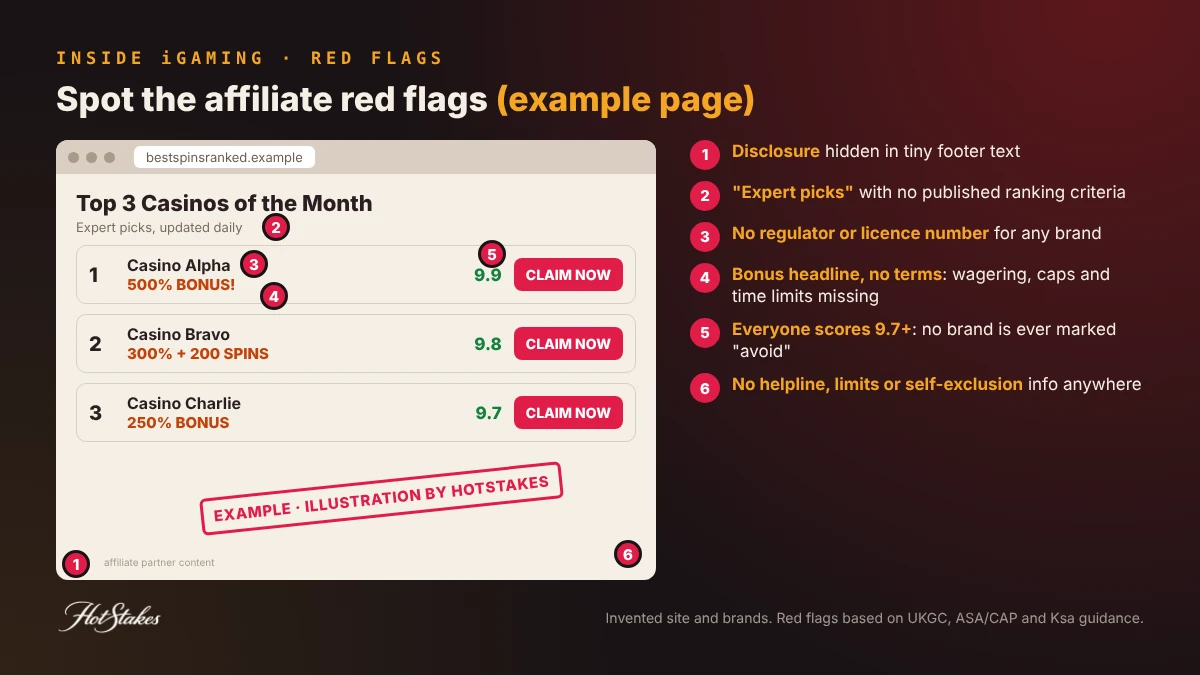
Takeaway: A trustworthy affiliate site passes most of these checks without you hunting. If it fails three or more, treat its rankings as advertising.
What this means for you
- A “top 10 casinos” list is a sales channel first. Some are honest sales channels. Few are neutral.
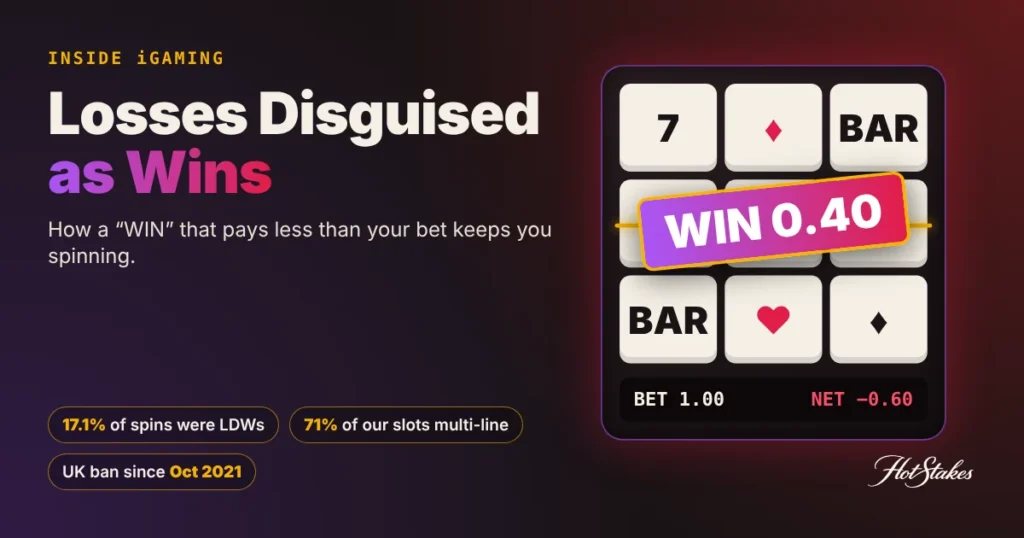
- Never sign up because a ranking or a bonus told you to. The same industry that pays for your losses also designs slots that dress up losses disguised as wins.
- If gambling has stopped being fun, read our honest guide on whether gambling is bad for you. In the UK, the National Gambling Helpline is free and open 24/7 on 0808 8020 133.
More on how the business works behind the screen is in our Inside iGaming section.
Takeaway: Knowing who gets paid when you lose won’t change the odds. It will change which “expert” advice you trust.
FAQ
How do gambling affiliates make money?
Operators pay them commission for players they refer. The main models are CPA (a one-off payment per referred player), revenue share (a percentage of the net gaming revenue those players produce) and hybrid deals that mix the two.
What is casino affiliate revenue share?
It is a percentage of the operator’s net gaming revenue from the players an affiliate referred: broadly, what those players lost, minus deductions such as bonuses, fees and taxes. The affiliate earns more when its referred players lose more.
What is negative carryover in gambling affiliate commission?
If referred players win more than they lose in a period, the affiliate’s revenue share goes negative. Under negative carryover, that deficit rolls into later periods and must be recovered before new commission is paid. Some programmes reset each month instead.
Are gambling affiliates regulated in the UK?
Mostly through the operators. Gambling Commission licence condition 1.1.2 makes licensees responsible for third parties they contract with, and the ASA can rule against both operator and affiliate for ads that break the CAP Code.
Does HotStakes earn affiliate commission?
Some links on HotStakes are affiliate links. We may earn a commission at no cost to you, and it never changes our rankings. You can test that claim with the seven-point checklist above.
HotStakes is an independent directory. Some links on this site are affiliate links; we may earn a commission at no cost to you, and it never changes our rankings. Gambling involves risk — only play with money you can afford to lose, and if it stops being fun, seek help. This article is general information, not legal advice.
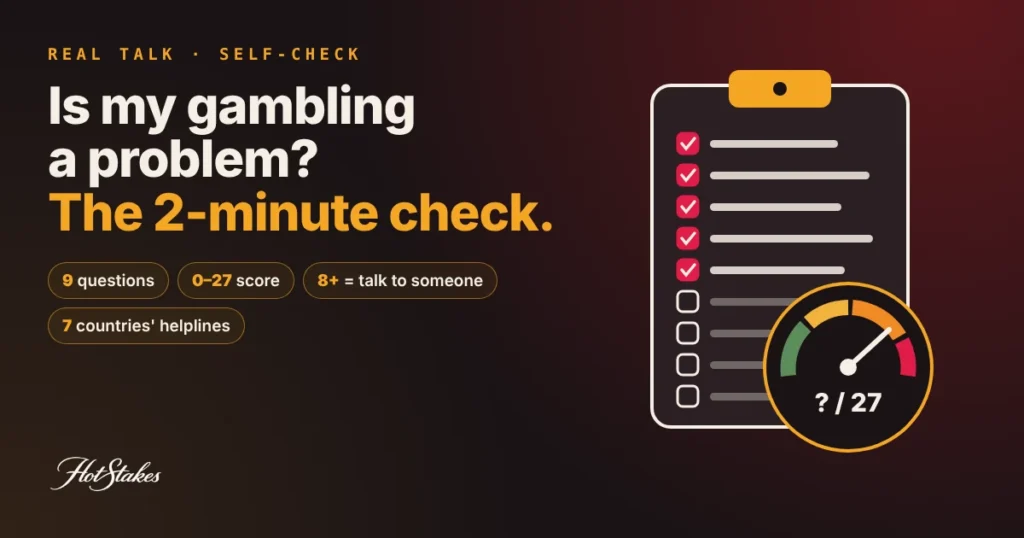 Next story →Signs of Gambling Addiction: A 2-Minute Self-Check

Start the discussion