
Why the House Always Wins: The Maths, Explained
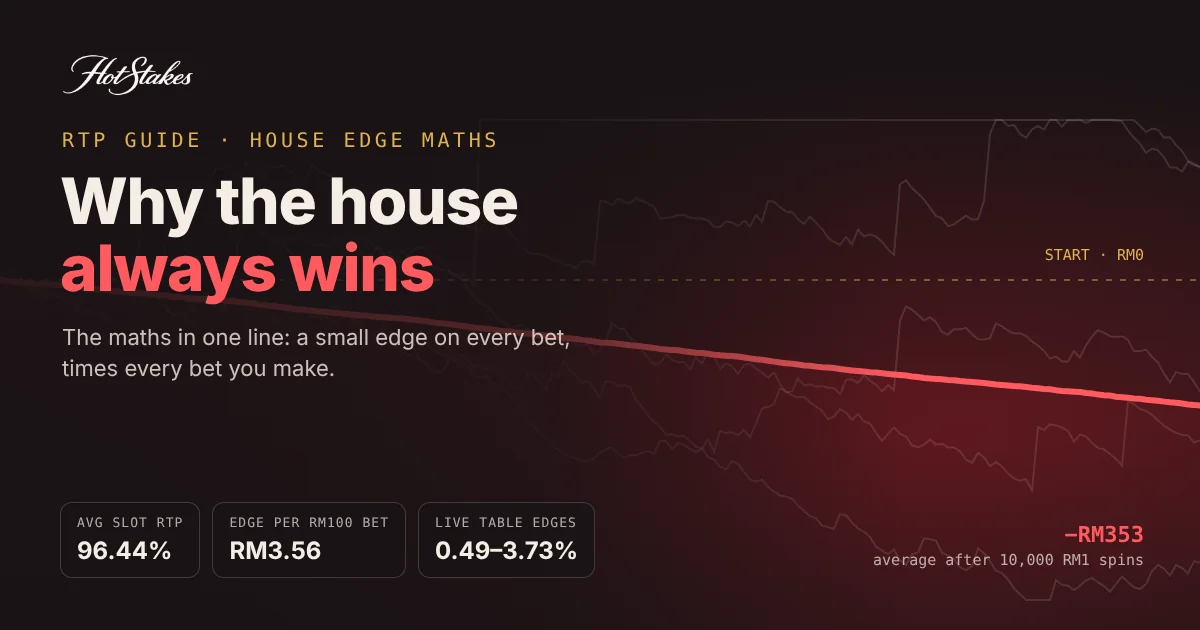
Why does the house always win? House edge = 100% − RTP, applied to every bet. Our data and simulation show what that costs per RM100 and per hour.
In this article
The house doesn’t need luck. It takes a small, fixed slice of every bet, and that slice is set by the game’s maths. The house always wins because every game pays back slightly less than it takes in, so the more you bet in total, the more surely the gap turns into your loss. In our data, the 424 Hotdog Gaming slots average 96.44% RTP. That means an expected RM3.56 kept for every RM100 you wager. Below: the formula, what it costs per hour, and a simulation we ran to show when luck stops hiding it.
The one number that decides everything
Every casino game has a return to player (RTP). It’s the share of all money bet that the game pays back as prizes, on average. Whatever is left over is the house edge.
House edge = 100% − RTP. A slot with 96.5% RTP has a 3.5% edge. A baccarat Banker bet with a 1.06% edge has an RTP of 98.94%.
The UK Gambling Commission is blunt about what RTP is not. It says the figure is “an average achieved over a significant number of game plays”, and that on an 85% machine you shouldn’t expect 85p back for every £1 in one session. Its guidance for operators measures actual RTP the simple way: total paid out divided by total turnover.
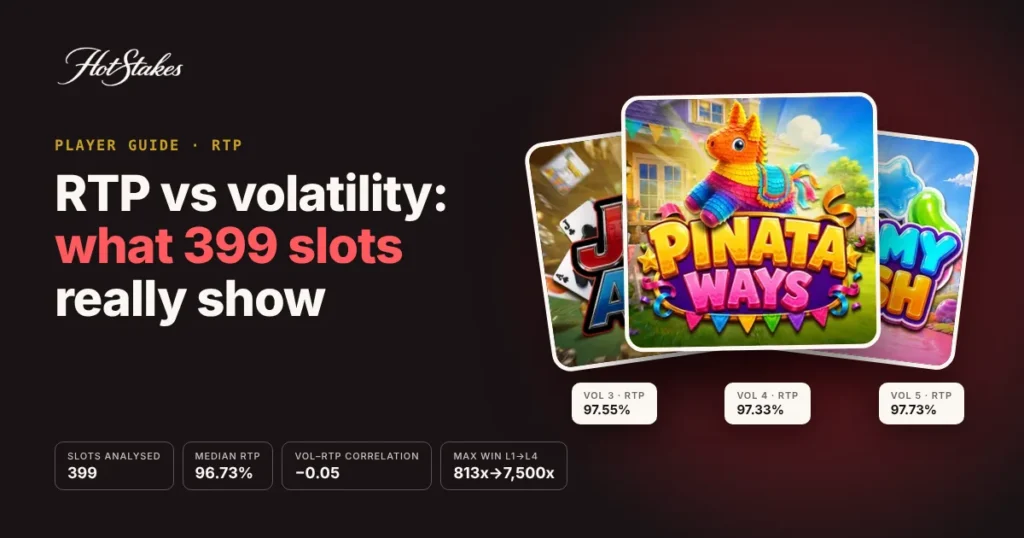
So what do real edges look like? We pulled every slot from our Hotdog Gaming catalogue (data synced 20 Oct 2026):
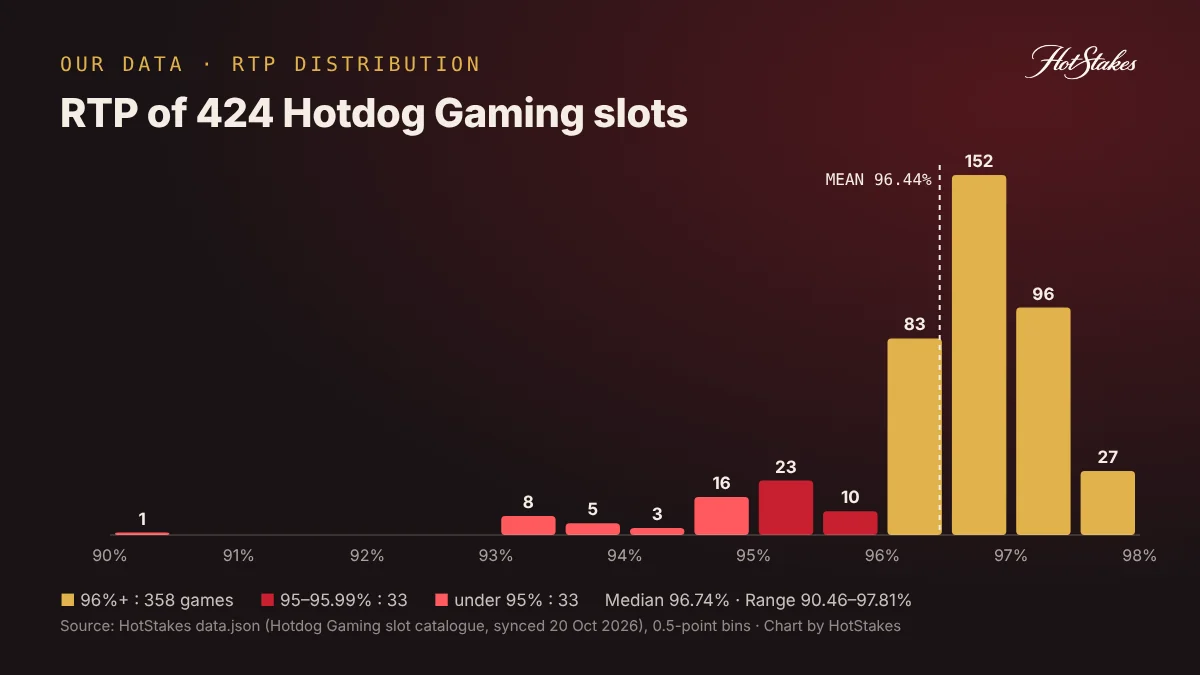
- 424 slots, average RTP 96.44%, median 96.74%.
- Highest: Mahjong Ways 2 Deluxe at 97.81%. Lowest: King of Fruits at 90.46%.
- 123 slots sit at 97% or above, 235 between 96% and 96.99%, 33 between 95% and 95.99%, 19 between 94% and 94.99%, and 14 below 94%.
The games people actually play most score a little better. The current Top 30 slots (ranked by September 2026 turnover) average 97.02% RTP across all markets. By market: THB 97.09%, PHP 96.99%, INR 96.97%, MYR 96.92%, IDR 96.82%. Even the best game in the list still keeps RM2.19 of every RM100.
Takeaway: not one game in our catalogue pays back 100%. The question is only how big the slice is.
The edge eats turnover, not your deposit
This is the part most players miss. You don’t bet your deposit once. You bet it, win some back, and bet that again.
Every re-bet ringgit is new turnover, and the edge applies to all of it. So the real question is never “how much did I put in?” It’s “how much did I put through?”
We simulated this. In our simulation, 5,000 players each started with RM100 and spun RM1 a time on a 96.5% RTP slot until they couldn’t cover a spin (or hit 100,000 spins). What we found:
- 99.9% ran out of money before 100,000 spins.
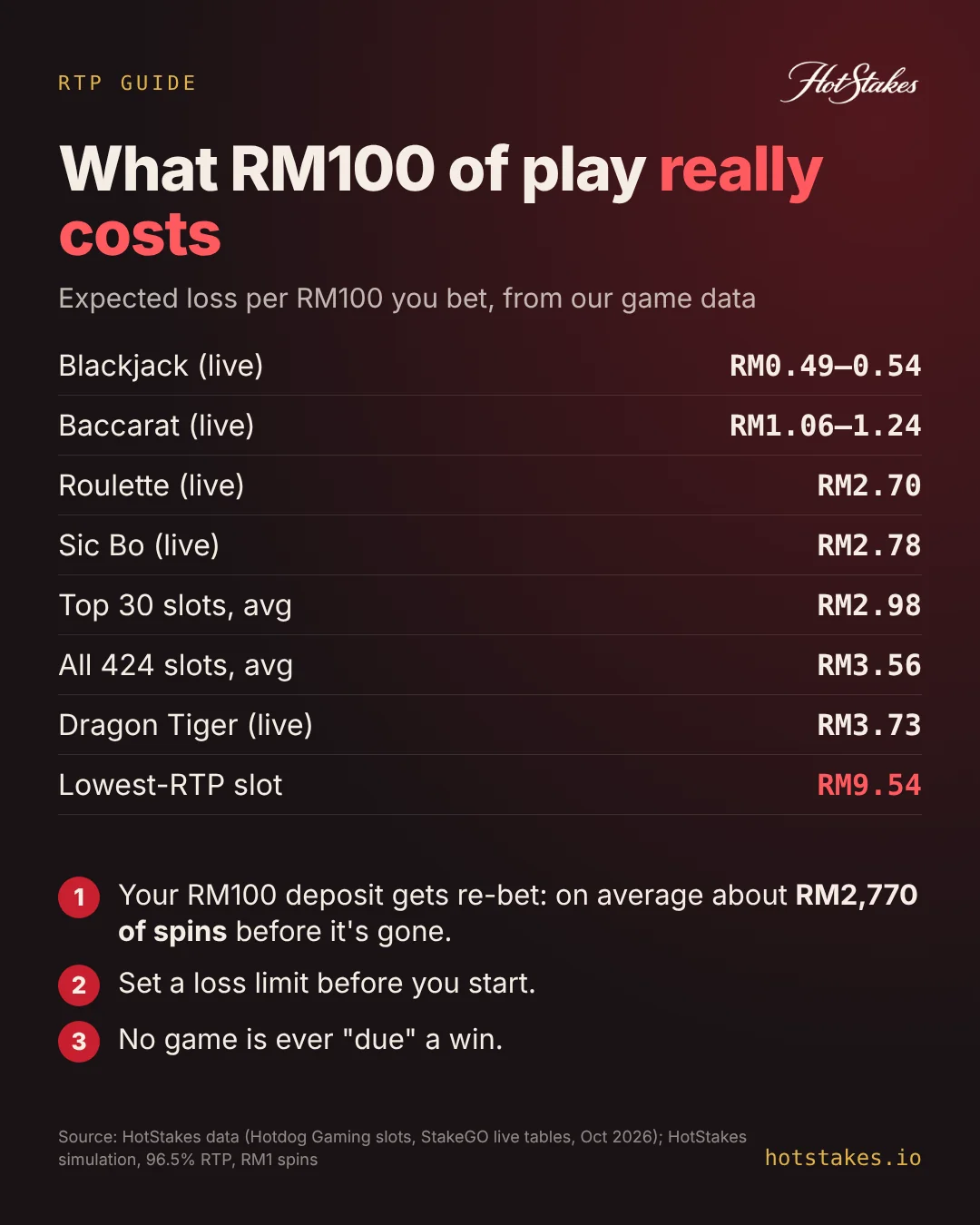
- The average player made about 2,770 spins, so roughly RM2,770 of bets from one RM100 deposit.
- That matches the theory: RM100 ÷ 3.5% edge ≈ RM2,857 of expected turnover before the deposit is gone.
- The median player lasted only 881 spins. Half the players were out sooner.
Takeaway: a 3.5% edge sounds tiny, but it hits every spin, and you make thousands of spins.
Expected loss per hour: the formula
You can work out what a session should cost before you start. Three steps:
- Find the edge. 100% minus the RTP shown in the game info, or the published house edge for a table bet.
- Estimate your hourly turnover. Bet size × rounds per hour. RM1 spins at 600 an hour is RM600. RM10 hands at 60 an hour is also RM600.
- Multiply. Expected loss per hour = bet × rounds per hour × edge.
Here is the same RM600 an hour across games in our data. The pace is our assumption; yours may be faster or slower, and the cost scales with it.
| Game (our data) | House edge | Expected cost per RM100 bet | Expected cost per hour at RM600 turnover |
|---|---|---|---|
| Live blackjack (StakeGO, RTP 99.46–99.51%) | 0.49–0.54% | RM0.49–0.54 | RM2.94–3.24 |
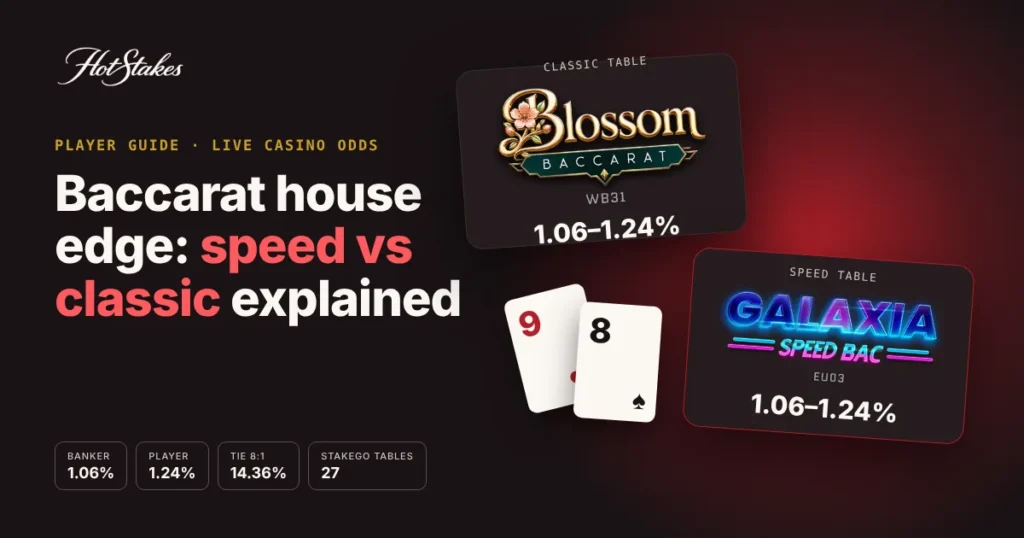
| Live baccarat, classic and speed (Banker–Player) | 1.06–1.24% | RM1.06–1.24 | RM6.36–7.44 |
| Live roulette, single zero | 2.70% | RM2.70 | RM16.20 |
| Live sic bo | 2.78% | RM2.78 | RM16.68 |
| Top 30 slots, average RTP 97.02% | 2.98% | RM2.98 | RM17.88 |
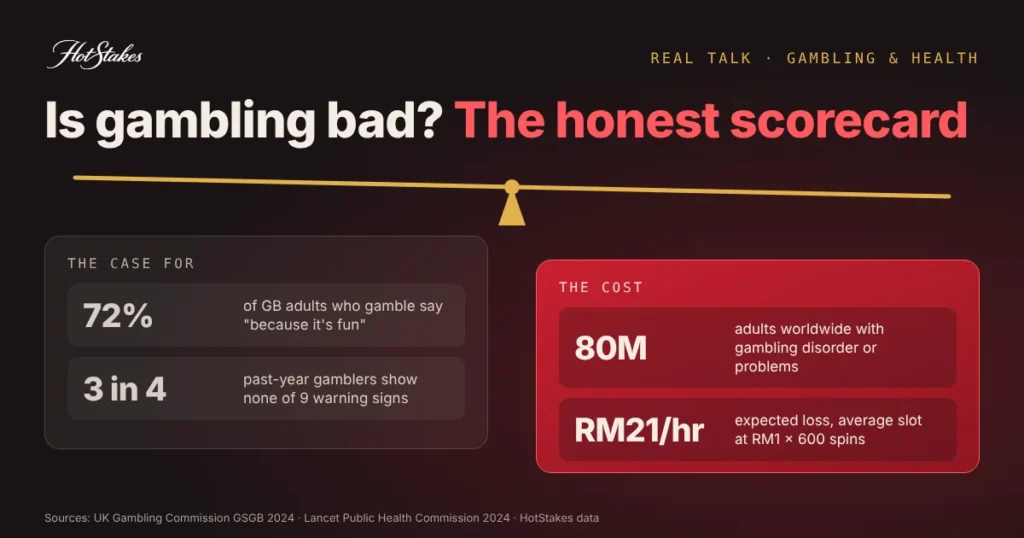
| All 424 Hotdog slots, average RTP 96.44% | 3.56% | RM3.56 | RM21.36 |
| Live Dragon Tiger | 3.73% | RM3.73 | RM22.38 |
| Lowest-RTP slot in our list (90.46%) | 9.54% | RM9.54 | RM57.24 |
Blackjack’s low edge assumes near-perfect basic strategy; mistakes raise it. Some of our roulette tables list 2.9% with certain bet options switched on. The baccarat and roulette figures match the independent tables at Wizard of Odds (Banker 1.06%, Player 1.24%, single-zero roulette 2.70%), and its Dragon Tiger page gives 3.73% where ties lose half. For a bet-by-bet breakdown of baccarat, see our Speed Baccarat house edge guide.
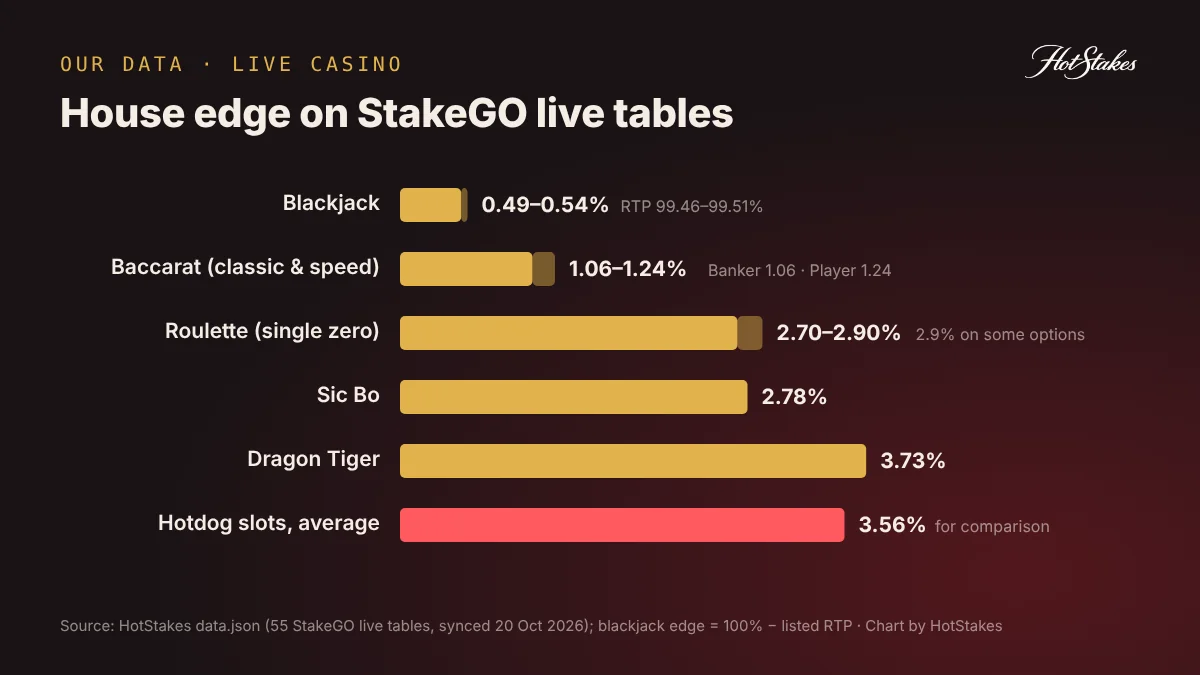
Takeaway: a “low-edge” game played fast can cost more per hour than a higher-edge game played slowly. Speed is part of the price.
Why you can still win tonight
If the maths is so certain, why do people walk away up? Volatility.
The edge is an average. Single results swing far around it, especially on slots, where most of the RTP is paid out in rare big hits. Our pillar guide on RTP vs volatility explains how that spread works game by game. Here’s what it means for your wallet.
In the short run, the swing is much bigger than the edge. After 100 RM1 spins on our stylised 96.5% slot, the expected loss is about RM3.50. But the middle 80% of simulated players ended anywhere from −RM38 to +RM29. A RM3.50 drift is invisible inside a RM67 range.
There’s a second trap. The “average” loss is propped up by a few big winners. After 10,000 spins, the mean result was −RM353, but the median player lost RM463. Most people do worse than the average suggests.
Takeaway: a win tonight proves nothing about the edge. It just means the sample is small.
The long run arrives: our simulation
To show when luck stops hiding the edge, we ran a Monte Carlo simulation on 20 Oct 2026. It’s our model, not any real game. The assumptions:
- Slot: 5,000 players, flat RM1 spins, a made-up paytable tuned to exactly 96.5% RTP (38% hit rate, top prize 1,000x).
- Even-money bet: 200,000 players, flat stakes, a 1.06% edge (similar to a baccarat Banker bet, ties ignored).
- Random seed 20261020, Python/NumPy. “Ahead” means finishing above the starting balance.
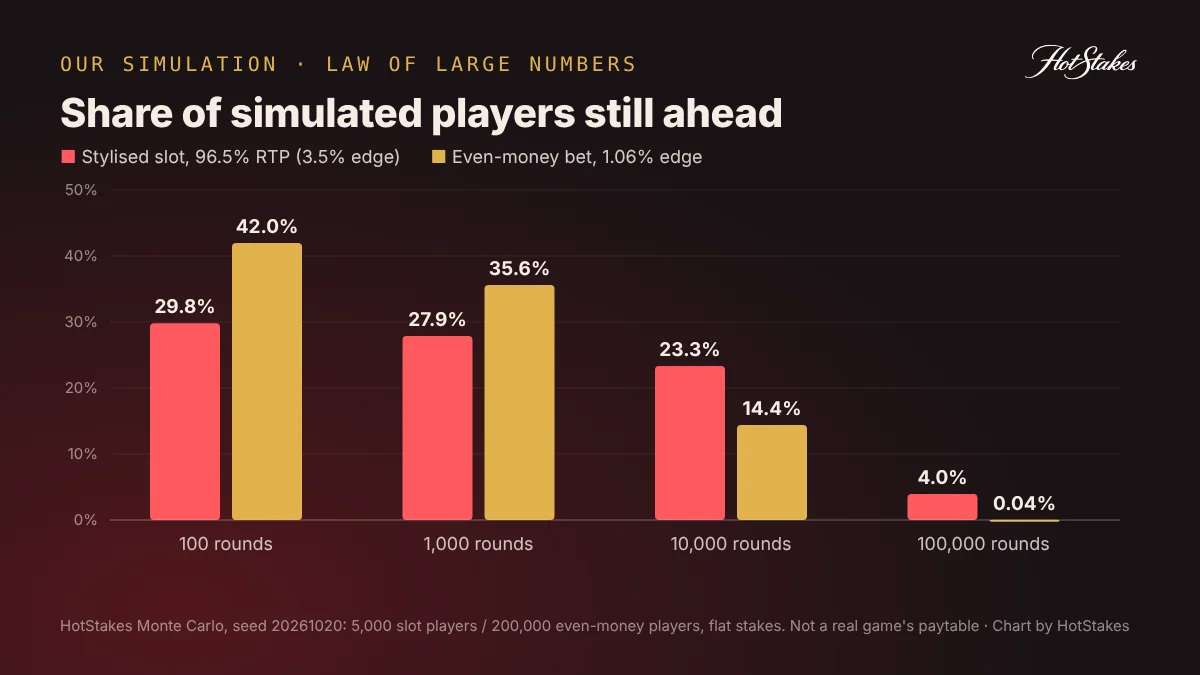
The results:
- Slot (3.5% edge): 29.8% ahead after 100 spins, 27.9% after 1,000, 23.3% after 10,000, 4.0% after 100,000.
- Even-money bet (1.06% edge): 42.0% ahead after 100 rounds, 35.6% after 1,000, 14.4% after 10,000, 0.04% after 100,000.
Notice the slot keeps more players ahead for longer, despite its bigger edge. High volatility hides the edge, but it doesn’t remove it. It only delays the reveal.
This is the law of large numbers. Britannica puts it simply: the ratios probability predicts are “increasingly accurate as the number of events increases”. The UK Gambling Commission says the same about machines: over many games, “the averaging effect evens out the volatility of wins and losses”.
A casino is the one player that always reaches the long run. It adds up every spin from every player, every day.
Takeaway: you might stay ahead for a night. Over a gambling lifetime, you are in the 100,000-round column.
“Due for a win” is a fallacy
After a long losing run, it’s tempting to think a win must be coming. It isn’t.
Each spin or hand is independent. David Lane’s introductory statistics textbook (Rice University) puts it plainly: a head on one coin flip “does not affect the outcome of the second flip”. Believing otherwise is the gambler’s fallacy, which Britannica describes as the idea that each play is wrongly assumed to be “dependent on the others”.
Online games are built to stay that way. Testing labs check the random number generator for exactly this. eCOGRA, for example, says it runs “extensive statistical analysis on the output of the RNG over many iterations” to confirm results show no pattern.
The law of large numbers doesn’t “correct” a losing streak by paying you back. It just buries old results under a pile of new ones. The money you lost stays lost.
Takeaway: the next spin has the same odds as the last one. Chasing losses only adds turnover, and turnover is what the edge eats.
What actually helps
No betting system, pattern or timing beats a fixed edge. What you can control is how much turnover you give it. If you play, play like it’s paid entertainment:
- Set a loss limit before you start, and treat it as the price of the night, not a target to win back.
- Set a time limit. Expected loss grows with every hour, so a shorter session is a cheaper session.
- Check the RTP before you play. A 97% game costs less per RM100 than a 90% one, though both still cost money.
- Watch out for bonus wagering. Wagering requirements force extra turnover, and the edge applies to all of it. See wagering requirements explained.
- Stop chasing. If you’re betting to win back losses, or it’s stopped being fun, take a break and talk to a gambling support service in your country.
Takeaway: the only reliable way to lose less is to bet less in total.
FAQ
Why does the house always win?
Every casino game pays back slightly less than it takes in. That gap is the house edge, 100% minus the RTP. It applies to every bet, so the more you bet in total, the closer your results get to losing that percentage.
How do I work out my expected loss per hour?
Multiply your bet size by rounds per hour by the house edge. For example, RM1 spins at 600 an hour on a 96.44% RTP slot is RM600 × 3.56% = about RM21 an hour, on average.
Does a higher RTP mean I will win?
No. A higher RTP only means a smaller expected loss per RM100 you bet. In our data the best slot is 97.81% RTP, which still keeps RM2.19 of every RM100 on average.
Can I be ahead after a session?
Yes, in the short run. In our simulation of a 96.5% RTP slot, 29.8% of players were ahead after 100 spins. That fell to 4.0% after 100,000 spins, because the edge shows through as the number of bets grows.
Is a slot or table due to pay after a losing streak?
No. Each result is independent of the last, and tested random number generators show no pattern. Believing a win is due is the gambler’s fallacy.
HotStakes is an independent directory. Some links on this site are affiliate links; we may earn a commission at no cost to you, and it never changes our rankings. Gambling involves risk — only play with money you can afford to lose, and if it stops being fun, seek help. This article is general information, not legal advice.
Looking for operators checked by Cyndia’s team? Browse vetted operators by currency.
 Next story →Wrong-Number Text Scam: The Script, Message by Message