

Gambling Chargeback: Can You Get Deposits Back?
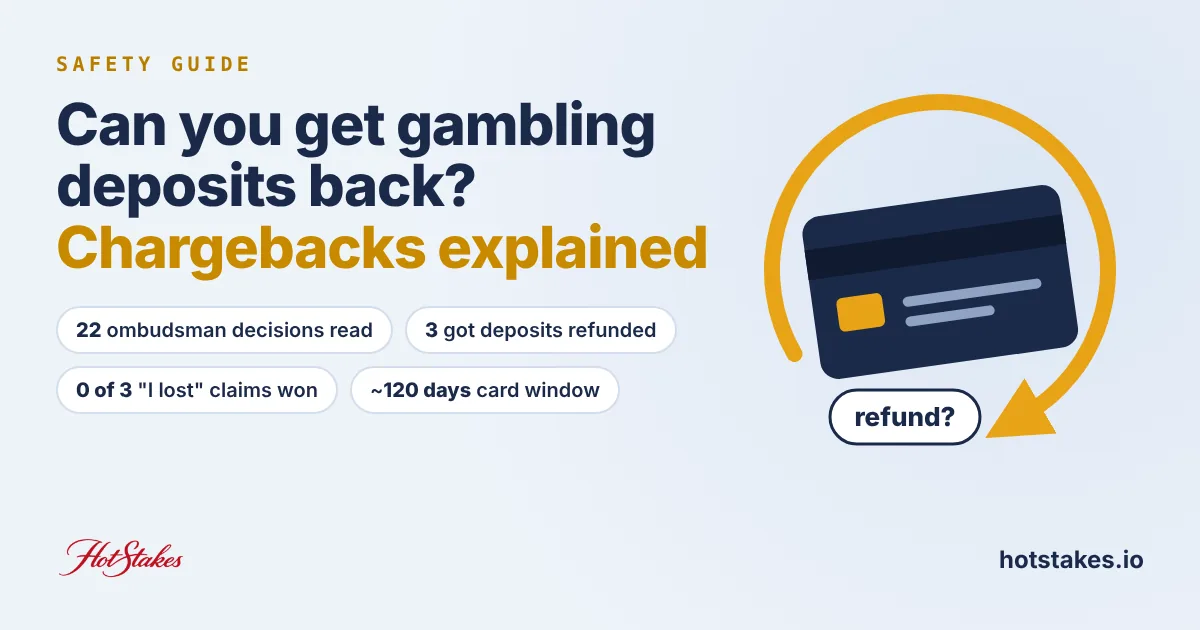
We read 22 ombudsman decisions on gambling refunds. Deposits came back in 3. When a chargeback works, when it fails, and where to escalate in Asia.
In this article
- When a gambling chargeback can work, and when it won’t
- We read 22 ombudsman decisions: here’s what won and what lost
- How card rules treat gambling: codes, debit vs credit, deadlines
- The risks before you file
- Chargeback vs “recovery company”: don’t pay for what your bank does free
- What to do now: three situations
- Bank said no? Where to escalate in Asia
- FAQ
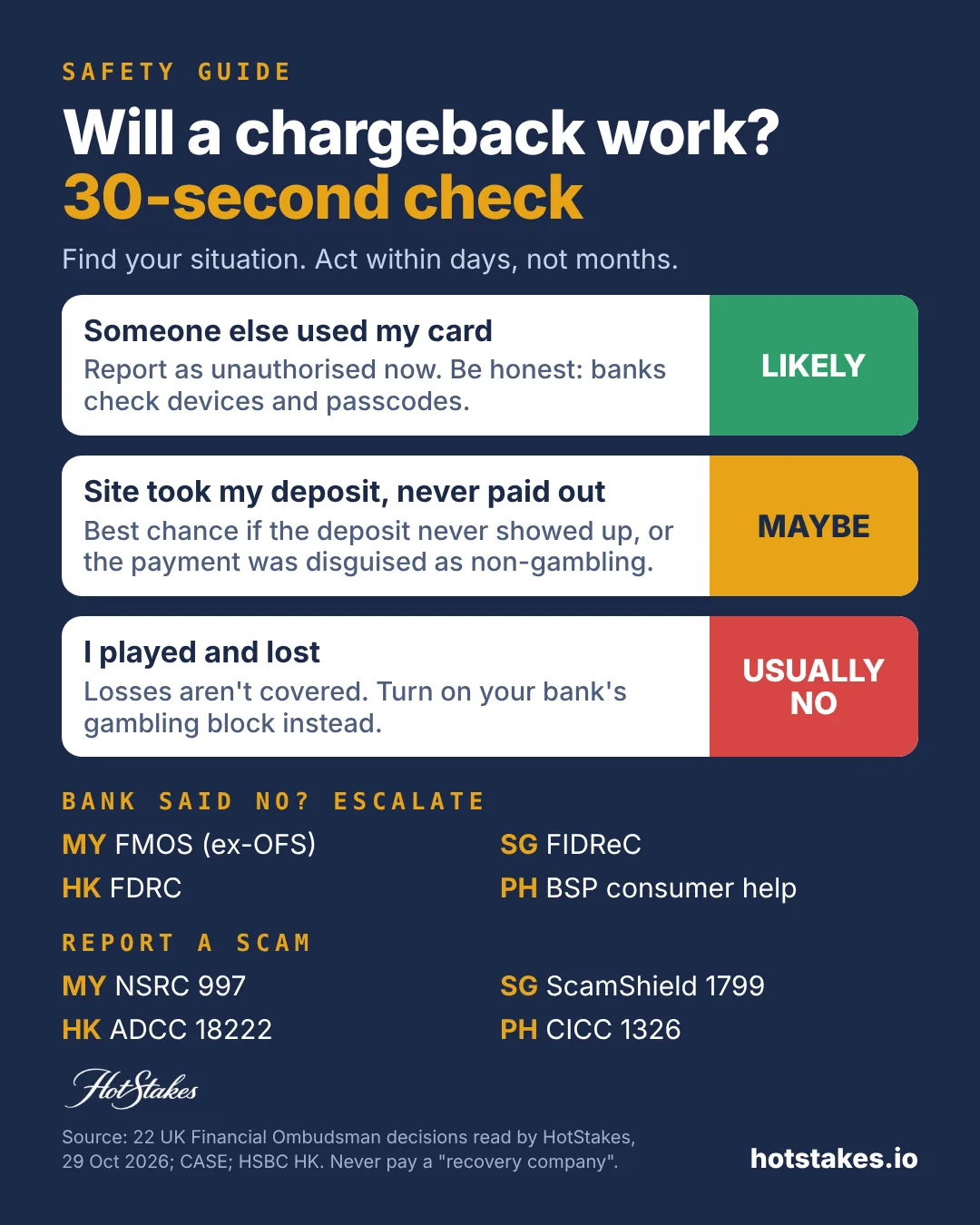
Sometimes, but rarely for the reason most people hope. Card scheme rules give almost no chargeback rights for gambling you authorised and lost. We read 22 UK Financial Ombudsman decisions on gambling refunds, and the deposits came back in only 3, all because the bank or the payment coding failed, not because the player lost. Below: which claims win, which fail, the deadlines, the risks, and where to escalate in Malaysia, Singapore, Hong Kong and the Philippines.
When a gambling chargeback can work, and when it won’t
A chargeback is the process where your card issuer asks the merchant’s bank to reverse a payment. The UK ombudsman describes it as a voluntary card scheme process governed by Mastercard’s rules. The bank files it. The card scheme decides.
For gambling, those rules are tight. In one decision, Mastercard told the ombudsman that gambling transactions have no chargeback rights, even where the wrong merchant code was used. Another decision explains the narrow exception: a claim can cover funds that never reached your gambling account, not losses, winnings or withdrawals.
| Your situation | Chance | Why |
|---|---|---|
| Someone else used your card without permission | Likely, if the evidence backs you | Unauthorised payments are a standard dispute type (CASE). Banks check devices, IP addresses and one-time passwords. |
| You paid, but the deposit never appeared in your casino balance | Maybe | The one gambling case card rules allow: value not received. |
| The payment was disguised as shopping or “digital goods” to dodge your gambling block | Maybe (Visa cards especially) | Two of our 22 decisions refunded on this ground. |
| The site won’t pay your winnings, or you think it’s a scam | Usually no | You received the gambling service. Winnings and withdrawals aren’t covered. |
| You gambled, lost and regret it | Usually no | You authorised the payment and got what you paid for. |
Takeaway: a chargeback fixes a broken payment, not a lost bet.
We read 22 ombudsman decisions: here’s what won and what lost
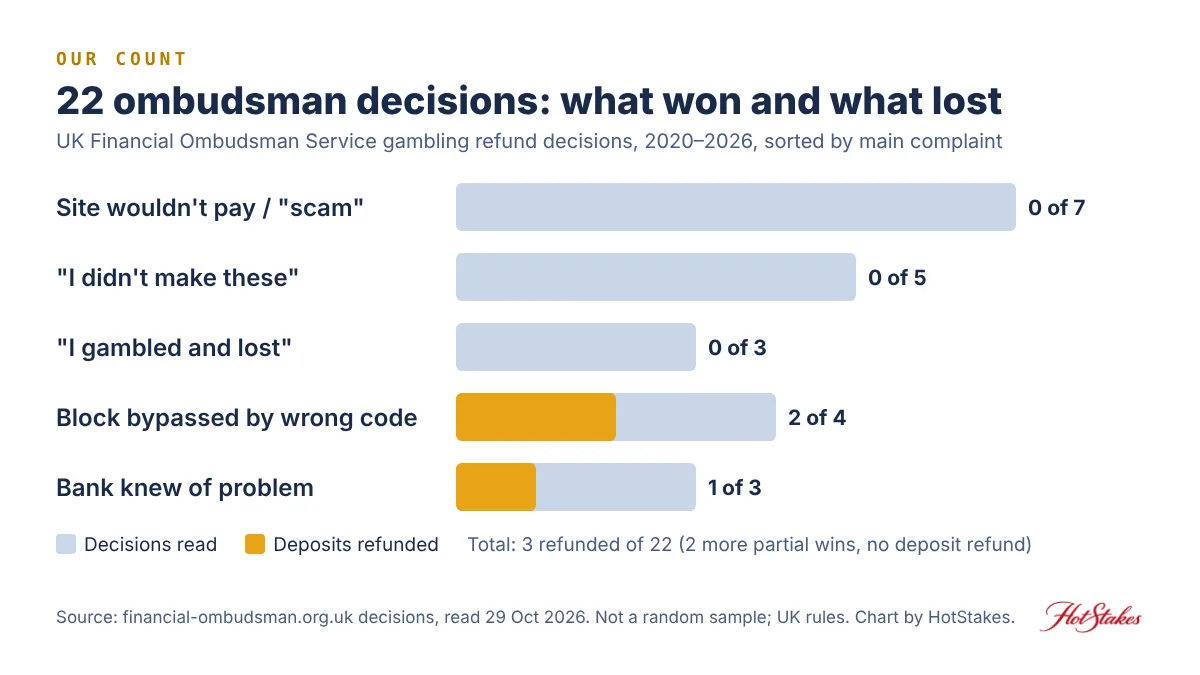
On 29 Oct 2026 we searched the UK Financial Ombudsman Service’s published decisions for gambling chargeback and refund complaints. We read all 22 that we opened, dated 2020 to 2026, and sorted each by the main complaint and the outcome. Banks include Monzo, Starling, NatWest, Lloyds, Chase and TSB. Complainants are anonymised.
| Complaint type | Read | Deposits refunded | What the ombudsman said |
|---|---|---|---|
| Site wouldn’t pay out / “it’s a scam” | 7 | 0 | The player got the gambling service; an offshore or unlicensed site isn’t automatically a scam (Chase, Monzo). |
| “I didn’t make these payments” | 5 | 0 | Evidence pointed to the customer: same IP address, same phone for passcodes, own ID on the casino account (Co-op, HSBC UK). |
| “I gambled and lost” | 3 | 0 | Losses are excluded from gambling chargebacks (Starling). |
| Gambling block bypassed by a wrong merchant code | 4 | 2 | Visa’s “invalid data” rule could apply when the gambling code was hidden (Zopa, NatWest). |
| Bank knew about a gambling problem and didn’t act | 3 | 1 | NatWest took about 20 days to apply a block after the customer asked (NatWest). |
| Total | 22 | 3 | Two more got partial wins: £100 for poor communication (Monzo), and a loan reworked plus £500 (Lloyds). |
What won
- A hidden gambling code. In the Zopa case, the casino’s payments weren’t coded as gambling. Zopa admitted its card controls would have blocked them otherwise, so the ombudsman said a chargeback should have been raised. In a NatWest case, 54 payments slipped past a gambling block through merchants likely using incorrect codes. NatWest had to refund 70%.
- A bank that didn’t act on a request for help. The customer told NatWest about his gambling and asked for a block. He got back the gambling payments made between his request and the date the block finally went on, minus winnings.
What lost
- “The site won’t pay me.” Seven out of seven failed. Rules say “chargeback rights are not available for refunds, withdrawals or transfer requests”.
- Claiming payments were unauthorised when the evidence said otherwise. All five failed. In one, the ombudsman noted that “the betting pattern on the account has remained consistent” across disputed and undisputed bets.
Two cautions. These are UK decisions under UK rules; banks in Asia apply their own terms and local regulators’ guidance. And complaints reach an ombudsman because they were disputed, so genuine fraud victims who were refunded quickly never appear here. Takeaway: treat this as a pattern, not legal advice. The wins came from bank or coding failures, never from the loss itself.
How card rules treat gambling: codes, debit vs credit, deadlines
Every card merchant carries a four-digit merchant category code. Gambling is MCC 7995. Bank gambling blocks work by stopping that code. Offshore sites coded as games, payments or shopping slip past them, as Lloyds’ block did in one case. It’s also why a miscoded payment can open a dispute route that an honest 7995 payment doesn’t.
Debit or credit? Both can be disputed through the card scheme. The difference is often the clock. HSBC Hong Kong asks you to report within 60 days: from the statement date for credit cards, from the transaction date for debit cards.
How long do you have? Singapore’s consumer association says you can generally ask for a chargeback within 120 days of the transaction. Some reasons are shorter: the Zopa decision cites a 75-day limit for the invalid-data claim. In an MBNA case, months of payments fell outside the 120-day window and couldn’t be disputed at all.
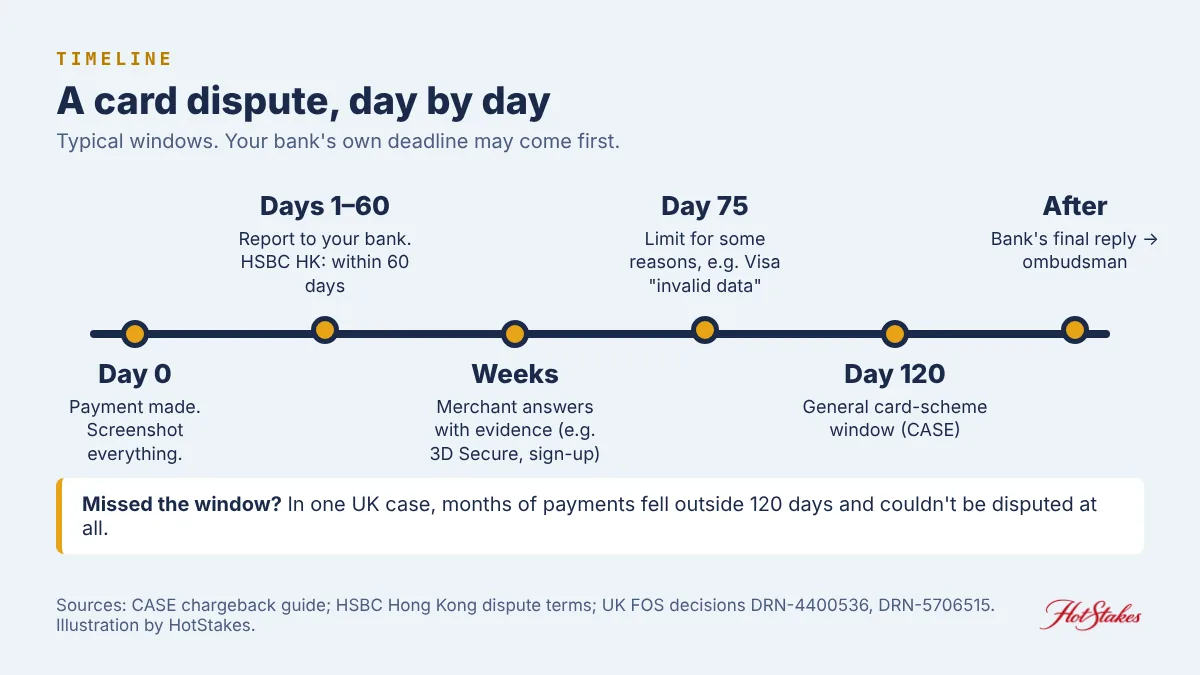
Takeaway: report in days, not months. Your bank’s own deadline usually comes first.
The risks before you file
- The refund can be taken back. Temporary credits are reversed if the claim fails. The Co-op was allowed to reclaim remaining temporary credits. HSBC Hong Kong says it will re-debit an authorised dispute plus any interest.
- The merchant answers back. In the TSB case, the merchant showed a completed registration and 3D Secure checks, and the claim failed.
- The casino can close your account. In a 2023 case published by the Pennsylvania Gaming Control Board (we do not link it because the file names the player), a player filed 39 chargebacks after wagering his deposits. The casino suspended his account, and he later appeared on the state’s exclusion list.
- A false “unauthorised” claim is dishonest. If you made the payments, say so. Banks check, and the ombudsman sided with them every time in our sample.
Takeaway: only dispute what is genuinely wrong, and be ready to show why.
Chargeback vs “recovery company”: don’t pay for what your bank does free
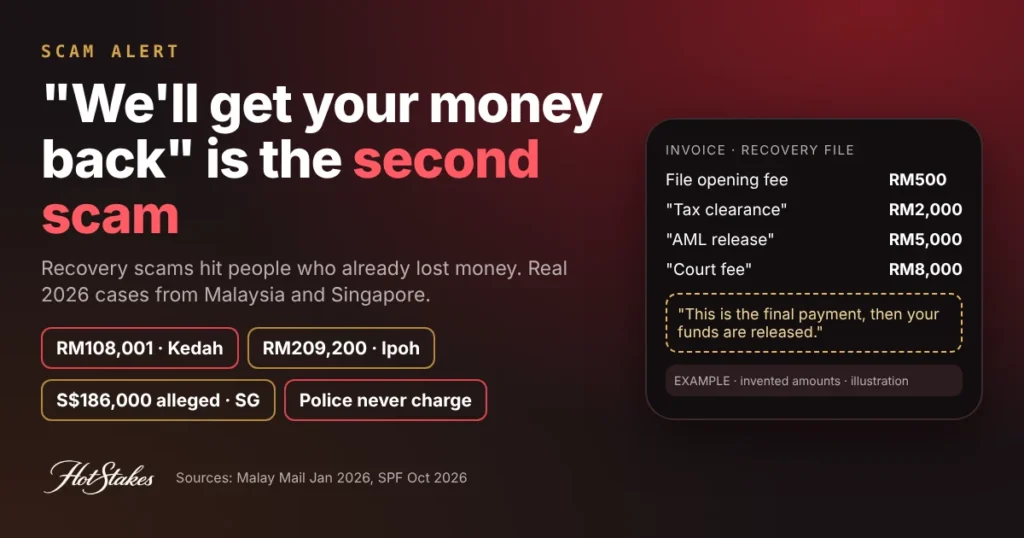
Firms promise to “trace” or “charge back” your deposits for an upfront fee. Singapore Police warned that such fund recovery scams ask for upfront payments, sometimes your OTPs or remote access to your phone. At least 29 cases cost victims S$1.2 million in under two months of 2024. In Malaysia, police warned in April 2026 of scammers posing as NSRC staff demanding advance fees.
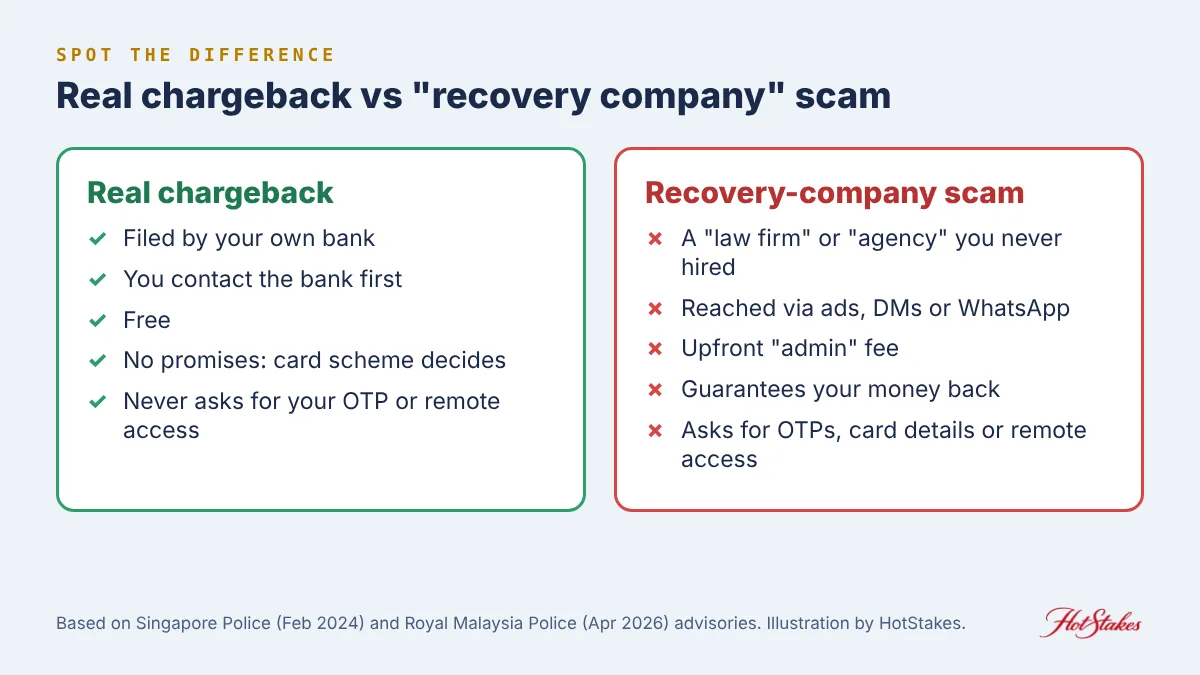
Takeaway: if anyone but your bank offers to get your gambling money back for a fee, stop. Our recovery scam explainer shows the scripts they use.
What to do now: three situations
(a) Someone used your card without permission
- Freeze the card in your banking app or call the bank’s hotline now.
- Report each payment as unauthorised, not as a merchant dispute. List dates and amounts.
- Tell the truth about who had your card or details. If you’d shared it with a family member before, say so. Banks look at devices, IP addresses and passcodes.
- If your card or phone was stolen, make a police report and keep the reference.
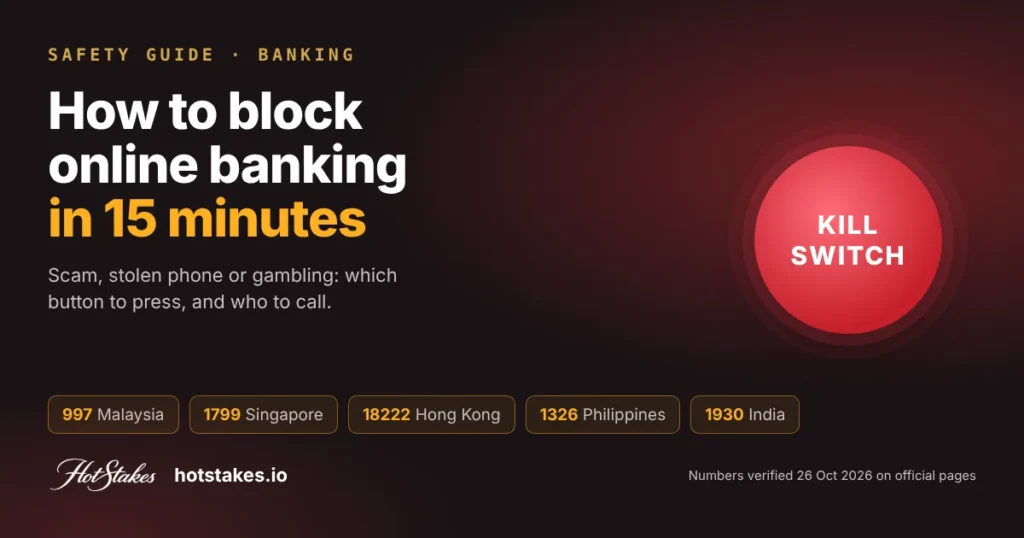
- Change your passwords. Our online banking block guide covers locks and limits.
(b) You paid a site that never paid out, or a scam site
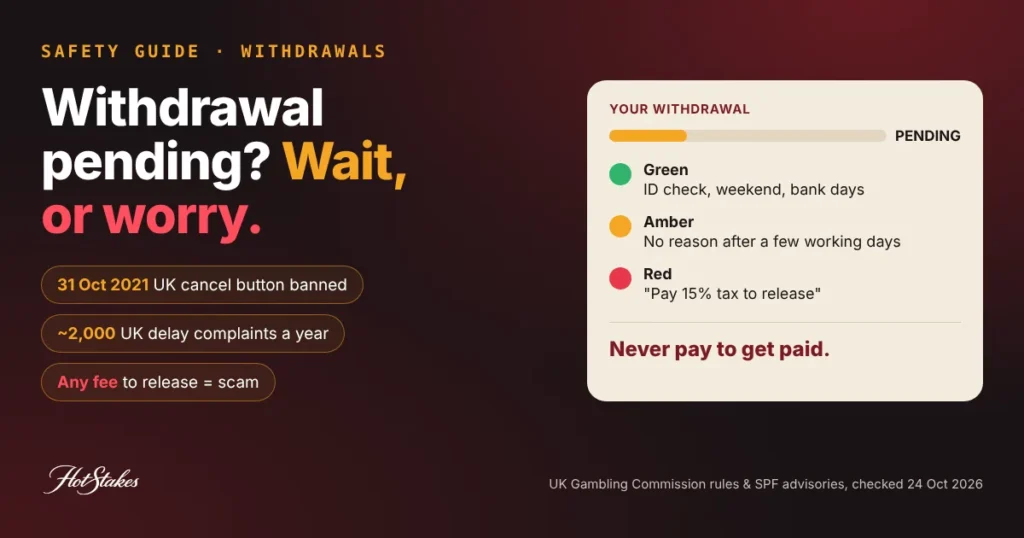
- Stop depositing. Never pay a “tax”, “release fee” or “verification deposit” to release a withdrawal. See why withdrawals stay pending.
- Screenshot your balance, deposit receipts, chats, the site address and any licence it claims.
- Check your statement. If the payment shows a non-gambling name, or the money never appeared in your casino balance, tell your bank exactly that.
- Ask for a chargeback straight away, in writing.
- Report it: Malaysia NSRC 997 (24 hours), Singapore ScamShield 1799, Hong Kong ADCC 18222, Philippines CICC 1326.
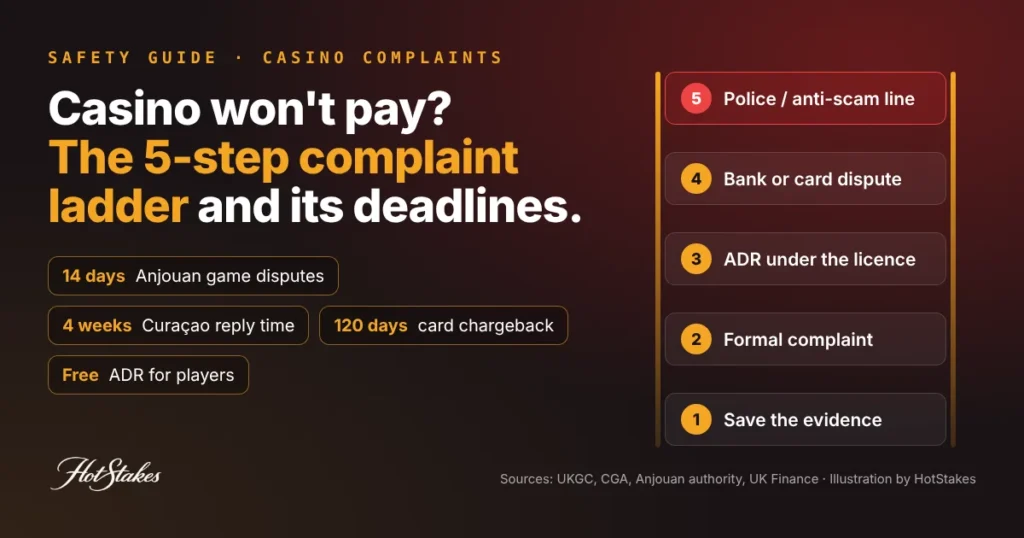
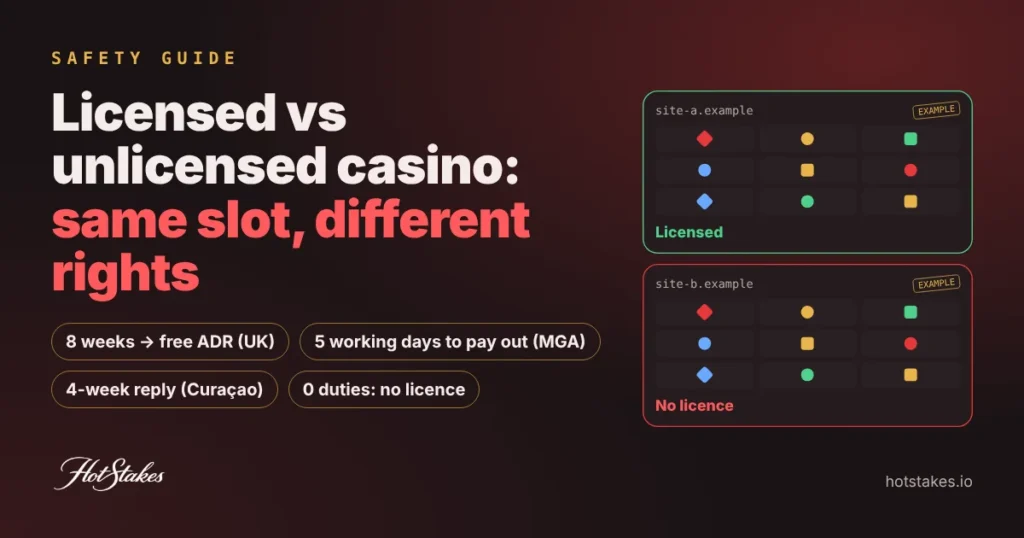
- If the site claims a licence, complain to the regulator too. Our casino complaint guide shows how, and how to spot an unlicensed casino helps you check.
- Paid in USDT or other crypto? There is no chargeback. Read our USDT deposit risks checklist and report it anyway.
(c) You gambled, lost, and want it to stop
- Turn on your bank’s gambling block today, with the steps in our online banking block guide.
- Add site blockers and self-exclusion from our guide to blocking gambling, because blocks miss miscoded sites.
- Tell your bank you’re struggling with gambling. In our sample, the one vulnerability refund came after the bank was told and was slow to act.
- If there’s debt, start with our gambling debt guide. Talk to someone: Singapore NCPG 1800-6-668-668, Philippines PAGCOR 02-8248-9568 (24/7), Hong Kong 183 4633, Malaysia HEAL 15555.
Bank said no? Where to escalate in Asia
First get your bank’s final written reply. Then a free or low-cost dispute body can review whether the bank treated you fairly. None of them can force an offshore casino to pay.
| Country | Body | Key limits |
|---|---|---|
| Malaysia | Financial Markets Ombudsman Service (FMOS), which replaced the OFS in January 2025 | Free. Disputes on financial accounts or transactions up to RM250,000. |
| Singapore | FIDReC | Free to file. Adjudication up to S$150,000 per claim. |
| Hong Kong | Financial Dispute Resolution Centre (FDRC) | Up to HK$1,000,000, within 24 months of first knowing of the loss. Fees apply. Written complaint to the bank first. |
| Philippines | BSP consumer assistance (BSP Online Buddy chatbot) | Via the BSP website, app or Facebook Messenger. Unauthorised transactions are among the top complaints; offers mediation. |
Takeaway: complain to the bank in writing first, keep the reply, then escalate.
FAQ
Can I get a chargeback on gambling losses?
Almost never. Card scheme rules exclude losses, winnings and withdrawals from gambling chargebacks. In the 22 UK ombudsman decisions we read, no “I gambled and lost” claim succeeded.
Does a chargeback work on a debit card?
Yes, debit and credit cards can both be disputed through Visa or Mastercard. Deadlines may start from different dates, so check your bank’s terms and report quickly.
How long do I have to dispute a gambling payment?
Generally up to 120 days from the transaction under card scheme rules, but your bank may ask you to report within 60 days, and some dispute reasons have shorter limits.
Will the casino ban me if I file a chargeback?
It can. Casinos can suspend accounts after chargebacks, and a regulator-published US case shows a player’s account suspended and him later placed on an exclusion list.
Should I pay a company to recover my gambling deposits?
No. Your bank files chargebacks free. Police in Singapore and Malaysia warn that recovery services demanding upfront fees are a common scam.
Can I get crypto or USDT casino deposits back?
Not through a chargeback, which only applies to card payments. Report the loss to your national scam centre and keep all wallet addresses and transaction records.
HotStakes is an independent directory. Some links on this site are affiliate links; we may earn a commission at no cost to you, and it never changes our rankings. Gambling involves risk — only play with money you can afford to lose, and if it stops being fun, seek help. This article is general information, not legal advice. Read our full disclaimer.
 Next story →Gambling Streamers: Who Pays Them and How It Works
Start the discussion