

Gaming Supplier Licence: Who Checks the Game Makers?
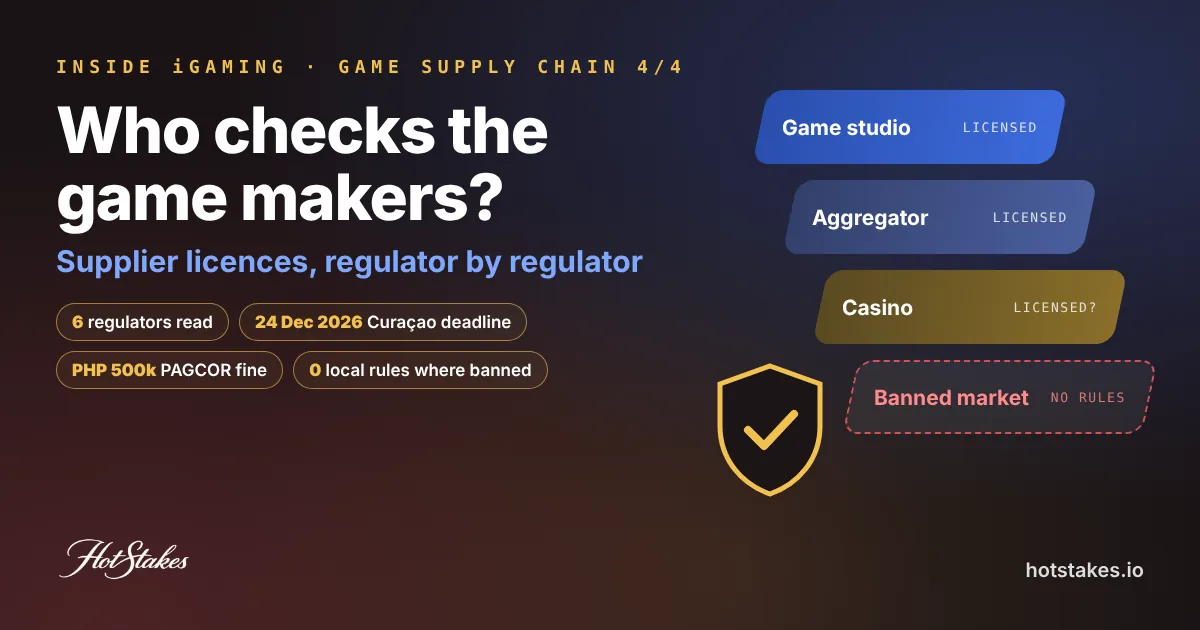
Who licenses the studios behind casino games? Six regulators' supplier rules compared, and why the checks stop at the border in much of Asia.
In this article
Who checks the companies that make casino games? In regulated markets, the answer is a gaming supplier licence: the studio, not just the casino, is vetted, its games are tested, and its customers are watched. But that check only reaches as far as each regulator’s border, and in most of Asia there is no supplier rulebook at all. We read the supplier rules of six regulators on 28 Oct 2026. Below is what each one demands, who can be searched on a public register, and which ones punish a supplier for feeding illegal sites.
This final part of our Game supply chain series names no companies. It describes rules only.
Why game makers need their own licence
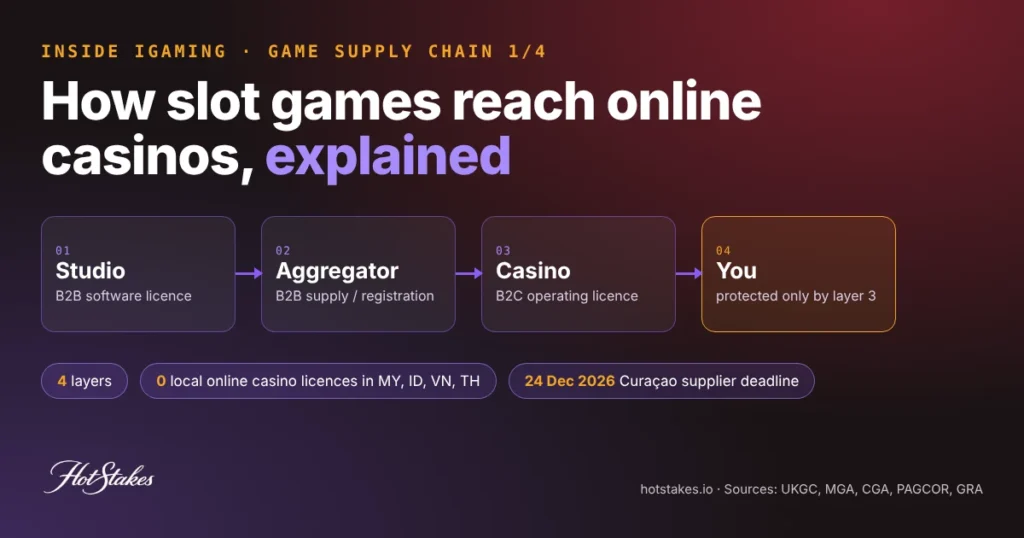
Most casinos do not build their slots. As our series pillar on how slot games reach online casinos explains, a studio makes the game, a middleman often distributes it, and the casino rents it. The game file usually runs on the supplier’s server.
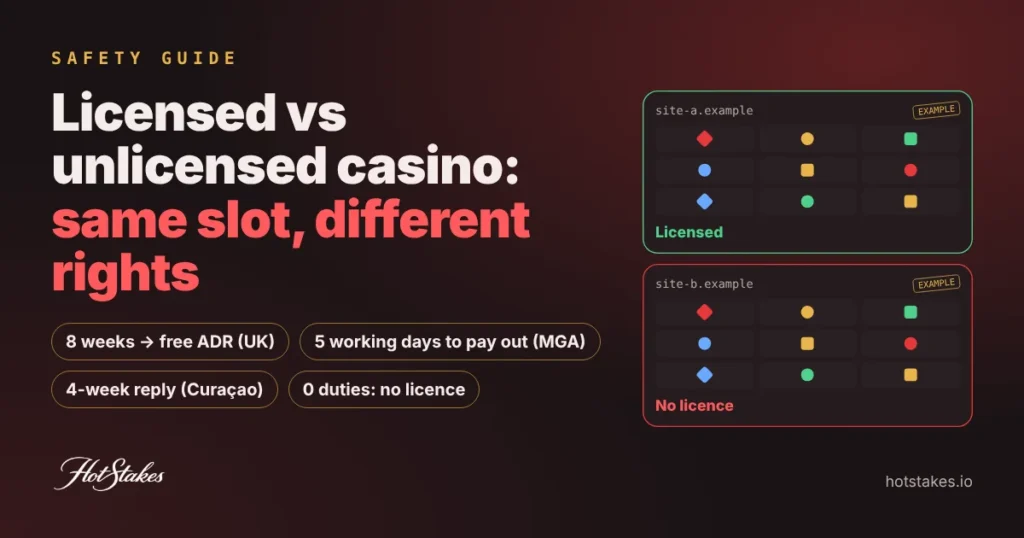
So the casino’s licence is only half the story. If the maker is never checked, nobody has looked at who owns it, tested its maths, or asked who else it sells to. Part 2 of this series showed that the same slot can sit on a licensed and an unlicensed casino. Supplier licensing is the regulator’s attempt to control that.
The UK law is blunt. Under section 41 of the Gambling Act 2005, as the Gambling Commission explains, it is an offence to manufacture, supply, install or adapt gambling software in the course of business without a licence. Licensed UK casinos must buy software only from licence holders.
Takeaway: a licence on the casino and a licence on the game maker are two different checks. Strict regimes demand both.
Gaming supplier licence rules, regulator by regulator
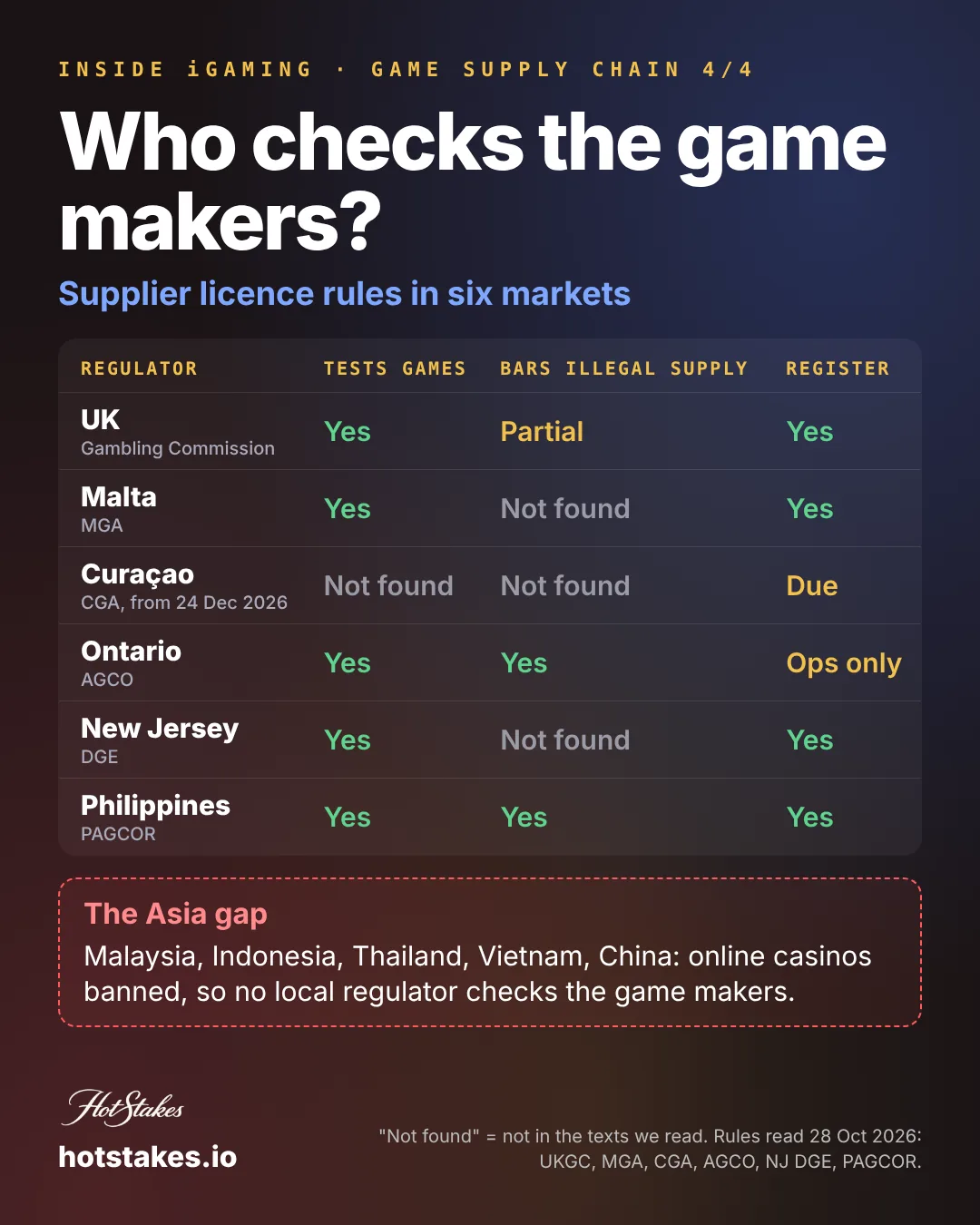
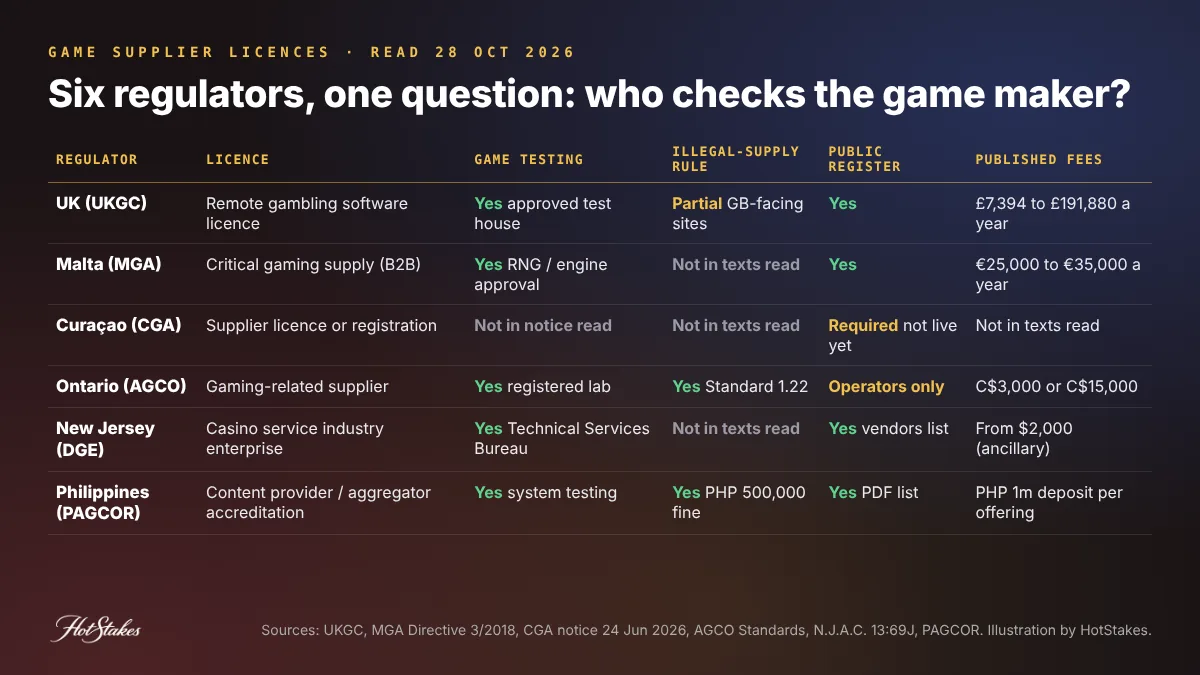
We read the primary texts on 28 Oct 2026. “Not in texts read” means the documents we opened did not cover the point, not that no rule exists.
| Regulator | Licence name | Who needs it | Game testing | Rule against supplying illegal sites | Public register | Published fees |
|---|---|---|---|---|---|---|
| UK Gambling Commission | Remote gambling software licence | Makers, suppliers, installers or adapters of gambling software for GB | Yes, approved test house; report filed before release | Partial: warning that supplying sites illegally serving GB puts a licence at risk | Yes | Application £7,212 to £99,446; annual £7,394 to £191,880 (from 1 Oct 2026) |
| Malta Gaming Authority | Critical gaming supply (B2B) licence | Game and back-office suppliers in or from Malta | Yes, prior approval of new RNGs and game engines; certification as required | Not in texts read | Yes | €5,000 application; €25,000 to €35,000 a year |
| Curaçao Gaming Authority (LOK) | Supplier licence (local) or registration (foreign) | Critical suppliers: RNG game makers, live studios, aggregators | Not in the supplier notice read | Not in texts read | Required by law; not yet live when we checked | Not in texts read |
| AGCO (Ontario) | Gaming-related supplier registration | Game developers, platforms, test labs serving Ontario | Yes, certified by a lab registered by the Registrar | Yes: must cease unregulated Ontario activity | Operators listed; no supplier list found | C$3,000 or C$15,000 regulatory fee |
| NJ Division of Gaming Enforcement | Casino service industry enterprise (CSIE) licence | Internet gaming software or system providers | Yes, Division’s Technical Services Bureau | Not in texts read | Yes, active vendors list | Ancillary CSIE: from $2,000, billed by staff time |
| PAGCOR (Philippines) | Accreditation as game content provider or game aggregator | B2B providers contracted by PAGCOR licensees | System testing part of accreditation | Yes: fine for offering services to unauthorised gaming entities | Yes, PDF list | PHP 1,000,000 performance cash deposit per game offering |
UK: a licence for the software itself
The UKGC’s remote gambling software licence covers making, supplying, installing or adapting software remotely. Studios that offer games only through other operators’ platforms may also qualify for a host licence, if they hold this software licence and do not contract with players directly.
Testing is not optional. Software licensees must send game and RNG test reports to the Commission, and the testing strategy says new games “can only be released once the testing has been completed” (procedure for testing). Software must be capable of meeting the remote technical standards (RTS).
Malta: the “critical gaming supply” licence
The MGA’s business-to-business licence, per its licence FAQ, lets a company “supply and manage the material elements of a game”. The game provider page lists the fees.
Under the MGA’s Gaming Authorisations and Compliance Directive, a new RNG or game engine needs the Authority’s prior written approval (Art. 19). Licensees must check that a supplier holds a B2B licence or recognition notice (Art. 27).
Curaçao: licence or registration from 24 Dec 2026
Curaçao’s new law, the LOK, brings suppliers in for the first time. (operator side: our Curaçao licence reform explainer). For suppliers, the CGA’s announcement of 24 June 2026 sets the rules:
- Local suppliers of critical services need a CGA supplier licence (LOK Art. 1.5).
- Foreign suppliers only register. In the CGA’s words: “A Curaçao supplier license is not required for suppliers established outside Curaçao.”
- Operators may only use registered suppliers (Art. 5.16(4)), and the CGA must keep a public supplier register (Art. 5.16(1)).
- Deadline: the two-year transition ends on 24 December 2026. Registration was expected to open in October 2026.
Ontario and New Jersey: suppliers registered like operators
Ontario’s AGCO says game developers, platforms and even test labs may need to register as gaming-related suppliers. Under the Registrar’s Standards for Internet Gaming, games must be approved by the Registrar or certified by a registered lab before going live (Standard 4.08).
New Jersey’s rules at N.J.A.C. 13:69J require a CSIE licence for “companies providing Internet gaming software or systems”. New products go to the Division’s Technical Services Bureau for testing under N.J.A.C. 13:69E-1.28R.
Takeaway: every strict regulator checks three things about a game maker: who owns it, whether its games were tested, and who it sells to.
Supplying illegal markets: where each regulator draws the line
A supplier can hold a top licence and still sell the same games to sites that are illegal somewhere else. Regulators treat that very differently.
- UK: in a January 2025 warning notice, the UKGC said it had found licensed games on unlicensed sites serving GB, often via third-party resellers. Licensees who let this happen may “place their own licence at risk”. At its November 2025 CEO briefing, chief executive Andrew Rhodes said: “There will be no more warnings for those actors.”
- UK, the limit: the UK rules focus on GB. The software licence page notes that the RTS do not apply to software supplied to unlicensed overseas operators. In a January 2026 speech at ICE Barcelona, the Commission’s Tim Miller urged the industry to make “supplying unlicensed operators commercially toxic”, and said this was not an implied threat of regulatory action.
- Ontario: Standard 1.22, added in October 2022, says registrants “must cease all unregulated activities” in Ontario that would need registration.
- Philippines: PAGCOR’s offences and penalties framework (Rev. 3), as we read the scanned copy, lists a PHP 500,000 fine for offering products or services to unauthorised gaming entities.
- Malta, Curaçao, New Jersey: the texts we read set suitability and supplier-registration rules but did not contain an explicit ban on supplying illegal markets abroad.
Takeaway: “grey market” supply is judged market by market. Clean in Ontario can still mean illegal where you live.
Asia: PAGCOR accreditation, Singapore, and the gap
Of the Asian markets we cover, the Philippines has the most detailed public B2B rulebook we found. PAGCOR’s Regulatory Framework for the Accreditation of Gaming Affiliates and Support Service Providers covers game content providers and game aggregators. A Chambers summary of the framework reports probity checks, a PHP 1,000,000 performance cash deposit per game offering, and a duty for licensees to use only accredited providers.
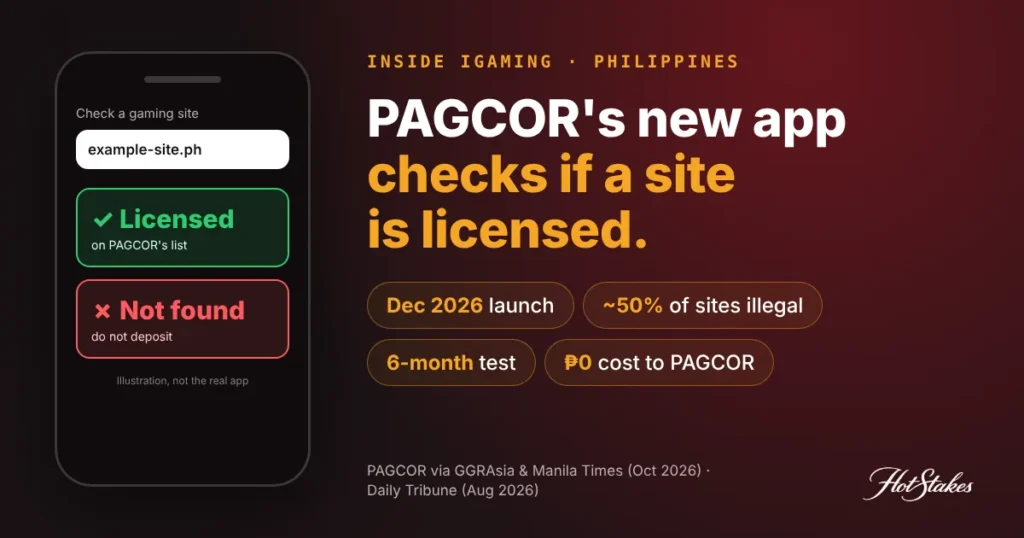
According to AGB’s report on a PAGCOR memo of 21 May 2026, non-compliant B2B systems faced decommissioning from 1 August 2026. PAGCOR publishes a list of accredited gaming affiliates. The copy we opened, dated 20 Oct 2026, had about 45 content providers and 14 aggregators. Foreign providers that skip accreditation must work through an accredited local distributor, per Annex D.
Singapore is the opposite case. The GRA says one operator is “the only operator licensed by GRA to provide remote gambling services”. There is no market of licensed online casinos for studios to supply.
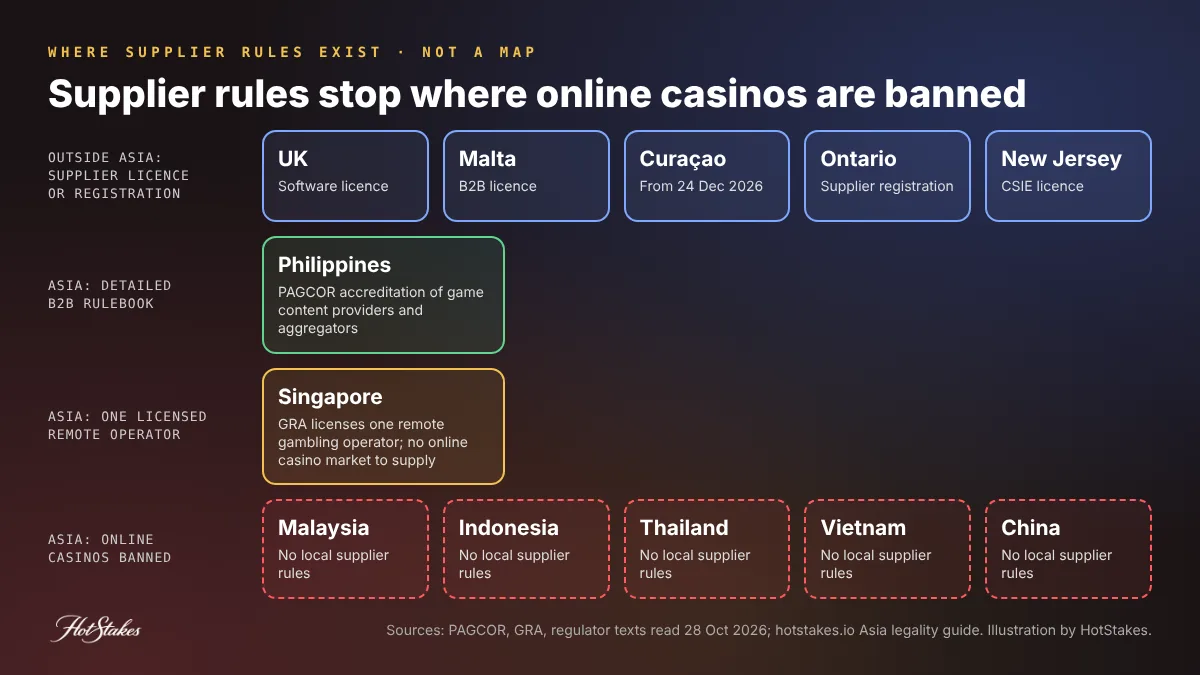
Then the gap. Malaysia, Indonesia, Thailand, Vietnam and mainland China do not license online casinos for the public; see our country guide on whether online gambling is legal in Asia. With no legal online casino market, there is no local supplier licence either. Players there see games from sites and makers no local regulator checked.
Takeaway: a supplier licence from London or Malta does not follow the game into a market where online casinos are banned. Nobody local is checking.
What a supplier must prove
Strip away the jargon and strict regimes ask the same four things.
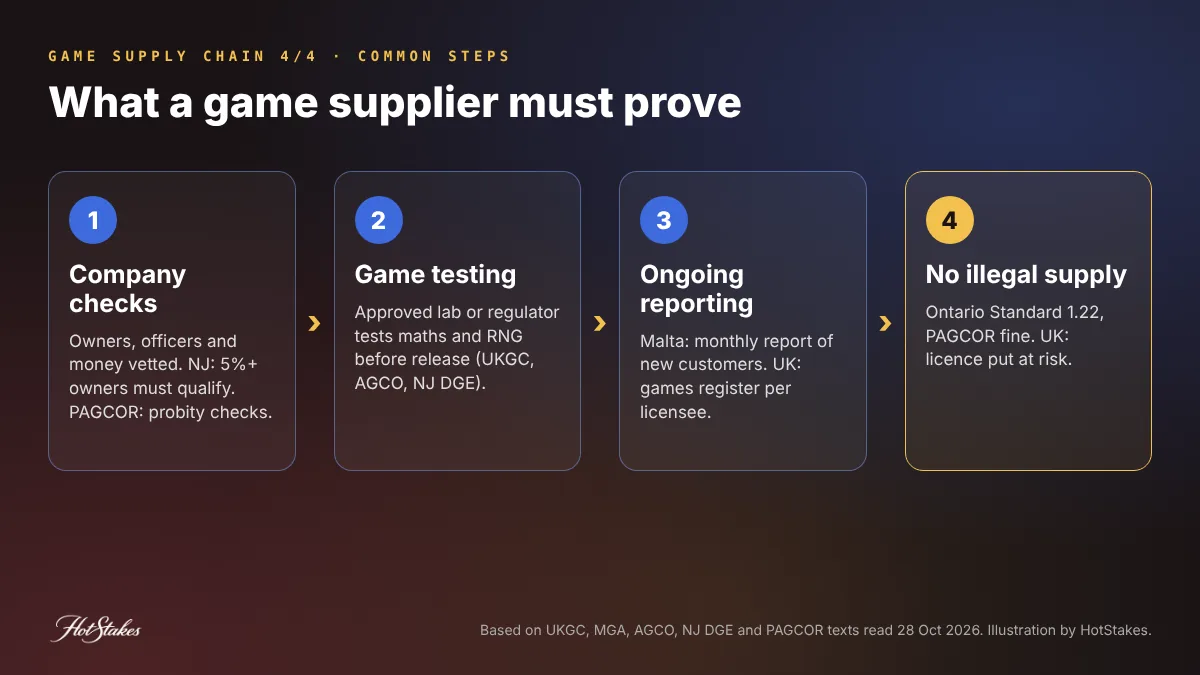
- Company checks. Owners, officers and money are vetted. New Jersey requires 5%+ owners to qualify. PAGCOR runs probity checks on beneficial owners.
- Game testing. An approved lab or the regulator tests the maths and RNG before release. Our guide to what an RTP certification really proves covers the limits of that seal.
- Ongoing reporting. Malta wants monthly customer reports from B2B licensees. The UK keeps a games register per licensee.
- Clean customers. Ontario and PAGCOR rules target supply to unregulated or unauthorised sites. The UK has warned that it puts a licence at risk.
Takeaway: a licensed maker has passed all four. A copied or pirated game has passed none, which is why part 3 of this series built a checklist for spotting a fake slot game.
How to check a game maker yourself
- Find the supplier’s name in the game’s info or help screen, not just the casino footer.
- Search the regulator’s register. The UKGC public register searches by business name or domain. The MGA licensee register searches by name, status, URL or gaming service.
- For the Philippines, look for the name on PAGCOR’s accredited list. Our guide on how to check a PAGCOR licence shows the casino side.
- For New Jersey, the DGE’s internet gaming page points to its active vendors list.
Takeaway: a two-minute register search beats any “certified” badge. And a licensed maker never makes the casino legal where you live.
FAQ
Do slot providers need a licence?
In strict markets, yes. The UK requires a gambling software licence to make, supply, install or adapt gambling software. Malta issues a critical gaming supply licence. Ontario, New Jersey and the Philippines register, license or accredit game suppliers. Curaçao requires local suppliers to be licensed and foreign ones to register by 24 December 2026.
What is a B2B gaming licence?
A licence for companies that supply casinos rather than players, such as game studios, aggregators and platforms. Malta calls it a critical gaming supply licence; the UK calls it a gambling software licence.
Can a licensed game supplier also supply illegal casinos?
It depends on the regulator. Ontario requires registrants to stop unregulated Ontario activity, PAGCOR’s penalty rules list a fine for serving unauthorised gaming entities, and the UK has warned that letting games reach illegal GB sites puts a licence at risk. The Malta, Curaçao and New Jersey texts we read had no explicit rule on markets abroad.
Is there a public list of licensed game suppliers?
Some regulators publish one. The UKGC and MGA have searchable registers, New Jersey has an active vendors list, and PAGCOR publishes a PDF list of accredited content providers and aggregators. Curaçao must keep a public supplier register under the LOK.
Who checks game makers in Malaysia, Indonesia or Vietnam?
No local regulator does, because online casinos are not licensed for the public there. Whatever licence a maker holds elsewhere, no local regulator approved the games players see.
HotStakes is an independent directory. Some links on this site are affiliate links; we may earn a commission at no cost to you, and it never changes our rankings. Gambling involves risk — only play with money you can afford to lose, and if it stops being fun, seek help. This article is general information, not legal advice. Read our full disclaimer.
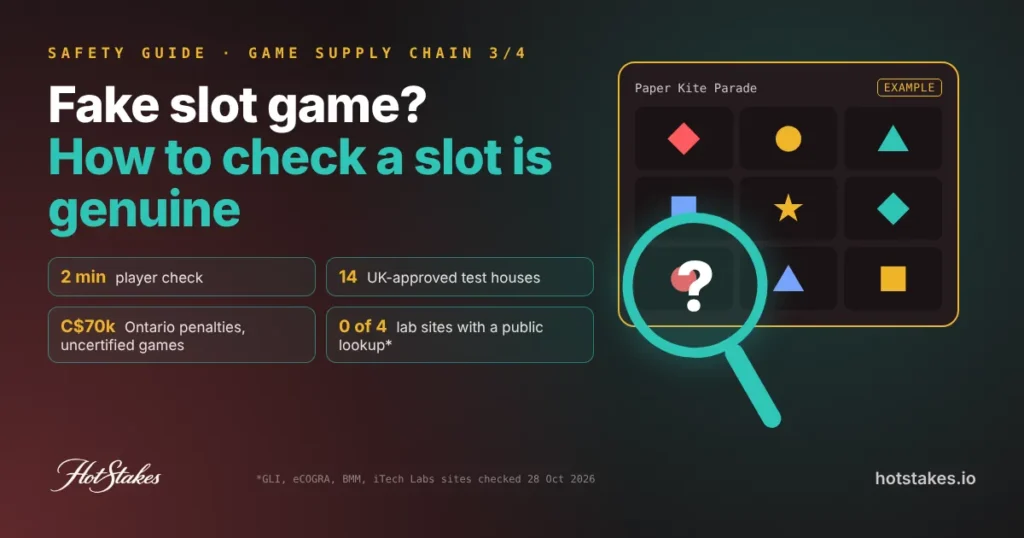 Next story →Fake Slot Games: How to Check a Slot Is Genuine

Start the discussion