

Curaçao Licence Reform Explained: What the LOK Changed
Curaçao's licence reform explained: the LOK ended sub-licences, the CGA granted 604 provisional licences and what it means for players in Asia.
In this article
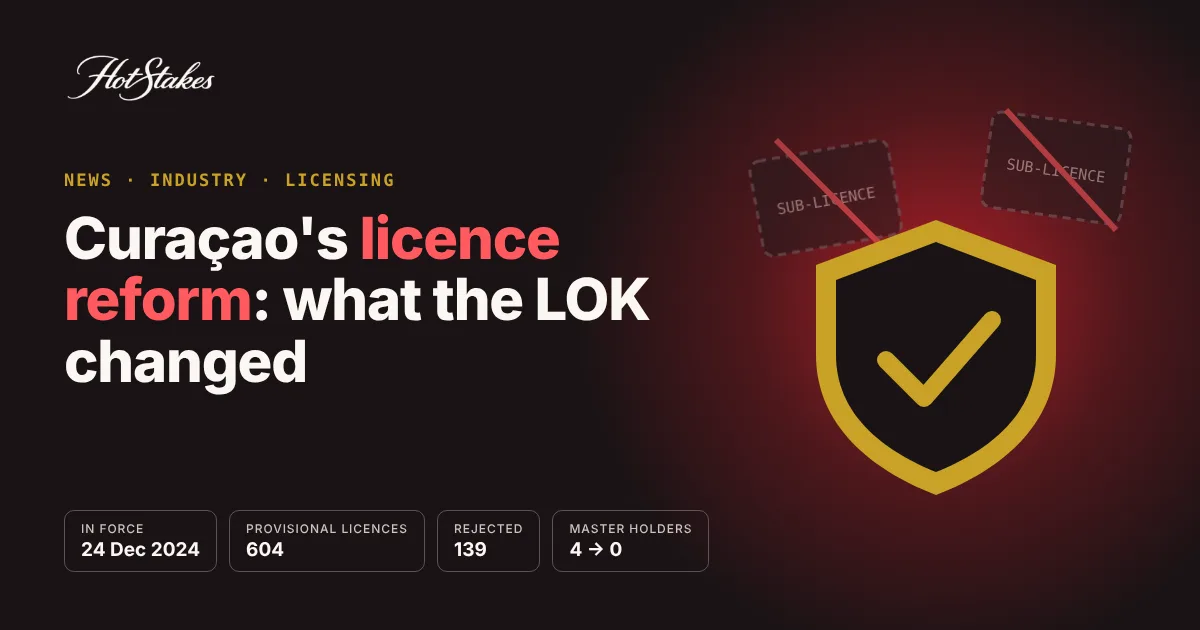
For nearly three decades, a large part of the world’s offshore online gambling ran on Curaçao “sub-licences” issued by four private master-licence holders. Since 24 December 2024, Curaçao’s new gaming law, the LOK, has abolished that system: every operator now needs its own licence directly from the Curaçao Gaming Authority (CGA), with real fees, a local office and AML duties. This guide covers what changed, the numbers and what it means for players in Asia.
The old system: four masters, hundreds of sites
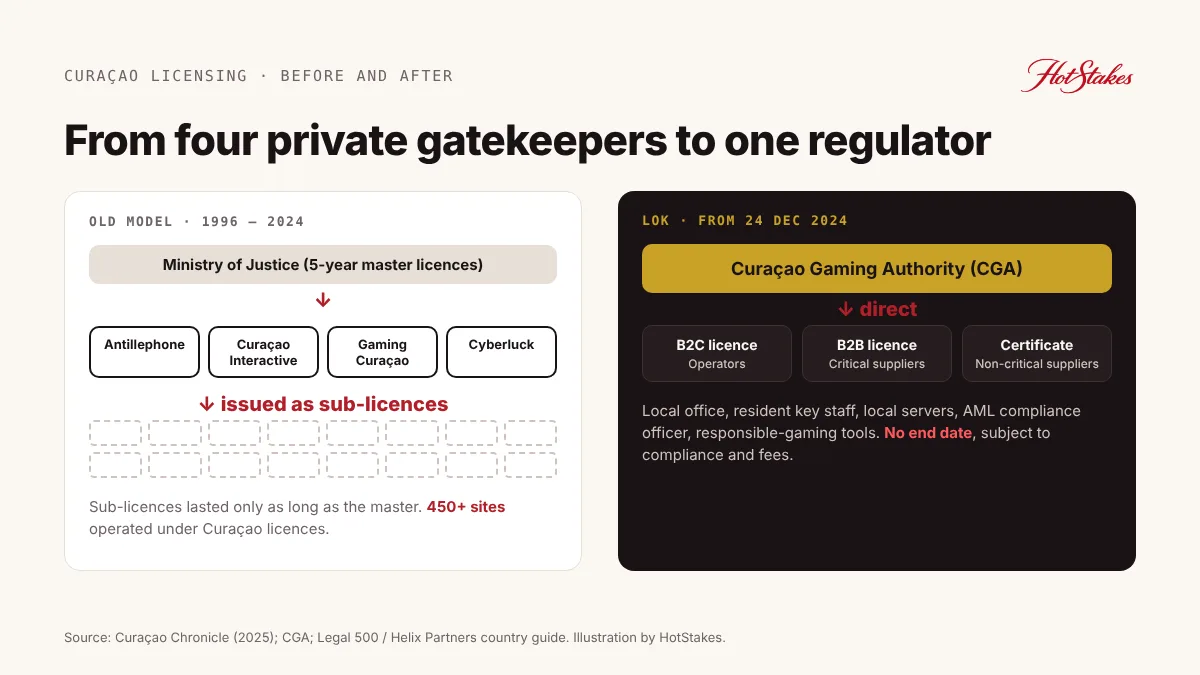
Curaçao began regulating online gaming with a National Offshore Gambling Decree in 1993 and started issuing licences in 1996. Under the old model, the Ministry of Justice issued five-year master licences, and in practice only four companies held one. Each master holder could then issue sub-licences, which lasted as long as its own master licence.
Those four masters were Antillephone, Curaçao Interactive Licensing, Gaming Curaçao and Cyberluck (Curaçao eGaming). Curaçao Chronicle reported that critics accused them of weak enforcement and poor accountability. It cited one case in which Cyberluck refused to pay a Turkish player about 620,000 lira. Courts later held Cyberluck and Trigonon Group jointly liable, and Cyberluck went bankrupt. The same report said more than 450 online casinos and betting sites operated under Curaçao licences.
The old structure is now being shut down. Gaming Curaçao’s own website now shows only a notice saying it “has ceased operations” as of 18 August 2024, that its sub-licences expired that day, and that showing its seal as active would be treated as fraudulent.
Takeaway: under the old system, a “Curaçao licence” usually meant a sub-licence from a private company, not a direct approval from a state regulator.
What the LOK changed
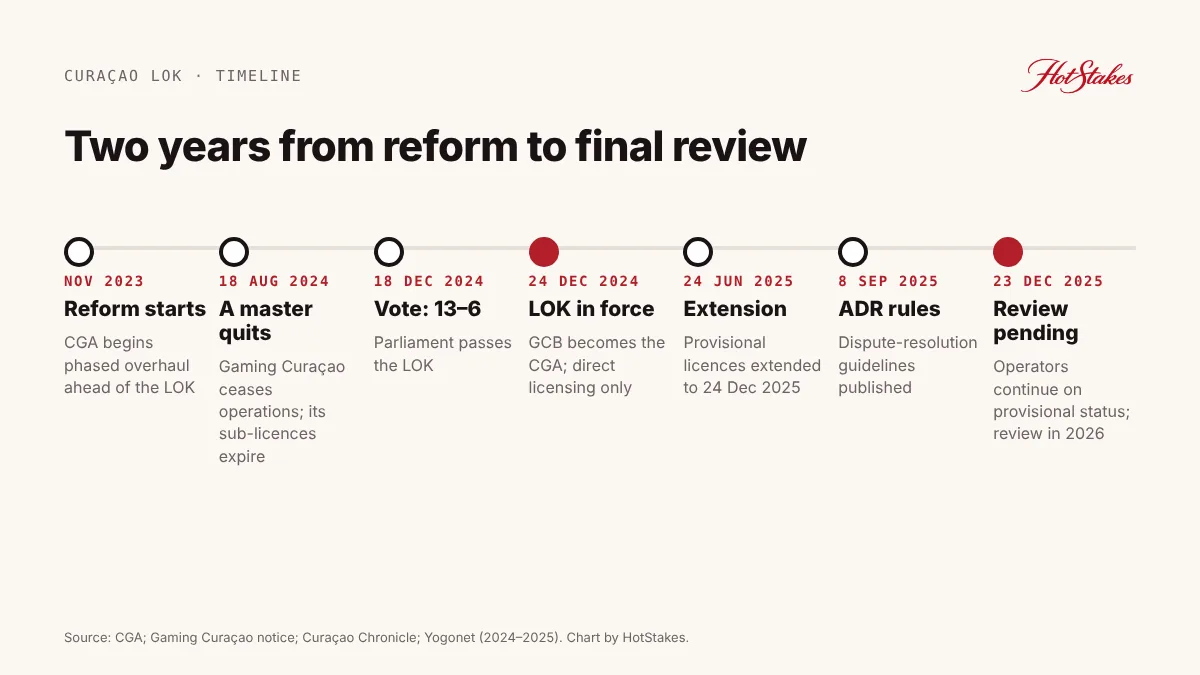
The Landsverordening op de kansspelen (National Ordinance on Games of Chance, or LOK) came into effect on 24 December 2024, according to the CGA. The CGA had been carrying out a phased reform since November 2023 to prepare for it. Under the LOK, the old Gaming Control Board became the Curaçao Gaming Authority, an independent public body with powers to license, supervise and enforce.
A Legal 500 country guide by Helix Partners sets out the main changes:
- Direct licensing. B2C licences cover operators, and B2B licences cover suppliers of software and critical services. Non-critical suppliers can get a cheaper certificate instead. Licences have no end date but depend on continued compliance and fee payment.
- Local presence. Licensees need a registered office in Curaçao, key roles held by local residents, local servers and accounts kept on the island. Owners, directors and key staff must pass fit-and-proper checks.
- AML duties. Customer due diligence applies from NAf 4,000 (about €1,926). Unusual transactions are reported to the Financial Intelligence Unit (FIU), and records must be kept for at least five years. Licensees also need an independent compliance officer and annual audits.
- Player protection. Operators must provide age checks, deposit limits, cooling-off periods from 24 hours to 3 months, self-exclusion from 1 to 10 years or permanently, and a responsible gaming officer. Credit-based betting is banned.
- Penalties. Deliberate violations can lead to up to four years in prison. Administrative powers include shutting down sites and seizing servers.
| Old model (to 2024) | LOK (from 24 Dec 2024) | |
|---|---|---|
| Who grants the licence | One of four private master holders | Curaçao Gaming Authority, directly |
| Licence types | Master and sub-licence | B2C operator, B2B supplier, certificate |
| Duration | Master: 5 years; sub-licence tied to master | No end date, subject to compliance |
| Annual cost (B2C) | Paid to the master holder | €22,960 to CGA + €24,490 to the Treasury |
Takeaway: the LOK turns Curaçao from a place to buy a licence into a regulator that sets conditions and can enforce them.
Why Curaçao did it
The reform was pushed by outside pressure as well as local politics. In November 2024, Curaçao Chronicle reported that parliament was fast-tracking the LOK during a mutual evaluation by the Caribbean Financial Action Task Force (CFATF). That evaluation tests a country against international anti-money-laundering standards. In the Dutch parliament, MP Michiel van Nispen led a motion asking the Netherlands to press Curaçao to tighten its rules.
On 18 December 2024, Curaçao’s parliament passed the LOK by 13 votes to 6. Finance Minister Javier Silvania projected at least 40 million guilders a year in licensing revenue. Critics, including the Dutch government, doubted whether that money would arrive.
Takeaway: anti-money-laundering scrutiny was the main driver. Curaçao needed to show international evaluators that it had a real gaming regulator.
Year one in numbers
On the law’s first anniversary, the CGA published an overview through Curaçao Chronicle. As of 17 December 2025, it had granted 604 provisional licences (551 B2C and 53 B2B) and rejected 139 applications. It had finished processing every application from the old regime and received 37 new applications under the LOK. It had also collected about XCG 40 million, shared between the government and the CGA.
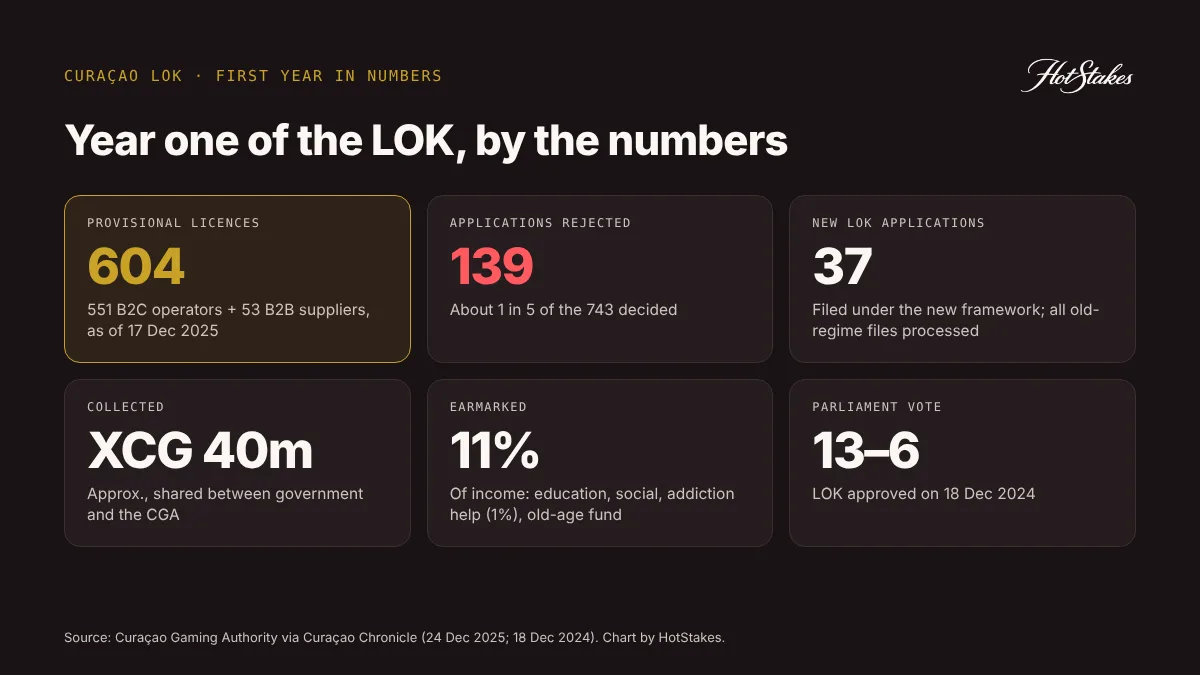
Each year, 11% of that income is set aside: 3% for education, culture and sport, 2% for social development, 1% for foundations that fight gambling addiction and 5% for the old-age fund. The year also brought new rules, in this order:
- 9 January 2025: AML/CFT policy and compliance officer requirements take effect.
- 1 March 2025: the CGA sets up an Enforcement Unit.
- 17 April 2025: the Responsible Gaming Policy is published.
- 23 May 2025: certification opens for gaming test houses. Two were certified by year end.
- 18 June 2025: an updated player Complaints Policy is issued.
- 8 September 2025: guidelines for alternative dispute resolution (ADR) are published, with six ADR provider applications under review.
Takeaway: the CGA’s first year was mostly about clearing a backlog. About one application in five was rejected (139 out of 743 decided), and every licence granted so far is still provisional.
The provisional-licence problem
Under the LOK, the CGA can issue a provisional licence for six months and extend it once for another six. The first provisional licences were due to expire on 24 June 2025, and the CGA extended them to 24 December 2025. It told operators they should be “compliant or show significant progress in relation to their issued checklists.”
When the second deadline arrived, the CGA said it had not yet decided which operators would get indefinite licences, because it was still checking the large volume of documents submitted. Operators could keep working under their provisional status until they received a final decision. The CGA’s anniversary statement said it would review these licences in 2026 and admitted that “not all aspects of the LOK are fully embedded yet.”
The process has also drawn political attacks. Yogonet reported that opposition politician Luigi Faneyte filed a complaint with the attorney general alleging corruption and licences issued without a legal basis. The CGA strongly denied the allegations.
Takeaway: a Curaçao licence today is a real CGA licence, but most are still provisional, and the final review could remove some operators.
What it means for players in Asia
- Check the CGA register, not the logo. The CGA publishes a public licence register with PDF lists of online licensees, certificate holders and an enforcement register. The CGA itself warns that these lists may not reflect current validity. A seal from Gaming Curaçao or another old master is not proof of a licence, and Gaming Curaçao itself says showing its seal as active is fraudulent. Fake licence badges are also a common sign of fake gambling apps. Our licence-checking guide walks through this.
- Complaints have a route now. The LOK requires a complaints policy and ADR. Before, a dispute could end with a private master holder that later went bankrupt.
- Expect stricter KYC. Customer due-diligence thresholds and transaction reporting to the FIU are now licence conditions. That explains many withdrawal holds, as our guide to why withdrawals get held shows.
- A Curaçao licence is permission from Curaçao only. It is not permission from Kuala Lumpur, Bangkok or Jakarta. Local law still applies where you live. The Philippines, for example, has gone the other way and banned offshore gaming outright.
Takeaway: the reform gives players in Asia a regulator they can check and complain to, but only if they check the register themselves.
FAQ
Are old Curaçao sub-licences still valid?
No. The LOK replaced the master and sub-licence model with direct CGA licensing, and former master holders such as Gaming Curaçao have stopped operating.
How much does a Curaçao licence cost now?
According to the Legal 500 guide, a B2C licence costs a base application fee of €4,592 plus €22,960 a year to the CGA and €24,490 a year to the Treasury. These fees can be adjusted for inflation.
How many operators hold a CGA licence?
As of 17 December 2025, the CGA had granted 551 B2C and 53 B2B provisional licences, and the final review is continuing in 2026.
Does a Curaçao licence protect my deposits?
It gives you a regulator and a complaints process. It does not guarantee payouts, so check the register and the operator’s terms before you deposit.
HotStakes is an independent directory. Some links on this site are affiliate links; we may earn a commission at no cost to you, and it never changes our rankings. Gambling involves risk — only play with money you can afford to lose, and if it stops being fun, seek help.
Looking for operators checked by Cyndia’s team? Browse vetted operators by currency.
 Next story →Philippines POGO Ban Explained: Timeline and Numbers

Start the discussion