

Losses Disguised as Wins: How Slots Keep You Spinning
A slot flashes WIN 0.40 on a 1.00 bet. What research says about losses disguised as wins, the payline maths, and the rules now banning them.
In this article
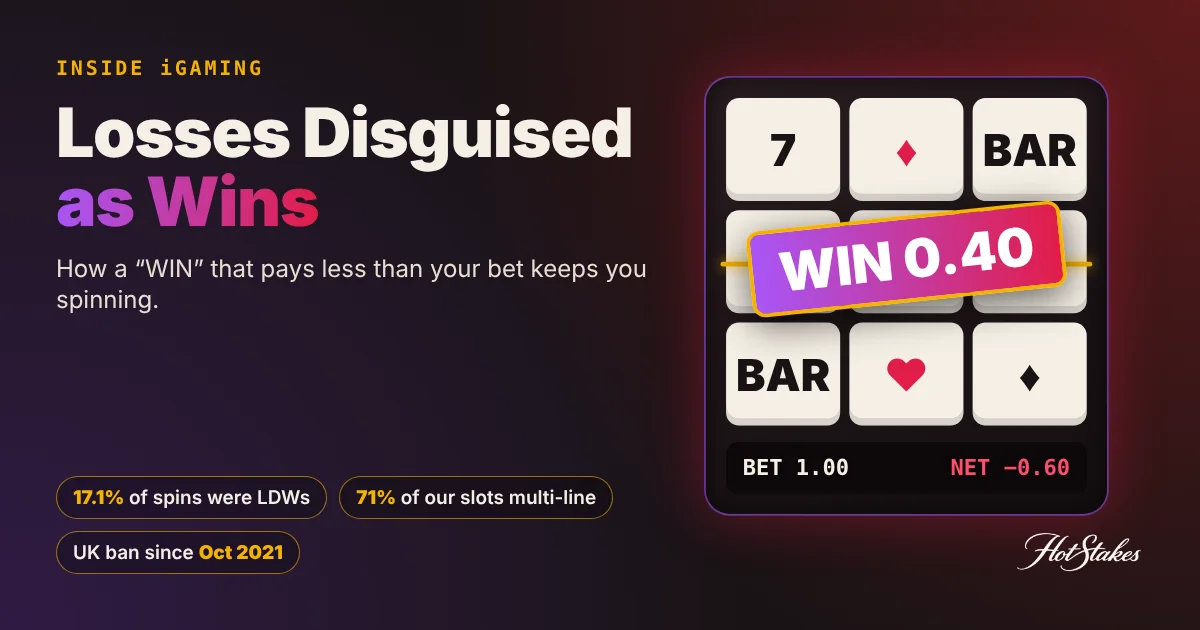
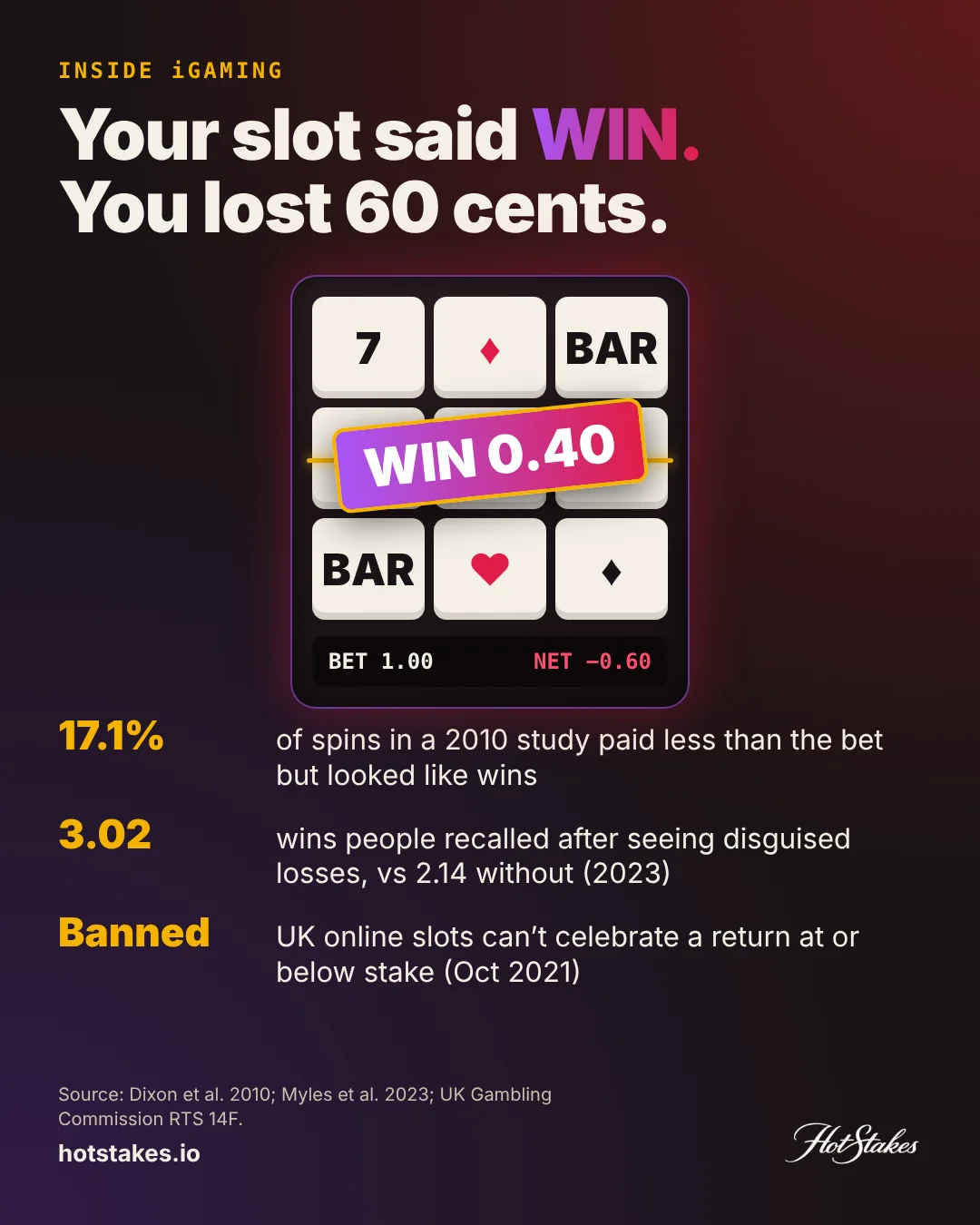
You bet 1.00. The reels stop, coins rain, a banner flashes WIN 0.40. You just lost 60 cents. A loss disguised as a win is any spin that pays back less than you staked but is presented like a win, and peer-reviewed research shows players’ bodies and memories often count it as one. Below: what the studies measured, the simple maths that makes multi-line slots produce more of these spins, what our data says about how common those games are, and which regulators have now banned the fake celebration.
What is a loss disguised as a win?
The term comes from a 2010 study by Mike Dixon and colleagues at the University of Waterloo. They used it for multi-line slot outcomes where the amount “won” is smaller than the total bet.
It only works because modern slots split one bet across many lines. Any single line can pay. The machine then shows that line’s payout as a win, even when the spin as a whole lost money.
Every spin lands in one of three boxes:
- Real win: you get back more than you staked (bet 1.00, get 2.50).
- Loss disguised as a win (LDW): something pays, but less than you staked (bet 1.00, get 0.40). Net result: minus 0.60.
- Plain loss: nothing pays (bet 1.00, get 0). Net result: minus 1.00.
The middle box is the problem. It loses money, but on many games it looks and sounds like the first box.
Takeaway: judge a spin by your balance, never by the animation.
What the research found
This is not a hunch from angry forums. It has been measured with sweat sensors, think-aloud sessions, brain scans and a sample of almost a thousand people.
Your body reacts as if you won
In the original study (Dixon et al., 2010, Addiction), novice players bet 15 lines on a real multi-line video slot while researchers tracked skin conductance, a standard measure of arousal.
- LDWs made up 17.1% of spins. Real wins were only 15.6%.
- Arousal after LDWs was not significantly different from arousal after real wins.
- Both were higher than after plain losses.
In other words, the game delivered more “win-like” moments that lost money than moments that paid.
Takeaway: the excitement you feel on a small payout is real, even when the money isn’t.
Your memory counts them as wins
A follow-up study, Jensen et al. (2013, International Gambling Studies), had 47 novices play 200 spins. Most of them verbally called LDWs “wins”, and players exposed to more LDWs gave higher estimates of how often they had won.
The biggest test came in 2023. Myles et al. (Addictive Behaviors Reports) showed 940 people short videos of simulated online slot play. Both videos had exactly two real wins. One also had three LDWs.
- Viewers of the LDW video estimated 3.02 wins on average.
- Viewers of the clean video estimated 2.14.
- The effect held for low-risk and higher-risk gamblers alike.
Takeaway: experience doesn’t make you immune. Your “I’ve been winning a lot” feeling is the least reliable number you have.
More lines, more “wins”, same payback
Harrigan, Dixon and colleagues (2011, Journal of Gambling Issues) asked what happens when you buy more lines. On one game, playing 20 lines instead of one lifted the share of spins that paid something from 15.4% to 47.88%. The payback percentage was identical in both conditions.
In their simplified five-line model, half of all spins paid something, but 13 of those 18 hits were net losses. They also logged a real 40-cent spin across 20 lines that “won” 36 cents and was still celebrated with sound and animation.
Takeaway: more lines change how often you are rewarded, not how much you keep.
Near-misses: losing that feels close
Near-misses are the cousin of LDWs: two jackpot symbols and the third one just above the line. In a brain-imaging study, Clark et al. (2009, Neuron) found that “near-misses were experienced as less pleasant, but increased desire to play”.
Near-misses also activated brain regions that respond to real wins. The effect showed up only when players felt they had some control over the gamble.
Takeaway: “so close” is not a signal that a win is coming. Each spin is independent.
| Study | Who and what | Key finding |
|---|---|---|
| Dixon et al. 2010 | Novices, 15-line video slot, skin conductance | LDWs (17.1% of spins) outnumbered real wins (15.6%) and aroused players like wins |
| Harrigan et al. 2011 | Same game at 1 vs 20 lines | Paying spins rose from 15.4% to 47.88%; payback unchanged |
| Jensen et al. 2013 | 47 novices, 200 spins, think-aloud | Most called LDWs wins; more LDWs led to higher win estimates |
| Myles et al. 2023 | 940 online participants, simulated slot videos | LDWs pushed estimated wins from 2.14 to 3.02, including in higher-risk players |
| Clark et al. 2009 | Brain imaging, simulated slot | Near-misses felt worse but raised the urge to keep playing |
Takeaway: five studies, several methods, one pattern. Small fake wins and near-misses keep people spinning.
The maths: why more lines means more disguised losses
You don’t need a psychology lab to see why multi-line games produce LDWs. You need one division.
Split a 1.00 bet across 20 lines and each line carries 0.05. A modest line pay of 8x returns 0.40. That is a “win” on screen and a 0.60 loss in your wallet. On a single-line game, the same 8x pays 8.00 and is a real win.
To show the effect at scale, we built a deliberately simple model. This is a pure maths illustration by HotStakes, not any real game: each line independently has a 2% chance to pay 8x its line bet, 0.5% to pay 40x and 0.05% to pay 1,200x. That gives 96% RTP no matter how many lines you play.
Real games are more complex; their lines share the same symbols, so they are not independent.
- 1 line: 2.6% of spins show a win. None are disguised losses.
- 10 lines: 22.8% of spins show a win. 15.9% of spins are disguised losses.
- 20 lines: 40.3% of spins show a win. 29.3% of spins are disguised losses, about 7 in every 10 “wins”.
- 50 lines: 72.5% of spins show a win. 62.6% of spins are disguised losses, about 86% of all “wins”.
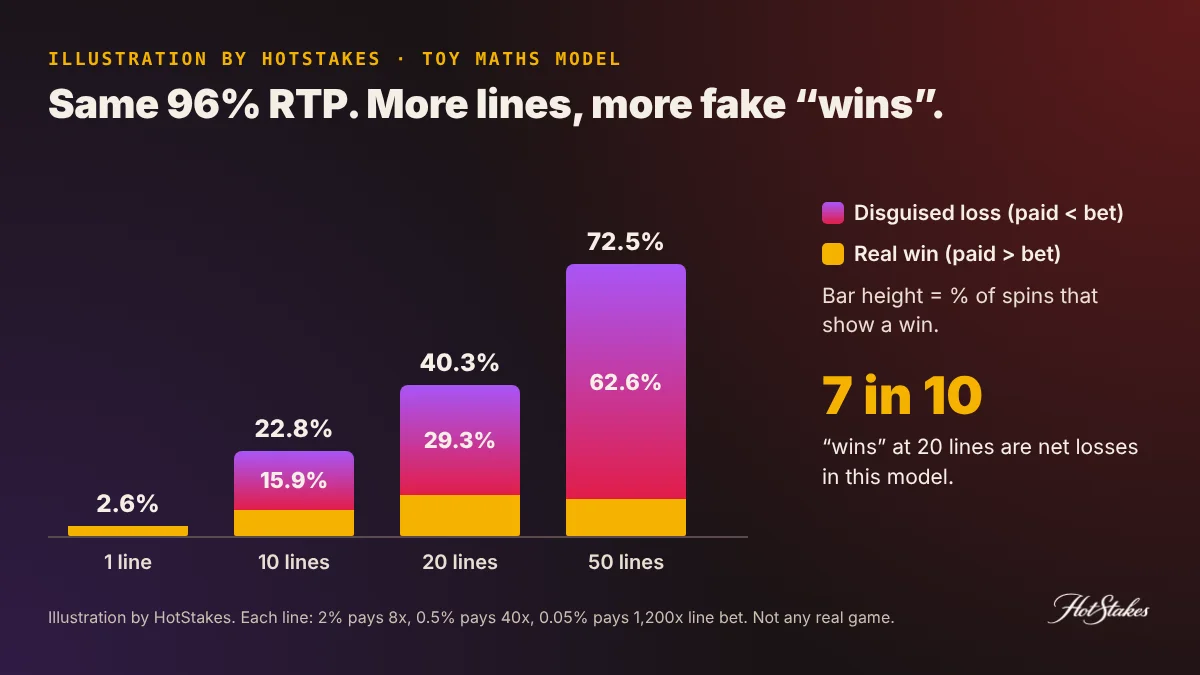
The expected return never moves. What moves is how often the game gets to celebrate. That is the gap between RTP and volatility: same long-run price, very different feel per spin.
Takeaway: more lines turn the same losing maths into a stream of small “wins”.
What our data shows: 7 in 10 slots are multi-line or “ways” games
We classified the “lines” field for all 424 slots in the Hotdog Gaming catalogue in our directory data (checked 20 Oct 2026). Here is the split:
- 172 slots (41%) list 10 or more fixed paylines. Twenty lines is the single most common setting (61 games).
- 130 slots (31%) are “ways” games, which pay matching symbols on adjacent reels in any position. 82 of them list 1,000+ ways, and the highest listed is 46,656.
- 43 slots (10%) have 2 to 9 lines, and 9 use cluster or pay-anywhere mechanics.
- Only 14 slots (3%) are single-line.
- The other 56 list a base bet, a cascade mechanic or nothing usable, so we left them unclassified.
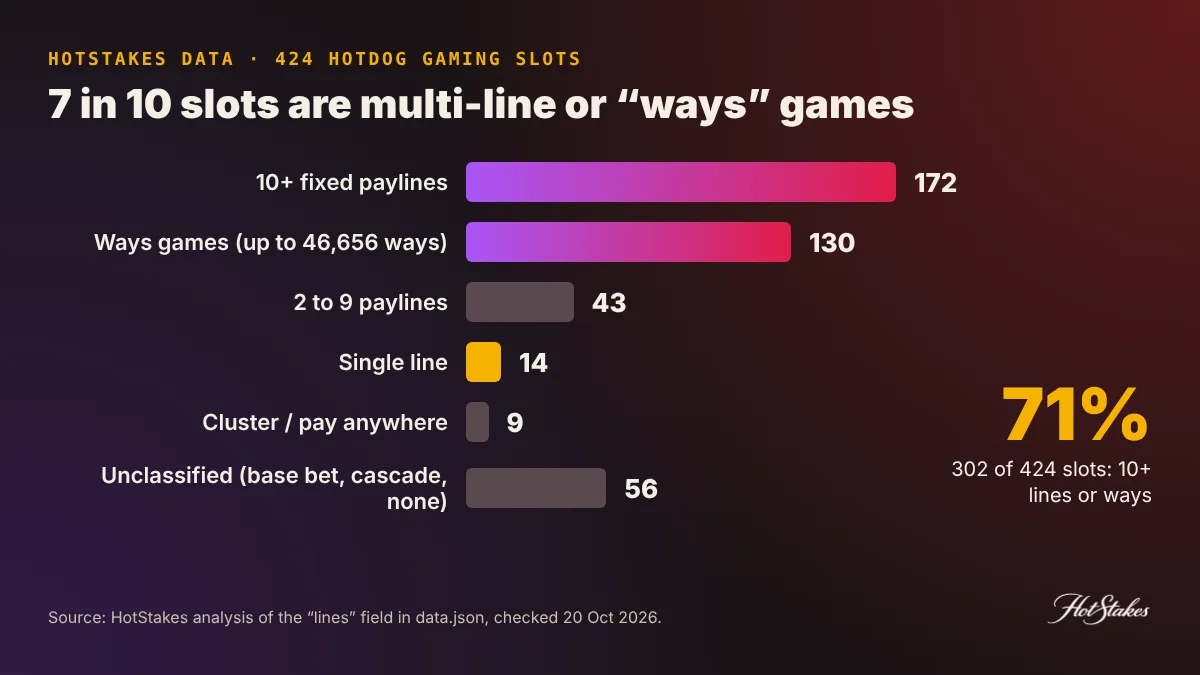
Together, 302 of 424 slots (71%) are built in the multi-line or ways format where, mathematically, a payout below the stake is common.
What we are not saying: we did not test how any of these games present sub-stake payouts, and we make no claim about any specific title. The point is structural. The format is the norm, so the presentation rules matter.
Takeaway: on most modern slots, small payouts below your bet are a normal outcome, not a rare one.
What regulators did about it
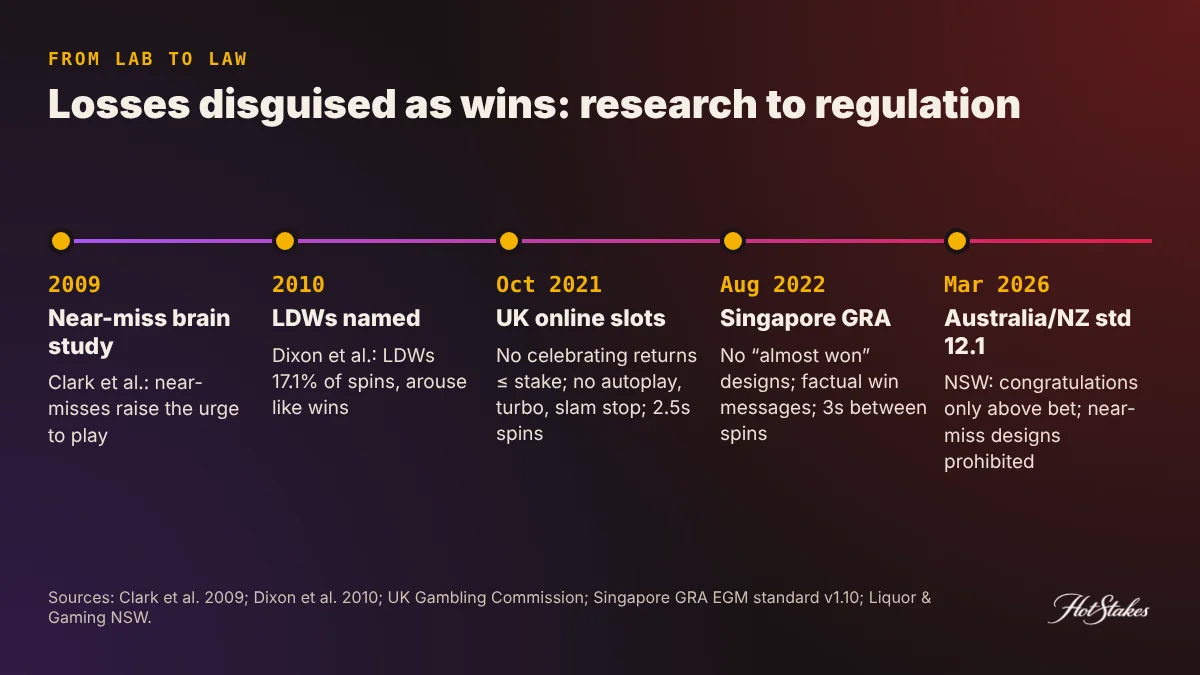
Since 2021, regulators in Britain, Singapore and Australia have written rules aimed at exactly these tricks.
- UK, from 31 October 2021: online slots must not celebrate a return “less than or equal to the total stake gambled”. The payout itself is still allowed; only the celebration went. The same package banned autoplay on slots, banned turbo, quick spin and slam stops, set a 2.5-second minimum per spin and required the player’s net position on screen.
- Singapore, from 15 August 2022: the GRA’s technical standard for casino gaming machines bans games designed to make players feel they “almost won a prize”. When the player is net down, win messages must be factual, and spins must start at least 3 seconds apart.
- Australia/New Zealand, version 12.1 of the national standard: the Gaming Machine National Standard allows congratulatory sounds and animations only when the prize beats the bet, and prohibits programmed near-miss designs. NSW says most of these reforms took effect there on 12 March 2026, with some features given a 12-month transition. NSW sums up the package as including a prohibition on “loss-disguised-as-wins”.
- Victoria: the state government announced in November 2024 that machines approved after 1 December 2025 must take at least 3 seconds per game, up from 2.14 seconds.
| Rule | UK online slots (2021) | Singapore casino EGMs (2022) | Australia/NZ standard 12.1 |
|---|---|---|---|
| Celebrating a payout at or below stake | Banned | Win messages must be factual when net down | Congratulations only when prize beats bet |
| Near-miss designs | Not covered in this check | Banned (“almost won”) | Programmed near-miss designs prohibited |
| Minimum time per spin | 2.5 seconds | 3 seconds | Victoria: 3 seconds for new machines |
| Speed-up buttons / autoplay | Turbo, slam stop and autoplay banned | Not covered in this check | Not covered in this check |
Two limits are worth knowing. These rules cover only games under those regulators. And an offshore site licensed elsewhere may follow none of them, which is one more reason to understand how casinos keep players engaged before you trust a “win” sound.
Takeaway: regulators now treat the fake celebration as a harm, not a feature. Most of the world’s slots still sit outside those rules.
How to see through it next session
You can’t switch off the animation on most games. You can switch off its effect on you.
- Watch the balance, not the banner. Note your balance before you start and check it every few minutes.
- Compare every “win” to your total bet. If the payout is smaller, say “loss” in your head. It sounds silly. It works.
- Know the price. Run the game’s RTP through our RTP calculator to see the expected cost per hour, and read why the house always wins.
- Set a time and money limit before the first spin, and stop when either runs out, whatever the screen says.
- Distrust “so close”. A near-miss carries no information about the next spin.
Takeaway: the only honest scoreboard is your balance against what you started with.
If it has stopped being fun
If you find yourself chasing the next small “win”, that pattern is worth taking seriously. Our Real Talk guide on whether gambling is bad for you covers the recognised warning signs, and more honest pieces live in Real Talk. Free, confidential help:
- Singapore: National Council on Problem Gambling helpline 1800-6-668-668
- Hong Kong: gambling counselling hotline 1834 633
- Elsewhere: contact your local health service or a doctor.
Takeaway: asking for help early is cheaper than any session.
FAQ
What does “losses disguised as wins” mean?
It means a slot spin that pays back less than your total bet but is presented like a win, with a banner, sound or animation. Example: bet 1.00, get 0.40 back, see “WIN”. You lost 0.60.
Are losses disguised as wins illegal?
It depends where the game is regulated. UK-licensed online slots may not celebrate a return at or below the stake since 31 October 2021, though the payout itself is allowed. The Australia/New Zealand national standard 12.1 limits congratulations to prizes above the bet, and Singapore requires factual win messages when the player is net down.
Why do multi-line slots produce more losses disguised as wins?
Because your bet is split across many lines. A line can pay a decent multiple of its own small share and still return less than the whole bet. In our labelled toy model with the same 96% RTP, disguised losses went from 0% of spins at one line to 29.3% at 20 lines.
Do experienced players fall for them too?
Yes. In a 2023 study of 940 people, those who watched slot play with disguised losses overestimated their wins, and the effect held for low-risk and higher-risk gamblers.
Is a near-miss a sign a win is coming?
No. Each spin is independent. Research found near-misses feel worse than clear misses but still raise the urge to keep playing, which is why some regulators now ban designs built to create them.
Who else profits from these sessions? Read how gambling affiliates make money.
HotStakes is an independent directory. Some links on this site are affiliate links; we may earn a commission at no cost to you, and it never changes our rankings. Gambling involves risk — only play with money you can afford to lose, and if it stops being fun, seek help. This article is general information, not legal advice.
 Next story →How to Block Gambling: Self-Exclusion, Bank & App Blocks


Start the discussion