

Is Online Gambling More Addictive? What the Data Shows
Is online gambling more addictive than a casino? UK survey data by game, our speed maths (RM58 vs RM1 an hour) and the friction that helps.
In this article
- Short answer: it’s the game and the speed, not just the screen
- Speed: how many bets fit into one hour
- Four things online adds that a casino doesn’t
- The honest balance: most people who gamble online are fine
- Quick self-check (from the PGSI)
- Friction you can add today
- Where to get help in Asia (verified 1 Nov 2026)
- FAQ
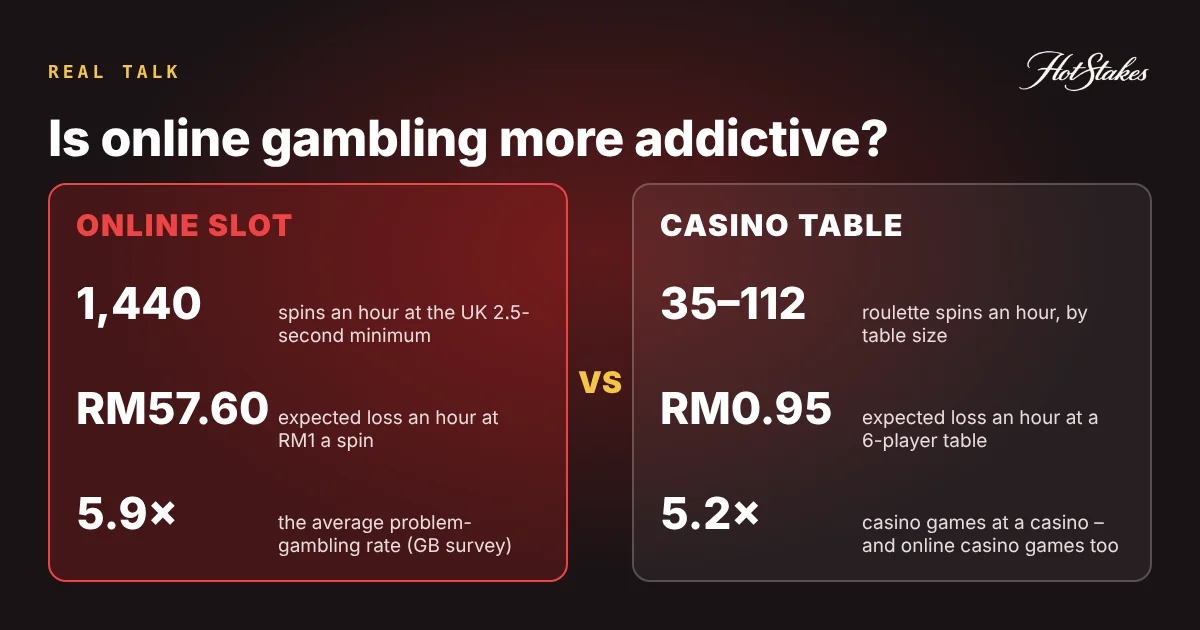
Online gambling is not automatically more addictive than a casino. The risk follows the game and its speed. In Great Britain’s national survey, people who played online casino games had exactly the same problem-gambling ratio as people who played casino games at a casino. Online slots scored higher than slot machines in person, though. What makes online play riskier is a fast game you can reach from your phone at any hour, not the internet itself. Below: the survey data by game, our own speed-and-cost maths, a quick self-check and the friction that helps.
Short answer: it’s the game and the speed, not just the screen
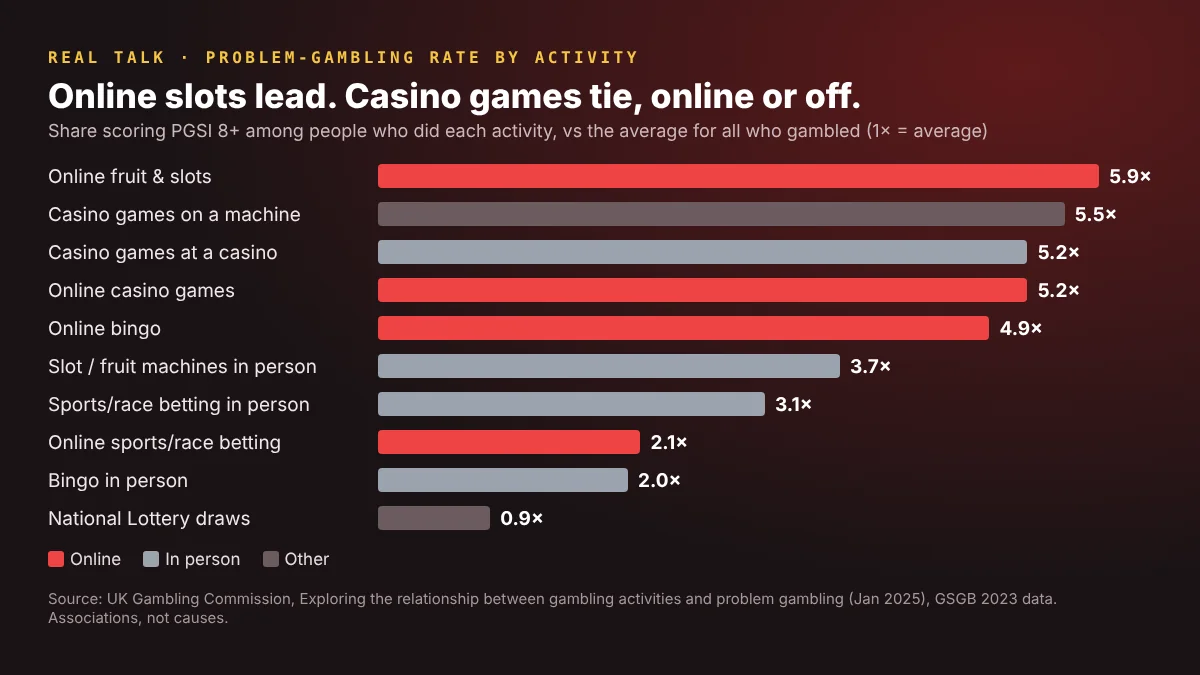
The best product-by-product data we found comes from the UK Gambling Commission’s January 2025 analysis of the Gambling Survey for Great Britain (GSGB, 2023 data). It compares each activity with the average for everyone who gambled in the past year. The measure is the share of people scoring 8 or more on the Problem Gambling Severity Index (PGSI), the questionnaire national surveys use to spot problem gambling.
A ratio of 1 means average. A ratio of 5 means five times the average. Here are the pairs that matter for this question:
| Activity (past 12 months) | Online | In person |
|---|---|---|
| Casino games | 5.2× | 5.2× (at a casino) |
| Slots / fruit machines | 5.9× | 3.7× |
| Betting on sports or races | 2.1× | 3.1× |
| Bingo | 4.9× | 2.0× |
| National Lottery draws (for comparison) | 0.9× | |
Two patterns stand out. Online is not uniformly worse: in-person sports betting scored higher than online sports betting. And the top of the list is crowded with what the same report calls “faster, continuous gambling formats (casino, slots, online instant wins)”.
What this data can’t tell you
These are associations, not proof that a game causes harm. The Commission says so directly.
- Heavy gamblers try everything. People who gamble a lot tend to play more products. When the Commission adjusted for how many activities people did and how often, many of the ratios shrank. Casino games and slots, online and in person, stayed significant.
- It’s one country, one year. We did not find an Asian survey that splits problem-gambling rates by online and in-person product in the same way.
- The survey may run high. The Commission warns its method risks overstating the true level of harm.
Takeaway: Fast casino-style games carry the highest risk wherever they’re played. Online slots stand out because they combine speed with easy access.
Speed: how many bets fit into one hour
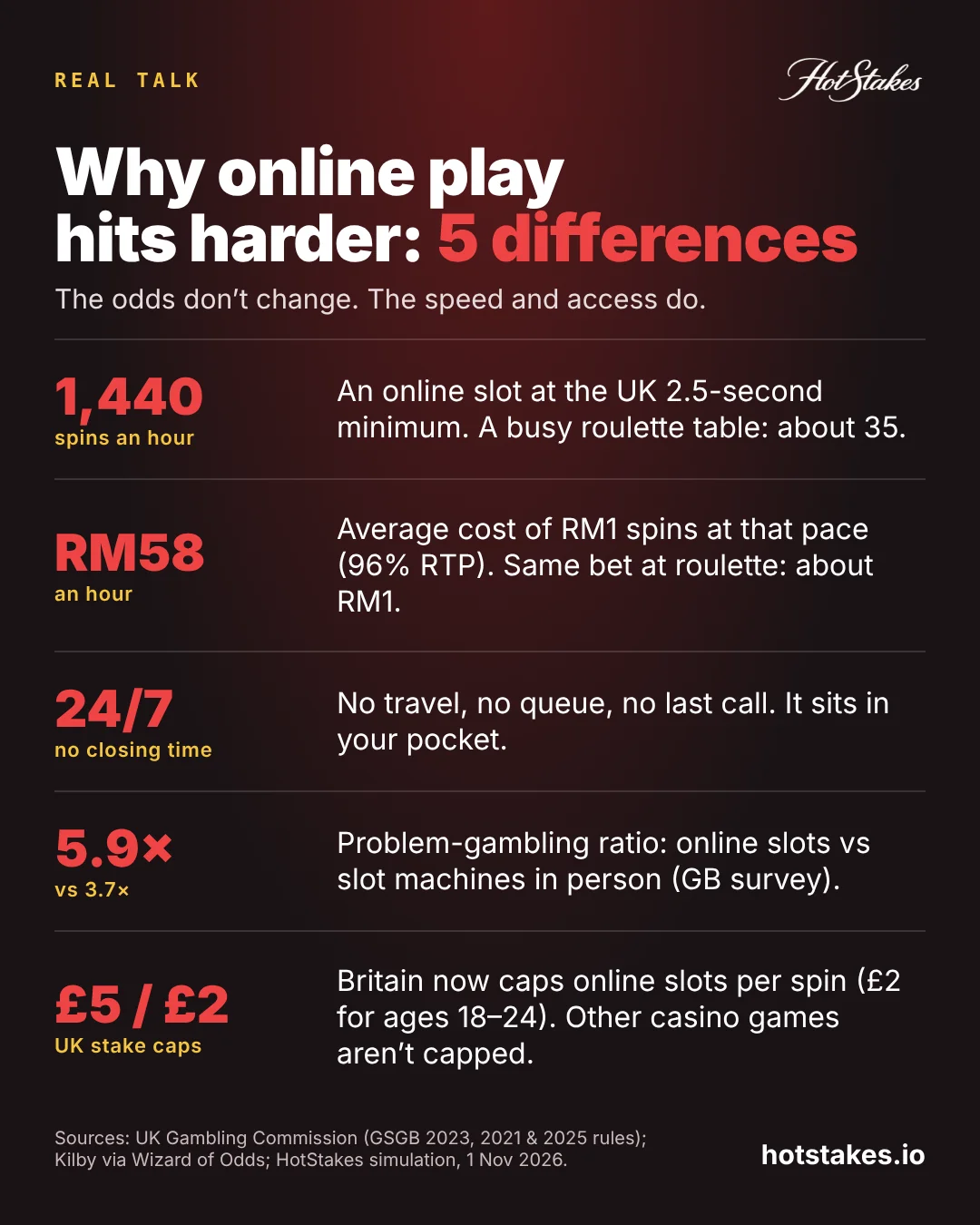
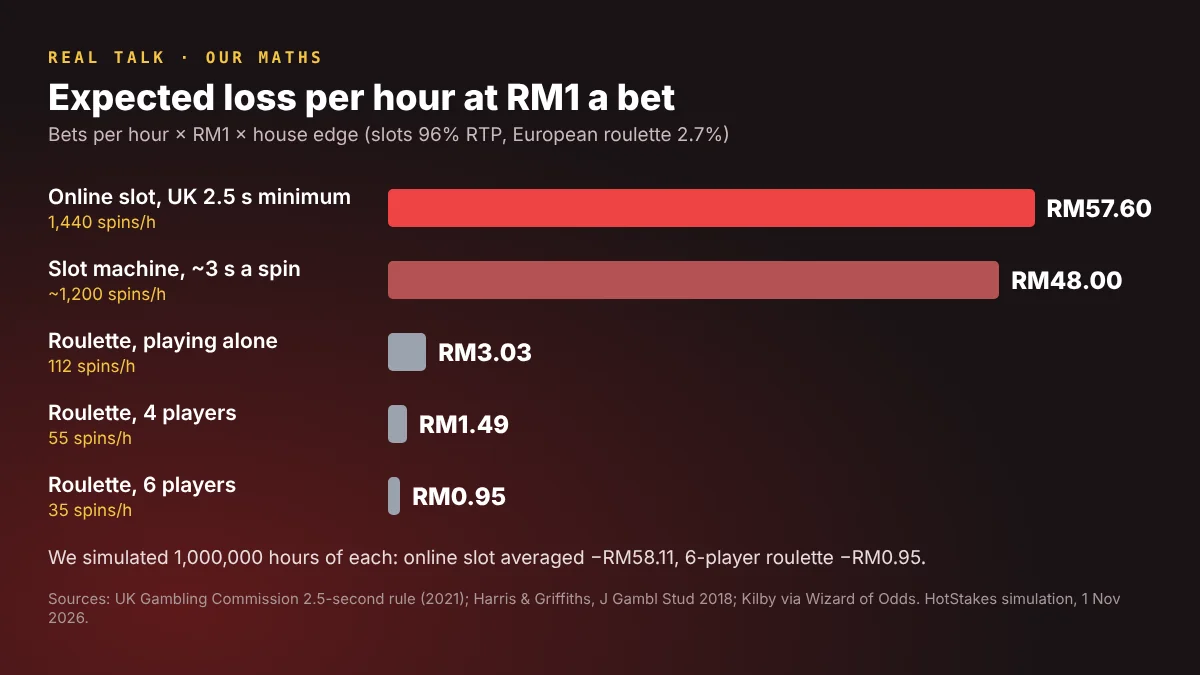
Speed is the easiest difference to measure, so we did the maths (1 Nov 2026). For online slots we used Great Britain’s legal floor. Since 2021, the Commission has banned “slot spin speeds faster than 2.5 seconds”. That’s up to 1,440 spins an hour. The rule is British. Many sites that Asian players use don’t have to follow it, so treat 1,440 as a floor for fast play, not a ceiling.
For land-based machines, a 2018 review in the Journal of Gambling Studies notes electronic gaming machines commonly run at about one event every three seconds, or roughly 1,200 an hour. For roulette we used casino-operations figures from Jim Kilby, as published by the Wizard of Odds: 112 spins an hour with one player, 55 with four and 35 with six.
Then we priced one hour at RM1 a bet. For slots we assumed a 96% RTP. For European roulette, the house edge is 2.7%.
| Game | Bets per hour | Expected loss per hour at RM1 | Our simulation (mean of 1,000,000 hours) |
|---|---|---|---|
| Online slot at the UK 2.5-second floor (96% RTP) | 1,440 | RM57.60 | −RM58.11 |
| Slot machine, one spin every ~3 seconds (96% RTP) | ~1,200 | RM48.00 | −RM47.79 |
| Roulette, playing alone | 112 | RM3.03 | −RM3.03 |
| Roulette, 4 players | 55 | RM1.49 | −RM1.49 |
| Roulette, 6 players | 35 | RM0.95 | −RM0.95 |
The expected loss is simple: bets per hour × stake × house edge. We also simulated 1,000,000 hours of each game to check it. For the slots we used a 96% paytable we built for illustration. The averages matched the formula.
At the online-slot pace, the simulated player finished an hour ahead about 24% of the time. At a full roulette table it was about 44%. But the table player lost about RM1 on average, while the slot player lost about RM58.
Same RM1 stake, roughly 60 times the hourly cost. Notice that the land-based slot machine sits close to the online slot. The big gap is slots versus table games. Online adds access on top of that.
Why speed matters for addiction, not just cost
The same Harris and Griffiths review found that faster games tend to encourage more wagers and longer play. It also found they appeal most to people who already have a problem, who find it harder to stop. The authors call the evidence “in its relative infancy”, so treat this as a strong pattern rather than a settled law.
Fast games also mean more near-misses and more losses disguised as wins per hour. More “almost” moments means more chances for the urge to keep going.
Takeaway: More bets per hour means a bigger expected loss and less time to think between decisions. The house edge is the same maths at any speed. Speed just runs it faster.
Four things online adds that a casino doesn’t
A 2015 review in Current Addiction Reports by gambling researcher Sally Gainsbury pulled the research together. Her review points to features of online play that can raise risk for some people:
- It never closes. No travel, no closing time, no queue. You can play for long, unbroken stretches from bed.
- Money feels less real. Electronic payments are linked to higher spending, especially among problem gamblers. A tap is easier to repeat than handing over cash.
- Nobody sees you. A casino trip is hard to hide from family. A phone isn’t. A small interview study of 30 gamblers by LaTour and Cotte, published in 2009, found online players described gambling more often and fitting it into daily routines.
- Fewer natural stopping cues. Fast bets with instant results mean there’s no walk to the cashier and no dealer shuffle to break the rhythm.
Regulators have noticed. Great Britain’s 2021 rules banned autoplay and required online slots to show total losses and time played. The Commission said at the time that “slot games have by far the highest average losses per player of online gambling products”. In 2025 Britain went further, capping online slot stakes at £5 a spin for adults 25 and over (from 9 April 2025) and £2 for 18- to 24-year-olds (from 21 May 2025). The cap applies to online slots only, not other casino games.
Takeaway: When a regulator puts a special speed rule and a special stake cap on one product, it’s telling you which product it thinks is riskiest.
The honest balance: most people who gamble online are fine
This matters if you’re a worried relative: online gambling is not a guaranteed path to addiction.
- In the GSGB 2023 annual report, 4.2% of people who gambled in the past year scored 8 or more on the PGSI. The large majority did not.
- Gainsbury’s review concluded that internet gambling “does not cause gambling problems in, and of, itself”. It noted that online play is more common among highly involved gamblers.
- The same review reports that more than half of problem online gamblers said their problems started before they first gambled online.
The same review also says online play appears to “significantly contribute” to problems for some people. Both things are true. Most people are fine. For the minority who are vulnerable, fast online games can make things worse faster.
Takeaway: Don’t judge the risk by “online or not”. Judge it by the game, how fast it runs, how often it’s played, and whether money is going out that shouldn’t. For the wider picture, read is gambling bad for you? The evidence on both sides.
Quick self-check (from the PGSI)
These four questions come from the Problem Gambling Severity Index, the tool used in the British survey above. Think about the last 12 months:
- “Have you bet more than you could really afford to lose?”
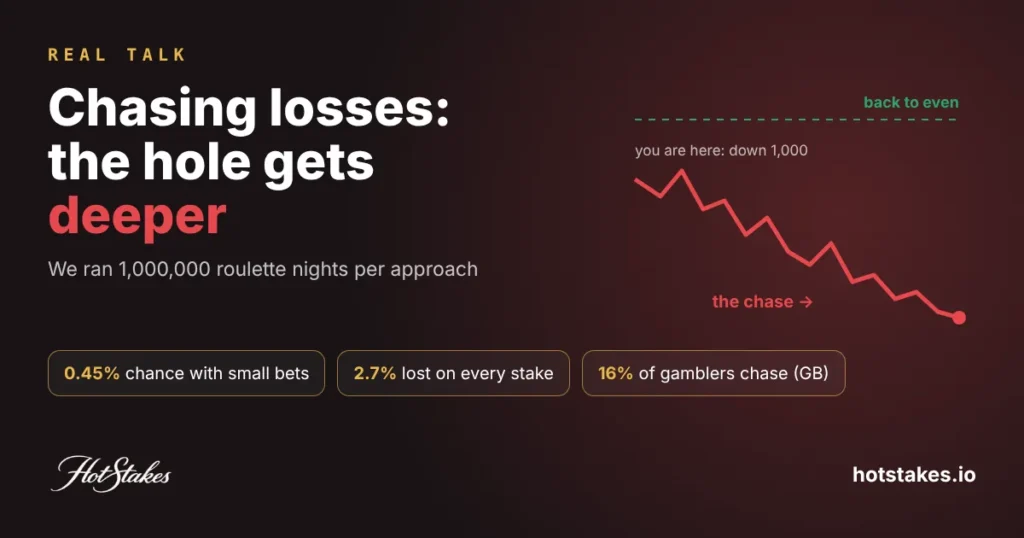
- “Have you gone back on another day to try to win back the money you lost?”
- “Have you borrowed money or sold anything to gamble?”
- “Have you felt guilty about the way you gamble or what happens when you gamble?”
This is not a diagnosis. But any “yes”, especially to borrowing or chasing losses, is a reason to slow down and talk to someone.
Takeaway: For all nine questions and what your score means, take our 2-minute gambling self-check.
Friction you can add today
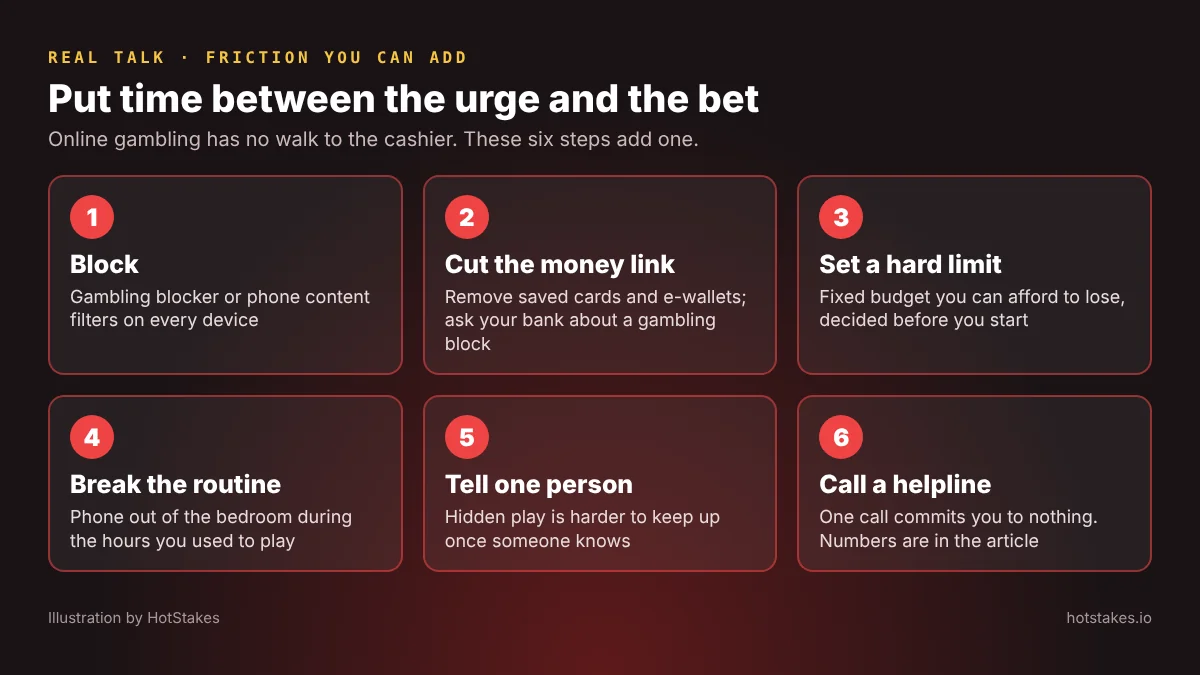
Online’s biggest risk is that nothing stands between the urge and the bet. So put things there. Start with whichever step takes you under five minutes:
- Block the apps and sites. Use a gambling blocker or your phone’s content filters. Our guide to blocking yourself from gambling walks through three locks that work.
- Cut the money link. Remove saved cards and e-wallets from your phone. Ask your bank whether it offers a gambling transaction block.
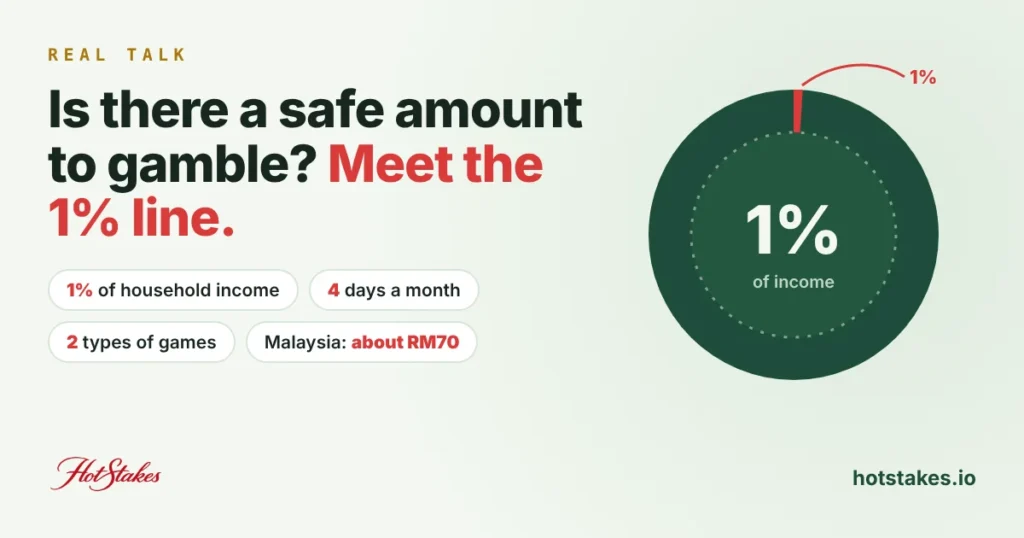
- Set a hard limit before you start. Decide a fixed budget you can afford to lose. Our safe amount to gamble explainer shows how to size it.
- Break the routine. Keep the phone out of the bedroom and off the table during the hours you used to play.
- Tell one person. Hidden play is harder to keep up once someone knows.
- Call a helpline. The numbers are below. One call doesn’t commit you to anything.
If you’re the worried family member
Watch for patterns, not one-off bets. Long phone sessions late at night, money that doesn’t add up, borrowing and secrecy are more telling than whether someone ever plays. Talk calmly, don’t pay off debts in secret, and look after yourself too. Our guide for partners of someone who gambles covers what to say and what to avoid.
Takeaway: Every minute of friction between the urge and the bet helps. Fast online games give you none unless you add it.
Where to get help in Asia (verified 1 Nov 2026)
We checked each number on an official or reputable page on 1 Nov 2026. Services and hours can change, so check the linked page if a call doesn’t connect.
| Country | Service | Number | Source |
|---|---|---|---|
| Malaysia | Talian HEAL, Ministry of Health mental health line (daily 8am–midnight). We found no national gambling-specific helpline. | 15555 | The Star, 9 Jul 2026 |
| Singapore | NCPG National Problem Gambling Helpline (daily 8am–11pm, webchat too) | 1800-6-668-668 | MSF / NCPG |
| Philippines | PAGCOR 24/7 National Problem Gambling Helpline | 02-8248-9568 | GMA News |
| Philippines | NCMH Crisis Hotline (mental health, 24/7) | 1553 | Daily Tribune, 27 Dec 2025 |
| Hong Kong | Gambling Counselling Hotline | 1834 633 | HK Information Services Dept |
| India | Tele-MANAS, free 24×7 mental health helpline | 14416 | JIPMER |
| Indonesia | Healing119, Ministry of Health mental health service (24 hours) | 119 ext. 8 | Kemenkes |
If you are thinking about harming yourself, call your local emergency number now.
Takeaway: You don’t need to be sure it’s “addiction” to call. Worry is reason enough.
FAQ
Is online gambling more addictive than a casino?
Not automatically. In Great Britain’s survey, online casino games and casino games at a casino had the same problem-gambling ratio (5.2 times the average). Online slots were higher than in-person slot machines (5.9 vs 3.7 times). Speed and 24/7 access are what raise the risk.
Why are online slots so addictive?
They are fast, always available and paid with digital money. Even at Britain’s 2.5-second minimum, that’s up to 1,440 spins an hour. Research links faster games to more bets and longer play, especially among people who already struggle. That’s why Britain capped online slot stakes in 2025.
Does everyone who gambles online get addicted?
No. In the 2023 British survey, 4.2% of people who gambled in the past year scored 8 or more on the PGSI. A 2015 research review found internet gambling does not cause problems in and of itself, though it can make them worse for some people.
How much can you lose in an hour of online slots?
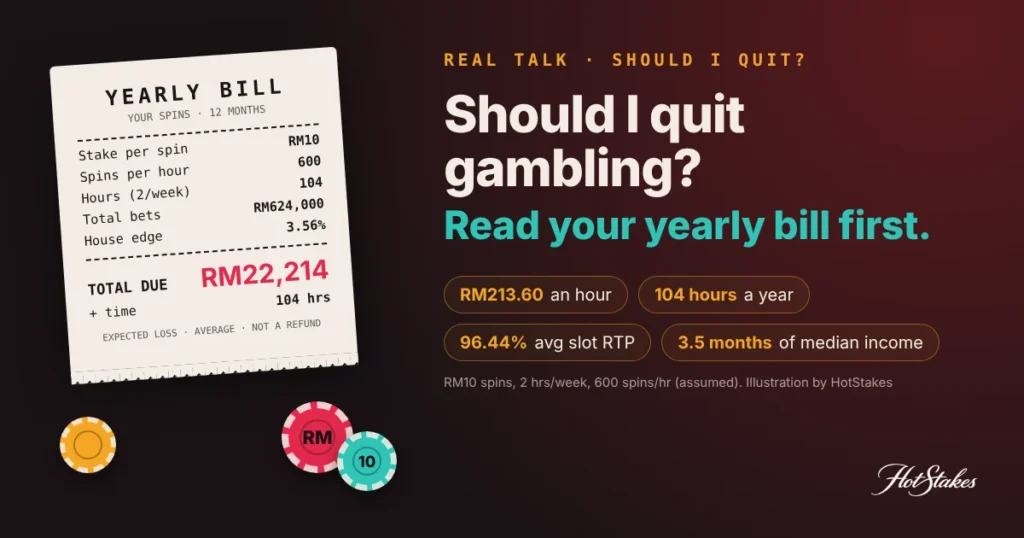
At RM1 a spin, 1,440 spins an hour and 96% RTP, the expected loss is about RM57.60 an hour. Our 1,000,000-hour simulation averaged RM58.11. At a six-player roulette table, the same RM1 bet costs about RM0.95 an hour. Individual hours vary a lot either way.
How do I make online gambling harder to reach?
Block gambling apps and sites, remove saved cards and e-wallets, ask your bank about a gambling block, keep your phone out of the bedroom, and tell one person. If you’re worried, call a helpline from the table above.
HotStakes is an independent directory. Some links on this site are affiliate links; we may earn a commission at no cost to you, and it never changes our rankings. Gambling involves risk — only play with money you can afford to lose, and if it stops being fun, seek help. This article is general information, not legal advice. Read our full disclaimer.
 Next story →WSCBET Review 2026: Licence, Bonus Terms & Safety Check
Start the discussion