

Signs of Gambling Addiction: A 2-Minute Self-Check
The recognised signs of gambling addiction, a 2-minute PGSI self-check, what your score means, and helplines for 7 countries.
In this article
If you’re asking whether your gambling is a problem, you don’t need a label first. You need an honest number and a next step. The quickest recognised check is nine questions about the last 12 months, scored 0 to 3, and a total of 8 or more is the point where the NHS says gambling is likely causing harm. Below you’ll find that self-check, what each question looks like on a phone in 2026, how it compares with the two other screens professionals use, and helplines for seven countries we checked on 21 Oct 2026.
The 2-minute self-check (PGSI)
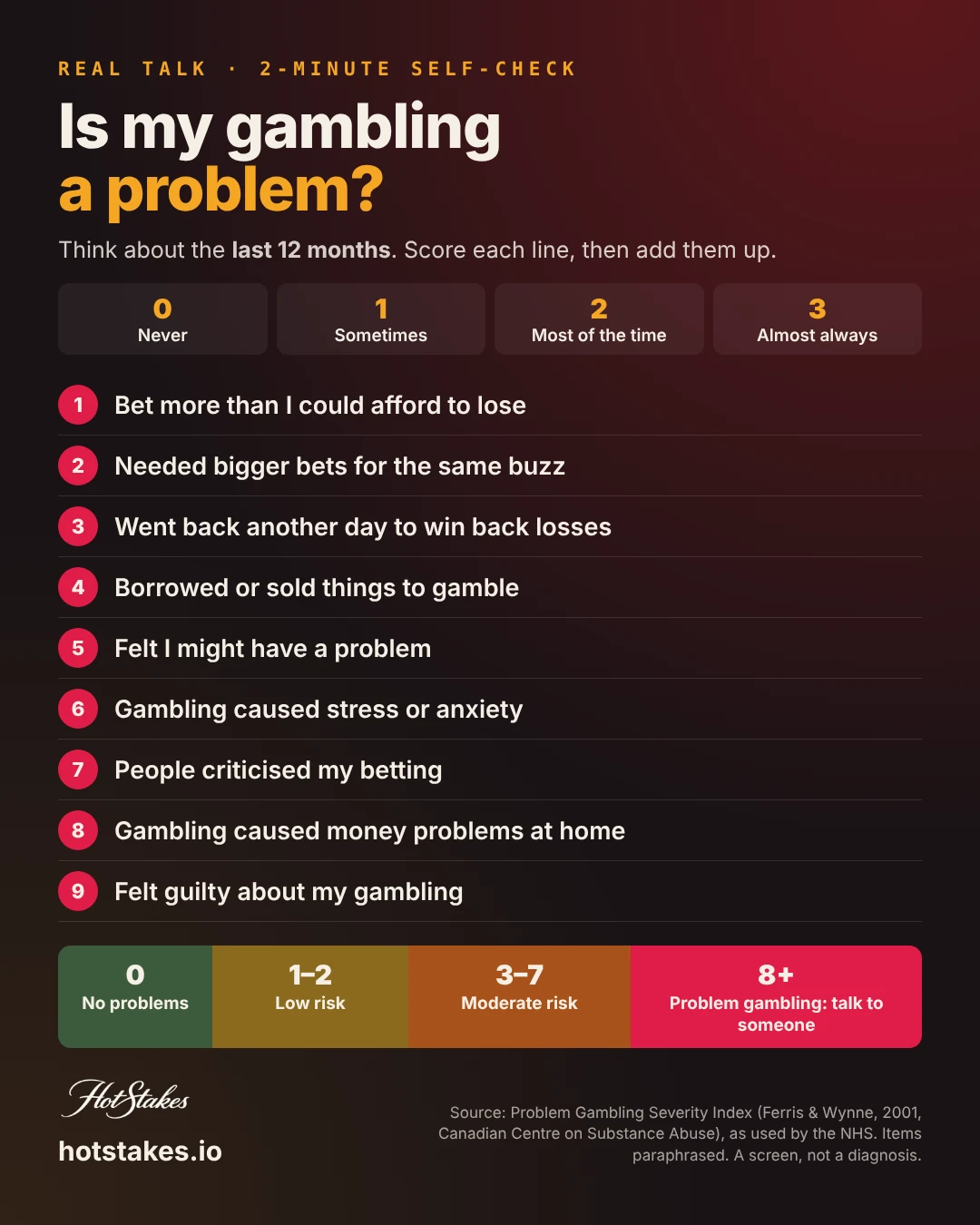
The Problem Gambling Severity Index (PGSI) was built by Jackie Ferris and Harold Wynne in 2001 for the Canadian Centre on Substance Abuse (now the Canadian Centre on Substance Use and Addiction). It was designed for the general public, not for clinics. Britain’s Gambling Commission uses it in its national surveys, and the NHS gambling page offers the same nine questions as a self-check.
Think about the last 12 months only. For each question, score 0 for never, 1 for sometimes, 2 for most of the time and 3 for almost always. The questions, paraphrased from the published PGSI:
- Have you bet more than you could really afford to lose?
- Have you needed to gamble with larger amounts to get the same excitement?
- Have you gone back another day to try to win back money you lost?
- Have you borrowed money or sold anything to get money to gamble?
- Have you felt you might have a problem with gambling?
- Has gambling caused you health problems, including stress or anxiety?
- Have people criticised your betting or said you had a problem, whether or not you agreed?
- Has your gambling caused money problems for you or your household?
- Have you felt guilty about the way you gamble or what happens when you gamble?
Add up your nine answers. The total runs from 0 to 27.
What your score means
These bands come from the original PGSI report. The right-hand column shows how common each band was among adults in the Gambling Survey for Great Britain 2024 (official statistics, published October 2025).
| Score | Original PGSI band | What it suggests | Share of GB adults surveyed |
|---|---|---|---|
| 0 | Non-problem gambling | None of the nine harms reported | Not shown separately |
| 1–2 | Low risk | A few issues, few or no consequences yet | 8.8% |
| 3–7 | Moderate risk | Some negative consequences. The NHS says 1–7 can still mean gambling is affecting you | 3.1% |
| 8 or more | Problem gambling | Harm with possible loss of control. The NHS says you, or people close to you, are likely being harmed | 2.7% (4.5% of past-year gamblers) |
One wrinkle: some sites group scores differently. Ireland’s gambling regulator, for example, labels 0–2 as “low risk”. The cut-off of 8 is the same everywhere.
A score is a signal, not a diagnosis. Only a doctor or trained counsellor can assess you properly, and a self-check can’t see your whole life.
Takeaway: Any score above 0 is worth paying attention to. A score of 8 or more is a clear reason to talk to someone this week.
What each question looks like on a phone in 2026
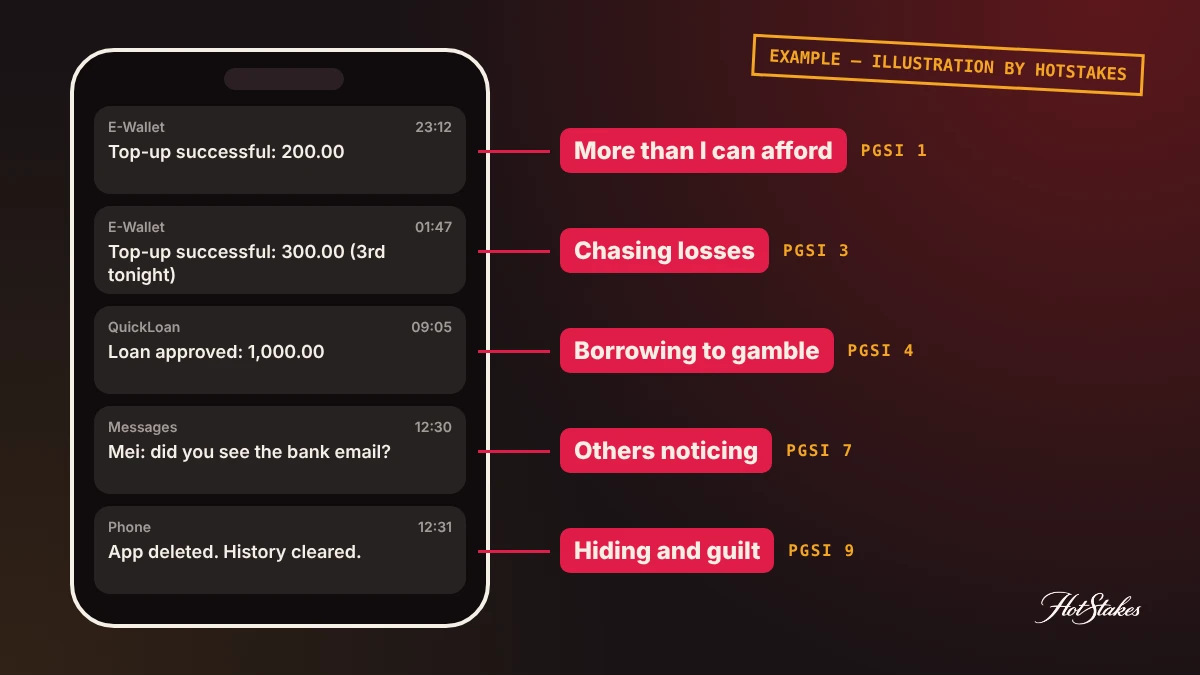
The PGSI was written in 2001, before betting lived in your pocket. The questions still work, but the behaviour looks different now. The examples below are written by HotStakes to help you recognise yourself. They are illustrations, not a checklist from the PGSI authors.
| PGSI question | What it can look like now (EXAMPLES) |
|---|---|
| 1. Bet more than you could afford | Topping up an e-wallet with money set aside for rent, bills or school fees |
| 2. Needed bigger bets for the same buzz | Small spins feel boring, so you move to higher stakes or faster games |
| 3. Went back to win it back | Re-depositing the same night, or the next morning, “just to get back to zero” |
| 4. Borrowed or sold to gamble | A quick loan app, buy-now-pay-later, a credit card cash advance, or selling a phone or gold |
| 5. Felt you might have a problem | Searching for this article at 2am |
| 6. Health problems, stress, anxiety | Bad sleep, checking results in the bathroom at work, a knot in your stomach when the phone buzzes |
| 7. Others criticised your betting | A partner asking about missing money, or a friend’s joke that lands too close |
| 8. Money problems at home | Late bills, a shared account that keeps running low, juggling between cards |
| 9. Felt guilty | Deleting the app after a loss, clearing your history, reinstalling it days later |
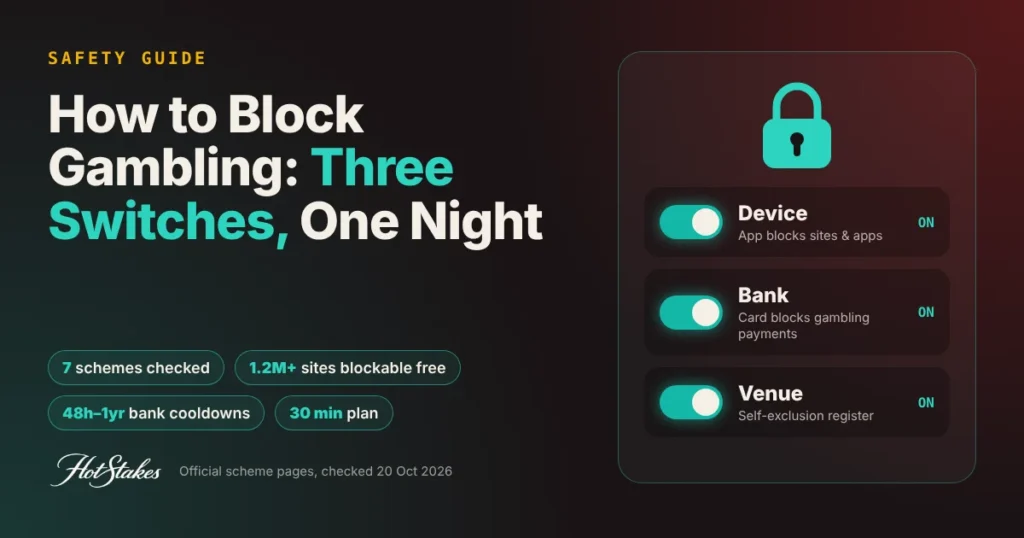
Payment apps also make gambling harder to block. GamCare notes that a bank gambling block may not work with an e-wallet or faster payments. Our guide on how to block gambling on your phone, bank and e-wallets covers the gaps.
Takeaway: If two or more rows sound like your last month, score yourself honestly and keep reading.
Three screens compared: Lie/Bet, PGSI and DSM-5
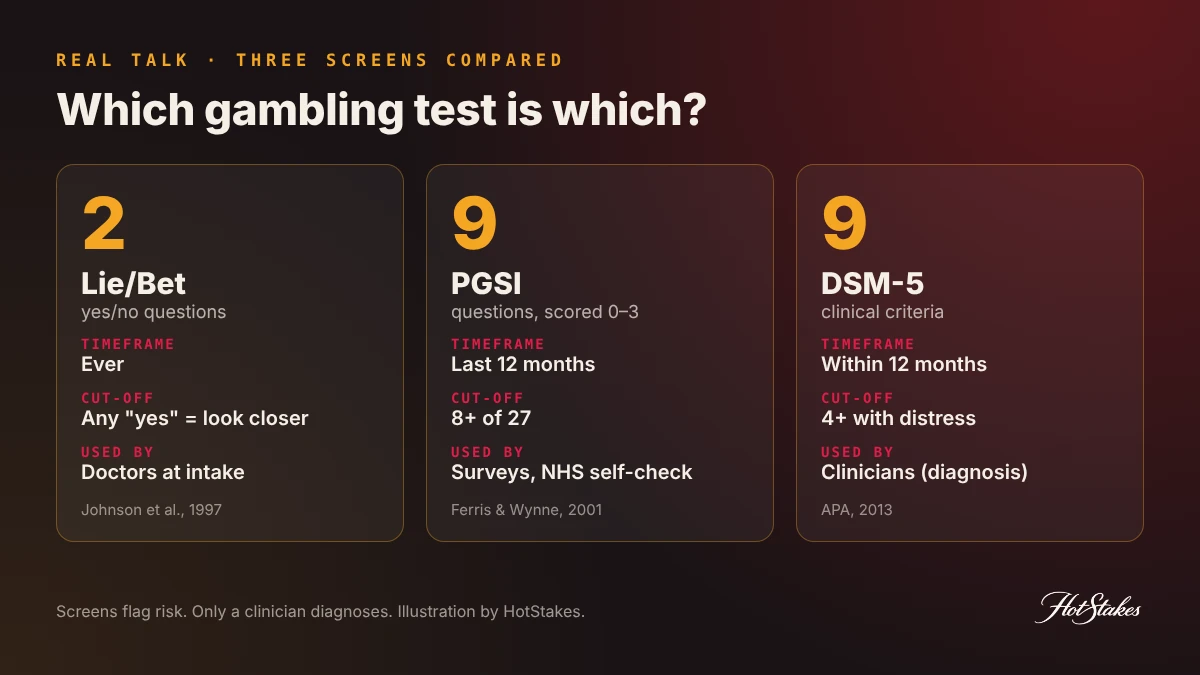
You’ll see three tools mentioned online. They answer different questions. The Lie/Bet asks “should anyone look closer?” The PGSI asks “how much harm, and how often?” The DSM-5 is what a clinician uses to diagnose.
| Lie/Bet | PGSI | DSM-5 gambling disorder | |
|---|---|---|---|
| Items | 2 yes/no questions | 9 questions, scored 0–3 | 9 criteria |
| Timeframe | Ever (lifetime) | Last 12 months | Within a 12-month period |
| Cut-off | “Yes” to one or both = assess further | 8+ of 27 = problem gambling | 4+ criteria, with significant distress or impairment |
| Who uses it | Doctors and health workers at intake | National surveys, the NHS self-check, researchers | Psychiatrists, psychologists and trained clinicians |
| What a “positive” means | Worth a longer screen | Level of risk and harm | A diagnosis, rated mild, moderate or severe |
| Source | Johnson et al., 1997 | Ferris & Wynne, 2001 | American Psychiatric Association, 2013 |
Lie/Bet: the two-question screen
The Lie/Bet was published by Edward Johnson and colleagues in Psychological Reports in 1997. It asks two things, paraphrased:
- Have you ever felt the need to bet more and more money?
- Have you ever had to lie to people important to you about how much you gambled?
Answering yes to one or both means a longer assessment is worth doing, according to Maine’s health department. In 2023, Minnesota’s Department of Human Services urged licensed providers to use it. It is short on purpose: it flags, it doesn’t measure.
DSM-5: the clinical criteria
The American Psychiatric Association’s manual lists nine criteria for gambling disorder. Paraphrased from the version published by Washington State’s Health Care Authority, they are:
- Needing bigger bets to get the same excitement
- Feeling restless or irritable when trying to cut down
- Repeated failed attempts to control or stop
- Being preoccupied with gambling, such as planning the next bet or how to get money
- Gambling when feeling distressed, guilty, anxious or low
- Returning another day to chase losses
- Lying to hide how much you gamble
- Risking or losing a relationship, job or study opportunity
- Relying on others for money to fix a crisis caused by gambling
A diagnosis needs four or more within 12 months, causing significant distress or impairment, and not better explained by a manic episode. Connecticut’s DMHAS lists the severity levels: mild is 4–5 criteria, moderate 6–7, severe 8–9.
Takeaway: Counting criteria yourself can be eye-opening, but a diagnosis belongs in a conversation with a professional.
The early signs people miss: chasing, hiding, borrowing
Three behaviours appear in all three screens in some form. They are also the ones people explain away the longest.
- Chasing. Going back to win back a loss is a PGSI item and a DSM-5 criterion. It often hides behind a belief that a win is “due”. It isn’t, as we explain in is a slot ever due to hit?
- Hiding. Lying about how much you bet is one of the two Lie/Bet questions. Small lies count: rounding a loss down, or saying “I’m about even”.
- Borrowing. The PGSI asks about borrowing or selling to gamble. DSM-5 asks about relying on others to fix a money crisis.
There’s a fourth, quieter one: feeling like you’re winning when you aren’t. Slots celebrate payouts that are smaller than your bet, which can blur how much you’ve really lost. See losses disguised as wins.
Takeaway: If you’ve chased, hidden or borrowed even once this year, that’s information, not a verdict. Act on it early.
Checking on someone else?
The PGSI is a self-report tool. You can’t score it for another person, but you can notice the outward signs it describes: missing money, new loans, secrecy around a phone, mood swings after results.
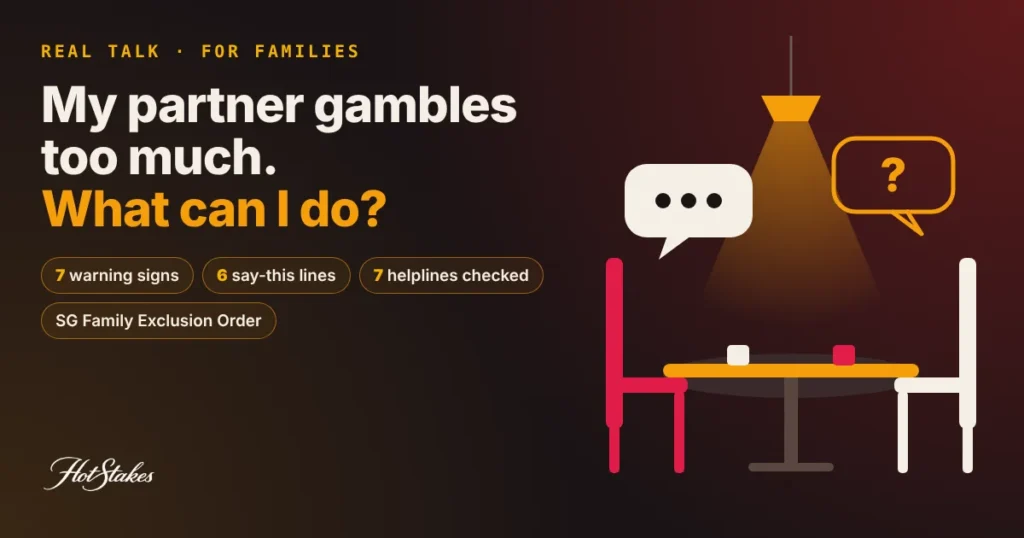
Don’t try to diagnose them. Share what you’ve seen and how it affects you, then point to help. Our guide for partners covers what to say and how to protect shared money. Most helplines below also take calls from family.
Takeaway: You can’t do the test for them, but you can call a helpline for yourself today.
What to do next
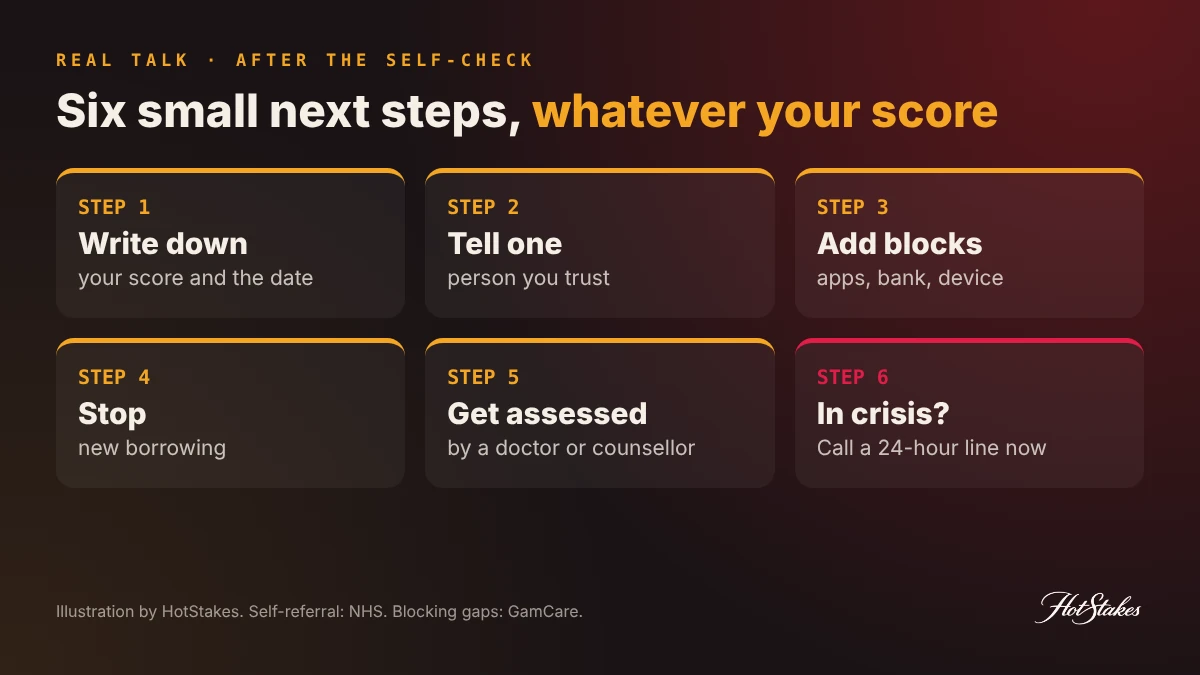
- Write your score down. Note the date. Retake it in a month to see the direction.
- Tell one person. A friend, partner or helpline counsellor. Secrecy is one of the signs, so saying it out loud matters.
- Add friction. Self-exclude, delete apps and switch on bank and device blocks. Start with our step-by-step blocking guide.
- Stop the borrowing. Don’t take new credit to chase a loss. List what you owe and ask a helpline about free debt advice.
- Get a proper assessment. See a doctor or counsellor. In England, the NHS says you can self-refer to a gambling clinic.
- If you feel unsafe, call now. If you are in crisis or thinking about ending your life, call your local emergency number or a 24-hour line below.
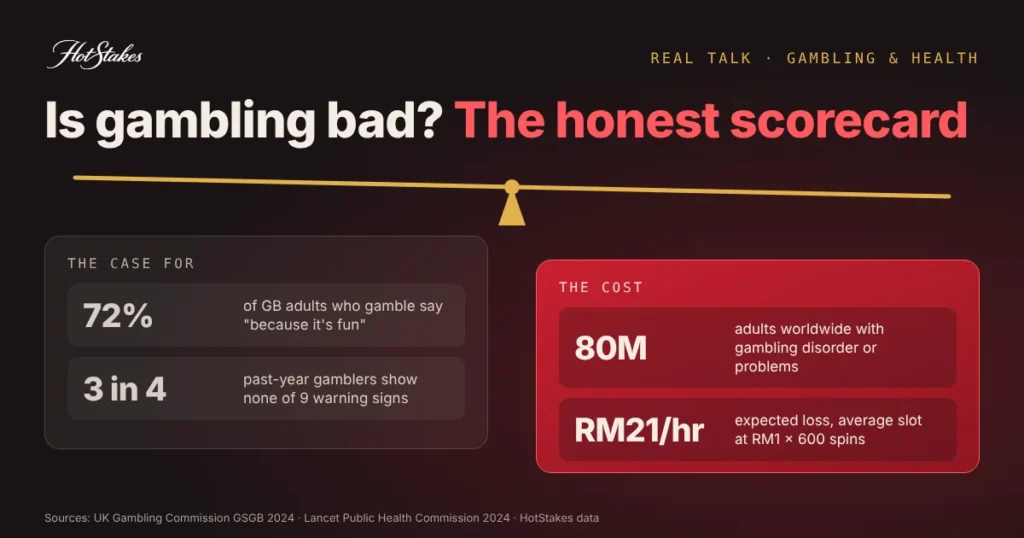
For a wider, non-judgemental look at where gambling turns harmful, read our Real Talk pillar, is gambling bad for you?
Where to get help (checked 21 Oct 2026)
We opened an official or major-news page for each line below on 21 Oct 2026. We could not verify a dedicated national gambling helpline in Malaysia or India, so we list general mental-health lines there.
| Where | Line | Number | Notes |
|---|---|---|---|
| Malaysia | HEAL (Ministry of Health) | 15555 | National mental-health line, not gambling-specific (Malay Mail) |
| Malaysia | Befrienders KL | 03-7627 2929 | 24 hours, emotional support (Befrienders) |
| Singapore | National Problem Gambling Helpline (NCPG) | 1800-6-668-668 | Webchat also available (NCPG) |
| Hong Kong | Gambling counselling hotline | 1834 633 | Funded centres also help families (HK Government) |
| Philippines | National Problem Gambling Helpline (PAGCOR) | (02) 8248-9568 | 24/7, for gamblers and families (AGB) |
| India | Tele-MANAS | 14416 | Toll-free, round-the-clock mental-health line, 20 languages (PIB) |
| UK | National Gambling Helpline (GamCare) | 0808 8020 133 | 24/7, free, live chat too (GambleAware) |
| Australia | National Gambling Helpline | 1800 858 858 | Free, confidential, 24/7 (Department of Social Services) |
More honest guides on gambling and wellbeing are in our Real Talk section.
Takeaway: Save your country’s number in your phone now, while things are calm.
FAQ
What are the signs of gambling addiction?
Recognised signs include betting more than you can afford, needing bigger bets for the same buzz, chasing losses, borrowing to gamble, lying about how much you bet, failed attempts to cut down, and stress, guilt or money problems caused by gambling.
Is there a free “am I a gambling addict” test?
Yes. The Problem Gambling Severity Index (PGSI) is nine questions about the last 12 months, scored 0 to 3 each. The NHS offers it as a self-check. A total of 8 or more suggests gambling is likely causing harm.
Can a self-assessment diagnose gambling disorder?
No. Screens like the PGSI and Lie/Bet flag risk. A diagnosis of gambling disorder uses the DSM-5 criteria (four or more of nine in 12 months) and is made by a trained clinician.
What does a PGSI score of 3 to 7 mean?
It falls in the moderate-risk band: some negative consequences from gambling. The NHS says any score from 1 to 7 can still mean gambling is affecting you, so it’s worth acting early.
Is there a gambling helpline in Malaysia?
We could not verify a dedicated national gambling helpline in Malaysia on 21 Oct 2026. The Ministry of Health’s HEAL line (15555) and Befrienders KL (03-7627 2929, 24 hours) offer emotional support.
HotStakes is an independent directory. Some links on this site are affiliate links; we may earn a commission at no cost to you, and it never changes our rankings. Gambling involves risk — only play with money you can afford to lose, and if it stops being fun, seek help. This article is general information, not legal advice.
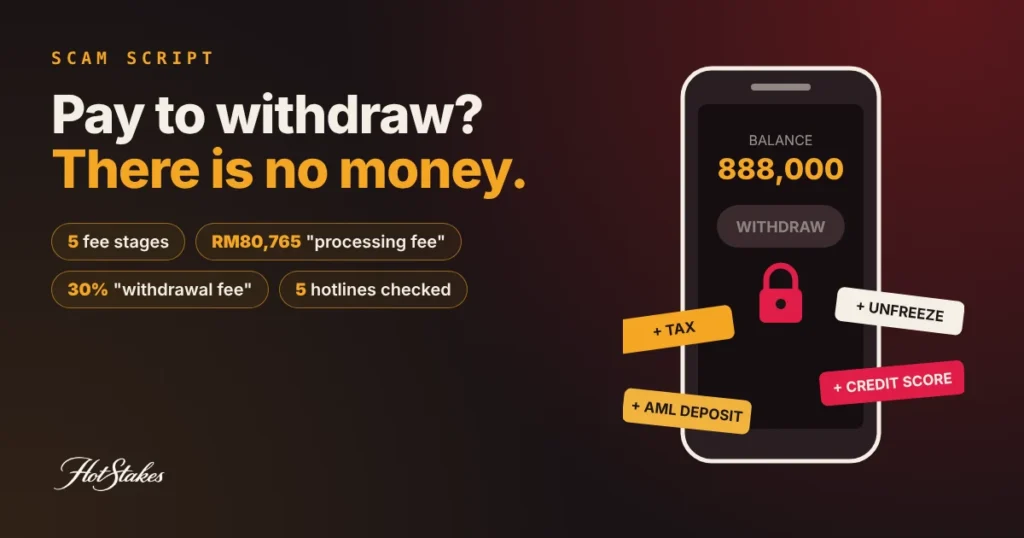 Next story →Withdrawal Fee Scam: The Pay-to-Withdraw Script, Explained

Start the discussion