

Should I Quit Gambling? What Your Habit Costs a Year
Should I quit gambling? RM10 spins, two hours a week, cost about RM22,200 and 104 hours a year. The maths, the warning signs and 5 first steps.
In this article
- Should I quit gambling? Start with the bill, not the feeling
- How much does gambling cost? A year of spins, by stake
- Turn the yearly number into things you would notice
- Why quit gambling: what the research says about harm
- The loss-chasing trap
- When you might NOT need to quit
- What people report gaining when they stop
- If you’ve decided to stop: the first 5 steps
- FAQ
You have probably asked yourself this after a bad night, not a good one. Here is a straight answer, worked out in ringgit and hours rather than guilt. If you play RM10 slot spins for two hours a week, the maths says you hand over about RM22,000 and 104 hours a year, so if that number scares you, or you can’t stick to a limit, quitting is the honest choice. If your play is small, rare and fully under control, you may not need to stop. Below: the yearly bill, the warning signs, and the first five steps.
Should I quit gambling? Start with the bill, not the feeling
Most “should I stop” articles hand you a quiz about feelings. Feelings matter, and we cover them below. But a lot of people never see the plain cost, because gambling never sends a bill.
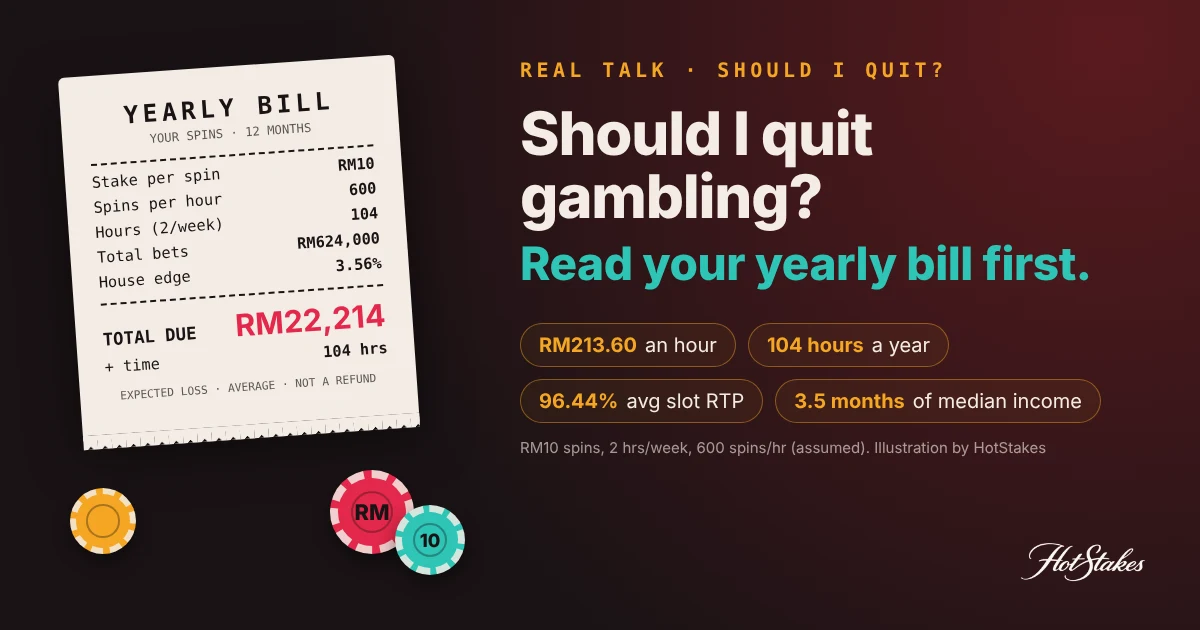
So we wrote one. The inputs are simple:
- House edge: the 424 Hotdog Gaming slots in our database average 96.44% RTP (HotStakes data, synced 20 Oct 2026). The other 3.56% is what the game keeps over time. Our explainer on why the house always wins shows where that comes from.
- Speed: in Great Britain, online slots must leave at least “2.5 seconds” between spins, a cap of 1,440 spins an hour. Many sites outside the UK have no such limit. We assume a slower 600 spins an hour (one every six seconds). That is our assumption, not a measured figure.
- Habit: two one-hour sessions a week, 52 weeks a year. That is 104 hours.
The formula: expected yearly loss = stake × spins per hour × hours per year × house edge.
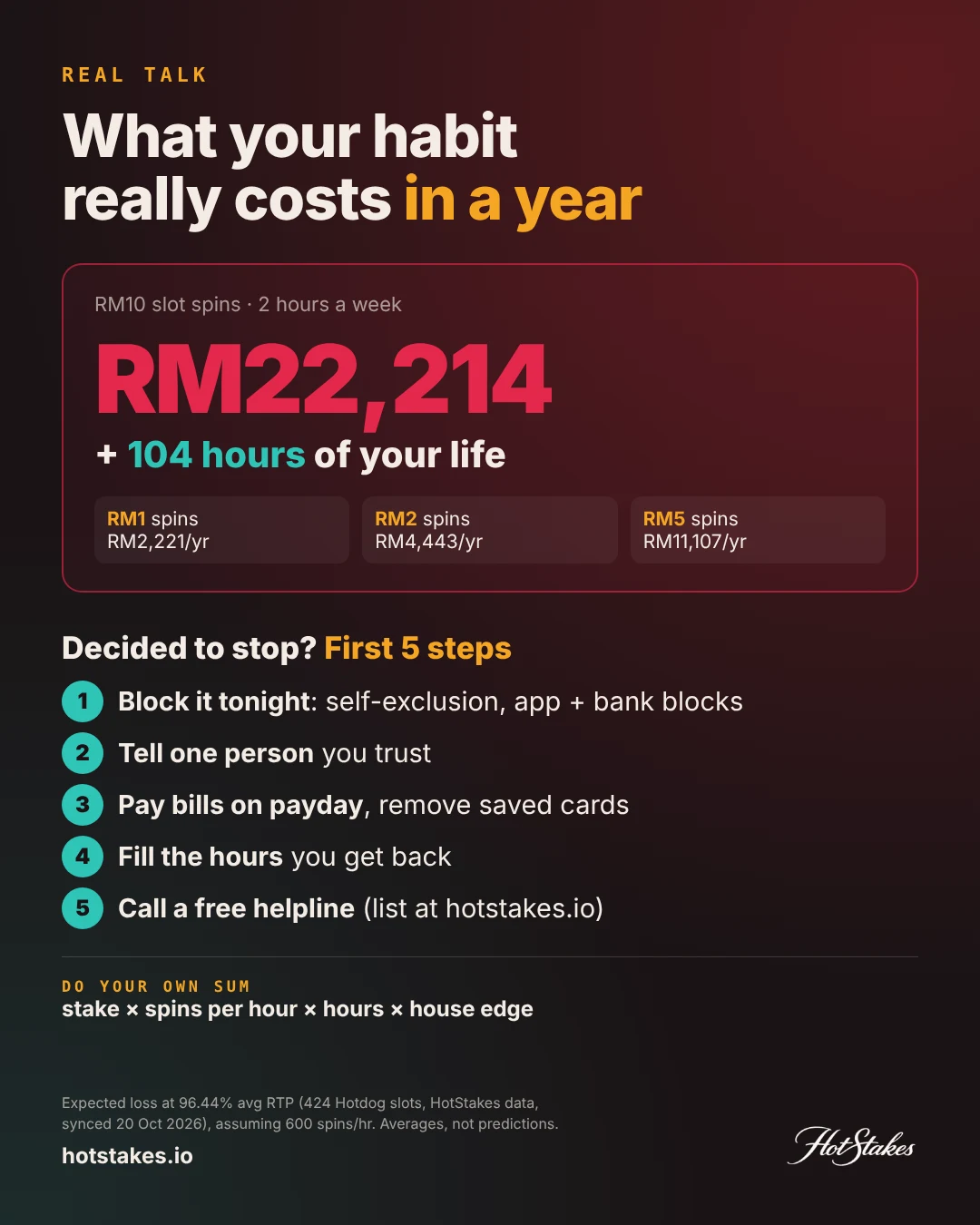
For RM10 spins: 10 × 600 × 104 × 3.56% = RM22,214. That is RM213.60 an hour.
Takeaway: Your habit has a price per hour. Multiply it out before you decide anything.
How much does gambling cost? A year of spins, by stake
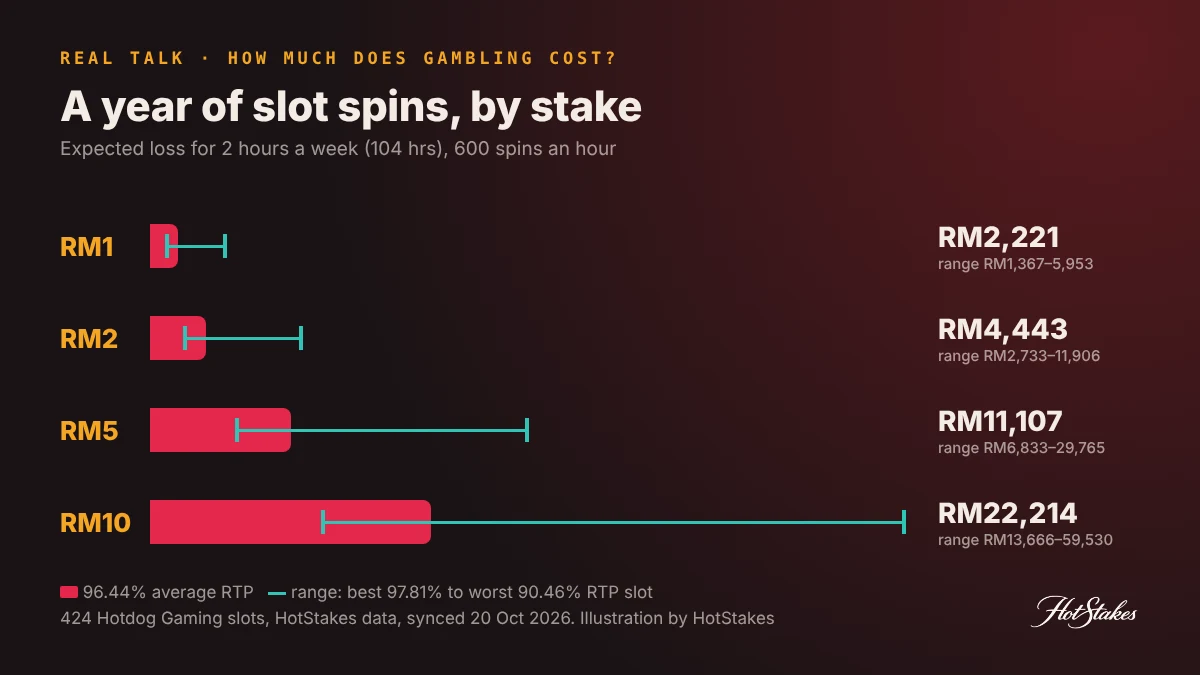
The same habit at different stakes, plus the cheapest and dearest slots in our data (97.81% and 90.46% RTP).
| Stake per spin | Expected loss per hour (96.44% RTP) | Per year, 2 hrs a week | Per year at 97.81% RTP | Per year at 90.46% RTP |
|---|---|---|---|---|
| RM1 | RM21.36 | RM2,221 | RM1,367 | RM5,953 |
| RM2 | RM42.72 | RM4,443 | RM2,733 | RM11,906 |
| RM5 | RM106.80 | RM11,107 | RM6,833 | RM29,765 |
| RM10 | RM213.60 | RM22,214 | RM13,666 | RM59,530 |
Play an hour every night instead of twice a week and the RM10 figure becomes about RM78,000 and 365 hours.
“But I never bet RM22,000”
True. Almost nobody deposits that much at once. You recycle. A RM200 balance gets bet, partly won back, bet again.
That is exactly how the edge works. It takes its 3.56% on every pass, not just on your deposit. At RM10 a spin and 600 spins an hour, a RM200 balance lasts about 56 minutes on average (200 ÷ 213.60). Some nights you win. Over 104 hours, the average catches up. Check any game’s numbers in our RTP calculator.
What about table games?
Live tables are slower and some carry lower edges. The baccarat tables in our StakeGO live data have a house edge of 1.06–1.24%; roulette is 2.7%. Assuming 60 baccarat hands or 40 roulette spins an hour (our assumptions), RM10 bets for 104 hours cost about RM660–770 or RM1,120 a year.
Cheaper is not free. And the trap below pushes most people to bet bigger, not smaller.
Takeaway: Stake size, speed and hours drive the bill far more than which game you pick.
Turn the yearly number into things you would notice
Abstract numbers don’t hurt. These do. Using the RM10, two-hours-a-week habit:
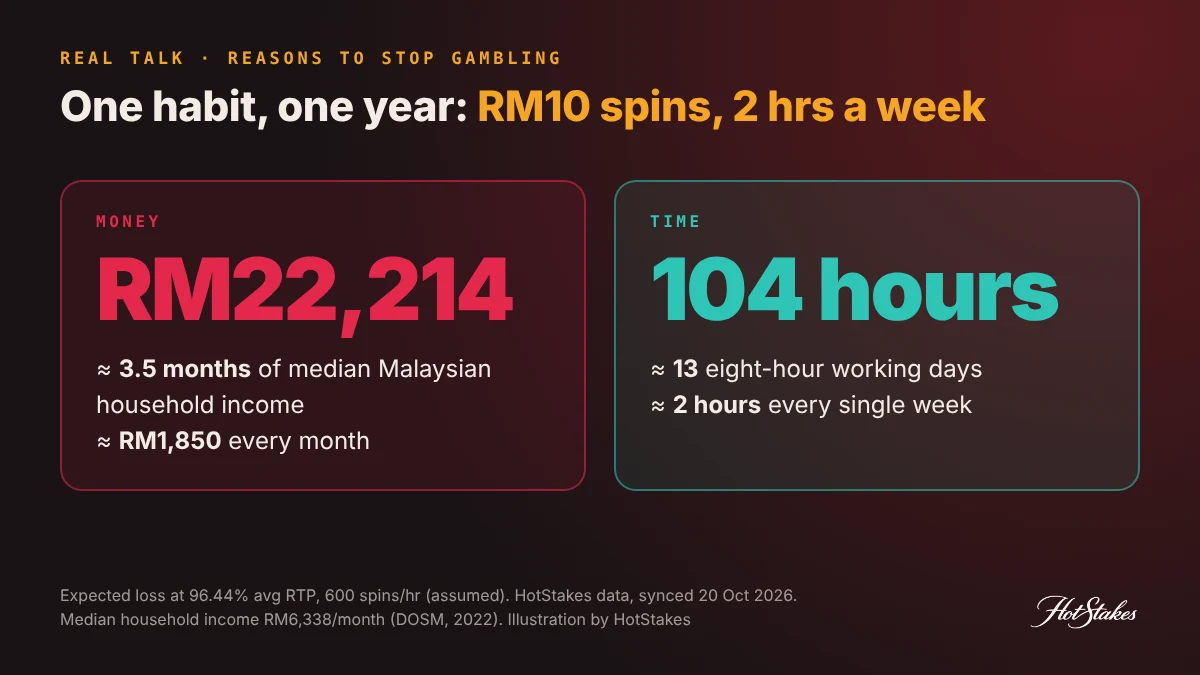
- RM22,214 a year is about 3.5 months of Malaysia’s median household income, which the statistics department put at RM6,338 a month in 2022.
- It is about RM1,850 a month, a car loan or rent payment, every month.
- 104 hours is 13 full eight-hour working days. Every year.
- At RM2 spins it is still RM4,443, about 70% of a month’s median household income.
Takeaway: If you would never sign a RM1,850-a-month contract for this, ask why you are paying it in spins.
Why quit gambling: what the research says about harm
Money is only one line on the bill. Large reviews now treat gambling as a public health problem, not a personal failing.
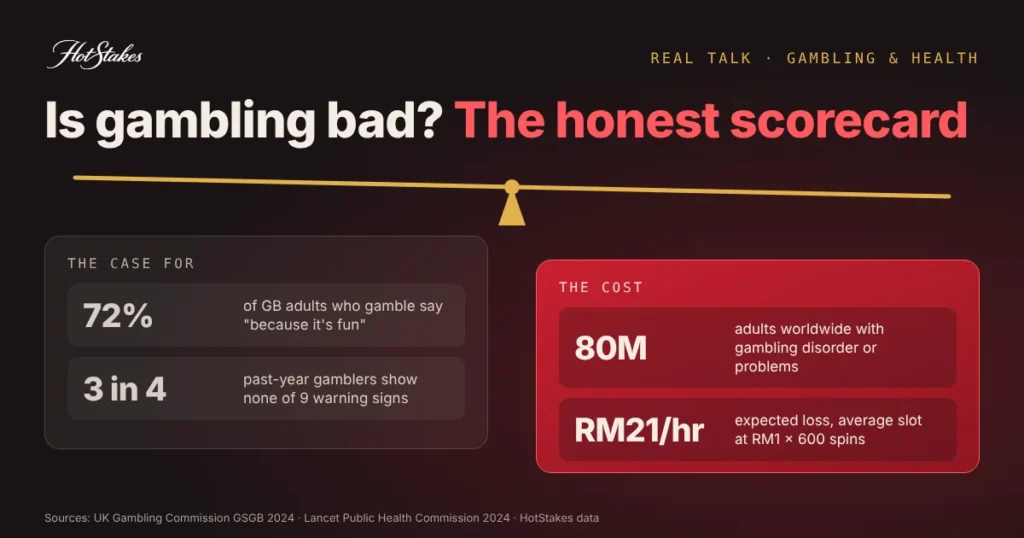
- The Lancet Public Health Commission (2024): about 80 million adults worldwide have gambling disorder or problematic gambling. Among adults who gamble on online casino or slot products, 15.8% could be affected.
- WHO (Dec 2024): the WHO fact sheet lists harms including “relationship breakdown, family violence, financial distress”. It says for each person gambling at high-risk levels, about six others are affected.
- Great Britain: the Gambling Commission’s 2025 survey found 4.0% of past-year gamblers scored 8+ on the problem gambling scale; 5.9% had lied to family at least occasionally.
- Singapore: the Ministry of Social and Family Development reports a probable pathological gambling rate of about 1.2% in the 2020 NCPG survey.
Most people who gamble are not in those groups. But the share is higher for fast online products, which is the type of play this article costs out. The evidence on both sides is in our pillar guide.
Takeaway: The harm is real, it spreads to families, and it is highest on fast online slots.
The loss-chasing trap
Chasing losses means betting more, or longer, to win back what you lost. The NHS lists it as a warning sign: “Have you tried to win back money you have lost (chasing losses)?”
The maths is unkind to chasers. Doubling your stake from RM5 to RM10 doubles your expected loss per hour, from RM106.80 to RM213.60. Playing an extra hour adds another full hour of edge. The fix you reach for makes the hole deeper, on average.
Near-misses and small “wins” that pay less than your bet make it worse, because they feel like progress. We explain that in losses disguised as wins.
Takeaway: If you have ever raised your bet to “get it back”, treat that as a serious signal, not a strategy.
When you might NOT need to quit
Honesty works both ways. Not everyone who gambles needs to stop. Canada’s Lower-Risk Gambling Guidelines, published by the Canadian Centre on Substance Use and Addiction in 2021, set three limits to follow together:
- “Gamble no more than 1% of household income before tax per month.”
- “Gamble no more than 4 days per month.”
- “Avoid regularly gambling at more than 2 types of games.”
On Malaysia’s median household income, 1% is about RM63 a month. Our RM10, two-hours-a-week example costs about RM1,850 a month on average, nearly 30 times that, and runs 8 or 9 days a month.
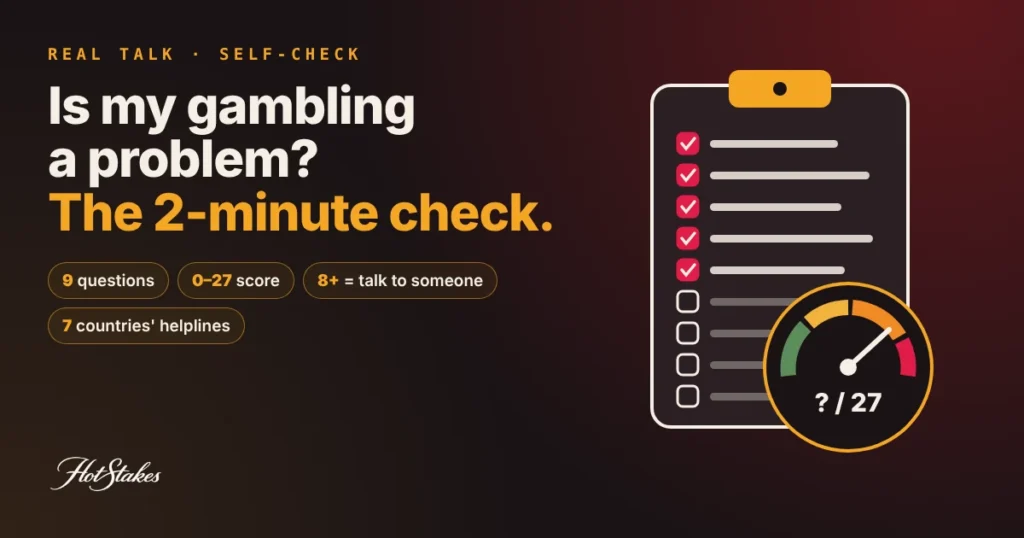
You may be fine to carry on if all of these are true: you stay inside those limits, you treat it as paid entertainment, you never chase, you never borrow, and nobody close to you is worried. If any one of them is false, run our 2-minute self-check.
Takeaway: Small, rare and fully budgeted play can be lower risk. Anything beyond that, the case for stopping gets strong fast.
What people report gaining when they stop
We did not interview anyone for this piece. These are short lines from public posts on the GamCare recovery forum, where people share their experience openly:
- “I am a lot healthier in body and in mind.” (GamCare forum, 10 months free)
- “I have a better relationship with my kids and my wife now.” (same post)
- “no longer have that feel of dread and dishonesty” (GamCare forum, one year free)
Notice what they mention first: health, family, honesty. Money comes up too, but not always first. The same writer said money worries were “no-where near as bad”, not gone.
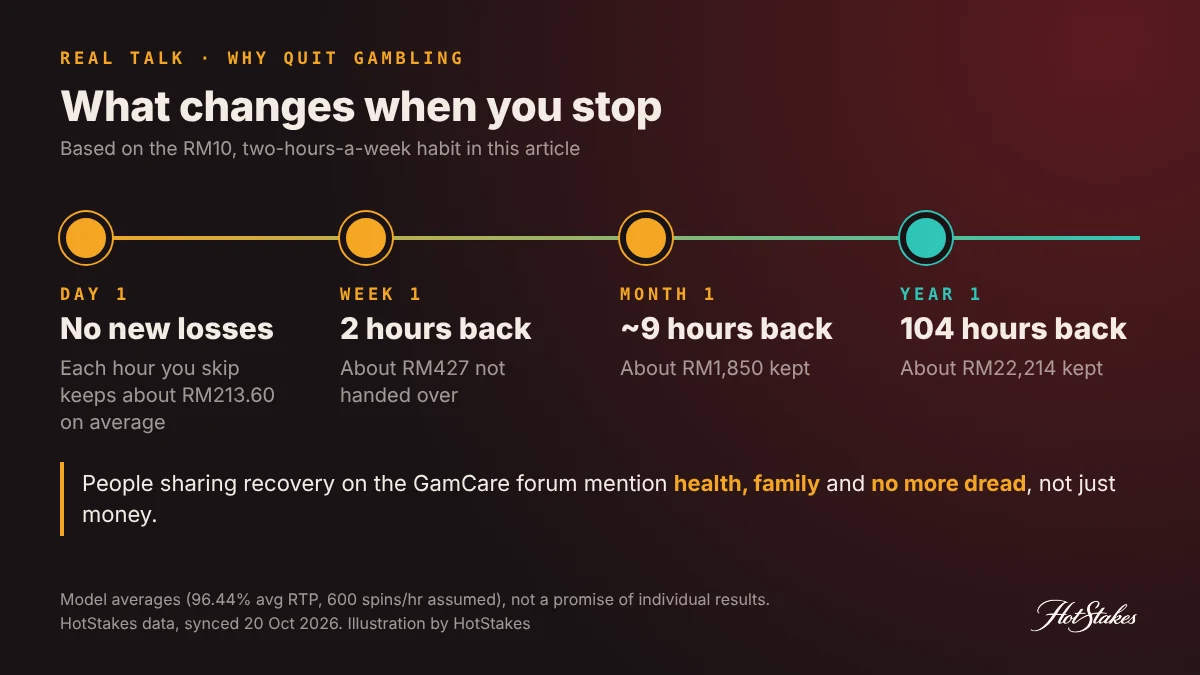
Takeaway: The first thing you get back is time and the absence of dread. The money follows.
If you’ve decided to stop: the first 5 steps
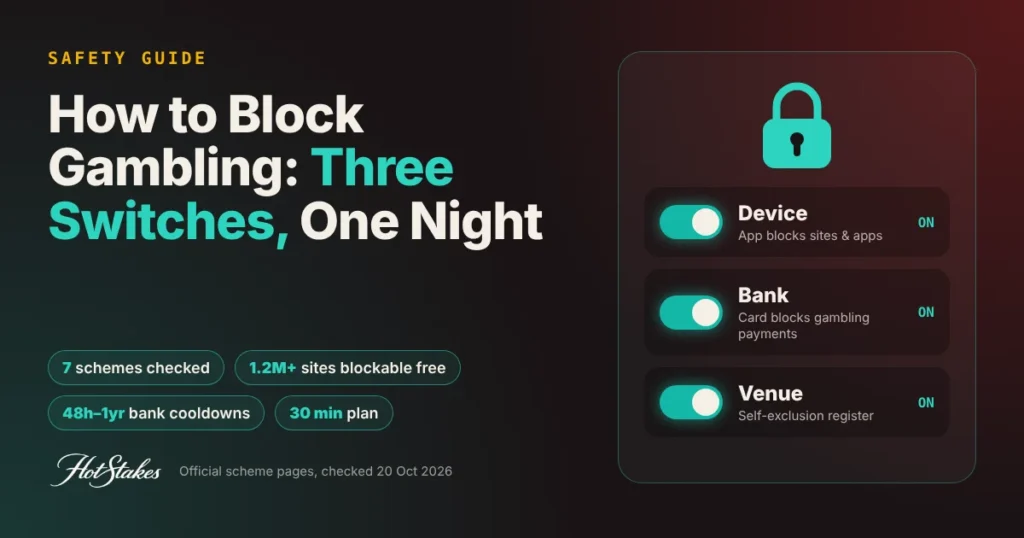
- Block it tonight. Use self-exclusion, a blocking app and your bank’s gambling block. Our how to block gambling guide walks through each one.
- Tell one person. A partner, sibling or friend. Hiding play is part of the problem; saying it out loud breaks it. Families can start with our guide for partners.
- Put money out of reach. Pay bills on payday, before anything else, as the NHS suggests. Remove saved cards and e-wallets from your phone.
- Fill the hours. You are getting back about two hours a week in our example. Plan what goes in them before the urge arrives.
- Call a helpline. It is free and confidential:
- Malaysia: we found no dedicated national gambling helpline. Call HEAL 15555 (mental health) or Befrienders KL 03-7627 2929.
- Singapore: NCPG helpline 1800-6-668-668
- Hong Kong: Tung Wah gambling counselling 1834 633
- Philippines: PAGCOR (02) 8248-9568
- India: Tele-MANAS 14416
- UK: National Gambling Helpline 0808 8020 133
- Australia: Gambling Help 1800 858 858
More honest takes on gambling are collected in our Real Talk section.
Takeaway: Block, tell, protect your money, fill the time, get support. In that order, starting today.
FAQ
Should I quit gambling if I’m not losing much?
Not necessarily. Canada’s lower-risk guidelines suggest no more than 1% of household income a month, no more than 4 days a month and no more than 2 types of games. If you stay inside all three and never chase or borrow, your risk is lower. If you can’t keep to them, stopping is the safer choice.
How much does gambling cost in a year?
It depends on stake, speed and hours. At the 96.44% average slot RTP in our data, RM10 spins at 600 spins an hour cost about RM213.60 an hour on average. Two hours a week comes to about RM22,214 a year; RM1 spins come to about RM2,221.
What is chasing losses?
Chasing losses means betting more or longer to win back money you have lost. The NHS lists it as a sign of gambling harm. Because every bet carries the house edge, bigger or longer play raises your expected loss.
What are the main reasons to stop gambling?
The common ones are money, time, health and relationships. WHO links gambling harm to financial distress, relationship breakdown and mental illness, and says about six other people are affected for each person gambling at high-risk levels.
Is there a gambling helpline in Malaysia?
We found no dedicated national gambling helpline in Malaysia. You can call the HEAL line on 15555 for mental health support or Befrienders KL on 03-7627 2929.
HotStakes is an independent directory. Some links on this site are affiliate links; we may earn a commission at no cost to you, and it never changes our rankings. Gambling involves risk — only play with money you can afford to lose, and if it stops being fun, seek help. This article is general information, not legal advice.
 Next story →Golden Mahjong vs Caishen Win!: RTP, Max Win & the Catch

Start the discussion