

Lend Money to Someone Who Gambles? What 10 Guides Say
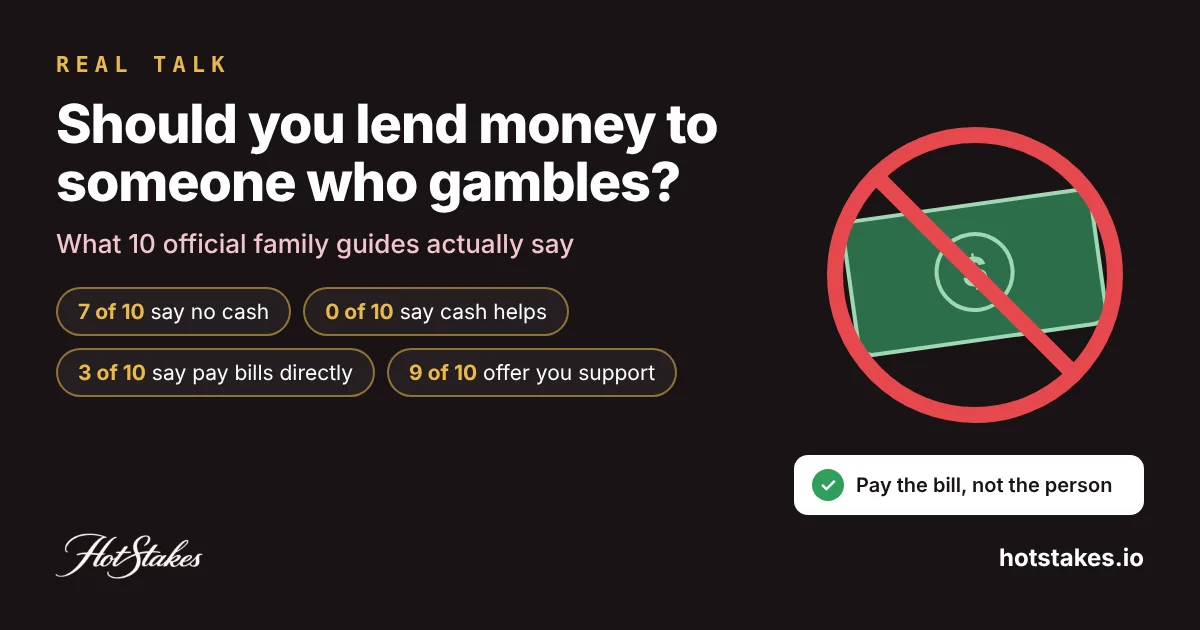
Asked for money by someone who gambles? We read 10 official family guides: 7 say no cash. What to do instead, what to say and where to get help.
In this article
- We read 10 official family guides. Here’s what they say about money
- Why cash usually makes things worse
- What to do instead of handing over cash
- Say this instead: lines you can use
- What if they owe money to loan sharks?
- Saying no without cutting them off
- Look after yourself, too
- Help for families in Asia: numbers we verified today
- FAQ
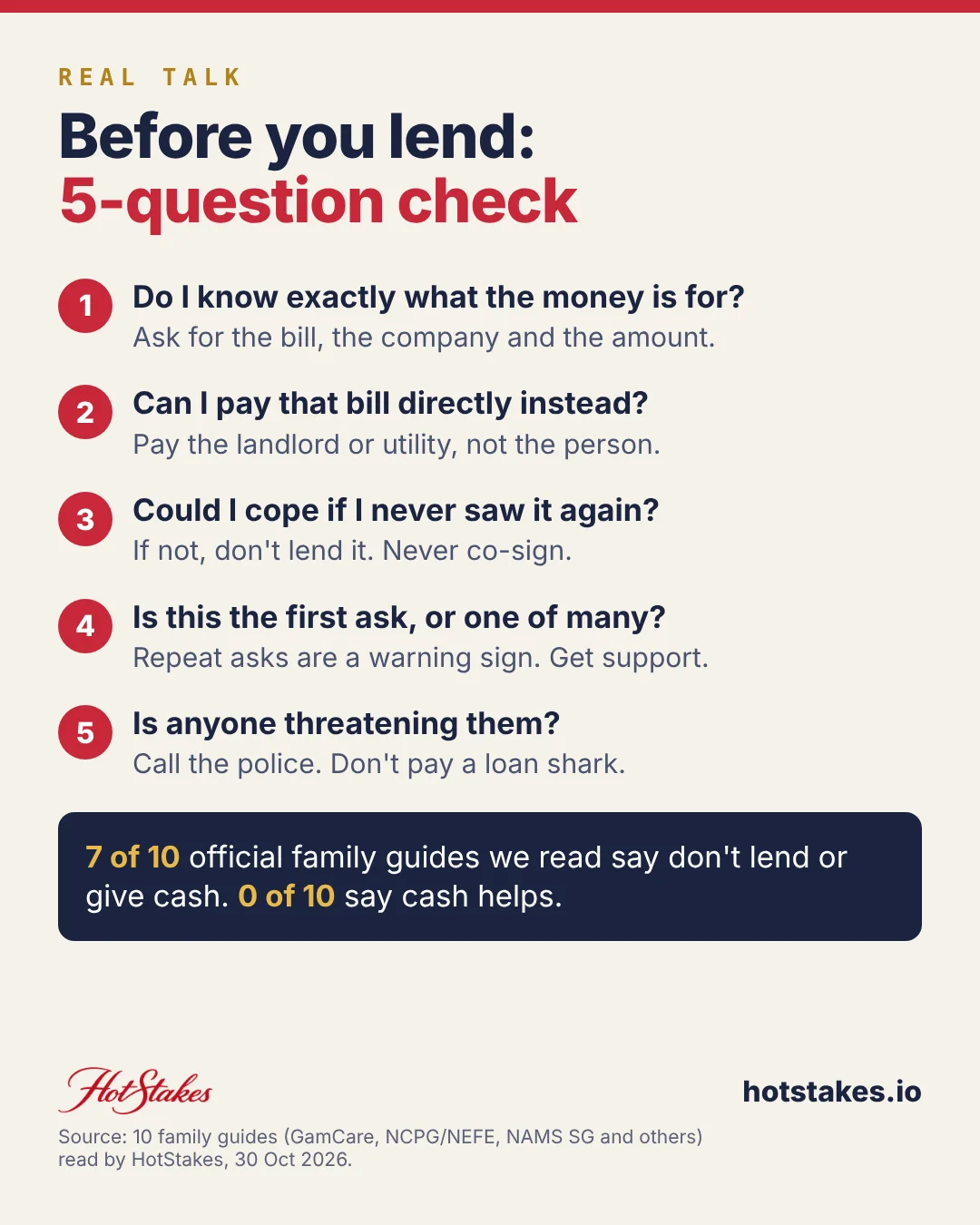
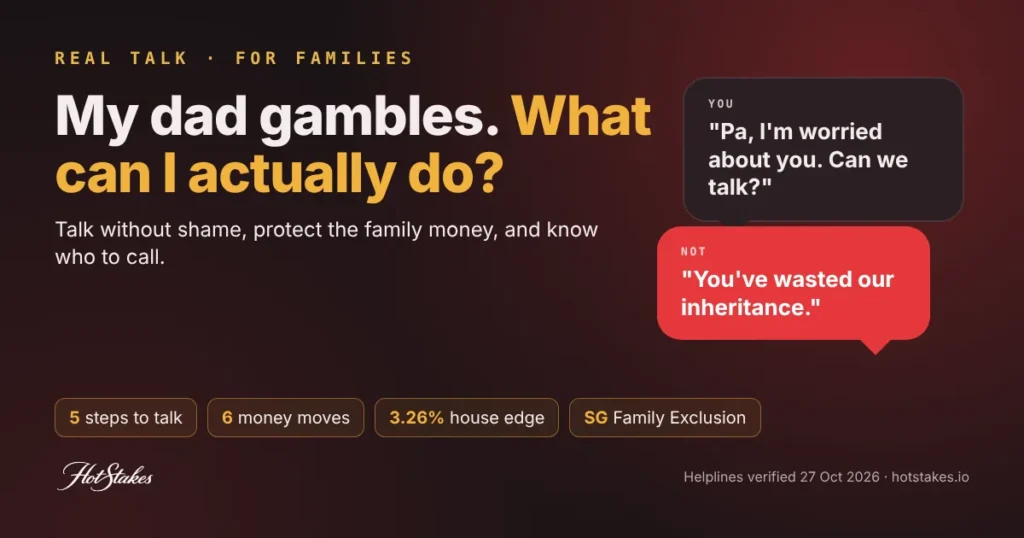
Usually not as cash. Cash can’t tell rent from a bet, and a loan to someone who is struggling with gambling often turns into a gift you both resent. On 30 Oct 2026 we read 10 official family guides from charities, health services and governments: 7 say don’t lend or give cash, and not one says cash helps. You can still help. Below: what to do instead, words for saying no, what to do about loan sharks, and verified family helplines across Asia.
We read 10 official family guides. Here’s what they say about money
Most articles on this question repeat one line: “don’t enable.” We wanted to see what the people who run helplines actually tell families. On 30 Oct 2026 we opened 10 pages and leaflets written for family and friends by gambling charities, health services and governments in the UK, US, Canada, Australia and Singapore. We noted what each says on four points.
| Source | Don’t lend or give cash? | Pay bills directly? | Protect your own money? | Support for you? |
|---|---|---|---|---|
| GamCare (UK charity) | Yes: lending “rarely helps in the long run” | Cautions: paying for them “isn’t a long-term solution” | Yes: freeze joint accounts, avoid guarantor deals | Yes |
| NCPG and NEFE handbook (US) | Yes: refuse bailouts, don’t co-sign | Yes: the non-gambler pays household bills | Yes: own accounts | Yes |
| Addictions Foundation of Manitoba (Canada) | Yes | Not covered | General only | Not on this page |
| Nebraska problem gambling service (US) | Yes: don’t lend or pay debts | Partly: take control of family finances | Yes: separate accounts | Yes |
| PEI Gambling Support (Canada) | Yes: “Do not give them cash” | Yes | Yes | Yes |
| Better Health Channel (Victoria, Australia) | No: allows help if paired with counselling and repayment | Yes: budget and direct debits | Yes: hold their cards | Yes |
| Gambling Help Queensland (Australia) | Not covered | Not covered | Yes: financial safety plans | Yes |
| Gambling Harm Support SA (Australia) | Not covered | Not covered | Not covered | Yes |
| National Addictions Management Service (Singapore, 2024) | Yes: “Refrain from lending money” | Not covered | Partly: credit counsellor referral | Yes |
| Changi General Hospital leaflet (Singapore, 2011) | Yes: “Do not give money” | Not covered | Yes: two signatures for withdrawals | Yes |
| Total | 7 of 10 | 3 of 10 (+1 partly) | 7 of 10 | 9 of 10 |
Two limits. This is a sample we chose, not every guide in the world. And we couldn’t find an English-language family money guide from an official body in Malaysia or Hong Kong, so neither is in the count.
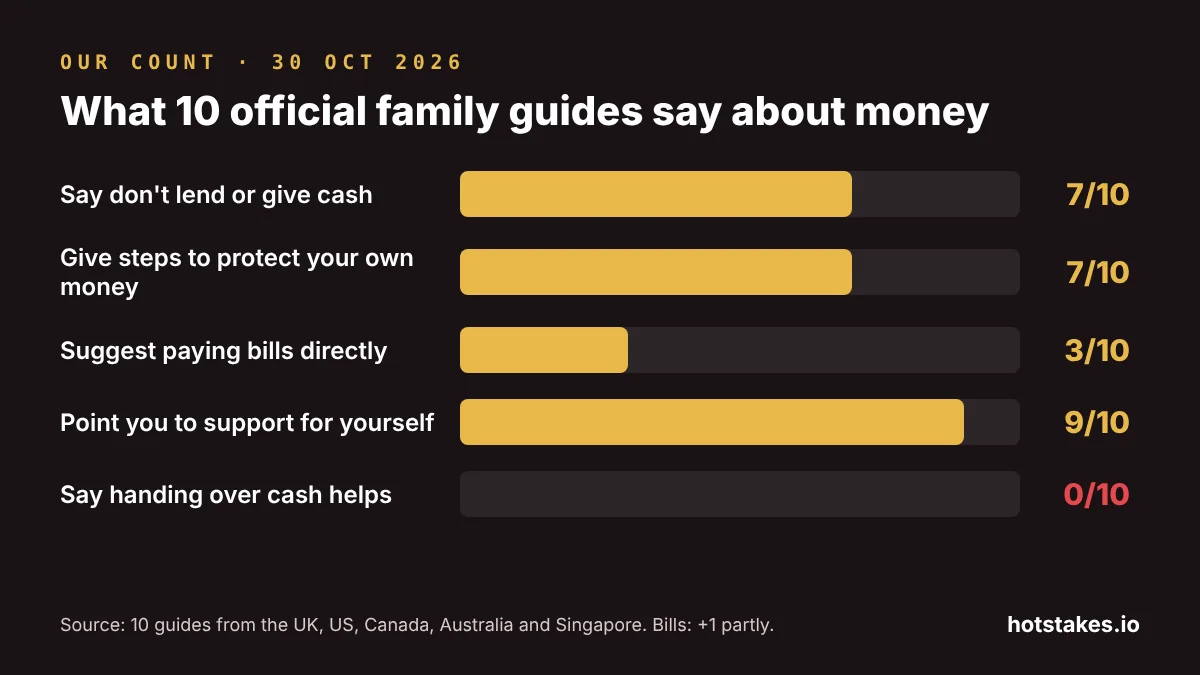
Takeaway: across five countries the advice was nearly the same. No cash, protect yourself, get support. Only one guide, Victoria’s, allowed a loan, and only with conditions.
Why cash usually makes things worse
Borrowing is built into how gambling problems are measured. One of the nine questions in the Problem Gambling Severity Index asks whether you have “borrowed money or sold anything to get money to gamble”. In Britain, 3.3% of adults who gambled in the past year said yes, at least sometimes.
And the people asked are usually family. A study of Australians found that a typical problem gambler affects six others, most often partners and children. A January 2026 GambleAware review estimates 8.1% of British adults are negatively affected by someone else’s gambling. It notes that paying off a loved one’s debts can erode trust and your own financial stability.
The Manitoba guide puts the core problem simply: if people are bailed out, they “don’t have to face the financial problems”. That’s not a judgement about character. It’s how the cycle keeps going.
Takeaway: a cash loan rarely fixes the problem it’s asked for. It often pays for the next bet, or for the debt that the last bet created.
What to do instead of handing over cash
Saying no to cash doesn’t mean letting the lights go off. Here’s what the guides suggest, in order.
- Ask what the money is for. Get the bill, the name of the company and the amount.
- Pay that bill directly. Pay the landlord, the utility or the school yourself. PEI’s guide says “pay the bills or make purchases directly”. Buy the groceries yourself rather than sending money for them.
- Don’t co-sign or act as guarantor. GamCare warns that being a guarantor or sharing a loan can tie your credit to theirs. The NCPG handbook says refuse to co-sign.
- Protect shared money. Open an account in your name only. Ask your bank whether a joint account can need both signatures. Turn on the bank’s gambling block if they agree; our guide to blocking gambling in online banking shows how.
- Point to free debt help. One high-interest debt usually sits beside others. A credit counsellor can see the whole picture. Our gambling debt guide covers the first steps.
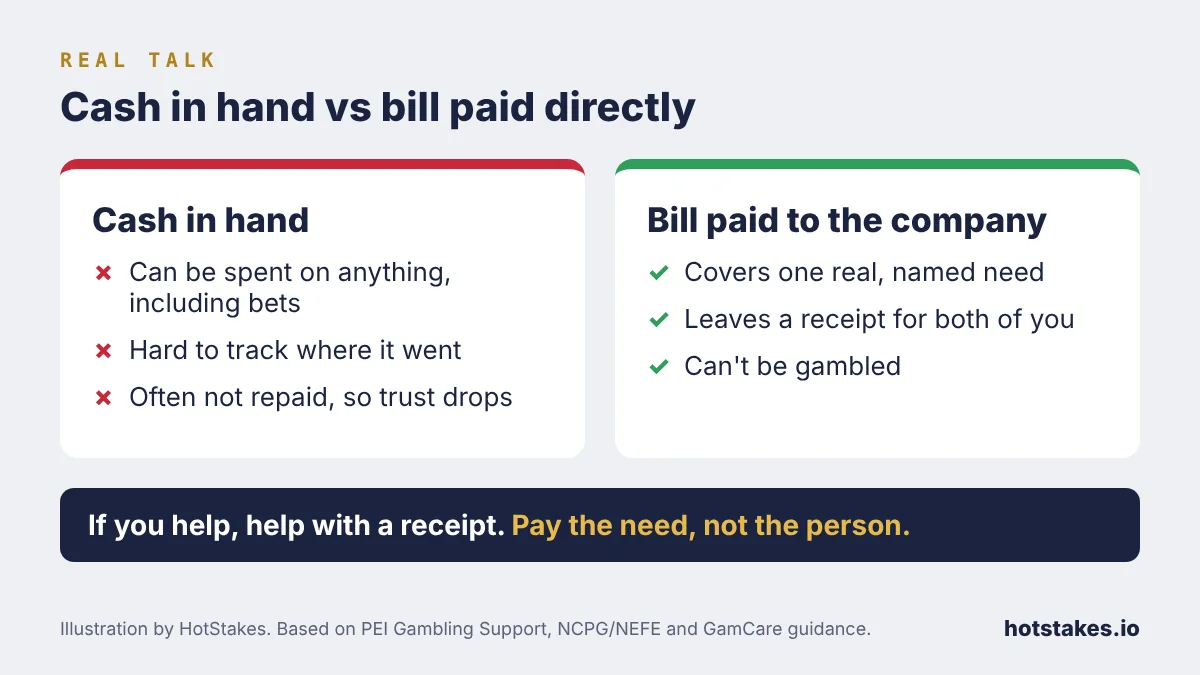
Takeaway: if you help, help with a receipt. Pay the need, not the person.
Say this instead: lines you can use
The hardest part is the conversation. These lines are ours, written to be kind and clear. Use them in your own words.
- Separate the person from the money. “I’m not saying no to you. I’m saying no to cash.”
- Offer the specific help. “Send me the electricity bill. I’ll pay the company directly.”
- Buy time when you’re pressured. “I don’t decide money things on the spot. Let’s talk tomorrow.”
- Keep the door open. “If you want to call a helpline, I’ll sit with you while you do.”
- When there are threats. “If someone is threatening you, I’ll go to the police with you. I won’t pay them.”
The NCPG handbook’s own suggested script includes a short, honest line: “I can’t bail you out again.” Expect anger or tears. That reaction doesn’t mean you were wrong.
Takeaway: say it once, calmly, and repeat the same words. You don’t have to win the argument.
What if they owe money to loan sharks?
This is where families feel most pressure, and where paying is most dangerous. Illegal lenders keep adding interest. In one Malaysian case reported in January 2026, a family first paid off a brother’s loans, hoping he would change. He was described as a compulsive online gambler. He fell back into debt of over RM30,000, and the family’s home was later splashed with paint.
In another Malaysian case, the head of a political party’s complaints bureau, Perak MCA, told families “Parents and relatives should not repay the loans”. GamCare adds that people who borrowed from loan sharks “have not done anything wrong”. The lender has.
- Don’t hand cash to the lender or to your relative for the lender.
- Report threats or harassment to the police. Singapore Police advise the public to stay away from loansharks and call 999; the X-Ah Long Hotline is 1800-924-5664. In Malaysia, police are reached through MERS 999, or make a report at a police station.
- Keep evidence. Screenshot messages, note dates and save photos of any damage.
- Get debt advice. In Malaysia, AKPK, listed by Bank Negara Malaysia, offers financial counselling and debt management on 1800 88 2575. In Singapore, Credit Counselling Singapore helps people with unsecured debt.
Takeaway: paying a loan shark doesn’t end the debt. It tells them who will pay next.
Saying no without cutting them off
You don’t have to choose between bailing them out and walking away. Researchers have tested an approach called CRAFT (Community Reinforcement and Family Training). It teaches family members to reward gambling-free time, step back from rescuing, and raise treatment at calm moments.
The evidence is encouraging, with limits. In a 2007 trial with 186 family members, people who used a CRAFT-based workbook did better on the gambler’s days of gambling and on whether their own needs were met. Every group improved in its own wellbeing. But the workbook didn’t increase how many gamblers entered treatment. A smaller 2016 trial found family distress fell, and two gamblers in each group (17.4%) had entered treatment by six months. Its authors note CRAFT teaches families to stop “paying bills for gamblers” and let consequences land.
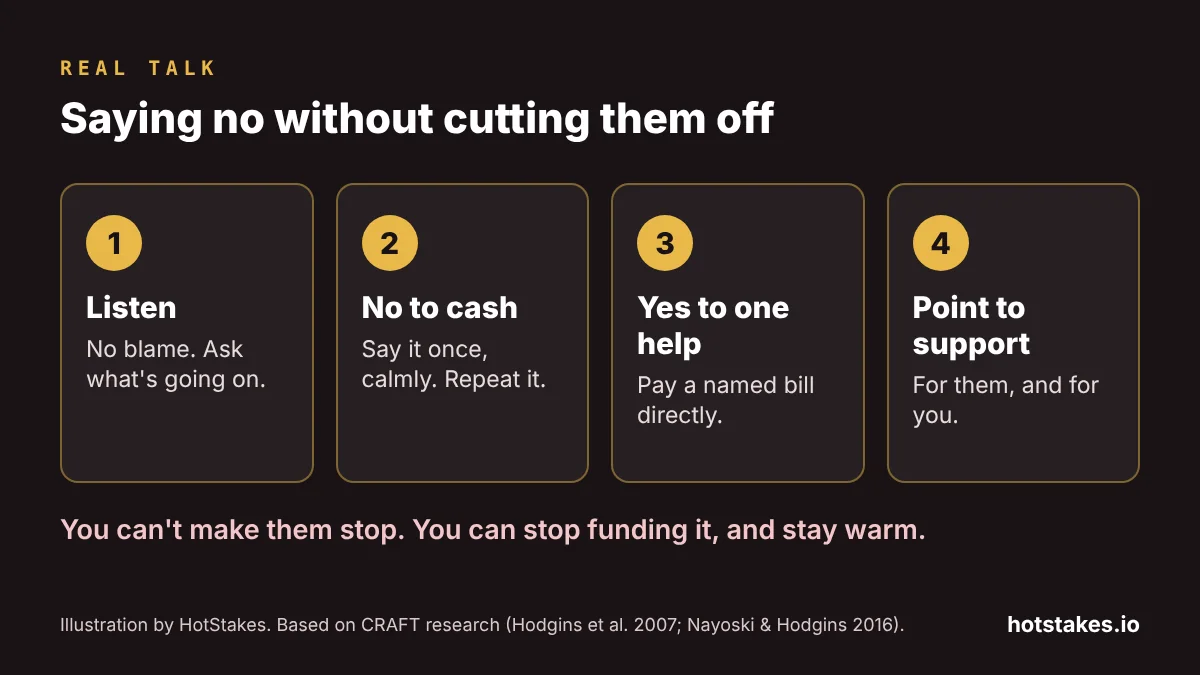
Takeaway: you can’t make someone stop. You can stop funding it, stay warm, and look after yourself. Our guides for when your partner has a gambling problem and when a parent gambles go deeper, and the signs of a gambling problem checklist helps you name what you’re seeing.
Look after yourself, too
Living with someone else’s gambling is stressful. Nine of our ten guides offered support for family members, not just for the gambler.
- Singapore: the NCPG helpline 1800-6-668-668 (8am to 11pm daily) and its webchat take calls about “someone you know”. NCPG also handles Family Exclusion Order applications.
- Peer support: Gam-Anon runs groups for relatives and friends, with virtual and international meetings listed on its site.
- Your own limits: decide in advance what you will and won’t pay for, and write it down.
Takeaway: getting help for yourself isn’t giving up on them. It keeps you steady enough to stay.
Help for families in Asia: numbers we verified today
We checked each number on an official or reputable page on 30 Oct 2026. Where we found no national gambling helpline, we list the national mental health line instead.
| Country | Gambling help | General counselling |
|---|---|---|
| Malaysia | No national gambling helpline found | Talian HEAL 15555 (Health Ministry, 8am to midnight) |
| Singapore | NCPG 1800-6-668-668, 8am to 11pm, also for family | Same line and webchat |
| Philippines | PAGCOR 02-8248-9568, 24/7, also for families | NCMH Crisis Hotline 1553 |
| Hong Kong | Gambling Counselling Hotline 183 4633, open to people affected by problem gamblers | Same line |
| India | No national gambling helpline found | Tele-MANAS 14416 or 1-800-891-4416, toll-free |
| Indonesia | No national gambling helpline found | Healing119: dial 119 ext. 8, 24 hours (Health Ministry) |
Takeaway: call for yourself, not only for them. If you’re unsure whether the gambling is a problem yet, start with our plain-language guide to whether gambling is bad for you.
FAQ
Should I lend money to someone who gambles?
Usually not as cash. Seven of the 10 official family guides we read on 30 Oct 2026 advise against lending or giving cash, and none says cash helps. If there’s a real need, pay that bill directly.
Is it OK to pay their rent or bills directly?
It’s safer than cash, because the money can’t be gambled. Three of the 10 guides suggest it. GamCare cautions it isn’t a long-term fix, so pair it with debt advice and support.
What if they owe money to loan sharks?
Don’t pay the lender for them. Report threats to the police, on 999 in Singapore and Malaysia, keep evidence, and get debt advice from AKPK in Malaysia or Credit Counselling Singapore.
Am I responsible for a family member’s gambling debts?
Usually only if your name is on the debt or you acted as guarantor, according to UK charity GamCare. Rules differ by country, so get local legal or credit advice.
Where can family members get support?
Singapore’s NCPG helpline 1800-6-668-668 takes calls about someone you know. Hong Kong’s 183 4633 and the Philippines’ PAGCOR line 02-8248-9568 also help families. Gam-Anon runs virtual meetings.
HotStakes is an independent directory. Some links on this site are affiliate links; we may earn a commission at no cost to you, and it never changes our rankings. Gambling involves risk — only play with money you can afford to lose, and if it stops being fun, seek help. This article is general information, not legal advice. Read our full disclaimer.
 Next story →A6STAR Review 2026: Licence, Bonus Terms & Safety Check


Start the discussion