

Gambling Recovery Stories: What Actually Helped People Quit
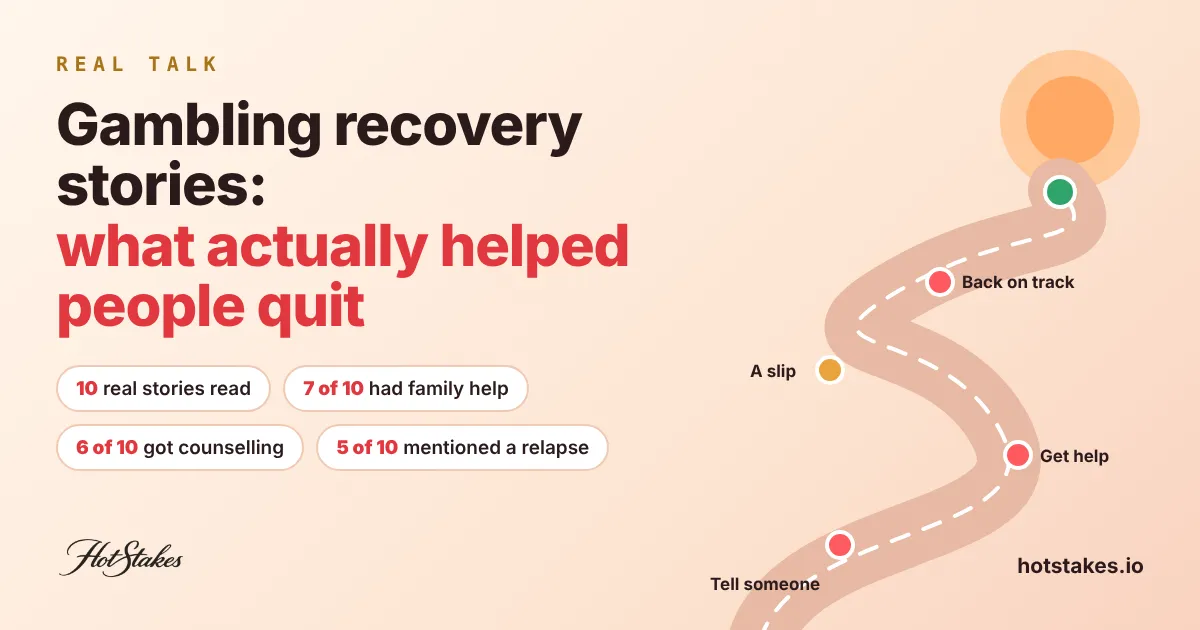
We read 10 real gambling recovery stories from Asia and counted what helped. Family, counselling and peer groups led. Half mentioned a relapse.
In this article
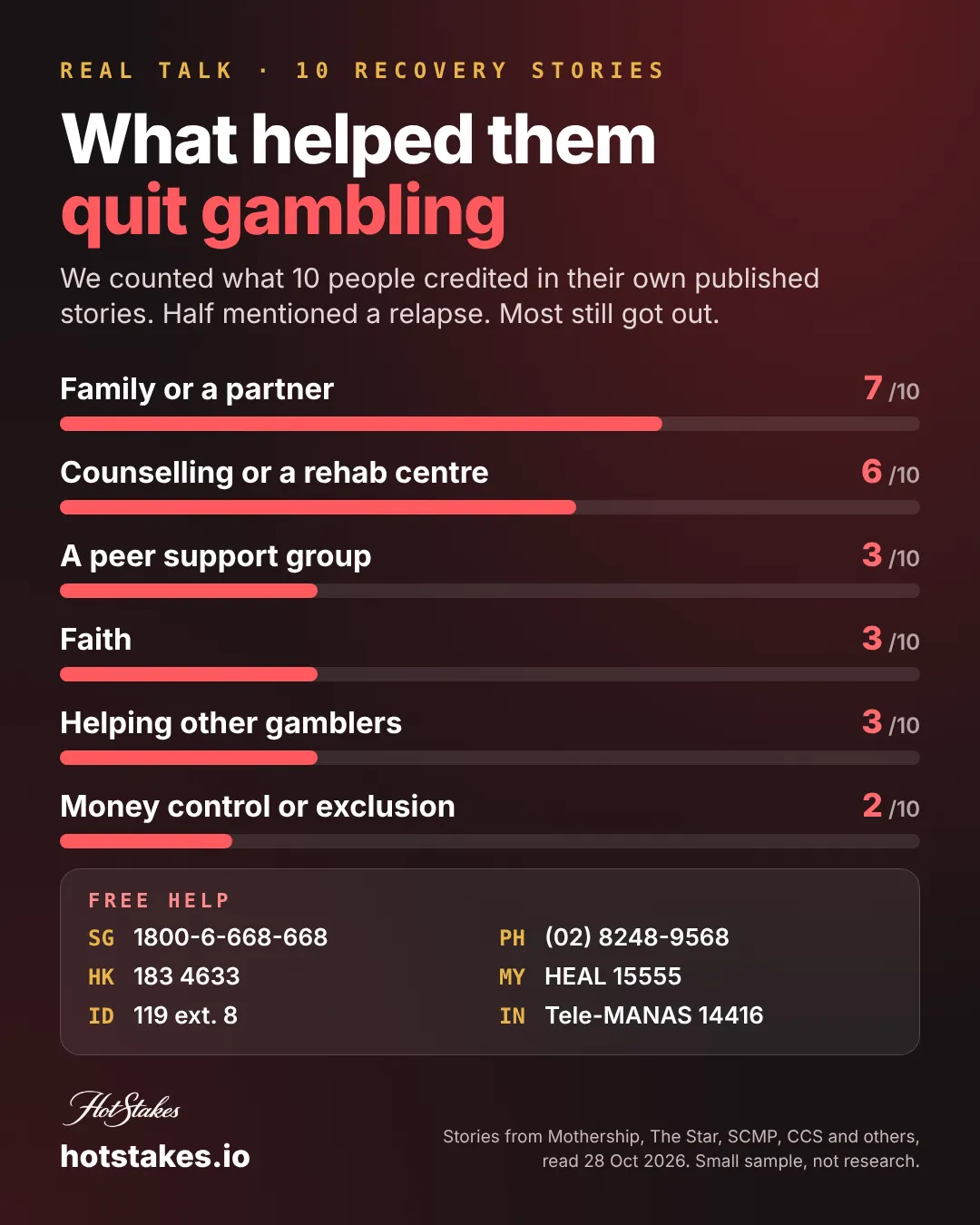
We read 10 gambling recovery stories that people in Singapore, Malaysia, Hong Kong and the Philippines told publicly, and counted what helped them stop. Seven of the ten involved family or a partner, six got counselling, and five mentioned slipping back. None of them credit willpower alone. They told someone, got help, and changed the money and the people around them. If you want to quit, or you love someone who gambles, here is what worked for them, story by story, plus a verified helpline for six countries.
Below: the 10 stories in one table, the tally, what the research adds, a first-week plan and where to call.
The 10 gambling recovery stories we read
On 28 Oct 2026 we opened every story below and coded it ourselves. We only used accounts people chose to tell publicly: to a newspaper, to a charity, or on a named profile. We use names only where the person or outlet published them. Where the outlet used a pseudonym or no name, so do we.
Be clear about what this is. It is a small, non-random set of published stories, not a study. People who tell their story in the news are often further along, and outlets pick dramatic ones. Treat the counts as a pattern worth noticing, not a statistic.
| Story (as published) | Where | What pulled them in | Turning point | What helped | Relapse? |
|---|---|---|---|---|---|
| “Ah Ying”, 55 (Mothership, May 2026) | Singapore | Casino ship, later online gambling | Her sister’s blunt ultimatum to get help | Sister and husband, counselling, weekly group, volunteering | Not mentioned |
| A Singaporean man, unnamed (Mothership, Jun 2026) | Singapore | Football bets during national service, early wins | Reached his lowest point and asked a charity for help | Two rounds of counselling, a partner who brought him back | Yes |
| “James”, 25 (The Star, Jun 2026) | Malaysia | Online platform, aimed to make RM100 a day | Ran out of money and told his parents | Parents, a rehab centre | Not mentioned |
| Raymond Lim (Everyday People, Yahoo) | Singapore | Sports betting with friends, the “high of winning” | Came clean to his partner, a mentor and two friends | Partner, cut up cards, self-exclusion, new friends, work, faith | Yes |
| “John”, 45 (Credit Counselling Singapore, Jan 2024) | Singapore | Entertaining clients at casinos, roulette | Saw a debt charity online and called | Debt plan and budget, gambling counselling, casino exclusion order, some family help | Not mentioned |
| Sow, 35 (Straits Times via The Star, Nov 2024) | Singapore | Football at 15, illegal sites with S$500 free credit | Lenders harassed his wife; his in-laws said stop | Peer support group, faith, his partner | Yes, twice |
| “Ken Chan” (SCMP via The Star, Jun 2026) | Hong Kong | Legal football bets, then Telegram tip groups and illegal sites | Bankruptcy in 2023 | Counselling, social workers, bass guitar, a football team | Still bets smaller sums |
| Mark Lee, actor (NCPG video, 2019) | Singapore | 4D, the thrill of winning | His mother’s words | His mother | Not mentioned |
| Bryant Leong (Christianity Malaysia, Apr 2026) | Malaysia | Occasional bets that became a habit | A low point at home, then faith | Rehab programme, faith, helping others | Yes |
| “Pedro”, 30 (Cover Story PH) | Philippines | Carnival games as a child, influencers posting wins | His life was being affected | A peer support group (first session) | Not mentioned |
Takeaway: these are ordinary people: a sales director, a cyber-security worker, a student, a 55-year-old woman, an actor. Different games, same exits.
What helped them quit: the tally
We counted each thing that the story itself credited with helping. One story can count in several rows.
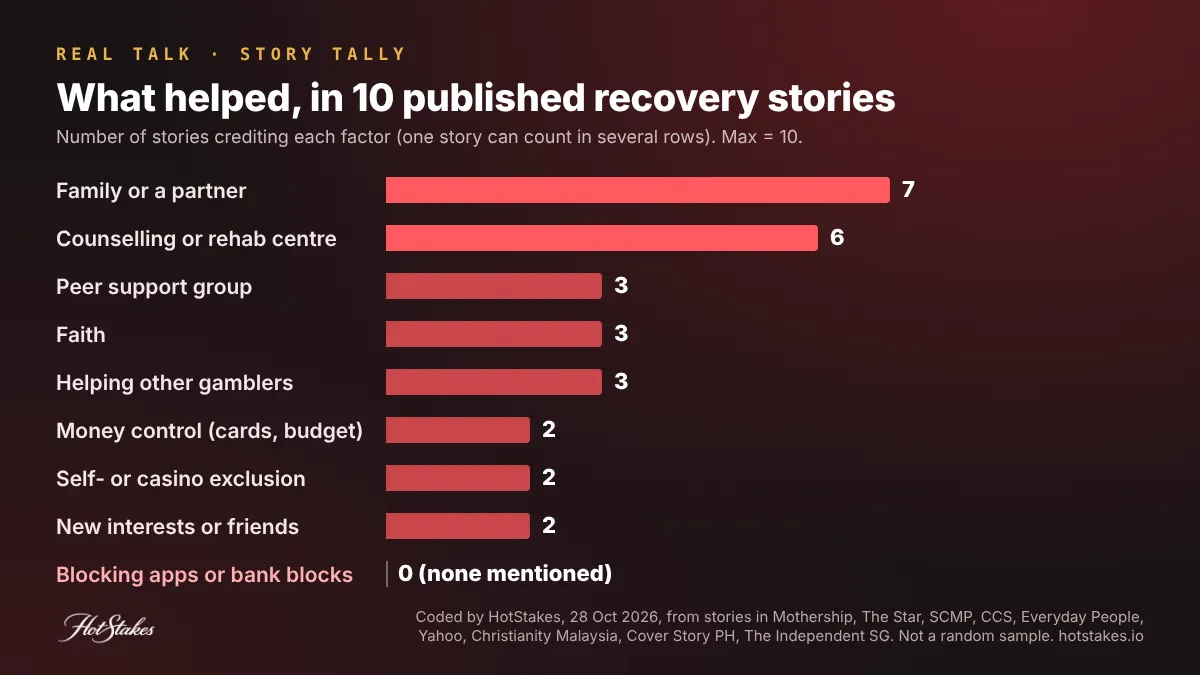
- Family or a partner (7 of 10). Often it started with telling one person. “James” came clean to his parents when the money ran out: “I didn’t want to let my family and partner down”. For Mark Lee, it was his mother.
- Counselling or a rehab centre (6 of 10). Charities like Blessed Grace Social Services, Credit Counselling Singapore and Hong Kong’s counselling centres show up again and again.
- A peer group (3 of 10). Sow had tried two groups before one worked. In the one that did, “I could feel the love from other members of the group.”
- Faith (3) and helping others (3). Ah Ying now volunteers and visits prisons. Raymond Lim and Bryant Leong support other gamblers.
- Money control (2) and exclusion (2). Raymond Lim cut up his credit cards and joined self-exclusion. “John” used a debt management plan and a casino exclusion order.
- New people and new interests (2). Raymond Lim says “the key to recovery is choosing your friends.” “Ken Chan” took up bass guitar and joined a football team.
One gap stood out. Not one of the 10 stories mentioned blocking apps or bank gambling blocks, even though most involved online betting. Those tools are cheap and fast. Our guide on how to block gambling sites and payments walks through them.
Takeaway: the stories rarely credit willpower alone. They credit people: a family member, a counsellor, a group.
What pulled them in
The hooks were strikingly similar, and worth knowing because they come back as urges later.
- Early wins or the thrill of winning (5 of 10). “John” told Credit Counselling Singapore: “At first, I was happy when I placed bets and won.”
- Online betting (6 of 10), often illegal sites, sometimes after starting with a legal one.
- Free credit or welcome rewards (3 of 10). Sow started on illegal sites with S$500 of free credit. “Ken Chan” described trying to collect every site’s welcome offer.
- Chasing losses. The unnamed Singaporean man said “All I could think about was placing the next bet”.
If those lines sound familiar, our signs of a gambling problem checklist is a calm place to start.
Takeaway: a win, a free credit and an app in your pocket is how most of these stories began.
Recovery is not a straight line
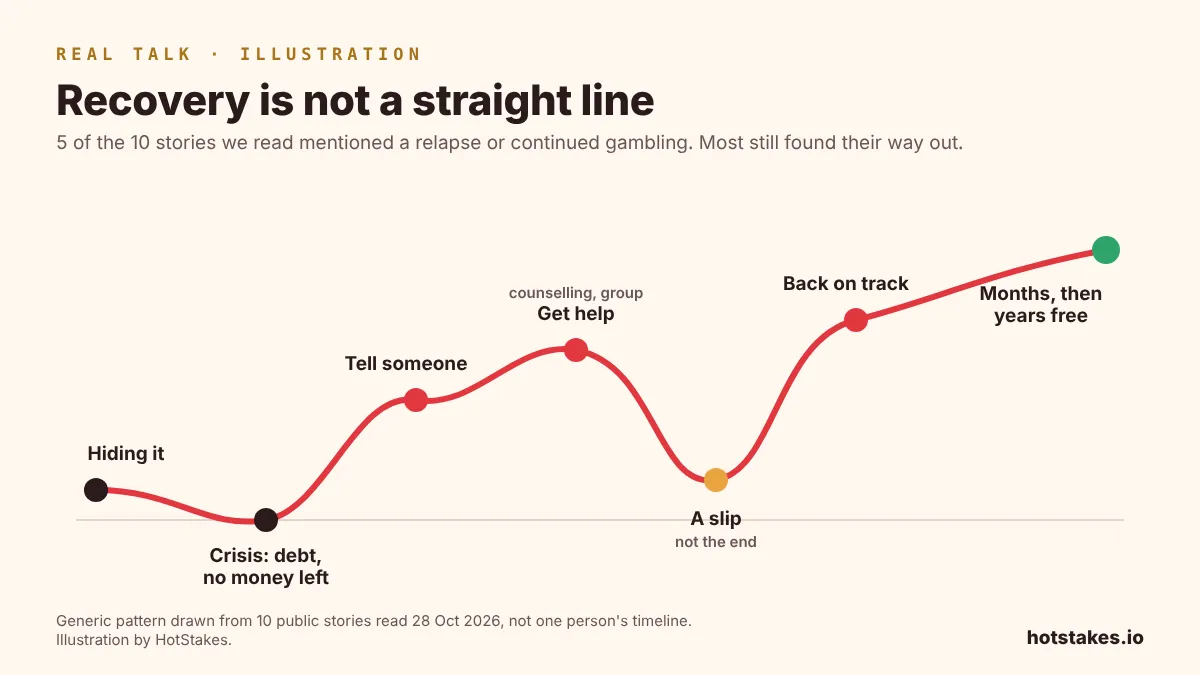
Five of the 10 stories mentioned a relapse or continued gambling. The unnamed Singaporean man’s first eight months after counselling went well. Then he lost S$500,000 on one basketball bet. His partner brought him back for a second round, and his debts have since been cleared. Sow relapsed twice in his first year in a support group. He has not gambled for six years.
“Ken Chan” is the honest outlier. After counselling, he still bets a few thousand Hong Kong dollars a month and calls it “even harder to quit than drug addiction”. Recovery for some people is still in progress.
Research says the same, with more people:
- Many people do recover. In two US national surveys, Slutske (2006, American Journal of Psychiatry) found 36 to 39% of people with a lifetime history of pathological gambling had no problems in the past year. Only 7 to 12% had ever sought treatment or Gamblers Anonymous, so about a third recovered without formal treatment.
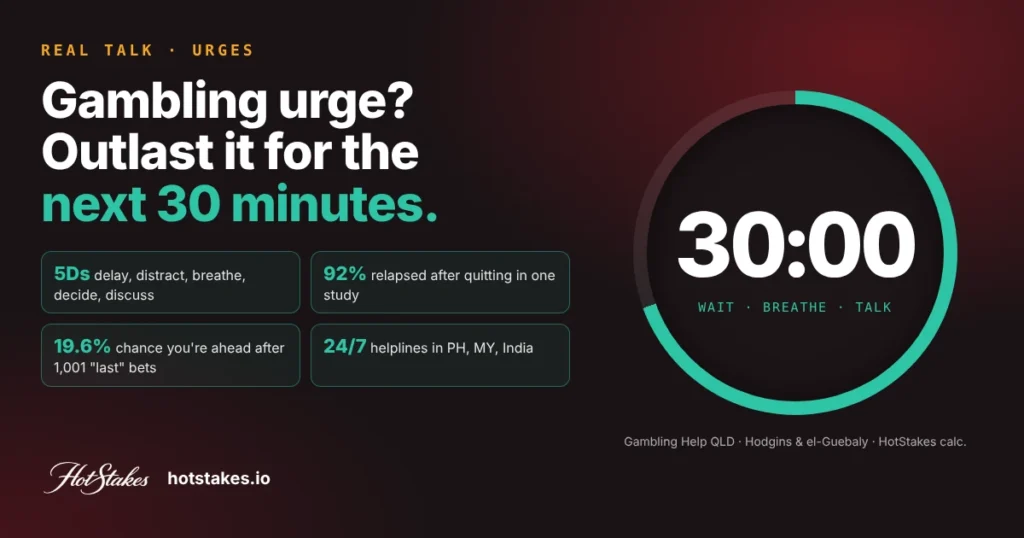
- Relapse is common. A 2026 systematic review by Torrance and colleagues in Addiction Research & Theory says relapse “is common” in people treated for gambling disorder. Studies report rates from about 22% to 92%, partly because they define relapse differently.
- The same review found protective factors that echo our tally: family support, meaningful activities and going to self-help meetings.
One caution: recovering without treatment does not mean you should go it alone. It means getting out is common. Help makes it more likely to stick.
Takeaway: a slip is information, not a verdict. Most stories that ended well had one.
If you are the family: what the stories say about you
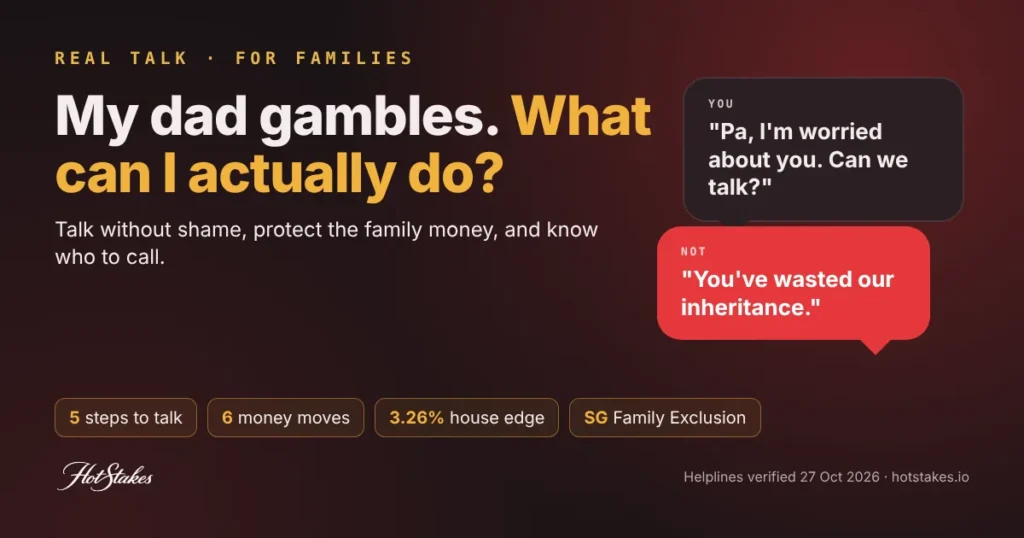
In these stories, family was the most common turning point, but not always gently. A sister gave an ultimatum. In-laws drew a line. A mother said one hard sentence. Partners stayed, set conditions, or brought someone back to counselling.
- Your words can land, even if not the first time. Mark Lee said “I ignored advice from everyone.” Then his mother’s words got through.
- Protect money first. Several families lost savings. Our guides for a partner with a gambling problem and for a parent who gambles cover what to do.
- In Singapore, families can apply for a Family Exclusion Order through the National Council on Problem Gambling.
Takeaway: you cannot quit for them, but in these stories family was the turning point more often than anything else.
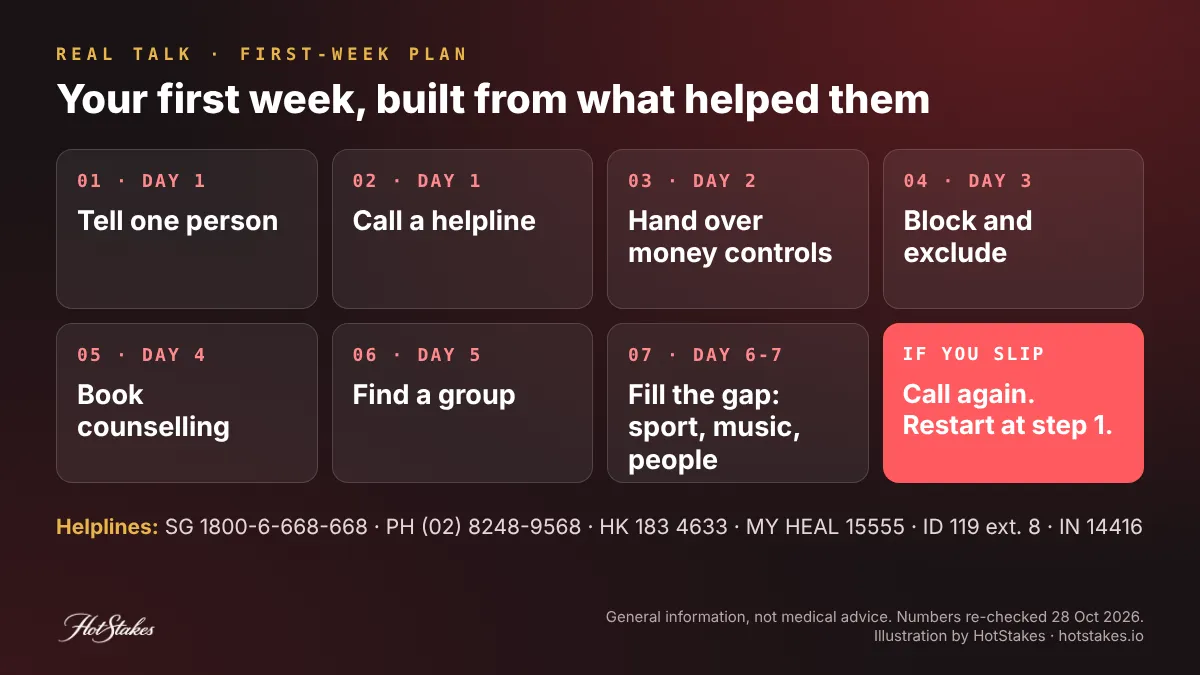
A first week, built from the stories
This is not a treatment plan. It is the order things happened in the stories that went well, turned into steps. If you are unsure whether to stop, read should I quit gambling? first.
- Day 1: tell one person. A partner, a parent, a sibling, a friend. Every family-led story started here.
- Day 1: call a helpline from the table below. It is free and confidential.
- Day 2: hand over the money controls. Cards, banking app limits, a joint account. If debt is crushing, see our gambling debt guide.
- Day 3: block and exclude. Self-exclusion where it exists, app blockers, bank gambling blocks.
- Day 4: book counselling. Six of the 10 stories credited it.
- Day 5: find a group. Peer support helped Sow and Ah Ying. It may take more than one try.
- Days 6 and 7: fill the gap. The hours you gambled need a new use: sport, music, work, people. Our guide on what to do when an urge hits helps here.
Where to get help
We re-checked each line on 28 Oct 2026. Where we could not find a national gambling helpline, we say so and list the government-backed general line. If you are in immediate danger, call your local emergency number.
| Country | Who to call | Source |
|---|---|---|
| Singapore | NCPG National Problem Gambling Helpline 1800-6-668-668 (8am to 11pm daily), plus webchat, self-exclusion and Family Exclusion Orders | MSF / NCPG |
| Malaysia | No national gambling helpline found. HEAL 15555 (national mental health line); Befrienders KL 03-7627 2929 (24 hours) | Malay Mail, Befrienders |
| Philippines | PAGCOR National Problem Gambling Helpline (02) 8248-9568, 24/7 since May 2026; NCMH Crisis Hotline 1553 | Manila Bulletin, Manila Bulletin (DOH) |
| Hong Kong | Gambling counselling hotline 183 4633 (four counselling centres funded by the Ping Wo Fund) | HKSAR Government |
| Indonesia | No dedicated gambling helpline found. Healing119: call 119 ext. 8 or use healing119.id (24 hours, Ministry of Health) | Kemenkes |
| India | No national gambling helpline found. Tele-MANAS 14416 (free, 24×7, Government of India) | JIPMER |
For the bigger picture on harm, our pillar guide is gambling bad for you? covers money, mood and family.
Takeaway: in these stories, asking for help was the step that changed things.
FAQ
Can people really quit gambling?
Yes. Most people in the 10 stories we read describe stopping; one still bets smaller sums and one had just joined a group. A study of two US national surveys found 36 to 39% of people with a lifetime history of pathological gambling had no problems in the past year.
What helps most when quitting gambling?
In our small sample of 10 published stories, family or a partner (7), counselling (6), and a peer group, faith or helping others (3 each) came up most. A 2026 review also lists family support, meaningful activities and self-help meetings as protective.
Is relapse normal in gambling recovery?
Relapse is common. Half of the stories we read mentioned one, and a 2026 systematic review says relapse is common among people treated for gambling disorder. A slip does not erase progress. Contact your counsellor or helpline and restart the plan.
Can you quit gambling without treatment?
Some people do. In two US national surveys, about a third of people with a past gambling disorder had recovered without formal treatment. Counselling and support groups still help many people, and helplines are free, so there is no reason to go it alone.
How can family help someone stop gambling?
Speak plainly, protect shared money, and point them to a helpline or counsellor. In the stories we read, a parent, sibling or partner was the turning point more often than anything else. In Singapore, families can also apply for a Family Exclusion Order.
HotStakes is an independent directory. Some links on this site are affiliate links; we may earn a commission at no cost to you, and it never changes our rankings. Gambling involves risk — only play with money you can afford to lose, and if it stops being fun, seek help. This article is general information, not legal advice. Read our full disclaimer.
 Next story →Siam66 Review 2026: Licence, Bonus Terms & Safety Check

Start the discussion