

Chasing Losses Gambling: How to Stop (We Ran the Maths)
Lost money and want to win it back? We simulated 1M roulette nights: chasing deepens the loss. The maths, a self-check and a 10-minute plan.
In this article
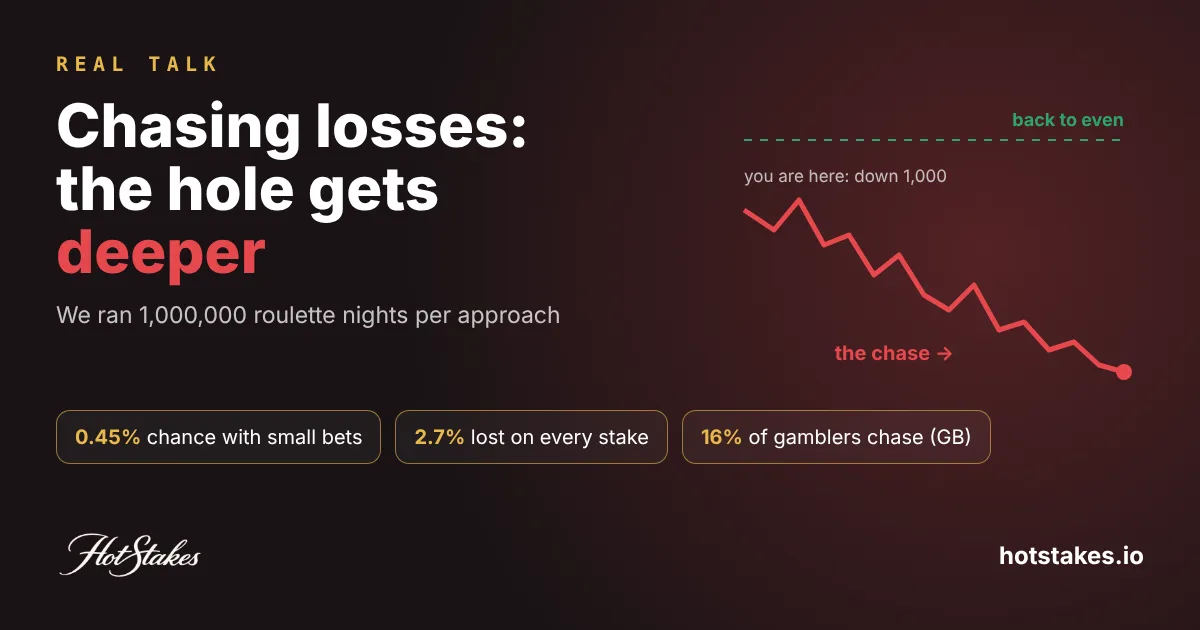
Chasing losses means gambling more to win back money you just lost. Sometimes it works for one night. On average it makes the hole deeper, because every extra bet carries the same house edge. We simulated one million roulette nights per approach to measure it, and the most “careful” way to chase was the worst. If you are down right now, the single best move is to stop the next bet, not plan it. Below: the maths, why your brain pushes you to chase, a quick self-check, and what to do in the next 10 minutes.
What chasing losses actually is
Researchers define loss chasing as “the tendency to continue and/or intensify gambling following losses”. A 2023 systematic review in Neuroscience and Biobehavioral Reviews found it shows up in two shapes:
- Within a session: bigger stakes, riskier bets or faster play straight after a loss.
- Between sessions: coming back another day to get the money back, often with higher stakes.
That second shape is a recognised warning sign. The DSM-5 criteria for gambling disorder list it word for word: “After losing money gambling, often returns another day to get even”. It is one of nine criteria. A diagnosis needs four or more within 12 months, and only a trained professional can make it.
The Problem Gambling Severity Index (PGSI), the questionnaire used in national surveys, asks it too: “Have you gone back on another day to try to win back the money you lost?”
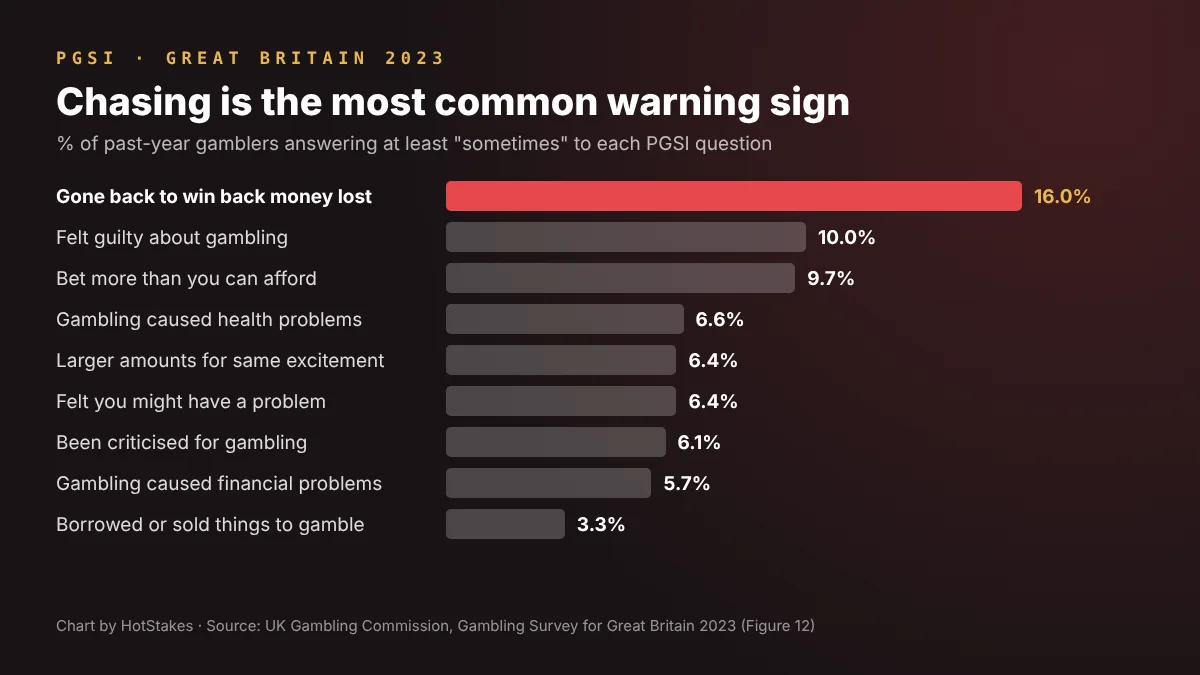
How common is it? In the UK Gambling Commission’s Gambling Survey for Great Britain 2023, 16.0% of people who had gambled in the past year said they chased at least “sometimes”. That made it the most common of the nine PGSI items, ahead of feeling guilty (10.0%) and betting more than you can afford (9.7%).
Takeaway: Chasing is not a character flaw or a rare extreme. It is the most common early warning sign, and it is worth taking seriously the first time you notice it.
Can you win it back? We ran the maths
On 31 Oct 2026 we wrote a short Python simulation. Here is the setup:
- Game: European (single-zero) roulette, betting on red. You win 18 times in 37 and get paid 1:1. That gives the house an edge of 2.7%, one of the lowest in a casino.
- Situation: you are already down 1,000 and have 2,000 left. Use any currency, the maths doesn’t change.
- Goal: get back to even, then stop. Each run ends when you get there or can’t cover the next bet.
- Size: 1,000,000 runs per approach. For the three rows that have an exact formula (gambler’s ruin), our results matched it to within 0.1 percentage points.
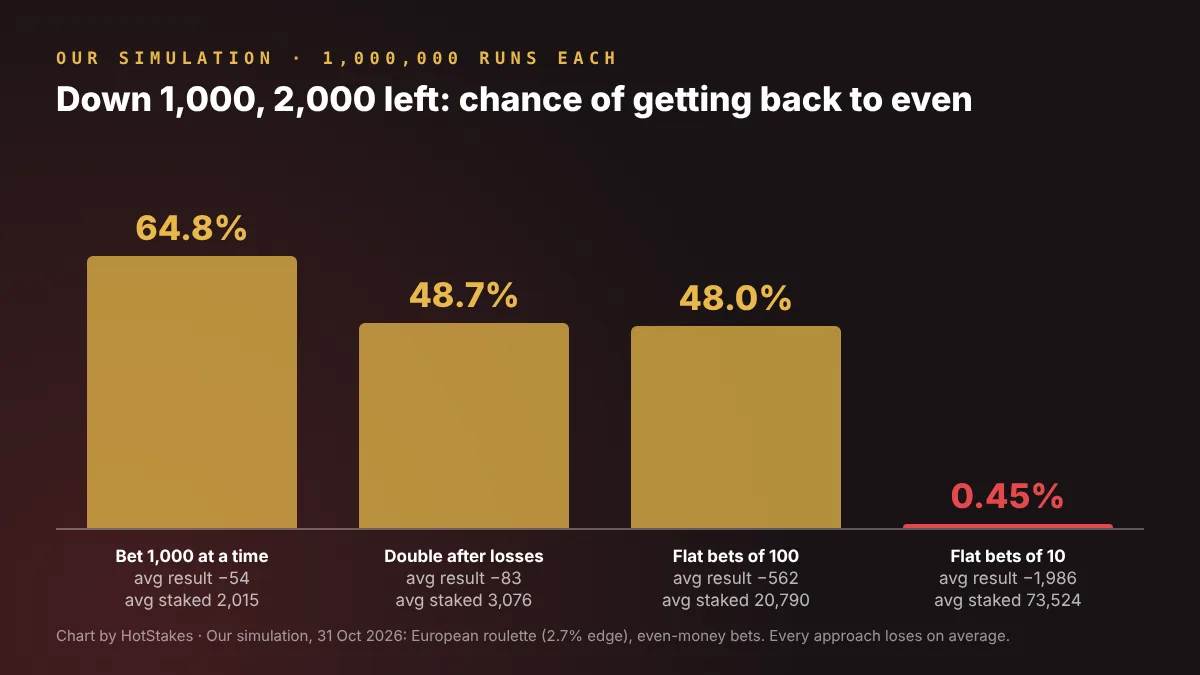
| How you chase | Chance of getting back to even | Average result of the chase | Average total staked | If it fails |
|---|---|---|---|---|
| Bet 1,000 at a time | 64.8% | −54 | 2,015 | You lose all 2,000 (down 3,000 on the night) |
| Double after every loss, starting at 100 | 48.7% | −83 | 3,076 | You lose about 1,109 on average |
| Flat bets of 100 | 48.0% | −562 | 20,790 | You lose all 2,000 |
| Flat bets of 10 (“careful”) | 0.45% | −1,986 | 73,524 | You lose all 2,000 |
HotStakes simulation, 31 Oct 2026. European roulette, even-money bets, 1,000,000 runs per row. This is a model of the maths, not a betting strategy. Every row loses money on average.
Why the careful approach is the worst
Look at the “average result” and “total staked” columns together. In every row, the average loss is almost exactly 2.7% of what was staked.
That is the whole story. The house edge charges a small fee on every bet. Small bets don’t lower the fee. They make you play longer, so you pay it many more times. At 10 per spin, the average chaser pushed over 73,000 across the table to try to win back 1,000. The edge ground them down 99.5% of the time.
The bigger-bet rows only look “better” because they end fast. They also turn a 1,000 loss into a 3,000 loss more than a third of the time. That is not a fix. It is a faster coin toss with worse stakes. Doubling up (the “Martingale”) fails the same way. One ordinary losing streak breaks it. For the bigger picture, see why the house always wins.
What about slots?
Same rule, harder edge. A slot with 96% RTP keeps about 4% of everything you spin through it over time. Chase 1,000 by cycling 10,000 through the reels and the expected cost is about 400, before the swings. Past spins don’t change that either, as our test in is a slot due to hit? shows.
Even “winning it back” is a trap
The best possible outcome of a chase is zero. You are back where you started, after hours of stress. And the brain that just “won” is now primed to keep playing. The table assumes you stop the moment you get even. In the moment, that is the hardest part.
Takeaway: You can’t out-bet the house edge. Chasing raises how much you stake, and how much you stake decides how much you lose.
Why your brain wants to chase anyway
If the maths is this clear, why does chasing feel so reasonable in the moment? A few reasons are well studied.
- Losses change how we take risks. Neuroscientists point to prospect theory: people get more risk-seeking when they feel behind. A 2013 review in the Journal of Neuroscience says this “may account for the ‘loss chasing’ behavior” seen in problem gambling.
- The loss feels temporary. As long as you keep playing, the money doesn’t feel gone yet. Stopping makes it real.
- Apps and offers push the same button. “Win back” offers, cashback and VIP messages land right after a loss. We took them apart in casino win-back offers.
Real-world data adds a twist. A University of British Columbia team analysed 1,909,681 online casino sessions from 15,544 players. Within a session, gamblers “bet more and played longer sessions after immediate losses”. Between sessions, the same team found “limited evidence for loss chasing”. Most players came back more slowly after a losing visit and faster after a winning one.
So the danger zone is the minutes right after a loss. Chasing a win (playing on because you are “hot”) is real too.
Takeaway: The pull to chase is strongest straight after a loss, and the data suggests it eases with distance. That’s why the next 10 minutes matter so much.
Self-check: is chasing becoming a pattern?
These questions are drawn from the PGSI, the DSM-5 chasing criterion and the behaviours in the 2023 review. Answer honestly for the past 12 months. This is not a diagnosis.
- Have you gone back another day to try to win back money you lost?
- After a loss, do you raise your stake or switch to riskier bets?
- Do you play faster, or longer than you planned, after a losing spin or hand?
- Have you borrowed, used credit or moved savings to keep chasing?
- Have you hidden how much you’ve lost so you could “fix it” first?
One “yes” is a signal to slow down. Two or more, or any borrowing, is a good reason to talk to a helpline. For the full nine-question version, use our 2-minute gambling self-check.
Takeaway: Noticing the pattern early is the cheapest point to stop it.
Lost money? What to do in the next 10 minutes
You don’t need a perfect plan, just to get through the next few minutes without placing another bet.
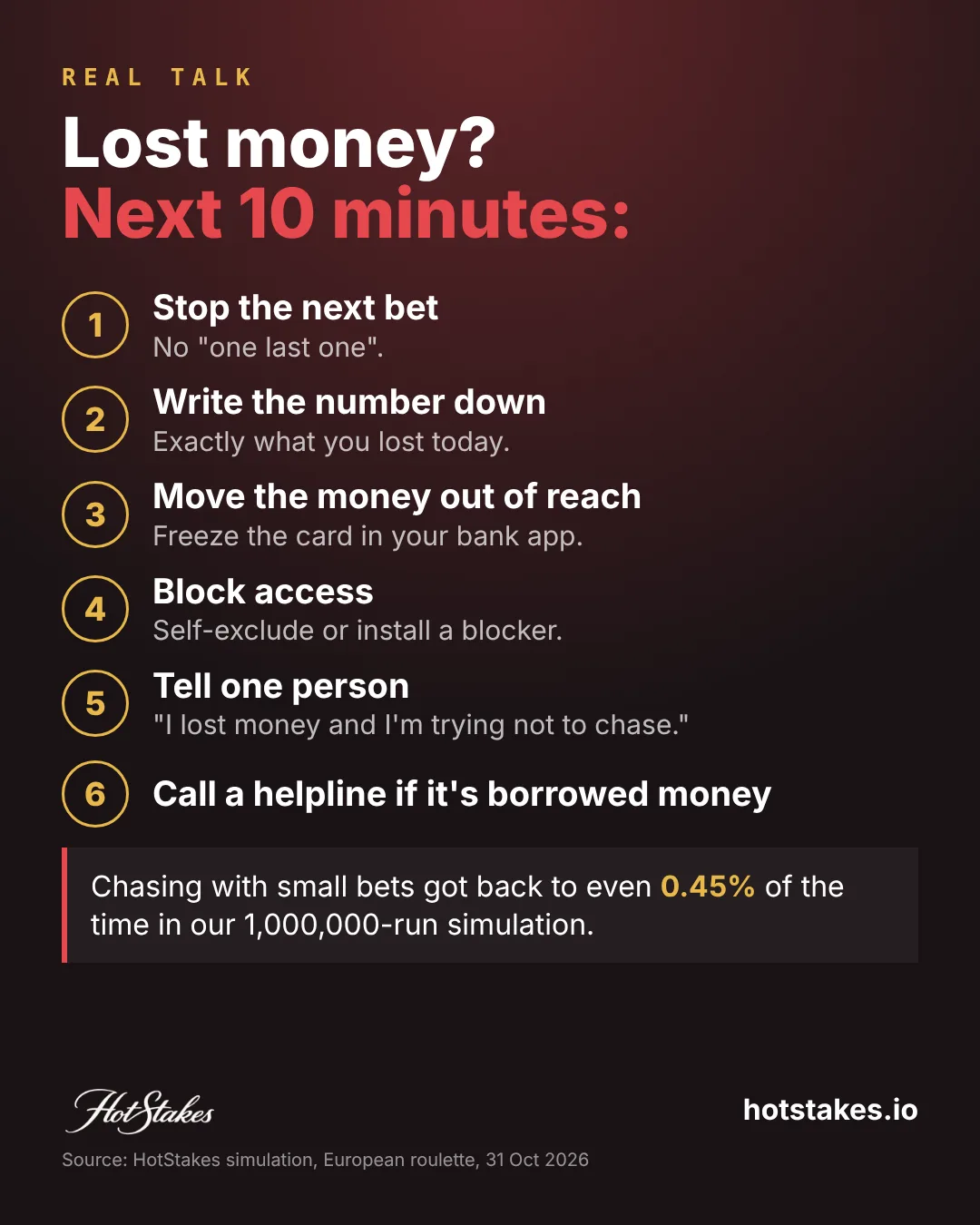
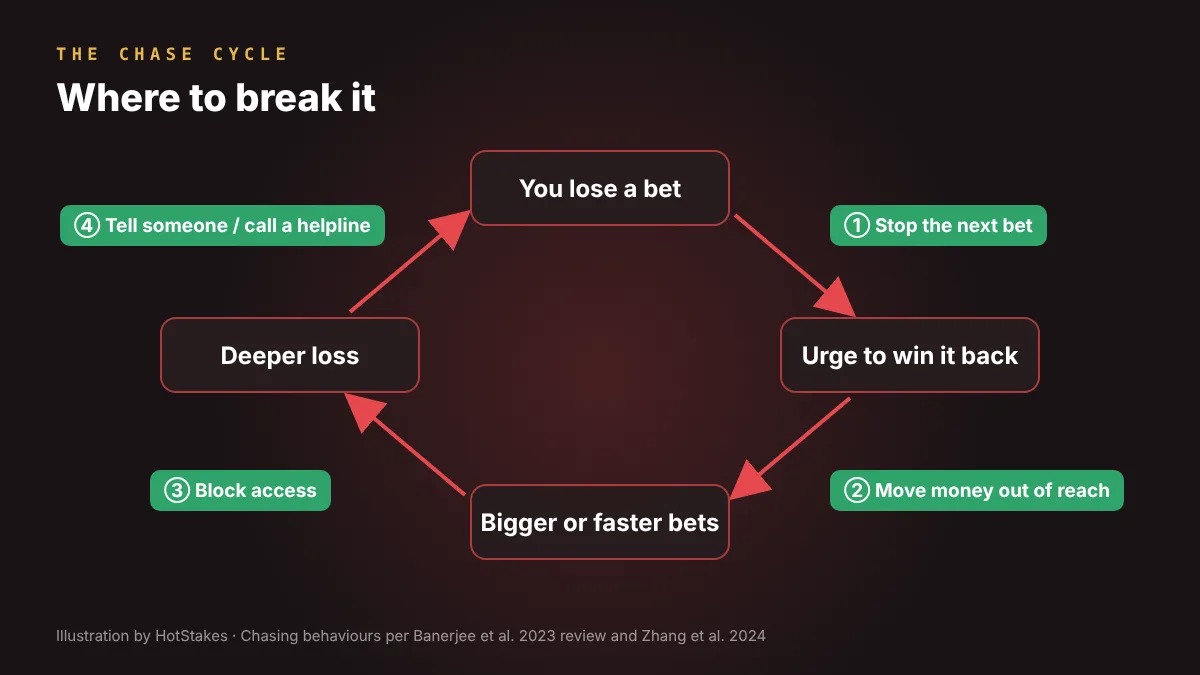
- Stop the next bet. Close the app or walk away from the table now. Don’t play “one last one”.
- Write the number down. Exactly how much you lost today. Seeing a real number makes it harder to pretend one more bet will fix it.
- Move the money out of reach. Move what’s left out of the account you gamble from, or freeze the card in your banking app.
- Block the door. Self-exclude or install a blocker while the resolve is fresh. Our self-exclusion guide walks you through it.
- Tell one person. Send a message to someone you trust: “I lost money gambling and I’m trying not to chase it.”
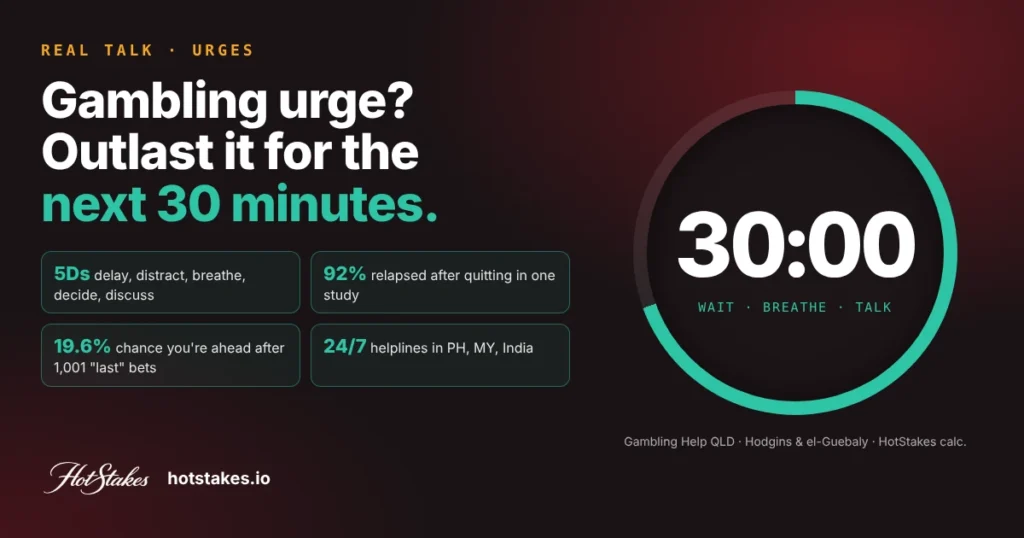
- Change where you are. Leave the room, take a walk, eat something. Put distance between you and the loss. Our 30-minute urge plan has more ideas.
- Call a helpline if it’s big. If the loss involves borrowed money, bills or rent, call one of the numbers below today. Don’t wait until it’s worse.
If you’re the family member or friend
Chasing often looks like secrecy and urgency: sudden requests for money, “just until payday”, money moved between accounts.
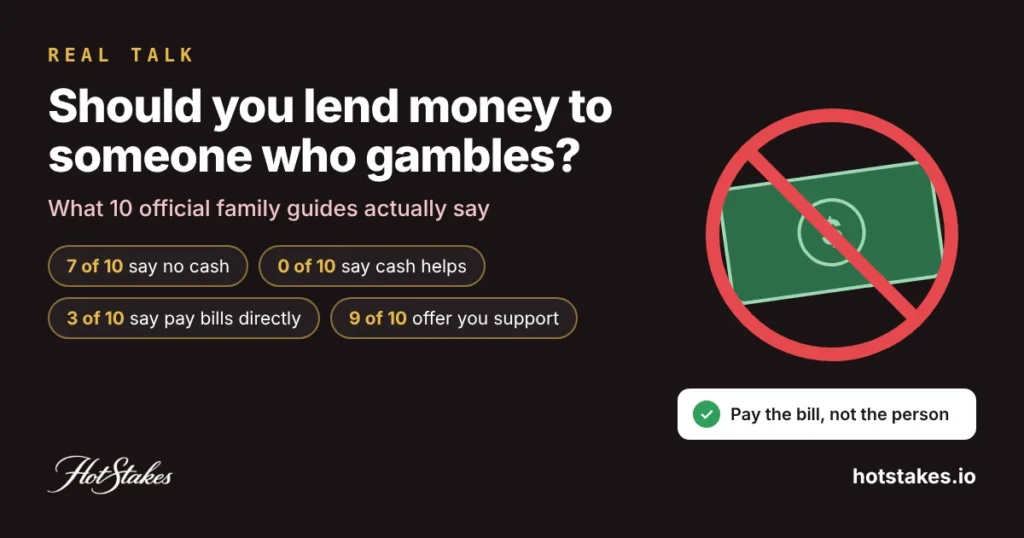
- Don’t fund the chase. Lending money to cover a gambling loss usually pays for the next bet.
- Talk about the pattern, not the person. “I’ve noticed you play longer after you lose” lands better than “you’re an addict”.
- Help with the paperwork, not the debt. If there’s debt, our first-48-hours debt guide covers the practical first steps.
Takeaway: Your job isn’t to fix the loss. It’s to make the next bet harder and help them reach support.
Where to get help in Asia (verified 31 Oct 2026)
We checked each number on an official or reputable page on 31 Oct 2026. Services and hours can change, so check the linked page if a call doesn’t connect.
| Country | Service | Number | Source |
|---|---|---|---|
| Singapore | NCPG National Problem Gambling Helpline (daily 8am–11pm, webchat too) | 1800-6-668-668 | MSF / NCPG |
| Hong Kong | Gambling Counselling Hotline | 183 4633 | HK Information Services Dept |
| Philippines | PAGCOR 24/7 National Problem Gambling Helpline | 02-8248-9568 | GMA News, 27 May 2026 |
| Philippines | NCMH Crisis Hotline (mental health) | 1553 | Manila Bulletin, 3 Jan 2026 |
| Malaysia | Talian HEAL, Ministry of Health mental health line (8am–midnight). We found no national gambling-specific helpline. | 15555 | The Star, 6 Jan 2026 |
| India | Tele-MANAS, free 24×7 mental health helpline | 14416 or 1-800-891-4416 | Govt of Assam |
| Indonesia | Healing119, Ministry of Health mental health service | 119 ext. 8 | Kemenkes |
If you are thinking about harming yourself, call your local emergency number now.
Takeaway: One call costs nothing and doesn’t commit you to anything. For the bigger picture, read is gambling bad for you?
FAQ
Why do I keep chasing losses?
Losses make most people more willing to take risks, and stopping makes the loss feel final. Big real-world data shows people bet more and play longer straight after a loss. The urge is normal. Acting on it is what costs money.
Can you ever win back gambling losses?
Sometimes, on a single night. But every bet carries the house edge, so the more you stake while chasing, the more you lose on average. In our roulette simulation, chasing with small bets got back to even less than 1% of the time.
Is chasing losses a sign of gambling addiction?
It’s a recognised warning sign. It is one of the nine DSM-5 criteria for gambling disorder and one of the nine PGSI questions. On its own it isn’t a diagnosis, but it’s the most commonly reported PGSI warning sign in Great Britain’s survey. If it keeps happening, talk to a helpline or professional.
Does the Martingale (doubling up) stop you losing?
No. Doubling wins small amounts often and loses big amounts sometimes. In our simulation it got back to even 48.7% of the time and still lost money on average. When it failed, the loss averaged about 1,109.
How do I stop chasing losses right now?
Stop the next bet, write down what you lost, move the remaining money out of reach, block access, tell one person, and call a helpline if borrowed money is involved. Research suggests the pull is strongest right after a loss, so distance helps.
HotStakes is an independent directory. Some links on this site are affiliate links; we may earn a commission at no cost to you, and it never changes our rankings. Gambling involves risk — only play with money you can afford to lose, and if it stops being fun, seek help. This article is general information, not legal advice. Read our full disclaimer.
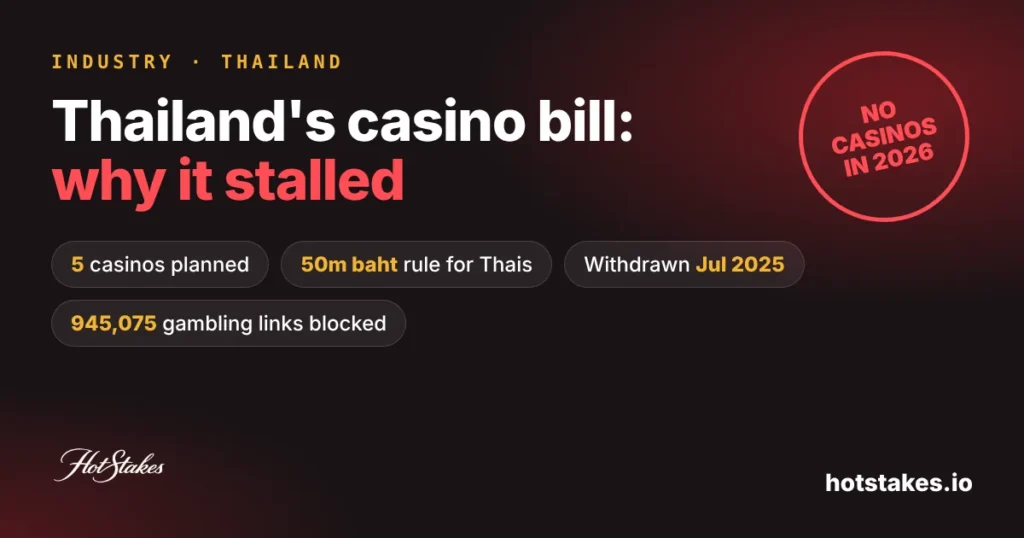 Next story →Thailand Casino Bill Explained: Why It Stalled in 2026

Start the discussion