

Is Online Casino Illegal in Japan? The Crackdown Explained
Yes, even on Curaçao-licensed sites. Japan's penalties, the NPA's 3.37M-user estimate, the 2025 ad ban and the 2026 blocking debate.
In this article
- Yes, playing is the crime, not just running the site
- How big is it? The NPA numbers
- Timeline: from casino resorts to a blocking debate
- Who has been caught
- What the 2025 law actually changed
- 2026: site blocking is on the table
- What is legal in Japan, and what is not
- If you have already played, or cannot stop
- FAQ
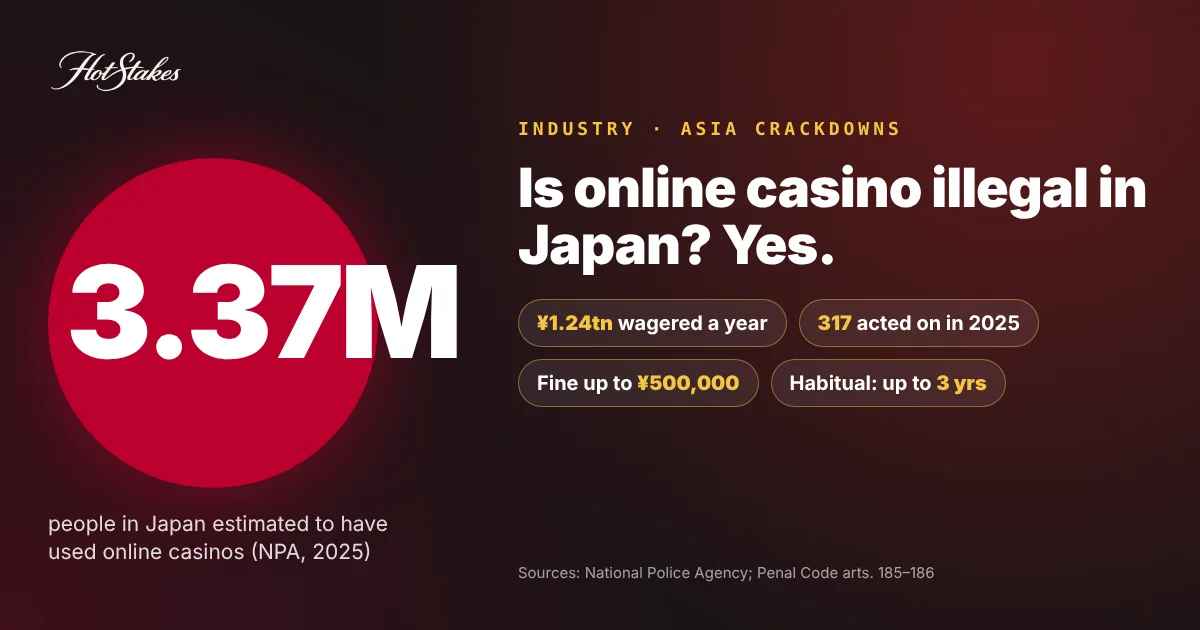
Yes. In Japan the crime is the betting itself, not only running the site. If you place a bet on an online casino from inside Japan, you can be charged under the Penal Code. It does not matter that the site holds a Curaçao or Malta licence, or that you are a foreign resident or tourist. An overseas licence makes the casino legal where it is licensed, not where you are sitting. Below: the exact law, the police numbers, what changed in 2025, the 2026 site-blocking debate and what is actually legal in Japan.
Yes, playing is the crime, not just running the site
Japan has no licence for online casinos. Gambling is banned by the Penal Code of 1907, with exceptions only where a special law allows it (horse racing, lotteries and so on). Two articles matter for players. From the government’s official English translation of the Penal Code:
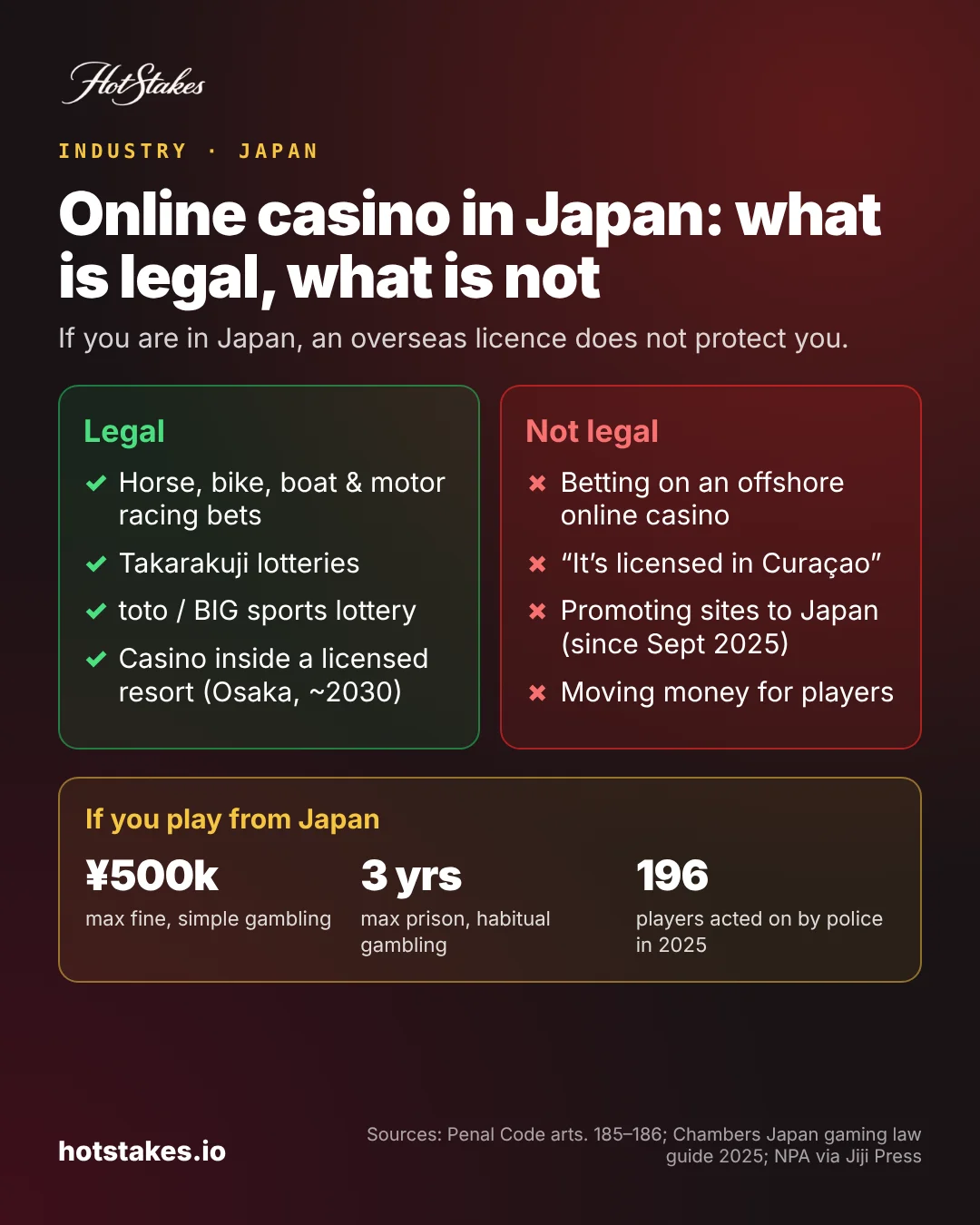
- Article 185 (Gambling): “A person who gambles shall be punished by a fine of not more than 500,000 yen or a petty fine.” Small bets on things “for momentary entertainment”, like who buys lunch, are exempt.
- Article 186(1) (Habitual gambling): “A person who habitually gambles shall be punished by imprisonment with work for not more than 3 years.” Since 1 June 2025, Japan’s penal reform folds “imprisonment with work” into a single custodial sentence; the 3-year maximum is unchanged.
- Article 186(2): running a gambling place for profit carries 3 months to 5 years. Police have used this charge against people running gambling operations linked to offshore sites.
Online casinos are not real-money betting on lunch. A deposit on a slot or a baccarat table is a bet of money, so Article 185 applies. Repeat play can push a case into Article 186.
“But the site is licensed in Curaçao”
That is the most common misunderstanding, and the sites do little to correct it. The NPA looked at the 40 online casinos most often promoted on seven comparison sites. All 40 held overseas licences, about 70% of them from Curaçao. 38 of the 40 did not clearly say that playing from Japan is prohibited.
The government’s position is the opposite. In a 20 June 2023 statement, summarised in Chambers’ Japan gaming law guide, it said a player can commit a gambling crime even when the online casino is legally operated abroad. A foreign licence is a rule for the operator in that country. It is not permission for a player in Japan. (Our explainer on Curaçao’s licence reform explains what that licence covers.)
Foreigners and tourists are not exempt
The Penal Code applies to acts committed in Japan, whatever your passport. A bet placed on your phone in a Tokyo hotel room is placed in Japan.
Takeaway: if you are physically in Japan and you bet real money on an online casino, you are breaking Japanese law. The licence and the language of the site change nothing.
How big is it? The NPA numbers
In March 2025 the NPA published its first survey on online casino use. It questioned about 27,000 people aged 15 to 79, then ran a follow-up with 7,000 of them. The headline figures, from the NPA’s English summary:
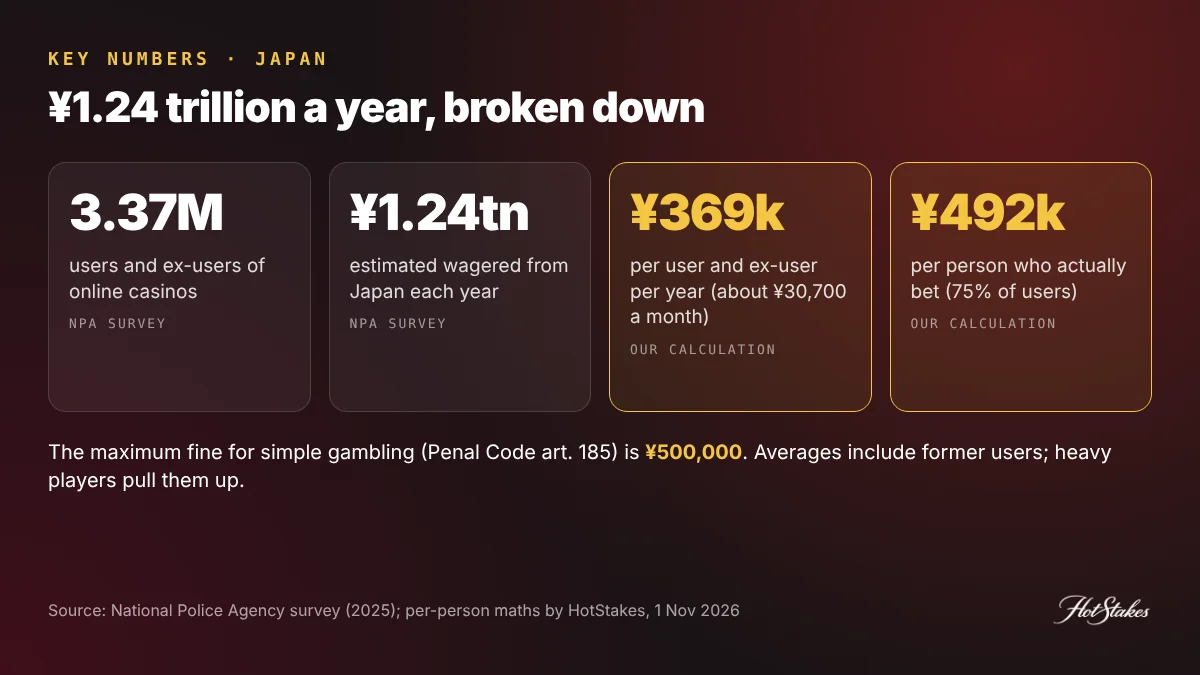
- About 3.37 million people in Japan are estimated to have used online casinos (current and former users).
- About ¥1.2423 trillion is wagered from Japan each year.
- About 75% of people who visited the sites went on to bet money.
- 58.8% of users and ex-users are in their 20s and 30s. 3.6% are teenagers.
- Half or more of users in their 20s and 30s had taken on debt because of online casino gambling.
- About 44% of all respondents did not know online casinos are illegal in Japan.
Our maths: what ¥1.24 trillion means per person
We divided the NPA’s own figures on 1 Nov 2026. This is our calculation, not an NPA number.
- ¥1.2423 trillion ÷ 3.369 million users and ex-users = about ¥369,000 per person per year, or about ¥30,700 a month.
- Only about 75% actually bet money. Spread over them, it is about ¥492,000 per betting user per year.
That second number sits just under the ¥500,000 maximum fine in Article 185. Two caveats: the total mixes current and former users, and a few heavy players will pull the average up. Most players stake less. Some stake far more.
Takeaway: this is not a fringe habit. The money involved is roughly ¥1 trillion-plus a year, much of it from people under 40, and many did not know they were breaking the law.
Timeline: from casino resorts to a blocking debate
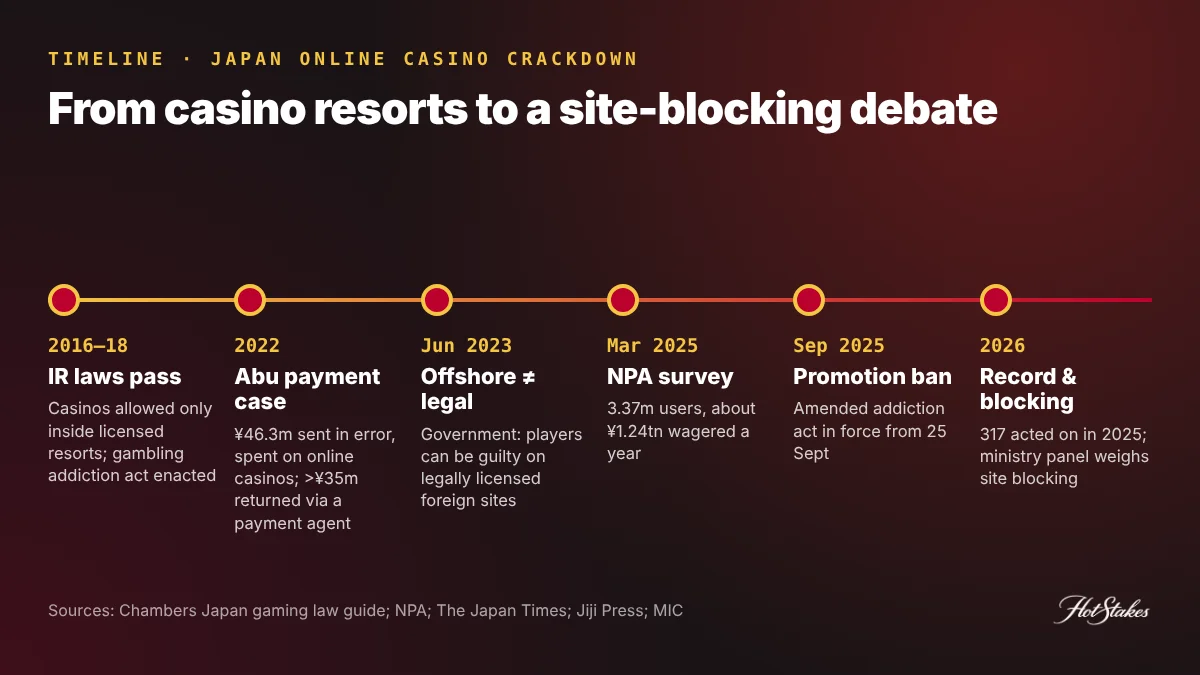
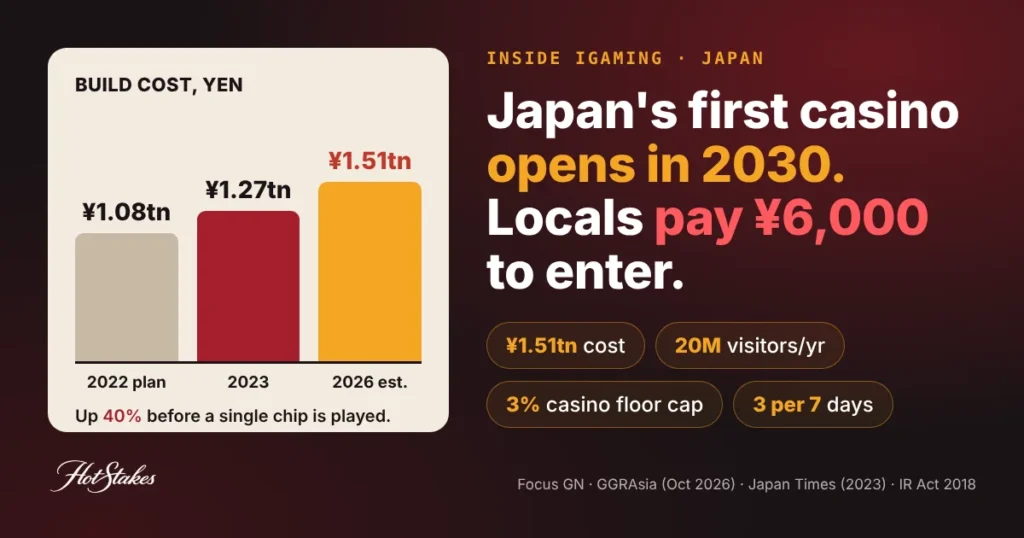
- 2016 and 2018: Japan passes the IR Promotion Law and then the IR Implementation Law, allowing casinos only inside licensed integrated resorts. The Basic Act on Countermeasures Against Gambling Addiction is enacted in July 2018 (Chambers). Online casinos stay illegal.
- 2022: The town of Abu in Yamaguchi wrongly sends ¥46.3 million of COVID-19 relief money to one resident, who uses it on online casinos. About ¥43 million is later recovered, over ¥35 million of it from a domestic payment processing agent, The Japan Times reported. The case puts payment agents in the spotlight.
- April 2023: Osaka’s IR plan is approved, the only one so far.
- 20 June 2023: The government states that players can be guilty even on legally licensed offshore sites.
- Early 2025: Several comedians and athletes are referred to prosecutors over online casino gambling, as reported in national news.
- March 2025: The NPA publishes its survey: 3.37 million users, about ¥1.24 trillion a year.
- 18 June 2025: The Diet amends the gambling addiction law to ban promoting online casinos. It takes effect on 25 September 2025.
- April 2026: The NPA reports 317 people, the most since 2018, arrested or subject to other enforcement action in 2025. A communications ministry panel publishes a draft report on site blocking.
- July 2026: The panel’s final report is published. A government decision on blocking is expected from autumn 2026.
Takeaway: the pattern is clear. Japan started by policing players and local cafés. It is now going after the pipeline around them: ads, affiliates, payment agents and, possibly, internet access itself.
Who has been caught
Enforcement has climbed fast. In 2024, police arrested 279 people over online gambling, up 160.7% on the year before, according to the NPA. For 2025, the NPA figures reported by Jiji Press show:
- 317 people arrested or subject to other enforcement action, the highest since 2018, when comparable records began.
- 196 online casino customers, up 54 on 2024.
- 25 affiliate marketers and payment service providers linked to the casinos.
- 38 customers and 58 staff at physical shops that let people play online casinos on their computers.
Public figures have been part of it. In 2025, Tokyo police sent case papers on six comedians from the agency Yoshimoto Kogyo to prosecutors on suspicion of gambling at online casinos, The Japan Times reported. All six reportedly admitted it. Professional athletes were also referred to prosecutors that year. Promoters are in the frame too, which matters for gambling streamers and the affiliates who pay them.
Our check: the odds vs the pattern
196 players acted on in 2025, against 3.37 million users and ex-users, works out to roughly 1 in 17,000 (our calculation, 1 Nov 2026). That sounds like low odds. It is the wrong way to read it.
Police do not need random checks. Deposits move through bank transfers, cards and payment agents, and those leave a trail. The Abu case was traced through a payment agent, and in 2025 police acted against 25 affiliates and payment providers. The people who handle the money are now a priority.
Takeaway: the risk is not a lottery. It is a record. Every deposit through an agent, bank transfer or card leaves one.
What the 2025 law actually changed
A lot of coverage reads as if 2025 made online casinos illegal. It did not. They already were. The amendment to the Basic Act on Countermeasures Against Gambling Addiction, enacted on 18 June 2025 and in force from 25 September 2025, targets the people pulling players in. According to Chambers, it:
- bans presenting websites or apps for illegal online gambling to people in Japan;
- bans spreading information that encourages people in Japan to gamble on them (ads, social posts, “how to start” guides);
- requires national and local government to raise awareness that online gambling is illegal.
The Act itself carries no criminal penalties. The jail terms and fines still come from the Penal Code. Its target is promotion, not play.
Takeaway: for players nothing changed legally. For affiliates and influencers, promoting these sites to Japan is now explicitly unlawful.
2026: site blocking is on the table
The communications ministry set up a study group on online casino access in April 2025. On 24 April 2026 it released a draft report, and on 27 July 2026 the ministry published the final report along with 236 public comments.
The sticking point is the Constitution. Blocking means internet providers checking where every user’s traffic goes, which clashes with the guarantee of secrecy of communications. The panel said blocking “should not be ruled out”, and most public comments supported it, The Star reported. First, the government will test softer steps, such as outlawing social posts that steer users to casinos and asking the countries behind the operators to cut off Japan. It could judge whether those work as early as autumn 2026, then decide on blocking. When we checked on 1 Nov 2026, we found no blocking law passed.
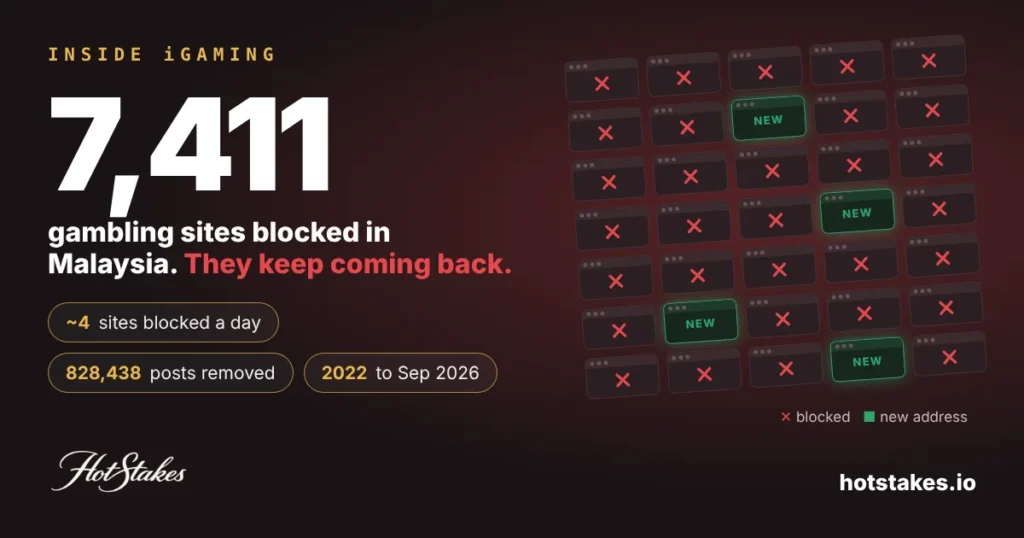
Japan would be late to this compared with its neighbours. Malaysia already blocks thousands of gambling sites, South Korea runs a long-standing crackdown on illegal betting sites, and Indonesia is running its own online gambling crackdown. Our 14-country Asia legality guide compares them all.
Takeaway: if blocking comes, it will most likely come only after the ad ban and payment pressure are judged not to be enough.
What is legal in Japan, and what is not
Japan is not a no-gambling country. It is a country where gambling is legal only when a special law carves it out, and online casinos have no such law.
| Form of gambling | Status in Japan | Who runs it | Online? |
|---|---|---|---|
| Horse, bicycle, boat and motorcycle racing (keiba, keirin, kyotei, auto race) | Legal under special laws | Public bodies | Yes, official betting |
| Takarakuji lotteries | Legal | Public bodies | Yes, official sales |
| Sports lottery (toto / BIG) | Legal | Japan Sport Council | Yes, official sales |
| Pachinko and pachislot | Grey zone, treated as amusement (three-shop system) | Private parlours | No |
| Casino in an integrated resort | Legal only in licensed IRs (Osaka, planned for about 2030) | Licensed operator | No |
| Offshore online casino | Illegal for players and promoters | Foreign operators | Yes, illegally |
Sources: Chambers Japan gaming law guide (Nov 2025 update); HotStakes explainers linked above.
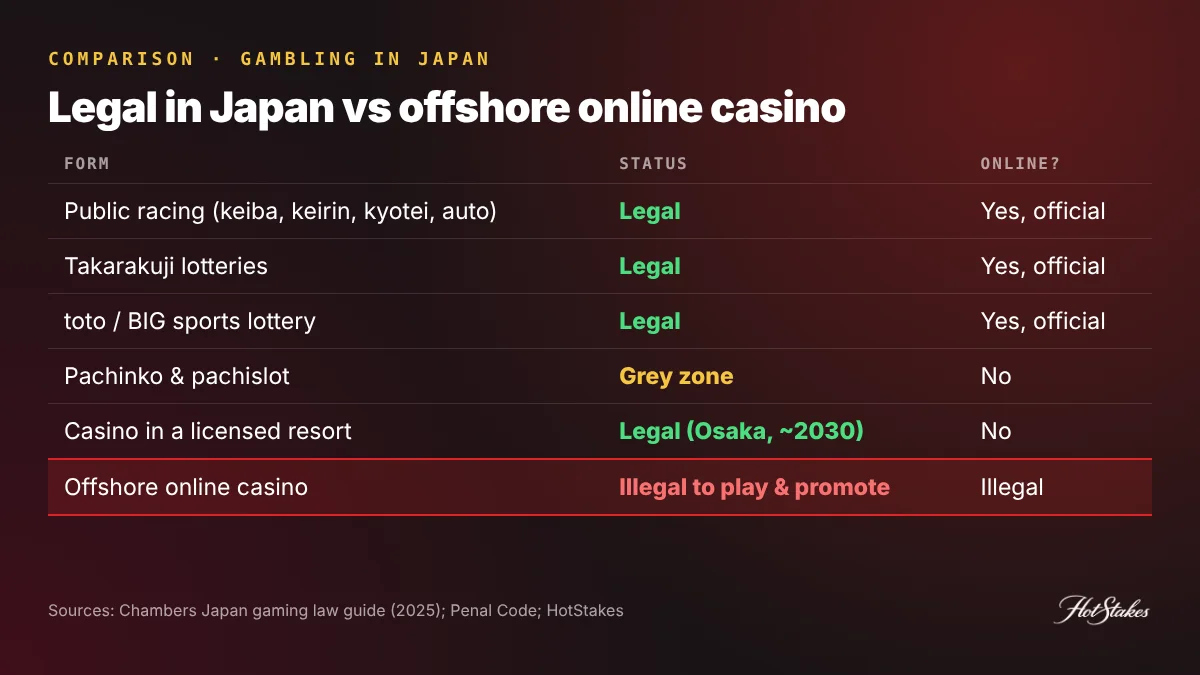
Takeaway: legal betting in Japan is publicly run, and some of it is online. Offshore online casinos are the one major form with no legal route at all.
If you have already played, or cannot stop
This is general information, not legal advice. If you are worried about a case, speak to a lawyer in Japan.
- Stop depositing now. Every new deposit adds to the record, and to the debt.
- Do not use “payment agents” or bank-account renters. Police are targeting them, and their customer records go with them.
- Do not lend your bank account to anyone offering easy money. That can drag you into a much more serious case.
- Talk to someone. Every prefecture and designated city in Japan has a public mental health and welfare centre (精神保健福祉センター) that takes gambling consultations, and local health centres (保健所) can advise too. Search the National Center for Addiction Measures map of consultation points and clinics (依存症対策全国センター). Self-help groups such as Gamblers Anonymous also meet in Japan.
- Get debt help. A leaflet on the health ministry’s addiction site points people with gambling debt to Houterasu (Japan Legal Support Center) and local consumer affairs centres.
Not sure about the rules in another country? Our is-it-legal checker covers Asia market by market.
FAQ
Is online casino illegal in Japan for players?
Yes. Betting money on an online casino from inside Japan is gambling under Penal Code Article 185, with a fine of up to ¥500,000. Habitual gambling under Article 186 can mean up to 3 years in prison.
Is it legal if the casino is licensed in Curaçao or Malta?
No. The government said in June 2023 that a player in Japan can commit a crime even on a site legally operated abroad. The licence covers the operator in that country, not you in Japan.
Can foreigners and tourists be arrested for online gambling in Japan?
Yes. The Penal Code applies to acts committed in Japan regardless of nationality, so a bet placed from a phone in Japan counts.
How many people have been arrested?
The NPA reported 279 arrests over online gambling in 2024. In 2025, 317 people were arrested or faced other enforcement action, including 196 online casino customers and 25 affiliates and payment providers.
What did the 2025 online casino law change?
From 25 September 2025 it became unlawful to present online casino sites or apps to people in Japan or to post content encouraging them to play. It added no new penalties for players. Those still come from the Penal Code.
Will Japan block online casino websites?
Not yet. A communications ministry panel said in 2026 that blocking is effective but raises constitutional concerns about secrecy of communications. The government planned to judge softer measures first, as early as autumn 2026, before deciding.
Is pachinko gambling?
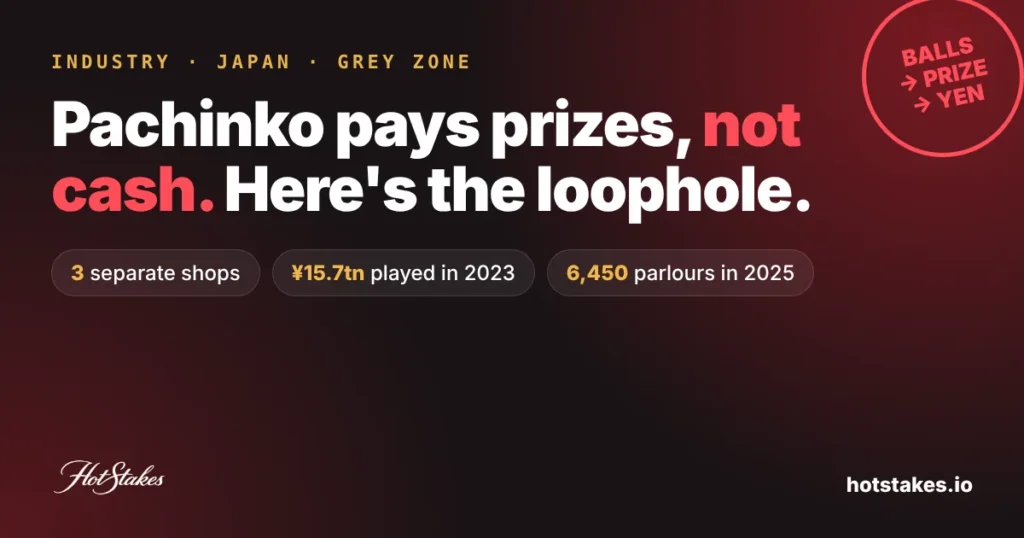
Legally it is treated as amusement, because prizes are swapped for cash at a separate shop. That loophole is why pachinko is often called a grey zone.
HotStakes is an independent directory. Some links on this site are affiliate links; we may earn a commission at no cost to you, and it never changes our rankings. Gambling involves risk — only play with money you can afford to lose, and if it stops being fun, seek help. This article is general information, not legal advice. Read our full disclaimer.
 Next story →Is Online Gambling More Addictive? What the Data Shows


Start the discussion