

How to Tell Your Family You Have a Gambling Problem: 4 Steps
How to tell your family you have a gambling problem: a 6-item checklist, a 4-part script, the money talk, and helplines across Asia.

In this article
Tell the person who shares your money first, in private, when nobody has to rush off. Before you start, write down your total debt, who you owe and what is due this week. Then say it in four parts: an opening line, the facts, what you are asking for, and what you have already done to stop. The hardest part of telling your family you have a gambling problem is saying the real number, and the real number is what makes the conversation work. Below: a checklist, an example script, what to expect in the first days and helplines.
Why hiding it feels safer, and why it isn’t
If you have been hiding your gambling, you are not unusual. In a study of 44 people with gambling problems, shame was almost universal. Hing, Nuske, Gainsbury and Russell (International Gambling Studies, 2016) identified secrecy as the main way participants coped with that stigma. Stigma was a major barrier to telling anyone and getting help.
Secrecy protects you from one bad conversation. It also keeps the debt growing where nobody can help. Health bodies point the other way. The NHS gambling addiction page advises you to “talk to someone you trust about what is happening”. GamCare’s self-help workbook suggests “honestly discussing what is going on for you with others that you trust, without holding back”.
Without holding back is the important part. Unsure it’s a real problem? Try our 2-minute gambling self-check.
Takeaway: Shame makes secrecy feel safe. Keeping the secret is what lets the debt get bigger.
Before you say a word: the disclosure checklist
Most guides tell you to “be honest”. Few tell you to get your numbers ready first. Your family will ask “how much?” fast. If you can’t answer, it sounds like more hiding. Spend 30 minutes on this list, alone, on paper:
- The total you owe. Add up every card, loan, app, overdraft and personal debt. One number.
- Who you owe. Banks, card issuers, loan apps, and any friends or relatives.
- What is due in the next 7 days. Rent, instalments, a loan repayment. This is what needs sorting first.
- What you have left. Cash, balances, next pay date.
- Anything they will find out anyway. A joint account you used, an item you sold, money you borrowed in their name. Say it now.
- What you have already done. Blocked an app, called a helpline, booked a session. Even one step counts.
The New York Council on Problem Gambling’s Know The Odds guide to telling your parents suggests similar preparation: how it started, any debt or harm, and your recovery plan. The 800GAMBLER guide to telling loved ones suggests jotting down bullet points or rehearsing.

To put the debts in order, use our gambling debt guide for the first 48 hours.
Takeaway: One piece of paper with six answers turns a confession into a conversation you can actually manage.
Who to tell first, and when
Start with the person whose money or home is affected. That is usually a spouse or partner, or parents you live with or owe. Know The Odds notes you might tell one parent first, or a trusted relative or friend who can support you.
For timing, choose a calm, private place where you won’t be interrupted, and leave plenty of time, as the 800GAMBLER guide advises. In practice, that means:
- Not just before work, school pickup or a family event.
- Not straight after a big loss, when you may still be chasing it.
- Soon. If a payment is due this week, the conversation can’t wait for a perfect moment.
If it’s your wife or husband
If you share a home, bills or accounts, your partner may already be paying for the debt without knowing it. Say that plainly. Tell them which shared accounts or cards were used. Our guide for partners of someone who gambles shows the conversation from their side.
If it’s your parents
If you live with parents, or they may feel expected to cover family debts, an instant bail-out can feel like the only outcome. It shouldn’t be (see below). Start with whichever parent is easier to talk to.
If you fear the other person may react violently, don’t go ahead alone. Gambling Help Online, writing for families, says you “should never put yourself in harm’s way”. Plan it with a helpline counsellor first.
Takeaway: Tell the person most affected first. Do it this week, in private, with time to spare.
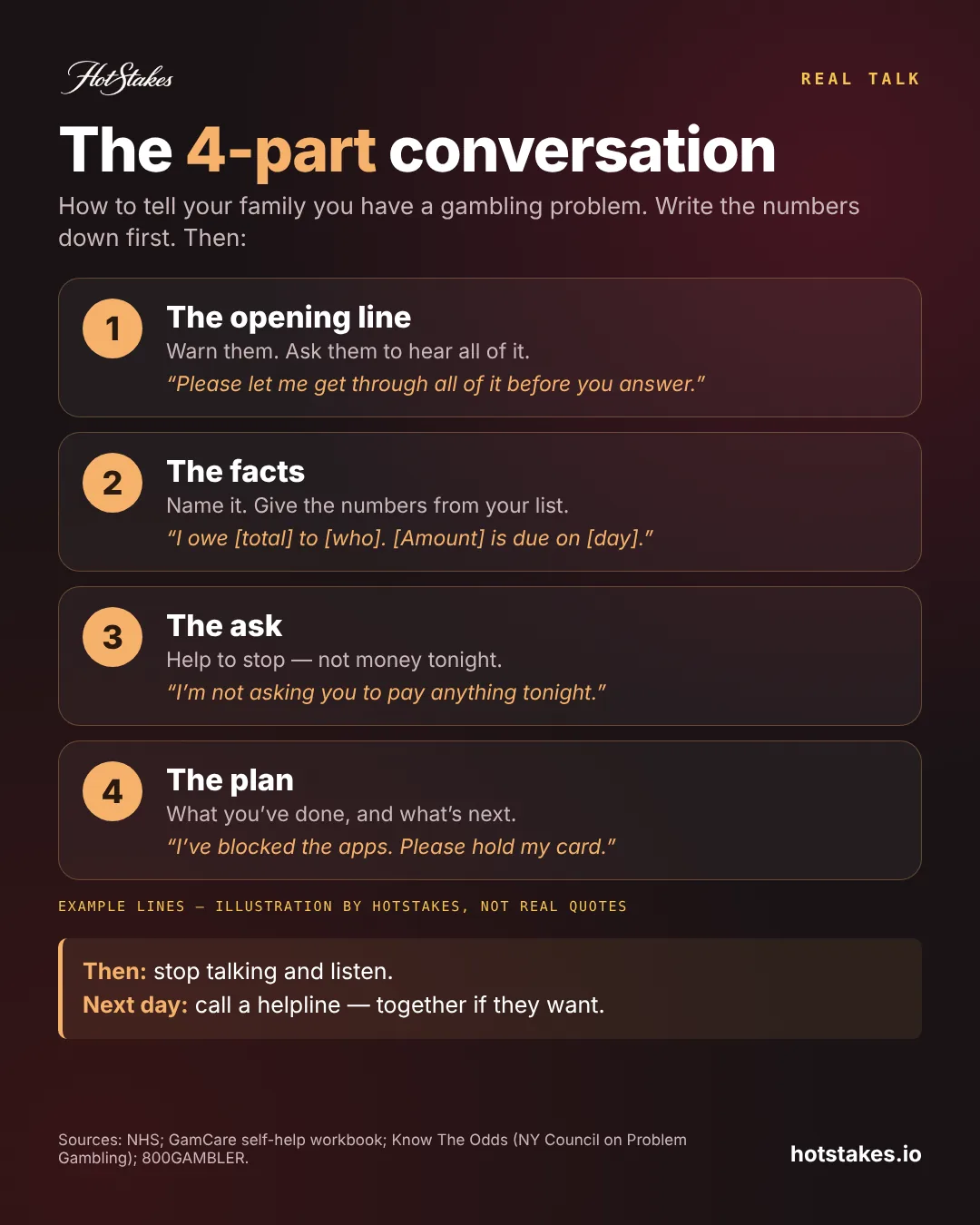
The 4-part conversation (example script)
The lines below are our own illustrative example, not a real quote. Use your own words.
- The opening line. Warn them, and ask them to hear all of it. “I need to tell you something hard. Please let me get through all of it before you answer.”
- The facts. Name it, then give the numbers from your list. “I have a gambling problem and I’ve been hiding it. I owe [total] to [who]. [Amount] is due on [day].”
- The ask. Ask for help to stop, not for money. “I’m not asking you to pay anything tonight. I’m asking you to help me stop.”
- The plan. Say what you have done and what you will do next. “I’ve blocked the apps. I’ll call the helpline tomorrow, and I’d like you to hold my card.”
Then stop and listen. 800GAMBLER advises you to expect anger or hurt and to hear how your behaviour has affected them.
Takeaway: Opening, facts, ask, plan. Then listen for longer than you spoke.
What not to do
These mistakes turn one hard night into months of mistrust:
| Instead of this | Do this | Why |
|---|---|---|
| A partial confession (“I owe a bit”) | The full total from your list | A second confession lands harder. Not ready to give a figure? Say so rather than lie (800GAMBLER). |
| Asking for a bail-out the same night | Asking for help to stop, money later | A rushed payoff skips the debt plan. Favour a repayment plan (Gambling Help Online). |
| “It will never happen again” | Steps you have already taken | After secrecy, they need something they can check. |
| Explaining it away | Naming the problem plainly | Context can come later. |
| Telling them while chasing a loss | Telling them after you’ve stopped for the day | “Win it back first” grows debts. See our guide to the next 30 minutes of an urge. |

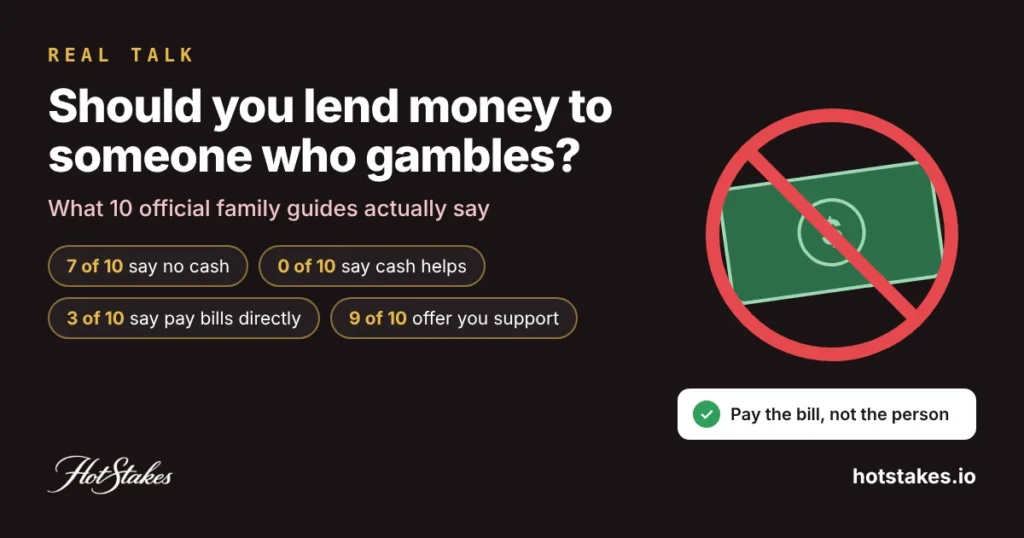
Your family may want to pay something off immediately. Our guide on whether to lend money to someone who gambles compares what 10 help guides say. Agree a written plan before any money moves.
Takeaway: The whole truth, no bail-out ask, and proof instead of promises.
Protective steps to offer (before they ask)
Offering these yourself shows you mean it. GamCare’s workbook suggests you “eliminate easy access to money” and “let someone else manage your money for a while if needed”. It suggests someone you trust could “check your bank statements at random intervals”. The NHS suggests you “ask your bank to block any money going to gambling websites and apps”.
| Step you can offer | What it does | Where to start |
|---|---|---|
| Hand over cards or let them co-manage money | Removes easy access to cash for a while | GamCare self-help workbook |
| Bank gambling block | Stops card payments to gambling merchants, where your bank offers it | Ask your bank; NHS advice |
| Block apps and sites on every device | Puts friction between the urge and the bet | How to block yourself from gambling |
| Self-exclusion | Bars you from venues or betting accounts where a scheme exists | In Singapore, NCPG runs self-exclusion and visit limits |
In Singapore, family can also apply to NCPG for a Family Exclusion Order against someone “whose gambling has caused serious harm to the family”. It covers the casinos, jackpot machine rooms at private clubs and Singapore Pools online betting. Exclude yourself first, and they never have to.
Takeaway: Every step you offer is one less thing they have to fight you for.
What to expect in the first days
Know The Odds warns the following weeks or months may be difficult, and calls honesty “the first step of regaining trust”.
- That night: shock, anger, tears or a long silence. Some people feel relief. Answer truthfully, even repeated questions.
- Next day: call a helpline, together if they want to. Finish blocking apps, cards and sites.
- Days 2–3: take your debt list to a free debt adviser or counsellor. Deal with whatever is due this week first.
- First week: expect them to check statements and your phone. Let them.
- After that: regular check-ins, a recovery plan, and support for them too.

Your family needs help as well. A University of Bristol study found that in a 2021 survey of GB adults, 78% of people affected by someone else’s gambling had not sought any advice or support for themselves. Gam-Anon is a fellowship for anyone affected by another person’s gambling. Its “Pressure Relief Group” meetings help members build a budget that covers family needs and all debts.
A slip after you’ve told them is not the end. GamCare’s workbook says, “If you lapse, seek help as soon as possible.” The GamCare community forum has threads on telling a partner, telling everything and admitting a relapse. Our gambling recovery stories show what helped others keep going.
Takeaway: Plan for a hard week and a slow month. Trust comes back through checks, not speeches.
Where to get help (verified 2 Nov 2026)
We checked each number on the linked page on 2 Nov 2026. Some are general mental health lines.
| Country | Service | Number | Source |
|---|---|---|---|
| Malaysia | Talian HEAL, Ministry of Health mental health line (daily 8am–midnight). We found no national gambling-specific helpline. | 15555 | The Star, 9 Jul 2026 |
| Singapore | NCPG National Problem Gambling Helpline (daily 8am–11pm, webchat too) | 1800-6-668-668 | MSF / NCPG |
| Philippines | PAGCOR 24/7 National Problem Gambling Helpline | 02-8248-9568 | GMA News |
| Philippines | NCMH Crisis Hotline (mental health, 24/7) | 1553 | Daily Tribune, 27 Dec 2025 |
| Hong Kong | Gambling Counselling Hotline | 183 4633 | HK Information Services Dept |
| India | Tele-MANAS, free 24×7 mental health helpline | 14416 | JIPMER |
| Indonesia | Healing119, Ministry of Health mental health service (24 hours) | 119 ext. 8 | Kemenkes |
| Anywhere (online) | Gambling Therapy, free online support from the charity Gordon Moody | Online | gamblingtherapy.org |
| Several Asian countries | Gamblers Anonymous: directory lists India, Japan, Korea, Malaysia, Philippines, Singapore, Thailand; virtual meetings too | See directory | GA international directory |
In the UK, GamCare runs the free 24/7 National Gambling Helpline on 0808 8020 133 (GamCare).
If you are thinking about harming yourself, call your local emergency number now.
Takeaway: A counsellor can help you plan what to say. For the bigger picture, read is gambling bad for you? The evidence on both sides.
FAQ
How do I tell my family I have a gambling problem?
Write down your total debt, who you owe and what is due this week. Tell the person most affected first, in private. Use four parts: opening line, facts, the ask (help, not money) and your plan.
How do I tell my wife I have a gambling debt?
Give her the full figure and say which shared accounts or cards were used. Don’t ask her to pay anything that night. Offer to hand over cards and block apps, then agree a written debt plan together.
How do I tell my parents I gamble?
Prepare the same way: how it started, the debt and your plan. Start with whichever parent, or trusted relative, is easier. Know The Odds says waiting is okay if now isn’t the right time; talk to a counsellor meanwhile.
Should I tell them everything at once?
Yes, if you can. A partial confession can lead to a second one, which hurts trust more. If you can’t say a figure yet, say so rather than give a smaller number.
What if they want to pay off my debts straight away?
Thank them, and ask to make a plan first. Help guides favour repayment plans, debt advice and someone else managing the money for a while.
HotStakes is an independent directory. Some links on this site are affiliate links; we may earn a commission at no cost to you, and it never changes our rankings. Gambling involves risk — only play with money you can afford to lose, and if it stops being fun, seek help. This article is general information, not legal advice. Read our full disclaimer.
 Next story →H3BET Review 2026: Licence, Bonus Terms & Safety Check

Start the discussion