

Gambling Urge? What to Do in the Next 30 Minutes
Fighting an urge to gamble? A minute-by-minute 30-minute plan, the maths of one last bet, what to do after a relapse, and helplines.
In this article
- The 30-minute urge plan, minute by minute
- Why urges pass (and what urge surfing really does)
- The “one last bet” trap, in numbers
- Thoughts that give you permission (and a reply to each)
- Just gambled again? What to do after a slip
- For family: how to help during an urge
- When to get professional help
- Where to get help tonight (verified 25 Oct 2026)
- FAQ
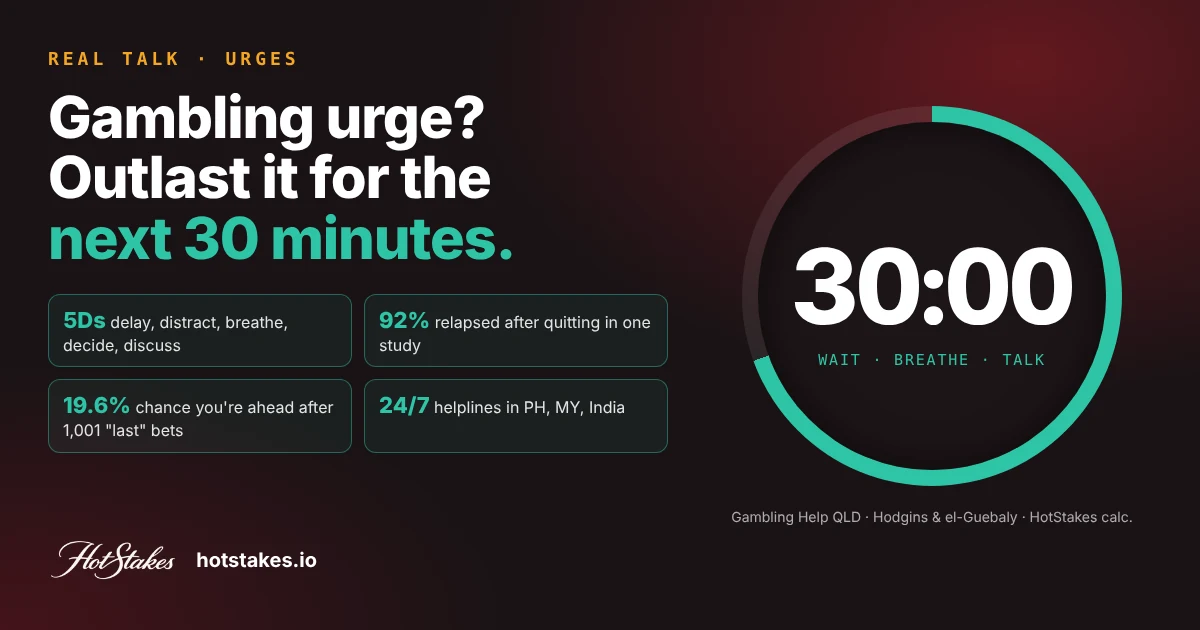
If you are fighting an urge to gamble right now, you do not have to beat it. You only have to outlast it: delay for 30 minutes, put distance between you and the money, and talk to someone before you decide anything. Urges rise, peak and fade if you do not act on them, and every one you ride out makes the next one easier to handle. Below: a minute-by-minute plan from published self-help guidance, helplines, and what to do if you already gambled again.
The 30-minute urge plan, minute by minute
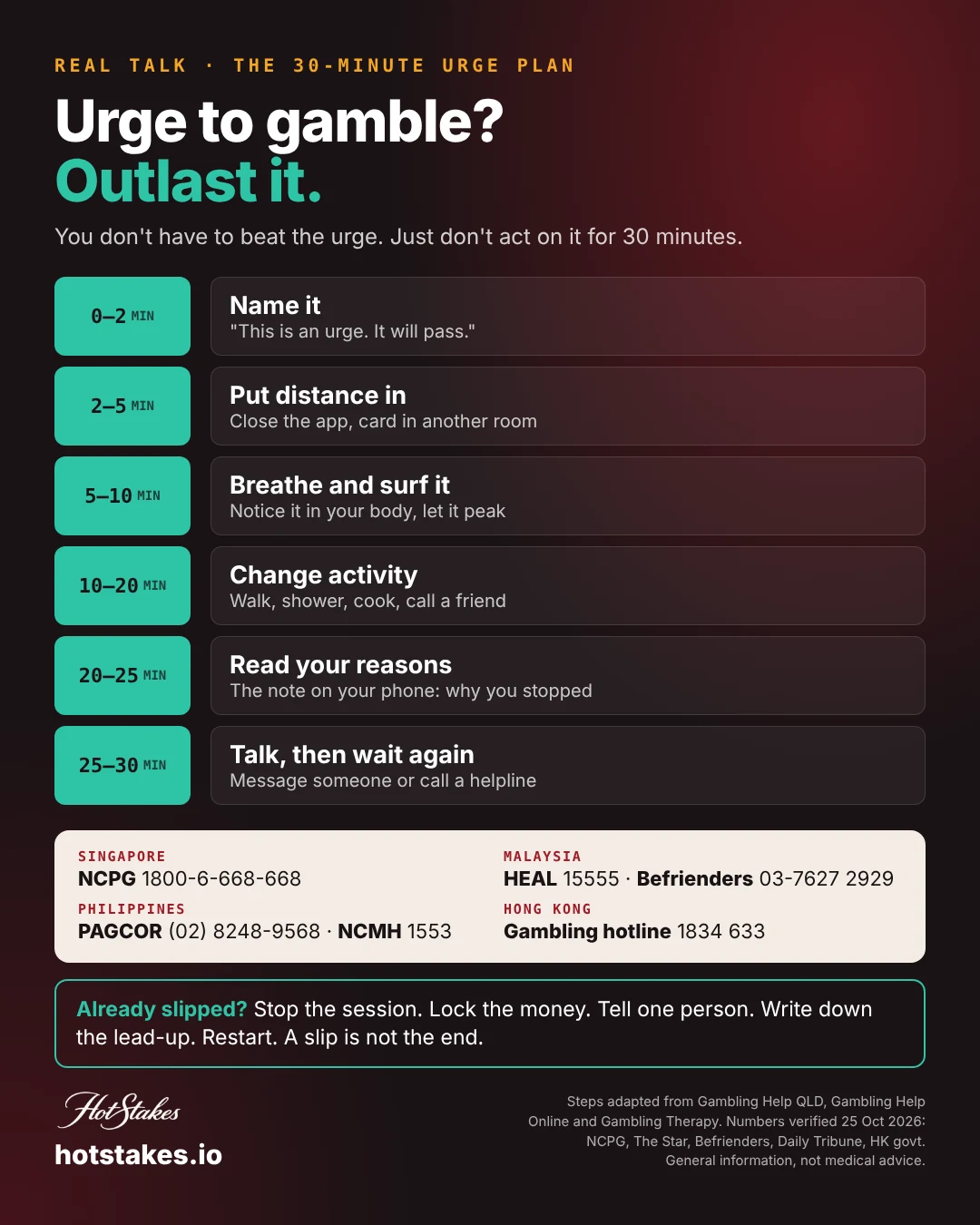
Why 30 minutes? Queensland’s Gambling Help service advises: “try to wait at least half an hour” before acting, then wait another half hour if you feel OK (Gambling Help QLD). We turned that into a plan. The half hour is a delay target, not a promise that every urge ends in exactly 30 minutes.
Australia’s free Gambling Help Online service teaches the “5Ds”: Delay, Distract, Deep breathe, Decide, Discuss (Gambling Help Online). Here is how they fit into half an hour.
- Minutes 0–2: Name it. Say it: “This is an urge. It will pass.” Gambling Therapy, a free global service run by the UK charity Gordon Moody, suggests naming the urge and being honest about how you feel (Gambling Therapy).
- Minutes 2–5: Put distance in. Close the app. Log out. Put your bank card in another room or hand it to someone. If you are near a venue, walk away from it. Our guide to blocking gambling sites, apps and payments covers the permanent version of this step.
- Minutes 5–10: Breathe and surf the urge. Slow breaths. Notice where you feel the urge in your body, and let your shoulders drop on each out-breath. The steps are in the next section.
- Minutes 10–20: Change what you are doing. Go for a walk, shower, cook, or call a friend about anything else. Gambling Help QLD lists exactly these, and says “Distracting yourself with other activities can help.”
- Minutes 20–25: Read your reasons. Open the note on your phone with why you stopped: the debt, the family, the sleep. Gambling Help Online suggests carrying a personal reminder card for exactly this moment.
- Minutes 25–30: Discuss, then decide. Message someone you trust or contact a helpline (table below). Then decide to wait another half hour. Repeat if you need to.
Takeaway: The goal is not to feel nothing. The goal is to get to minute 30 without placing a bet.
Why urges pass (and what urge surfing really does)
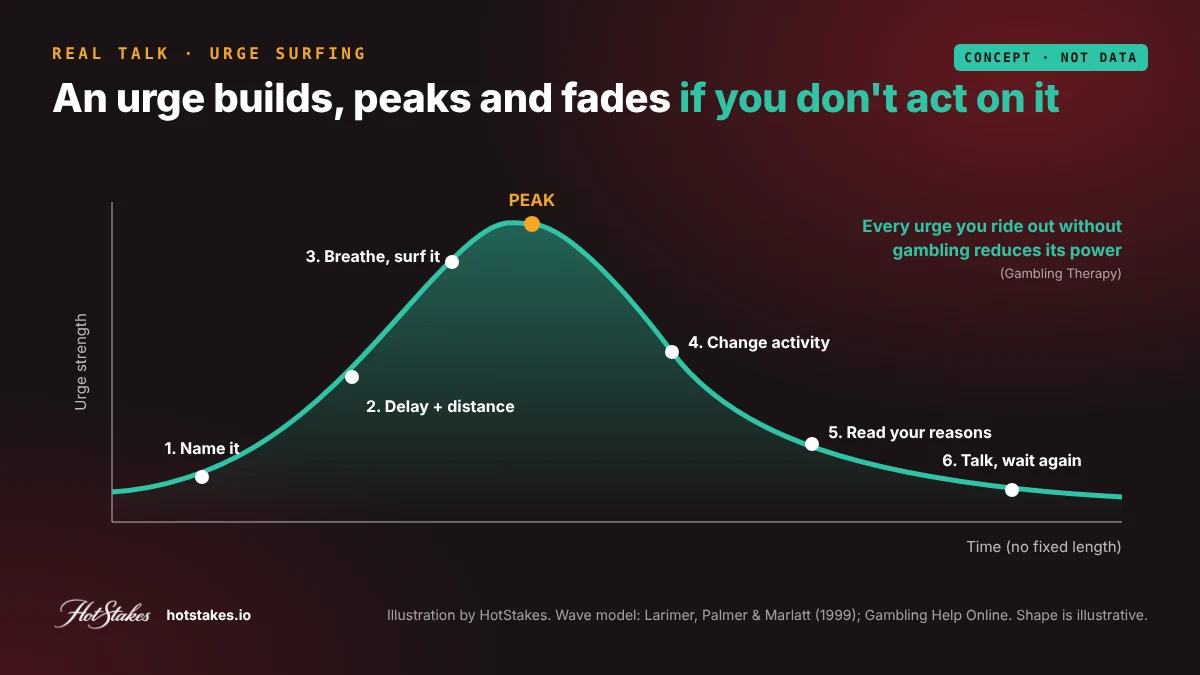
“Urge surfing” comes from Alan Marlatt’s relapse-prevention model. In it, “the client is taught to visualize the urge or craving as a wave” and not to struggle against it or give in to it (Larimer, Palmer & Marlatt, Alcohol Research & Health, 1999). Gambling Help Online uses the same picture: urges “start small, build to their highest point, and then break and flow away.” Gambling Therapy adds that each choice not to gamble is “reducing the power of the urges.”
Here is the part most articles miss. In a small trial with student smokers, brief urge-surfing instruction did not make urges weaker, yet that group smoked fewer cigarettes over the next 7 days (Bowen & Marlatt, Psychology of Addictive Behaviors, 2009). That was smoking, not gambling, so treat it as a clue rather than proof.
The lesson still holds. You can feel the full urge and still not act on it.
It is worth practising: a South Australian study of 158 people seeking help for gambling linked stronger urges to relapse (Smith et al., Journal of Gambling Studies).
How to urge-surf in 60 seconds
- Sit down. Breathe in slowly through your nose.
- Find the urge in your body: chest, stomach, hands, jaw.
- Describe it to yourself, like a weather report: “tight chest, restless hands.”
- On each out-breath, let that spot loosen a little.
- Watch the urge rise. Do not argue with it. Do not obey it. Repeat.
Takeaway: Urge surfing is not about making the urge vanish. It is about letting it pass without placing a bet.
The “one last bet” trap, in numbers
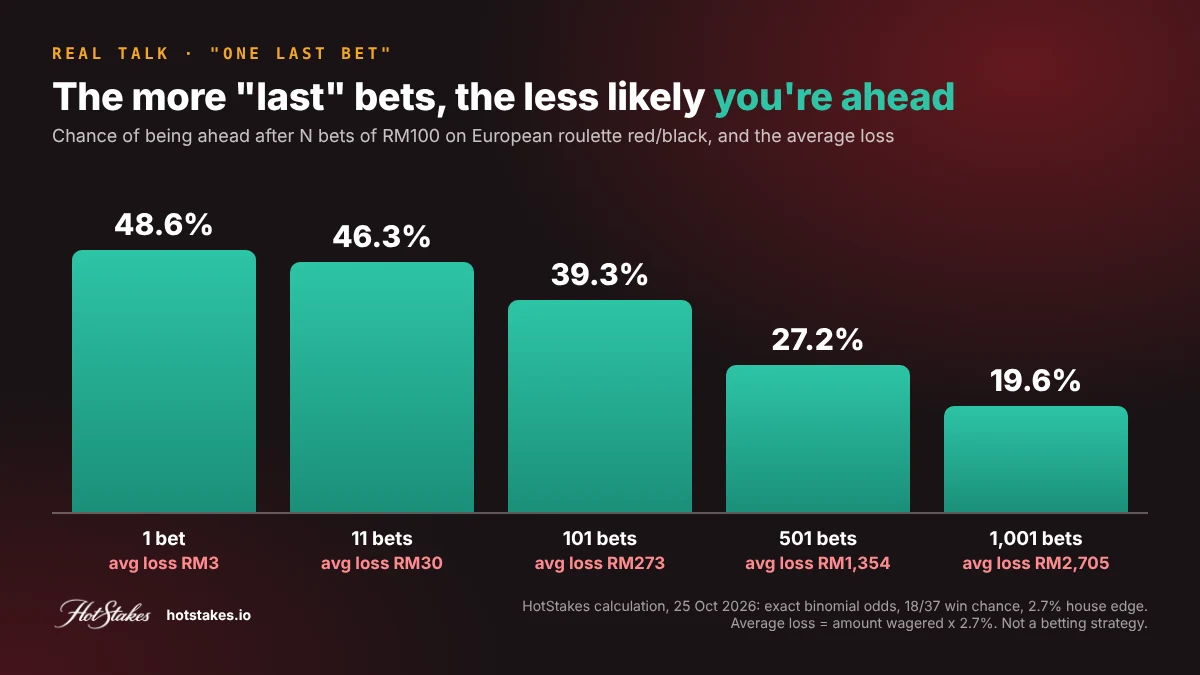
The most dangerous thought during an urge is “just one, to win it back.” So we ran the numbers.
HotStakes calculation, 25 Oct 2026: exact binomial odds for RM100 even-money bets on European roulette (18 in 37 chance to win, a 2.7% house edge). We used odd numbers of bets so there are no ties.
| “Last” bets placed (RM100 each) | Chance you are ahead | Total wagered | Average loss |
|---|---|---|---|
| 1 | 48.6% | RM100 | RM3 |
| 11 | 46.3% | RM1,100 | RM30 |
| 101 | 39.3% | RM10,100 | RM273 |
| 501 | 27.2% | RM50,100 | RM1,354 |
| 1,001 | 19.6% | RM100,100 | RM2,705 |
Now the real chase. You lost RM1,000 tonight and have RM500 left. You keep betting until you are back to RM1,500 or broke. With RM50 bets, you win it back only 17.6% of the time. The other 82.4%, you lose the last RM500 too. Bigger bets do not fix it: even all-in RM500 bets succeed only 31.5% of the time.
This is not a strategy. Every extra bet hands the house its edge again. Our explainer on why the house always wins goes deeper.
Takeaway: “One last bet” is the start of a session, not the end of one.
Thoughts that give you permission (and a reply to each)
Gambling Help Online calls these “permission-giving thoughts”. Spot them early.
| The urge says | What is actually true | Do this instead |
|---|---|---|
| “Just one bet to win it back.” | Chasing usually means many bets, and each one costs you on average. | Read the table above. Wait 30 minutes. |
| “I’m due a win.” | Each spin or hand is independent. See is a slot ever due to hit? | Name the thought out loud. Change rooms. |
| “I’ve had a good day, I deserve it.” | Good moods can trigger relapse too (see the research below). | Celebrate with something that is not a bet. |
| “I’m bored, it’s only small.” | Boredom was the second most common relapse situation in one study. | Have a ready list of 3 boring-proof activities. |
| “I’ve already slipped, so why stop now?” | A slip is not a relapse unless you let it become one. | Use the after-a-slip plan below. |
Takeaway: If a thought ends with “so I might as well bet”, treat it as the urge talking.
Just gambled again? What to do after a slip
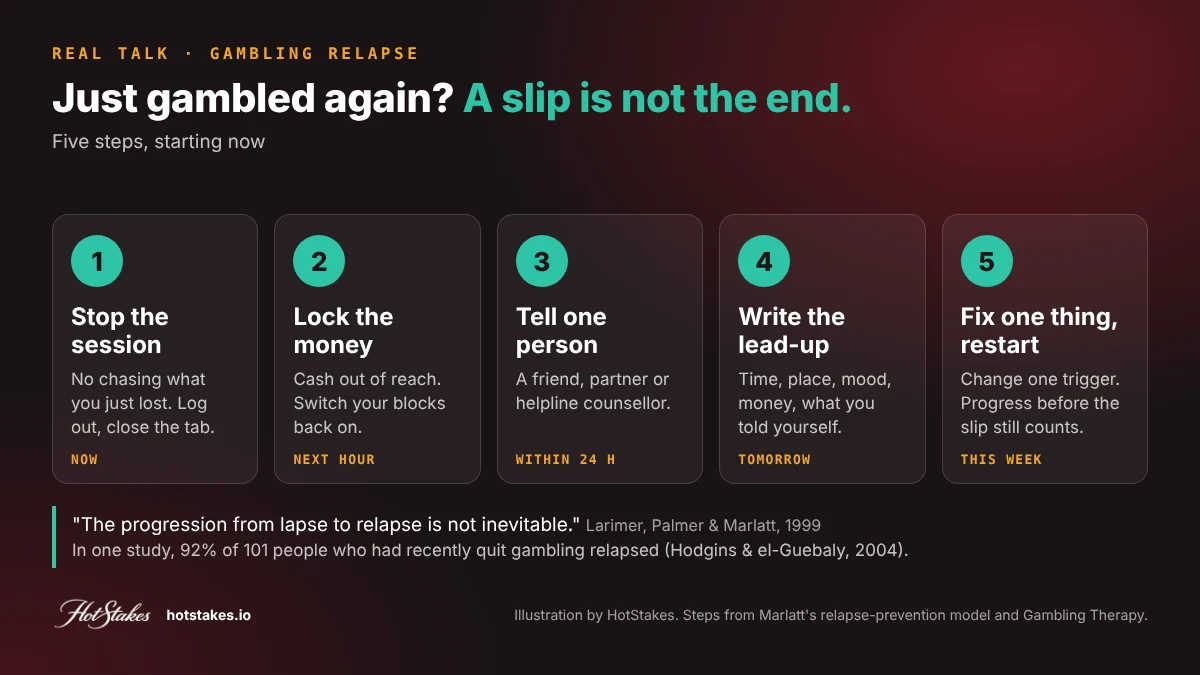
First, breathe. You are not unusual. In a study of 101 people who had recently quit gambling, researcher David Hodgins reports: “Remarkably, 92% of individuals relapsed” (Hodgins, BASIS, on Hodgins & el-Guebaly 2004). The most common relapse situation was “a resurgence in optimism about winning”, followed by boredom. People were just as likely to slip after positive feelings as after negative ones.
In a separate 40-month follow-up, “escape from thoughts or feelings” was the top-rated reason for going back (Hodgins & Peden, Journal of Gambling Issues).
Marlatt’s model separates a lapse (one slip) from a relapse (a return to the old pattern). It warns that blaming yourself as a personal failure makes things worse, and that “the progression from lapse to relapse is not inevitable” (Larimer, Palmer & Marlatt).
- Stop the session now. Do not chase what you just lost. Log out, close the tab.
- Lock the money. Move cash out of reach and switch your blocks back on.
- Tell one person within 24 hours. A friend, a partner, or a helpline counsellor. Secrecy feeds the next slip.
- Write down the lead-up. Time, place, mood, money, what you told yourself. Gambling Therapy notes that urges usually have a lead-up, such as stress about work, relationships or money.
- Fix one thing and restart. Change the one trigger you found. Your progress before the slip still counts.
If the slip left you owing money, read our gambling debt guide for the first 48 hours before you do anything else.
Takeaway: A slip is information, not a verdict. Stop, lock, tell, learn, restart.
For family: how to help during an urge
If someone you love texts “I really want to gamble right now”, that is a good sign: they reached out instead of betting.
- Stay calm and thank them for telling you.
- Offer to be the distraction: a call, a walk, food.
- Do not hand over money “just this once”, and do not lecture.
- Suggest a helpline together, and look after your own support too.
Our guide for when a partner has a gambling problem goes further, including how to protect your own money.
Takeaway: Be the delay, not the judge.
When to get professional help
Self-help plans work best alongside support. A 2022 Cochrane review of 14 studies found evidence supporting cognitive behavioural therapy (CBT) for reducing gambling soon after treatment, though “the durability of therapeutic gain is unknown” (Cochrane, 2022).
If urges are daily, if you have slipped more than once this month, or if gambling is hurting your money, sleep or relationships, talk to a counsellor. Not sure where you stand? Try our signs of a gambling problem checklist or read should I quit gambling?
Takeaway: Asking for help is a recovery skill, not a failure.
Where to get help tonight (verified 25 Oct 2026)
We checked every number below on the linked page on 25 Oct 2026.
| Where | Service | Contact | Hours / notes |
|---|---|---|---|
| Singapore | NCPG National Problem Gambling Helpline and WebChat | 1800-6-668-668, webchat on ncpg.org.sg | Daily 8am–11pm; you can stay anonymous (NCPG hours, NCPG number) |
| Malaysia | Talian HEAL (Health Ministry mental health line) | 15555 | 8am–midnight; a 24-hour service is planned (The Star, 22 Oct 2026). No national gambling-specific line found. |
| Malaysia | Befrienders KL (emotional support) | 03-7627 2929 | 24 hours, free, confidential (Befrienders) |
| Philippines | PAGCOR National Problem Gambling Helpline | (02) 8248-9568 | 24/7, launched May 2026 (Daily Tribune) |
| Philippines | NCMH Crisis Hotline | 1553 | 24/7, toll-free landline (Daily Tribune) |
| Hong Kong | Gambling counselling hotline (Ping Wo Fund centres) | 1834 633 | Run with Tung Wah’s Even Centre, Caritas and others (HK government, Tung Wah) |
| India | Tele-MANAS (government mental health line) | 14416 | Free, 24×7 (JIPMER). No national gambling-specific line found. |
| Anywhere | Gambling Therapy (Gordon Moody) | gamblingtherapy.org | Free, global online support, many languages (Gambling Therapy) |
If you feel unsafe or are thinking about ending your life, call your local emergency number now.
Takeaway: Save one number in your phone today, before the next urge.
FAQ
How do I stop a gambling urge right now?
Delay for at least 30 minutes, put distance between you and the money, breathe slowly, switch to another activity, read your reasons for stopping, and talk to someone. Then decide to wait again. This follows published self-help guidance such as the 5Ds: Delay, Distract, Deep breathe, Decide, Discuss.
How long does a gambling urge last?
There is no fixed time. Self-help services describe urges as waves that build, peak and pass if you do not act on them. Gambling Help QLD suggests waiting at least half an hour, then another half hour if needed.
What is urge surfing for gambling?
Urge surfing is a technique from Marlatt’s relapse-prevention model. You picture the urge as a wave, notice where you feel it in your body, and breathe through it without fighting it or acting on it.
Is relapse normal when you quit gambling?
Yes, it is common. In one study of 101 people who had recently quit, 92% relapsed. A slip does not erase your progress. Stop the session, lock your money, tell someone, learn what led to it, and restart.
Where can I get help for gambling urges in Singapore, Malaysia, the Philippines or Hong Kong?
Singapore: NCPG 1800-6-668-668 (daily 8am to 11pm). Malaysia: Talian HEAL 15555 or Befrienders KL 03-7627 2929. Philippines: PAGCOR helpline (02) 8248-9568 or NCMH 1553. Hong Kong: gambling counselling hotline 1834 633. Anywhere: Gambling Therapy online.
HotStakes is an independent directory. Some links on this site are affiliate links; we may earn a commission at no cost to you, and it never changes our rankings. Gambling involves risk — only play with money you can afford to lose, and if it stops being fun, seek help. This article is general information, not legal advice. Read our full disclaimer.
 Next story →GCash Gambling Ban Explained: What the BSP Order Changed


Start the discussion