

PAGCOR Revenue 2026: Why It Fell 23% and Where ₱19.7bn Went
PAGCOR revenue fell 23% to ₱64.41bn in Jan–Sep 2026. Our maths on where the ₱19.7bn went, the e-wallet delink and the 85% profit drop.
In this article
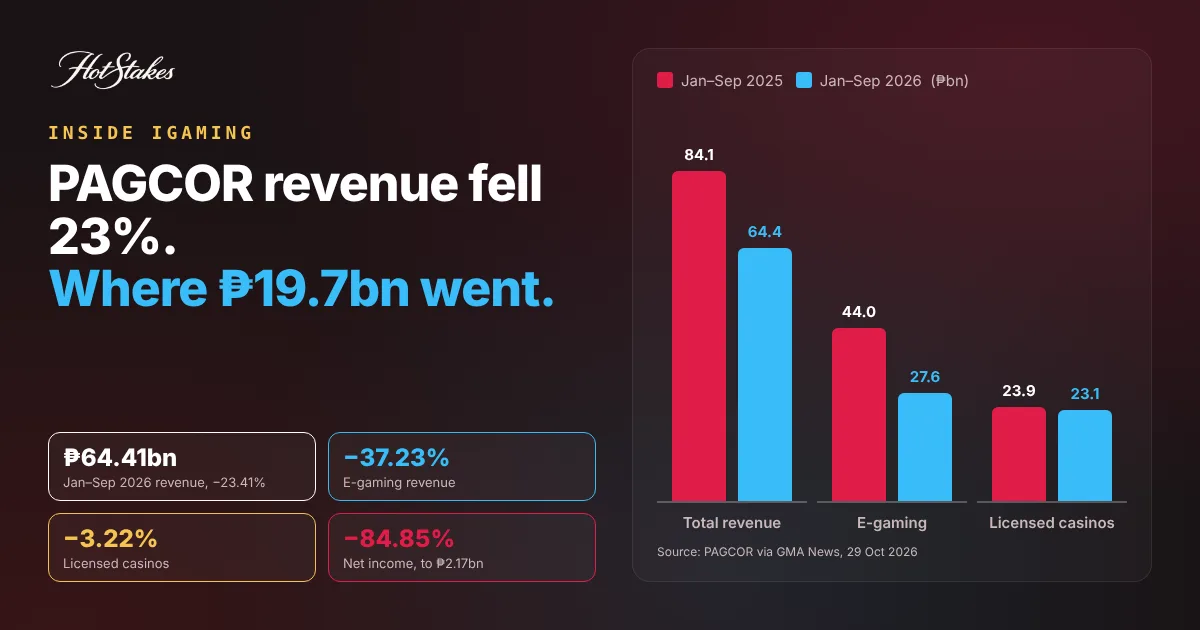
PAGCOR’s revenue fell 23.41% in January to September 2026, to ₱64.41 billion from ₱84.09 billion a year earlier. That is ₱19.7 billion gone. One segment, electronic gaming, accounts for ₱16.4 billion of it, and the main named cause is the August 2025 order that cut gambling links from GCash and Maya. Inflation and Middle East tensions also hit spending. Net income fell 84.85%, which PAGCOR blames on a Supreme Court ruling on sports funding. Below: the full numbers, our own maths (2 Nov 2026), and what the sources say about where players went.
The numbers: January–September 2026 vs 2025
PAGCOR, the Philippine Amusement and Gaming Corporation, is both the country’s gambling regulator and a casino operator. Its nine-month results came out on 29 October. GMA News reported the full breakdown from PAGCOR’s release. Here it is in one table. The last column is our maths.
| Segment (Jan–Sep) | 2025 | 2026 | Change | Share of the ₱19.68bn drop* |
|---|---|---|---|---|
| Electronic gaming | ₱44.03bn | ₱27.63bn | −37.23% | 83% |
| Licensed casinos | ₱23.87bn | ₱23.10bn | −3.22% | 4% |
| Casino Filipino (PAGCOR-run) | ₱7.91bn | ₱7.28bn | −8% | 3% |
| Poker | ₱110.97m | ₱105.86m | −4.60% | <0.1% |
| Total gaming | ₱75.93bn | ₱58.13bn | −23.44% | 90% |
| Other related services | ≈₱4.95bn* | ₱3.04bn | −38.59% | 10% |
| Other income | ₱3.20bn | ₱3.23bn | +0.9% | — |
| Total revenue | ₱84.09bn | ₱64.41bn | −23.41% | 100% |
| Net income | ₱14.32bn | ₱2.17bn | −84.85% | — |
*Our maths, 2 Nov 2026. PAGCOR gave only the 2026 figure and the percentage for other related services, so we worked back to the 2025 figure. The segments add up to the reported totals within rounding.
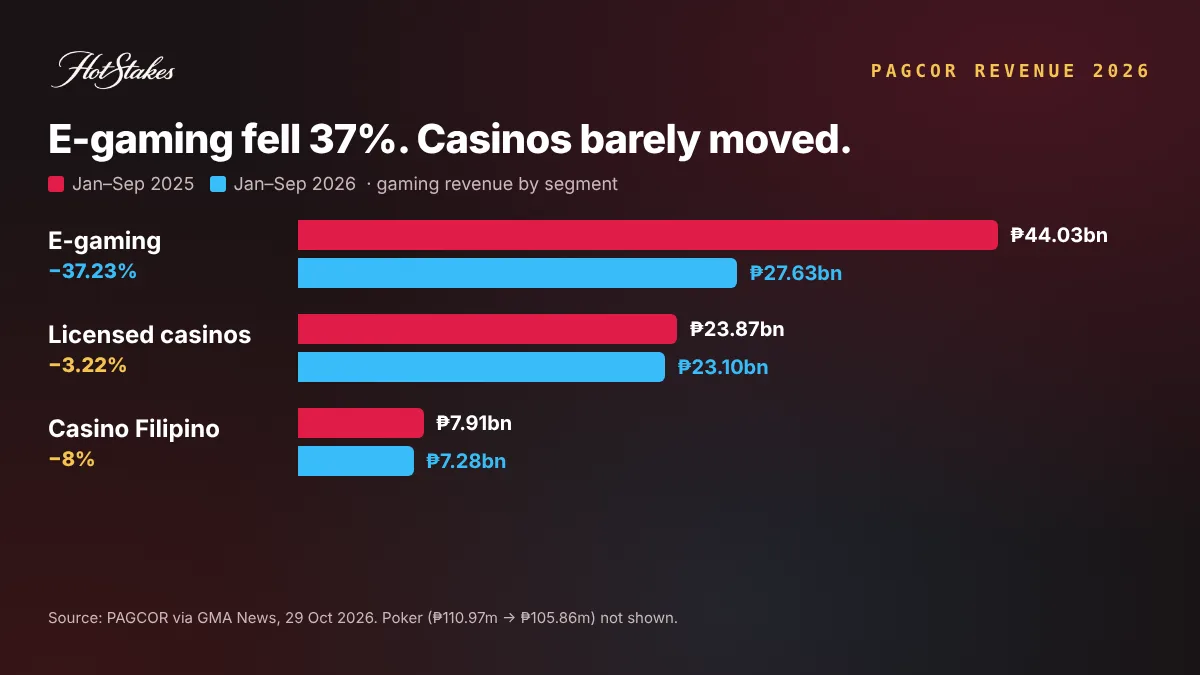
Takeaway: Casinos barely moved. The online side fell off a cliff.
Our maths: one segment did almost all the damage
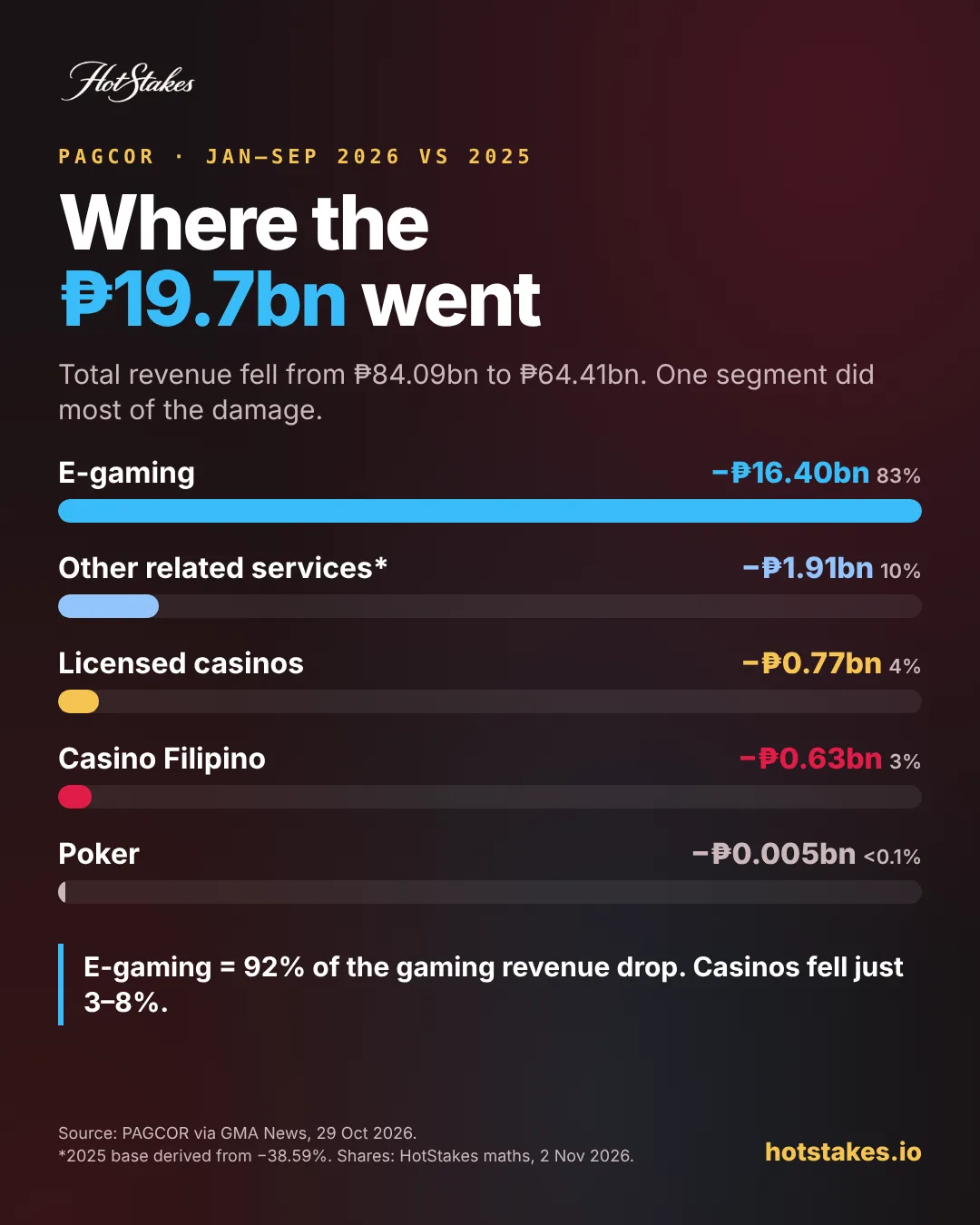
Gaming revenue fell ₱17.80 billion. Electronic gaming fell ₱16.40 billion. That is 92% of the gaming drop coming from one line.
Three more numbers make the point:
- E-gaming’s share of gaming revenue dropped from 58.0% in Jan–Sep 2025 to 47.5% in 2026. Online is still PAGCOR’s biggest gaming source, but no longer the majority.
- Everything else in gaming combined (licensed casinos, Casino Filipino, poker) fell from ₱31.90 billion to ₱30.50 billion. That’s −4.4%. A soft year, not a crisis.
- Licensed casinos’ share rose from 31.4% to 39.7% of gaming revenue, simply because e-gaming shrank around them.
If e-gaming had fallen at the same 4.4% rate as the rest, PAGCOR’s gaming revenue would be about ₱14.5 billion higher.
PAGCOR’s revenue is not the industry’s revenue
Don’t mix these figures up with gross gaming revenue (GGR), the amount operators keep after paying out wins. PAGCOR’s revenue is its own take as regulator and operator. In January, Chairman and CEO Alejandro Tengco told Inside Asian Gaming that online gaming GGR set a record of more than ₱200 billion in 2025, despite the delink. PAGCOR’s own e-gaming revenue for the first nine months of 2025 was ₱44.03 billion. The two numbers measure different things.
Takeaway: This is an e-games story. Strip out e-gaming and PAGCOR’s gaming business shrank by less than 5%.
Q3 looks better. It isn’t, quite.
PAGCOR’s first-half results, reported by GMA News on 30 July, let us split out the third quarter. AGBrief did this for total revenue: roughly ₱21.1 billion in Q3 2026 against about ₱25.0 billion a year earlier. We did the same for each segment (2 Nov 2026):
| Period | Total revenue | E-gaming* | Other gaming |
|---|---|---|---|
| H1 2026 vs H1 2025 | ₱43.32bn, −26.6% | ₱18.60bn, −41.9% | ₱20.32bn, −4.7% |
| Q3 2026 vs Q3 2025 (our maths) | ₱21.09bn, −15.8% | ₱9.03bn, −24.9% | ₱10.18bn, −3.0% |
| Quarterly average, H1 2026 | ₱21.66bn | ₱9.30bn | ₱10.16bn |
*The H1 release calls this line “eGames, eBingo and bingo grantees”. We treat it as the same line as “electronic gaming” in the nine-month release. If PAGCOR grouped them differently, the Q3 split would shift.
At first glance the year-on-year fall in e-gaming halved, from −42% to −25%. That looks like a recovery. But Q3 e-gaming revenue of ₱9.03 billion was below the ₱9.30 billion PAGCOR averaged in each of the first two quarters.
So why does Q3 look better? The comparison quarter changed. GCash and Maya switched off gambling links on 16 August 2025. That means Q3 2025 already contained about six weeks of post-delink trading. H1 2025 had none. The 2026 numbers are being compared with a weaker base, not rising.
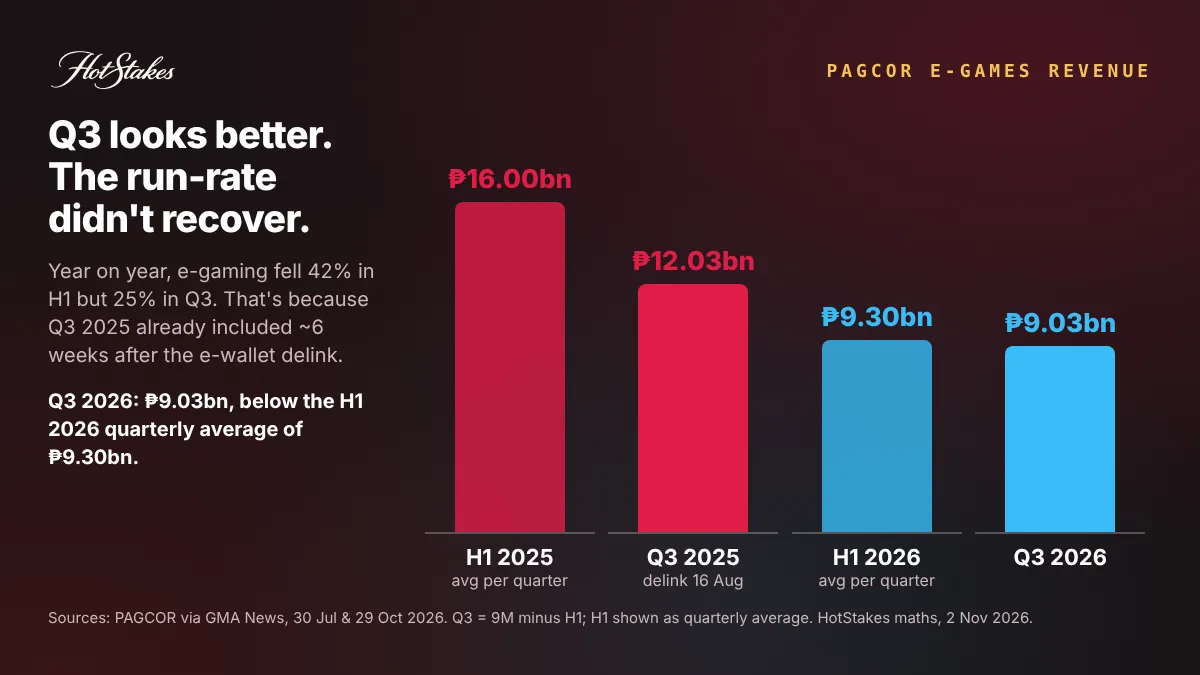
Takeaway: Expect the year-on-year decline to keep shrinking into Q4, because the comparison is with post-delink months. That is not the same as players coming back.
Why e-games fell: what each source actually says
PAGCOR has given different reasons at different times. Here is the order of events, with what each source says:
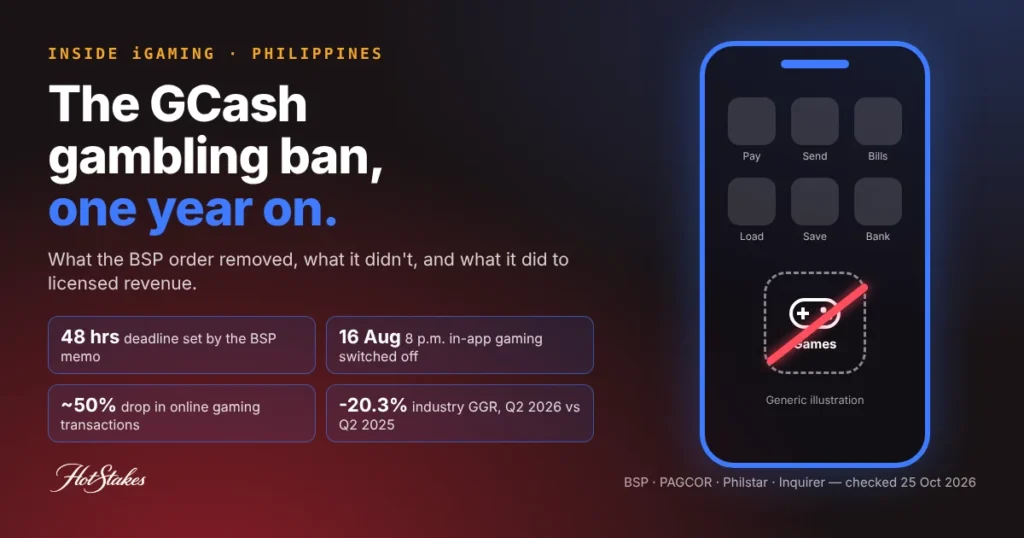
- 14 Aug 2025: The central bank (BSP) told e-wallets to “take down and remove all icons and links redirecting to gambling sites”, Deputy Governor Mamerto Tangonan said at a Senate hearing, as SunStar reported. The deadline was 48 hours.
- 16 Aug 2025: GCash and Maya cut in-app gambling access at 8pm, under BSP Memorandum No. M-2025-029, according to AGBrief.
- 20 Aug 2025: Tengco told a House briefing that transactions on licensed platforms “fell by about 50 percent”, World Casino News reported.
- 10 Dec 2025: PAGCOR blocked credit cards and cryptocurrency for betting, citing risks of “over-borrowing and impulsive behavior”, Manila Bulletin reported.
- 30 Jul 2026: The H1 release put the revenue fall down to Middle East tensions that hit spending in Q1. It did not mention e-wallets.
- 24 Aug 2026: At a House budget hearing, Tengco said the delink made deposits take extra steps: it “contributed to a 40% decline” in gaming activity, GMA News reported.
- 29 Oct 2026: The nine-month release singled out e-gaming, which “declined considerably by 37.23%”, in Tengco’s words.

The other causes: prices and the Middle East
The delink is not the only factor. Tengco also blamed the Middle East conflict, which he said mostly hit online players in the C, D and E income classes, The Philippine Star reported. In June, PAGCOR warned gross gaming revenue could fall by as much as 19% in 2026. Analysts quoted by AGBrief said “higher fuel, food, and utility costs are weighing on nonessential spending”.
Our maths can’t split the e-games drop between these causes. But one pattern stands out. Casinos face the same inflation and fell only 3–8%. E-games, the segment that lost its payment shortcut, fell 37%.
Takeaway: The delink is the most likely main cause, and PAGCOR’s own chairman says so. Inflation is a real second factor. For what the ban covers today, see our GCash gambling ban status explainer.
Where did the players go? Claims vs evidence
This is the question everyone asks. Nobody has answered it with hard data. Here’s who claims what:
- A survey says some moved to unlicensed sites. Research firm The Fourth Wall polled 1,250 active online gamblers in August 2025. It reported regulated platforms lost as many as 70% of users while traffic to illegal sites rose 40%, World Casino News reported. That measures traffic and self-reports, not money wagered.
- Licensed operators warned of a black market. The PlaySafe Alliance, a group of 18 online gaming operators and a law firm, argued the delink could push players to untraceable illegal sites, Manila Bulletin reported. Its members have a commercial stake in the rule.
- A senator said operators found new routes. Sen. Erwin Tulfo said operators were moving to encrypted messaging and e-commerce platforms, according to Marketing-Interactive.
- PAGCOR says the illegal market was already big. Tengco estimated in August 2025 that about 60% of platforms operate without a licence, and said “it’s really hard to go after” them.
What we can’t tell you: whether those players are betting elsewhere, betting less, or have stopped. PAGCOR’s revenue only counts licensed activity. A fall there fits all three stories.
Some evidence points to real reduced spending, not just a move. The parent of GCash, Mynt, saw payment revenue fall 3.7% in H1 2026. Analysts at AP Securities said this reflected “the full impact” of the delink, AGBrief reported. Licensed operator DigiPlus reported H1 revenue down 31.2%, the same report said.
Takeaway: The “players went offshore” claim is plausible but unproven. If you play, a site with no PAGCOR licence gives you no Philippine regulator to complain to. Check a PAGCOR licence in two minutes before you deposit.
Why net income fell 85%
Net income fell from ₱14.32 billion to ₱2.17 billion. PAGCOR blamed a Supreme Court ruling that it must remit 5% of gross revenue to the Philippine Sports Commission (PSC). GMA News says that’s nearly double the previous level. PSC payments came to ₱3.01 billion in the nine months.
We set those numbers against each other (2 Nov 2026):
- Net income fell ₱12.15 billion.
- Revenue fell ₱19.68 billion.
- PSC payments of ₱3.01 billion are about 4.7% of revenue. If that is “nearly double” the old level, the extra cost is roughly ₱1.5 billion.
So the revenue drop, not the PSC ruling, looks like the bigger driver on these figures. There is one caveat. The Philippine Star reported a retroactive PSC liability of ₱37 billion costing about ₱300–400 million a month. PAGCOR hasn’t said how that is booked, so the full PSC effect may be larger than the payments line shows.
Meanwhile the government still got ₱27.61 billion as its 50% share. Total contributions to the state and statutory obligations came to ₱45.28 billion, PAGCOR says.
Takeaway: The headline 85% is partly a legal-accounting story. But a ₱19.7 billion revenue hole would have hurt profits anyway.
What this means for players
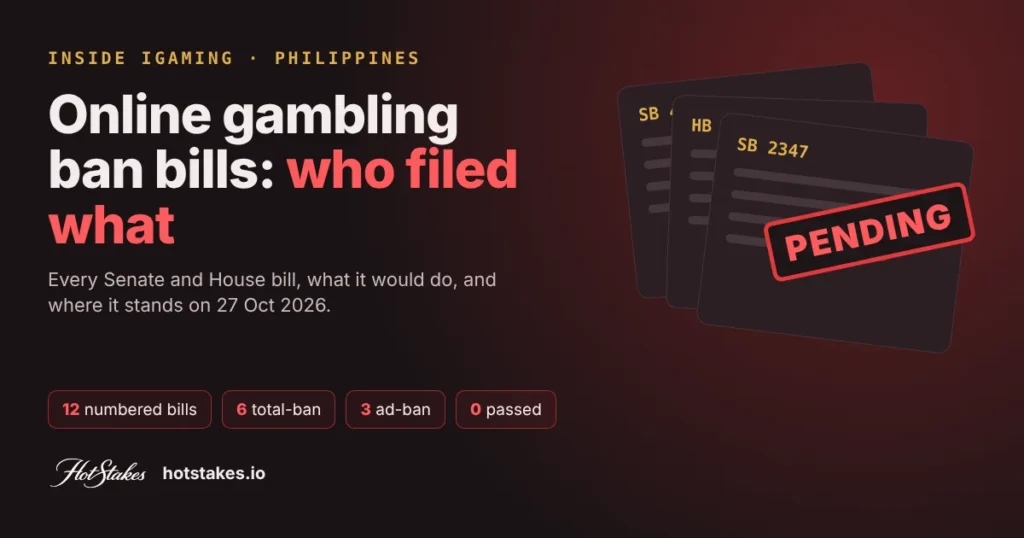
If you play in the Philippines, the result changes nothing about the rules. It does tell you where the pressure is. Several 2026 bills propose tighter rules or an outright ban on online gambling; our guide to every 2026 online gambling ban bill tracks them.
- Check the licence first. Use the PAGCOR app to find licensed gaming sites or our licence checker.
- Be wary of new payment routes. If a site suddenly asks you to pay through a messaging app, a voucher or a personal account, treat it as a red flag.
- Don’t confuse old and new rules. POGOs, the offshore operators serving foreign players, were banned separately. Our POGO ban explainer covers why.
- Compare regulators. Many offshore sites carry foreign licences instead. Our Curaçao licence reform explainer shows what those do and don’t protect.
FAQ
How much did PAGCOR revenue fall in 2026?
PAGCOR’s total revenue for January to September 2026 was ₱64.41 billion, down 23.41% from ₱84.09 billion in the same period of 2025. That is a fall of about ₱19.7 billion.
Why is PAGCOR revenue falling?
Mostly because electronic gaming revenue fell 37.23%, to ₱27.63 billion. PAGCOR’s chairman links this to the August 2025 removal of gambling links from e-wallets like GCash and Maya, plus inflation and Middle East tensions. Casino revenue fell only 3–8%.
Did the GCash gambling ban cause the drop?
It is the main named cause. PAGCOR’s chairman said the delink “contributed to a 40% decline” in gaming activity. By our maths, e-gaming made up 92% of the fall in gaming revenue. Inflation also played a part, and the split between causes isn’t published.
Why did PAGCOR net income drop 84.85%?
PAGCOR blames a Supreme Court ruling requiring it to remit 5% of gross revenue to the Philippine Sports Commission. Net income fell to ₱2.17 billion. On our maths, the ₱19.7 billion revenue fall also played a large role.
Did players move to illegal gambling sites?
Some sources say so. A survey by The Fourth Wall reported a 40% rise in traffic to illegal sites after the delink, and licensed operators warned of a black market. PAGCOR’s results can’t confirm this, because they only count licensed play.
HotStakes is an independent directory. Some links on this site are affiliate links; we may earn a commission at no cost to you, and it never changes our rankings. Gambling involves risk — only play with money you can afford to lose, and if it stops being fun, seek help. This article is general information, not legal advice. Read our full disclaimer.
 Next story →How to Tell Your Family You Have a Gambling Problem: 4 Steps
Start the discussion