

Gambling and Depression: Which Comes First?
Does gambling cause depression, or the other way round? What the big studies found, the two-way loop, signs to notice and where to get free help.
In this article
- How often do gambling problems and depression go together?
- Which comes first? The evidence runs both ways
- Why low mood can lead to gambling: the “escape” motive
- Why gambling can lead to low mood: the loss-chasing loop
- Signs to notice in yourself: a quick self-check
- Why treating only one side often fails
- What helps: five steps
- If you’re the family: how to respond
- Free, confidential help (verified 9 Nov 2026)
- FAQ
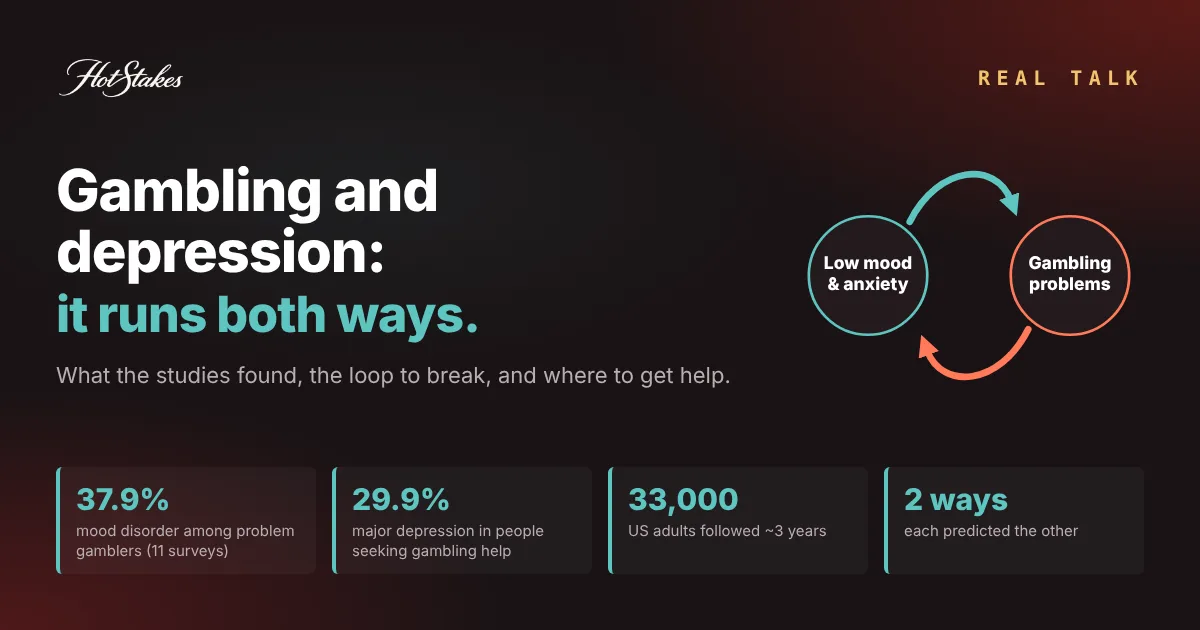
Does gambling cause depression, or does depression lead to gambling? The research says both. In a large US survey, earlier anxiety and mood disorders predicted who later developed a gambling disorder. In another, people with gambling problems were more likely to develop new mood and anxiety disorders three years later. Gambling and depression feed each other, so the honest answer to “which comes first?” is “either, and then both.” That matters, because fixing only one side often leaves the loop running.
How often do gambling problems and depression go together?
Often. Far more often than in the general population.
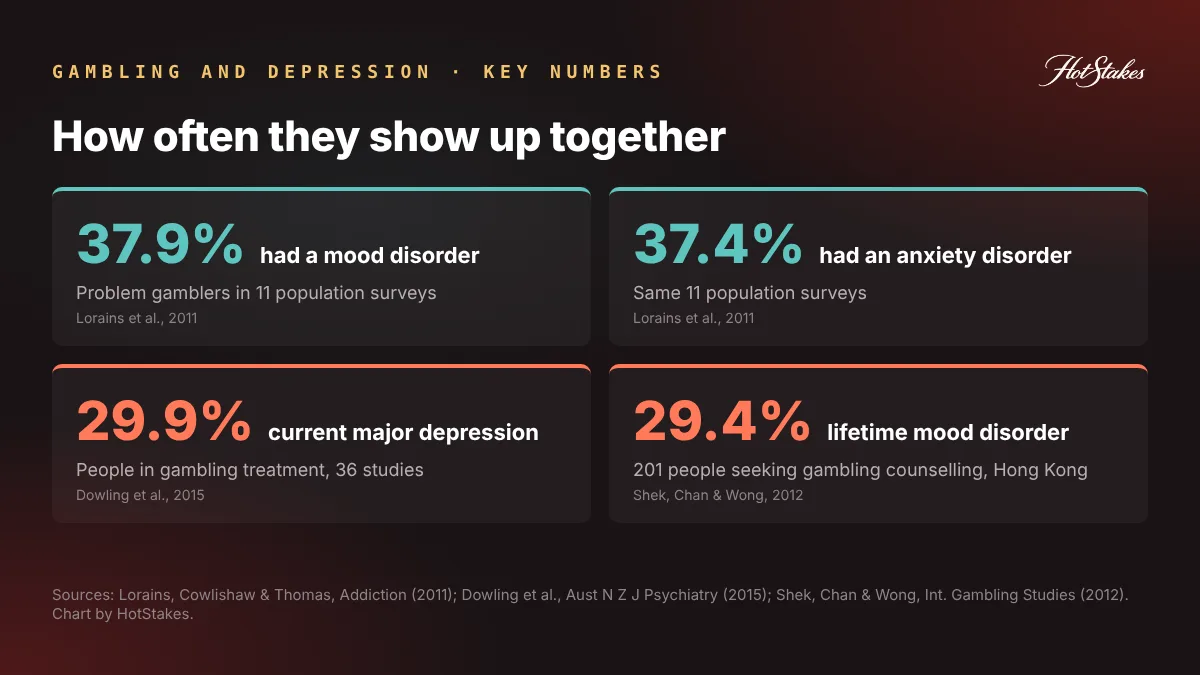
The best summary of community data is a 2011 meta-analysis by Lorains, Cowlishaw and Thomas in Addiction. It pooled 11 population surveys of people with problem or pathological gambling. The average rates:
- 60.1% nicotine dependence
- 57.5% a substance use disorder
- 37.9% any mood disorder (which includes depression)
- 37.4% any anxiety disorder
Among people who seek gambling treatment, depression stands out even more. A 2015 meta-analysis of 36 studies by Dowling and colleagues in the Australian and New Zealand Journal of Psychiatry found 29.9% had current major depressive disorder. About three in four (74.8%) had at least one current mental health condition of the kind the study measured.
Hong Kong data points the same way. Shek, Chan and Wong (2012) assessed 201 people seeking help for pathological gambling. 63.7% had a lifetime psychiatric disorder, and mood disorders were the most common, at 29.4%.
A caution on these numbers: they come from different countries, tools and years, and the authors themselves warn the estimates vary. We looked for a comparable published figure from Singapore, Malaysia, the Philippines or India on depression among people with gambling problems and did not find one we could verify today, so we have not quoted one.
Takeaway: If you gamble and feel low or anxious, you are not unusual. Roughly a third of people with gambling problems in these studies had a mood disorder too.
Which comes first? The evidence runs both ways
Here is what the major studies actually found.
| Study | Who and where | What it found | Direction |
|---|---|---|---|
| Kessler et al., 2008, Psychological Medicine | US National Comorbidity Survey Replication (nationally representative adults) | Gambling disorder was “predicted by a variety of prior” anxiety, mood, impulse-control and substance use disorders. It also predicted later generalised anxiety disorder, PTSD and substance dependence. | Both ways |
| Chou & Afifi, 2011, American Journal of Epidemiology | About 33,000 US adults, interviewed in 2000–01 and again in 2004–05 | Past-year disordered gambling at the start predicted new mood disorders, generalised anxiety disorder, PTSD and alcohol problems at follow-up, even after adjusting for health, quality of life and stressful life events. | Gambling → mood |
| Lorains et al., 2011, Addiction | 11 population surveys | 37.9% mood disorder, 37.4% anxiety disorder among problem gamblers | Co-occurrence only |
| Dowling et al., 2015, Aust N Z J Psychiatry | 36 studies of people in gambling treatment | 29.9% current major depression; 17.6% current anxiety disorder | Co-occurrence only |
| Shek, Chan & Wong, 2012, International Gambling Studies | 201 treatment seekers, Hong Kong | 63.7% lifetime psychiatric disorder; 29.4% mood disorder | Co-occurrence only |
Two limits are worth knowing. Kessler’s timing comes from people recalling when problems started, which is imperfect. And Chou and Afifi tested one direction: gambling first, then mood. Neither study proves cause. Together, though, they fit a two-way relationship far better than a one-way one.
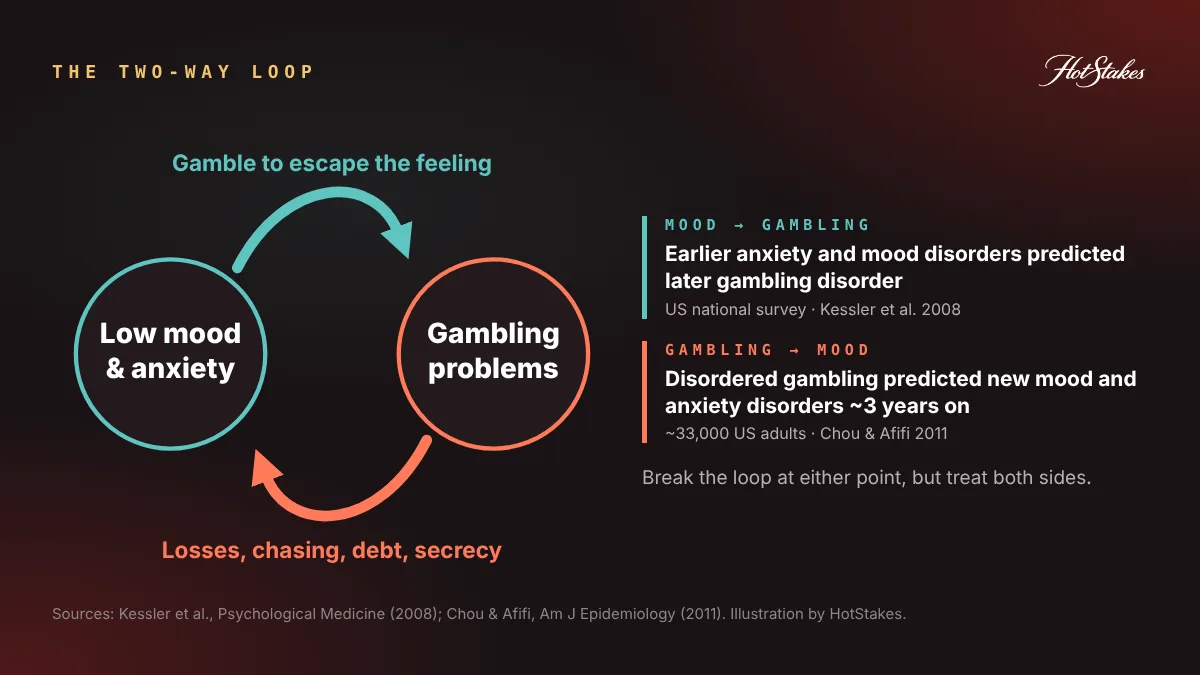
Takeaway: “Which comes first?” differs from person to person. For many, it stops mattering once the loop is running.
Why low mood can lead to gambling: the “escape” motive
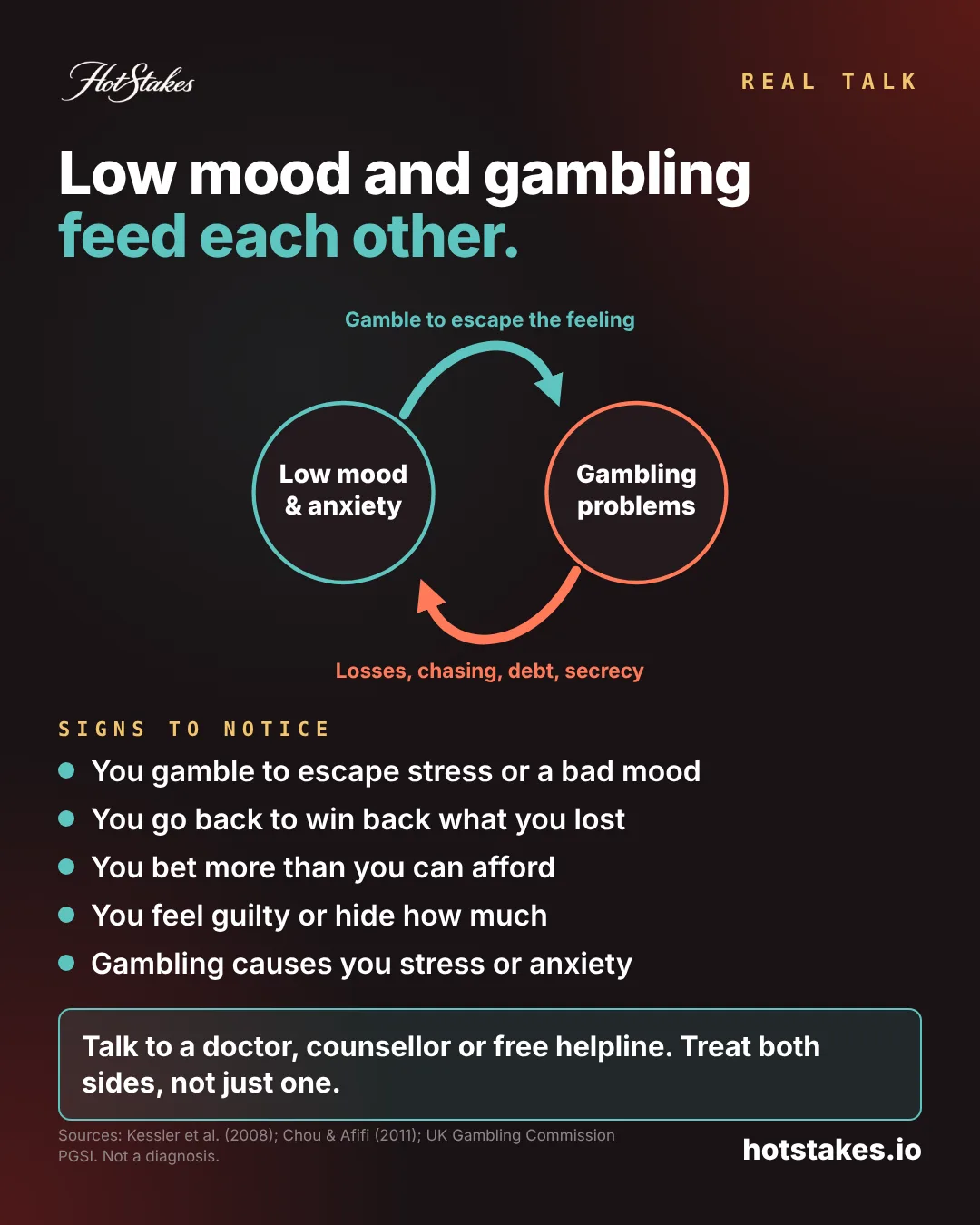
Gambling to get away from bad feelings is so recognised that it appears in the diagnostic checklist. The survey version of the DSM-IV criteria published by the UK Gambling Commission includes: “Gamble as a way of escaping from problems or of relieving a dysphoric mood”, with helplessness, guilt, anxiety and depression given as examples.
Psychologists Alex Blaszczynski and Lia Nower built this into their pathways model (Addiction, 2002). It describes three subgroups of problem gamblers. One is “emotionally vulnerable problem gamblers”: people for whom anxiety, depression or a hard past come first, and gambling becomes a way to cope.
The trap is that it works, briefly. A spin or a match gives your mind something else to hold. Then the session ends and the feeling returns, often with a loss attached.
Takeaway: If you mostly gamble when you feel stressed, lonely or low, that is a signal worth taking seriously, whatever the amount.
Why gambling can lead to low mood: the loss-chasing loop
The other direction is easier to picture. It usually runs like this:
- A loss. Bigger than planned, or money that was meant for something else.
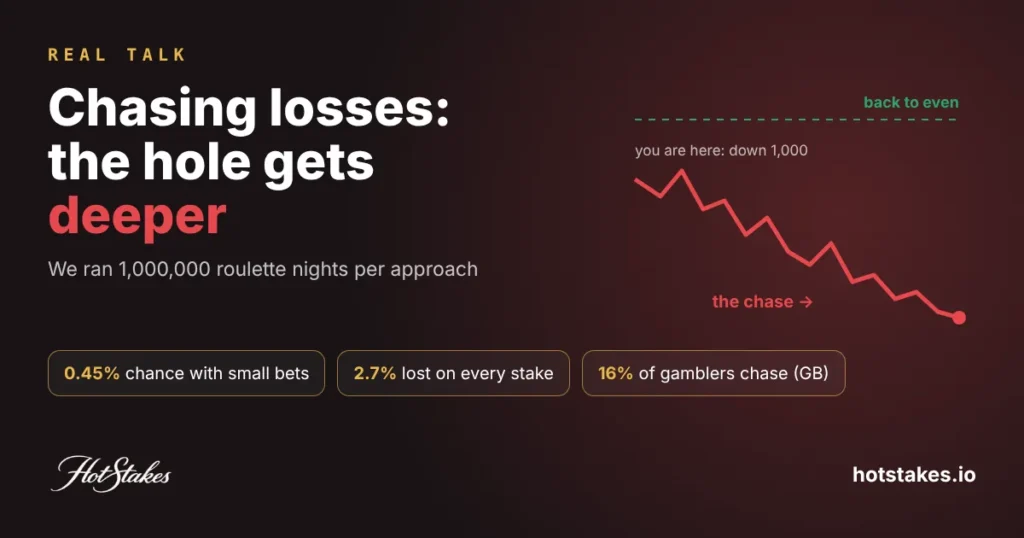
- Chasing. You go back to win it back. The PGSI screen asks about exactly this.
- Debt and borrowing. Cards, apps, friends, family.
- Secrecy. Hiding the numbers from the people closest to you.
- Guilt, worry and sleepless nights. Which make the next escape bet more tempting.
If step 2 is where you are now, read how to stop chasing losses. If step 3 is already here, our guide to what to do about gambling debt sets out the order to tackle it.
Takeaway: Money stress is a mood problem as well as a money problem. Stopping the chase protects both.
Signs to notice in yourself: a quick self-check
The Problem Gambling Severity Index (PGSI) is a nine-question screen used in national surveys. These are its questions, as published by the UK Gambling Commission. Each asks about the last 12 months.
- Have you bet more than you could really afford to lose?
- Have you needed to gamble with larger amounts of money to get the same feeling of excitement?
- When you gambled, did you go back another day to try to win back the money you lost?
- Have you borrowed money or sold anything to get money to gamble?
- Have you felt that you might have a problem with gambling?
- Has gambling caused you any health problems, including stress or anxiety?
- Have people criticised your betting or told you that you had a gambling problem?
- Has your gambling caused any financial problems for you or your household?
- Have you felt guilty about the way you gamble or what happens when you gamble?
Answers are scored never (0), sometimes (1), most of the time (2) or almost always (3). In survey use, 1–2 is low risk, 3–7 moderate risk and 8 or more problem gambling.
Look at questions 6 and 9. Stress, anxiety and guilt are built into the screen, because they are part of how gambling harm shows up. For a plain-English version, see our signs of a gambling problem checklist.
Takeaway: This is a screen, not a diagnosis. Any “most of the time” answer is worth raising with a doctor, counsellor or helpline.
Why treating only one side often fails
If you treat only the gambling, low mood can stay and pull you back towards the escape. If you treat only the low mood, the debts and the chasing keep refilling it. That is the logic behind Dowling and colleagues’ conclusion: they call for “routine screening and assessment of psychiatric co-morbidity” in gambling services, and for treatment that manages both.
In practice, that means telling whoever you see the full picture. Mention the gambling to your doctor. Mention the low mood or anxiety to your gambling counsellor. Ask how both will be looked at. Decisions about treatment, including any medicine, belong with your doctor.
Takeaway: You don’t have to fix both at once, but the people helping you need to know about both.
What helps: five steps
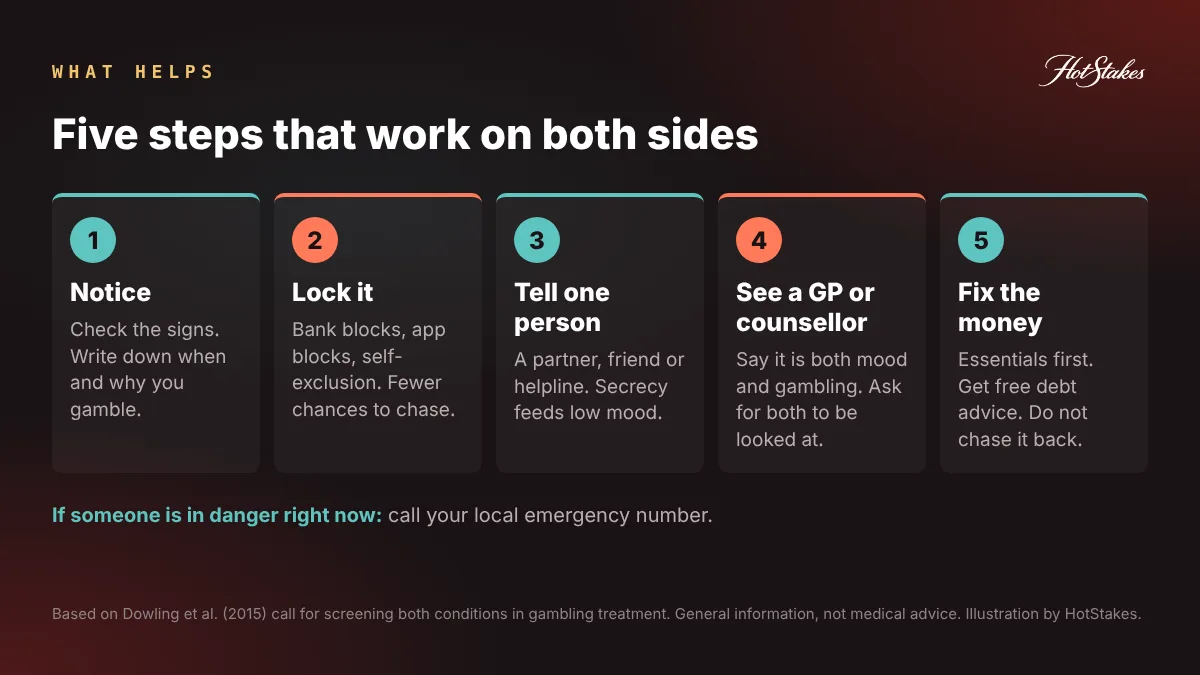
- Notice your pattern. For a week, jot down when you gamble and how you felt just before.
- Put barriers in place. Bank gambling blocks, app blockers and self-exclusion take the decision out of a bad hour. See how to block gambling.
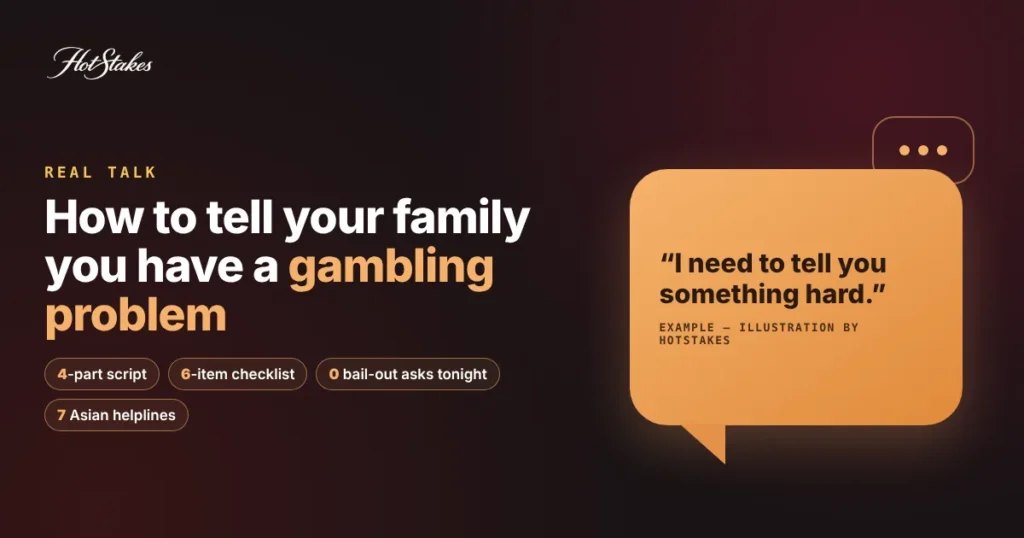
- Tell one person. Secrecy feeds both guilt and chasing. Our guide on how to tell your family has opening lines.
- See a GP, doctor or counsellor. Say it is both mood and gambling. Or start with a free helpline below.
- Steady the money. Essentials first, free debt advice, no “one last bet” to fix it.
For the bigger picture of risks and benefits, read our pillar guide, is gambling bad for you?
Takeaway: Small, practical steps count. None of them needs you to feel better first.
If you’re the family: how to respond
- Lead with the mood, not the money. “You’ve seemed really down lately” opens more doors than “How much did you lose?”
- Don’t pay off debts in secret. It removes the pressure that could lead to getting help.
- Protect the household. Separate accounts and agreed limits are reasonable, not cruel.
- Offer to sit in. Help book the GP appointment or make the first helpline call together.
- Look after yourself. Gambling Therapy and the helplines below support family members too.
Partners can find more in My partner gambles: what can I do?
Takeaway: Kind about the person, firm about the money.
Free, confidential help (verified 9 Nov 2026)
We checked each number on the linked page on 9 Nov 2026. Where we found no national gambling-specific line, we list the government mental health line, which can talk about gambling too. If you or someone else is in danger right now, call your local emergency number.
| Where | Service | Contact | Source |
|---|---|---|---|
| Malaysia | HEAL national mental health helpline (no national gambling-specific line found) | 15555 | Malay Mail, 6 Jan 2026 |
| Singapore | NCPG Helpline and webchat, daily 8am–11pm | 1800-6-668-668 | MSF / NCPG |
| Philippines | NCMH Crisis Hotline (no national gambling-specific line found) | 1553, 0919-057-1553, 0917-899-8727 | Manila Bulletin, 3 Jan 2026 |
| Hong Kong | Gambling counselling hotline | 1834 633 | HK Government, 4 Dec 2024 |
| India | Tele-MANAS mental health helpline (no national gambling-specific line found) | 14416 or 1-800-891-4416 | PIB, Ministry of Health |
| Anywhere | Gambling Therapy (Gordon Moody), free online support, including for families | gamblingtherapy.org | Gambling Therapy |
Takeaway: You don’t need to be in crisis, or sure it’s “bad enough”, to call.
FAQ
Does gambling cause depression?
It can contribute. In a US study of about 33,000 adults, people with gambling problems were more likely to develop new mood disorders over the next three years, even after other factors were taken into account. That is a strong link, not proof that gambling alone causes depression.
Can depression make you gamble more?
Yes, for some people. A US national survey found earlier mood and anxiety disorders predicted later gambling disorder. Gambling to escape a bad mood is one of the recognised diagnostic criteria.
Is gambling anxiety normal?
Stress or anxiety caused by gambling is one of the nine PGSI warning questions. About 37% of problem gamblers in population surveys had an anxiety disorder. If gambling regularly leaves you anxious, talk to a doctor, counsellor or helpline.
Should I stop gambling or treat my depression first?
Ideally, both get attention. Researchers recommend gambling services routinely screen for depression and anxiety, and treat them together. Tell your doctor or counsellor about both and let them guide the plan.
Is online gambling worse for mood?
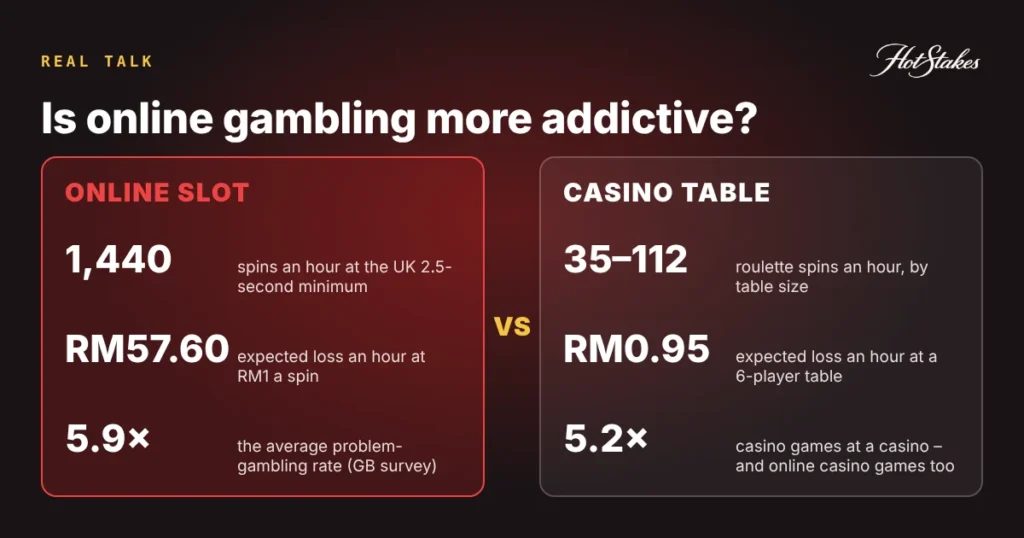
Online gambling is available around the clock, including at the low moments when escape gambling is most tempting. See our explainer on whether online gambling is more addictive.
HotStakes is an independent directory. Some links on this site are affiliate links; we may earn a commission at no cost to you, and it never changes our rankings. Gambling involves risk — only play with money you can afford to lose, and if it stops being fun, seek help. This article is general information, not legal advice. Read our full disclaimer.
 Next story →Is Lottery Prize Money Taxed? Asia’s Rules Compared
Start the discussion