

Is a Slot Due to Hit? The Hot-and-Cold Myth, Tested
We ran 100 million simulated spins. After 50 losses in a row, the next spin's odds were unchanged. Why slots are never 'due', hot or cold.
In this article
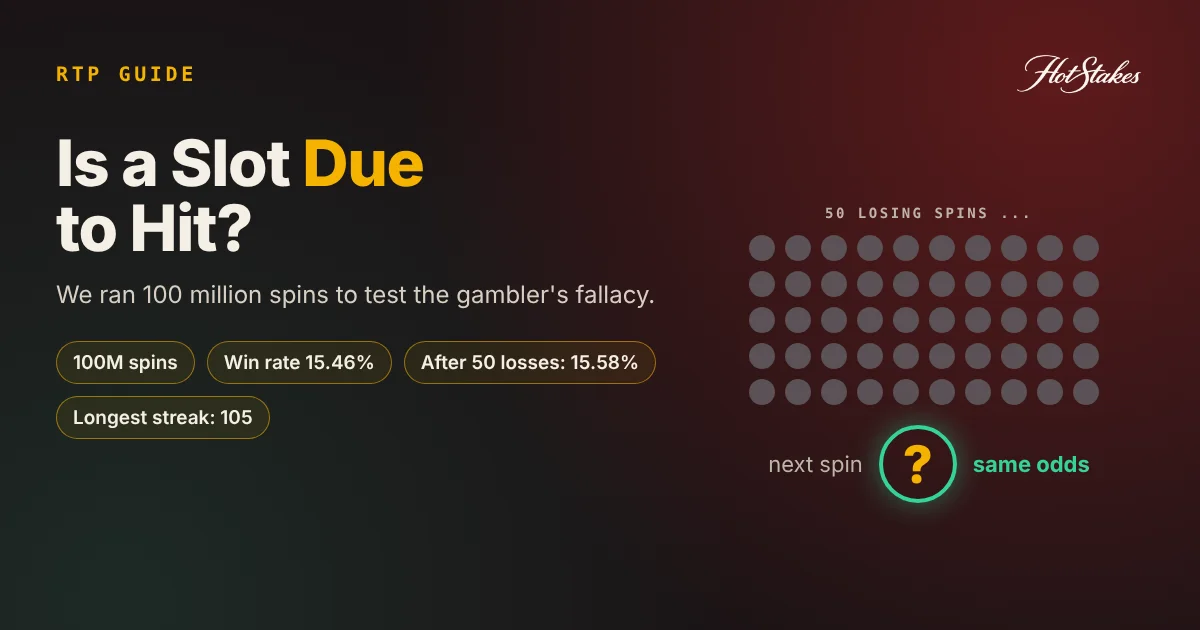
You’ve lost 50 spins in a row and the machine feels “ready”. So, is a slot due to hit? No: a certified slot has no memory, so the chance of a win on the next spin is exactly the same after 50 losses as after 50 wins. We didn’t just take that on faith. We ran 100 million spins of a model slot calibrated to a real Hotdog game’s RTP and measured what happens after long losing streaks. Below are the numbers, the rules that require them, and what actually changes your results.
Why “it’s due” feels so convincing
Your brain expects randomness to look balanced, even over a handful of spins.
Psychologists Amos Tversky and Daniel Kahneman called this belief “the law of small numbers”: people expect a short run to look like the long-run average. Their chapter on representativeness links it directly to the gambler’s fallacy and to the idea that chance “corrects itself”.
It isn’t just a lab effect. Rachel Croson and James Sundali studied security videotapes from a Reno casino roulette table (Journal of Risk and Uncertainty, 2005):
- 18 hours of play, 139 players, 904 spins, 24,131 bets.
- After a streak of six or more of the same outcome, 85% of even-money bets went against the streak.
- 80% of players left the table after a loss rather than after a win.
The most famous example is older. In 1913 at Monte Carlo, black came up 26 times in a row, and the Medical Journal of Australia notes that gamblers’ “losses snowballed” as they kept betting on red.
Takeaway: the “due” feeling is a well-documented bias in real casinos, not a sign of anything in the machine.
What the rules say: a slot has no memory
Online slots are tested against written standards, and those standards ban the very thing “due” implies.
The testing lab Gaming Laboratories International’s GLI-19 standard for interactive gaming requires that knowing one result “shall not provide information” on future ones (section 3.2.4). Outcomes must stay available “independent of previously produced outcomes” (3.2.5), and future RNG values must be “computationally infeasible to predict” (3.3.2).
The UK Gambling Commission’s technical standard RTS 7 is blunter: a “compensated game is not permitted”. That means no game that raises the odds to make up for a cold run.
| Myth | What the standards say | Source |
|---|---|---|
| “It hasn’t paid for ages, so it’s due.” | Past results give no information on future results. | GLI-19 §3.2.4 |
| “It’s hot — it just paid, keep going.” | Each outcome stays available independent of previous outcomes. | GLI-19 §3.2.5 |
| “The game tops up after a cold run to hit its RTP.” | Adaptive (compensated) games are not permitted. | UKGC RTS 7A |
| “You can spot the pattern if you watch long enough.” | Future RNG values must be infeasible to predict. | GLI-19 §3.3.2 |
Takeaway: in a properly tested game, “due”, “hot” and “cold” describe your memory, not the machine’s.
We tested it: 100 million spins of a model slot
Rules are one thing. We wanted to see the numbers.
After 50 losing spins, the next spin is no different
We looked at every spin that followed a run of losses and counted how often it won.
| Losing spins in a row before | Spins observed | Win rate on the next spin |
|---|---|---|
| Any (all spins) | 100,000,000 | 15.46% |
| 10 or more | 18,649,543 | 15.47% |
| 20 or more | 3,470,203 | 15.49% |
| 30 or more | 647,793 | 15.44% |
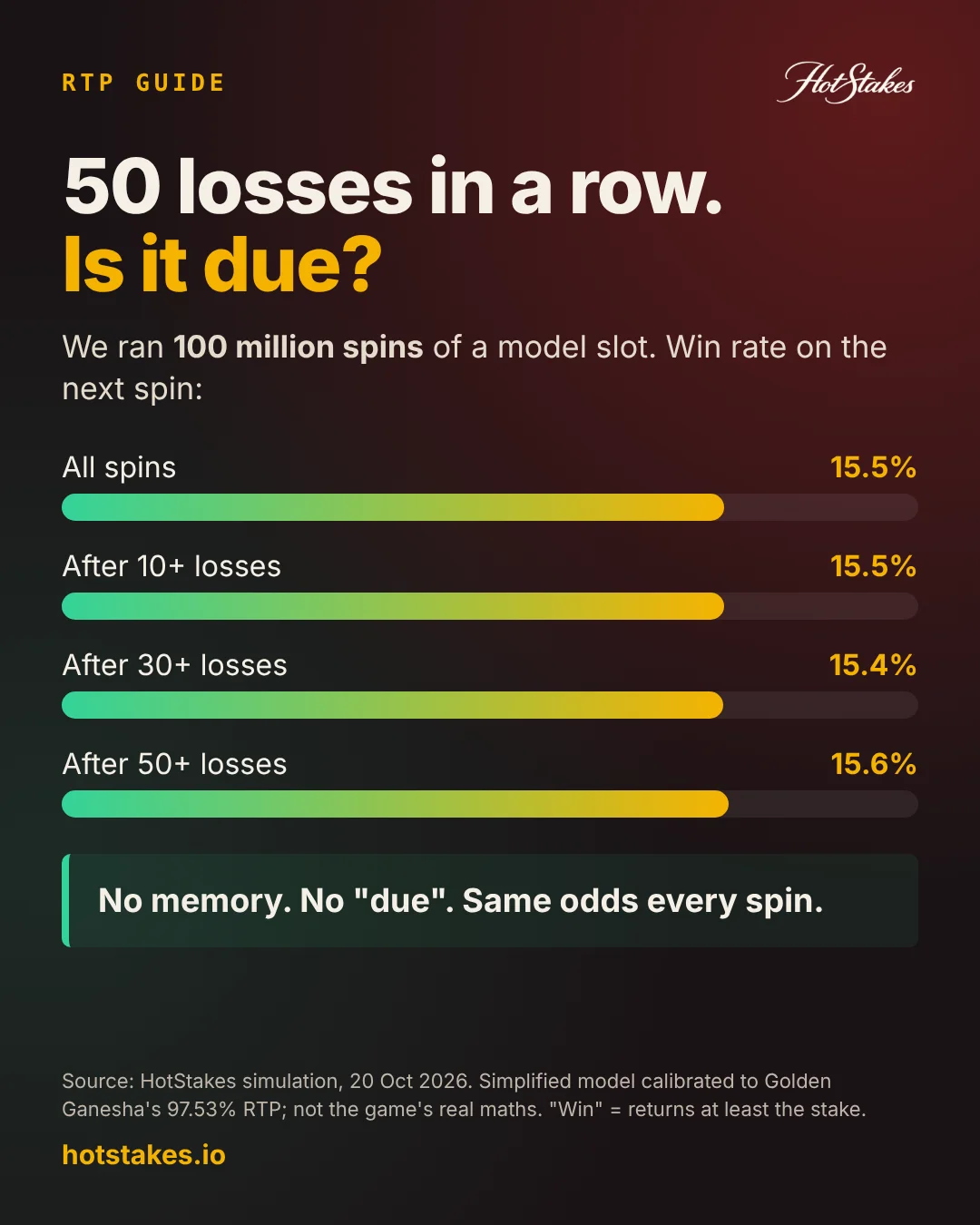
| 50 or more | 22,887 | 15.58% (±0.47 pts) |
| 75 or more | 372 | 15.86% (small sample, ±3.7 pts) |
The small wobbles are sampling noise. All of them sit within the margin of error of the 15.46% baseline.
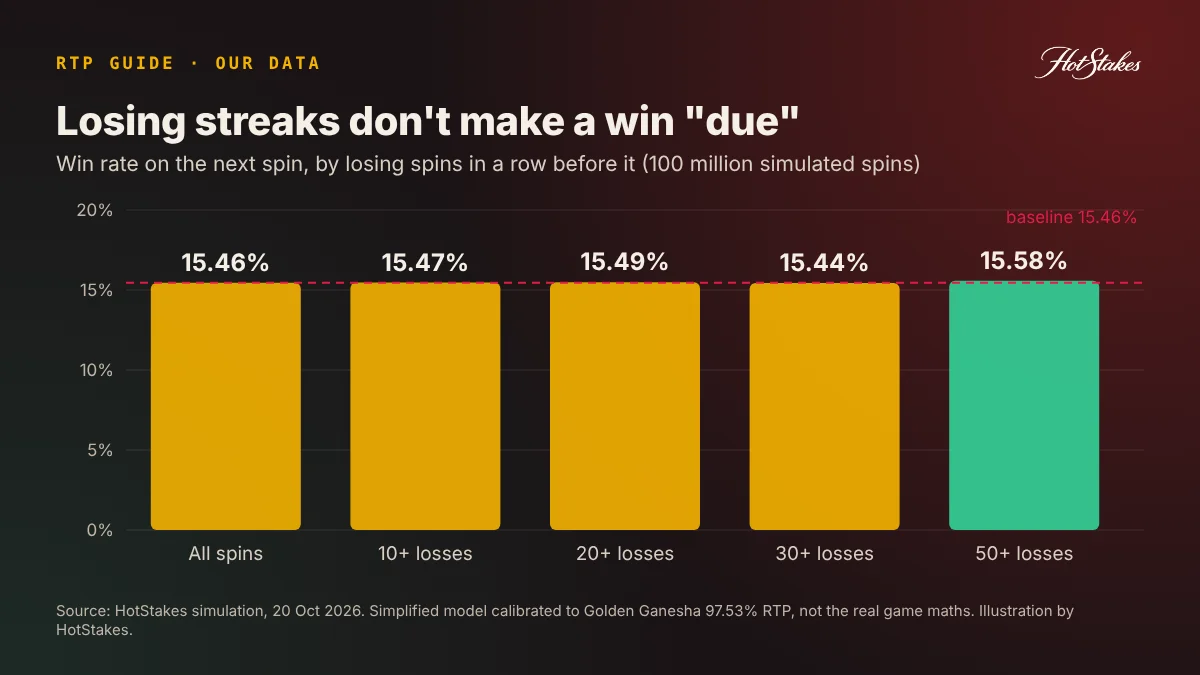
Takeaway: 50 losses in a row bought nothing. The next spin had the same odds as any other.
“Hot” machines: does a win make another win likelier?
We checked the opposite myth on a fresh 10 million spins. After a win, the next spin won 15.44% of the time. After a loss, it won 15.43%.
That’s a gap of about one-hundredth of a percentage point, well inside random noise.
Takeaway: hot and cold slot machines are patterns we read into noise; the model shows no carry-over either way.
How long losing streaks really get
Long dry runs feel like evidence that something is wrong. In our 100 million spins they were simply normal:
- Typical gap between wins: 4 losing spins (median), 5.5 on average.
- Runs of 10+ losses: 18.7% of all streaks.
- Runs of 20+ losses: 3.5%. Runs of 30+: 0.65%.
- Runs of 50+ losses: 0.023%, about 1 streak in 4,300.
- Longest losing streak in 100 million spins: 105.
Those shares match the textbook formula for independent spins almost exactly (0.8454 to the power of the streak length). If a game “owed” wins, long streaks would be rarer than that formula predicts. They weren’t.
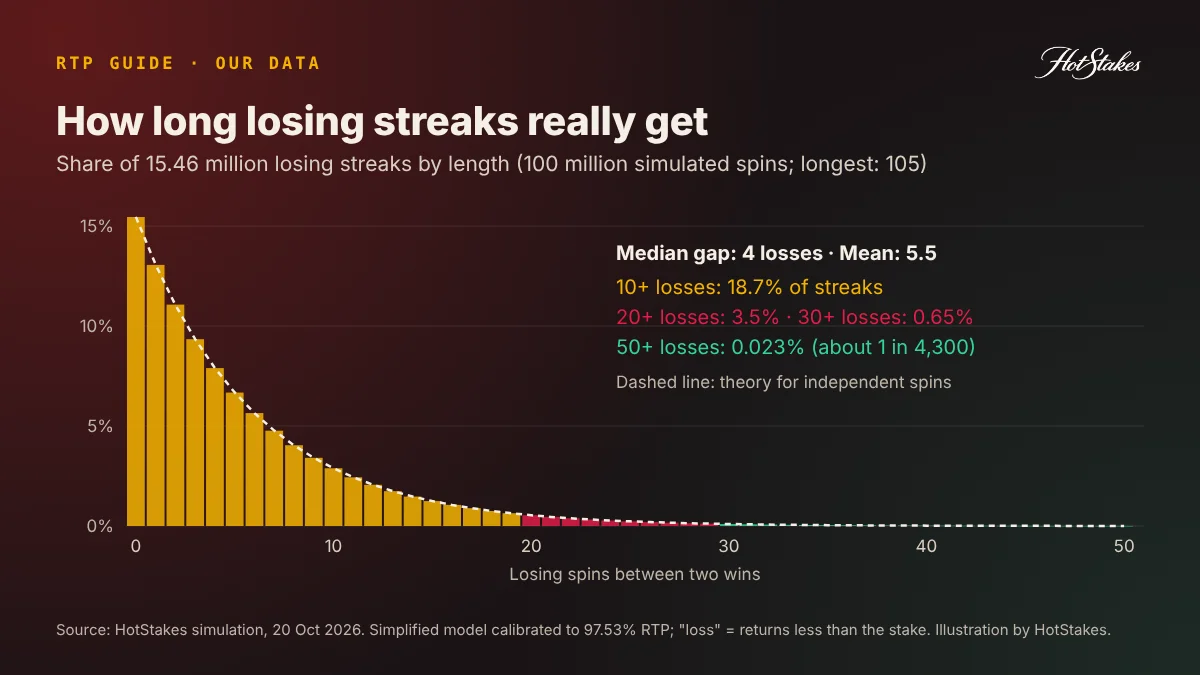
Takeaway: a 30-spin drought is something you’ll see often if you play long enough; it says nothing about spin 31.
RTP is a long-run average, not a schedule
The other half of the “due” myth is the idea that the game must “catch up” to its RTP. It doesn’t need to. The average gets there by sheer volume, not by paying back debts.
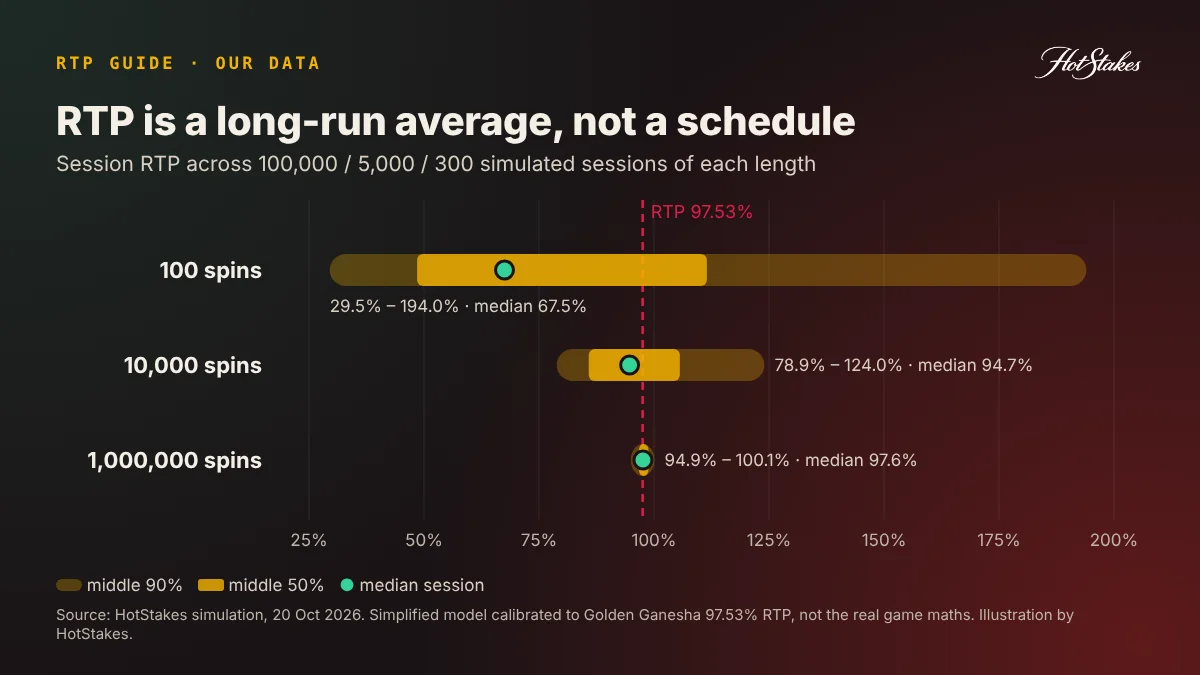
We played the same model in thousands of separate sessions and recorded each session’s RTP:
| Session length | Sessions run | Middle 90% of results | Median | Sessions ending at 100%+ |
|---|---|---|---|---|
| 100 spins | 100,000 | 29.5% – 194.0% | 67.5% | 27.7% |
| 10,000 spins | 5,000 | 78.9% – 124.0% | 94.7% | 39.1% |
| 1,000,000 spins | 300 | 94.9% – 100.1% | 97.6% | 7.3% |
Notice the median 100-spin session returns just 67.5%. Most short sessions lose more than the RTP suggests; a few rare big hits pull the average up. Only at a million spins does the spread close in on 97.53%.
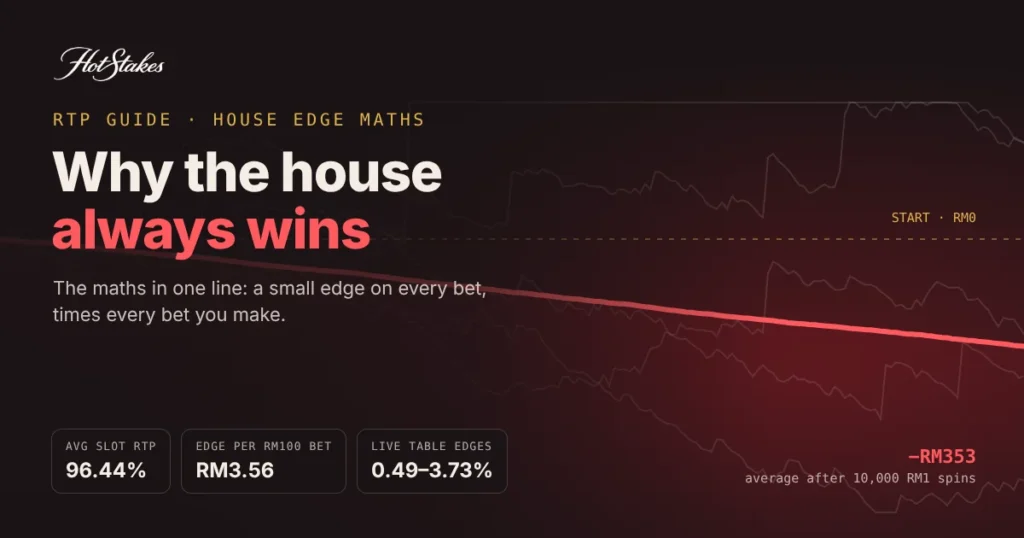
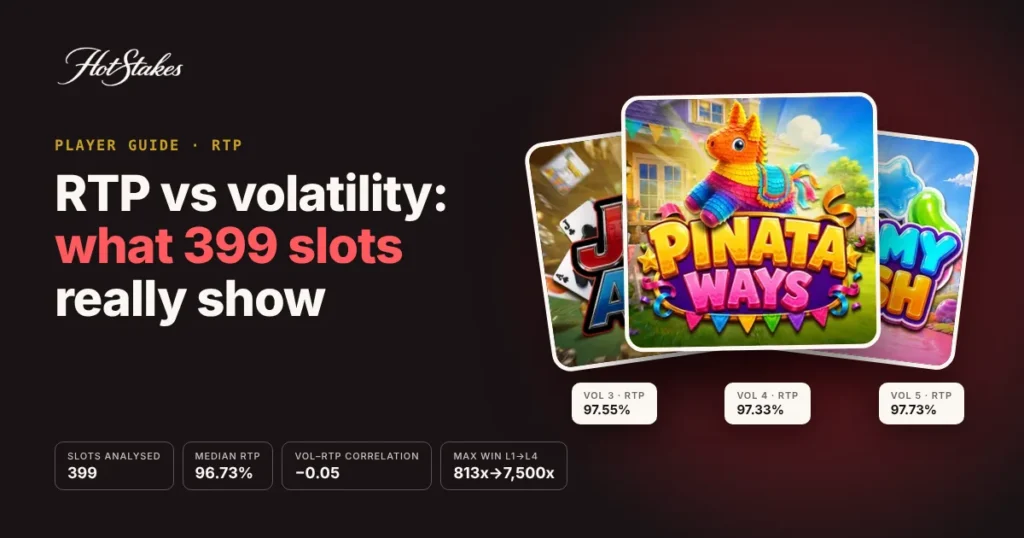
Want to see what an RTP means for your own stake and spin count? Try our RTP calculator. For why the average always favours the house, see why the house always wins. For how RTP and swinginess interact, read the RTP vs volatility guide.
Takeaway: RTP describes millions of spins across all players, not a promise to your session.
What actually matters instead
You can’t time a slot. You can control which game you play and how much you play it:
- Check the published RTP. Across 424 Hotdog slots in our database, RTPs range from 90.46% to 97.81%. Compare games on our top slots list.
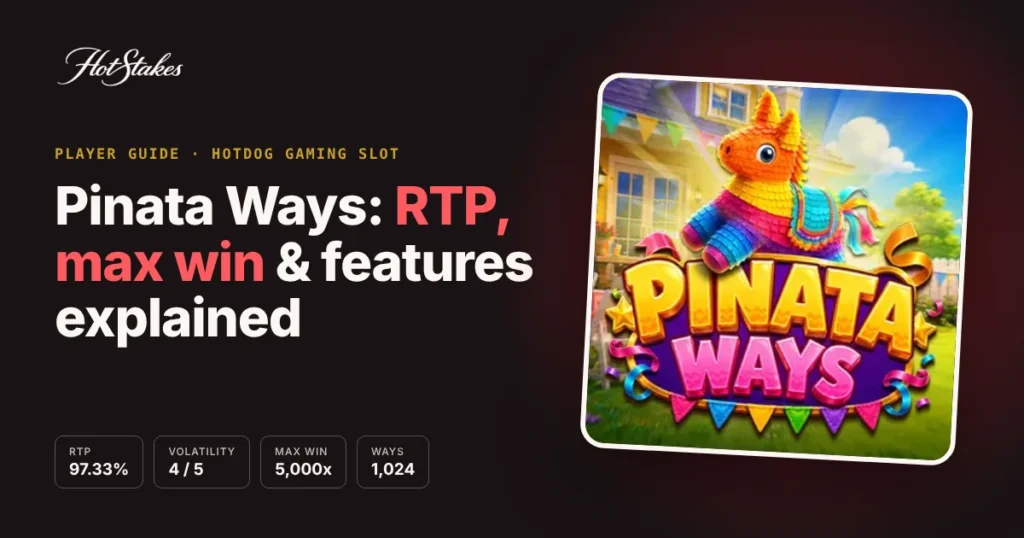
- Check volatility. High-volatility games have longer dry runs by design; our Pinata Ways RTP breakdown shows how that plays out.
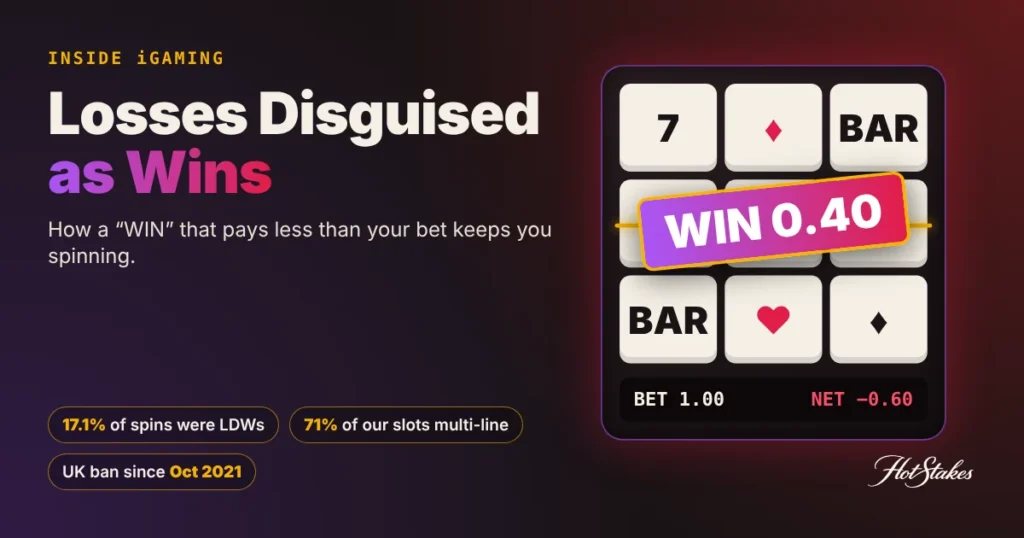
- Don’t count small payouts as wins. A 0.5x “win” is still a loss, explained in losses disguised as wins.
- Set a loss limit before you start and stop when you hit it, not when the machine “feels” ready.
- Never raise your stake to chase a “due” win. The next spin’s odds are the same; only your risk goes up.
If you notice you’re chasing losses or can’t stop, talk to someone. In Singapore, the NCPG helpline is 1800-6-668-668. In Hong Kong, the gambling counselling hotline is 1834 633.
Takeaway: pick the game and the limit; leave the timing to no one, because no one controls it.
FAQ
Is a slot due to hit after a long losing streak?
No. Tested online slots must produce outcomes independent of previous results. In our 100-million-spin simulation, the win rate after 50 losing spins (15.58%) matched the overall rate (15.46%) within the margin of error.
Are there hot and cold slot machines?
Not in a certified game. Streaks happen by chance. In our model, a spin after a win won 15.44% of the time and a spin after a loss won 15.43%.
Does a slot pay more to catch up to its RTP?
No. The UK Gambling Commission’s RTS 7 says adaptive, or “compensated”, games are not permitted. RTP is reached over millions of spins, not by paying back a cold run.
What is the gambler’s fallacy in slots?
It’s the belief that past losses make a win more likely. Tversky and Kahneman linked it to the “law of small numbers”, and a Reno casino study found players bet against streaks after six or more repeats.
How many spins does it take for RTP to show up?
Far more than one session. In our model, 100-spin sessions ranged from 29.5% to 194% RTP (middle 90%). Even at 10,000 spins the range was 78.9% to 124%.
For how speed changes the cost of play, see bonus buy slots explained.
HotStakes is an independent directory. Some links on this site are affiliate links; we may earn a commission at no cost to you, and it never changes our rankings. Gambling involves risk — only play with money you can afford to lose, and if it stops being fun, seek help. This article is general information, not legal advice.
 Next story →Losses Disguised as Wins: How Slots Keep You Spinning


Start the discussion