

Thailand Casino Bill Explained: Why It Stalled in 2026
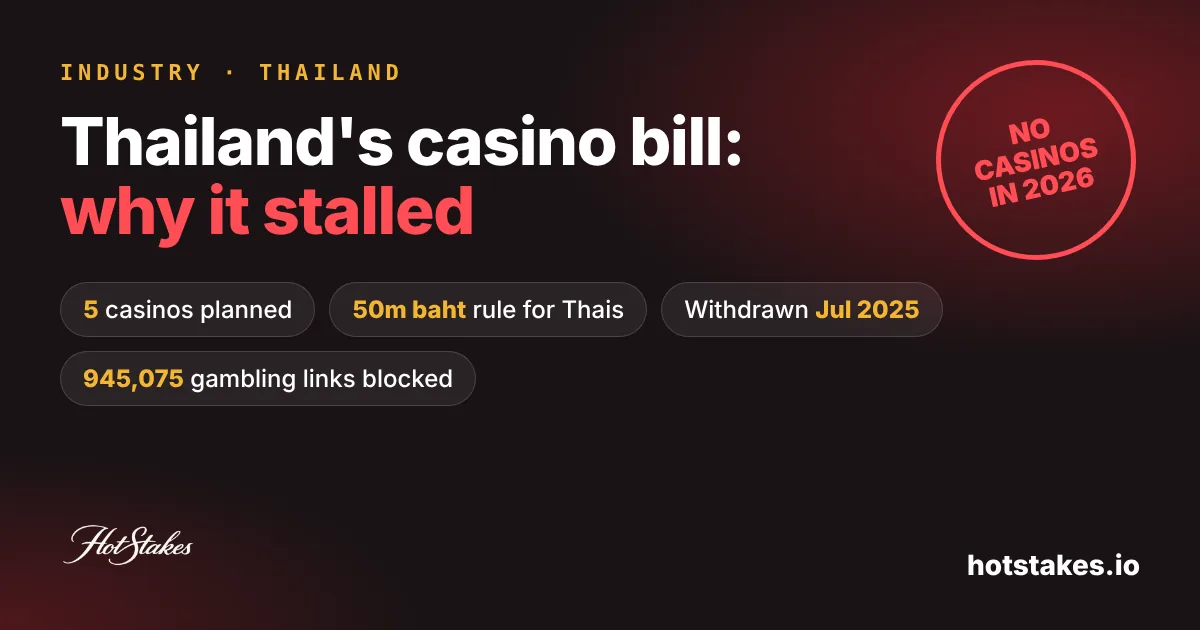
Thailand's casino bill was withdrawn in 2025 and the PM says no casinos in his term. What it proposed, why it failed, and what it means for players.
In this article
- What is legal in Thailand today
- What the Entertainment Complex Bill proposed
- Why the bill collapsed: a timeline
- The 50 million baht rule, in numbers
- Where things stand in October 2026
- What the government is doing instead: blocking illegal betting
- What this means if you play in Thailand
- How Thailand compares with its neighbours
- FAQ
Thailand came closer to legal casinos in 2025 than at any point in its history, then the plan fell apart in a few months. As of October 2026 Thailand has no casino law: the Entertainment Complex Bill was withdrawn in July 2025, rejected by a Senate committee in September 2025, and Prime Minister Anutin Charnvirakul, re-elected in March 2026, says there will be no casinos while he is in office. Below: what the bill proposed, why it collapsed, who still wants it, and what it means for players in Thailand today.
What is legal in Thailand today
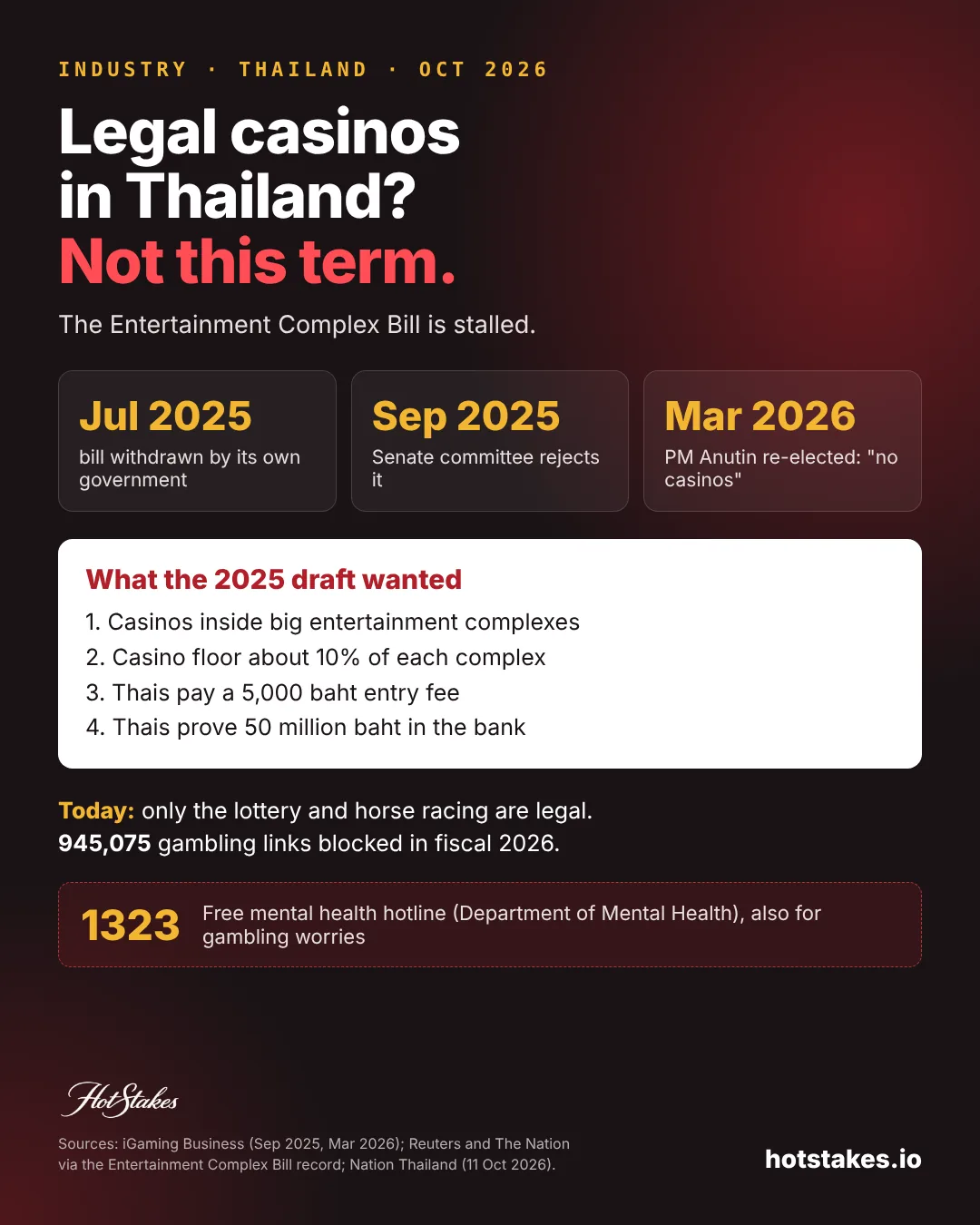
Thailand is one of the strictest gambling markets in Southeast Asia. The Gambling Act dates from 1935, and only two forms of gambling are legal: the government lottery, drawn on the 1st and 16th of each month, and betting on horse races, as the overview of gambling in Thailand summarises. There are no legal casinos, and there is no licence for online casinos or online sports betting.
That is why so many Thai players end up on foreign or unlicensed sites, and why the government’s main gambling story in 2026 is enforcement, not legalisation. You can check Thailand’s status, and 13 other Asian countries, in our free Is it legal where I live? tool and in our Asia legality guide.
Takeaway: only the lottery and horse racing are legal. A website that offers Thai players slots, baccarat or football betting is operating outside Thai law.
What the Entertainment Complex Bill proposed
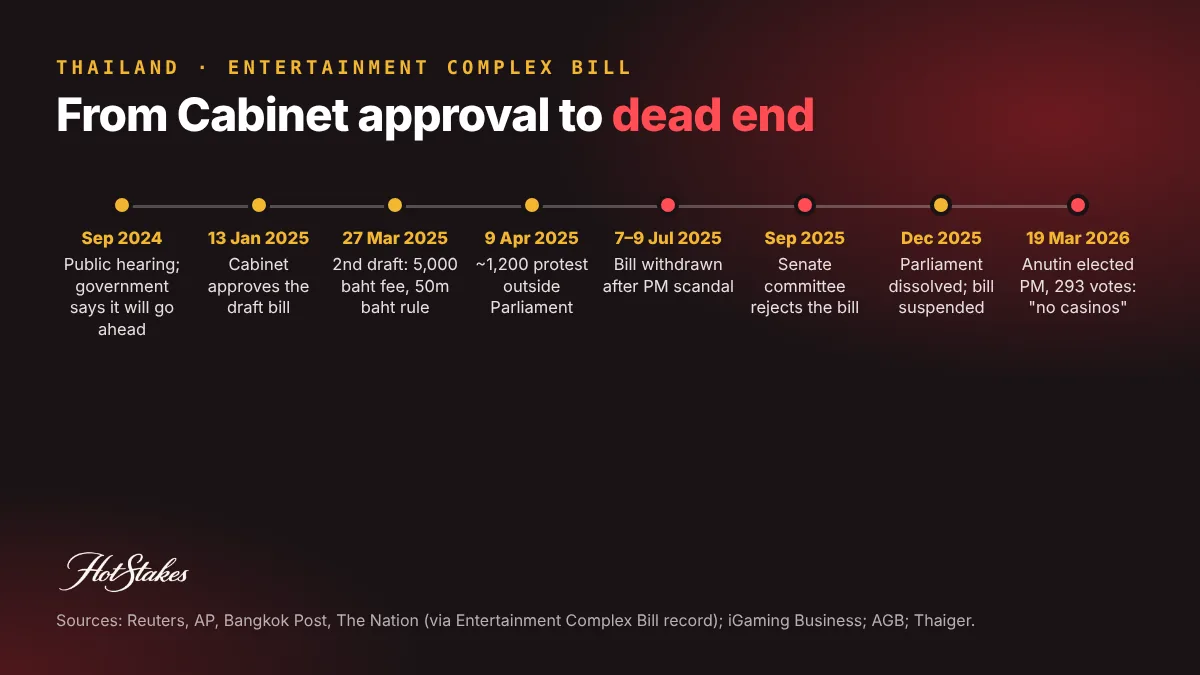
The idea was to copy the integrated-resort model used in Singapore and planned in Japan: a huge hotel, shopping and entertainment complex where the casino is only one part. The government said a public hearing in September 2024 showed strong support, and the Cabinet approved the draft on 13 January 2025, according to the record of the bill compiled from Reuters, AP and Bangkok Post reporting. A second draft approved on 27 March 2025 added rules for Thai citizens.
| Rule in the March 2025 draft | What it meant |
|---|---|
| Casino floor limited to about 10% of each complex | The casino was meant to be a small part of a big tourism project |
| 5,000 baht entry fee for Thai citizens | A cost barrier for locals; foreign tourists would not pay it |
| Thai players must prove at least 50 million baht in bank deposits | The “millionaire clause”: only the very rich could enter |
| Complexes run by Thai-registered companies | Foreign groups such as Macau operators would need local structures |
| Five first-wave casinos: two in Bangkok, one each in Pattaya, Chiang Mai and Phuket | Reported plan of the Paetongtarn government (iGaming Business) |
The money looked big. iGaming Business reported an estimated potential market of 263 billion baht (about US$8 billion), and said all six Macau concessionaires were expected to bid, with Melco opening a Bangkok office to prepare. Not everyone was keen: Hard Rock’s chairman said his company had “zero interest” because of political instability.
Takeaway: the bill was built for foreign tourists and very rich Thais, not for ordinary local players.
Why the bill collapsed: a timeline
Three things killed the bill in under a year.
- Street and religious opposition. About 1,200 people protested outside Parliament on 9 April 2025, the day of a planned first reading, and the debate was pushed to the next session. Polls from the National Institute of Development Administration (NIDA) found people feared addiction, crime and politicians profiting, as iGaming Business reported. A Fiscal Policy Office public comment round claimed 80% approval, but a former election commissioner questioned that result.
- A political scandal. Prime Minister Paetongtarn Shinawatra, the bill’s main backer, was hit by a leaked phone call with Cambodian leader Hun Sen about a deadly border clash. Her government withdrew the bill on 7 July 2025, and the House approved the withdrawal on 9 July. She was later removed from office over ethics charges.
- A new prime minister who says no. Anutin Charnvirakul became interim prime minister in September 2025. That same month a Senate committee formally rejected the bill over social impact, infrastructure cost and national security. One senator said the casino was “not a side feature – it’s the core of the proposal”.
Parliament was then dissolved in December 2025, which formally suspended the bill before any final vote, as Thaiger notes.
Takeaway: the bill never reached a final vote. It was withdrawn by its own government and then rejected by a Senate committee.
The 50 million baht rule, in numbers
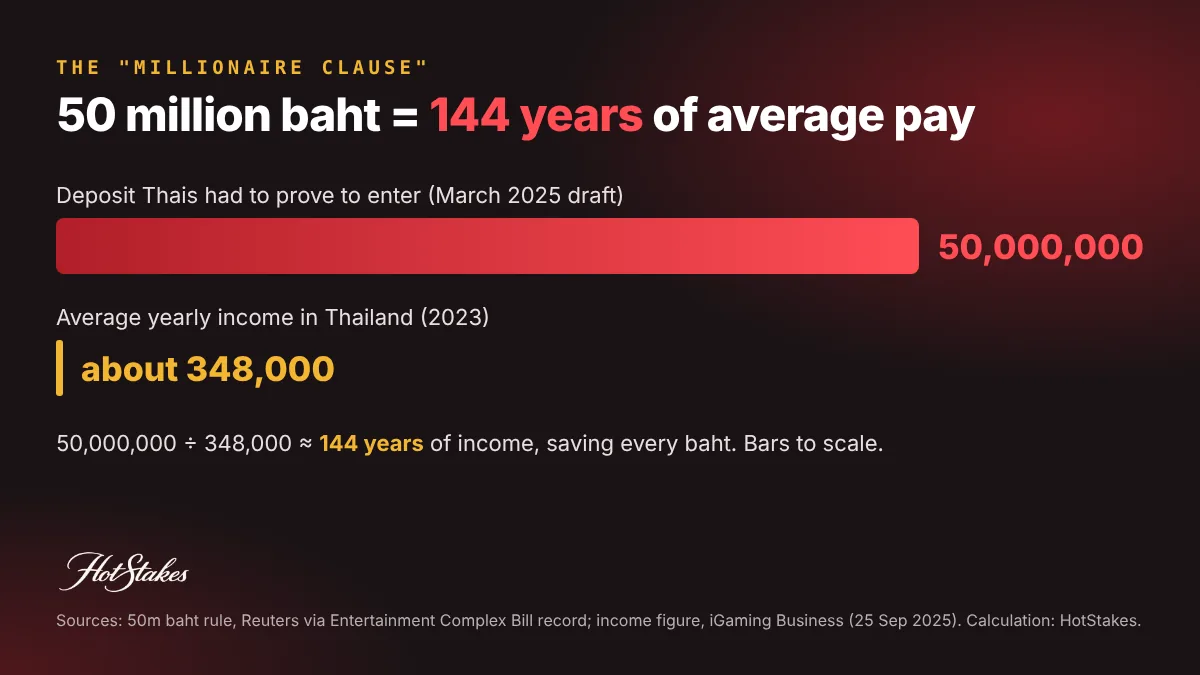
The “millionaire clause” was meant to protect ordinary Thais. It also showed who the casinos were really for. iGaming Business put Thailand’s average yearly income at about 348,000 baht in 2023. At that income, a person would need about 144 years of earnings, without spending a single baht, to reach the 50 million baht threshold.
Later reports said a revised framework would drop the clause, but we found no government statement or tabled bill confirming any revised draft (see below).
Takeaway: under the 2025 draft, almost no Thai citizen would have been allowed to gamble in the new casinos.
Where things stand in October 2026
Thailand held a general election in February 2026. Anutin’s Bhumjaithai party won 191 seats and formed a coalition that includes Pheu Thai, the party that had pushed the casino plan, according to AGB. On 19 March 2026 the House elected Anutin prime minister with 293 votes, against 119 for the People’s Party candidate.
His position has not moved. iGaming Business reports he has said Thailand must “wait for another prime minister” for legal casinos, argues casinos would hurt tourism from China, and reportedly told Chinese leader Xi Jinping in November 2025 that the plan was off the table while he is in office. Analysts quoted by the same outlet describe the project as stalled.
| Claim you may read online | What we could verify |
|---|---|
| “Casinos are coming to Thailand soon” | No. The PM says no casinos during his term; no bill is before Parliament as far as we could find. |
| “A revised bill with a 17% tax and three complexes is agreed” | Reported by one Thai outlet (Thaiger, updated May 2026). We found no government statement or tabled draft confirming it. |
| “Online gambling will be legalised” | A draft amendment to the Gambling Act went to public hearing in early 2025 (law firm Tilleke & Gibbins). It has not become law. |
| “Pheu Thai is back in government, so the bill will return” | Pheu Thai is in the coalition, but as the junior partner under a PM who opposes casinos (AGB, March 2026). |
Takeaway: under the current government, legal casinos in Thailand are off the table. Treat any “Thai casino opening soon” story with caution.
What the government is doing instead: blocking illegal betting
While the casino debate is frozen, enforcement is not. The Ministry of Digital Economy and Society said it blocked 945,075 gambling web addresses between October 2025 and September 2026, most of them through court orders, as Nation Thailand reported on 11 October 2026.
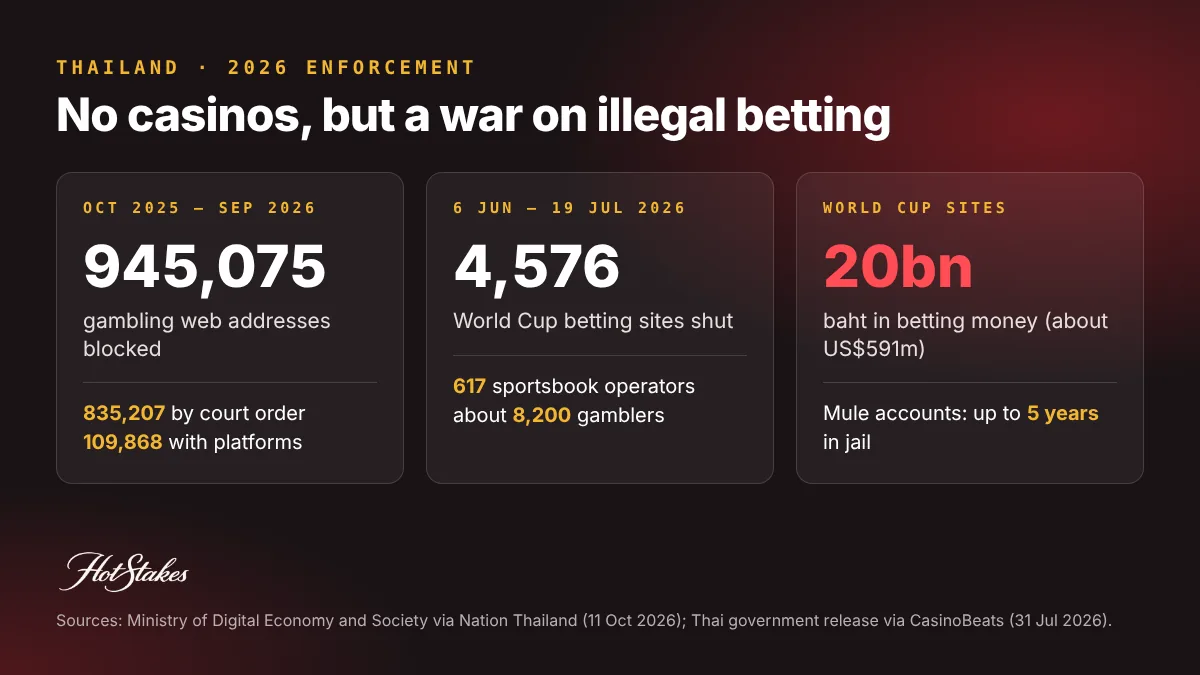
During the 2026 World Cup, between 6 June and 19 July, the authorities said they shut 4,576 football betting websites and 617 illegal sportsbook operators, and acted against almost 8,200 gamblers. The sites handled about 20 billion baht, according to a government release reported by CasinoBeats. The same report says people who rent out their bank accounts to betting networks face up to five years in jail, the same “mule account” risk we explain in our money mule guide.
Takeaway: the real policy in 2026 is a crackdown on illegal sites and the bank accounts behind them.
What this means if you play in Thailand
- Know the law. Only the government lottery and horse racing are legal. Online casinos and online sports betting are not licensed in Thailand.
- Expect sites to disappear. With almost a million gambling links blocked in a year, a site you use today can vanish tomorrow with your balance.
- Never rent or lend your bank account. Betting networks need local accounts to move money; the account holder carries the legal risk.
- Ignore “guaranteed win” tipsters and “VIP casino” invites. They follow every big tournament. See how the guaranteed-win Telegram scam makes money.
- If you lost money to a scam, use our scam help tool to find the right reporting line, and act quickly.
- If gambling is hurting you or your family, Thailand’s Department of Mental Health runs a free hotline, 1323; you can also book a call online, as the government information page explains.
How Thailand compares with its neighbours
Thailand is moving the opposite way to some neighbours. Japan is building its first casino resort in Osaka under strict rules for locals (see Osaka casino resort explained). Cambodia went the other way on the internet, banning online gambling licences (see Cambodia’s online gambling ban). Macau, the region’s casino capital, rebuilt its rules after the junket collapse. Thailand’s choice, for now, is no casinos at all and heavy enforcement.
Takeaway: Asia has no single direction. Each country’s rules decide what is legal for you, so check before you play.
FAQ
Are casinos legal in Thailand in 2026?
No. Casinos are illegal under the Gambling Act of 1935. Only the government lottery and horse racing are legal. The Entertainment Complex Bill that would have allowed casinos was withdrawn in July 2025 and has not returned.
Is the Thailand casino bill coming back?
Not under the current government. Prime Minister Anutin Charnvirakul, re-elected by the House on 19 March 2026, says there will be no casinos while he is in office. Some Thai media report talk of a revised draft, but we found no tabled bill or government confirmation.
What was the 50 million baht rule?
The March 2025 draft would have required Thai citizens to prove at least 50 million baht in bank deposits, and pay a 5,000 baht entry fee, before entering a casino. At an average income of about 348,000 baht a year, that is roughly 144 years of earnings.
Is online gambling legal in Thailand?
No. There is no licence for online casinos or online sports betting. The government blocked 945,075 gambling web addresses between October 2025 and September 2026.
Where can I get help for gambling problems in Thailand?
Call the Department of Mental Health hotline 1323, a free service, or book a call online through the 1323 website. Families can use it too.
Sources: Wikipedia (Entertainment Complex Bill; Gambling in Thailand), iGaming Business (25 Sep 2025; 19 Mar 2026), AGB (19 Mar 2026), Thaiger (2026), Nation Thailand (11 Oct 2026), CasinoBeats (31 Jul 2026), Tilleke & Gibbins (6 Feb 2025), Thailand.go.th. Facts checked on 31 October 2026.
HotStakes is an independent directory. Some links on this site are affiliate links; we may earn a commission at no cost to you, and it never changes our rankings. Gambling involves risk — only play with money you can afford to lose, and if it stops being fun, seek help. Online gambling is not legal in Thailand. This article is general information, not legal advice. Browse vetted operators by currency. Read our full disclaimer.
 Next story →Binance Hack Explained: What Happened and What Users Should Do Now

Start the discussion