

Fake Casino Investment Scam: How a Penang Agent Lost RM760K
A WhatsApp stranger, a RM3,000 'win', 20 transfers in 13 days. How a Penang agent lost RM759,950, stage by stage, and the red flags at each step.
In this article
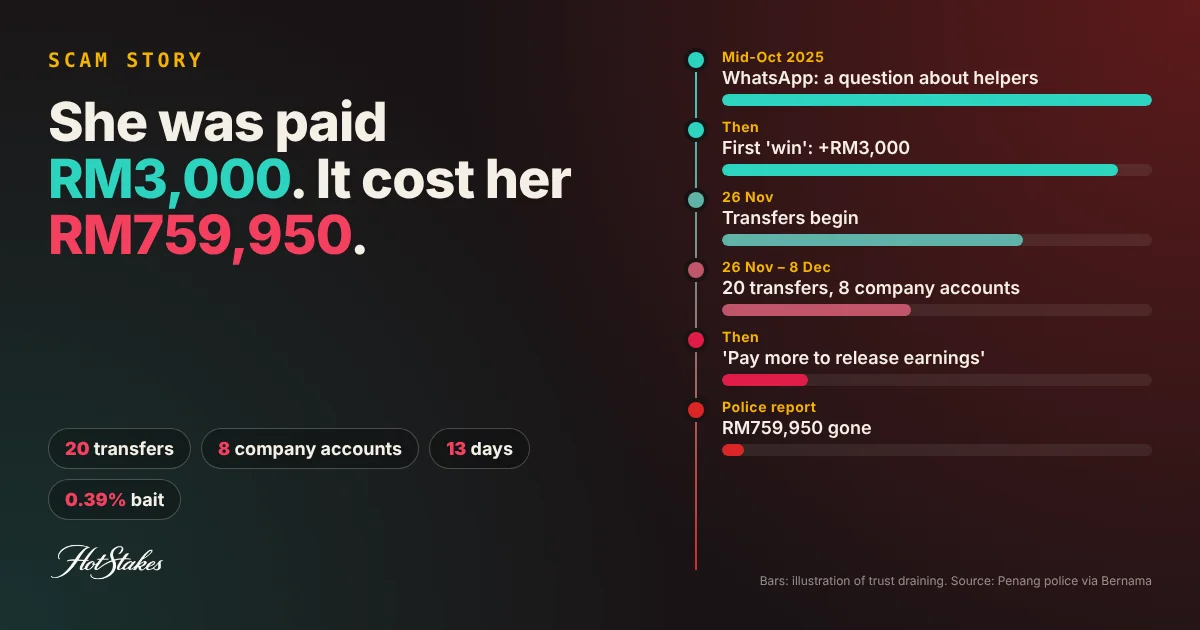
A 64-year-old real estate agent in Penang lost RM759,950 to an online gambling “investment” that began with a WhatsApp question about domestic helpers. She was shown a RM3,000 profit first, then sent 20 transfers to eight company bank accounts in 13 days, and was told to pay even more to release “earnings” that never existed. Below is the case stage by stage, with the red flag at each step and what to do instead. If money is leaving your account right now, call your bank and Malaysia’s NSRC on 997 first, then read on.
Sources: Penang police statement as reported by Bernama, Malay Mail and New Straits Times (3 Jan 2026). All sources opened and figures checked on 20 Oct 2026.
The case in one paragraph
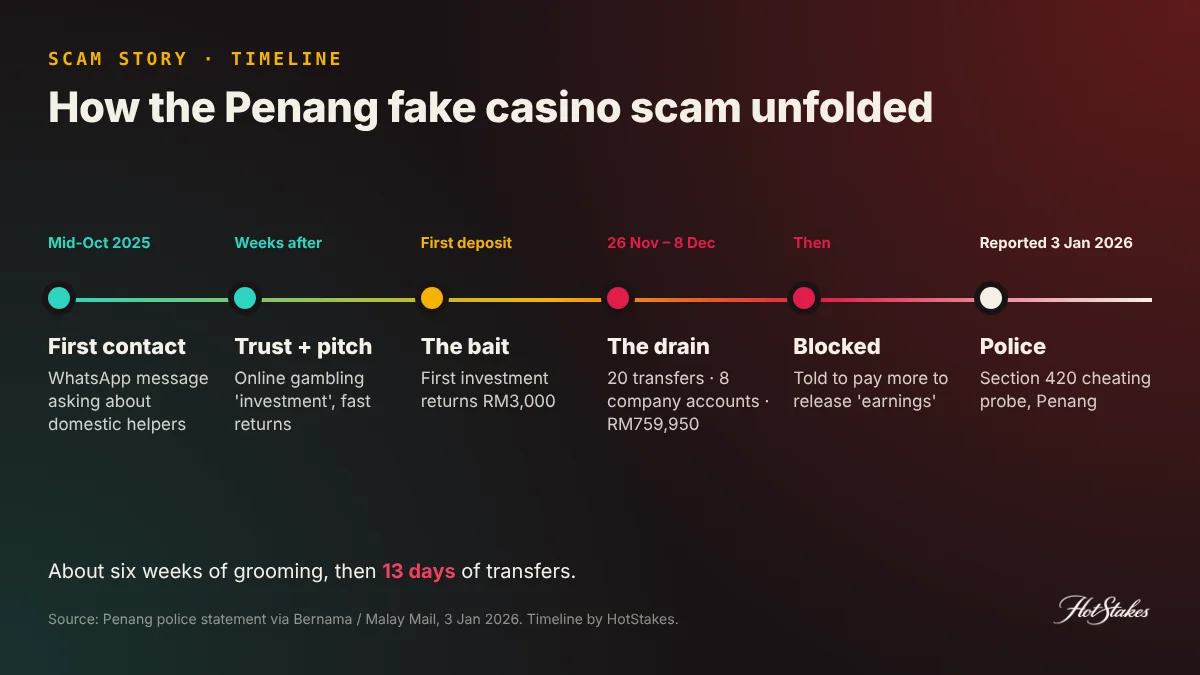
In mid-October 2025, a man messaged the woman on WhatsApp asking about domestic helpers. She passed him a friend’s number.
He kept in touch, then promoted an online gambling “investment” that he said offered “lucrative returns within a short period,” according to the police statement reported by Bernama. Her first investment returned RM3,000.
Between 26 November and 8 December 2025 she made 20 transfers into eight bank accounts held by different companies, totalling RM759,950. When the promised profits did not arrive and she was told to pay more to release them, she went to the police.
Penang police chief Datuk Azizee Ismail said the case is being investigated as cheating under Section 420 of the Penal Code. No arrest had been reported in the coverage we found. We do not name the victim; the outlets did not either.
Takeaway: the scam took about six weeks to set up and only 13 days to drain.
How the scam unfolded, stage by stage
The reports give the skeleton. The red flags below come from that skeleton and from how the Singapore Police Force has described fake gambling platform scams: a stranger, a platform, a bank account number for “credits,” then a frozen account that needs more money before you can cash out. We have not added any detail the police or press did not publish.
Stage 1 – First contact: a harmless question
The first message was not about money at all. It was a question about domestic helpers. She did something kind and normal: she shared a friend’s contact.
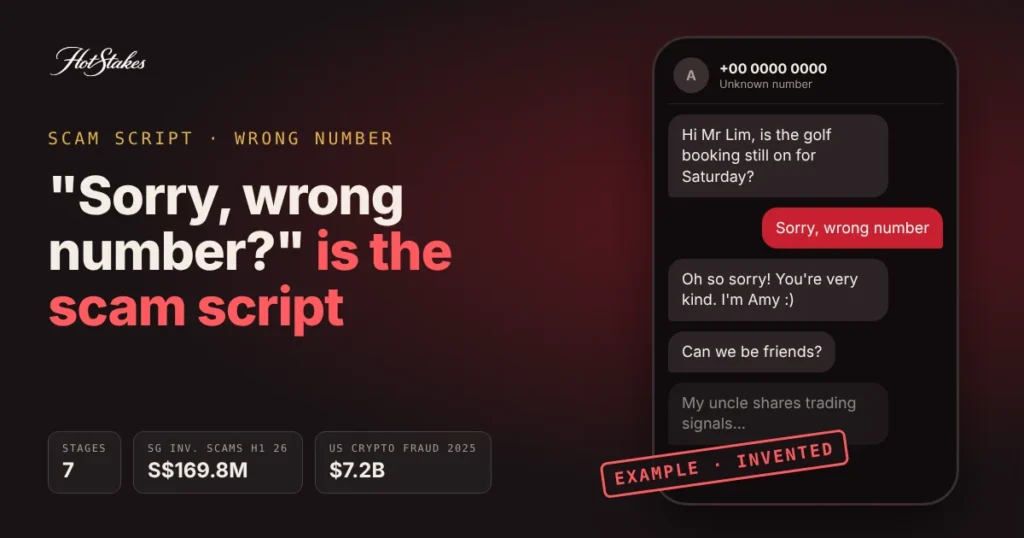
That is the point. An innocent opener gets a reply, and a reply gives the sender a live, friendly number to work on. It is the same move as the “wrong number” text script, with a different costume.
- Red flag: a stranger who keeps chatting after the original reason for contact is finished.
- Do instead: answer the question once, then stop. You owe a stranger nothing more.
Takeaway: the first message is designed to be the easiest one to answer.
Stage 2 – Trust: the stranger becomes an adviser
The man “continued to stay in touch,” the reports say, and then introduced the gambling “investment.” The pitch was speed: big returns in a short time.
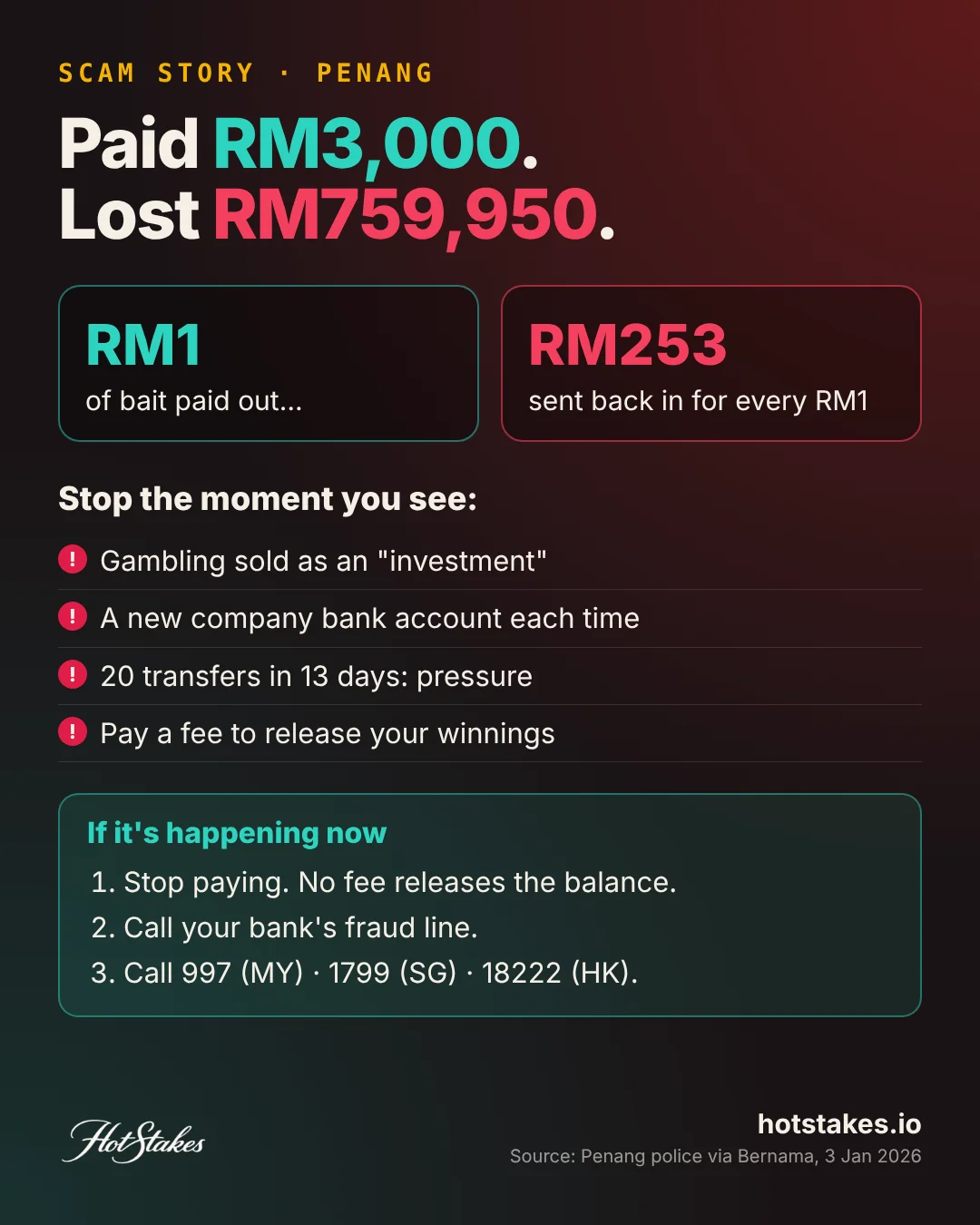
- Red flag: gambling sold as an investment. Betting has a house edge; nobody can promise returns from it. (Our explainer on fake gambling app red flags covers how these sites fake the results.)
- Red flag: a new contact who brings you a money opportunity. Malaysia’s Securities Commission keeps an Investor Alert List of unauthorised schemes, and it warns that the list is not exhaustive.
- Do instead: tell one person you trust about the offer before you send anything. Scams work best in private.
Takeaway: “investment” plus “casino” in the same sentence is the warning, not the opportunity.
Stage 3 – The first “win”: RM3,000
Her first investment came back with a RM3,000 profit. Bernama’s report says this convinced her the scheme was real.
This is the most effective trick in the playbook. A real payout feels like proof. In fact, the scheme can afford to pay small amounts because it plans to take far more later.
- Red flag: a fast, clean first profit on a platform you found through a chat contact.
- Do instead: treat the first payout as the start of the test, not the end. Ask: who licenses this platform, and in which country? If the answer is vague, stop.
Takeaway: a small win you can withdraw does not prove a big win will ever be withdrawable.
Stage 4 – Bigger deposits: 20 transfers, 8 company accounts, 13 days
From 26 November to 8 December 2025, she made 20 transfers to eight different bank accounts, each held by a different company. That averages about RM38,000 per transfer and RM58,000 per day.
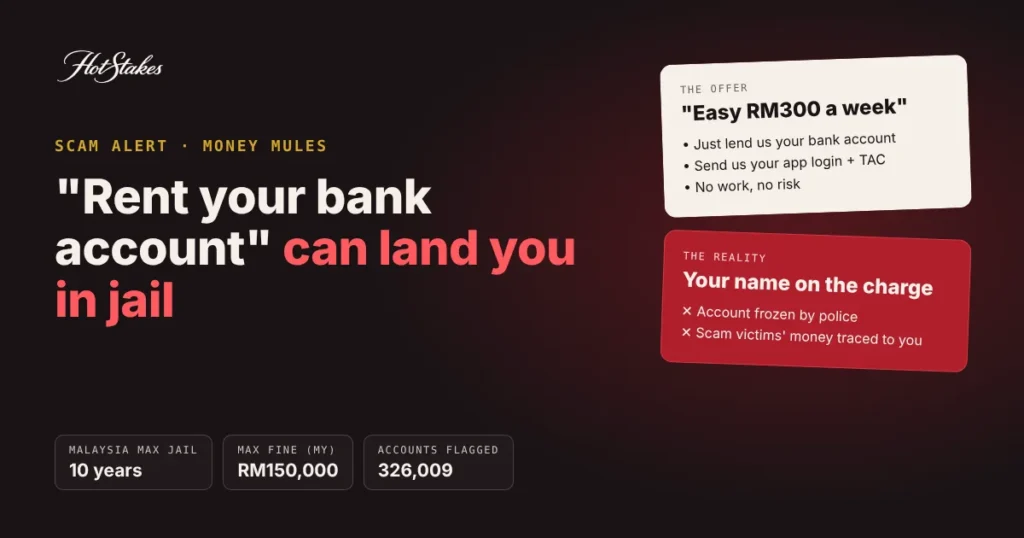
Look at where the money went. Not to one account in the platform’s name, but to eight companies with no visible link to a casino. Money split across many unrelated accounts is a classic sign of mule accounts: bank accounts rented, borrowed or opened to move scam money.
- Red flag: being told to pay a different company account each time.
- Red flag: pressure to send larger amounts quickly.
- Do instead: before any transfer, check the account number on the police Semak Mule portal (semakmule.rmp.gov.my), which lets the public check bank accounts, phone numbers and company names linked to scams, as reported by The Vibes. A clean result does not mean safe. A match means stop.
Takeaway: many accounts, many companies, short time frame: that pattern alone is enough to stop.
Stage 5 – Withdrawal blocked: “pay more to release your earnings”
The promised profits never arrived. Instead, she was told to make more payments to release them.
The Singapore police describe the same move in fake gambling scams: victims are told their accounts are frozen and must deposit more before they can cash out. After the extra money goes in, the scammers become unreachable.
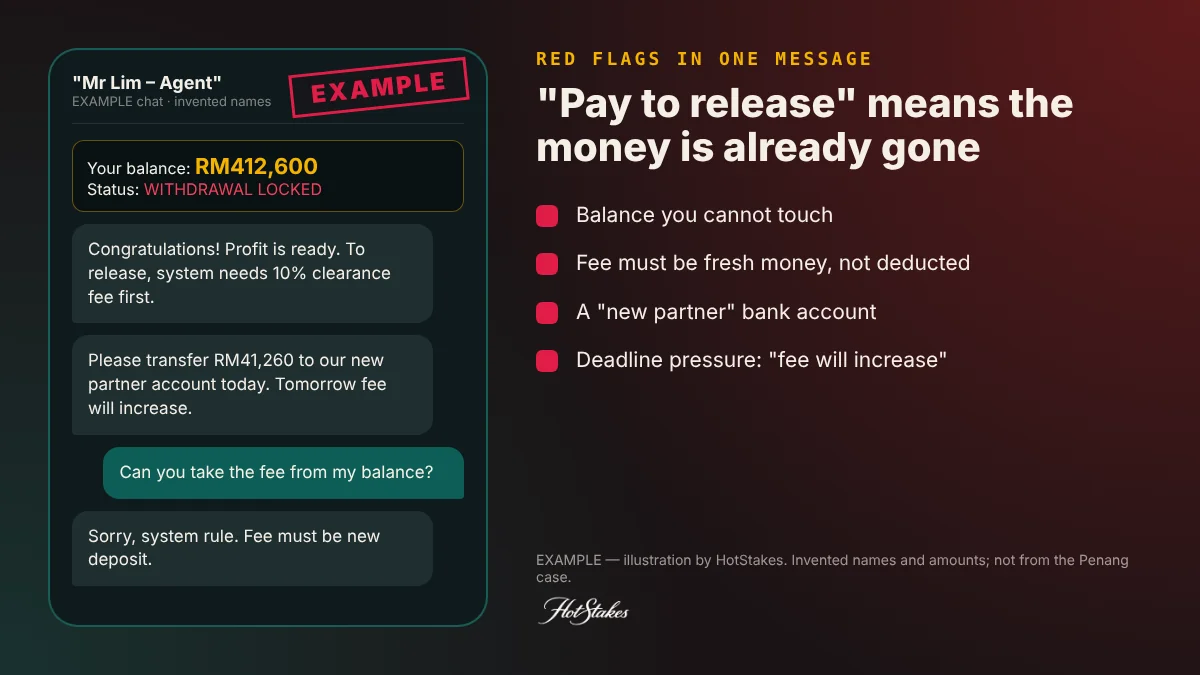
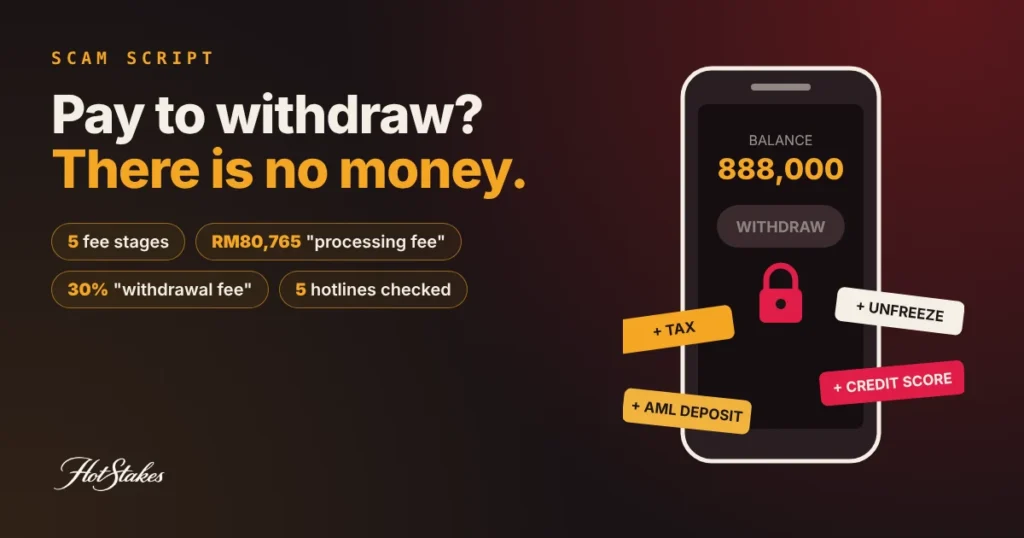
- Red flag: any fee, “tax,” “verification deposit” or “release payment” you must send before you can withdraw. Real winnings can have fees taken out of them; they never need fresh money sent in.
- Do instead: stop all payments the moment withdrawal depends on another deposit. That money is gone the second you send it.
Licensed sites do sometimes hold withdrawals for ID checks. Those checks ask for documents, not money. Our guide on KYC withdrawal holds explains the difference.
Takeaway: “pay to withdraw” is the one red flag that is never wrong.
Stage 6 – Discovery
She realised she had been cheated when the profits did not come and the demands did. She lodged a police report, and the Southwest District commercial crime unit took the case, according to the New Straits Times.
Reporting quickly matters. Malaysia’s government says to call the NSRC on 997 within 24 hours of discovering a scam so that accounts and transactions can be blocked.
Takeaway: the moment the “release fee” appears is the moment to call 997, not to find more money.
The numbers behind the bait
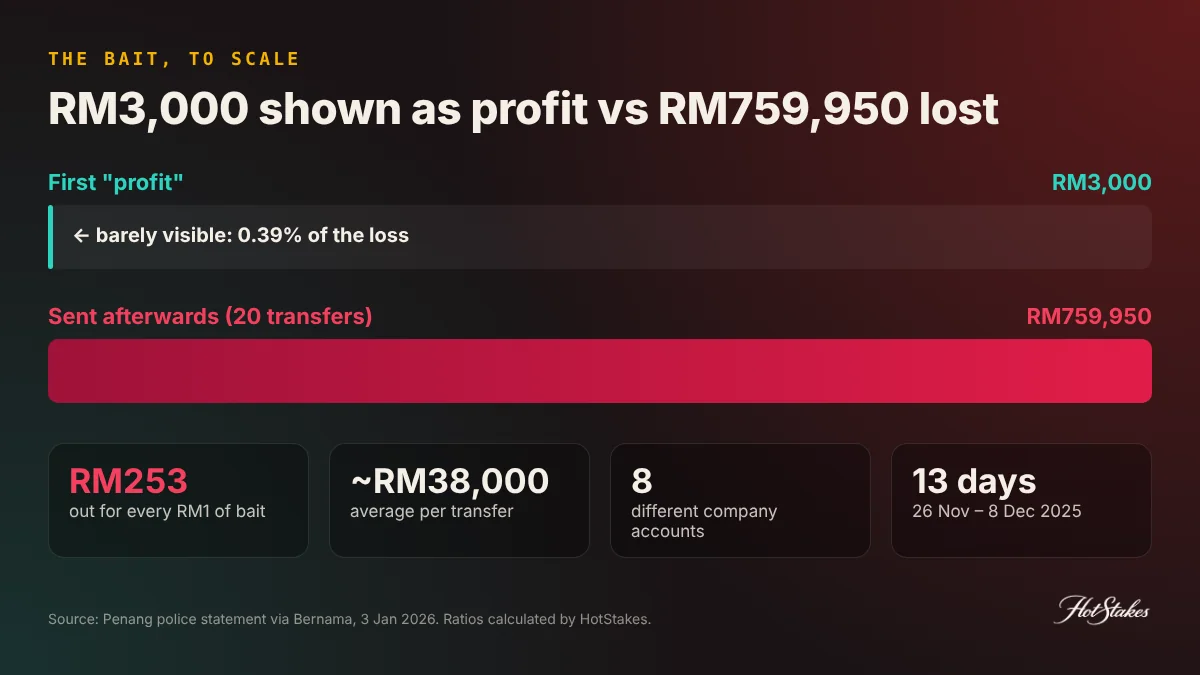
We worked these out from the figures in the police statement (calculated 20 Oct 2026). They are simple, and they show how lopsided the trade was.
- RM3,000 shown as profit up front.
- RM759,950 sent afterwards, in 20 transfers to 8 accounts.
- 0.39%: the bait as a share of the loss. About RM253 out for every RM1 in.
- 13 days from the first to last recorded transfer, after roughly six weeks of contact.
This case is one of thousands. Police data reported by Malay Mail counted 9,296 non-existent investment scheme cases from January to November 2025, with losses over RM1.37 billion: the costliest scam type in Malaysia that year.
Takeaway: the first payout is marketing, paid for by the victim’s own later deposits.
What happened vs what the red flag was
| Stage | What happened (per police) | The red flag | Safer move |
|---|---|---|---|
| 1. First contact | WhatsApp message from a stranger about domestic helpers (mid-Oct 2025) | Stranger keeps chatting after the reason ends | Reply once, then stop |
| 2. Trust | He stayed in touch, then pitched an online gambling “investment” | Gambling sold as an investment with fast returns | Check the SC Investor Alert List; tell someone |
| 3. First win | First investment returned RM3,000 | Easy early profit from a chat-introduced platform | Ask who licenses it; no clear answer, no more money |
| 4. Big deposits | 20 transfers, 8 company accounts, 26 Nov–8 Dec 2025 | Different company account each time; rising amounts | Check accounts on Semak Mule; refuse company accounts |
| 5. Withdrawal blocked | Told to pay more to release earnings | Pay-to-withdraw fee, “tax” or deposit | Stop paying; call bank and 997 |
| 6. Discovery | Police report; Section 420 cheating investigation | — | Report within 24 hours; keep all evidence |
Takeaway: there were at least five exits before the loss reached six figures.
If this is happening to you: what to do now
If you, or a parent, are in the middle of this, do not feel ashamed. These schemes are built by organised groups who do this full time. Act fast instead.
- Stop sending money. No fee, tax or deposit will release the balance. That balance is a number on a screen.
- Call your bank’s fraud line and ask them to stop or recall pending transfers.
- Call the anti-scam hotline in your country (list below). In Malaysia, call 997, ideally within 24 hours.
- Make a police report and get the report number. Banks and the NSRC may ask for it.
- Save everything: chat screenshots, the platform’s web address, every account number, receipts and dates.
- Block the contact and do not reply, but only after you have saved the evidence.
- Ignore anyone who offers to get your money back for a fee. That is often the same network coming back for a second round.
- Tell family. If you are the family member, lead with support, not blame. Shame keeps people paying.
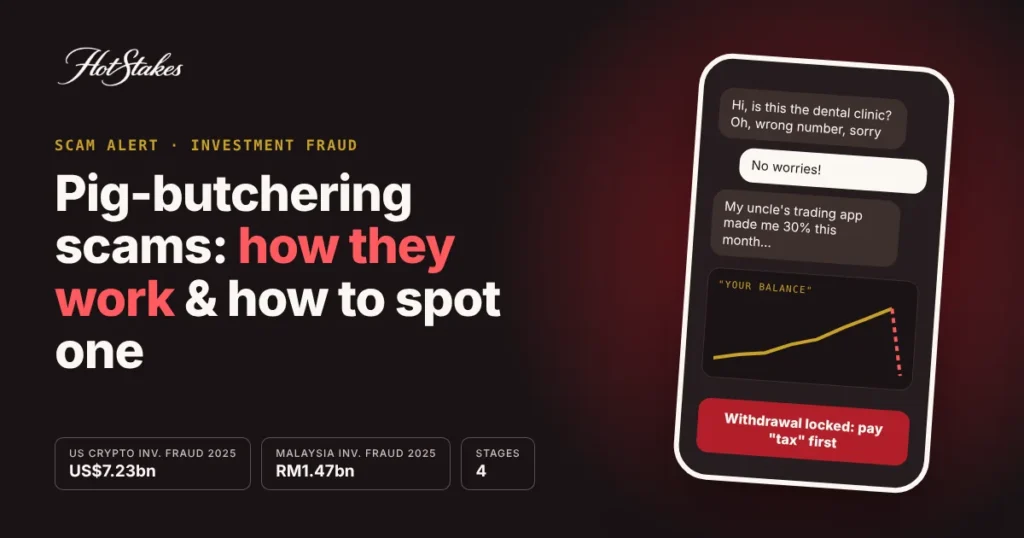
Not sure if it is a scam? Take our two-minute scam quiz, or read the full pig-butchering scam guide to see the long-con pattern this case follows.
Takeaway: the first hour matters more than the last ringgit you might “release.”
How to report it
| Where you are | Who to contact | Number / link |
|---|---|---|
| Malaysia | National Scam Response Centre (24 hours) | 997, plus your bank and a police report |
| Malaysia | Check an account, phone or company | Semak Mule (semakmule.rmp.gov.my); SC Investor Alert List |
| Singapore | ScamShield Helpline (24/7) | 1799 (overseas +65 6869 1799); police reports via SPF e-Services |
| Hong Kong | Anti-Deception Coordination Centre (24 hours) | 18222 |
| Philippines | Cybercrime Investigation and Coordinating Center | 1326 |
Losing savings is a heavy blow.
In Malaysia, the national mental health line HEAL is on 15555. HEAL is a general mental health line, not a gambling helpline, and a good first call if the stress feels too much. If anyone is in immediate danger, call emergency services.
Takeaway: save these numbers in a parent’s phone today, before anyone needs them.
FAQ
What is a fake casino investment scam?
It is a scheme where a contact sells online gambling as an “investment” with fast returns. The platform shows fake profits, may pay a small amount early, then demands more money before you can withdraw. In the Penang case, the victim lost RM759,950.
Why did the scammers pay her RM3,000 first?
A real payout builds trust. It costs the scheme little compared with what follows. In this case the RM3,000 was about 0.39% of the later loss.
Is it normal to pay a fee or tax to withdraw winnings?
No. A legitimate site may ask for ID documents before a withdrawal, but it does not ask you to send new money to release your own balance. Any “pay to withdraw” demand means stop.
Can I get my money back?
Sometimes part of it, if you act fast. Call your bank and your national anti-scam hotline (997 in Malaysia, 1799 in Singapore, 18222 in Hong Kong) and file a police report. Never pay a “recovery” service.
How do I check a bank account before I transfer money in Malaysia?
Search the account number, phone number or company name on the police Semak Mule portal, and check investment schemes against the Securities Commission’s Investor Alert List. Neither list is complete, so a clean result is not a green light.
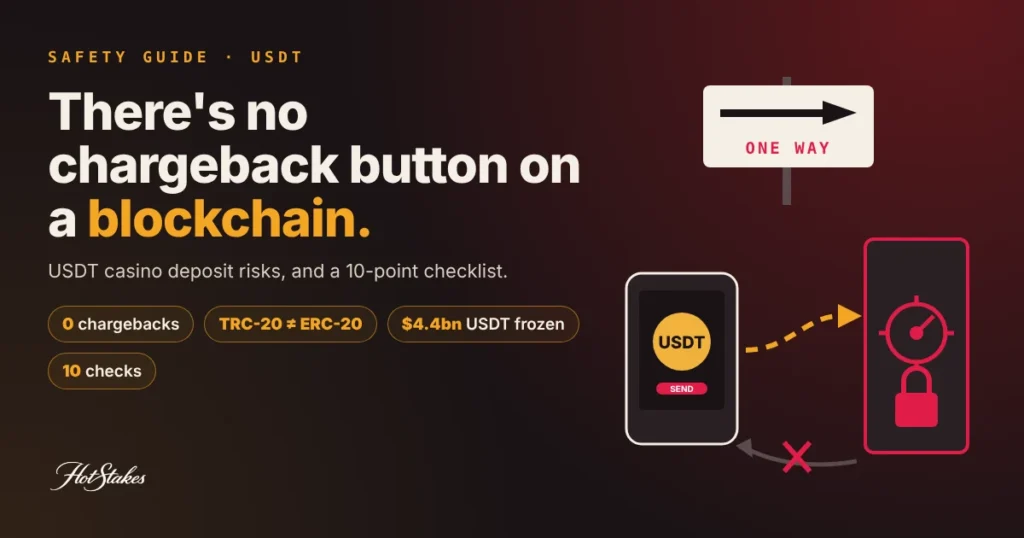
The “fees” in this case follow a pattern police see again and again; read the withdrawal fee scam script, stage by stage.
HotStakes is an independent directory. Some links on this site are affiliate links; we may earn a commission at no cost to you, and it never changes our rankings. Gambling involves risk — only play with money you can afford to lose, and if it stops being fun, seek help. This article is general information, not legal advice.
 Next story →Are Free Spins Really Free? The Maths Explained


Start the discussion