

Fake Gambling App Scams: 9 Red Flags and Real Cases
How fake betting apps and 'guaranteed win' groups take your money at withdrawal, the police cases behind them, and 9 red flags to spot early.
In this article
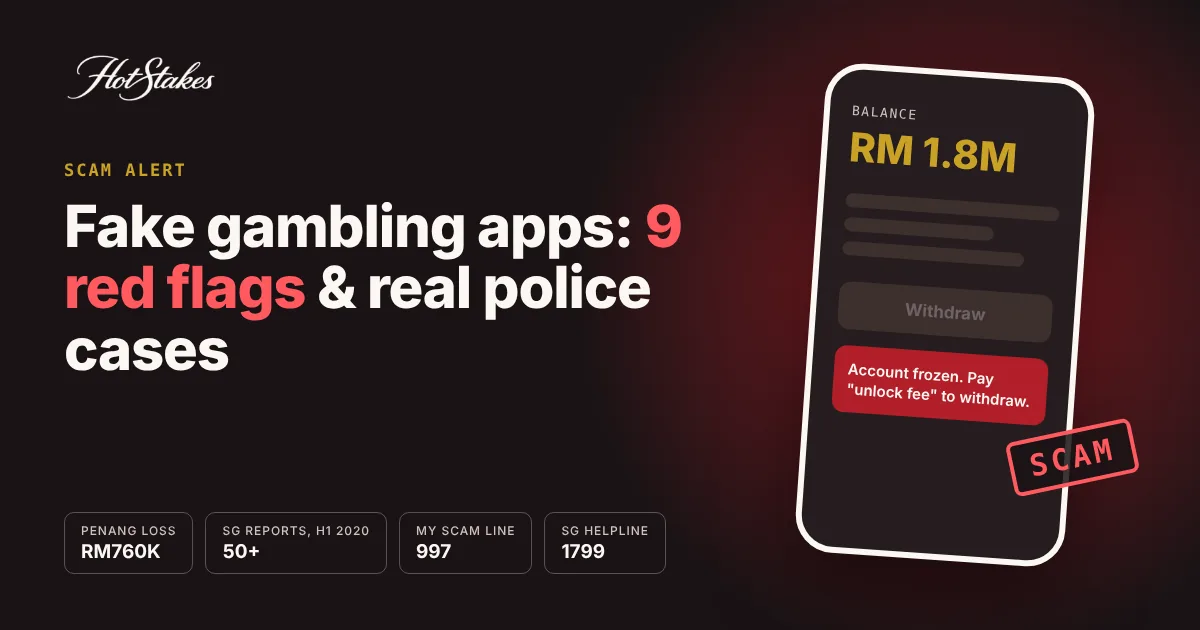
A fake gambling app is not a casino that cheats a little. It is a payment funnel dressed up as a casino: the balance on screen is just a number the scammers type in, and the real product is the bank transfer you make to “unlock” it. If an app or a “guaranteed win” group asks you to pay more money before you can withdraw your winnings, treat it as a scam and stop paying. Below, HotStakes breaks down how the trick works, the cases police across the region have published, and the red flags that give it away.
How the fake gambling app scam works
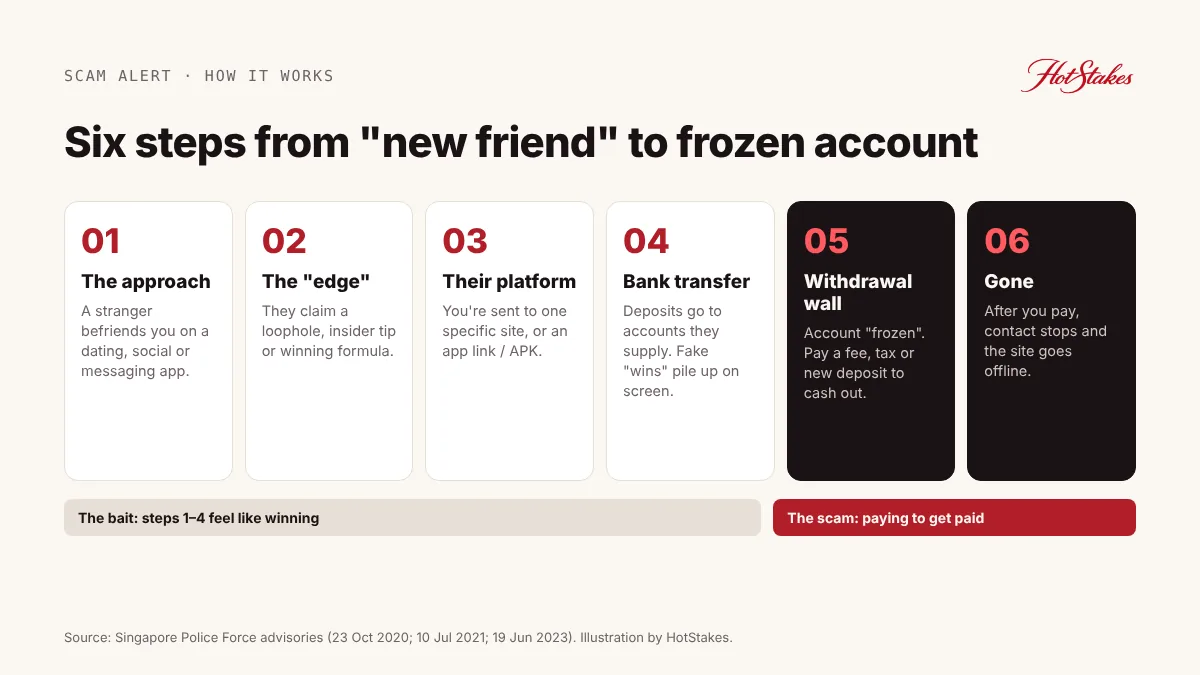
Police in Singapore have described the same script for years. In a 2020 Singapore Police Force advisory on illegal betting sites and apps, officers said they had received at least 50 reports between January and June 2020, with losses of at least S$2.1 million. The steps they listed are still the template:
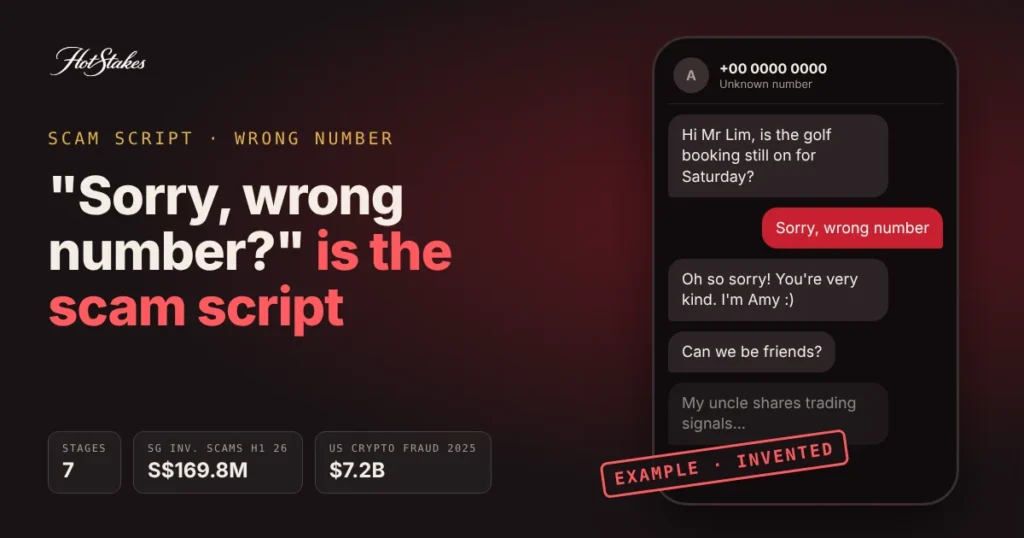
- The approach. A stranger befriends the victim on a messaging or dating app. The 2020 advisory named Facebook, Tinder and TanTan as the most common starting points.
- The “inside edge”. The new friend claims to know a loophole or have insider knowledge that makes winning easy.
- The private platform. The victim is told to open an account on one specific site or app, not a well-known brand.
- The personal bank account. Deposits go to bank accounts supplied by the scammers, in exchange for “betting credits”.
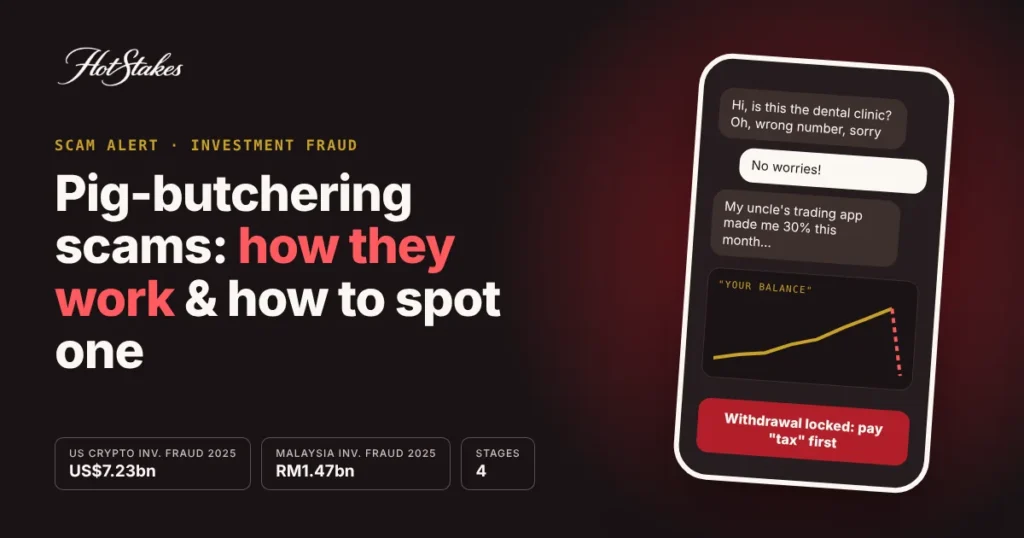
- The frozen account. When the victim tries to cash out, the account is suddenly “frozen” and more money is demanded first. Some victims were also charged “administrative fees”.
- The vanishing act. After the extra payment, the contact stops replying and the site goes offline.
Many fake apps never pass through Google Play or the App Store at all. They arrive as a link or an APK file sent in a chat. Singapore police warned in a June 2023 advisory on Android malware scams that apps downloaded from links like this can give scammers remote access to a phone and capture stored passwords. Police advised turning off “Install unknown apps” and installing only from official app stores. That case involved grocery ads, not betting, but the same delivery method is used to push fake casino apps.
Takeaway: the “win” is the bait. The scam happens at withdrawal, when you are asked to pay to get your own money back.
Reported cases: what police have published
The cases below come from police statements reported in the media. Victims are not named, and all amounts are as reported.
| Where / when reported | Hook | Reported loss | What gave it away |
|---|---|---|---|
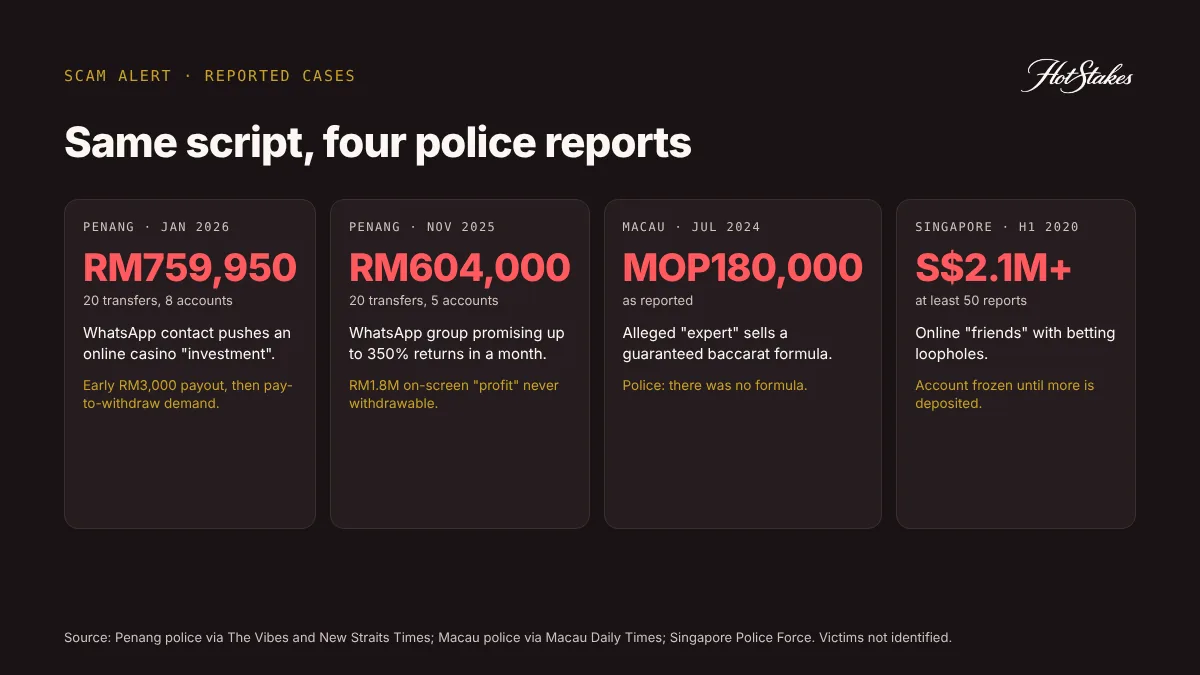
| Penang, Malaysia, Nov 2025 | WhatsApp group promising returns of up to 350% in a month from a gambling-style “investment” | RM604,000 over 20 transfers | On-screen “profits” of RM1.8 million that could never be withdrawn |
| Balik Pulau, Penang, Jan 2026 | A contact on WhatsApp promoting an online casino “investment” | RM759,950 over 20 transfers to 8 accounts | An early RM3,000 payout built trust, then payouts stopped and more money was demanded to withdraw |
| Macau, Jul 2024 | Alleged “gambling expert” offering a guaranteed baccarat formula with a signed “guarantee” | MOP180,000 (as reported) | Early returns, then excuses. Police said there was no formula |
| Singapore, Jan–Jun 2020 | Online friends with betting “loopholes” | At least S$2.1 million across 50+ reports | Account “frozen” until more was deposited |
The Penang cases were confirmed by state police chief Datuk Azizee Ismail and are being investigated as cheating under Section 420 of the Penal Code. They were reported by The Vibes (the RM604,000 case) and the New Straits Times (the RM760,000 case). In Macau, the Macau Daily Times reported that police arrested a suspect who allegedly offered a “lose one, buy two” baccarat method. Police said he had no winning formula and allegedly lost most of the money gambling in a casino.
The bigger picture is just as grim. Bukit Aman’s commercial crime chief told The Vibes that Malaysia’s National Scam Response Centre received 363,817 calls and that 77,771 police reports were lodged between October 2022 and March 2026, with reported losses of about RM1.05 billion. Those figures cover all scam types, not just gambling.
Takeaway: the pattern repeats across borders. A small early payout, a growing on-screen balance, and a wall at withdrawal.
Why “guaranteed win” groups are lying
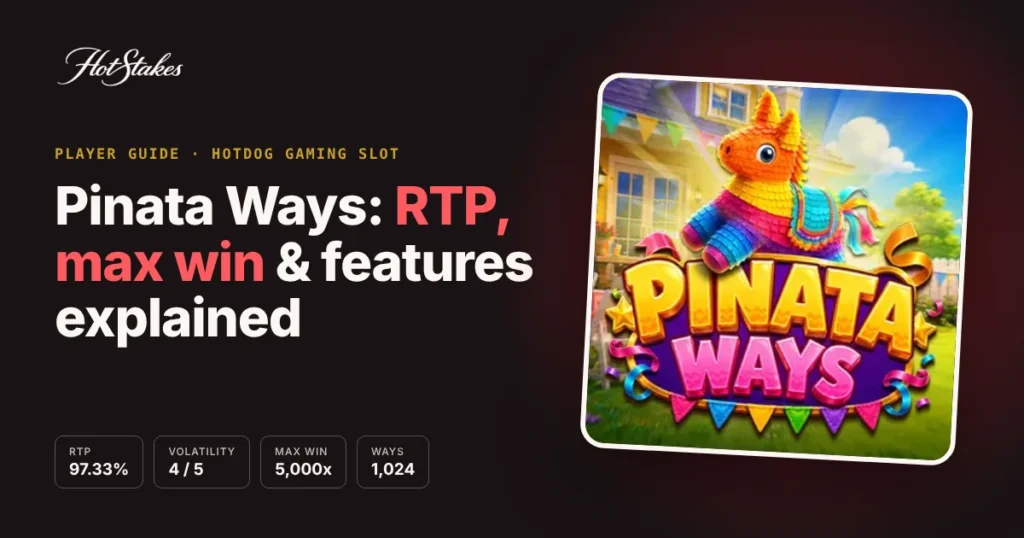
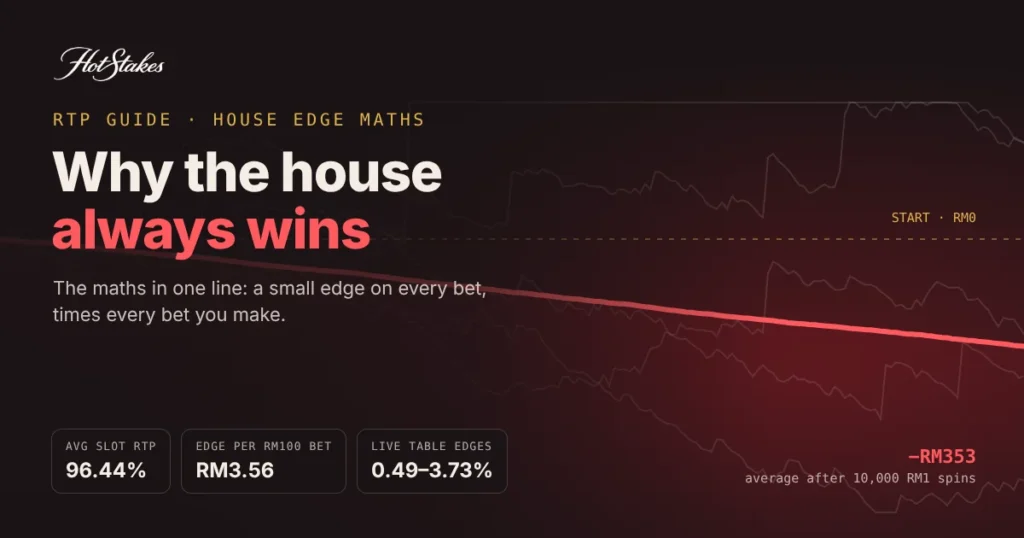
A real casino game has a built-in house edge, and that edge is published. Take the Classic Baccarat EU01 live table in the HotStakes directory: its game sheet lists a house edge of 1.06% to 1.24%, depending on the bet, and the table is certified by BMM Testlabs. Slots work the same way. Our Pinata Ways RTP breakdown shows a 97.33% return to player, which means a 2.67% edge for the house over the long run. A “formula” cannot change those numbers, and nobody with a working one would sell it to strangers on Telegram.
That is why these groups almost always steer you to their own platform. On a legitimate, independently tested game, the promised wins would never show up. On a fake app, the “wins” are just numbers on a screen and cost the scammers nothing to fake. Our guide to RTP vs volatility explains why even a high-RTP game can’t promise short-term profits.
Takeaway: anyone who guarantees gambling profits is either lying about the game or running the game themselves.
9 red flags of a fake gambling app
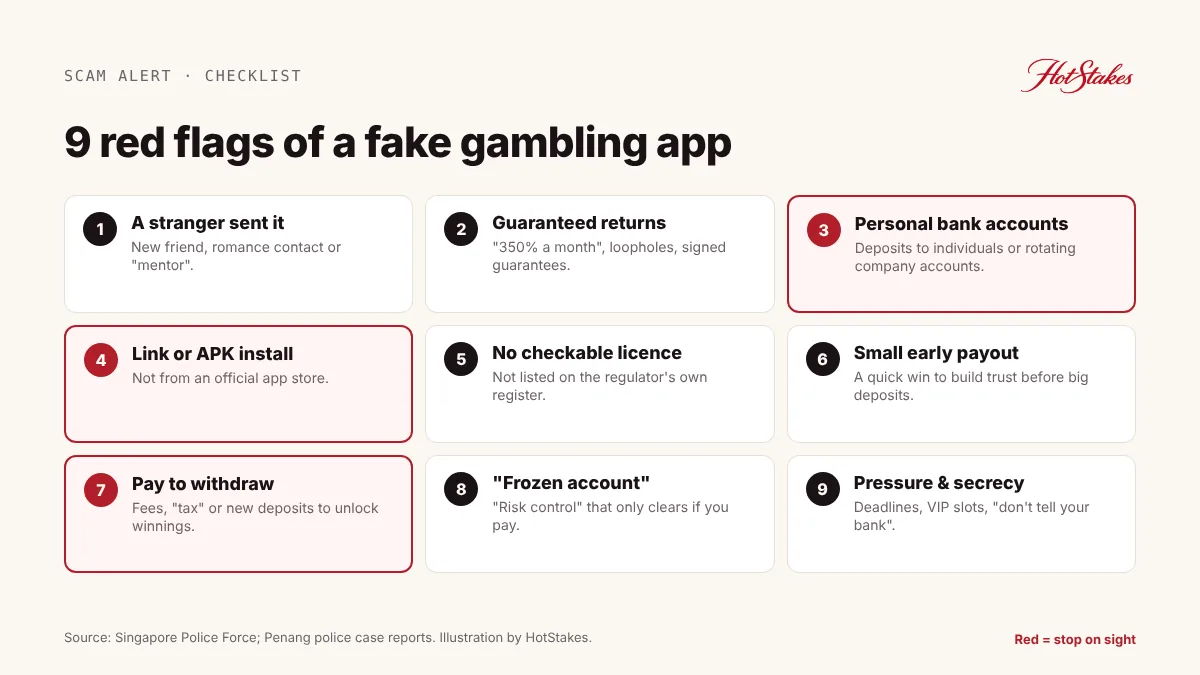
- A stranger introduced it. The app came from a new online friend, a romance contact or a “mentor”, not from your own search.
- Guaranteed or fixed returns. Phrases like “350% in a month”, “insider loophole” or a signed “guarantee agreement”.
- Personal or company bank accounts for deposits. You are told to transfer to a named individual or a rotating list of company accounts, not a regulated payment gateway.
- A download link or APK file. The app is sent in a chat instead of coming from an official app store.
- No checkable licence. No licence number, or one that doesn’t show up on the regulator’s own public register.
- A small early payout. A quick withdrawal (RM3,000 in one Penang case) to build trust before the big deposits.
- Fees, “taxes” or deposits to unlock a withdrawal. The single clearest sign. A real operator deducts any fees from your balance. It never asks you to send new money.
- “Frozen account” or “risk control” messages that only go away if you pay.
- Pressure and secrecy. Deadlines, VIP “slots” closing tonight, or advice not to tell your family or bank.
Takeaway: any one of flags 3, 4 or 7 on its own is enough to stop. When three or more show up together, you are almost certainly dealing with a scam.
Fake app vs licensed operator: side by side
| Check | Fake gambling app | Licensed operator |
|---|---|---|
| How you found it | A stranger, a WhatsApp/Telegram group or an ad promising profits | Your own research. The licence can be checked on a regulator’s site |
| Install | Link or APK sent in chat | Website or official app store listing |
| Deposits | Personal or rotating company bank accounts | Named payment methods in the cashier, in your own name |
| Withdrawal | “Pay a fee or tax first”, “account frozen” | Paid from your balance. ID checks are explained up front |
| Game maths | No published RTP or house edge, no testing lab | RTP or edge shown in the game info, often lab-certified |
| Complaints | Contact disappears and the site goes offline | A published complaints process and a regulator to escalate to |
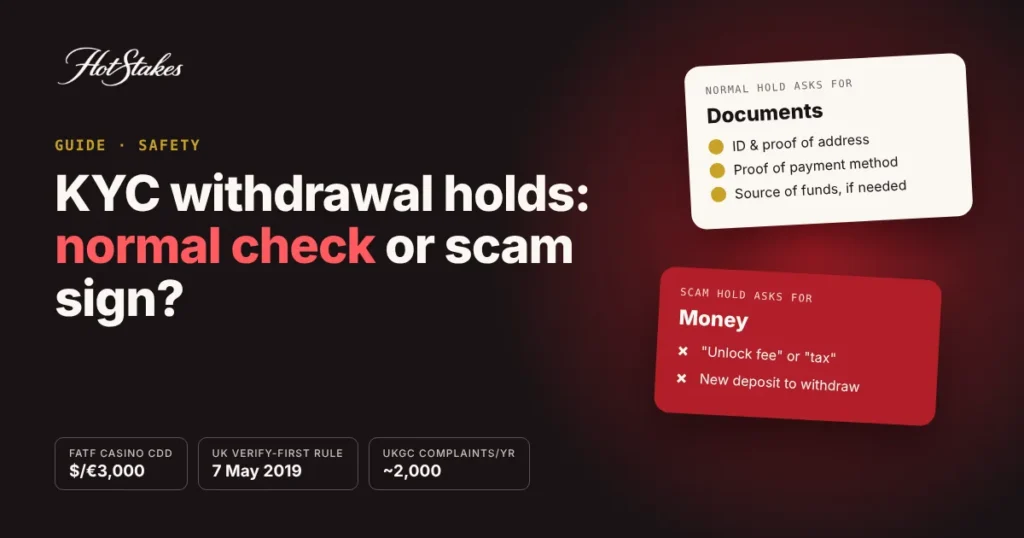
A legitimate operator may still ask for ID before paying out. That is a normal check, and our explainer on KYC and withdrawal holds shows how to tell a real compliance check from a scam. For licence checks, see how to spot an unlicensed online casino.
Takeaway: the difference isn’t the graphics, it’s the money flow. Who you pay, how, and whether you ever have to pay to get paid.
Already paid? What to do now
- Stop sending money, including any “final fee”, “tax” or “unfreeze deposit”.
- Call your bank immediately and ask it to stop or recall the transfers.
- Call the national scam line. In Malaysia, call NSRC 997 (24 hours, ideally within 24 hours of finding out). In Singapore, call the ScamShield Helpline 1799 (24/7, or +65 6869 1799 from overseas). In Hong Kong, call the ADCC Anti-Scam Helpline 18222 (24 hours, consultation only).
- File a police report with screenshots, chat logs, app names, bank account numbers and transfer receipts. The Hong Kong helpline gives advice only, so reports there have to be made at a police station.
- Delete the app and change your banking and email passwords from a different, clean device.
- Ignore “recovery agents” who contact you offering to get the money back for a fee. That is often the same scam coming back for a second round.
Takeaway: speed matters. Hotlines like 997 exist to trace and freeze funds, and that only works while the money is still moving.
FAQ
Can I get my money back from a fake gambling app?
Sometimes, but rarely in full. Malaysia’s NSRC reported RM9.2 million returned to victims, against about RM1.05 billion in reported losses between October 2022 and March 2026. Reporting fast gives you the best chance.
Is it a scam if a casino asks for my ID before a withdrawal?
Not by itself. Licensed operators run identity checks. The scam sign is being asked to send new money to release your winnings.
Are “baccarat formula” or “slot hack” groups ever real?
No. Published house edges and lab-tested RTPs mean no betting pattern can guarantee a profit. In the Macau case, police said the alleged “expert” had no formula at all.
Is it a crime just to use these platforms?
It can be. Singapore police have warned that placing bets on illegal online betting sites is an offence. Laws differ by country, so check your local rules.
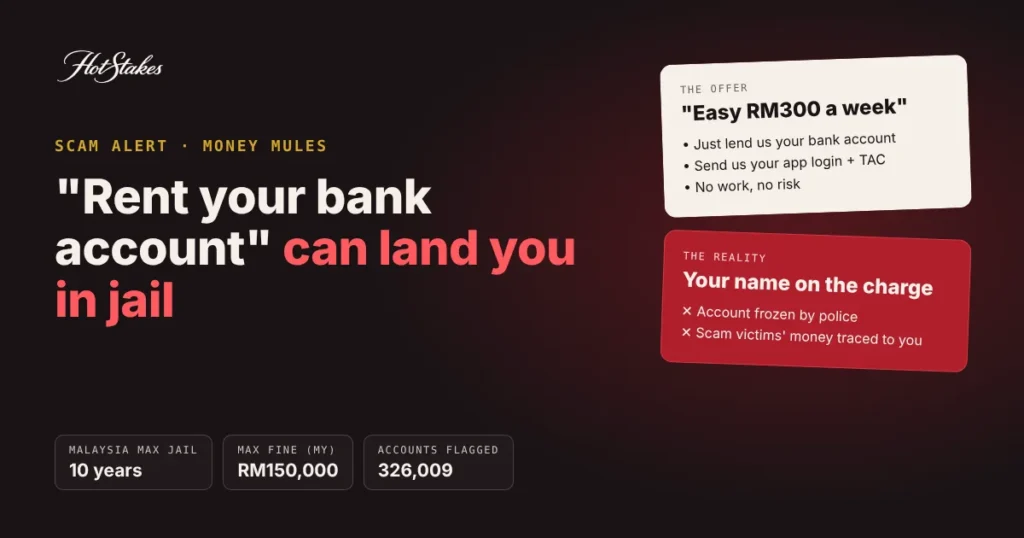
The “deposit to this personal account” step is the giveaway: those accounts are usually rented from ordinary people. Read how that works in our guide to money mule accounts and the penalties.
HotStakes is an independent directory. Some links on this site are affiliate links; we may earn a commission at no cost to you, and it never changes our rankings. Gambling involves risk — only play with money you can afford to lose, and if it stops being fun, seek help.
Looking for operators checked by Cyndia’s team? Browse vetted operators by currency.
 Next story →Pinata Ways RTP, Max Win & Features Explained

Start the discussion