

South Korea’s Illegal Betting Sites: The Crackdown Explained
Only Sports Toto and Betman are legal in Korea. Inside the 2026 illegal betting crackdown, eat-and-run sites, the penalties and where to get help.
In this article
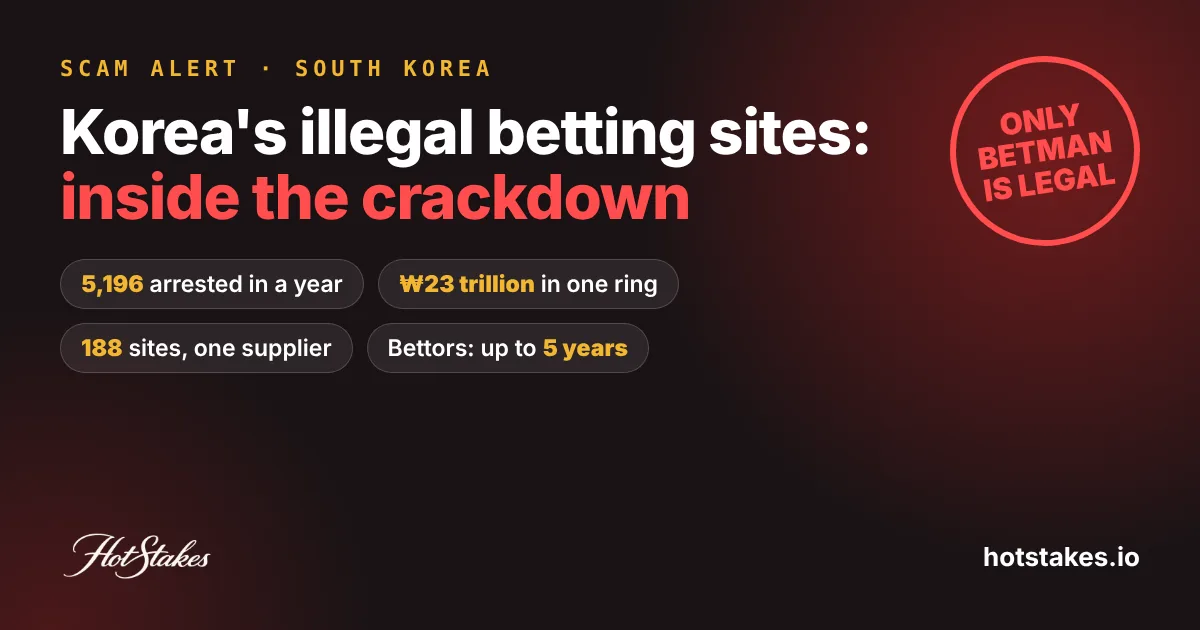
South Korea allows exactly one legal sports-betting product, and police spent all of 2026 hunting everything else. Every private sports-betting or casino site that takes bets from people in Korea is illegal, and under the National Sports Promotion Act a bettor on one faces up to five years in prison or a fine of up to 50 million won, while operators face up to seven years. Below: the biggest 2026 busts, how the illegal sites are really built, the “eat-and-run” trick that takes players’ money, why teenagers are in the crosshairs, and where to get help.
What is legal in South Korea, and what is not
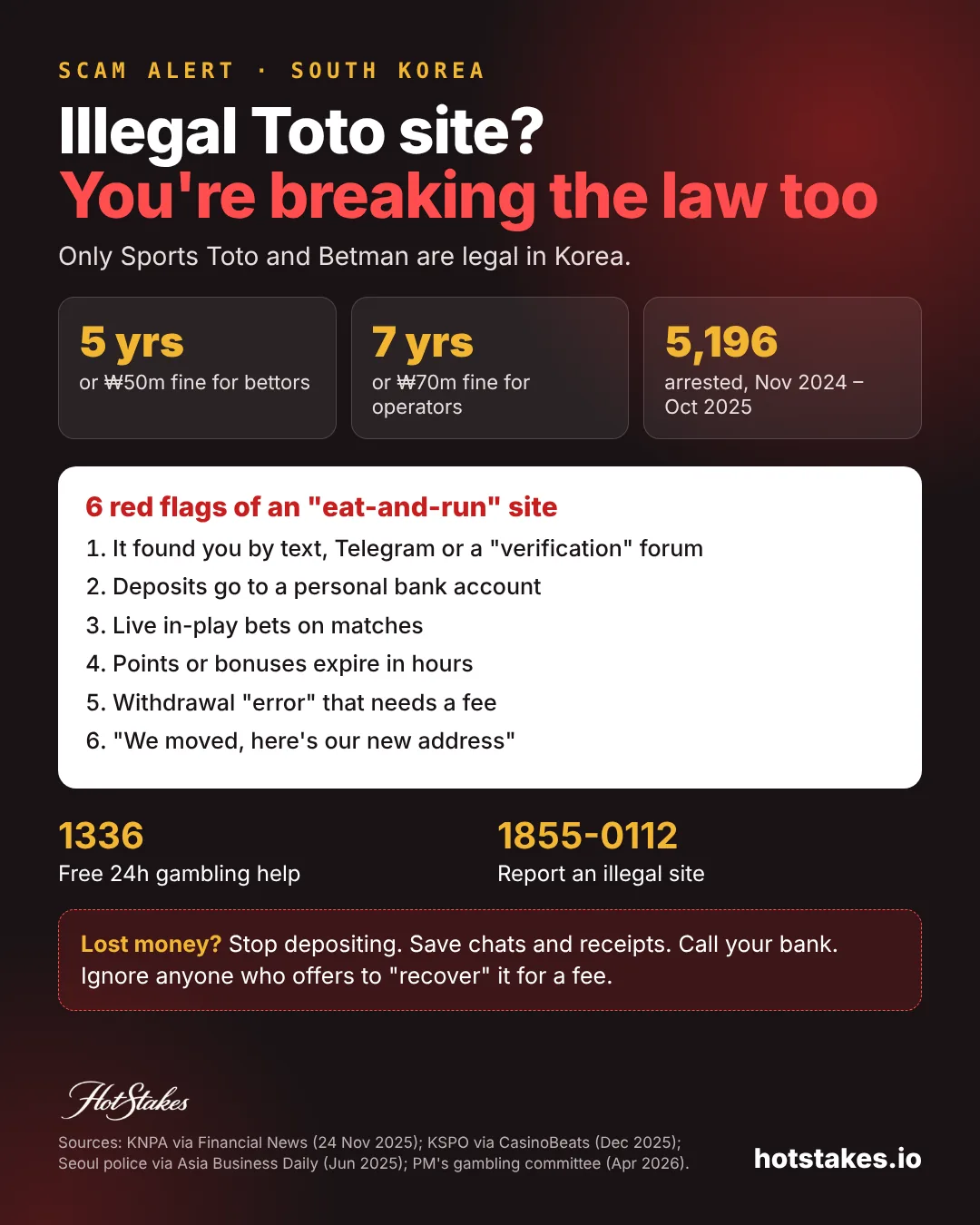
Korea is one of the strictest gambling markets in Asia. For sports betting the rule is simple. The Asia Business Daily put it plainly: only Sports Toto and Betman are legal, even if another “Toto site” claims business registration or expert management.
The penalties are not symbolic. According to the regulator’s figures reported by CasinoBeats in December 2025, the National Sports Promotion Act punishes illegal operators with up to seven years in jail or fines of up to 70 million won, and bettors with up to five years or fines of up to 50 million won.
| Legal (Sports Toto / Betman) | Illegal “private Toto” sites | |
|---|---|---|
| Who runs it | Korea Sports Promotion Foundation, a state body | Anonymous operators, often with servers and staff abroad |
| When betting closes | Before the match starts | Live in-play betting with moving odds, according to the Korea Communications Standards Commission |
| Payment | Regulated, with purchase limits | Bank accounts in other people’s names, gift vouchers, crypto such as USDT |
| If you win | Paid by a state body | Paid only if the site chooses to; “eat-and-run” closures are common |
| Risk for the player | None (legal) | Up to 5 years in prison or a 50 million won fine |
| Risk for the operator | — | Up to 7 years in prison or a 70 million won fine |
Takeaway: in Korea, the player is also breaking the law. “Everyone uses private Toto” is not a defence. For how this compares with Malaysia, Singapore, the Philippines and 10 other markets, see our Asia legality guide.
The 2026 crackdown in numbers
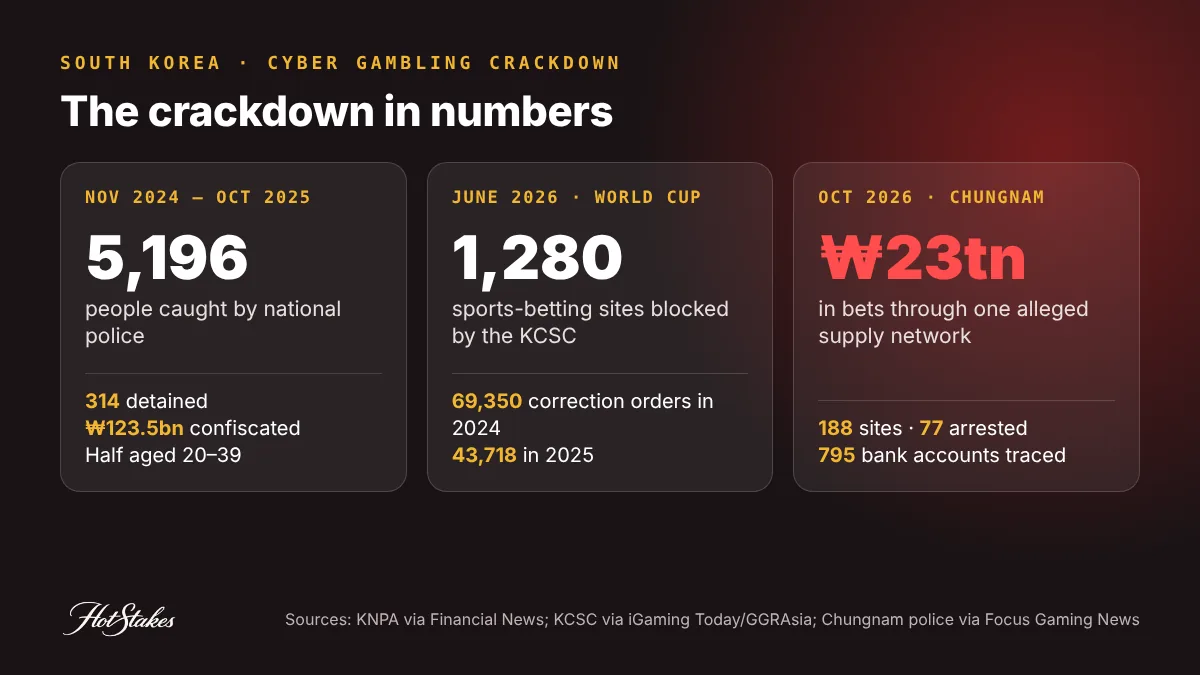
The Korean National Police Agency runs a year-long “special crackdown on cyber gambling” every year. The 2024–25 round ran from 1 November 2024 to 31 October 2025 and, the agency announced on 24 November 2025, caught 5,196 people in 3,544 cases, detained 314 and confiscated 123.5 billion won. People in their 20s and 30s made up about half of all suspects. The police said the 2026 round would focus on operators of overseas-based sites, and a regional police report confirms it runs until 31 October 2026.
It has produced some of the biggest cases the country has seen:
| Date announced | Police | What police said they found |
|---|---|---|
| 9 Jun 2026 | Korea Communications Standards Commission | 1,280 sports-betting sites blocked before the FIFA World Cup; 43,718 correction orders in 2025 and 69,350 in 2024 (iGaming Today, citing GGRAsia) |
| 15 Sep 2026 | Gyeongnam Provincial Police | A developer and a vendor that built and managed 153 illegal sites and sold about 270 billion won of “virtual betting money”; 9 arrested, 3 detained, about 1 billion won frozen (Seoul Economic Daily) |
| 19 Oct 2026 | Chungnam Provincial Police | An alleged supply network behind 188 sites that handled about 23 trillion won (US$17.3bn) in bets from March 2023 to July 2026; 77 arrested, 21 detained, 795 bank accounts traced, 9.6 billion won frozen (Focus Gaming News) |
For scale: a survey by the National Gambling Control Commission put Korea’s illegal gambling market at about 103 trillion won in 2022, while the commission had only 26 to 32 monitoring staff to watch it.
Takeaway: the 2026 cases are not about single websites. Police are going after the companies that build and supply hundreds of them.
How an illegal Korean betting site is really built
The two 2026 supply-chain cases describe the same business model. It looks less like a casino and more like a franchise:
- Content from abroad. According to Chungnam police, organisers contracted with overseas gaming companies for live-casino video feeds and “virtual gaming credits”.
- Software developers. Programmers, some recruited from major tech firms according to police, turned those feeds into complete betting platforms. The Gyeongnam developer earned about 2.18 billion won for building and managing 153 sites between June 2023 and April 2026.
- A vendor in the middle. The vendor bought betting credits in bulk and resold them to site operators, keeping 8% to 10% as commission, police said.
- Street-level operators. Operators rented finished sites for monthly maintenance fees of 1.5 million to 3 million won each, according to Focus Gaming News.
- Payments through borrowed names. Deposits ran through bank accounts opened under other people’s names, plus crypto and Telegram, with offices moved between Korea and Southeast Asia (Vietnam and Cambodia in the Chungnam case).
This is the same “white label” logic we explain in how slot games reach online casinos, without the licence. It also explains why blocking web addresses never ends: when one domain is blocked, the operator rents the next one from the same supplier.
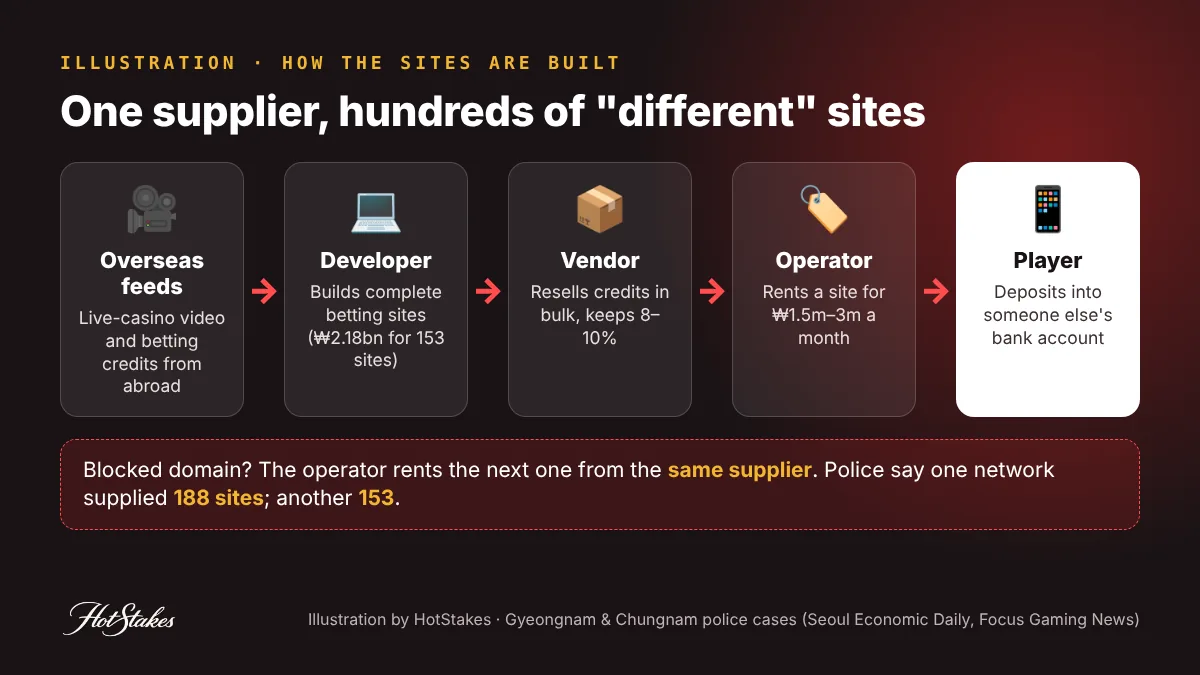
Takeaway: the person running the site you see may not own the software, the games or the money. When police knock, the site disappears, and so does your balance.
“Eat-and-run”: how illegal sites keep your money
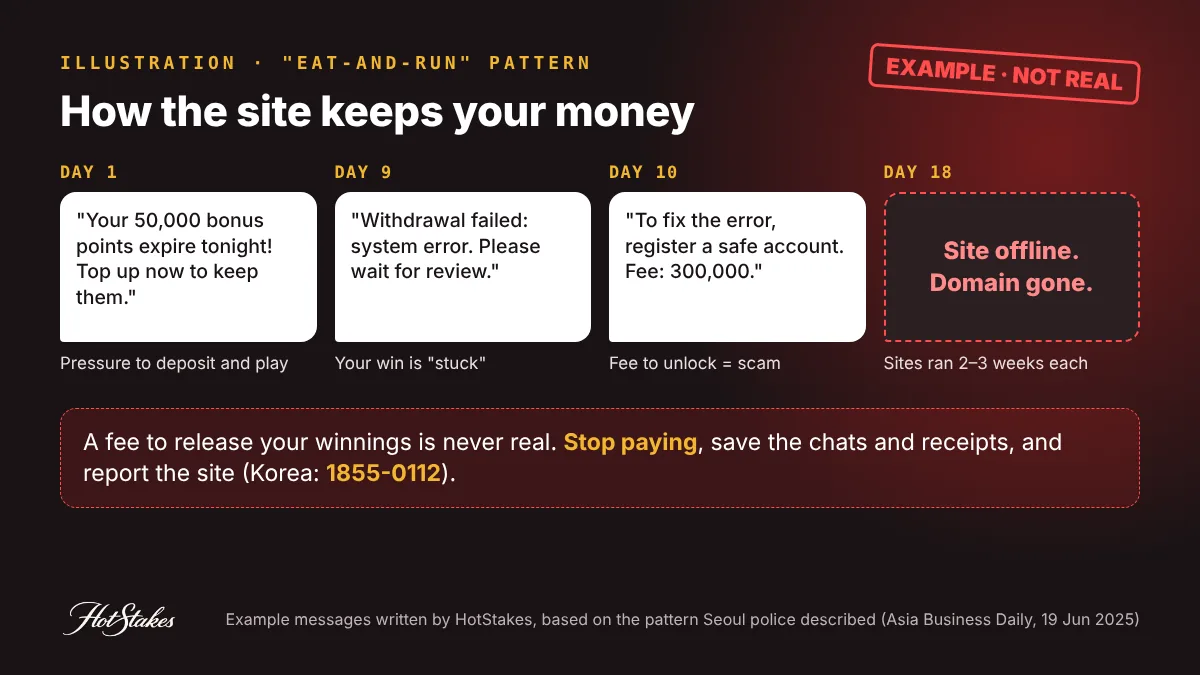
Korean players have a word for sites that take deposits and vanish: meoktwi, “eat and run”. A June 2025 Seoul police case shows the playbook. Officers referred 19 members of a fraud group to prosecutors, accused of running about 250 gambling sites, each open for only two to three weeks, from offices in the Philippines and Korea. Police said 334 users lost about 40 billion won. The pattern, as police described it:
- A message says your “points are about to expire”, pushing you to top up and play.
- When you try to withdraw, the site claims a “system error”.
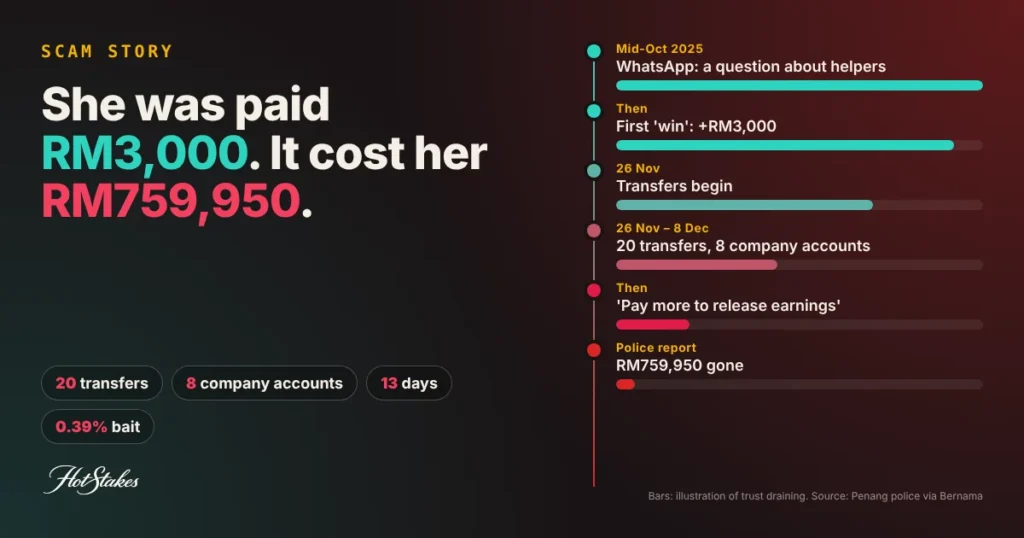
- To fix the error, you are told to pay a registration fee for a “safe account”.
- Each new fee unlocks a new excuse. After a few weeks, the site is gone.
It is the same trick we break down in our withdrawal fee scam script, and the same Telegram funnel behind “guaranteed win” betting groups.
Six red flags of an eat-and-run site
- It found you through a text, Telegram or a “Toto verification” community, not the other way round.
- It asks you to deposit into a personal bank account, and the name changes.
- It offers live in-play bets on Korean or foreign matches (legal Betman closes before kick-off).
- Bonuses or “points” expire within hours.
- Withdrawals hit an “error”, “audit” or “security review” that needs a fee.
- The domain changed recently, or the site asks you to move to a “new address”.
Takeaway: a fee to unlock a withdrawal is always the end of the road. Stop paying and report it. Practise spotting these in our Scam or Legit? quiz.
Why teenagers are a target
Police have said for three years that the illegal market is reaching children. In the September 2023 to March 2024 round, police caught 2,925 online gambling suspects, 1,035 of them teenagers, including a 9-year-old, and found about 1,000 bank accounts in teenagers’ names used to handle gambling money, according to Korea JoongAng Daily. Most were introduced by friends or by text messages. Baccarat was the most played game (41.9%), ahead of sports betting (19.8%).
Later, the police said they identified 4,715 minors from September 2023 to October 2024, 47.2% of everyone involved, and 7,153 minors in the 2024–25 round. Most young people are referred to counselling rather than charged.
The accounts matter. Lending your bank account to a betting site, even “just to receive deposits”, can make you part of the money trail. We explain the risks in money mule accounts explained. Parents can use our teen gambling warning signs guide.
Takeaway: if a friend offers money for the use of your bank account or phone number, say no. It is the front door to these sites.
Reporting an illegal site, and the reward
Korea pays people to report. During the 2026 World Cup, the National Gambling Control Commission paid 10,000 won per report that got a site blocked, 50,000 won if the tip included the operator’s bank account, up to 600,000 won a month. The sports regulator’s reporting centre paid about 600 million won in rewards in 2025, with up to 200 million won for tips that lead to an operator (CasinoBeats).
| Who | Contact | For |
|---|---|---|
| Illegal Gambling Industry Monitoring and Reporting Center | 1855-0112 | Reporting illegal gambling sites |
| Korea Center on Gambling Problems | 1336 (free, 24 hours, anonymous) | Counselling for gamblers and families |
| Youth crisis line | 1388 | Young people in any crisis |
| Korea Legal Aid Corporation | 132 | Free legal advice |
Numbers from a column by the Prime Minister’s gambling supervision committee (April 2026); 1336 also confirmed by Nocut News (August 2026).
What to do if you are caught up in an illegal site
- Stop depositing. No fee, tax or “safe account” payment will release a balance.
- Save evidence: the web address, chat logs, deposit receipts and the names on the bank accounts you paid.
- Call your bank about any account you paid into, and never pass your own account to anyone.
- Report the site (1855-0112 in Korea) and, if you were defrauded, to the police.
- Talk to 1336 if you can’t stop, or if someone in your family can’t. The Prime Minister’s committee also notes that debts from illegal gambling are mostly legally void or hard to enforce.
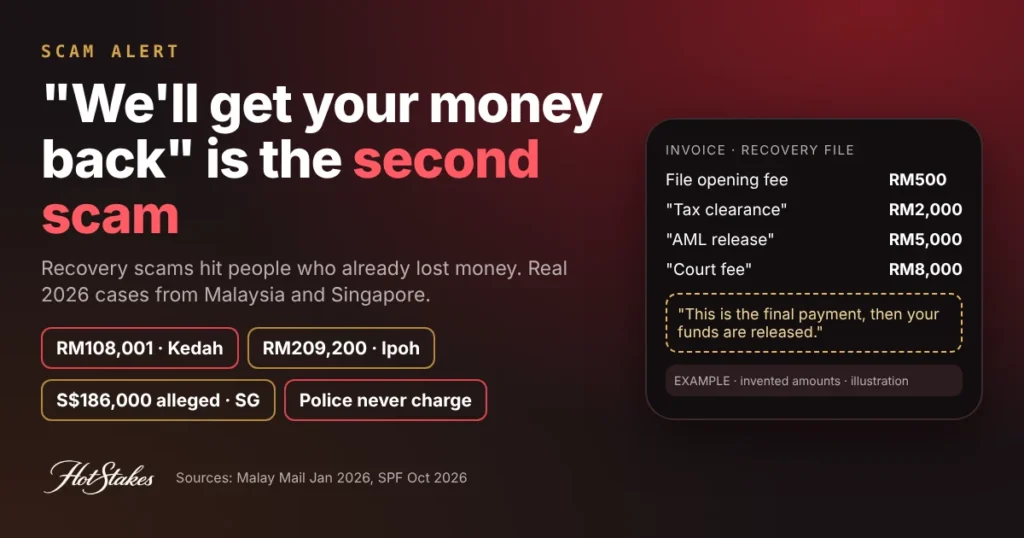
- Ignore “recovery” offers. Anyone promising to get your money back for a fee is running the next scam.
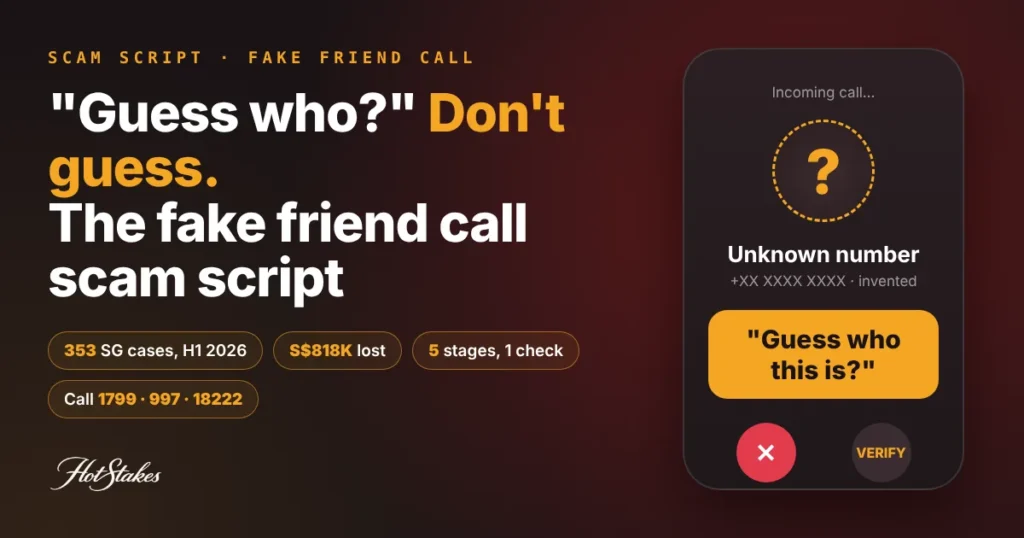
Outside Korea? Malaysia: NSRC 997. Singapore: ScamShield Helpline 1799. Hong Kong: Anti-Deception Coordination Centre 18222. Our “Scammed? Do this now” tool gives the steps for your country.
FAQ
Is online sports betting legal in South Korea?
Only through Sports Toto and its official online site Betman. Every other sports-betting site that accepts bets from people in Korea is illegal, including foreign sites.
Can I go to jail for betting on an illegal site in Korea?
Yes. Under the National Sports Promotion Act, bettors on illegal sports-betting sites face up to five years in prison or a fine of up to 50 million won. Operators face up to seven years or 70 million won.
What is an “eat-and-run” (meoktwi) site?
An illegal betting site that takes deposits and then blocks withdrawals with fake errors or fees before closing. In a 2025 Seoul case, police said one group ran about 250 such sites for two to three weeks each.
How many people were arrested in Korea’s cyber gambling crackdown?
The National Police Agency said its November 2024 to October 2025 crackdown caught 5,196 people, detained 314 and confiscated 123.5 billion won. The 2026 round runs until 31 October 2026.
Where can I get help for gambling in Korea?
Call 1336, the Korea Center on Gambling Problems, free and 24 hours a day, or text #1336. Families can call too. Illegal sites can be reported on 1855-0112.
HotStakes is an independent directory. Some links on this site are affiliate links; we may earn a commission at no cost to you, and it never changes our rankings. Gambling involves risk — only play with money you can afford to lose, and if it stops being fun, seek help. This article is general information, not legal advice. Browse vetted operators by currency. Read our full disclaimer.
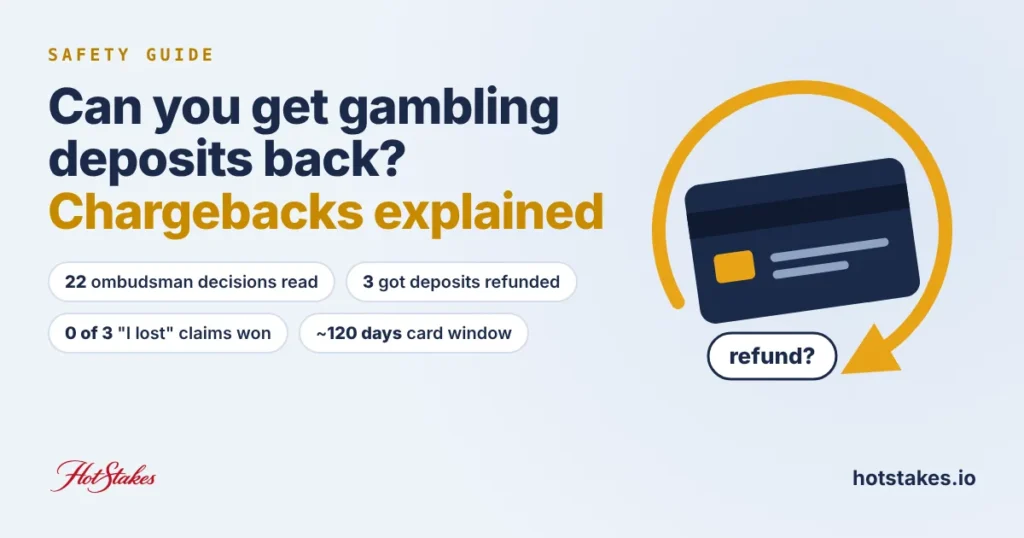 Next story →Gambling Chargeback: Can You Get Deposits Back?
Start the discussion