

USDT Casino Deposit Risks: A 10-Point Safety Checklist
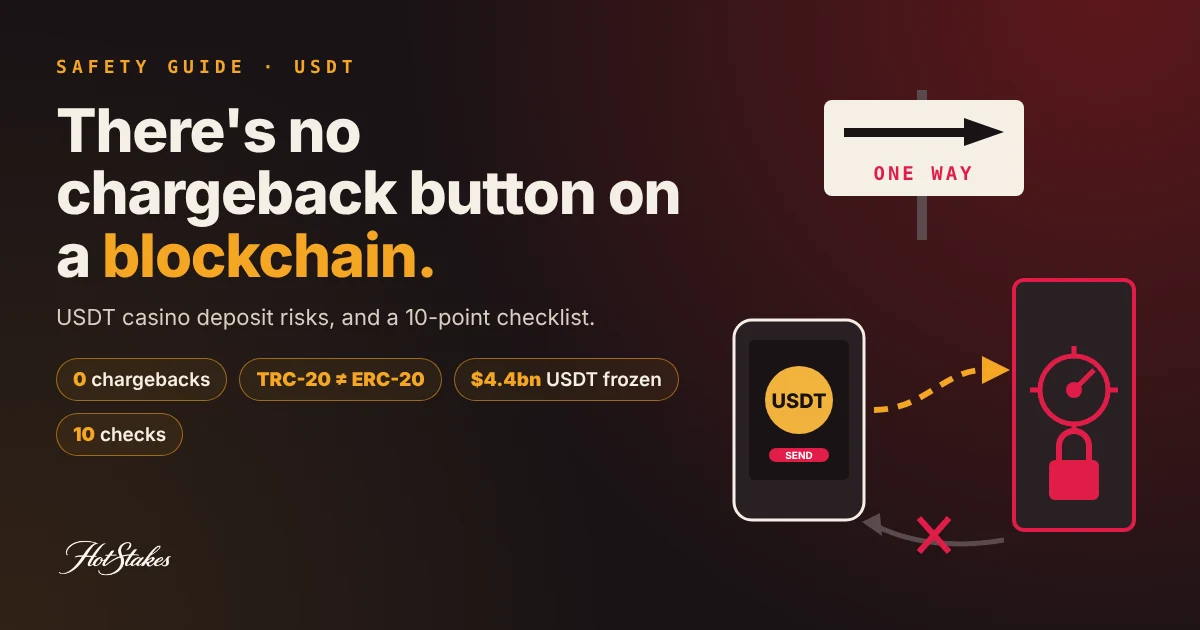
No chargeback, wrong-network losses, poisoned addresses and Tether freezes: the USDT casino deposit risks to check before you press send.
In this article
- Why a USDT deposit is a one-way door
- Card vs bank vs e-wallet vs USDT: who can get your money back?
- Five ways a USDT casino deposit goes wrong
- Buying USDT peer-to-peer: the money-mule trap
- Is it legal where you live?
- Your 10-point USDT casino deposit checklist
- Who should not deposit crypto at all
- Keep records for tax and AML checks
- FAQ
A USDT casino deposit is fast, but it has no undo button. Once USDT leaves your wallet, no bank, card scheme or casino can reverse it, so every safety check has to happen before you press send. This guide covers the risks most deposit guides skip: wrong-network transfers, poisoned addresses, clipboard malware, fake “new address” messages, issuer freezes and local gambling law. It ends with a 10-point checklist and an honest list of who shouldn’t use crypto at a casino at all. We checked every regulator page cited here on 21 Oct 2026.
Why a USDT deposit is a one-way door
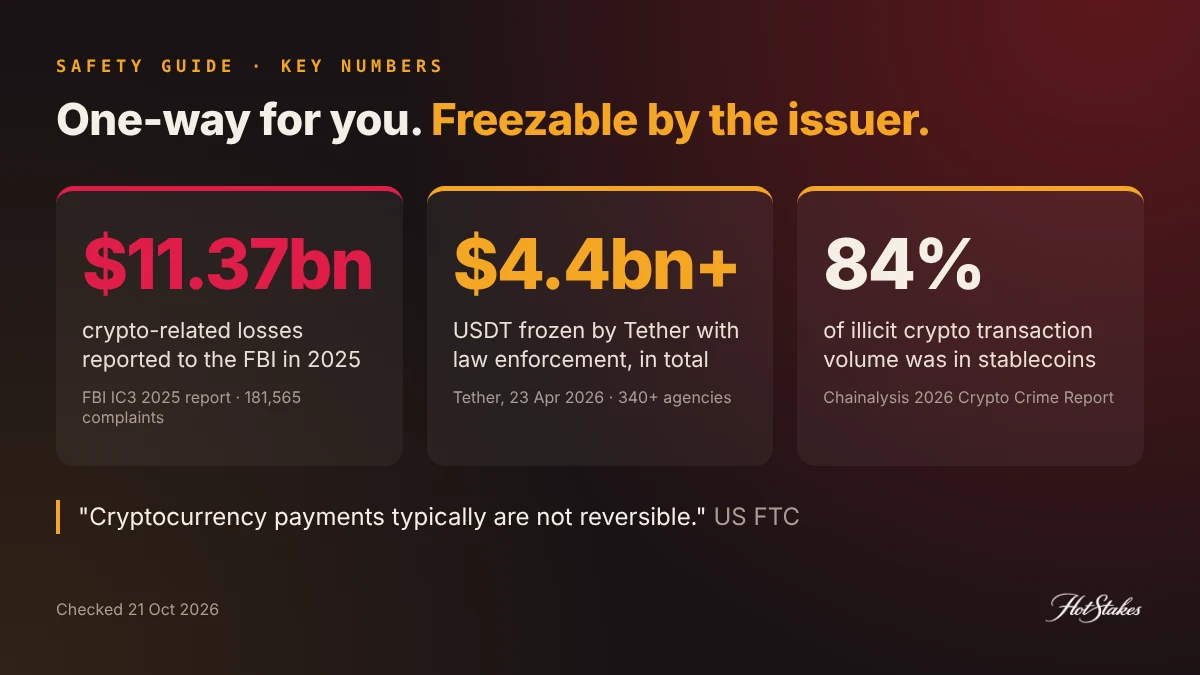
The US Federal Trade Commission puts it bluntly: “Cryptocurrency payments typically are not reversible.” The same page says crypto payments don’t come with the legal protections cards have, and you usually get money back only if the person you paid sends it back.
That matters at a casino. If a site won’t pay out, there is no card issuer to dispute with. If you mistype an address, there is no bank to call.
The scale of crypto fraud shows why. The FBI’s 2025 Internet Crime Report logged 181,565 crypto-related complaints and about $11.37 billion in crypto-related losses, more than half of all reported losses ($20.88 billion).
Takeaway: With USDT, “send” is final. Your protection is the checking you do beforehand.
The paradox: you can’t reverse it, but Tether can freeze it
Here is what most USDT casino guides leave out. USDT is not like Bitcoin. A company issues it, and that company can freeze it.
Tether said on 23 April 2026 that it has frozen more than $4.4 billion in total, working with more than 340 law enforcement agencies in 65 countries. The same release covers a single $344 million freeze across two addresses.
Freezes target criminal money, and that’s a good thing. But it shows who sits close to USDT. Chainalysis estimates that stablecoins “now account for 84% of all illicit transaction volume”. An offshore casino wallet, or a P2P seller you buy from, can be caught up in an investigation. If that happens, your balance may be stuck with it.
Takeaway: USDT is irreversible for you and freezable by the issuer. Neither feature works in your favour at an unlicensed casino.
Card vs bank vs e-wallet vs USDT: who can get your money back?
Before you choose USDT for speed, compare what you give up. The rules vary by country and provider, so treat this as a general guide and check your own bank’s or wallet’s terms.
| Method | Reversible? | Identity checks | Dispute route | Typical speed |
|---|---|---|---|---|
| Debit / credit card | Sometimes, through a dispute with your card issuer | Yes, via your bank | Card issuer, then the casino’s licensing regulator | Instant deposit; withdrawals slower |
| Bank transfer | Hard once sent; report fast | Yes, via your bank | Your bank’s fraud team, police, regulator | Minutes to days |
| E-wallet | Depends on the provider’s rules | Usually, by the wallet provider | Wallet provider, then regulator | Usually instant |
| USDT (TRC-20 / ERC-20) | No. Only the recipient can send it back (FTC) | At regulated exchanges, yes. Self-custody wallets, no | Only the casino’s regulator, if it has one | Minutes, once the network confirms |
Takeaway: USDT wins on speed and loses on every safety net. If dispute rights matter to you, it’s the weakest option in the table.
Five ways a USDT casino deposit goes wrong
1. Wrong network: TRC-20 vs ERC-20
USDT runs on several blockchains, most often Tron (TRC-20) and Ethereum (ERC-20). The casino’s deposit page will show one network. Your wallet must send on that same network.
Coinbase’s help centre says “The same network must be used on both the sending end and the receiving end”, and that it “cannot recover funds that are lost” when the wrong network is used. A casino isn’t obliged to help either, and an unlicensed one rarely will.
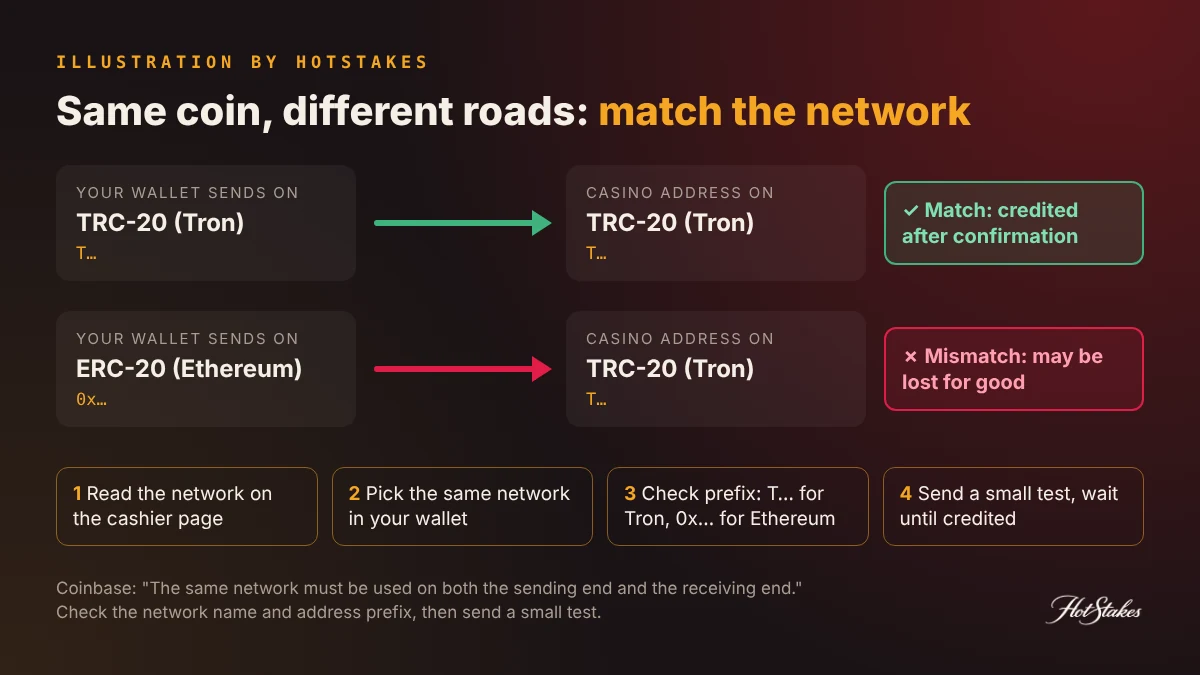
Takeaway: Read the network name on the deposit page, choose the same one in your wallet, and send a small test first.
2. Address poisoning
Scammers send tiny transfers from an address that looks like one you’ve used. It then sits in your transaction history, waiting for you to copy it.
In December 2025, a trader lost 49,999,950 USDT this way, The Block reported. The victim had even sent a 50 USDT test first. The fake address matched the real one’s first and last characters, and the differences hid in the middle.
Takeaway: Never copy a deposit address from your wallet history. Take it fresh from the casino’s cashier page every time and check the middle characters too.
3. Clipboard malware
Some malware watches what you copy and swaps a wallet address for the attacker’s. In June 2026, Microsoft warned about a USB-spread strain that checks the clipboard “every half a second” for Bitcoin, Ethereum and Tron addresses, BleepingComputer reported. The swapped address is chosen to look partly like yours.
Takeaway: After you paste, compare the address character by character with the casino’s page, or scan the QR code on a second device.
4. “Our deposit address has changed”
A message arrives in Telegram, WhatsApp or the site’s own chat: the old address is “under maintenance”, please use this new one. It might come from a fake agent, a hacked account or the site itself.
The FTC’s rule of thumb applies: “Only scammers demand payment in cryptocurrency.” A legitimate cashier shows the address inside your logged-in account. It doesn’t send a new one in a private message.
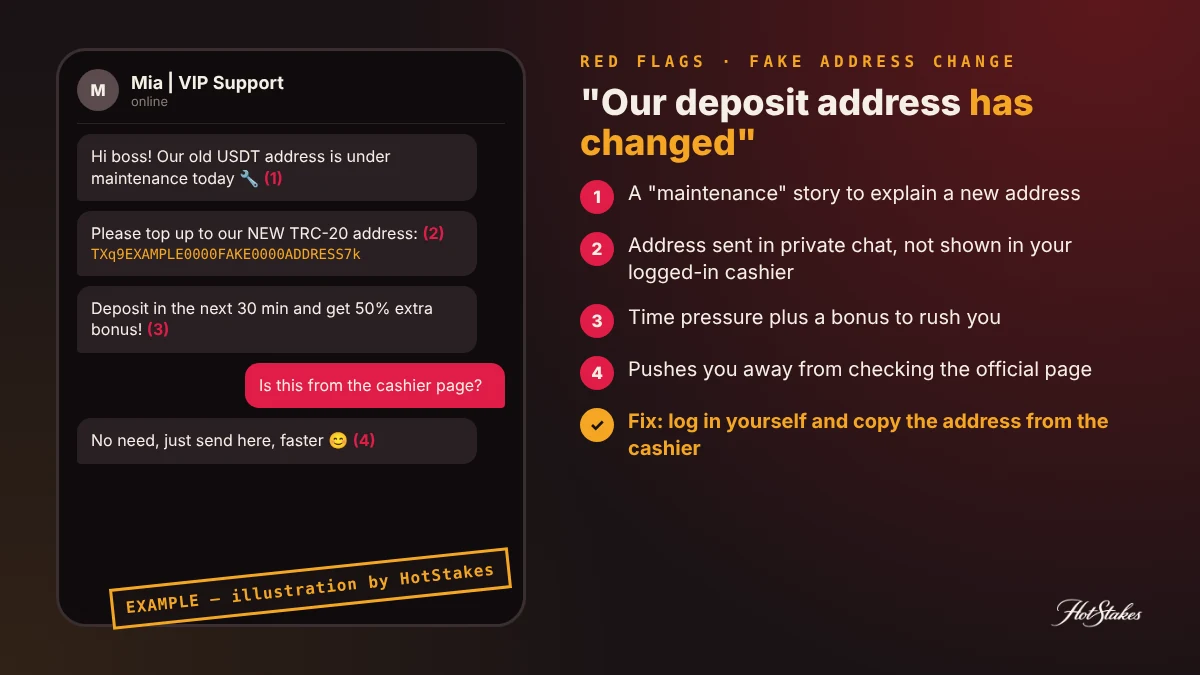
Takeaway: Ignore any deposit address that arrives by chat. Log in yourself and check the cashier page.
5. Unlicensed casinos and frozen withdrawals
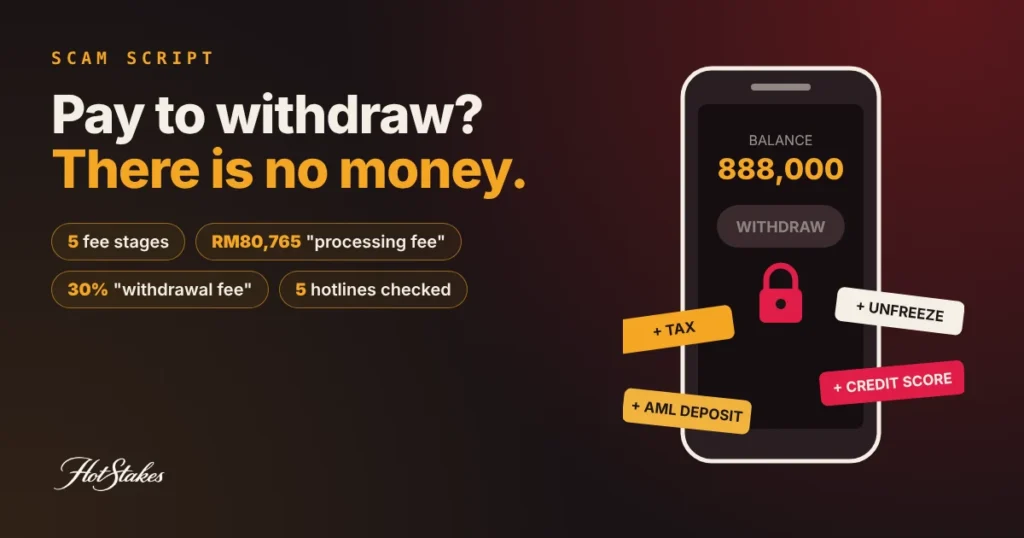
Many crypto-only casinos hold no licence that covers your country. Depositing is easy. The trouble starts when you try to withdraw and are told to verify, pay a “release fee” or wait indefinitely.
Licensed operators can accept crypto, but under conditions. The UK Gambling Commission says “Crypto-assets present additional risks compared with fiat currency”. It expects licensees to check source of funds and explain how money would be treated if they went bust.
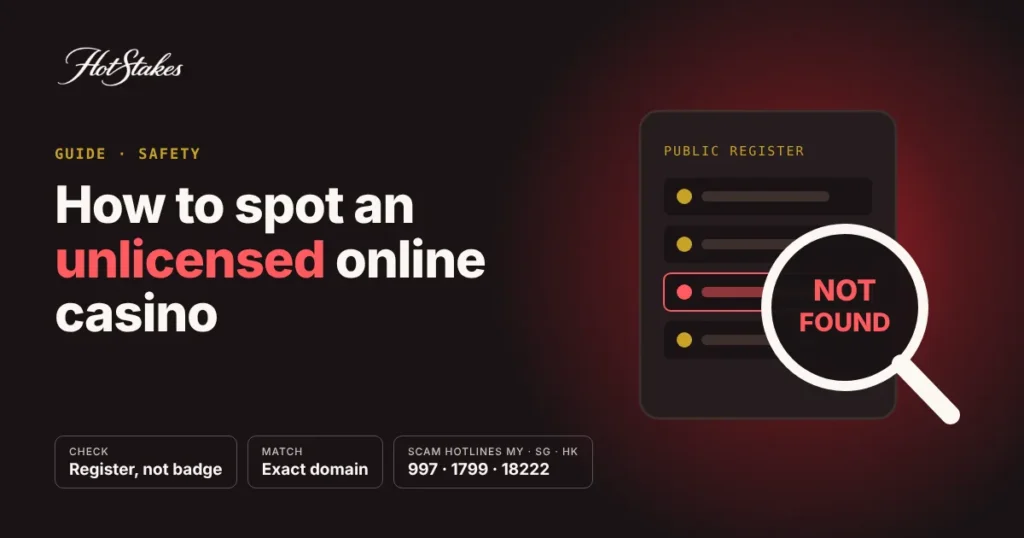
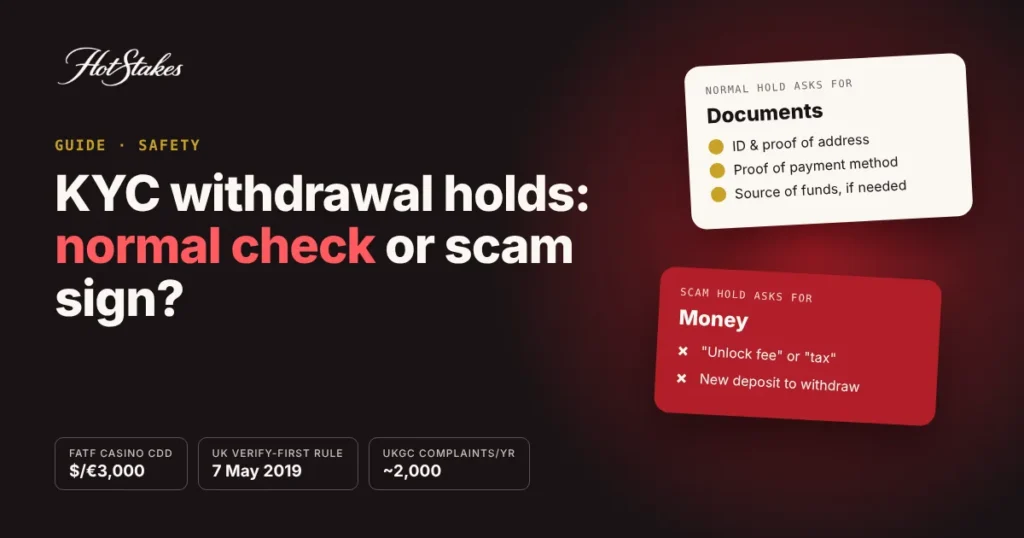
Learn the warning signs in our guide to spotting an unlicensed online casino. If a payout is stuck in verification, see why KYC withdrawal holds happen. Being asked to pay a fee to release winnings is a classic sign of a fake gambling app scam.
Takeaway: Check the licence before the cashier. If there’s no regulator to complain to, there’s no one to help you get a withdrawal paid.
Buying USDT peer-to-peer: the money-mule trap
Many players buy USDT on peer-to-peer (P2P) marketplaces, paying a stranger by bank transfer. The risk is what that stranger’s money is. If your bank payment, or the USDT you receive, is tied to scam proceeds, your account can be frozen and you may face questions.
This is not hypothetical for gambling. In June 2026, Singapore police said 25 of 30 people investigated in one operation had “sold or relinquished control” of bank accounts to illegal gambling syndicates. Our money-mule account scam explainer covers how ordinary people get pulled in.
- Buy only through an exchange that is licensed or registered in your country.
- Never let anyone “lend” you an account, or borrow yours, to move gambling money.
- Never accept a refund or “overpayment” from a stranger and pass it on.
Takeaway: The cheapest P2P rate can cost you your bank account. Use a regulated platform in your own name.
Is it legal where you live?
Crypto doesn’t change gambling law. It only changes how you pay.
- Singapore: Singapore Pools is the only operator licensed by the Gambling Regulatory Authority for remote gambling. Taking part in unlicensed remote gambling is an offence, with a fine of up to S$10,000, up to six months’ jail, or both (GRA). For crypto services, the Monetary Authority of Singapore warns consumers to avoid unregulated entities, “including those based overseas”.
- Malaysia: Police treat online betting as unlawful. In June 2026 a man was fined RM1,800 under Section 7(2) of the Common Gaming Houses Act 1953 after pleading guilty to online gambling on his phone (Daily Express). The government is weighing tougher online gambling laws (NST). On the crypto side, the Securities Commission says running a digital asset exchange without authorisation is an offence under Malaysian securities laws.
- UK: The FCA tells crypto buyers to be “prepared to lose all your money” and says compensation cover is highly unlikely.
Takeaway: If online casino play is illegal where you live, paying in USDT doesn’t make it legal. It only removes your protections. This is general information, not legal advice.
Your 10-point USDT casino deposit checklist
Run through this every time, not just the first time.
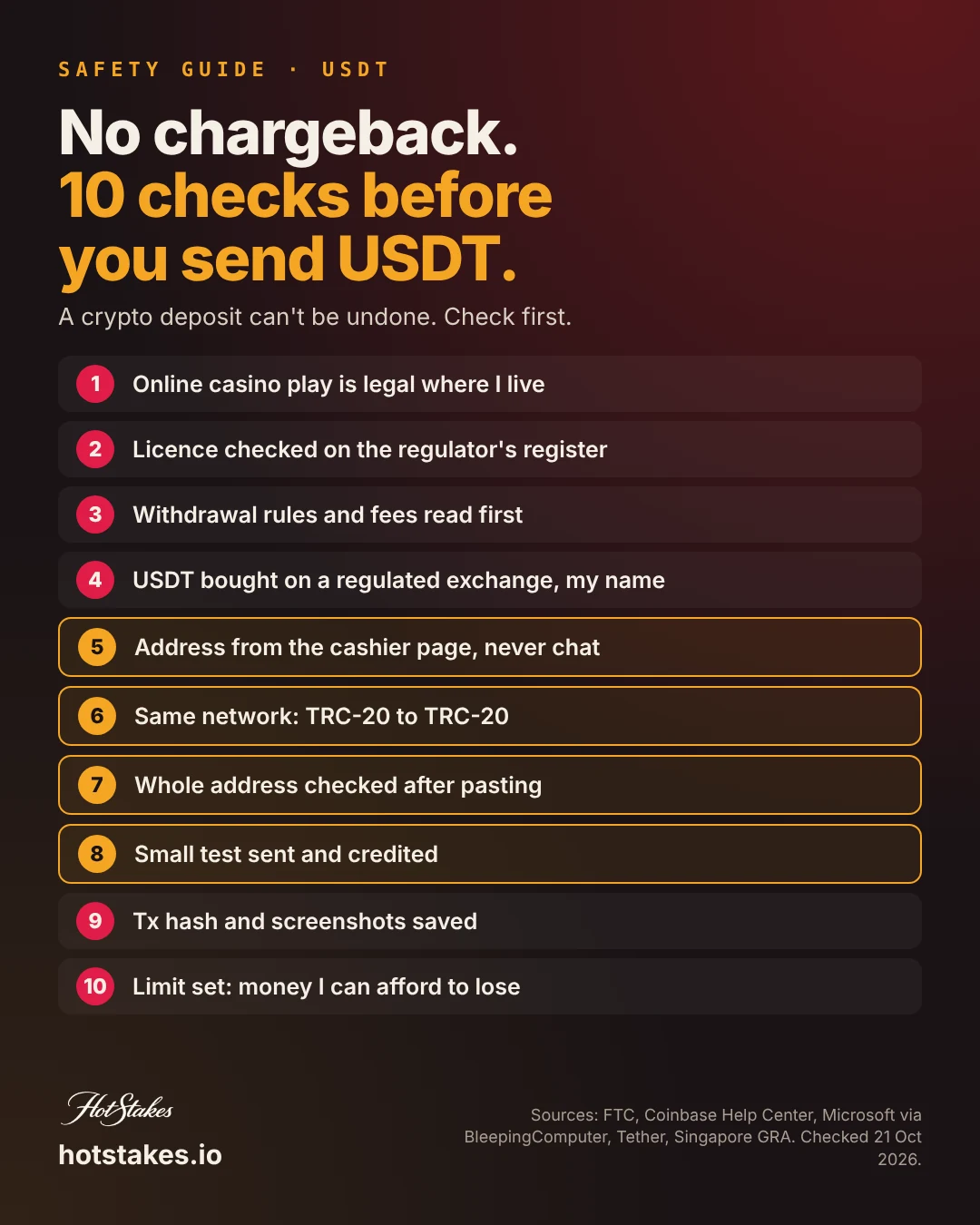
- Check it’s legal for you. Is online casino play allowed where you live?
- Check the licence. Find the regulator’s name and look the casino up on the regulator’s own register.
- Read the withdrawal rules first. Look for limits, fees, KYC steps and processing times before you deposit.
- Buy USDT on a regulated exchange in your name. Skip P2P strangers and anyone offering to “help” you top up.
- Get the address from the cashier page only. Never from chat, email or your wallet history.
- Match the network. TRC-20 to TRC-20, ERC-20 to ERC-20. Tron addresses start with “T”, Ethereum with “0x”.
- Check the whole address after pasting. First, middle and last characters, to catch clipboard swaps and poisoned lookalikes.
- Send a small test first. Wait until it is credited to your casino balance before sending the rest.
- Save the records. Keep a screenshot of the cashier page, the transaction ID (hash), the date and the amount.
- Set a limit you can afford to lose. Decide the amount before you open the wallet, not after a loss.
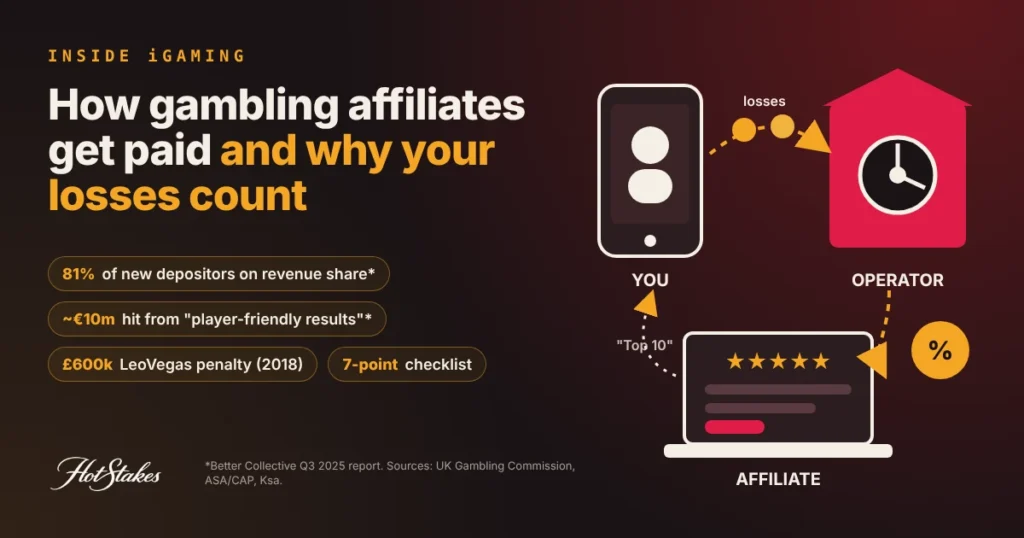
Ready to compare operators that list USDT? Our USDT casino directory page shows which operators take Tether. Run the checklist on any of them first.
Takeaway: Steps 5 to 8 take two minutes and block the most common irreversible mistakes.
Who should not deposit crypto at all
For some people, the honest answer is “don’t”. Skip USDT casino deposits if any of these fit you:
- You live where online casinos are illegal, such as Singapore outside Singapore Pools, or Malaysia.
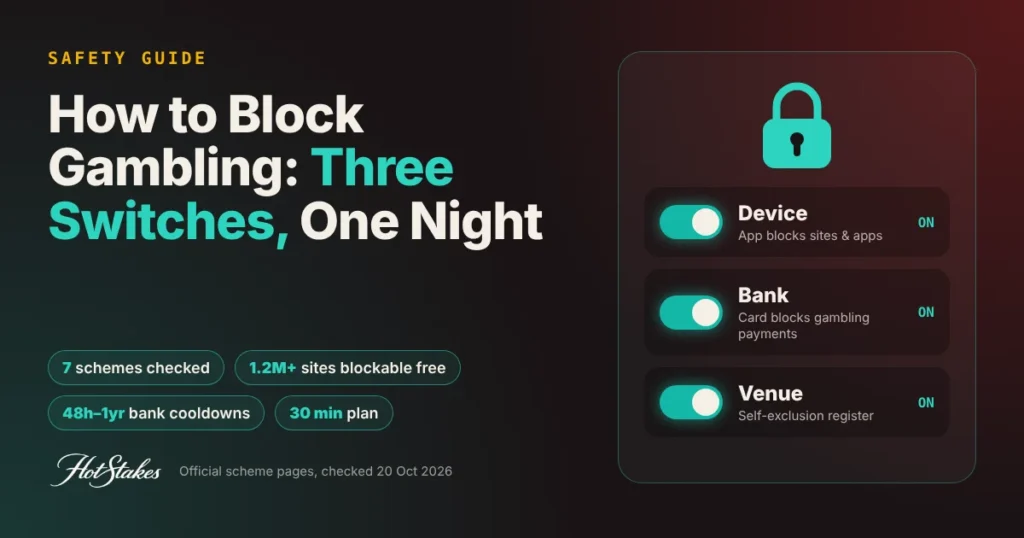
- You’ve self-excluded or set bank gambling blocks. Crypto can feel like a way around them. That’s a sign to get support, not a workaround. Our guide to blocking gambling covers devices and payments.
- You’re chasing losses, or borrowing to gamble.
- Someone else told you to pay in USDT: an “agent”, a new online friend or a betting tipster.
- You’re not confident with wallets and would struggle to check a network or address.
- You need the money back for anything soon.
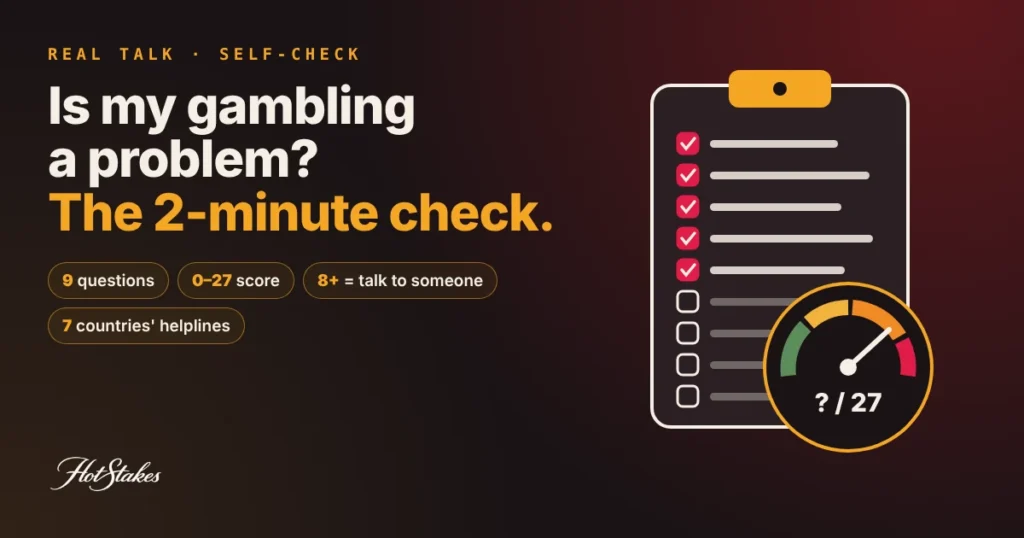
If gambling is getting hard to control, free help exists. Singapore: NCPG helpline 1800-6-668-668. UK: National Gambling Helpline 0808 8020 133. If you’ve been scammed, call Malaysia’s NSRC on 997 or Singapore’s ScamShield helpline 1799 straight away.
Takeaway: If USDT appeals to you because it’s harder to trace or block, that is the strongest reason not to use it.
Keep records for tax and AML checks
Licensed casinos must check where money comes from. The UK Gambling Commission lists source of funds as a specific crypto risk for licensees (UKGC), so expect questions on large deposits.
Clean records make those checks quick:
- Exchange purchase receipts in your name
- Transaction hashes for every deposit and withdrawal
- Screenshots of the casino cashier page and your balance
Tax rules on crypto and gambling winnings differ by country. Ask your local tax authority or a qualified adviser.
Takeaway: A complete paper trail is your best defence in a withdrawal review or a dispute.
FAQ
Is it safe to deposit USDT at a casino?
It can be, but only at a casino licensed where you live, using the correct network and an address taken from the cashier page. USDT payments are typically not reversible, so you lose card-style dispute rights. Never deposit more than you can afford to lose.
What happens if I send USDT on the wrong network (TRC-20 vs ERC-20)?
The funds may never arrive and are often unrecoverable. Coinbase says the same network must be used on both ends and it cannot recover funds sent on the wrong one. Some casinos may help, but they are not obliged to.
Can I get a chargeback on a USDT casino deposit?
No. There is no card issuer or bank in the middle. The FTC says you can usually get crypto back only if the person you paid sends it back. Your only route is the casino itself or its licensing regulator.
Can Tether freeze my USDT?
Tether can freeze USDT addresses and says it has frozen more than $4.4 billion with law enforcement as of April 2026. Freezes target criminal funds, but USDT held in or received from a tainted wallet could be affected.
Is gambling with crypto legal in Singapore or Malaysia?
In Singapore, gambling with an unlicensed remote operator is an offence (fine up to S$10,000, jail up to six months, or both). Malaysian courts have fined online gamblers under the Common Gaming Houses Act 1953. Paying in crypto doesn’t change this.
HotStakes is an independent directory. Some links on this site are affiliate links; we may earn a commission at no cost to you, and it never changes our rankings. Gambling involves risk — only play with money you can afford to lose, and if it stops being fun, seek help. This article is general information, not legal advice.
 Next story →Bonus Buy Slots: Does Buying the Feature Change Your Odds?

Start the discussion