

Online Gambling Job Scam: How a RM3,500 Ad Ended in Jail
A Facebook job ad, 17 Singapore bank accounts, S$4M and 8 months' jail. The two doors into a gambling syndicate and what each risks.
In this article
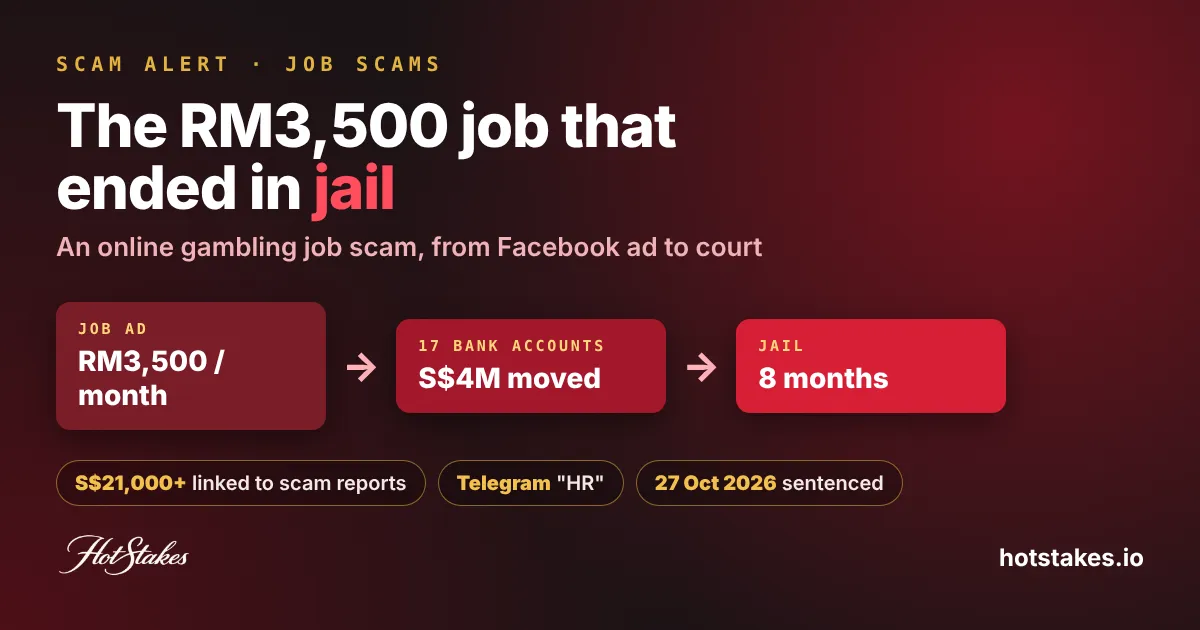
An online gambling job scam rarely looks like a scam. It looks like a job. A 28-year-old Malaysian man answered a Facebook ad, was promised RM3,500 a month on Telegram, and spent his shifts checking deposits in Singapore bank accounts that belonged to other people. Nearly S$4 million moved through 17 of those accounts. On 27 October 2026 a Singapore court jailed him for eight months, and the people who hand over their bank accounts to syndicates like his can face even heavier sentences.
What happened: the RM3,500 job, step by step
Everything below comes from public court reporting and police statements.
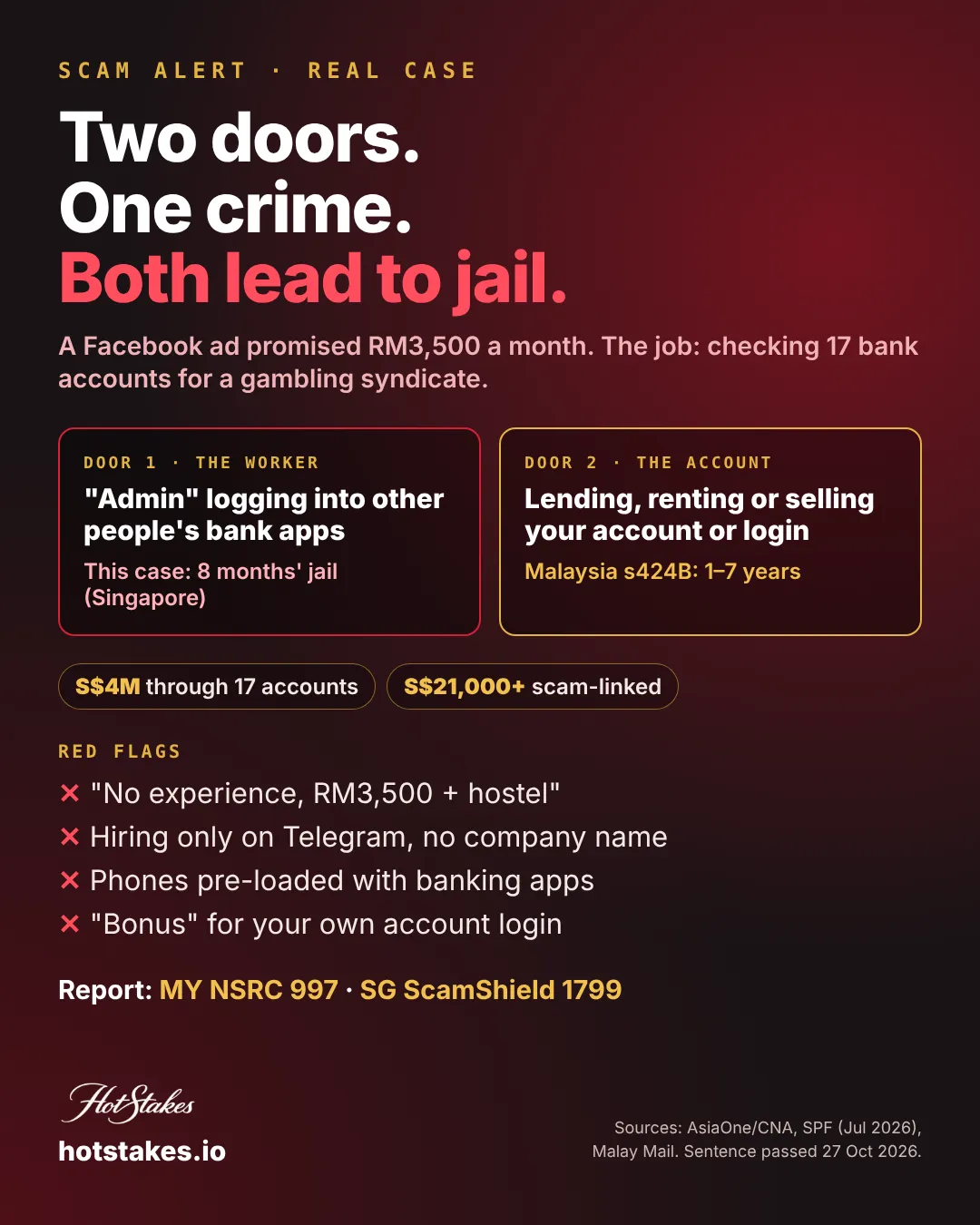
- September 2025: the ad. He found the job on Facebook. On Telegram he was told the pay was RM3,500 (about S$1,090) a month (AsiaOne, citing CNA).
- The workplace. He reported for work at an online gambling syndicate in Iskandar Puteri, Johor Bahru.
- The work. He checked deposits into Singapore bank accounts registered in other people’s names. He used phones already loaded with banking apps and login details, verified transactions in an internal system and shared payment screenshots on Telegram (Fintech News Singapore).
- The money. The 17 MariBank and GXS accounts processed S$3,996,971 while he worked there. More than S$21,000 was linked to reported scam cases in Singapore, with individual losses from S$150 to S$2,968. So the syndicate moved scam money as well as gambling money.
- March 2026: the raid. Information from MariBank helped police disrupt the syndicate. On 17 March 2026 Malaysian officers raided the premises and seized 83 phones, 45 bank tokens and a computer.
- 20–21 July 2026: arrest and handover. He was detained at Kuala Lumpur International Airport under a Singapore warrant of arrest and handed to the Singapore Police Force the next day (SPF, 21 July 2026).
- 27 October 2026: sentence. He pleaded guilty to conspiracy to commit unauthorised computer access under the Computer Misuse Act and got eight months’ jail. The maximum is two years, a S$5,000 fine, or both (Malay Mail / AsiaOne).
Two details matter for anyone reading a similar ad.
First, the charge police announced in July was heavier. The SPF said he would be charged with abetting, by conspiracy, the retention of criminal benefits under the Corruption, Drug Trafficking and Other Serious Crimes (Confiscation of Benefits) Act, which carries up to 10 years’ jail. He ultimately pleaded guilty to the computer misuse charge.
Second, “I didn’t know” did not end the case. His lawyer said he was unaware some transactions involved scam funds. But the court heard he knew the operation was illegal in both Malaysia and Singapore, and the prosecution asked for eight months because of the volume of transactions.
Takeaway: a syndicate “admin” job counts as taking part in the crime, not just having a job. Crossing a border does not keep you out of reach.
Why this case is bigger than one man
The syndicate was disrupted during Operation Frontier+ III. That was a two-month operation from 10 March to 7 May 2026, led by Singapore with nine foreign agencies, including Malaysia’s National Scam Response Centre (SPF, 20 May 2026).
- Across all the participating countries and territories: 3,018 arrests and nearly 102,000 bank accounts frozen.
- In Singapore, between 23 and 31 March 2026, police arrested 18 people who had knowingly opened or surrendered bank accounts or Singpass credentials for money.
- Three Malaysians were arrested in Johor Bahru after a 17 March raid on a syndicate linked to scam accounts.
The RM3,500 figure isn’t new either. In 2021, Kuala Lumpur police found four teenagers aged 16 to 18 who had been recruited on WeChat with RM3,500 a month plus lodging to work as “customer service” at an online gambling operation (Malay Mail / Bernama).
Gambling and scam operations also share buildings and staff. In November 2024, Johor police arrested 71 people in Iskandar Puteri in raids on two offices linked to gambling call centres and online job scams (The Sun). The setup is similar to the one in our explainer on what Malaysia’s raids on fake online casino call centres revealed.
Takeaway: the “admin job” and the mule account are parts of one machine. Police dismantle both at the same time.
The two doors into the same crime
A gambling or scam syndicate needs two things. It needs people to run the accounts, and it needs accounts that aren’t in the boss’s name. That gives two ways in for ordinary people.
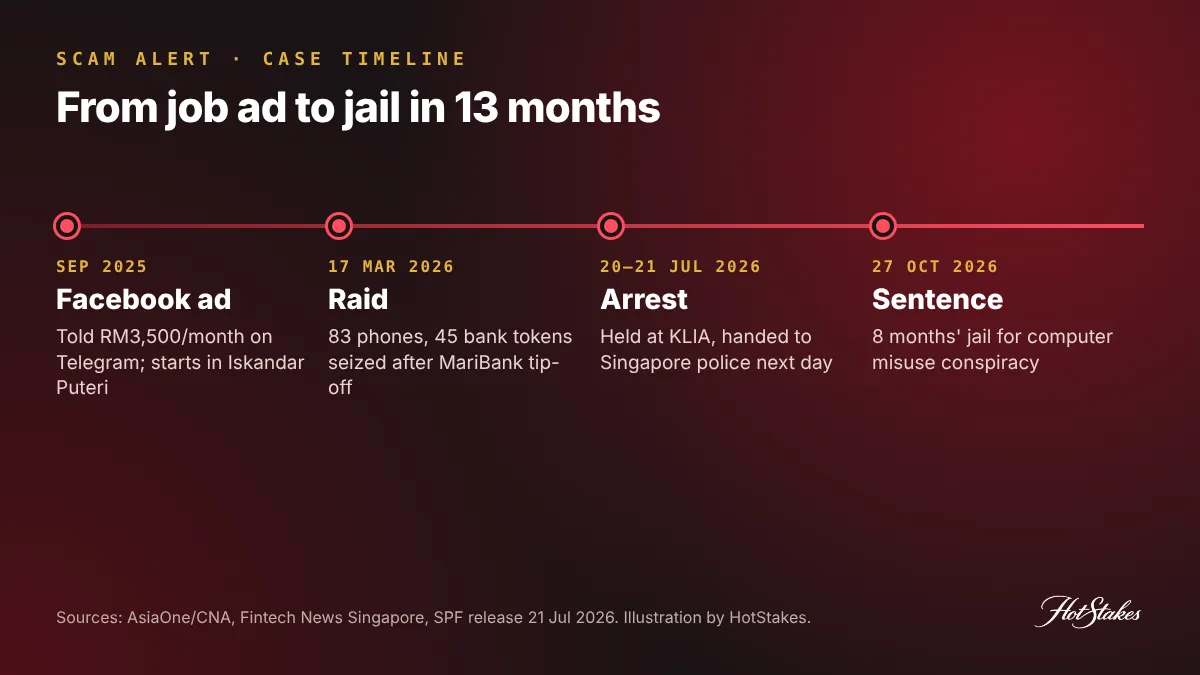
Door 1: the worker
You answer an ad for “admin”, “CS”, “data entry” or “finance assistant”. Your shift is spent logging into banking apps on company phones, confirming top-ups and sending screenshots. Every login to someone else’s account without their bank’s authorisation is a potential offence.
- Singapore: unauthorised access under the Computer Misuse Act, with a maximum of 2 years and S$5,000 for the charge in this case. Laundering-type charges under the CDSA can carry up to 10 years.
- Malaysia: Penang police warned in June 2026 that jobs sold as digital marketing or customer support can involve “managing online gambling accounts” and “processing customer transactions” (The Star). Section 424A of the Penal Code covers controlling someone else’s bank account without lawful authority.
Door 2: the account holder
You’re asked to “lend” your account for payroll, “rent” it for RM300 a month, or hand over your app login for a bonus. That makes you a mule, and the sentences on this side are often longer.
- A 24-year-old Malaysian who opened Singapore accounts for a Johor-based syndicate, handed over cards and passwords, then guided other mules, got 7 years and 4 months in May 2026. More than S$4.3 million flowed through the group’s 100 accounts (The Star).
- A 35-year-old Malaysian in debt to loan sharks was offered RM3,000 a month to open accounts at seven Singapore banks. One account was used by an illegal gambling operator. He got 5 years and 10 months in December 2025 (The Star).
- In Sabah, a 28-year-old who “leased” his account to a scam syndicate got 3 years’ jail in August 2026 after RM92,000 from a victim landed in it (The Star).
The two Singapore cases also involved cheating charges against the banks, so their sentences are not a direct comparison. The pattern still stands: the person who supplies the account is not treated as a bystander. Our guide to how money mule accounts work and what they cost in jail and fines covers the recruitment side in more depth.
What the law says on each side of the Causeway
On 29 October 2026 we read the current SPF releases and the Malaysian reports on the Penal Code amendments. These are the main offences.
| Offence | Who it hits | Maximum / range |
|---|---|---|
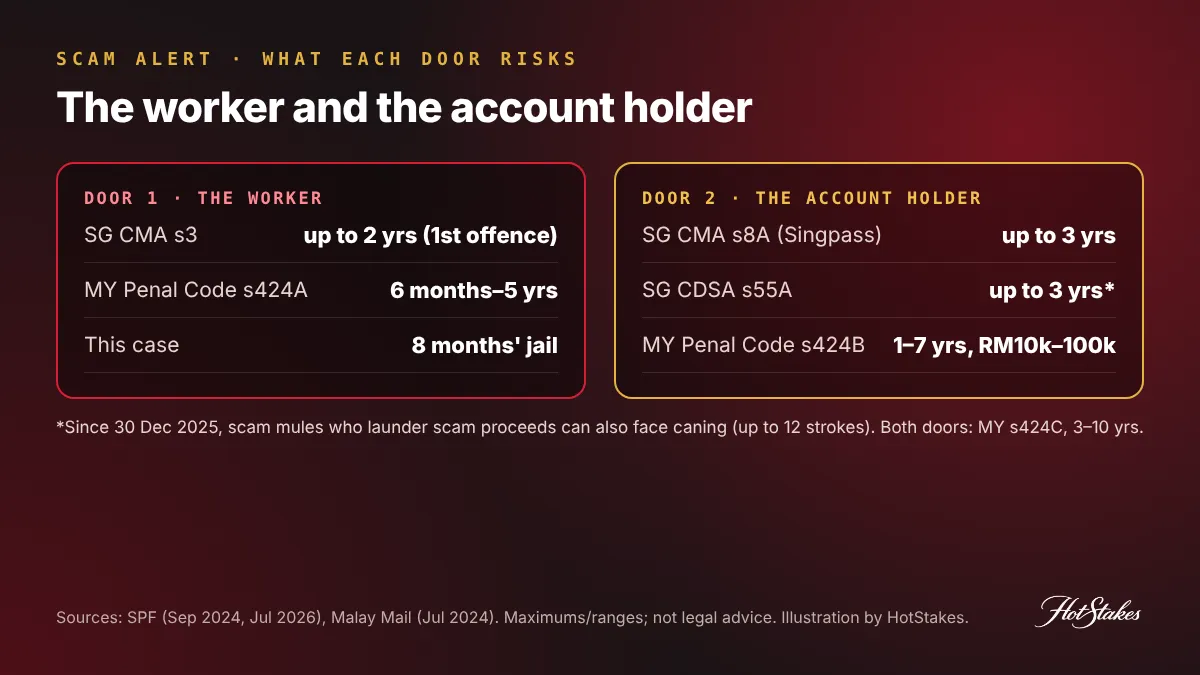
| Singapore CMA s3: unauthorised access (as in this case) | Worker logging into others’ accounts | 2 years, fine, or both (first conviction) |
| Singapore CMA s8A: disclosing your Singpass credentials | Account holder | 3 years, fine, or both |
| Singapore CDSA s55A: helping someone retain criminal benefits | Account holder or worker | 3 years, fine, or both |
| Singapore, from 30 Dec 2025: scam mules who launder scam proceeds | Account holder | Discretionary caning up to 12 strokes, on top of jail |
| Malaysia Penal Code s424A: controlling another person’s account | Worker / syndicate | 6 months–5 years and/or RM5,000–RM50,000 |
| Malaysia s424B: giving someone control of your account | Account holder | 1–7 years and/or RM10,000–RM100,000 |
| Malaysia s424C: transactions without lawful purpose | Both | 3–10 years and/or RM10,000–RM150,000 |
Sources: the SPF statement on the Singapore money-mule offences that came into force on 8 February 2024 (SPF, September 2024), the July 2026 SPF release on caning, and the Malaysian sections as tabled in July 2024 (Malay Mail). The Dewan Rakyat passed the bill on 10 July 2024 (NST). Courts decide the actual charge, so this table is a guide, not legal advice.
Takeaway: in both countries, “I only lent my account” is written into the law as an offence of its own.
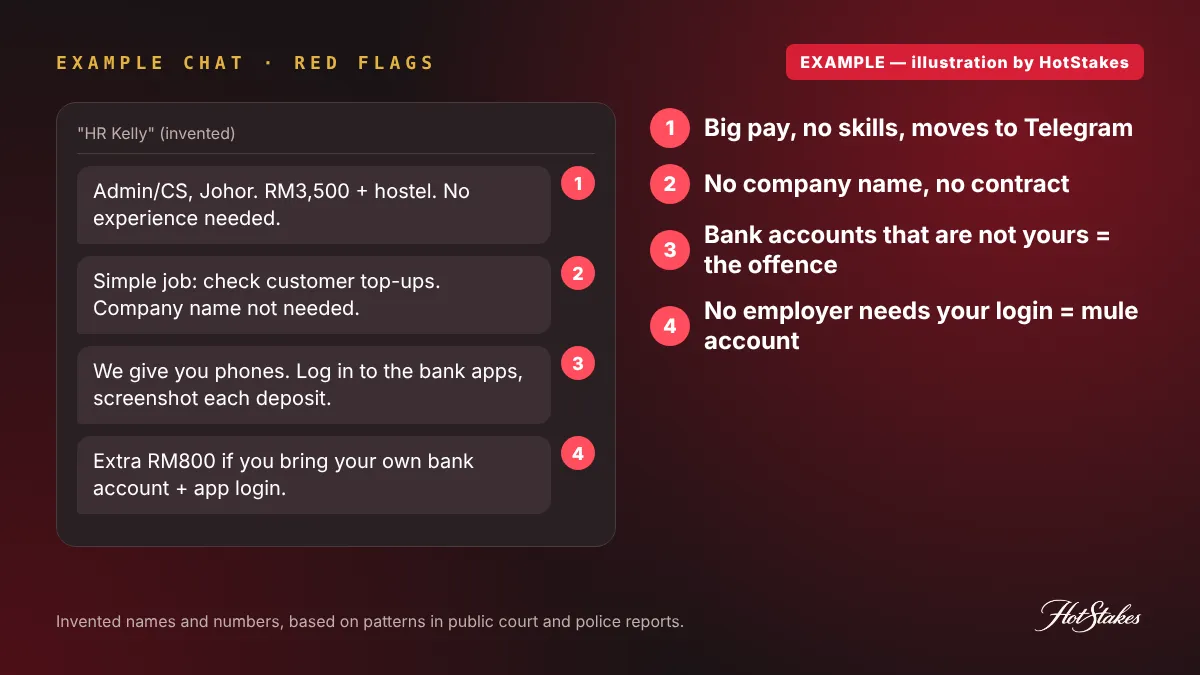
EXAMPLE: how the recruitment chat escalates
This invented chat follows the pattern in the public reports above, with made-up names and numbers, so you can recognise the stages.
Stage 1, the ad: “Admin / CS staff, Johor. RM3,500 + hostel. No experience. PM us on Telegram.”
Red flag: high pay, no skills needed, and the hiring moves to a private chat app.
Stage 2, “HR” on Telegram: “Simple job. Check customer top-ups, confirm in our system. Company name not needed, boss prefers private.”
Red flag: no company name, no contract, no SSM registration you can check.
Stage 3, the real job: “We give you phones. Just log in to the bank apps and screenshot every deposit.”
Red flag: you’re logging into bank accounts that aren’t yours. That is the offence.
Stage 4, the upsell: “Extra RM800 if you bring your own bank account + app login. For payroll only.”
Red flag: no employer needs your login. This is Door 2.
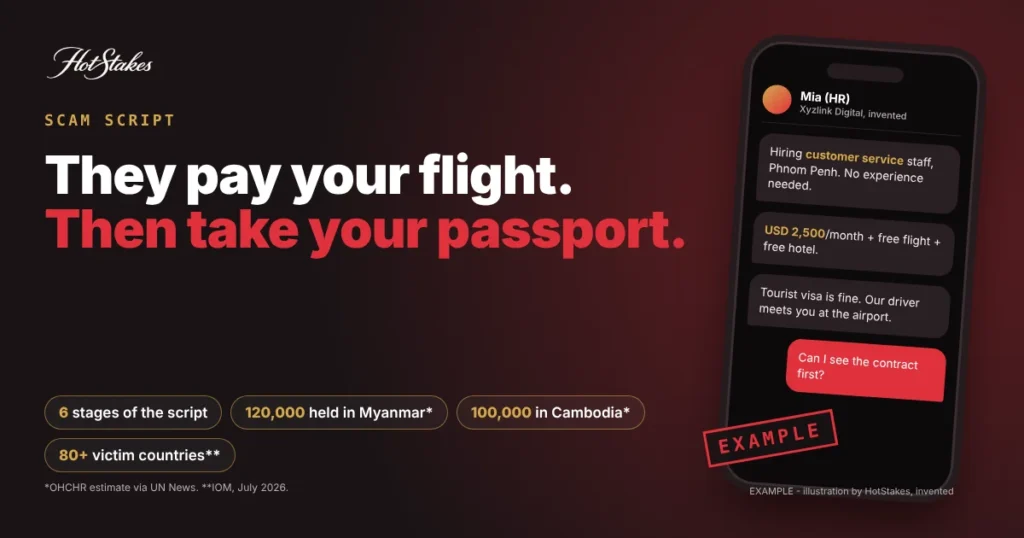
The same “easy job, then something more” structure shows up in our breakdown of the six messages in an overseas job scam script. That version can end in a Southeast Asian scam compound. The local version in this case ended with an arrest at the airport.
Real job vs syndicate job: red flags compared
| Check | Real job | Syndicate job |
|---|---|---|
| Company name | Named, registered, has an office address | “Boss prefers private”, or only a Telegram handle |
| Interview | Video or in person, with a named HR person | Chat only, hired within hours |
| Pay | Payslip, EPF/SOCSO (MY) or CPF (SG) contributions | Cash or transfers from personal accounts |
| Equipment | Work laptop with company systems | Stacks of phones with banking apps already logged in |
| Tasks | Described in a written contract | “Check top-ups”, “confirm deposits”, “screenshot transfers” |
| Your bank account | Used only to receive your salary | Asked to lend, rent or share login “for bonus” or “payroll” |
| Hours and housing | Normal shifts, you live where you like | Long shifts, company hostel, told not to discuss work |
Takeaway: if the job involves bank accounts that aren’t in your name, or asks for your login, walk away.
If you’re already inside: what to do
- Stop logging in to any account that isn’t yours, and stop forwarding screenshots.
- If you lent your account, call your bank, change your passwords and use its kill switch. Our guide to blocking online banking fast lists the steps for each bank.
- Get legal advice before you talk to the syndicate again. Don’t delete messages, because they show what you were told.
- Report it. Malaysia: call the National Scam Response Centre on 997, which runs 24 hours a day (Malay Mail), or pass information to police through 999, as Penang police urged. Singapore: call the ScamShield Helpline 1799, lodge a police report online, or call 999 / SMS 70999 in an emergency.
- Check before you accept the next offer. In Malaysia, look up an account or phone number on the PDRM CCID Semak Mule portal (semakmule.rmp.gov.my). In Singapore, check any recruiter against MOM’s Employment Agency Directory and read ScamShield’s job scam red flags.
Want to test your instincts? Try our 2-minute scam-or-legit quiz. For the long-con version, where the “job” turns into an investment, see how pig-butchering scams work.
FAQ
Is working for an online gambling company in Malaysia illegal?
Online gambling operations are illegal in Malaysia, and staff can be arrested in raids. Logging into bank accounts that aren’t yours can add computer misuse or mule-account charges, as this Singapore case shows.
What was the man in this case actually jailed for?
Conspiracy to commit unauthorised computer access under Singapore’s Computer Misuse Act. He checked deposits in 17 bank accounts that were not his, and got eight months’ jail on 27 October 2026.
Is lending or renting my bank account a crime?
Yes, in both countries. In Malaysia, giving someone control of your account carries 1–7 years’ jail under Penal Code s424B. In Singapore, sharing Singpass credentials or helping retain criminal benefits can each mean up to 3 years.
What if I didn’t know scam money was involved?
That did not stop this prosecution. The court heard he knew the operation was illegal. Not knowing may affect sentencing, but it is not a safe defence to rely on.
Where do I report a suspicious job offer?
Malaysia: NSRC 997 or police 999. Singapore: ScamShield Helpline 1799, an online police report, or 999 in an emergency.
HotStakes is an independent directory. Some links on this site are affiliate links; we may earn a commission at no cost to you, and it never changes our rankings. Gambling involves risk — only play with money you can afford to lose, and if it stops being fun, seek help. This article is general information, not legal advice. Read our full disclaimer.
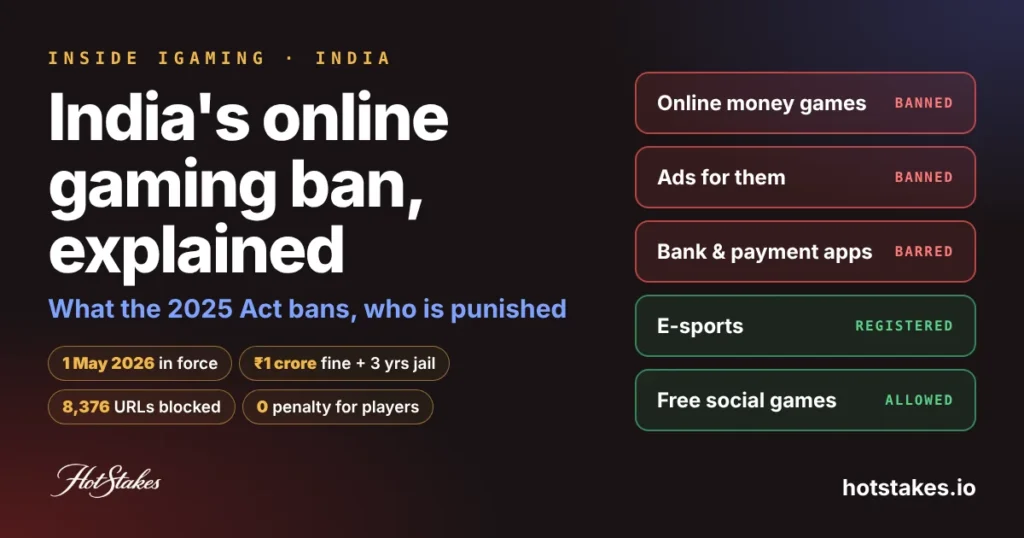 Next story →India Online Gaming Ban Explained: What the 2025 Act Bans




Start the discussion