

Pachinko Explained: Japan’s Three-Shop Gambling Loophole
Pachinko pays prizes, not cash. How Japan's three-shop system turns balls into yen, why police allow it, and the 2026 numbers.
In this article
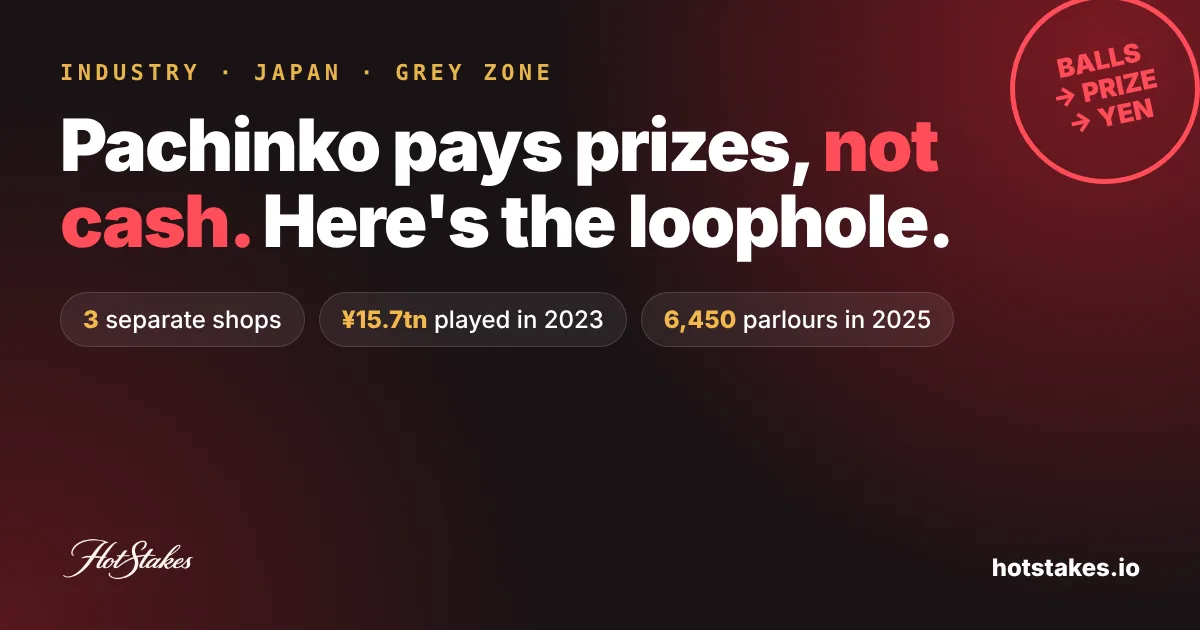
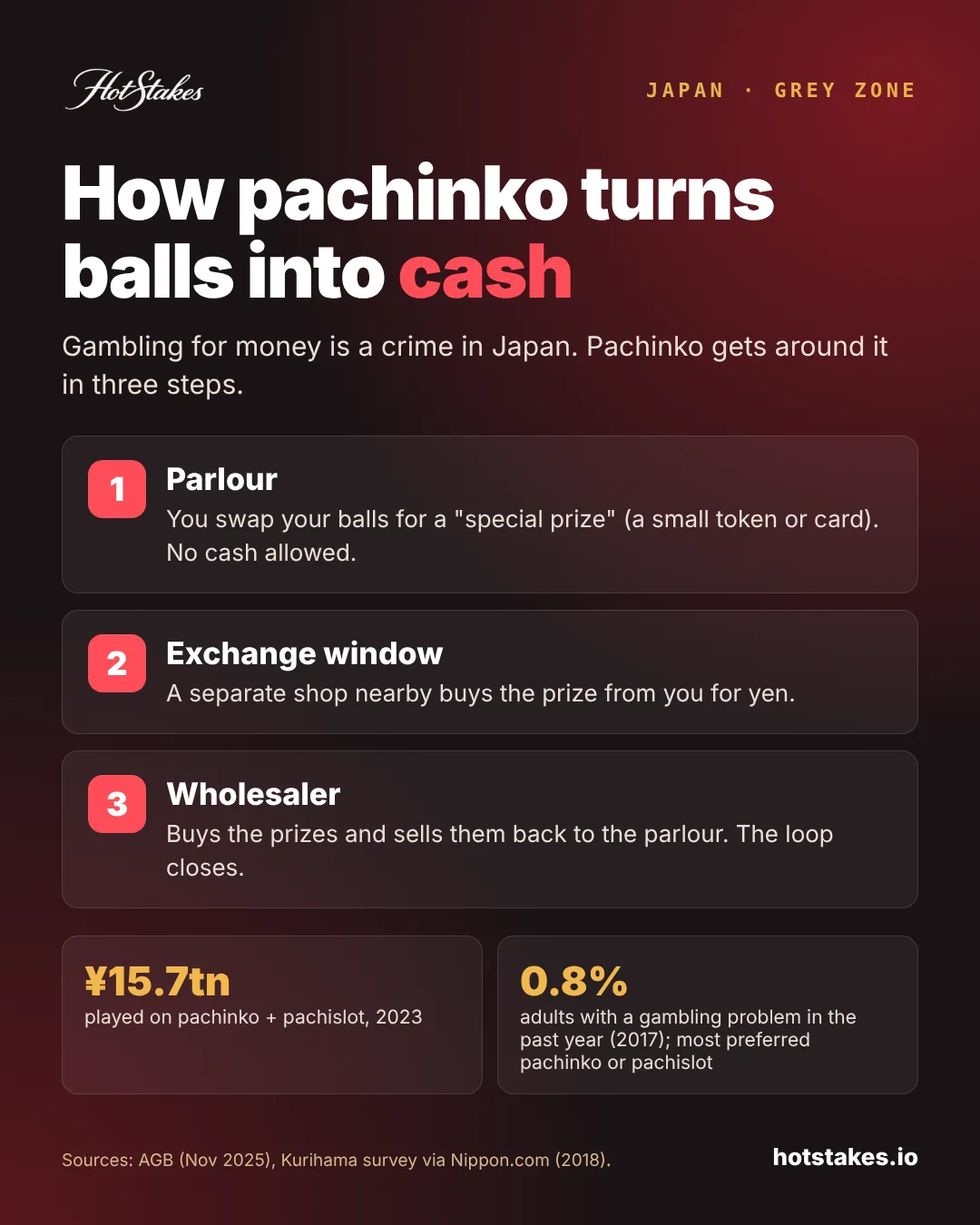
Pachinko is legal in Japan because parlours never pay cash: you swap your balls for a “special prize”, a separate shop next door buys that prize for yen, and a wholesaler sells it back to the parlour. This “three-shop system” (santen hōshiki) lets a ¥15.7 trillion industry sit alongside a Penal Code that bans gambling for money. Police tolerate it, the industry calls it recognised by the Diet, and critics call it Japan’s biggest grey zone. Here is how it works, what the numbers say in 2026, and what it costs players.
How the three-shop system works
A pachinko machine is a vertical pinball game: you rent steel balls, fire them into the machine, and win more balls when they land in the right pockets. Pachislot is the slot-machine version that pays in tokens. What happens after you stop playing is the clever part:
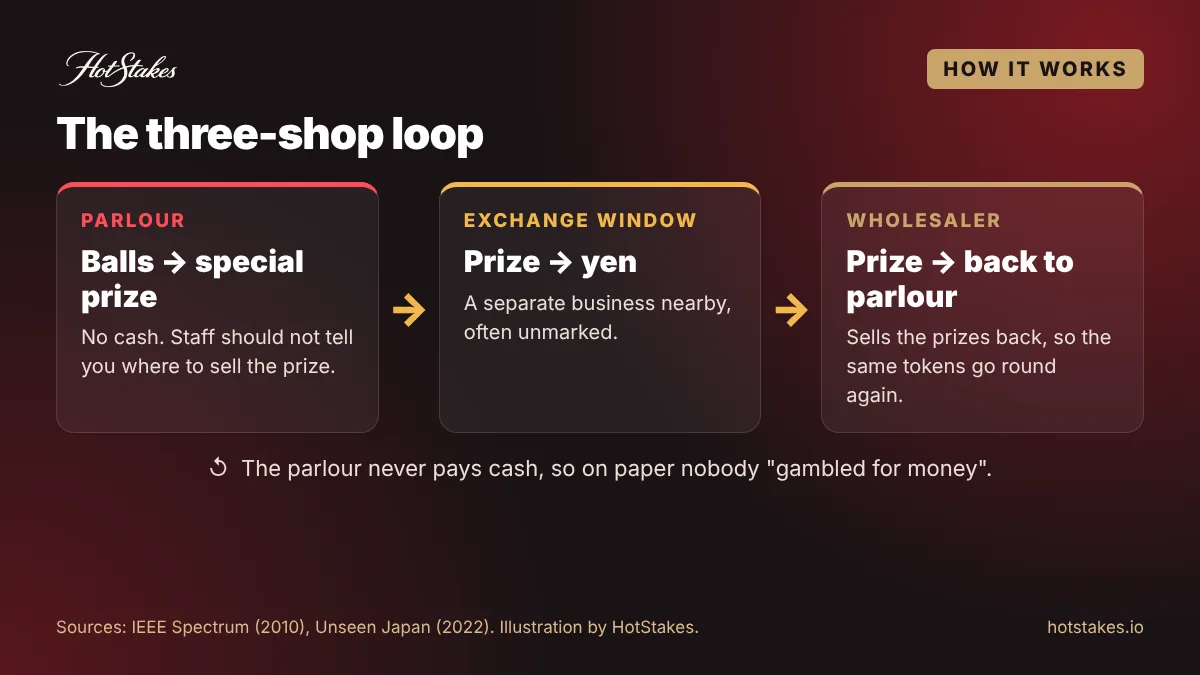
- At the parlour counter, you trade your balls for prizes. Anything from snacks to rice cookers is on offer, but regulars pick the “special prize”: a small, standard token or card. The parlour pays prizes, not cash (Unseen Japan).
- At the exchange window, a separate and often unmarked business around the corner buys the special prize from you for yen. IEEE Spectrum called this the “so-called three shop system” in its 2010 look inside the industry (IEEE Spectrum, 1 Oct 2010).
- At the wholesaler, the prizes the exchange window collected are sold back to the parlour, which hands them out again. The loop closes.
- The firewall: the parlour and the exchange window must have no ties. Staff are not supposed to tell customers where to sell their prizes, because that could be evidence of a link that makes the business illegal (Unseen Japan). A Hong Kong listing document from a Japanese parlour operator describes the same rule: the amusement-business law requires the hall operator, prize wholesalers and prize buyers to be independent, and buyers sign periodic statements saying so (HKEX filing, 2015).
Takeaway: the parlour never pays cash, so on paper no one gambled for money, even though everyone in the room knows where the prizes end up.
Why it is not “gambling” on paper
Japan’s Penal Code treats betting money as a crime. The exceptions are the public games run under their own laws: horse, bicycle, boat and motorcycle racing, plus lotteries and sports toto. Pachinko is not on that list. Instead, parlours are licensed as an amusement business under the law that also covers nightlife (fūeihō), and they are supervised by prefectural public safety commissions, which means the police (Unseen Japan; HKEX filing).
The official line is simple: no cash leaves the parlour, so there are no winnings. When pro-casino lawmakers floated a 1% tax on pachinko winnings in 2014, estimated to raise ¥200 billion a year, a National Police Agency official told them the agency keeps no such statistics “since there are no winnings”, and that it did not know anything about the places where players exchange prizes for money (The Japan Times, 8 Sep 2014). The paper noted that taxing winnings would amount to admitting pachinko is gambling. Industry voices go further: “The three-store system has been recognized as legal by the Diet,” Masa Suganuma, CEO of consultancy ReNeA Japan, told AGB (AGB, 26 Nov 2025).
The machines themselves are regulated too. The 2015 filing lists limits such as balls fired being capped at ¥400 worth per minute, and machines not being allowed to pay out more than twice, or keep more than half, of the balls played over a ten-hour test. Japan revised its pachinko and pachislot machine rules again in 2018, forcing parlours to replace models (Yano Research, 31 Mar 2026).
Takeaway: pachinko is legal because of how the prize is paid, not because Japan allows gambling. That is why the same country can ban online casinos outright while 6,000+ parlours stay open.
The numbers in 2026: a shrinking giant
Pachinko used to be called a “30-trillion-yen industry” (Yano Research). Pachinko machines took in ¥8.2 trillion and pachislot ¥7.5 trillion in 2023, about ¥15.7 trillion together and less than half the level of two decades earlier (AGB, Nov 2025). Those are amounts played, not profit: players get most of it back as balls before the house keeps its share.
| Measure | Then | Now | Source |
|---|---|---|---|
| Parlours | about 17,000 (1990 peak) | 6,450 (2025) | Nippon.com (NPA data); Yano Research |
| Parlours, forecast | — | 5,600 by 2030 | Yano Research, mid scenario |
| Operators | — | 1,825 at end-2023 (down 228 in a year) | AGB |
| Money played | “30-trillion-yen industry” | ¥15.7 trillion (2023) | Yano Research; AGB |
| Players | about 30 million (1989) | about 7 million (2020) | Unseen Japan |
Yano Research counted 6,450 parlours with operating licences in 2025, 256 fewer than a year earlier, and expects about 5,600 by 2030. It blames the 2018 machine rules, the cost of updating machines for Japan’s new banknotes, and pandemic losses that pushed small operators out, while “smart” pachinko and pachislot machines have helped big chains (Yano Research, 31 Mar 2026). Parlours are getting bigger as they get fewer: Nippon.com counted 346 halls with more than 1,000 machines in 2019, up from 278 four years earlier.
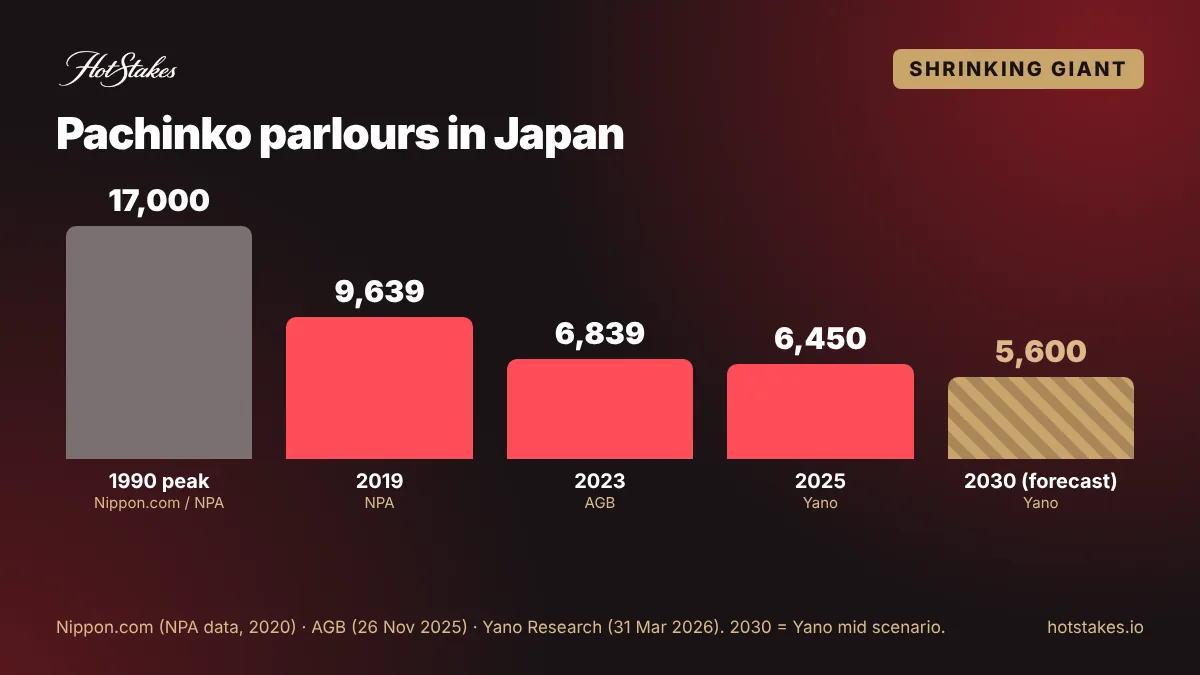
Takeaway: fewer parlours, fewer players, but still more money played each year than many countries’ entire gambling markets.
The human cost: what Japan’s surveys found
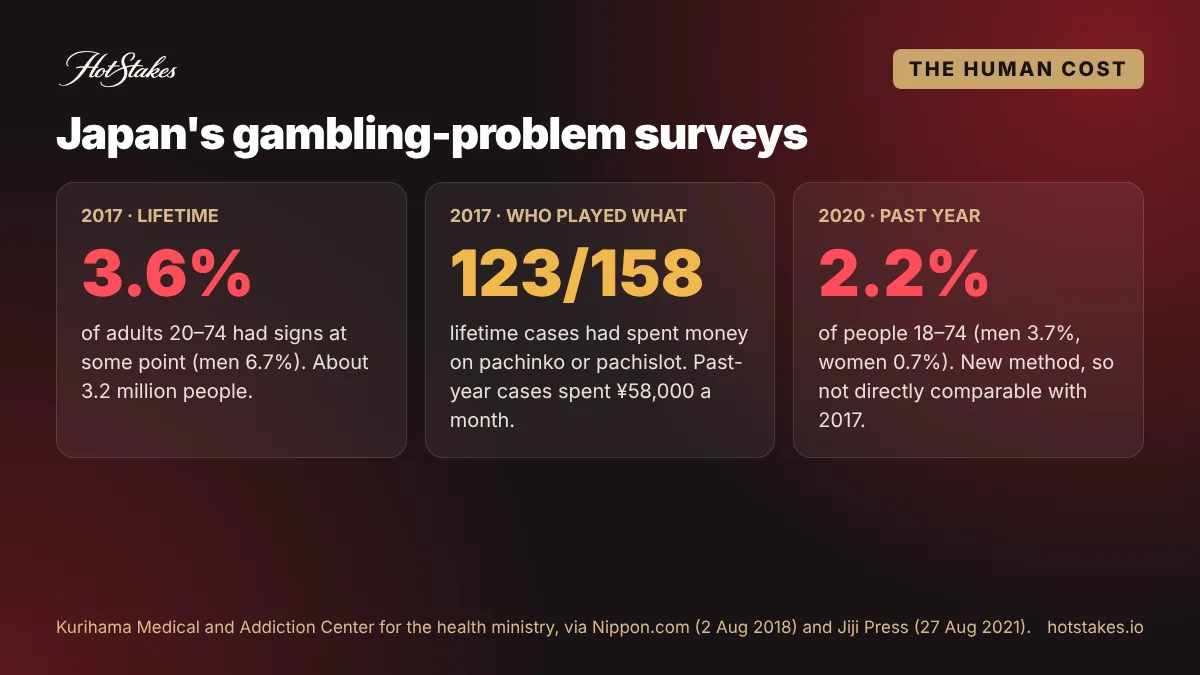
Because pachinko is everywhere, it is also where most gambling problems in Japan start. A 2017 survey by the Kurihama Medical and Addiction Center for the health ministry, with 4,685 valid answers from people aged 20 to 74, found:
- 3.6% had shown signs of gambling addiction at some point in their life (6.7% of men, 0.6% of women), about 3.2 million adults;
- 0.8% had signs in the past year, about 700,000 people;
- 123 of the 158 lifetime cases had spent money on pachinko or pachislot, and 26 of the 32 past-year cases preferred those games;
- past-year cases spent an average of ¥58,000 a month (Nippon.com, 2 Aug 2018).
A 2020 follow-up with a different method estimated that 2.2% of people aged 18 to 74 (3.7% of men, 0.7% of women) may have had a gambling problem in the past year, about 1.96 million people. Men spent most on pachislot, women on pachinko. The ministry warned the two results cannot be directly compared (Jiji Press, 27 Aug 2021).
Takeaway: the “it’s only prizes” logic changes nothing for the player. Money goes in, a smaller amount comes out on average, and the house edge works the same way it does in any casino. Our explainer on why the house always wins shows the maths.
Pachinko vs Japan’s casino resort vs online casinos
| Pachinko parlour | MGM Osaka casino (planned) | Online casino | |
|---|---|---|---|
| Legal in Japan? | Yes, as an amusement business | Yes, under the 2018 IR law, target opening 2030 | No; promoting it is also banned since 25 Sep 2025 |
| How you get money | Prize → separate exchange window | Cash and chips at the casino | Illegal for players in Japan |
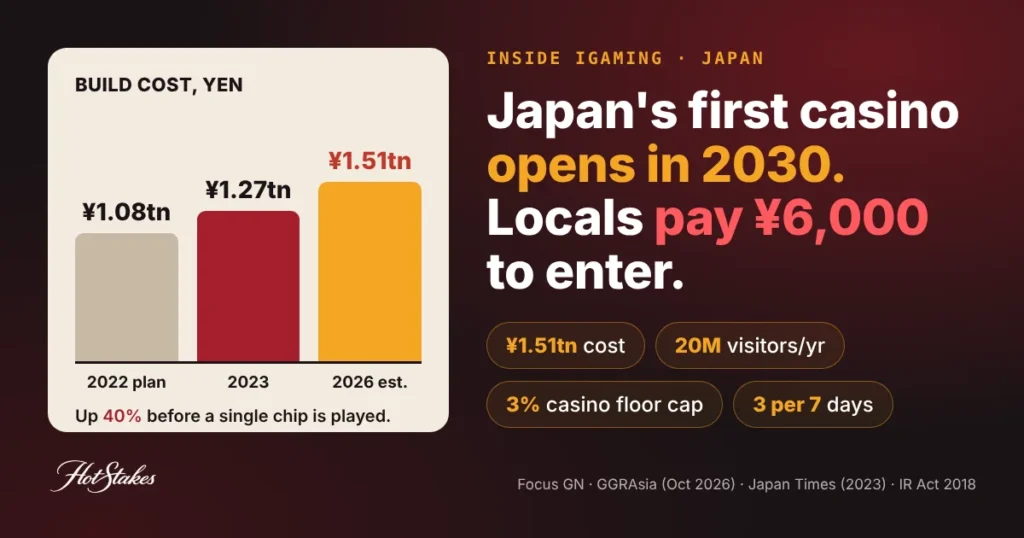
| Entry limits for locals | None | ¥6,000 entry fee, 3 visits a week, 10 in 28 days | — |
| Where to read more | This article | Osaka casino explained | Online gambling laws in Asia |
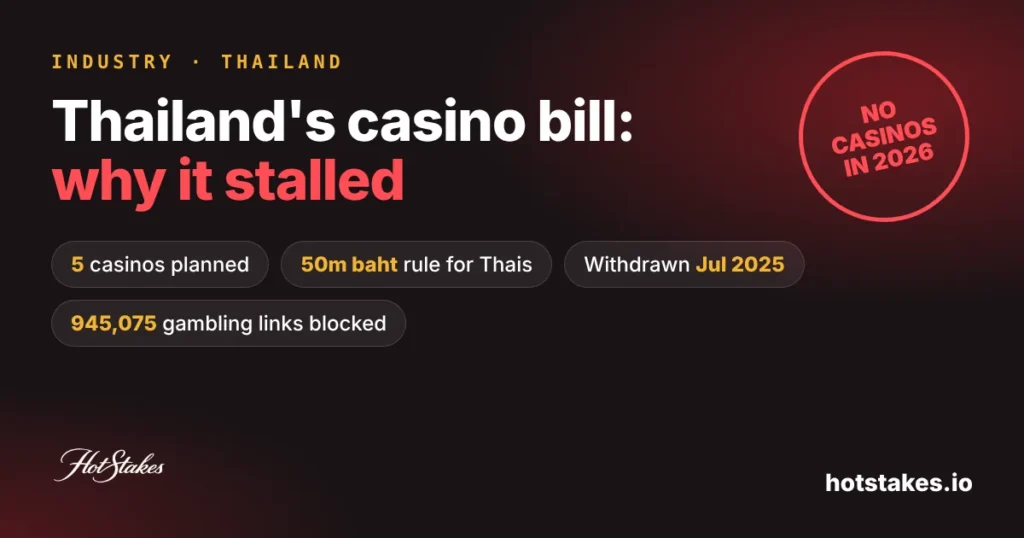
The contrast is the point critics make: a future casino will charge locals ¥6,000 to enter and limit visits, while pachinko parlours sit near train stations with no entry fee at all. For the wider picture of who runs gambling in Asia and how it changes, see our pieces on the Macau junket collapse and the Thailand casino bill, or check the rules where you live with our “Is it legal?” tool.
5 things to know before you play pachinko in Japan
- It is gambling in practice. Whatever the law calls it, you can lose real money fast, and the 2017 survey found most problem gamblers in Japan played pachinko or pachislot.
- Set a cash limit before you go in, and leave cards at your hotel. Balls are rented with cash, and machines are built for long sessions.
- Special prizes only become yen at the exchange window. Staff may not tell you where it is; that is the rule, not a trick.
- Never buy “systems” or “hot machine tips”. Machine payouts are set within regulated limits, and no tip changes that.
- Watch for the signs in yourself or family: chasing losses, borrowing, hiding play. Our warning-signs checklist and how to stop chasing losses are a good start.
FAQ
Is pachinko gambling?
Legally, no: parlours pay in prizes, not cash, so pachinko is licensed as an amusement business. In practice players turn special prizes into yen at a separate exchange window, which is why it is widely called a legal grey zone.
Why is pachinko legal in Japan when gambling is not?
Because of the three-shop system. The parlour, the exchange window and the prize wholesaler are separate businesses, so the parlour never pays cash. Police supervise parlours and have said there are “no winnings” to count.
How big is the pachinko industry?
About ¥15.7 trillion was played on pachinko and pachislot machines in 2023 (AGB). Japan had 6,450 licensed parlours in 2025, down from about 17,000 at the 1990 peak, and Yano Research expects about 5,600 by 2030.
Can you win money at pachinko?
You can win balls, swap them for special prizes and sell those prizes for yen at a nearby exchange window. Over time the machines keep a share of what is played, so most players lose more than they win.
Is online casino legal in Japan like pachinko?
No. Online casinos are illegal for players in Japan, and since 25 September 2025 promoting them, including affiliate links, is banned too. See our Osaka casino explainer for the rules.
Last checked 1 November 2026. 18+ only. If gambling has stopped being fun, take a break and talk to someone you trust.
HotStakes is an independent directory. Some links on this site are affiliate links; we may earn a commission at no cost to you, and it never changes our rankings. Gambling involves risk — only play with money you can afford to lose, and if it stops being fun, seek help. This article is general information, not legal advice. Browse vetted operators by currency.
 Next story →How to Play iBox 4D: Box, mBox and iBet Explained


Start the discussion