

Digital Arrest Scam: Inside the Fake CBI Call Centre
Fake CBI officers on video calls drained 73 victims of RM1.4m from a Kulim call centre. How the digital arrest scam works and where to report it.
In this article
- What happened in Kulim: the case in numbers
- How the victims in India were hooked, step by step
- THE SCRIPT: example lines and the red flag at each stage
- The second set of victims: the “telemarketing” job-seekers
- Not just India: the same playbook in Singapore and Malaysia
- What to do if the “officer” is on the line right now
- How to report it
- FAQ
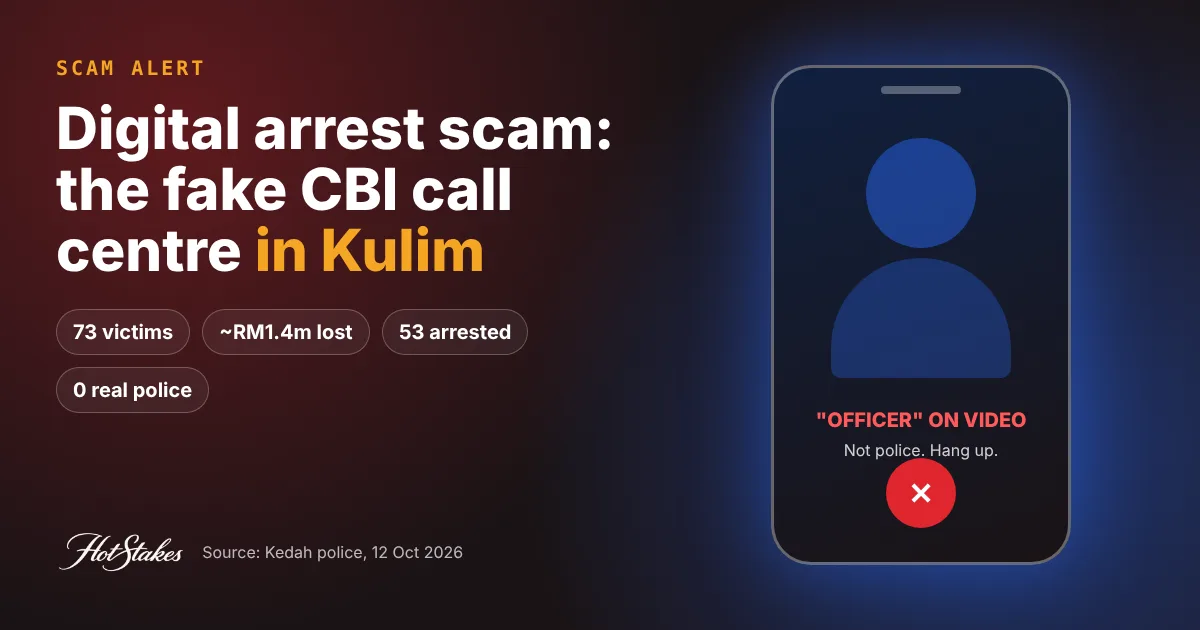
A “digital arrest” scam is a video call from fake police who say your phone number is linked to a crime, keep you on camera, and make you transfer money “for the investigation”. In October 2026, Kedah police said 73 people in India lost about RM1.4 million this way to callers working from shoplots in Kulim, Malaysia. There is no such thing as a digital arrest: real police never arrest you on a video call or ask you to move money to clear your name. Hang up and call your national scam line.
What happened in Kulim: the case in numbers
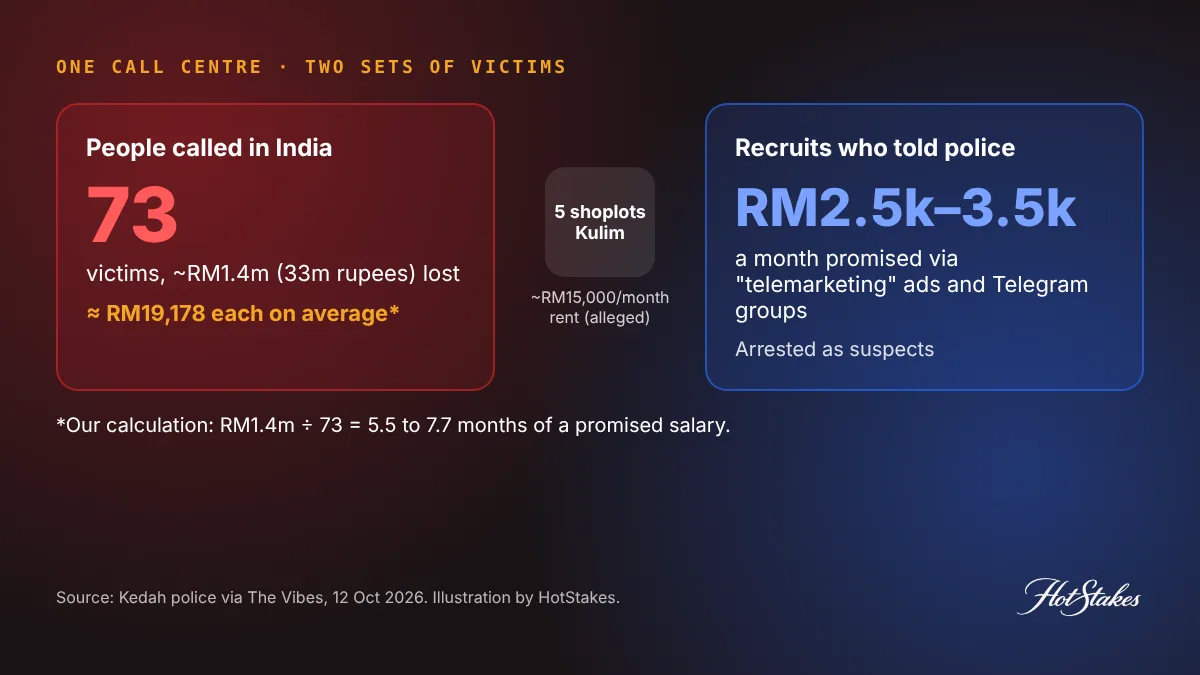
On Monday 12 October 2026, Kedah police chief Datuk Adzli Abu Shah told reporters that officers had raided a call centre in Bandar Putra, Kulim, at about 8pm the previous Friday. The Vibes reported that the syndicate ran from five three-storey shoplots and had allegedly operated since late August.
Police said the suspects wore Indian police uniforms and displayed a CBI flag to look genuine. Seized items included 89 mobile phones, seven laptops, three Indian police uniform shirts, two caps and one CBI flag, worth about RM70,000 in total.
The tally: 73 victims, all reportedly in India, with combined losses of nearly RM1.4 million (about 33 million rupees).
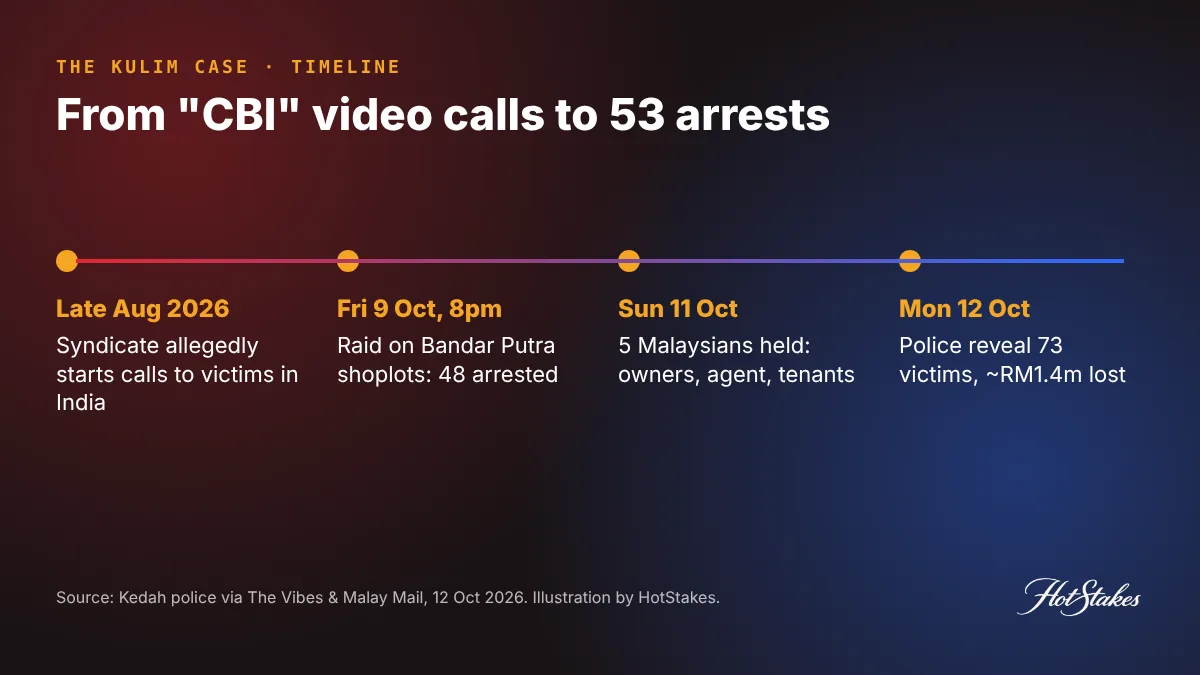
48 people were arrested in the first raid. Two days later police picked up five more Malaysians who they said were linked to the premises as owners, a property agent and tenants. Malay Mail reported that none of those five had prior criminal records, and that police credited tips from the public.
| Group arrested | Number | Detail police gave |
|---|---|---|
| Pakistani nationals | 33 | 28 men, 5 women (first raid) |
| Indian nationals | 8 | 6 men, 2 women (first raid) |
| Malaysians, first raid | 7 | Men, part of the 48 aged 20 to 43 |
| Malaysians, follow-up | 5 | 2 men, 3 women aged 44 to 51; owners, agent, tenants |
| Total | 53 | 43 men, 10 women |
The case is being investigated under Sections 420 (cheating) and 120B (criminal conspiracy) of the Penal Code, and Section 6(1)(c) of the Immigration Act. These are allegations under investigation, not convictions.
Takeaway: the “Indian police” on the screen were, police say, a rented office in northern Malaysia.
How the victims in India were hooked, step by step
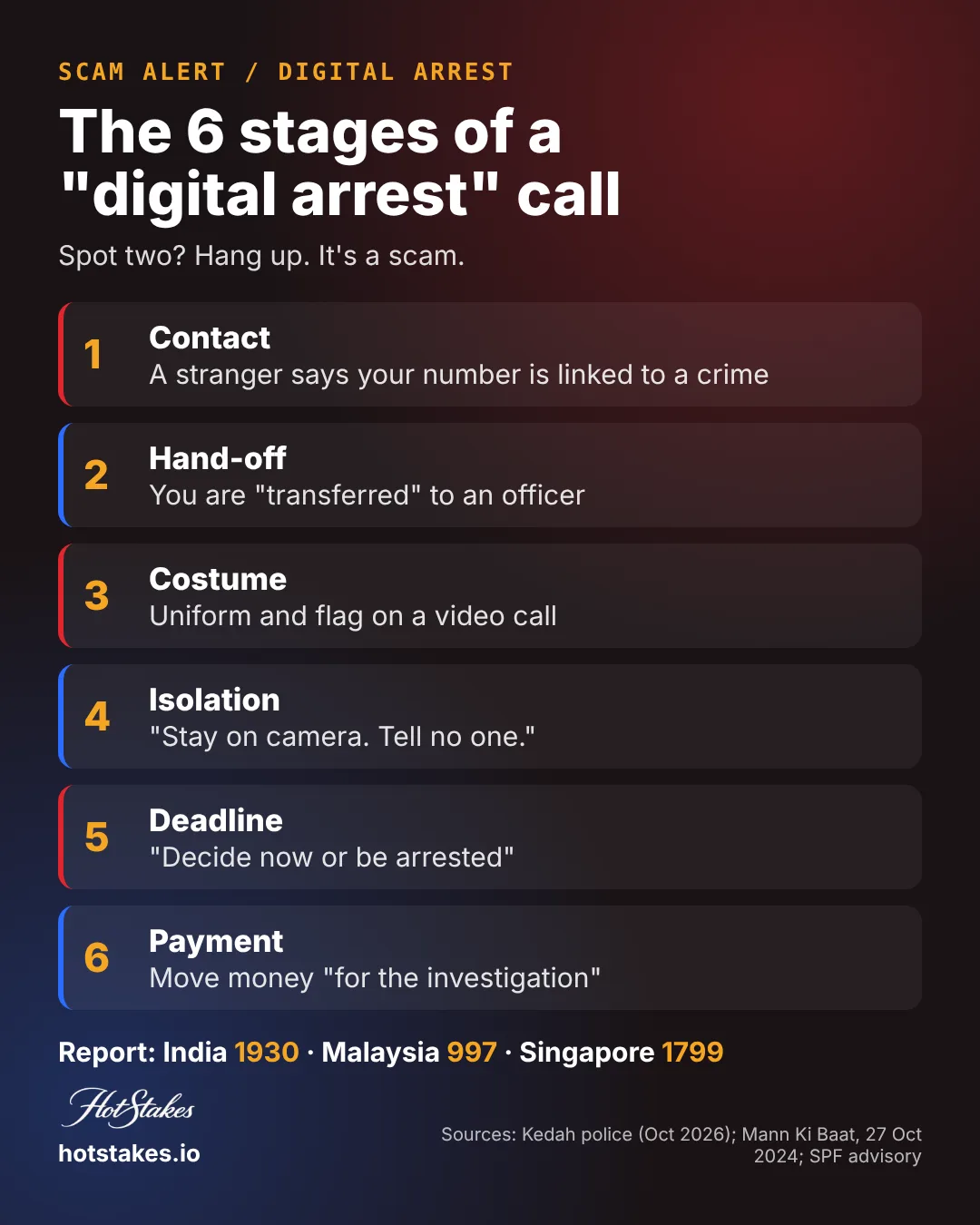
Police described a short, brutal sequence. We have put it in order using only what the two reports say:
- The contact. Victims in India were contacted over the Telegram app and then spoken to on video calls. Malay Mail quotes police: “They used the Telegram app to communicate and deceive victims.”
- The accusation. Victims were told their phone numbers were linked to criminal offences in India.
- The costume. On video calls, suspects wore Indian police uniforms with a CBI-emblem flag in view.
- The drain. Victims were told to move money from their own bank accounts into accounts the suspects supplied, supposedly for police investigations.
That matches the pattern India’s own government describes. In a written reply to Parliament, the Ministry of Home Affairs said scammers impersonate State police, the NCB, the CBI and the RBI, and use international spoofed calls that show Indian mobile numbers. It said more than 3,962 Skype IDs and 83,668 WhatsApp accounts used for digital arrest had been blocked.
One detail matters for anyone reading statistics: the same reply says NCRB does not keep separate data on digital arrest scams. So any single national “total” you see online deserves caution.
India’s Prime Minister addressed it directly on national radio in October 2024. His Mann Ki Baat address said “there is no system like digital arrest in the law” and urged three steps: Stop, Think, Take Action.
Takeaway: fear plus a uniform plus a deadline is the whole trick. Remove any one and it falls apart.
THE SCRIPT: example lines and the red flag at each stage
These are short, invented EXAMPLE lines so you can recognise the tone. They are not quotes from the Kulim case, and they are deliberately incomplete.
| Stage | EXAMPLE line (invented) | Red flag | Do this instead |
|---|---|---|---|
| 1. Contact | EXAMPLE: “This is about a case registered against your number.” | Unknown caller or Telegram message opens with a crime | Hang up. Don’t confirm your name or ID. |
| 2. Hand-off | EXAMPLE: “I am connecting you to the investigating officer.” | Being “transferred” to police | Singapore police say officials never transfer your call to the Police. |
| 3. Costume | EXAMPLE: “Switch on video. You are speaking to the CBI.” | Uniform and flag on a video call | Real agencies don’t question you by video. End the call. |
| 4. Isolation | EXAMPLE: “Do not disconnect. Do not tell your family.” | Secrecy, staying on camera | Tell someone at once. Secrecy protects the scammer. |
| 5. Deadline | EXAMPLE: “Decide now or a warrant will be issued.” | “Decide now or be arrested” | Stop and think. No real case needs payment in minutes. |
| 6. Payment | EXAMPLE: “Transfer funds to a verification account.” | Money moved “for the investigation” | Never pay. Call 1930 (India), 997 (Malaysia), 1799 (Singapore). |
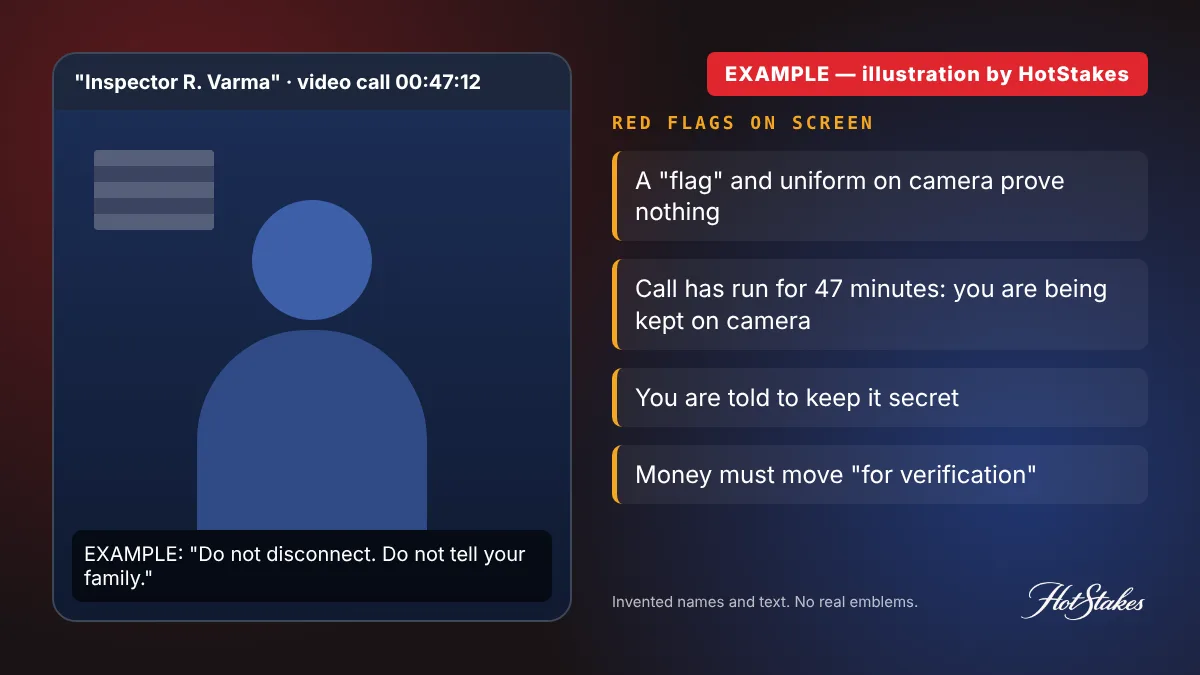
Stages 1, 3 and 6 come straight from the Kulim police account. Stage 2 echoes the Singapore Police Force scam advisory. Stage 5 is the time pressure described in Mann Ki Baat. Stage 4 matches what Deccan Herald calls “constant visual surveillance” over video calls.
Takeaway: if you spot two of these six, you are in the script. Hang up.
The second set of victims: the “telemarketing” job-seekers
Here is the part most coverage skips. According to The Vibes, some of the foreign nationals told police they had applied for telemarketing jobs advertised on social media. They were then added to Telegram groups and promised monthly salaries of RM2,500 to RM3,500.
Police also said suspects allegedly lived inside the building, which had a canteen. And none of the foreign nationals could produce valid travel documents.
We are careful here. Police have not said these recruits were trafficked, and they were arrested as suspects. But the hiring route is a warning on its own. A vague “telemarketing” job, found on social media, moved into Telegram, with pay quoted before any interview, is the same pipeline we describe in our guide to how Southeast Asia’s scam compounds recruit workers.
Job-seekers face a second risk: being asked to “lend” a bank account for payroll or refunds. That is how ordinary people become money mules, and our money mule account scam explainer shows why the account holder carries the legal risk.
Takeaway: if a job ad goes straight to Telegram and talks pay before duties, walk away.
Not just India: the same playbook in Singapore and Malaysia
The cast changes by country, but the story stays the same. On 20 October 2026, the Singapore Police Force warned of at least 62 cases since April 2026, with losses of at least $989,000. Victims downloaded an app from a fake social media ad, then got calls from people posing as government officials or bank staff. They were told they were linked to crime and pressed to move money “for investigations”.
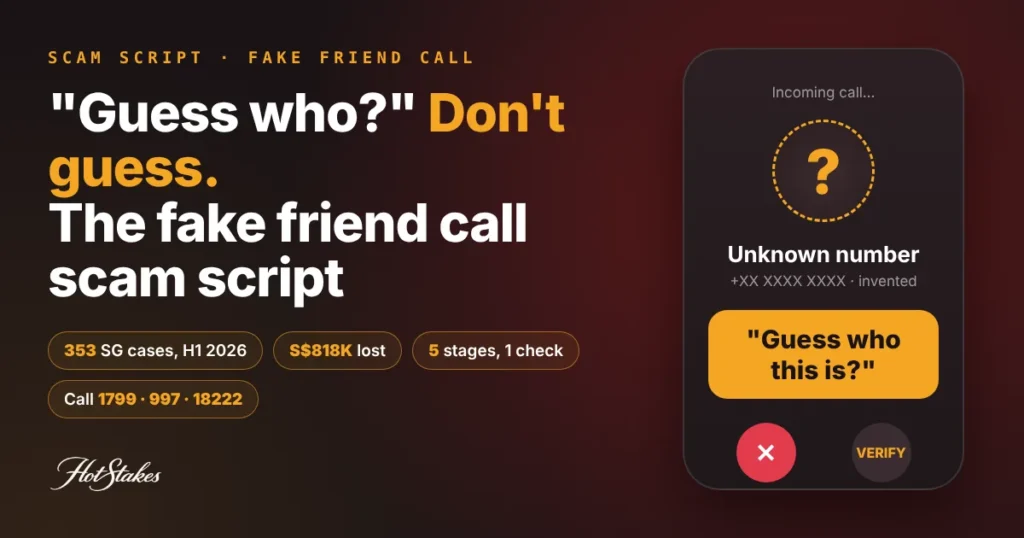
In Malaysia, the local version usually features fake bank staff or police. We break it down in how the Macau scam works. A close cousin is the fake friend call scam script, which swaps the uniform for a familiar voice.
Takeaway: “you’re linked to a crime, pay to clear it” is a scam in every country.
What to do if the “officer” is on the line right now
- End the call. You do not need permission to hang up. India’s Prime Minister said no investigative agency inquires like this by phone or video call.
- Don’t transfer anything. No “verification”, “security” or “safe” account exists.
- Call someone you trust. Breaking the isolation breaks the scam.
- Check independently. Find the agency’s number yourself, never from the caller.
- If money moved, call your scam line within minutes. India’s 1930 line exists to help freeze fraudulent transactions where possible, and Malaysia’s 997 centre traces and freezes illicit transfers. Speed matters.
- Test yourself. Try our scam quiz with your parents. It takes two minutes.
Fake police are one door into a bigger fraud economy. Our pig butchering scam guide shows the slow, friendly version run by similar networks.
How to report it
| Where you are | Number / channel | Verified at |
|---|---|---|
| India | Call 1930; report at cybercrime.gov.in | MHA via PIB |
| Malaysia | National Scam Response Centre 997 | New Straits Times, Mar 2026 |
| Singapore | ScamShield Helpline 1799 (24/7); then lodge a police report | SPF advisory, 20 Oct 2026 |
| Hong Kong | Anti-Scam Helpline 18222 (24/7 advice); report at a police station, 999 in an emergency | ADCC, Hong Kong Police |
If you are in Malaysia, the NST report says a 997 call is treated as a report, so you don’t need to file separately first. Wherever you are, call your bank too.
Takeaway: save your country’s number in your phone today, and your parents’ phones too.
FAQ
Is “digital arrest” legal in India?
No. India’s Prime Minister said in his 27 October 2024 Mann Ki Baat address that there is no system like digital arrest in the law. It is a fraud. Report it on 1930 or cybercrime.gov.in.
Would the CBI ever call me on a video call?
No. The Mann Ki Baat address said no investigative agency makes inquiries like this by phone or video call. A uniform and flag on screen prove nothing; in Kulim, police seized the uniforms and a CBI flag.
How much did victims lose in the Kulim case?
Kedah police said 73 victims in India lost nearly RM1.4 million, about 33 million rupees. That averages roughly RM19,178 per victim, by our calculation.
Were the call-centre workers trafficked?
Police have not said so. Some foreign nationals told police they answered telemarketing job ads on social media and were promised RM2,500 to RM3,500 a month. They were arrested as suspects.
Who do I call in Malaysia or Singapore?
In Malaysia, call the National Scam Response Centre on 997. In Singapore, call the ScamShield Helpline on 1799 and lodge a police report. Contact your bank immediately in both cases.
HotStakes is an independent directory. Some links on this site are affiliate links; we may earn a commission at no cost to you, and it never changes our rankings. Gambling involves risk — only play with money you can afford to lose, and if it stops being fun, seek help. This article is general information, not legal advice. Read our full disclaimer.
 Next story →Casino Withdrawal Pending? When to Wait, When to Worry






Start the discussion