

Osaka Casino Resort Explained: Japan’s First IR by 2030
Japan's first casino, MGM Osaka, targets autumn 2030: ¥1.51tn cost, ¥6,000 entry fee for locals, visit caps and an illegal online boom.
In this article
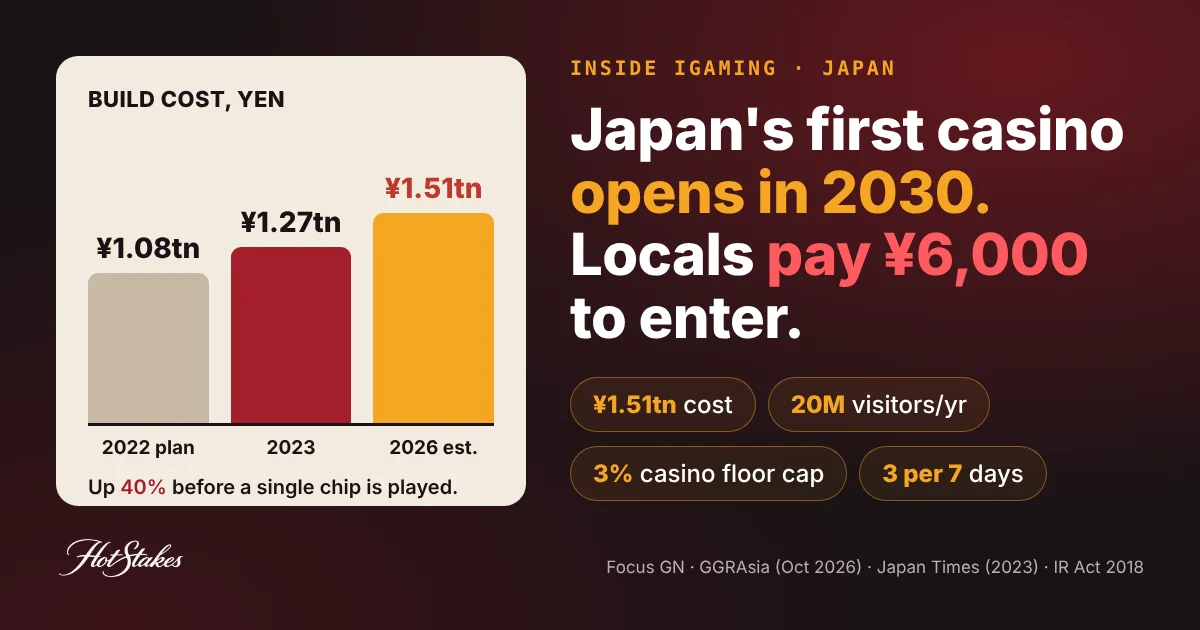
When will Japan’s first casino open, and who can go? Japan’s first legal casino, MGM Osaka on the artificial island of Yumeshima, is under construction and targets an autumn 2030 opening; Japanese residents will pay ¥6,000 per visit and can enter only three times in seven days and ten times in 28 days, while foreign tourists enter free. The resort now costs about ¥1.51 trillion, roughly 40% more than the first plan, and it is expected to earn about 80% of its money from the casino floor.
What is being built on Yumeshima?
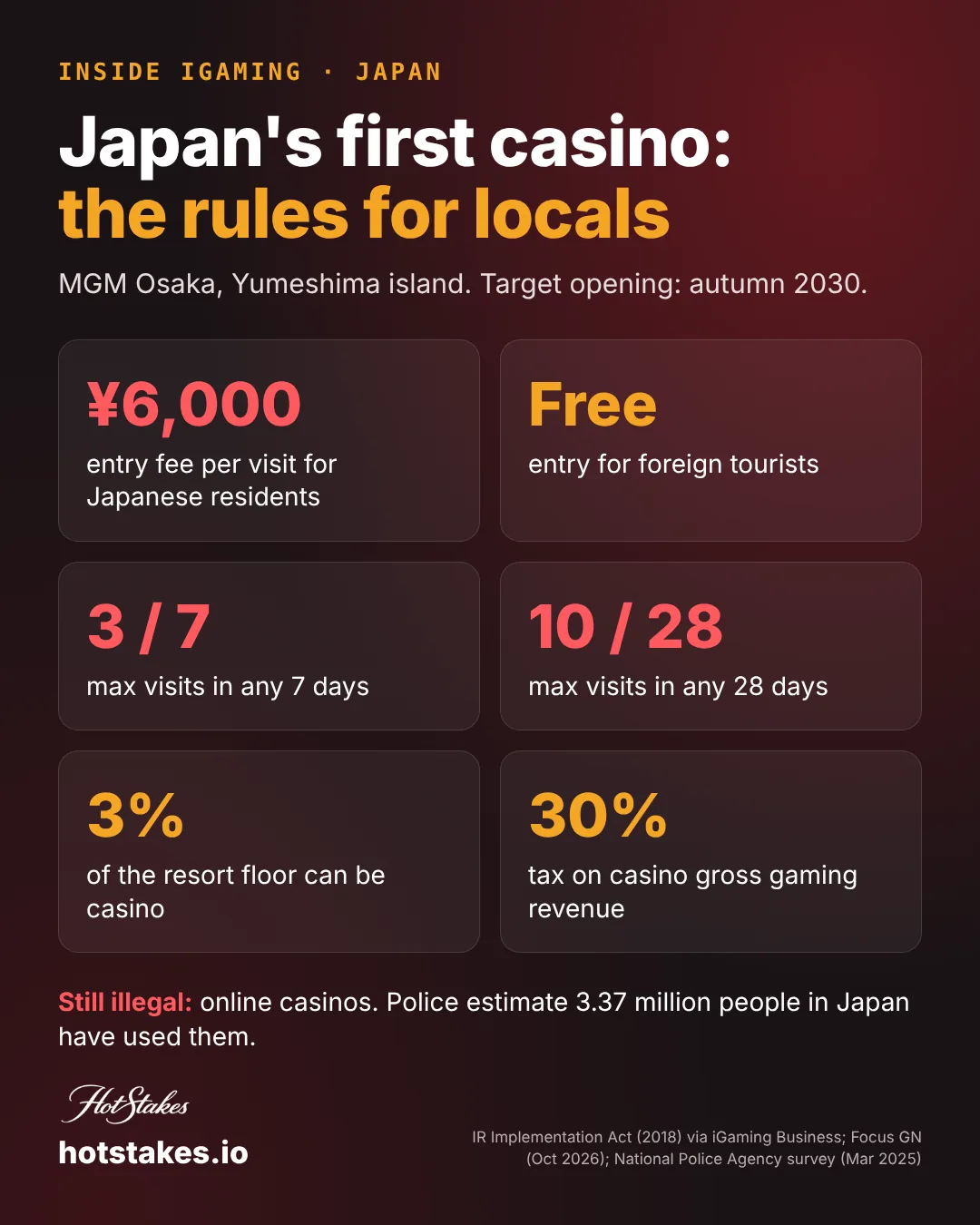
Japan legalised casinos only inside large “integrated resorts” (IRs): hotels, convention halls, shopping and shows, with a casino inside. The law caps the casino at 3% of each resort’s total floor area and allows only three IR licences in the whole country, Focus Gaming News reported in October 2026. Osaka holds the only one approved so far.
The Osaka resort sits on a 492,000-square-metre plot on Yumeshima, the reclaimed island in Osaka Bay that also hosted Expo 2025. Plans include about 2,500 hotel rooms, a 730,000-square-foot convention centre and a shopping mall, according to Macau Business. MGM Resorts’ Japanese arm and Orix Corp each own 40%; about 20 Japanese companies, including Panasonic Holdings and West Japan Railway, share the rest. If the name sounds familiar, MGM already runs MGM Cotai in Macau.
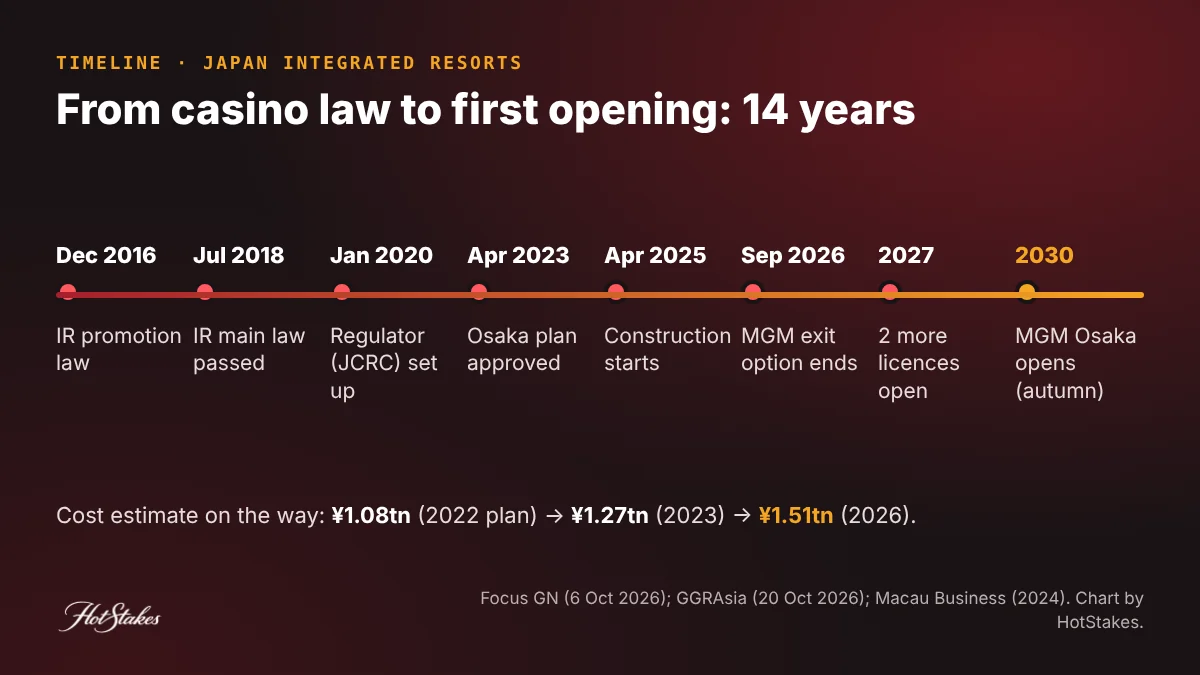
The national government approved Osaka’s plan on 14 April 2023. Construction began on 24 April 2025 and is scheduled to run until summer 2030. The resort expects about 20 million visits a year: 6 million international tourists and 14 million domestic visitors, Reuters reported at the approval.
Takeaway: it is a resort with a small casino floor by law, but the casino is the engine: about 80% of the planned ¥520 billion a year in revenue is expected to come from gaming.
The rules for Japanese players
Japan’s IR law was written to keep the casino mainly for tourists. When the Diet passed it in July 2018, it set a ¥6,000 entry fee per visit for Japanese residents, free entry for foreigners and a cap of three visits a week and ten a month, iGaming Business reported. The detailed rule counts three entries within any seven consecutive days and ten within any 28 days. The same law set the casino tax at 30% of gross gaming revenue (GGR), the money the casino keeps after paying winners.
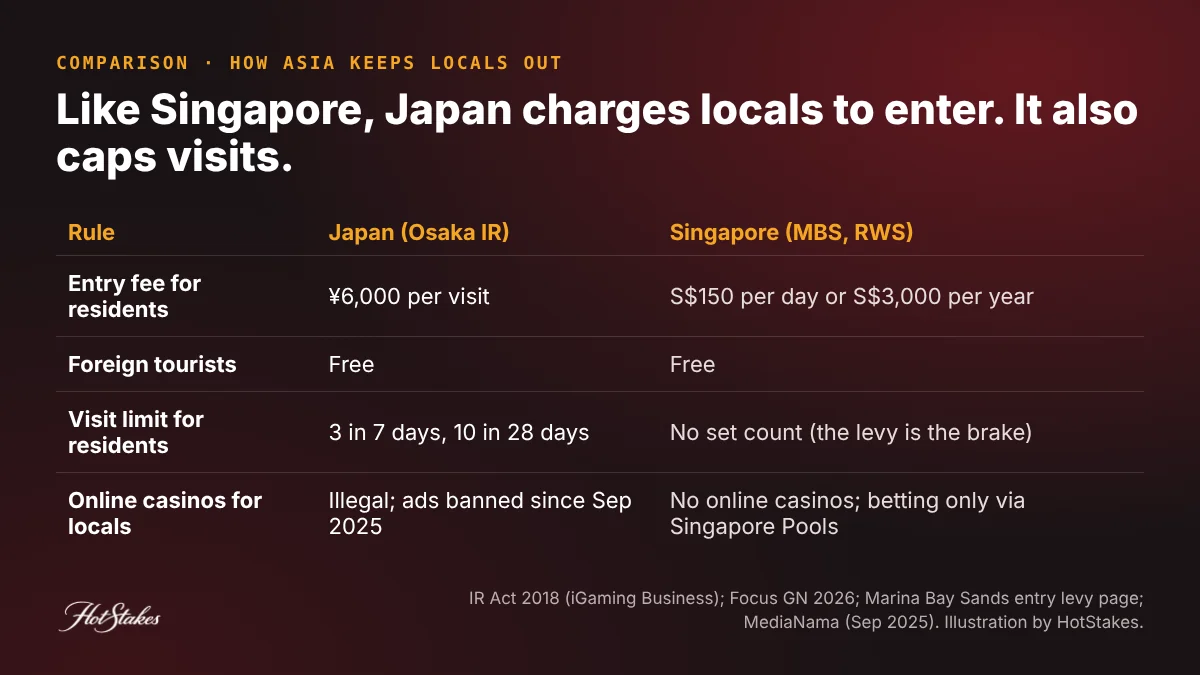
The model looks a lot like Singapore, where citizens and permanent residents pay an entry levy of S$150 a day or S$3,000 a year to enter Marina Bay Sands or Resorts World Sentosa. Japan adds a hard count on visits.
| Rule | Japan (MGM Osaka) | Singapore (MBS, RWS) |
|---|---|---|
| Entry fee for residents | ¥6,000 per visit | S$150 per day or S$3,000 per year |
| Foreign tourists | Free | Free |
| Visit limit for residents | 3 in 7 days, 10 in 28 days | No fixed count; the levy is the brake |
| Casino resorts allowed | Up to 3 (1 approved so far) | 2 (MBS and RWS) |
| Online casinos for locals | Illegal; promotion banned since 25 Sep 2025 | Not allowed; betting only through licensed operators |
Takeaway: if you live in Japan, a casino trip will cost ¥6,000 before your first bet, and a fourth visit in a week will simply be refused.
Who pays, and who profits?
The bill has grown. The developer’s first plan put the initial investment at about ¥1.08 trillion; by the September 2023 implementation agreement it was ¥1.27 trillion because of higher material costs, the Japan Times reported, and it now stands at about ¥1.51 trillion (US$9.6 billion). That is about 40% more than the first plan.
The public side pays too. In December 2021 it was decided that Osaka city would cover ¥79 billion for soil pollution and liquefaction measures on the reclaimed site, Inside Asian Gaming reported. The developer once had a clause letting it withdraw without penalty until September 2026 if costs got out of hand; it waived that right, according to the Macau Business report above.
In its review of fiscal 2025 (to 31 March 2026), the Japan Tourism Agency noted the project’s progress and asked for further planning. Core shareholders put in a combined ¥112.6 billion in that year, and on MGM’s 29 July earnings call its chief executive said the project was “on time and on budget”, GGRAsia reported on 20 October 2026.
What could the state earn? Here is our rough sum, not an official forecast: if about 80% of ¥520 billion (around ¥416 billion) is casino revenue taxed at 30%, that is roughly ¥125 billion a year. Analysts are more bullish on the top line: a Morningstar analyst said the resort could generate more than US$4 billion a year early next decade, compared with about US$3 billion pre-pandemic for Las Vegas Sands’ Singapore resort and US$4 billion for the Venetian Macau, AGB reported.
Takeaway: the money mostly comes from people losing at the tables. As we explain in why the house always wins, a casino’s revenue is its players’ combined losses.
The casino Japan already has: illegal online gambling
The bigger story is what is happening on phones. In March 2025 the National Police Agency published its first survey of online casino use. It estimated that 3.37 million people in Japan have used online casino sites, wagering about ¥1.24 trillion a year. About 44% of respondents did not know online casinos are illegal in Japan. Of users and former users, 58.8% were in their 20s or 30s and 3.6% were teenagers, and more than half of users and former users in their 20s and 30s had gone into debt over it.
Arrests are rising. In 2024 police handled 62 online gambling cases, up from 13, and arrested 279 people, the same NPA paper shows.
Japan then went after the marketing. A law revision passed by the upper house in June 2025 banned opening or running online casino sites and apps in Japan and treated content that lures people to them as illegal information, AGB reported. It took effect on 25 September 2025 and covers banner ads, social posts, influencer endorsements, ranking sites and affiliate links, MediaNama reported. HotStakes does not list online casinos for players in Japan.
And Japan already has a mass gambling habit in plain sight: pachinko. Pachinko and pachislot machines generated about ¥8.2 trillion and ¥7.5 trillion in 2023, less than half the level of two decades ago, from 6,839 parlours, AGB reported in November 2025.
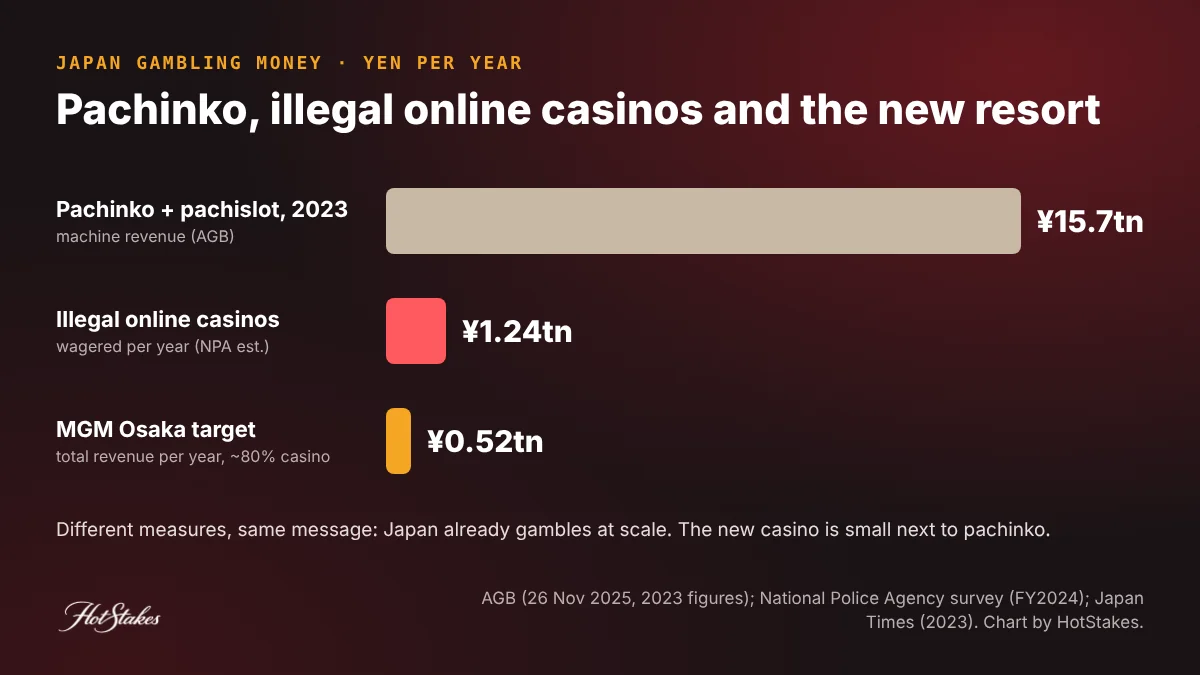
Takeaway: the casino resort is a regulated, fee-gated room in a house that already gambles. The fight that matters for Japanese players right now is online, not on Yumeshima.
What comes next: two more licences in 2027
Japan’s second application window runs from 6 May to 5 November 2027 for the two remaining licences. Hokkaido (Tomakomai and Hakodate have been named), Nagasaki (whose first bid was rejected in December 2023) and Aichi are expected to look at bids, according to Focus GN. The first round drew interest from Las Vegas Sands, Caesars and Wynn, which all later withdrew; only Osaka and Nagasaki applied by the April 2022 deadline.
For the rest of Asia, a Japanese resort means competition for high-spending tourists. Singapore and Macau already compete for the same visitors, and the end of the old junket system in Macau, which we covered in the Macau junket collapse, has made mass-market tourists the prize.
What it means for players in Asia
- Nothing to do until 2030. There is no legal casino in Japan today. Any “Japanese casino” app or site is not licensed in Japan.
- Tourists get in free; residents pay. If you live in Japan, budget ¥6,000 per visit and expect visit counts to be checked.
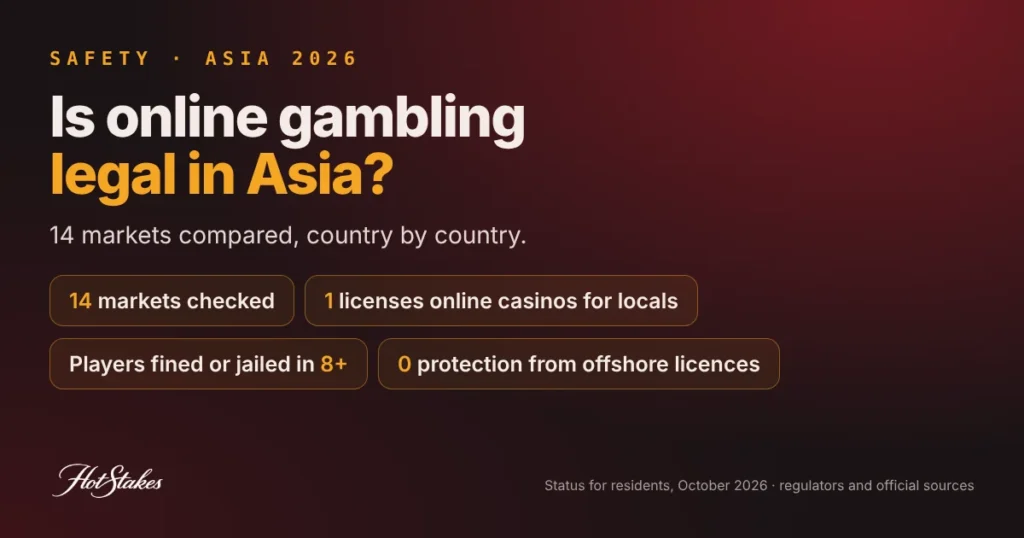
- Online casinos stay illegal in Japan. Playing and promoting them is against the law there; check your own country in our guide to online gambling laws in Asia.
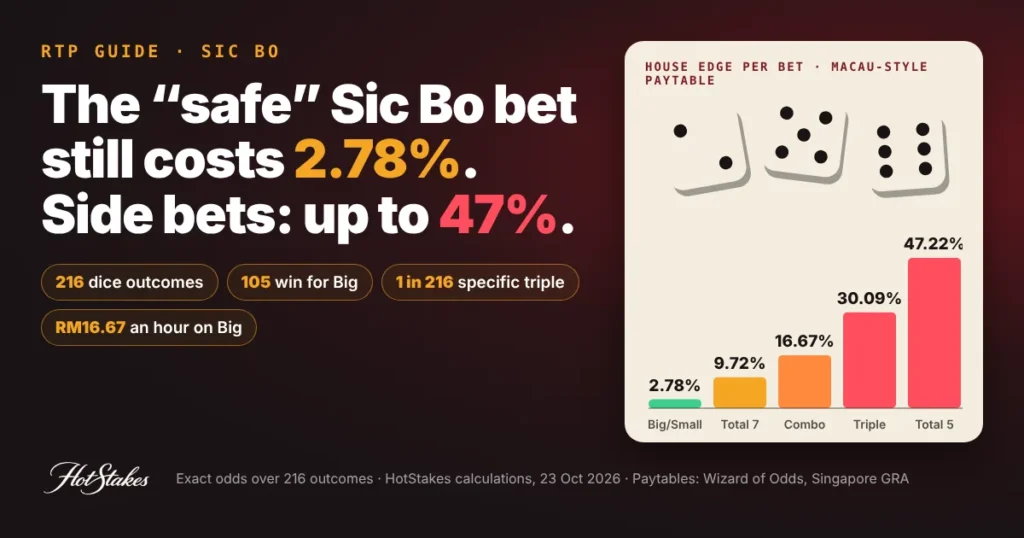
- The house edge does not change with the building. A ¥1.5 trillion resort still runs games where the casino keeps a percentage of every bet.
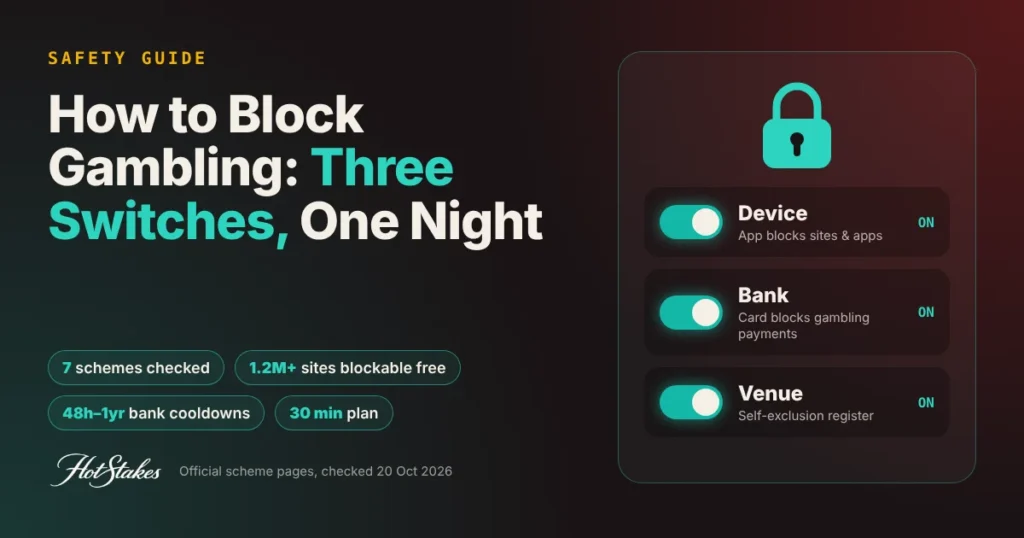
- Know the warning signs. If gambling stops being fun, read our signs of a gambling problem checklist and how to block gambling guide.
FAQ
When will Japan’s first casino open?
MGM Osaka targets autumn 2030. Construction began on 24 April 2025 on Yumeshima island in Osaka Bay and is scheduled to run until summer 2030.
How much does it cost Japanese residents to enter a casino in Japan?
¥6,000 per visit. Japanese residents can enter at most three times in seven days and ten times in 28 days. Foreign tourists enter free.
How much does MGM Osaka cost?
About ¥1.51 trillion (around US$9.6 billion) as of 2026, up from about ¥1.08 trillion in the first plan and ¥1.27 trillion in 2023.
Is online casino gambling legal in Japan?
No. Online casinos are illegal in Japan, and since 25 September 2025 promoting them, including through ads, influencers, ranking sites and affiliate links, is banned. Police estimate 3.37 million people in Japan have used them anyway.
How many casinos will Japan have?
The law allows up to three integrated resorts. Osaka has the only approved licence; the window for the other two runs from 6 May to 5 November 2027.
HotStakes is an independent directory. Some links on this site are affiliate links; we may earn a commission at no cost to you, and it never changes our rankings. HotStakes does not list online casinos for players in Japan. Gambling involves risk — only play with money you can afford to lose, and if it stops being fun, seek help. This article is general information, not legal advice. Read our full disclaimer.
 Next story →Casino Bonus Game Contribution: Why 35x Can Be 350x

Start the discussion