

GCash Gambling Ban Explained: What the BSP Order Changed
The BSP made GCash and Maya drop gambling links in Aug 2025. What the order said, what changed, PAGCOR revenue since, and where rules stand now.
In this article
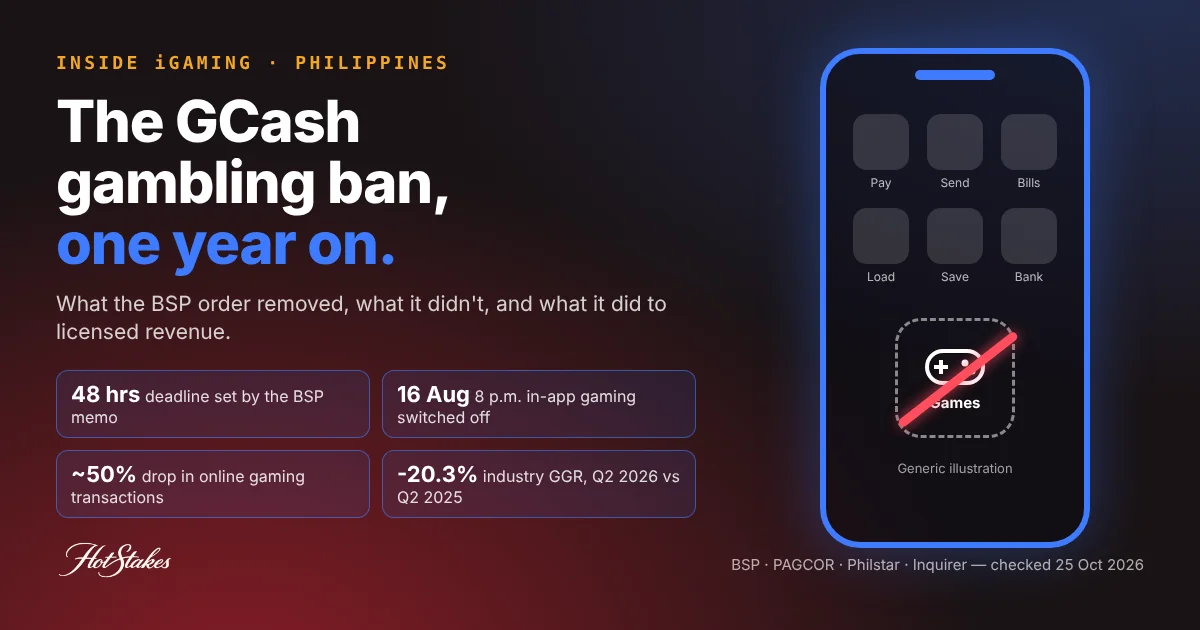
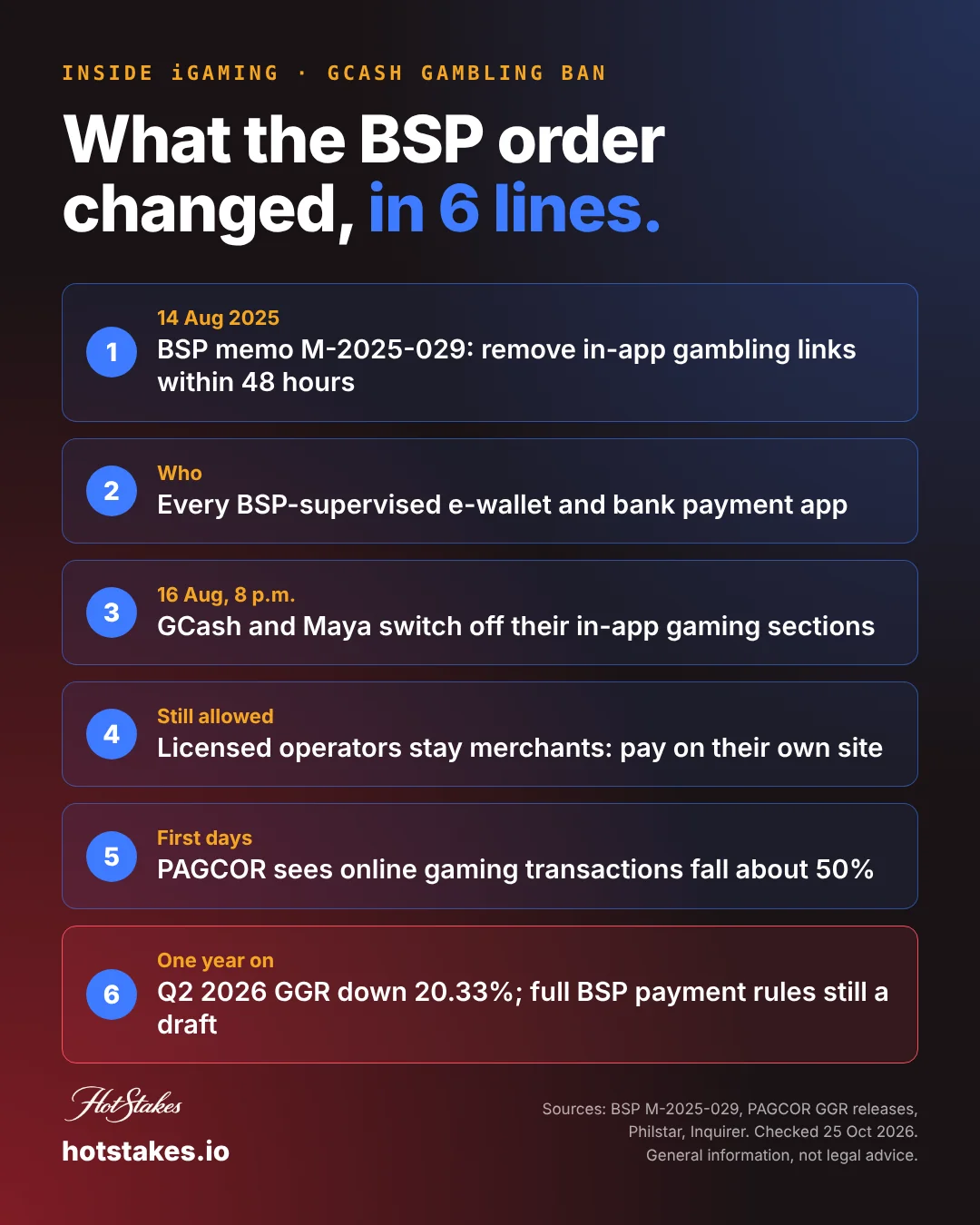
The “GCash gambling ban” is a Bangko Sentral ng Pilipinas (BSP) order, not a law. On 14 August 2025, BSP Memorandum No. M-2025-029 told every BSP-supervised bank and e-wallet to remove in-app links and icons to gambling sites within 48 hours. GCash and Maya switched off their in-app gaming sections at 8 p.m. on 16 August 2025, and the BSP has not lifted that suspension. Online gambling itself stayed legal for PAGCOR-licensed sites. What disappeared was the one-tap shortcut, and with it a large slice of licensed online gaming revenue.
What the BSP order actually said
The memo is titled “Suspension of In-app Gambling Access in Mobile Payment Apps and Websites” and is addressed to all BSP-supervised institutions (RegAlert text of M-2025-029). We read it on 25 Oct 2026. Four points matter:
- Who: all BSP-supervised institutions. That means e-wallets, and also banks’ payment apps and websites (Inquirer, 15 Aug 2025).
- What: “in-app gambling access”, defined as any product or service that redirects an account holder to a gaming or gambling site.
- When: within 48 hours of issuance. BSP Deputy Governor Mamerto Tangonan said the window also gave users time to withdraw money from gaming accounts (Philstar, 15 Aug 2025).
- How long: until the BSP finalises its policy on online gambling payment services (GGRAsia).
The order came out the same morning the Senate Committee on Games and Amusement opened its online gambling hearing. Senators wanted the links gone immediately. Committee chair Erwin Tulfo warned of contempt if online gambling was still reachable through e-wallets by Sunday, 17 August (Inquirer, 16 Aug 2025).
Takeaway: This was a temporary suspension tied to a future BSP rulebook, not a permanent ban written into law.
Timeline: from draft rules to one year on
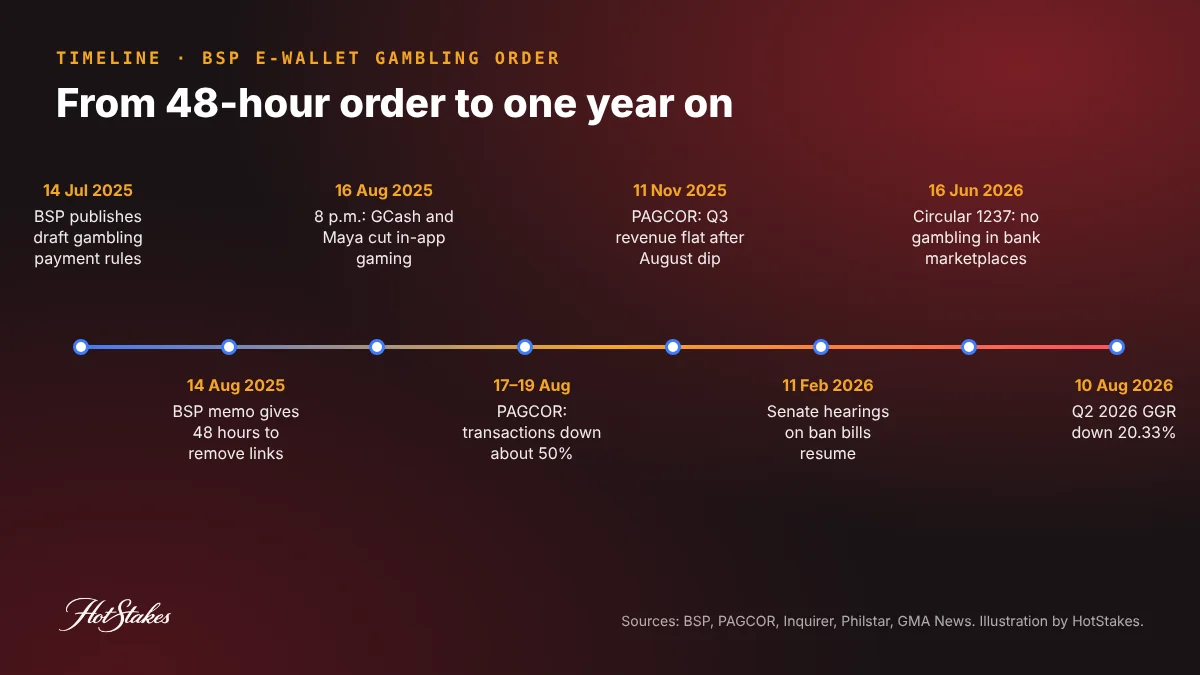
The memo did not come from nowhere. The BSP had already circulated draft payment rules a month earlier.
| Date | What happened | Source |
|---|---|---|
| 14 Jul 2025 | BSP publishes draft rules on online gambling payments; comments due 25 July | GMA News |
| 14 Aug 2025 | Senate hearing opens; BSP issues M-2025-029 with a 48-hour deadline | Inquirer |
| 16 Aug 2025, 8 p.m. | GCash (GLife) and Maya (Games) cut in-app gaming access | Inquirer Technology |
| 17 to 19 Aug 2025 | PAGCOR sees online gaming transactions fall about 50% | Philstar |
| 11 Nov 2025 | PAGCOR: Q3 GGR flat at PHP94.51B; e-games fell in August and September | PAGCOR |
| 11 Feb 2026 | Senate resumes hearings on Anti-Online Gambling Act bills | iGamingToday |
| 16 Jun 2026 | BSP Circular 1237 bars gambling-related products from bank and e-wallet “digital financial marketplaces” | DivinaLaw summary |
| 10 Aug 2026 | PAGCOR: Q2 2026 GGR down 20.33% to PHP88.13B | PAGCOR |
Takeaway: The shortcut vanished in 48 hours. The rules meant to replace it are still not final.
What GCash and Maya did, and what users saw
GCash said it would “fully comply” with the directive. Maya said it would comply while it kept “serving our customers” (Philstar, 14 Aug 2025). Both acted at the same moment: 8 p.m. on Saturday, 16 August 2025.
| Inside the e-wallet app | Before 16 Aug 2025 | After 16 Aug 2025 |
|---|---|---|
| Gaming section (GCash GLife, Maya Games) | Icons that opened licensed gaming sites in a tap | Gaming access removed |
| Moving gaming funds back to the wallet | Through the in-app gaming feature | Only via the gaming provider’s own website or app |
| Paying a PAGCOR-licensed operator | In-app, plus the operator’s own checkout | Operator’s own checkout only; licensed operators stay recognised merchants |
| Bank payment apps | Some linked to gaming sites | Same suspension applies |
| Spending caps, gambling-only accounts | None required | Proposed in the BSP draft; not final as of our check |
Sources for the table: the GCash and Maya notices reported by Inquirer Technology, and Tangonan’s Senate testimony in September that licensed operators remain recognised merchants, so users can still cash in and out through regulated channels (AGB, 17 Sep 2025).
That second point surprises many readers. The order removed the shortcut, not the payment rail. At an October 2025 House hearing, Maya and GCash said they still treat licensed operators as merchants, and the operators, not users, pay a fee on top-ups (Philstar, 22 Oct 2025).
Takeaway: If a site still shows a GCash button, that alone tells you nothing about whether it is licensed.
What happened to PAGCOR’s online gaming revenue
The early numbers were dramatic. PAGCOR reported online gaming transactions down about 50% between 17 and 19 August (Philstar). In September, a PAGCOR official told senators its income fell 40% to 50% in the first two weeks (AGB). By October, Philstar reported PAGCOR’s monthly income had dropped from PHP5.7 billion in May to PHP2.9 billion in September.
The quarterly data from PAGCOR’s own releases tells a slower story:
- Q3 2025: industry GGR PHP94.51B, almost flat. E-games still grew 17.4% to PHP41.95B, thanks to a strong July (PAGCOR).
- Full year 2025: GGR PHP396.14B, up 6.39%. Electronic and online gaming made PHP201.12B, 50.77% of the total (PAGCOR).
- Q1 2026: GGR PHP87.60B, down 15.87%. Electronic gaming PHP39.90B, down 22.43% (PAGCOR).
- Q2 2026: GGR PHP88.13B, down 20.33% from PHP110.63B. Electronic gaming PHP39.85B (PAGCOR).
Our calculation (25 Oct 2026): subtracting PAGCOR’s three published 2025 quarters from its full-year figure gives about PHP86.88B for Q4 2025, roughly 8% below Q3. Working back from the 22.43% fall, electronic gaming earned about PHP51.4B in Q1 2025.
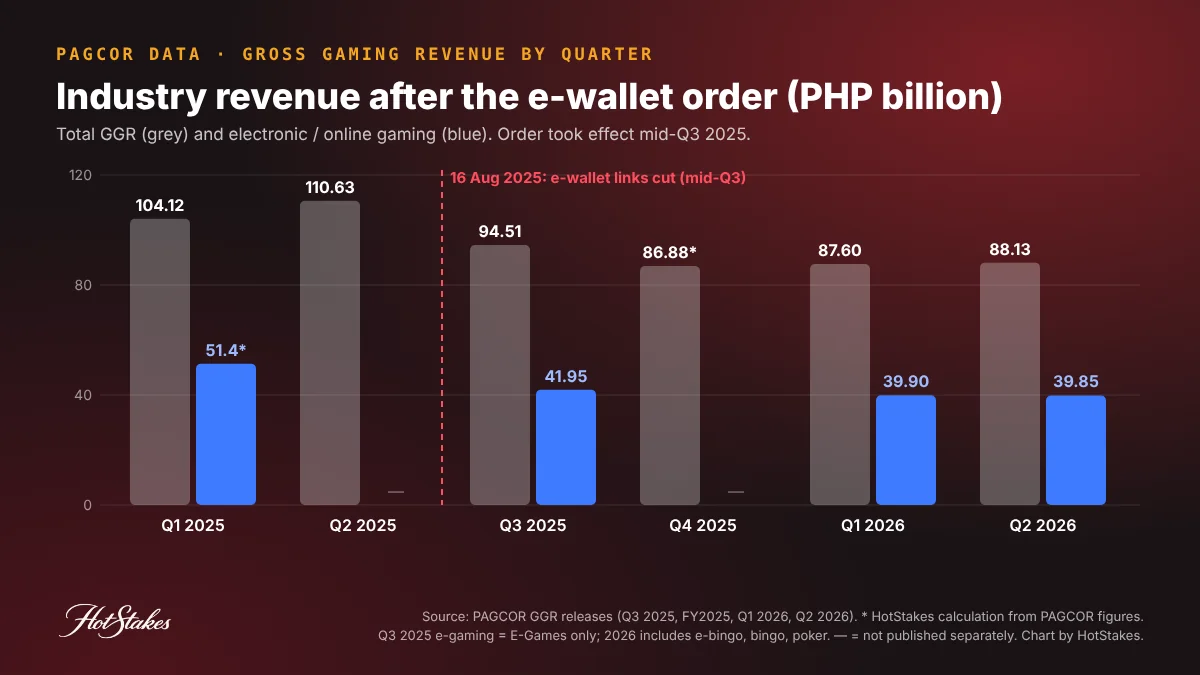
One caution. PAGCOR blames the 2026 slide partly on inflation, softer spending and Middle East tensions, not only the e-wallet order. Its chairman, Alejandro Tengco, called the delinking “a short-term decline in activity” at the time. Two weeks later he said the lower GGR reflects “an industry transitioning to stronger and safer practices” (PAGCOR, 27 Nov 2025).
Takeaway: Licensed online gaming revenue fell to about PHP40B a quarter, but the e-wallet order is one cause among several.
Who is affected, and how
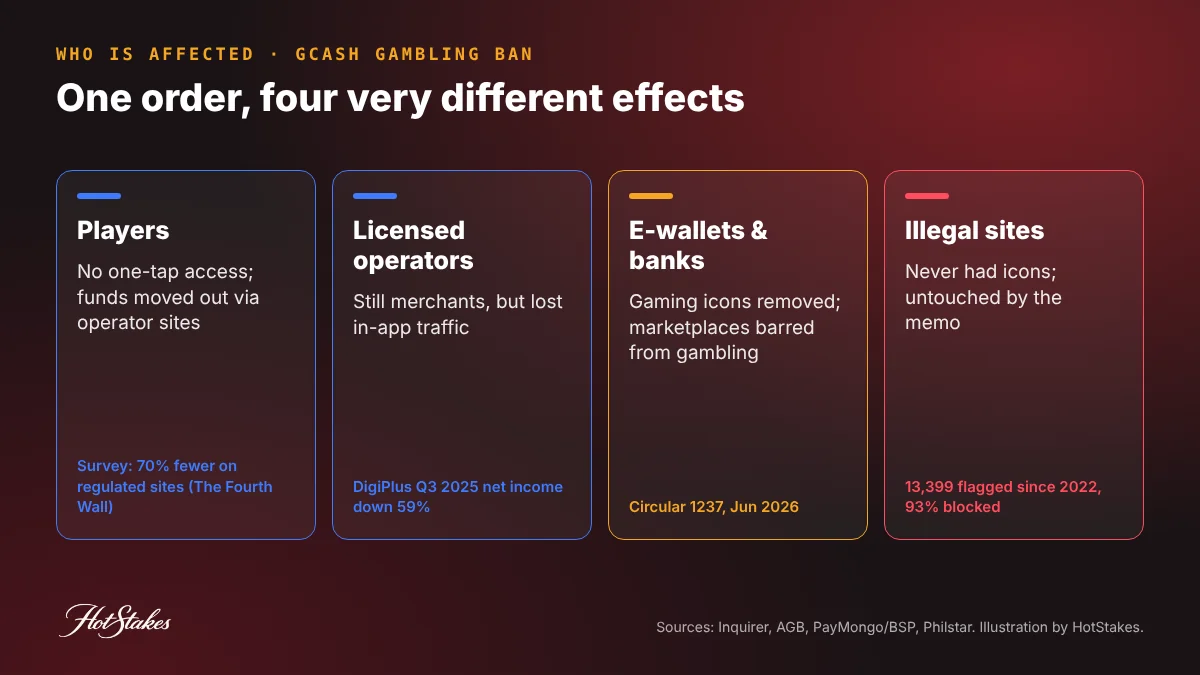
Players
Players lost one-tap access and had to move funds out through each operator’s own site. A survey of more than 1,000 players by the research firm The Fourth Wall found 92% preferred GCash for gaming payments. It also reported a 70% drop in players on regulated platforms and a 40% rise on unregulated ones (Inquirer, 27 Aug 2025). That is one private survey, not official data. Still, PAGCOR’s chairman made a similar warning: a total ban “will only drive players to illegal operators” (PAGCOR, 8 Sep 2025).
PAGCOR-licensed operators
Listed operator DigiPlus reported Q3 2025 net income down 59% and revenue down 23%, citing “temporary disruptions in player activity and transaction volumes” (AGB, 6 Nov 2025). Operators kept merchant status, so they can still take e-wallet payments through their own sites.
E-wallets and banks
Analysts quoted by BusinessWorld split on the hit. One said “the longer it stays in place, the bigger the potential drag” on e-wallet earnings. Another expected a limited impact, because users can still pay through operator websites (BusinessWorld, 18 Aug 2025). In June 2026, Circular 1237 added a further rule: digital financial marketplaces run by banks and e-money issuers cannot feature gambling-related products (PayMongo summary).
Illegal sites
Illegal sites never had in-app icons, so the order did not touch them directly. PAGCOR has flagged 13,399 illegal sites since 2022, with 93% blocked by the National Telecommunications Commission (Philstar). Tengco has also said illegal operators use “mule merchant” accounts to disguise gambling payments as purchases (Philstar). Our explainer on how money mule accounts work shows why lending your account is a crime risk.
Takeaway: The order squeezed the regulated side hardest. Illegal sites were always going to need a different fix.
Status one year on (October 2026)
The BSP’s full rulebook is still pending
The BSP’s exposure draft would require a separate Online Gambling Transaction Account (BSP exposure draft). We read it on 25 Oct 2026. Key proposals:
- Account owners at least 21 years old, verified with facial biometrics.
- Daily top-ups capped at 20% of the owner’s average daily balance.
- Gambling payments limited to a window of no more than six hours a day.
- Lending switched off on the same platform once a gambling account exists.
- Fines up to PHP1 million per transactional violation.
We could not find a final, numbered version of this circular on any page we opened on 25 Oct 2026. Until one is issued, the August 2025 suspension stays in force.
Congress: bans versus regulation
The Senate Committee on Games and Amusement held hearings on seven Anti-Online Gambling Act bills on 11 February 2026, alongside a regulation bill (iGamingToday). No bill had passed at our check. In the House, a bill filed in August 2026 (House Bill No. 10982) would ban online gambling ads, endorsements and sponsorships (Yogonet).
PAGCOR
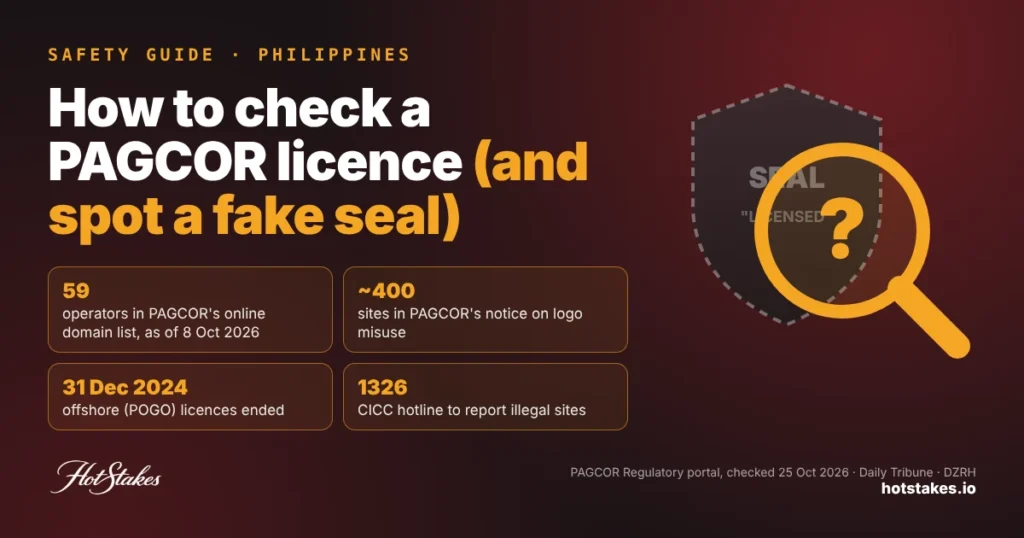
PAGCOR keeps arguing for stricter regulation over a ban. It also announced an app to help players confirm a site is licensed, due before the end of 2026 (PAGCOR). Our step-by-step guide shows how to check a PAGCOR licence and spot a fake seal.
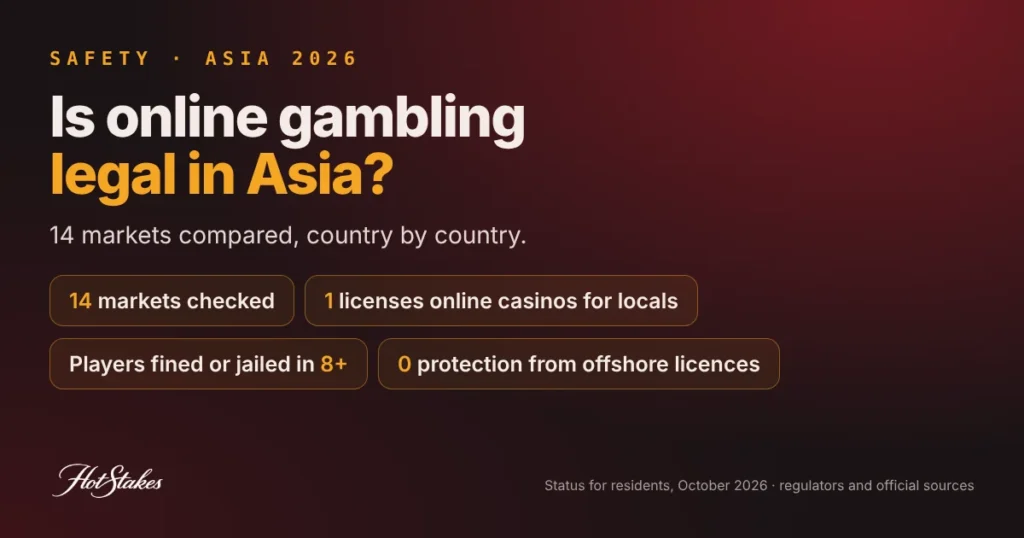
For the wider context, see how the same government shut down offshore operators in our Philippines POGO ban explainer, and where online gambling stands across the region in is online gambling legal in Asia?
Takeaway: One year on, the shortcut ban is the only part of the plan fully in force.
What to do if you play online in the Philippines
- Do not treat a payment logo as a licence. E-wallets still work on many unlicensed sites. Our guide to spotting an unlicensed online casino lists the red flags.
- Be wary of “GCash casino” apps sent by message. See our fake gambling app red flags.
- Never rent out or lend your e-wallet account to anyone collecting payments.
- Want a harder stop? Our guide to blocking gambling sites and payments walks through the options.
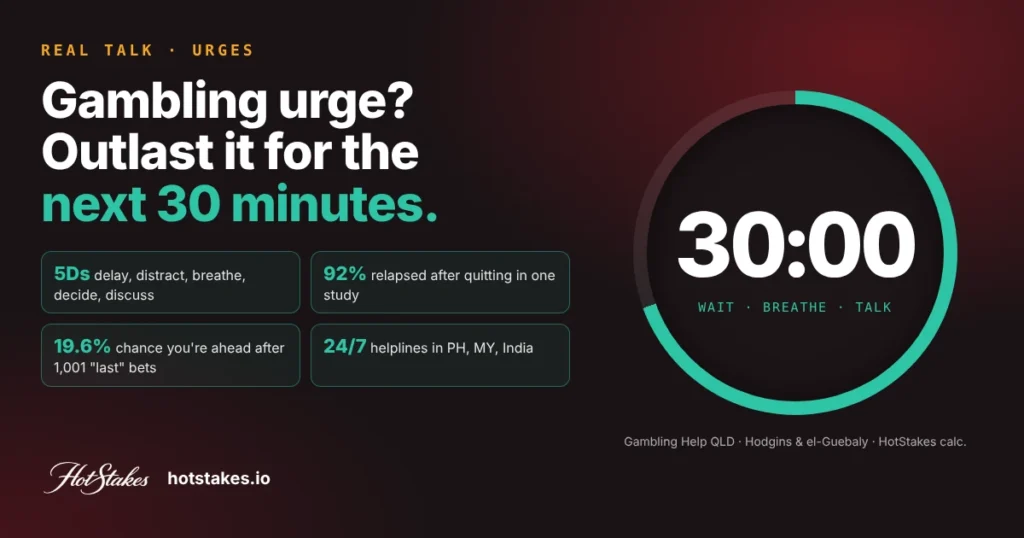
Need help? PAGCOR’s 24/7 helpline is (02) 8248-9568 (Daily Tribune), and the NCMH crisis hotline is 1553 (Daily Tribune). Not sure whether it is a problem? Try our signs of a gambling problem checklist.
Takeaway: Fewer shortcuts means more fake ones. Check the site, not the payment button.
FAQ
Is online gambling banned in the Philippines?
No. PAGCOR-licensed online gambling is still legal as of October 2026. The BSP order only removed gambling links and icons from e-wallet and bank apps. Several Senate bills would ban online gambling, but none had passed when we checked on 25 Oct 2026.
Can I still use GCash for online gambling?
The gaming section inside GCash was switched off on 16 August 2025. The BSP said licensed operators remain recognised merchants, so payments can still go through a licensed operator’s own website or app.
What is BSP Memorandum M-2025-029?
It is the 14 August 2025 BSP order titled “Suspension of In-app Gambling Access in Mobile Payment Apps and Websites”. It gave all BSP-supervised institutions 48 hours to remove features that redirect users to gambling sites, until the BSP finalises its online gambling payment rules.
Did the e-wallet gambling ban reduce PAGCOR revenue?
Yes, at first sharply. PAGCOR saw transactions fall about 50% in the first days. Industry GGR fell 15.87% in Q1 2026 and 20.33% in Q2 2026 year on year, though PAGCOR also blames inflation and weaker spending.
When will the BSP’s new online gambling payment rules take effect?
No date is set. The BSP published a draft in July 2025 that would create separate gambling accounts with daily caps. We could not find a final circular as of 25 Oct 2026. The draft says it takes effect 15 days after publication, with six months for providers to comply.
HotStakes is an independent directory. Some links on this site are affiliate links; we may earn a commission at no cost to you, and it never changes our rankings. Gambling involves risk — only play with money you can afford to lose, and if it stops being fun, seek help. This article is general information, not legal advice. Read our full disclaimer.
 Next story →How to Check a PAGCOR License (and Spot a Fake Seal)


Start the discussion