

Singapore Gambling Advertising Law: Why CS2 Teams Renamed
Four betting-backed CS2 teams reportedly must rename for the Singapore Major. What section 85 of the Gambling Control Act says, and why.
In this article
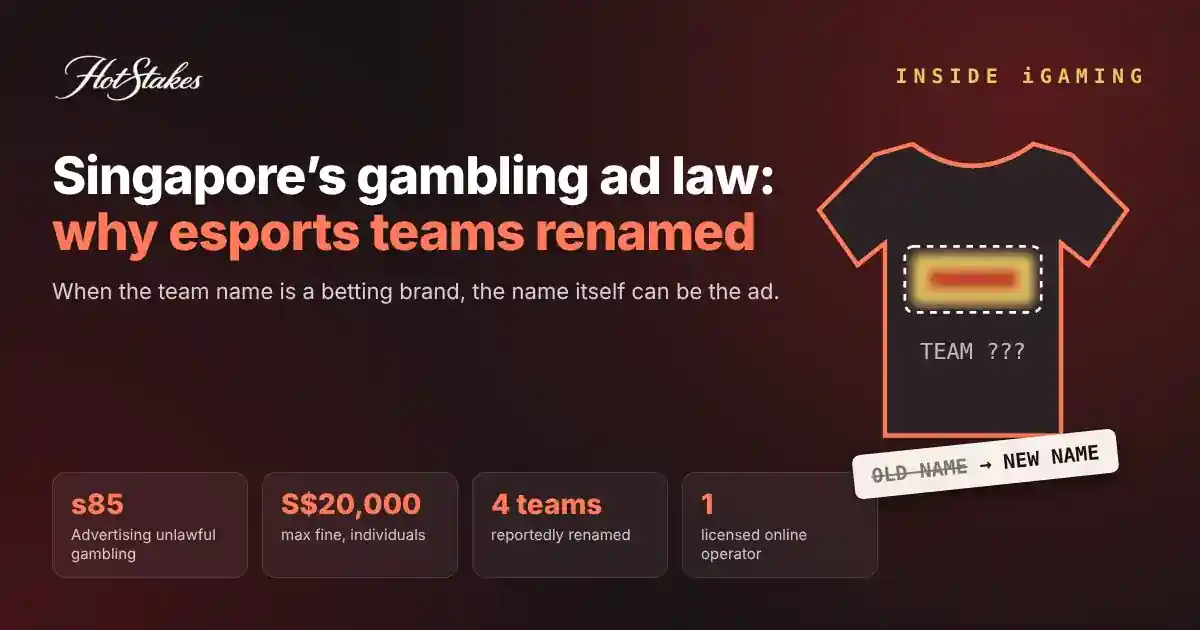
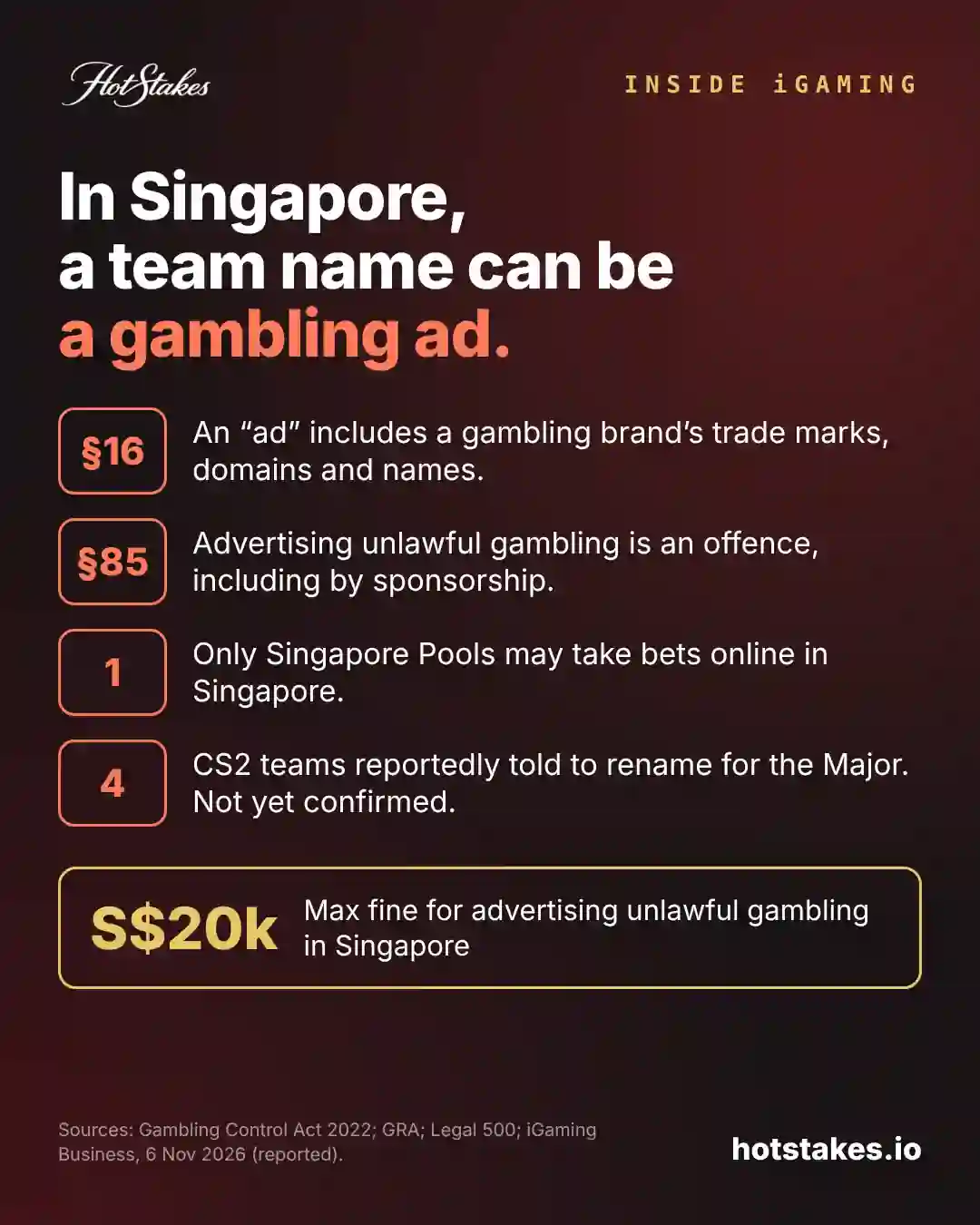
Four gambling-backed Counter-Strike 2 teams have reportedly been told to play the PGL Major Singapore 2026 (24 November to 13 December) under new names. The reason is Singapore’s gambling advertising law. Under the Gambling Control Act 2022, displaying a gambling brand’s name through sponsorship or brand-sharing can itself count as advertising unlawful gambling, so when the team’s name is the brand, the name has to go. PGL and Valve had not confirmed the changes when this was written. Below, we separate what is confirmed from what is reported, and set out what the law actually says.
What happened at the PGL Major Singapore: confirmed vs reported
The story started on a Counter-Strike insider Telegram channel, Esports Base. It reached the industry press on 6 November 2026, when iGaming Business reported that teams with gambling sponsors could not show them in Singapore. The site said its report had not been independently verified.
| Claim | Status (as of 9 Nov 2026) | Source |
|---|---|---|
| Major runs 24 Nov–13 Dec 2026 in Singapore | Reported consistently across outlets | iGB; Esports Radar |
| BC.GAME, 1win Esports, BETBOOM and PARIVISION must change organisation names | Reported, not confirmed by PGL or Valve | Esports Base via iGB, Strafe |
| Other teams must hide gambling sponsors | Reported | iGB |
| 24 hours to submit new names, logos and stickers | Reported | iGB; Strafe |
| BC.GAME has submitted a new name | Stated by BC.GAME, awaiting PGL/Valve | iGB |
| New team names for the Major | Not published | No outlet we checked |
BC.GAME’s CEO, Ali Muhanned, told iGB: “As CEO, it’s my responsibility to make sure we follow the rules, and that’s exactly what we’ll continue to do.” The Esports Radar called the information “currently unconfirmed and subject to official verification by PGL or Valve”. It also reported that rosters are not affected.
Takeaway: The renames are widely reported and one team has said it is complying. Until PGL or Valve confirm, treat the details (the deadline, the exact scope, any new names) as unofficial.
What Singapore’s gambling advertising law actually says
We read the Gambling Control Act 2022 on Singapore Statutes Online. Section 2 says one purpose of the Act is “to prohibit advertising of unlawful gambling”. Three parts matter here.
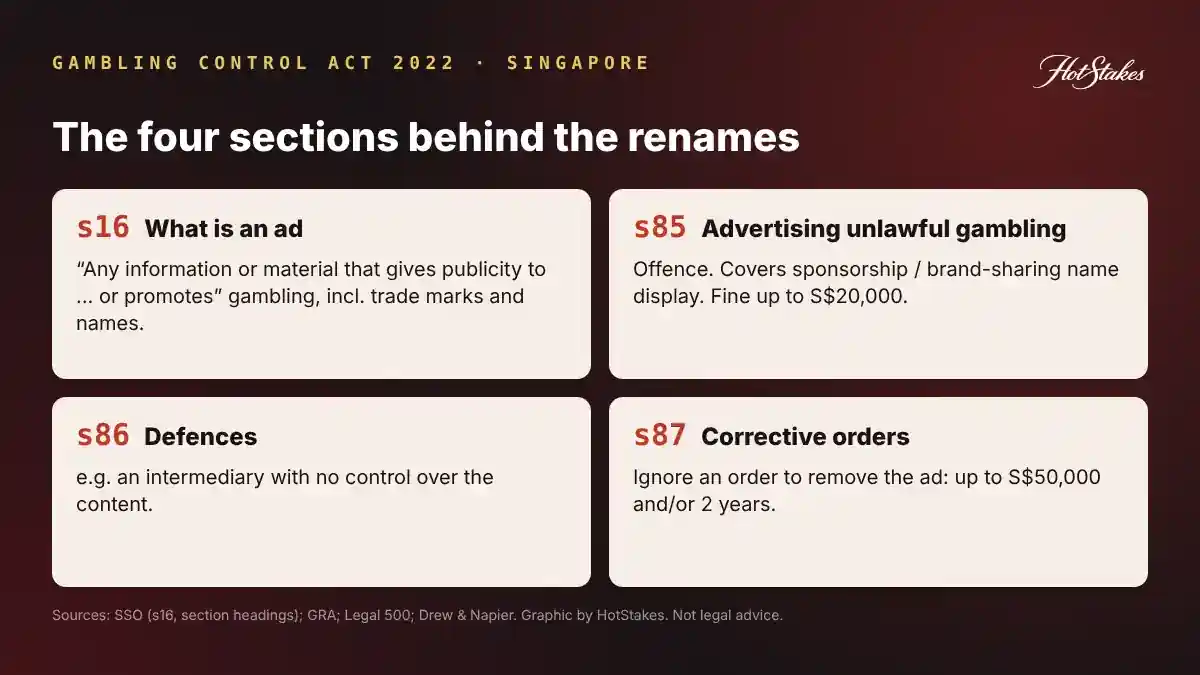
- What counts as an ad (section 16). A “gambling advertisement” is “any information or material that gives publicity to, or otherwise promotes or is intended to promote” gambling services. That includes the related trade marks, domain names and words closely associated with them. A team name that matches a betting brand fits that definition.
- Where it applies (sections 16 and 17). The ad must be published in Singapore or received there. That covers public display and broadcast in Singapore, and online material made accessible to people in Singapore by a Singapore-connected person. A stadium screen in Kallang qualifies.
- The offence (section 85, “Advertising unlawful gambling”). According to the Legal 500 Singapore guide, section 85(5) brings in “arrangements”, whether by sponsorship, brand-sharing or otherwise, under which a name is displayed in connection with an event or product.
The penalties are modest by gambling-law standards, but they apply to the act of advertising itself:
- Up to S$20,000 fine for advertising unlawful gambling, according to the Gambling Regulatory Authority of Singapore (GRA).
- Up to S$50,000 and/or 2 years’ jail for ignoring an order to remove or correct such an ad (section 87), according to Drew & Napier’s guide to the Act. The same guide notes that company officers can also be liable.
- Defences exist (section 86). They cover, for example, an intermediary with no control over the content.
One honest limit: Singapore Statutes Online loads sections on demand, and the full text of section 85 did not load for us. The section heading and the definitions above come from the statute. The sponsorship wording and penalties come from GRA and two law-firm summaries. iGB also cited section 85.
Takeaway: In Singapore, the brand is the ad. If a name promotes a gambling service that is not licensed in Singapore and it is shown there, it can be an offence, whether it sits on a billboard, a sleeve or a scoreboard.
Who is actually legal in Singapore
The list is short. GRA says “Singapore Pools (Private) Limited is the only operator licensed by GRA to provide remote gambling services”. On land, there are two casinos, at Resorts World Sentosa and Marina Bay Sands, both licensed in 2010 (GRA).
Even licensed operators cannot advertise freely. GRA states: “All forms of advertising and promotion by licensed gambling operators are prohibited unless otherwise approved by GRA.”
The penalties for taking part are real too. GRA lists a fine of up to S$10,000 or up to 6 months’ jail for gambling with an unlicensed remote operator. Running unlawful gambling carries up to S$500,000 and 7 years. Since 1 January 2025, the Singapore Police Force has handled website blocking, payment blocking and advertising enforcement.
Takeaway: Singapore Pools is the only licensed online operator, so no offshore betting brand on a CS2 jersey can hold a Singapore remote licence. That is why the law treats their logos as advertising for unlawful gambling.
Why a name, not just a logo
Most esports sponsorship is a patch on a sleeve, which can be removed or blurred. For these four organisations the brand is part of the team name itself, so it appears on scoreboards, brackets, broadcasts and in-game stickers. Hiding it means renaming the team.
They have done this before. iGB reports that BetBoom played as “BB Team” at IEM Beijing, and 1win played as “Team Iron Wing” at The International 2026. Strafe adds that at that Dota 2 event in Shanghai, BetBoom and PARIVISION played as BoomBoys and Team Vision. Strafe also recalls that at the Budapest 2025 Major, Valve stepped in when a team added a sticker resembling its gambling sponsor’s logo.
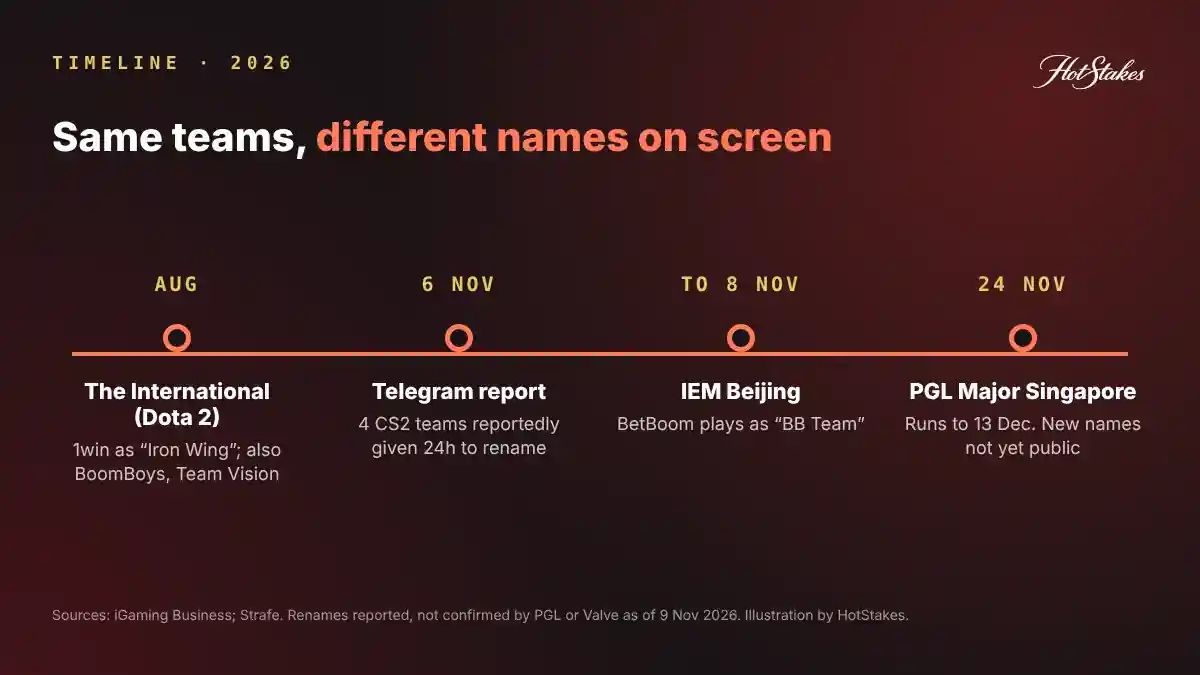
Takeaway: Short, neutral tags are now standard for gambling-named teams playing in strict markets. The team stays the same; only the name on the screen changes.
How Singapore compares
Singapore is not unusual in restricting gambling sponsorship. What sets it apart is how broadly it defines an ad. Here is how some other markets handle sponsorship.
| Market | Rule | Team/shirt sponsorship | Legal basis |
|---|---|---|---|
| Singapore | Advertising unlawful (unlicensed) gambling is an offence; licensed ads need GRA approval | Name display via sponsorship or brand-sharing can count as advertising | Gambling Control Act 2022, s85; fine up to S$20,000 |
| United Kingdom (Premier League) | Voluntary club agreement | No gambling sponsors on the front of matchday shirts from 2026-27; sleeves and pitch-side boards still allowed | League decision, announced April 2023 |
| India | Online money games banned, including their ads | Advertising or promoting them is an offence | Online Gaming Act 2025; up to ₹50 lakh or 2 years |
| China (esports events) | Gambling-named teams have used aliases | e.g. Iron Wing, BoomBoys, Team Vision at TI 2026 (reported) | Local constraints, per esports press |
For the full country-by-country picture, see our guide to whether online gambling is legal in Asia and our explainer on what India’s 2025 online gaming ban covers.
Takeaway: The UK removed one shirt slot by agreement. Singapore and India go further and treat promoting an illegal gambling product as an offence in itself.
What this means if you watch esports in Asia
The brands on streams and jerseys are usually offshore operators. Many hold offshore licences, for example from Curaçao or Anjouan, rather than one from your country. Here is what that means for you:
- Seeing a brand is not the same as it being legal for you. A sponsorship deal says the operator paid for visibility. It says nothing about whether you can legally bet with it in Singapore, Malaysia or elsewhere.
- Check the licence and where it is from. Our explainers on Curaçao’s licence reform and the Anjouan licence show what an offshore licence does and does not cover.
- Expect no local recourse. If an unlicensed operator holds your winnings, your own country’s regulator cannot step in. See licensed vs unlicensed casinos.
- Know the risk on your side. In Singapore, punters face up to S$10,000 or 6 months. Malaysia actively blocks thousands of gambling sites.
- Talk to younger viewers. Esports audiences skew young, and the Act separately punishes sending inducements to gamble to underaged individuals (up to S$300,000 or 6 years, section 34). Our guide to signs a teen is gambling covers skins and loot boxes. For how streamers fit in, see who pays gambling streamers.
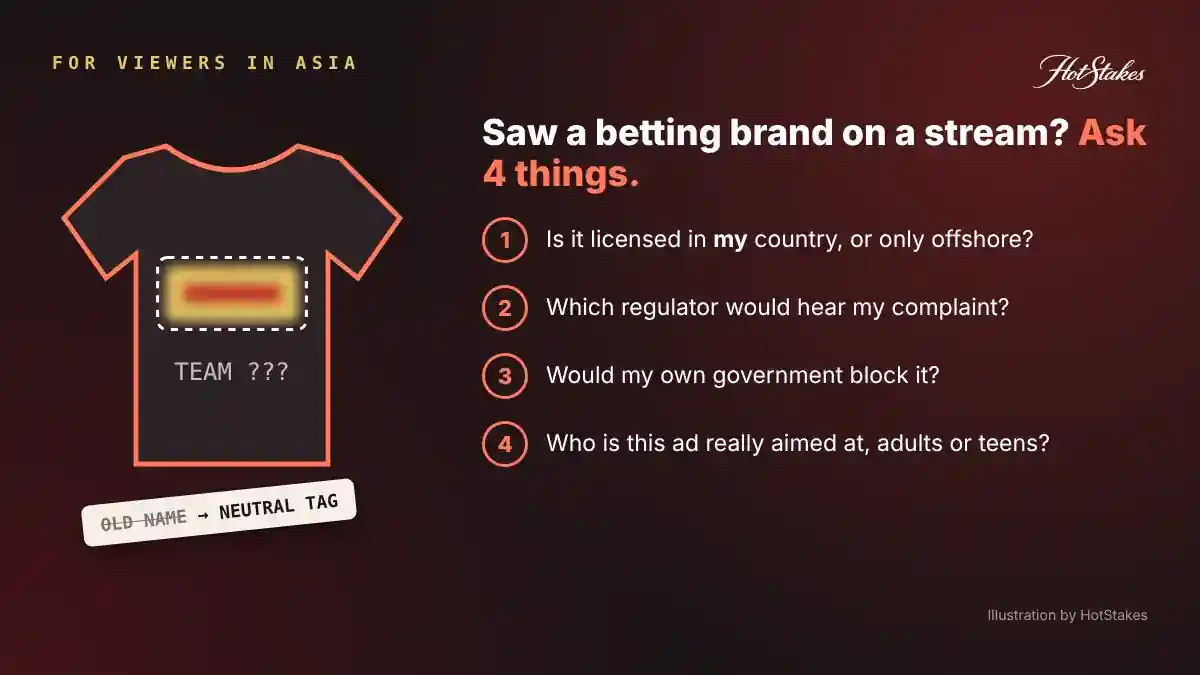
Takeaway: If a brand had to disappear from a Singapore stage, it is not licensed in Singapore. That is useful information before you sign up anywhere.
FAQ
Which teams reportedly had to change their names for the PGL Major Singapore?
BC.GAME, 1win Esports, BETBOOM and PARIVISION, according to reports first published by the Telegram channel Esports Base and covered by iGaming Business on 6 November 2026. PGL and Valve had not confirmed this by 9 November 2026.
Is gambling sponsorship illegal in Singapore?
Advertising unlawful gambling is an offence under the Gambling Control Act 2022. Legal summaries of section 85 say this includes sponsorship or brand-sharing arrangements that display a name. Licensed operators need GRA approval for any advertising.
What is the penalty for advertising unlawful gambling in Singapore?
GRA says an individual can be fined up to S$20,000. Ignoring an order to remove the ad can bring up to S$50,000 and/or 2 years’ jail.
Who can legally offer online gambling in Singapore?
Only Singapore Pools, according to GRA. The two casinos at Marina Bay Sands and Resorts World Sentosa are licensed for land-based gambling.
Does this mean the teams did something illegal?
No. No authority has accused any team of an offence. The reported renames are a step to comply with local rules before the event.
HotStakes is an independent directory. Some links on this site are affiliate links; we may earn a commission at no cost to you, and it never changes our rankings. Gambling involves risk — only play with money you can afford to lose, and if it stops being fun, seek help. This article is general information, not legal advice. Read our full disclaimer.
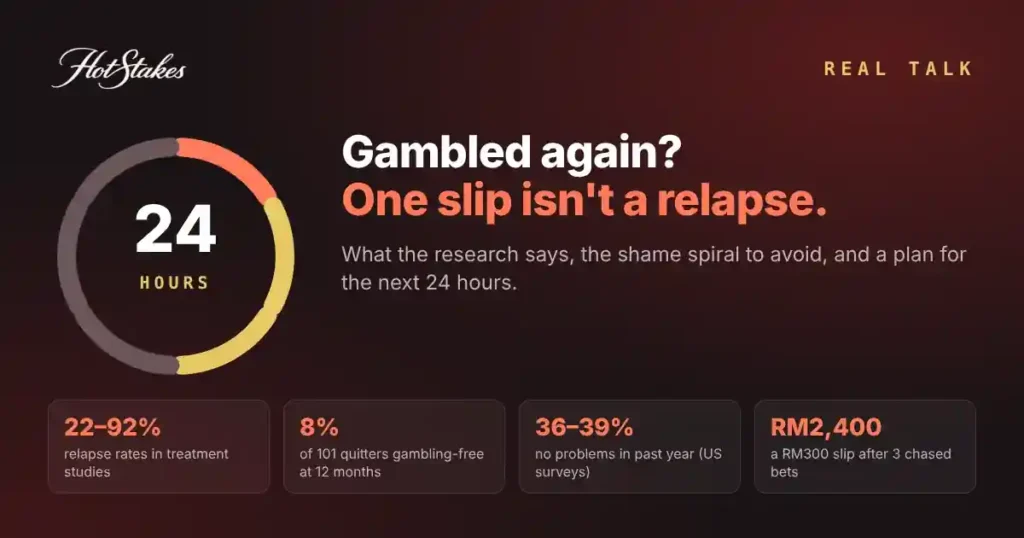 Next story →Gambling Relapse: What to Do in the First 24 Hours


Start the discussion